Skip to content

Sora and the painbot

Sora and the painbot published on No Comments on Sora and the painbot

Sora is a video generation model that translates text to video, a product of OpenAI released earlier this month, and a painbot is a concept I hatched a few days ago while talking to ChatGPT about AI empathy and the potential for AI to recognize, record, and react to human pain.

My initial thought was that the painbot could be trained on thousands of interactions between patients and their doctors discussing pain, with the idea of recognizing trends that thread through these discussions and thereby become a quasi-expert in pain without ever having to experience it.

I imagined this painbot in an emergency room setting, replacing that process in which patients are often asked to quantify their pain from 1-10, or by selecting a face icon from a row of five or six cartoon faces that indicate a range between “rapturously happy” and “about to faint from the torture.” A more refined evaluation could surely be conducted by AI, freeing up the frenzied medical staff for their more pressing responsibilities.

But this painbot could present a physical obstacle, because the last thing ER staff need is a robot obstructing their efforts to keep someone alive.

I realize how much the public distrust AI, to the point that 60% say they wouldn’t be comfortable with a doctor “relying” on AI to provide medical care. In another study the subjects who felt “heard” in terms of emotional support strategies, but the impact diminished when it was revealed that AI is what “heard” them.

But what if we could get around that? In other words, what if a painbot could:

  • Stay out of the way of ER staff
  • Capture and record images indicating facial expressions and body postures that indicate pain/distress
  • Focus attention on patients in the ER when staff can’t be available
  • Objectively evaluate pain however possible
  • Complement medical staff while clearly operating with a specific purpose, rather than trying to take over anyone’s job

With those goals in mind, I ventured onto Sora.com with the aim of depicting such a bot in a video.

My first attempts, at best, depicted the painbot as a recording device for doctors.

A lot of young white women with straight brown hair stared past the painbot impassively. Most of them were medical staff themselves, regardless of much I emphasized their patient status.

No matter how much I described a patient as being in pain, the most I could get from a woman was a furrowed eyebrow.

Once I made the patient male, I finally got pain expressed in an interview between the painbot and the patient. This is the clearest expression of pain that I got, and it’s good. Unfortunately, however, the most the painbot would do is silently bear witness to the pain from the background.

This is the first and only time I got a black patient. Have to admit, though, the lighting is amazing.

This may speak to the capacity of AI to actually measure pain based on facial expression, but I don’t want to read too much into that.

Editorial Cartooning as Visual Storytelling

Editorial Cartooning as Visual Storytelling published on No Comments on Editorial Cartooning as Visual Storytelling

Political cartoons illustrate the cultural zeitgeist– literally– while also offering critical commentary on it. An editorial cartoonist has a vast arsenal of tools at her disposal, allowing her to create visual metaphors, transmit brief but powerful narratives, elicit emotional responses, and present compelling arguments to persuade, inform, and potentially bolster public opinion.

An editorial cartoon can be composed of multiple panels, but the constraints of print media have created the single-panel standard. This has only enhanced the need to distill complex issues to their purest form in a single image. Within that image, emotions must be immediately readable, and symbols– including any text, whether dialog or labels– are slashed to the absolute minimum required to get the point across. It’s like trying to send a clear message in a tweet while paring it down to fewer than 180 characters.1

That’s just as true in every kind of cartooning,2 but beyond that it just makes for optimal design of user experience, generally. Familiar symbols and metaphors enable viewers to see a complex idea boiled down to its essential meaning. Familiarity and similarity are the strongest predictors of empathy, which is why Mel Brooks’ famous quote “Tragedy is when I stub my toe. Comedy is when you fall into an open manhole and die” is funny– we feel like we’re part of the “I” team along with him, even when it couldn’t be clearer that we’re actually playing for “you.”

“Diagrams are visual representations that help,” said Abby Covert in her book Stuck? Diagrams Help (which, at 352 pages, should be thankful that it isn’t a diagram). But a diagram helps by making a concept comprehensible, and doing that by locating it within a system of other concepts. Providing that context is what makes the diagram helpful.

Visual stories can be beautiful, but it’s not their first job. That just means they found work in a side hustle as a supermodel, while still fixing people’s plumbing. The visual-story-as-plumber fixes the pipes of You Understanding a Thing, in which your lack of understanding has become a clog. We shall not go into what it’s made of, or how it got there, because…ew.

So instead let’s grab a bottle of drain cleaner and move away from the “telling,” and into the “showing.”

First up– implied context

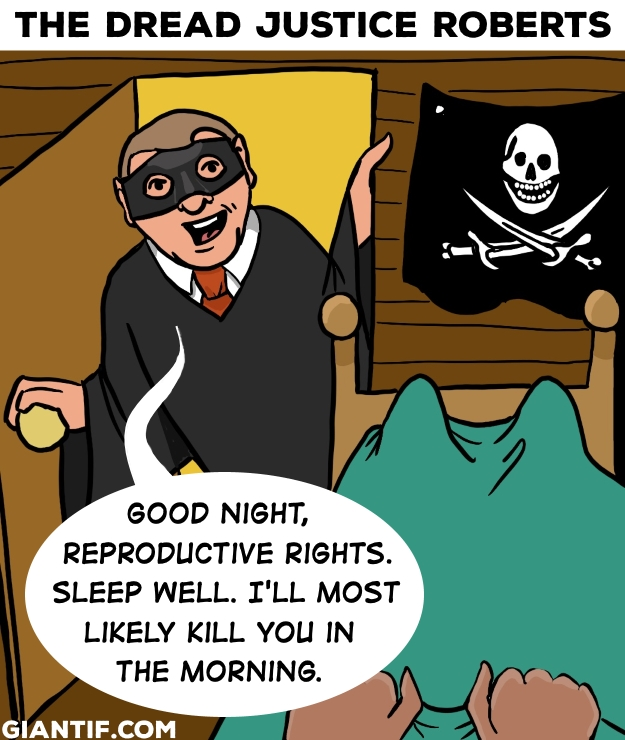
“The Dread Justice Roberts,” February 12, 2019

If you’ve seen The Princess Bride, and are vaguely aware of the Supreme Court, this cartoon has a dose of resonance beyond a flat depiction of a judge threatening you at bedtime.

Rather, Justice John Roberts hangs a proposition over our heads while we cower under the covers, living in a state of constant dread that Roe might be overturned by morning (which, spoiler alert…)

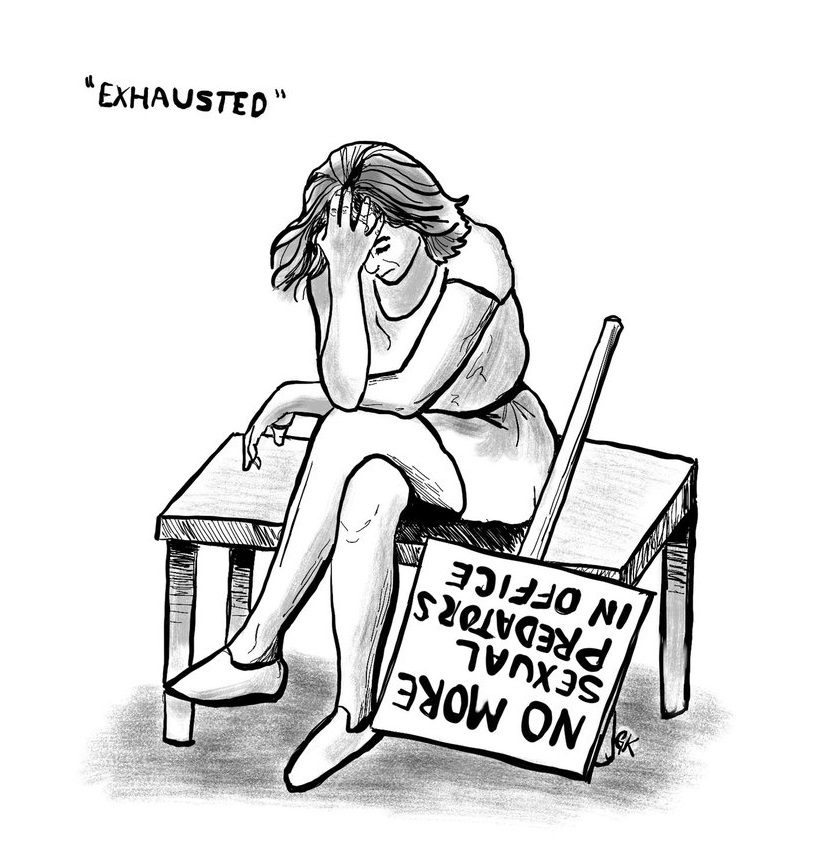
“Exhausted,” December 3, 2018

Character and Emotion

This cartoon shows how a facial expression, pose, and/or gesture can suggest a backstory and context. We don’t need to ask what the woman in this image is experiencing–the title is merely a label for what is already visible.

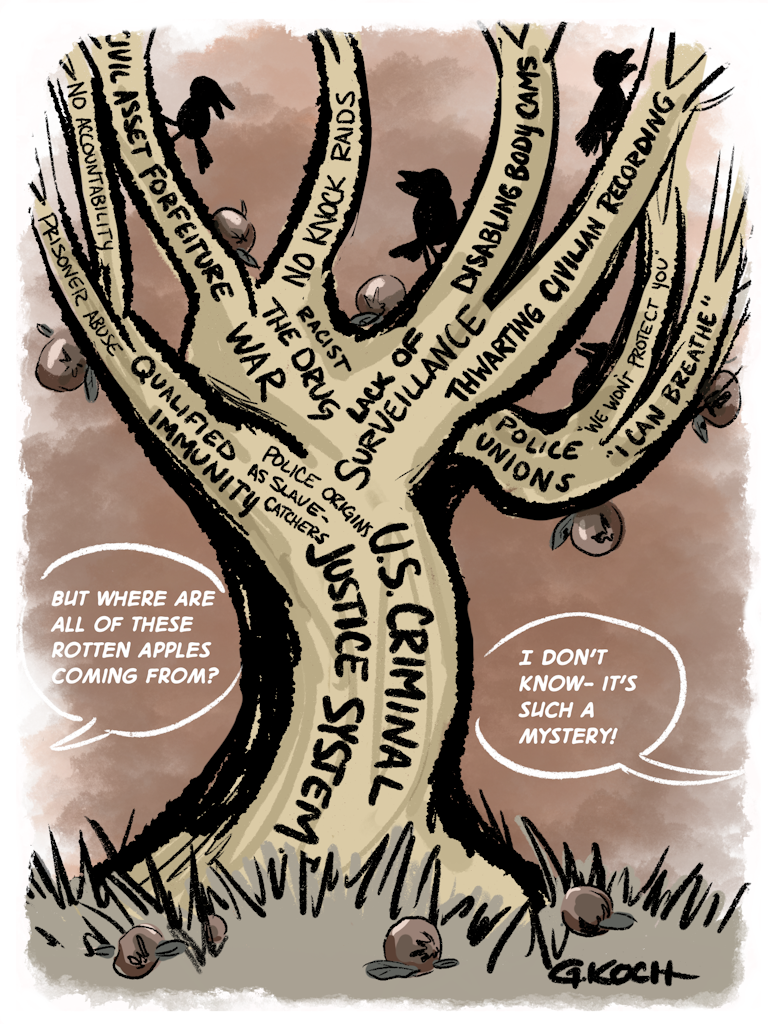
“The tree of rotten apples,” June 26, 2020

Focus on a core (har) message

Sometimes the rules are meant to be broken. The (ab)use of labels here makes the point that there are myriad effects that can be traced to a centralized cause, requiring that they be named and labeled.

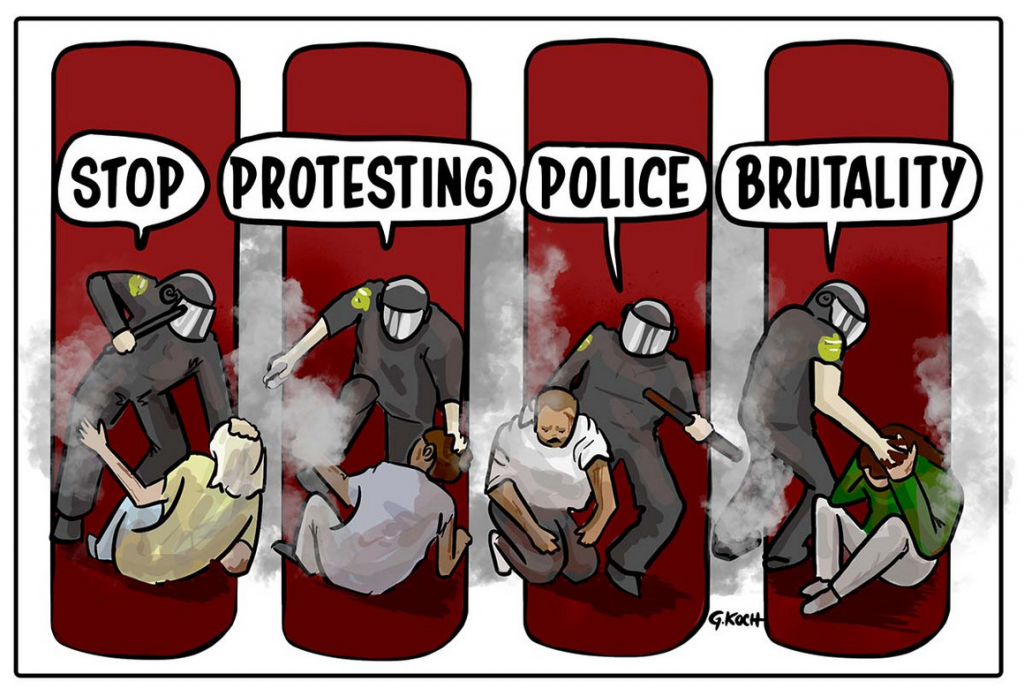
“Stop protesting police brutality,” June 5, 2020

Strategic composition

This could’ve been a single image of a police officer abusing a protestor. Making it a series of panels, however, communicates a pattern of incidents that ironically belie the message that unifies them.

“The treachery of Trump,” July 22, 2019

Captioning and Text

This is a play on words that’s better if you know who Magritte was, but it’s not necessary. You also don’t need to know French, which also is– thankfully– not necessary.

There are other principles pertaining to the elements of an impactful visual story, but these are a few that you can find in even the stories told by single-panel cartoons.

Though they contain simple messages, the experience of viewing these cartoons is not necessarily intended to be easy–rather, many political cartoonists view themselves as following a informal journalistic mandate to “comfort the afflicted and afflict the comfortable.” That’s why editorial cartoons don’t typically appear on the comics pages of the newspaper– which is not to say that their content is somehow above or below one of the “funnies,” which also tell visual stories. Those stories are just different in kind.

But even when the narrative is unpleasant and its message harsh, a visual story can feel friendlier and more honest, because the elements it incorporates are (again) shown; not just told.

We never really left picture books behind– they grew up with us, and now we’re illustrating our own.

  1. Or at least, that’s how it was in the Before Times. ↩︎
  2. Unless you count the exception that Allie Brosch carved out, which I’d describe as “mostly memoir, accompanied by illustrations of the author’s id.” ↩︎

Is empathy enough?

Is empathy enough? published on 1 Comment on Is empathy enough?

David Brooks has an interesting essay in the New York Times called The Limits of Empathy. In it he discusses the wealth of research published lately on how empathy works as a psychological response, and makes a case that it can’t and shouldn’t be considered the true foundation for morality. This is because the reaction of empathy doesn’t always kick in when it ideally should, to the extent that it should:

Empathy orients you toward moral action, but it doesn’t seem to help much when that action comes at a personal cost. You may feel a pang for the homeless guy on the other side of the street, but the odds are that you are not going to cross the street to give him a dollar. There have been piles of studies investigating the link between empathy and moral action. Different scholars come to different conclusions, but, in a recent paper, Jesse Prinz, a philosopher at City University of New York, summarized the research this way: “These studies suggest that empathy is not a major player when it comes to moral motivation. Its contribution is negligible in children, modest in adults, and nonexistent when costs are significant.” Other scholars have called empathy a “fragile flower,” easily crushed by self-concern.

And when it does, it is shockingly biased:

Moreover, Prinz argues, empathy often leads people astray. It influences people to care more about cute victims than ugly victims. It leads to nepotism. It subverts justice; juries give lighter sentences to defendants that show sadness. It leads us to react to shocking incidents, like a hurricane, but not longstanding conditions, like global hunger or preventable diseases.

All of this is true. Our sense of affective empathy (empathy as an emotional reaction) is most easily provoked when confronted with suffering of people who are like us and familiar to us.  That group includes family most immediately, but can extend toward members of virtually any group who are better known and more like us than those who are not.  Neighbors over non-neighbors. People who go to the same church over those who don’t, or don’t go to church at all. People of the same color vs. another race, people from the same town/state/country before foreigners. Bros before hos*. Preferential empathy isn’t antipathy, it’s important to note…but it can turn into it, given that allegiances with some people tend to create enemies out of the others.

Still, I find that a kind of odd criticism of empathy– that it isn’t all-encompassing, therefore it can’t be a good moral foundation. Psychologist Simon Baron-Cohen, best known for his work on autism, has written that having a deficient theory of mind (the term for our capacity to recognize and understand the thoughts and goals of others) makes it harder for people with autism to experience affective empathy.  But that certainly doesn’t make them into psychopaths.  Instead, it can lead to the creation of a more explicit, removed form of empathy– one based on broad notions of justice rather than being moved by the suffering of someone specific. I find it entirely fitting to use “empathy” as a term for this because the belief that it’s wrong to punish or reward people unequally for the same acts (for example) requires a sense of fairness, and a sense of fairness comes out of an ability to put oneself in the place of someone who is treated unfairly.  This is called the simulation theory of empathy– understanding what a person is thinking and feeling by approximating their situation as best as you can, drawing on your own experiences.  When your theory of mind is just that– a theory– this is how empathy works for you. Cognitively, rather than as an intuitive response.  This way of thinking might have the advantage of provoking people toward a consistent theory of justice, one which isn’t as subject to the biases discussed above.

Brooks concludes:

Think of anybody you admire. They probably have some talent for fellow-feeling, but it is overshadowed by their sense of obligation to some religious, military, social or philosophic code. They would feel a sense of shame or guilt if they didn’t live up to the code. The code tells them when they deserve public admiration or dishonor. The code helps them evaluate other people’s feelings, not just share them.

This is absolutely true. But from what I can tell, that is empathy, if it starts with a consideration for how others must feel and think. We all build our own codes– from scratch possibly, but for the vast majority of us something more like an amalgamation of those developed from people who came before us, cobbled together and modified as we’ve seen fit. If that codification is centered around being fair and not causing suffering, then it seems right to call it empathy-based.

*If ever an expression merited an immediate karmic punishment from the universe….

Equality worth working for

Equality worth working for published on 1 Comment on Equality worth working for

I have a dream that one day this nation will rise up and live out the true meaning of its creed: “We hold these truths to be self-evident: that all men are created equal.”

The true meaning, mind you– not merely what is reflected in the law, but in how we see each other.  How we evaluate each other’s worth, respectability, humanity.  Not by the color of each other’s skin, but the content of our characters.  That, in turn, will reveal our collective character.  

Dr. King’s foundation was unquestionably based in his faith.  Being a Baptist minister, that is naturally where he found his strength: “I have a dream that one day every valley shall be exalted, every hill and mountain shall be made low, the rough places will be made plain, and the crooked places will be made straight, and the glory of the Lord shall be revealed, and all flesh shall see it together.”  For him, the glory of the Lord could only be revealed when people of different colors could love and value each other as equals.  Jennifer Sanborn writes

You see, for me, the Rev. Dr. Martin Luther King, Jr. is first and foremost a Baptist minister, and a child of the same. I imagine it is because I am also the child of a Baptist pastor (and grandchild of two others) that I take particular pride in placing “the Reverend” at the start of his name. “Reverend” is a title that he earned with his education and his occupation, but also a title to which he was called, bringing unparalleled dignity and relevance to what it means to serve society as a religious leader.

I’m sure many people feel similarly, now as well as when MLK originally gave that iconic speech, which was essentially a sermon to America on the meaning of loving one’s fellow man.  As a non-believer I find no conflict in welcoming that sermon, and only a slight bit of discomfort in wondering how he would have responded if asked whether atheists would be included in the pluralistic group exhorted to “sing in the words of the old Negro spiritual, ‘Free at last! free at last! thank God Almighty, we are free at last!'”  I won’t remotely pretend, however, that there is any comparing the lot of atheists to that of black Americans in 1963.  That isn’t the point.  The point is, from whence is a committment to equality derived for those who don’t believe it was God-given?

It would be a fair bet to say that prejudice almost always precedes rationalization, whatever that rationalization is.  I’m pretty sure that human nature, perhaps ironically, includes both the justification for equality as well as the explanation for why humans are so prone to denying it.  And that is because of two salient facts:

1. Both science and religion have, at many points and many places in history, been used to rationalize bigotry. 
2. And yet, neither one has ever or will ever come up with a good reason to treat people unequally.  

If either of the above points seems at all contentious, remember that the numerous mentions of slavery in the Bible were used as a  primary reason to believe that black slavery was part of God’s divine order in the South, as well as the legacy of Spencerian “social Darwinism” which maintained that certain races were inherently inferior.  After all, if it weren’t so, why were they doing so poorly?  Why were they so easily conquered and used for the purposes of the more powerful white Europeans and Americans, if not because they are inherently inferior by evolution or design, whichever your preference? 

I’m still in the midst of my very long quest to discover what exactly human nature is, anyway, but the revelation of the above facts in my life can be attributed primarily to the cognitive psychologist Steven Pinker around 2004.  You see, after (and before) publishing a book called The Blank Slate which used powerful data from experimental psychology to demolish both the idea that there is no such thing as human nature as well as various myths about exactly what that nature is, Pinker and every other psychologist who uses evolution as a means to explain why humans behave as we do has been hounded by accusations that their work will be used to justify prejudice. 

And you know what? That’s exactly what has happened.  And it still happens.  People think that if they can show differences between the psychology of men and women, homosexuals and heterosexuals, blacks and whites, they will be able to show that treating any one or more of those groups as inherently less human is justified.  I really don’t want to get into all of the specific attempts to show that, because it would take away from the fundamental point that there’s nothing we can discover about a specific group of humans that would justify, for example, slavery.  Nothing that would justify physical or cultural genocide, rape, internment, disenfranchisement.  And that is because the humanity of humanity doesn’t need to be determined by conducting some elaborate experiment– it is literally standing right before us. 

I believe that tribalism is instinctive– that people find an element of safety in clinging tightly to those who are like themselves.  They will certainly base that in-group/out-group association on ideology, but it’s even easier to base it on traits that are evident at a glance.  Familiarity and similarity are the primary triggers for empathy, which means that strangers and people not like us are the “best” enemies.  And that is why, again and again throughout our history, we have been able to deny the humanity of certain groups of people in order to persecute them.  Not by knowing them, looking them in the face, having a conversation…because that would demonstrate that they’re more like us than we thought. 

I suppose that’s where I find my fundamental belief in equality– the abject failure, despite our best and most heart-felt efforts, to show that any class of humans really doesn’t deserve the label of “human.”  Martin Luther King Jr. managed to punch through that barrier of prejudice for so many people because he emphasized how much we have in common, how similar we are fundamentally, and how different life could be if we were just willing to encounter each other as fellow human beings, fairly and honestly.  That’s why his speech had and continues to have such a tremendous impact, and why we continue working to make his dreams come true.


The trickiness of characterizing empathy in politics, part 1

The trickiness of characterizing empathy in politics, part 1 published on No Comments on The trickiness of characterizing empathy in politics, part 1

So as mentioned, I’m working my way through Frans de Waal’s book The Age of Empathy.  On my drive I also listened to the audiobook of Michael Shermer’s The Mind of the Market, and it was almost comical to expose myself to both at the same time and read/listen to how both drew on the same research to reach radically different conclusions about how empathy works in American economics.  de Waal maintains that Americans practice little empathy toward their fellow man (which, in his eyes, would entail mandating the government to take better care of people) and believe that the free market will take care of everyone.  Shermer, by contrast, maintains that Americans trust the market barely at all and expect the government to make things fair for everyone.  Shermer is an American with a doctorate in the history of science, whereas de Waal is a primatologist and Dutch by birth though he has lived in the United States for almost thirty years. 

I couldn’t tell you whether or how much life in America has affected de Waal’s politics, but his book does contain the following passage:

Europeans are far more divided by rank and class and tend to prefer security over opportunity.  Success is viewed with suspicion.  It’s not for nothing that the French language offers only negative labels for people who have made it for themselves, such as nouveau riche and parvenu.  The result, in some nations, has been economic gridlock.  When I see twenty-year-olds march in the streets of Paris to claim job protection or older people to preserve retirement at fifty-five, I feel myself all of a sudden siding with American conservatives, who detest entitlement.  The state is not a teat from which one can squeeze milk any time of the day, yet that’s how many Europeans seem to look at it.  And so my political philosophy sits somewhere in the middle of the Atlantic– not too comfortable a place.  I appreciate the economic and creative vitality on this side but remain perplexed by the widespread hatred of taxes and government.  

 So to be fair to de Waal– he clearly has a mental boundary at which government taking care of people ceases to count as compassion and becomes pampering, and draws that line far in advance of where he sees other Europeans– mainly the French– drawing it.  But I would pay good money to put him and Shermer in a room together and see how they manage to resolve what constitutes “hatred of taxes and government.” I’m guessing Shermer would be incredulous at that characterization of Americans, as am I.  I don’t think that description even fits Tea Partiers (although putting one of them in a room with a French student might cause the heads of both to explode).  de Waal describes Americans after Katrina as expecting the market to take care of disaster relief, but also becoming angry about FEMA’s ineptness at tackling the problem quickly and efficiently.  Which is a head-scratcher for me– if they trusted the market to take care of it, why was their anger directed toward FEMA?  Wouldn’t that rather be a sign that they thought the government should handle the issue and felt cheated when it didn’t? 

Shermer, for his part, characterizes the American view of economics as analogous to how many of its population view evolution– with a conviction that there must be a top-down designer. Opponents of evolutionary theory claim that the environment could not exist with the species in it today without a designer, whereas Americans in Shermer’s view believe that the market could not function without economic disaster without its own designer: the government.  Shermer says this is false, but at the same time is not willing to advocate for no regulation, just much less.  He compares the free market to natural selection– not a process, but an emergent property.  A term for what happens when some species and products or serves are selected for or against in their given environment.  With evolution the environment is primarily physical, consisting of weather, geographic location, predator and prey relationships, and so on.  In economics, the environment is the market, consisting of incentives and psychology.  Shermer doesn’t just use evolution as an analogy, but actually discusses dispositions people have about economics as having been adaptive in our evolutionary past.  He and de Waal would have much to discuss in this regard as well. 

What does this have to do with empathy, now?  The answer is that as scholars who are fully aware that Adam Smith wrote his Theory of Moral Sentiments before his more popular book The Wealth of Nations, both Shermer and de Waal are convinced that empathy, or lack thereof, is at the root of economic beliefs and practices.  What’s revealing is that even with this as a given, they still reach near-opposite conclusions about how empathetic Americans would behave in an economic context.

Let’s check quickly on what the term “empathy” is supposed to mean.  In the common understanding of scientists who study it, there are two primary forms.  The first is affective, or emotional.  This can also be called “sympathy,” because it involves physically imitating the object of your empathic response, and often isn’t voluntary.  Emotional contagion, the act of yawning when someone else is yawning, or imitating the body posture of someone you’re talking to, are forms of affective empathy.  The second form is theoretical, reflective, usually deliberate.  It’s also called “perspective-taking,” because it involves consciously stepping into someone else’s shoes and trying to see the world through their eyes, to mix the most common metaphors.  These two don’t always go together, as exemplified by a sadist who can understand someone’s state of mind and uses that information to figure out how best to torture them.  Using one’s understanding of someone against them has been called the “dark side of empathy.” 

Now from what I can tell, trying to apply understanding of how empathetic someone is to what their political/economic philosophy will be is rather like trying to envision what Jesus’s political/economic philosophy would be today– everybody seems to have an opinion which is easy to reach, but is also inevitably diametrically opposed to someone else’s.  That’s because compassionate people, people who are not only strongly prone to affective empathy but are also compelled by it to help others, can have markedly different views on economics and politics.  How can this be?  Well, because there’s a difference between being nice to others and having the government do it for you.  I highly doubt that de Waal, for example, would want to claim that the French are kinder than he is.  Shermer’s primary argument for free market economics rests on the data he compiles to show that empathy and altruism are evolutionarily adaptive and that people feel and practice them without requiring any outside compulsion– that is, that America doesn’t need a big government because humans are empathetic.  I’m not entirely sure yet where de Waal is going to end up with his use of research on altruistic tendencies in non-human primates, but would make a good bet that it won’t be in Shermer’s land of the free market since that certainly isn’t where he started.   The main thing I am wondering at this point, actually, is whether it’s even possible for people who study human nature to divorce their own political views from it when it comes to discussing empathy in that context. 

This post is “part 1” because I discovered that one of my favorite psychologists Jonathan Haidt has been doing work on Libertarian morality using empathy as a primary factor, and libertarian magazine Reason has its own interpretation of it.  I want to discuss both of those, but need to do some more reading and thinking about it first.