Skip to content

Spokespeople

Spokespeople published on No Comments on Spokespeople
Not allowed to be right about
anything.

After posting a clip from Bill Maher’s show in which the comedian mocks the Republican presidential  candidates, Ed Brayton got some flack from readers complaining that they wouldn’t watch it because Maher has established himself as having some pseudoscientific views, specifically being anti-vaccination. When Ed expressed confusion about why that would mean refusing to listen to Maher’s comments on a completely unrelated issue, one response was:

Well Ed, sometimes people are annoyed to find that an idiot agrees with some of their positions. They feel, for whatever incredibly odd reason, that having a blithering idiot as a spokesperson is not the very best strategy they could hope for.  Examples for me are Maher and Hitchens. Great to hear them when they support me — both have a way with words (Hitchens even writes his, maybe Maher does his as well) — but I will always feel that their effectiveness is undercut by the fact that on some major — really major — issues they are idiots.

My reaction to this is utter bafflement. First, that it’s apparently an option between “supportive of my views” and “blithering idiot.” But mainly because I don’t understand why appreciating some things a person– especially a comedian– has to say means that you have somehow adopted him/her as your spokesperson.  What a mantle of responsibility to lay on someone you’ve never met, let alone never employed to speak for you! It’s as though public figures aren’t allow to have views of their own.

The ad hominem fallacy is not, as many confusedly believe, a statement that an argument is fallacious when it involves an insult to someone. It’s a statement that it’s fallacious to believe that you have discredited someone’s argument by disparaging something irrelevant about them, usually his/her character: Joe may sound like he has a good point about the feasibility of legalizing marijuana, but he’s a thief– don’t listen to him. Ronnie has a lot to say about public healthcare, but he’s a Republican and so can’t be trusted. Bill Maher might have something funny/insightful to say about the presidential election, but he’s an anti-vaxxer so I won’t listen. What?

If someone has valuable thoughts to offer, those thoughts can be appreciated without adopting that person’s worldview wholesale and allowing him/her to speak for you on every matter.  It’s important to realize this because no one in a position to advocate publicly for ideas that you hold dear is going to agree with you on everything. Nor are they infallible– everyone is wrong about at least a few things. At least.  They’re not even infallible in whatever area you find them to be dead-on. Christopher Hitchens is remarkably politically savvy, but that doesn’t mean he was correct in endorsing the invasion of Iraq. Nor, for that matter, did such an endorsement make him an idiot– it simply made him (in my view) wrong.  Richard Dawkins knows his arguments for and against the existence of God, but that doesn’t mean he was right to chastise Rebecca Watson for speaking out about a creepy come-on at a conference for atheists. There’s a certain of irony in the fact that both Hitchens and Dawkins are considered icons of the skeptical movement, yet so many within that movement are reluctant to be skeptical of them.  It’s as though continuing to evaluate claims on their own merits rather than the people making those claims is just too taxing, and so after identifying some heroes of skepticism people are content to turn their brains off and allow those heroes to do the thinking for them. Not very skeptical, that, whether you agree that Hitchens and Dawkins were wrong on these specific issues or not.

Having opted out in many realms of life so far, and being very accustomed to the idea, I realize that my feeling of repugnance for the practice of adopting uncritical acceptance of public figures as spokespeople is uncommon. But it’s something that should become more widespread, if ideas are really what is important rather than the mouths from which they come. A good idea is a good one no matter who is expressing it, and the same in reverse for a bad one. Let’s not be afraid to criticize our heroes when they’re wrong, or too willing dismiss everything a villain has to say as false and invalid. That’s what intellectual honesty requires.

The phenomenon of the petty tyrant

The phenomenon of the petty tyrant published on No Comments on The phenomenon of the petty tyrant

Researchers at the Stanford Graduate School of Business decided to examine the relationship between status and power in how people treat each other. So they organized a study that involved telling participants they would be working on a business exercise with another student, and randomly assigning each participant a role in the project with a different rank, from a low-status “worker” role to that of a high-status “idea producer.” In these exercises the participants were to give orders to their partners with varying degrees of respect conveyed, some orders being more demeaning than others. What the researchers found was that participants with the power to order their partners around but comparatively low status were more likely to issue demeaning orders than those with higher status:

The experiment demonstrated that “individuals in high-power/low-status roles chose more demeaning activities for their partners (e.g., bark like a dog three times) than did those in any other combination of power and status roles.” According to the study, possessing power in the absence of status may have contributed to the acts committed by U.S. soldiers in the Abu Ghraib prison in Iraq in 2004. That incident was reminiscent of behaviors exhibited during the famous Stanford Prison Experiment with undergraduate students that went awry in the early 1970s. In both cases the guards had power, but they lacked respect and admiration in the eyes of others, and in both cases prisoners were treated in extremely demeaning ways. Fast said that he and his colleagues focused on the relationship between power and status because “although a lot of work has looked at these two aspects of hierarchy, it has typically looked at the isolated effects of either power or status, not both. We wanted to understand how those two aspects of hierarchy interact. We predicted that when people have a role that gives them power but lacks status — and the respect that comes with that status — then it can lead to demeaning behaviors. Put simply, it feels bad to be in a low-status position and the power that goes with that role gives them a way to take action on those negative feelings.”

This reminds me of work done by social psychologist Roy Baumeister on the subject of self-esteem. He wanted to find out if it’s really low self-esteem that encourages people to bully each other, as the prevailing story went in the 1980’s. The goal was to discover, as he put it, the relationship between self-esteem and “violence and oppressive actions that so often are tangential or even contrary to the rational pursuit of material self-interest.” What he and colleagues discovered was that in actuality, high self-esteem can cause this kind of violence– if it is coupled with an artificially high sense of one’s own status. When that impression of high status is challenged, a person’s ego is threatened and aggression against the challenger can be the result:

Our main argument . . . does not depict self-esteem as an independent and direct cause of violence. Rather, we propose that the major cause of violence is high self-esteem combined with an ego threat. When favorable views about oneself are questioned, contradicted, impugned, mocked, challenged, or otherwise put in jeopardy, people may aggress. In particular, they will aggress against the source of the threat. In this view, then, aggression emerges from a particular discrepancy between two views of self: a favorable self-appraisal and an external appraisal that is much less favorable. That is, people turn aggressive when they receive feedback that contradicts their favorable views of themselves and implies that they should adopt less favorable views. More to the point, it is mainly the people who refuse to lower their self-appraisals who become violent.  

One might surmise that people are not exactly keen to lower their self-appraisals. So it’s natural to expect that many would attempt to maintain a favorable image of themselves by discouraging expressions that disagree with that view. This can be done by punishing those who have expressed such disagreement or instilling sufficient fear in them that they are unwilling to do so.  Thus is a petty tyrant made: people with power but not much status attempting to make up for such by exerting that power to punish all who oppose them!  Or who say anything remotely negative about them. Or who fail to exercise the proper deference to their authority. Or who look at them funny.

Ken at Popehat used the Stanford (Graduate School) experiments yesterday to describe TSA workers who abuse their authority, and the unwillingness of so many to do or even say anything about it.  Under the headline “Today’s TSA: Even Petty Power Corrupts. Perhaps ESPECIALLY Petty Power,” he writes:

TSA agents are poorly paid, work in nasty conditions, and have little status. Yet they have, within their petty fiefdoms, tremendous power to humiliate and demean. And God, do they ever use it. The fact that this is a recognized psychological phenomenon explains, but does not excuse, any more than it excuses police abuse and bureaucratic indifference. Nor does it excuse the leaders of the TSA and the Department of Homeland security, who have decreed a feckless facade of security theater that is calculated to lead to this result, all in the name of promoting unquestioning compliance.

How does one stop a petty tyrant, or prevent one from being created? Two ways, that I can see:

  1. Don’t give them power, thus cancelling the “tyrant,” or 
  2. Give them recognizable status to be respected, thus cancelling the “petty.”
This is of course a chicken and egg problem. When people recognize appalling abuse of power exercised on a regular basis by those to whom it has been allocated, they will abandon recognition of any status for the group to which the abusers belong. When people who have been given this power observe that they are not being accorded status, they have a motivation to abuse. The only way out is for those who have authority over the potential petty tyrants to both keep a tight rein on the means by which they may exert power and ensure that such power is only wielded for just causes. Crack down hard on the former student hall monitors who, upon observation, can be witnessed as being in it for the ability to wield power. Don’t hire them if possible, don’t give them the opportunity to be abusive while employed, and fire them if caught doing so. When this procedure is not followed, it is to all of our detriment.

Nor does it help to simply instruct people to give respect– the most that can be elicited is a grudging, fearful, and at most temporary silence. As soon as people are out of earshot and/or under cover of anonymity, the doubt and mistrust will return, now exacerbated.  The reasonable person must instead be presented consistently with the impression that the power being asserted over him/her is appropriate, effectively used, and not open to abuse as punishment for lack of respect of the person wielding it. There is no helping the fact that some people will disdain anyone presuming to exert power over them, no matter what. But it remains the responsibility of those doing so to be consistent and fair, not personal, regardless. That is how respect for status is earned and maintained, and petty tyranny avoided.  

Coulda been, shoulda been, never woulda been

Coulda been, shoulda been, never woulda been published on No Comments on Coulda been, shoulda been, never woulda been

Apparently October 9th is National Pro Life Cupcake Day. Did you know? It’s a day when pastries become  political…poor pastries. Pressed into service on behalf of highly controversial issue which doesn’t have, so far as I can tell, any direct connection to wax paper wrappers and frosting. But, one might ask, how is this joyous holiday celebrated? Well

Here’s how we celebrate: once a year, on October 9th, we would bake as many birthday cupcakes as humanly possible and hand them out for free wherever we can.  When people asked whose birthday it is, we tell them these cupcakes are for celebrating the birthdays of every person who never gets to have a birthday.  People respond in all ways – from refusing the cupcake, to sharing about abortions they’ve had in the past and the regret they carry, to just wanting to know more.

Amanda Marcotte offers up some lovely snark in response:

But really, they’re selling the whole “never will get a birthday” thing short!  After all, there are many, many, many more potential people that never come into existence than just those who may have been but for an abortion. After all, there are children you never had because you use contraception (to be fair, anti-choice activists are also against that).  But there are also children you didn’t have because you didn’t have sex in the first place.  Not fucking is clearly murder in these cases. Every time you’re ovulating and you elect to go to bed alone, you have deprived someone of a birthday!  So women like Lila Rose and Jill Stanek, who claim that contraception is a sin and therefore expect us to believe they simply use abstinence to keep from having babies, are also horrible deprivers-of-birthdays with all that abstaining. Stanek is in her 50s and has only one son, I do believe, meaning she’s deprived approximately 400 children of their chance to have a birthday. That’s a lot of cupcakes!

All I can think of this quote from Richard Dawkins’ book Unweaving the Rainbow:

We are going to die, and that makes us the lucky ones. Most people are never going to die because they are never going to be born. The potential people who could have been here in my place but who will in fact never see the light of day outnumber the sand grains of Arabia. Certainly those unborn ghosts include greater poets than Keats, scientists greater than Newton. We know this because the set of possible people allowed by our DNA so massively exceeds the set of actual people. In the teeth of these stupefying odds it is you and I, in our ordinariness, that are here.

 Have a cupcake.

What we could have done

What we could have done published on 2 Comments on What we could have done

That the band R.E.M.’s break-up and Troy Davis’ highly controversial state mandated execution would have taken place on the same day is probably an interesting coincidence to no one but me. You see, it was at an R.E.M. concert during their “Monster” tour back in 1994 that I, as a high school student, first lifted a finger to take part in a political cause– opposing the death penalty. Someone had a booth and a petition to sign, a mailing list to be on. While my parents appreciated my interest, I doubt they were too enthused about receiving periodic notices in the mail about the death penalty addressed to me for the following decade or so.

According to Gallup, in the year I attended that concert more Americans supported the death penalty than they had before (at least, back to when Gallup started polling on the question in 1936) or since. 80% answered “yes” to the question “Are you in favor of the death penalty for a person convicted of murder?” whereas by last year the number had fallen to 64%. And Troy Davis was executed, presumably because the state of Georgia is where a good number of those who answer “yes” to the death penalty reside.

My opposition to the death penalty, and my reasoning for opposing it, hasn’t changed since the day I signed that petition– I still believe that we as a society gain nothing from it, and we risk losing something which should always be significant: the life of an innocent. The Innocence Project, which was founded in 1992 to examine the cases of imprisoned convicts using DNA testing, has exonerated seventeen convicts from death row in eleven states. Collectively, they served over two hundred years in prison for crimes they didn’t commit.  But because they had not been executed (yet), it was possible to release them and allow them to have something of their previous lives back.  Nevertheless, this doesn’t appear to be a compelling thought at all for many Americans. From another Gallup poll:

However, for many Americans, agreement with the assertion that innocent people have been put to death does not preclude simultaneous endorsement of the death penalty. A third of all Americans, 34%, believe an innocent person has been executed and at the same time support the death penalty. This is higher than the 23% who believe an innocent person has been executed and simultaneously oppose the death penalty.

This result is shocking to me. I had no idea that there were so many people who grant that innocent people get placed on death row and are eventually executed, but consider that acceptable collateral damage in order to put the guilty to death. Was Troy Davis one of those innocents who was sacrificed? Perhaps– he professed his own innocence right up until the point of execution, and there’s a range of concerns with the entire course of his case. Davis’ race and the circumstances of his crime raise persistent questions about whether his case could have been decided fairly:

The finality of Mr. Davis’s sentence, and the outpouring of protest worldwide, leaves in its wake more than its share of questions — many that go beyond the facts of the case to encompass fundamental issues of capital punishment. Because Mark MacPhail, the Savannah, Ga., police officer he was convicted of killing in 1989, was white and Mr. Davis, above, was black, the progress of Mr. Davis’s case over two decades widened fault lines on the death penalty and, in particular, over the question of whether a black person in the South could be guaranteed the same justice as a white one. 

A New York Times editorial refers to a series of “grievous errors” and notes that over 630,000 letters pleading for clemency were delivered to the Georgia pardon and parole board to no avail, resulting in a “tragic miscarriage of justice.”  Director of the ACLU’s Capital Punishment Project Danny LeBoeuf condemned the outcome in no uncertain terms: “The execution of an innocent man crystallizes in the most sickening way the vast systemic injustices that plague our death penalty system.”

So here’s my question: what was the rush? The alternative to putting Troy Davis to death wasn’t to let him go free, to send him on his way with his old clothes back and money for cab fare. If he had not been executed we would have had the rest of his life, with him sitting patiently in prison, to decide to put him to a more obviously justified death. To analyze the circumstances of his accusation in a way that doesn’t provoke every human rights organization in the country, as well as death penalty supporters like former F.B.I. director William Sessions, to proclaim the injustice of it. Someone like me who opposes the death penalty outright would still not be satisfied, but we could do more to make sure that the people we put to death are obviously deserving of it. Could we not? Is that not in the death penalty supporter’s best interests, the single best defense of hanging onto such a practice?

Because after all, America is rather a stand-out in the fact that we do hang onto it. Not only does the U.S. have more of its population incarcerated than any other country in the world, we’re also willing to kill them whereas no other Western democracy will do so. Just speaking for myself, I would rather die than spend the rest of my life in prison. If the options are a life sentence or the death penalty, I would opt for the death penalty without hesitation. But Troy Davis is not me, and he was not given an option. Maybe he would have preferred to spend the duration of a life sentence (or as long as it would have taken) working to demonstrate his own innocence…and maybe he would have succeeded.  I don’t see what we would have had to lose by giving him the chance, and we would’ve had a greater system of justice and national dignity to gain.

Limbaugh’s big fat complete lack of self-awareness

Limbaugh’s big fat complete lack of self-awareness published on 4 Comments on Limbaugh’s big fat complete lack of self-awareness

Rush Limbaugh takes yet another poke at Michelle Obama for being fat. A commenter on Dispatches called Nemo writes

This meme on the right that Michelle Obama is overweight is utterly bizarre to me. A glance at her should serve to debunk it. I can’t see another explanation for its persistence than racism — they have to be thinking, even if unconsciously, something like “Black women are fat. Michelle Obama is black. Therefore, Michelle Obama is fat. QED.”

I had been busy noting that Limbaugh is no Kate Moss himself, and if he had a “No Fat Chicks” t-shirt it would have to come with a few X’s in front of the size “Large.” Ed Brayton remarks

Really, Rush? You’re going to do weight jokes? You might notice that I don’t ever poke fun at someone’s weight. You know why? Because I’m overweight myself and I’d look like an idiot and a hypocrite if I did it. That seems not to matter to Limbaugh.

No, I expect it doesn’t. But the reason for that isn’t quite clear. It could be because Limbaugh’s a racist, and therefore the charge of hypocrisy is dismissed as irrelevant or (more likely) doesn’t even register. But I think plain ol’ misogyny is closer to the truth. Insulting a woman’s appearance, especially by calling her fat, is the most basic, intellectually lazy things you can do to dismiss her. And it only seems relevant if you consider it important for her appearance to conform to your tastes…as Limbaugh pretty clearly does. Michael Heath points out that this tendency extends back in history beyond the Obama White House:

Mr. Limbaugh criticized Bill & Hillary Clinton’s daughter Chelsea’s physical appearance when she was a 13 year old child. While he’s clearly a racist, his misogyny goes back decades.
Cite:
“Socks is the White House cat. But did you know there is also a White House dog?”
— while holding up a photograph of 13-year-old Chelsea Clinton on his 1993 television show

And Sadie Morrison is not even necessarily convinced that Limbaugh thinks Obama is fat:

I don’t think that he necessarily views Michelle Obama as overweight; as previously mentioned, slurs regarding physical appearance are almost always the first offense directed against women by misogynists whether or not such slurs match any sense of objective reality.

And if the woman in question is so thin that there’s no way you can call her fat without looking like a lunatic, you say she’s horse-faced. For the dedicated yet lazy, there is always a physical put-down handy.  I would hazard a guess that this is part of the reason why some conservatives like to extol the beauty of Sarah Palin and Michelle Bachmann to the point of creepiness– it’s defensive tactic against the same sort of attacks they would be hurling against left-leaning female politicians. They have not taken into consideration the idea that a woman’s appearance as the most important thing about her might be a premise their opponents have discarded.

Why Rick Santorum is wrong

Why Rick Santorum is wrong published on 2 Comments on Why Rick Santorum is wrong

The title of this post might sound a little obvious to most who might read it– Rick Santorum, wrong? Perish the thought! But I think it’s important to take a look at why he was wrong, specifically, when he said this in an interview with Piers Morgan:

I think just because we disagree on public policy, which is what the debate has been about — which is marriage — doesn’t mean that it’s bigotry. Just because you follow a moral code that teaches that something’s wrong doesn’t mean that — are you suggesting that the Bible and that the Catholic Church is bigoted? If that’s what you believe, fine. […] Well, I shouldn’t say — not fine. I don’t think it’s fine at all. I think that is contrary to both what we’ve seen in 2,000 years of human history and Western civilization, and trying to redefine something that has been — that is — seen as wrong…I think is in itself an act of bigotry.

Okay, let’s unpack. Santorum is saying that the Bible and Catholic Church cannot be bigoted because of “2,000 years of human history and Western civilization,” which could mean one of two things:

  1. Over the past 2,000 years, homosexuals have justified the belief that homosexuality is immoral, and therefore that belief is not based in bigotry.
  2. The Bible and the Catholic Church have maintained that homosexuality is immoral for 2,000 years, and therefore can’t be wrong. 
What is bigotry? A good definition would be: a determination to ascribe to a group of individuals a characteristic(s) which is/are not logically required by the characteristic(s) which they do actually have in common. This would include the belief that black people are untrustworthy, which is particularly noxious considering that skin color is a circumstance of birth, and we tend to be most offended by the insistence that a people must share some undesirable trait based on something they were born with and can do nothing (or almost nothing) about. But a trait doesn’t have to be a circumstance of birth in order for someone to form bigoted beliefs about it. If I said that people who like to play Dungeons and Dragons are idiots, that would be a bigoted claim on my part because there is no evidence at all to show that there’s a particular attraction between that game and people of low intellectual caliber, let alone a necessary connection. If there was a connection but it wasn’t absolute, then I would still be guilty of making a false generalization. But the more I insist that individuals in a group must share a negative quality because of something else that they have in common, the more offensive I become because of how much more unfounded my insulting statements clearly are.  
If the first statement– that time has justified the belief that homosexuality is immoral– was Santorum’s intended meaning, would it be a good defense? Maybe…if it were true. If, over a period of 2,000 years, we could observe that sexual intercourse between people of the same gender resulted in something catastrophic every time, it might be fair to say that it’s immoral. Say, if sex between two women caused nearby buildings to explode. That would be pretty bad. We would have good reason to tell those lesbians to cut that out, and think poorly of them if they refused to.* But of course, there is no foundation for such a belief. Sexual intercourse between two people of the same gender does not inevitably result in anything unfortunate happening. And what’s more, the Bible and the Catholic Church (I’m going to continue grouping them that way in spite of the distinctions a person might want to point out, because it’s part of Santorum’s claim) do not claim that homosexuality is immoral based on any such observation, over 2,000 years or two months. Rather they claim it by fiat on God’s part, which strongly suggests that this is not what Santorum meant.
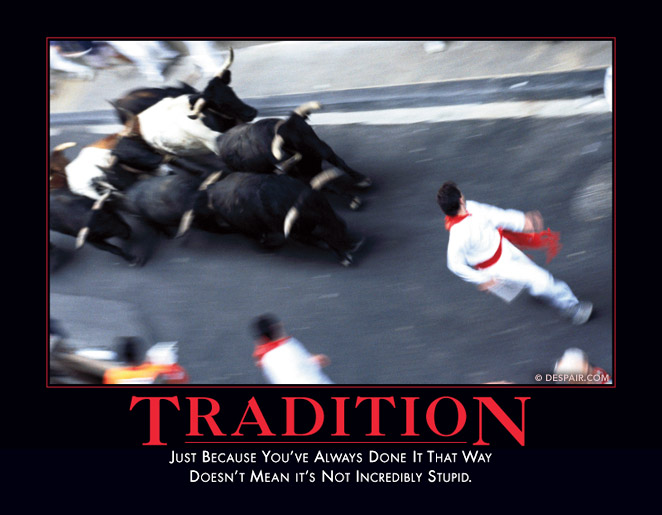
So let’s assume that Santorum is in fact saying that the sheer length of time that the Bible and the Catholic Church have been claiming that homosexuality is immoral demonstrate that it is.  That the Bible has been claiming it for that duration isn’t exactly impressive– it’s a book, albeit one with a large number of translations and interpretations which nonetheless haven’t much altered the statements regarding the morality of sex between two men or two women. That the Church has maintained that homosexuality is immoral for that period of time, on the other hand, demonstrates….what, exactly? That the Church is tenacious in this belief. Does its tenacity demonstrate the truth of the belief? Not remotely. The claim that the sheer amount of time that you’ve held onto something demonstrates its worth or validity is an appeal to tradition, and it’s a fallacy.

So we see that the allegation that the Bible and the Catholic Church are bigoted for calling gays immoral is not rendered unfounded by the reality of homosexual intercourse being immoral or the fact that they’ve been making this claim for a very long time. Santorum’s last objection is to “trying to redefine something that has been seen as wrong.” In other words, he objects to people saying that a previously held claim of something being immoral is mistaken. Really? So is there no such thing as moral progress– society did not advance in any way by the willingness of people being willing to say loudly and clearly that slavery, for example, was wrong? After all, there was (and still is, in some parts of the world) a long-standing belief to the contrary. When miscegenation was legalized in the United States, there was definitely still a widespread and firmly held belief that that was wrong. Would Santorum argue that this “redefinition of something that has been seen as wrong” was therefore a bad thing?  I doubt it.

Finally, there is Santorum’s allegation that believing that the Bible and Catholic Church’s insistence that homosexuality is immoral constitutes bigotry is itself a form of bigotry. Well, Rick, show us your work please…because that doesn’t hold by the definition of bigotry I’m using, or indeed any definition I know. For a start, neither the Bible nor the Catholic Church are a group of people. The Bible certainly isn’t, and the Church is an institution with identifiable agreed-upon doctrines. It might be mistaken to say that the Church is bigoted, but that could not be a bigoted statement in itself simply by definition. And there is no association being made which could constitute correlating an unfounded trait with a unifying trait– nobody is saying that the Bible and the Catholic Church say _______, therefore they must consider homosexuality immoral and are therefore bigoted. They say openly that homosexuality is immoral, and that is being evaluated as bigotry.  Rightly so, I have argued, whether homosexuality is considered a circumstance of birth or not.

* If they agreed, however, and became sexually inactive or were willing to have sex with men instead, they would not cease to be lesbians. I know this. I am not at all combating the notion that sexual orientation is a matter of identity, not behavior. I am simply for the purposes of this post treating it as a behavior in order to point out that negative associations on that basis still qualify as bigotry.  

A contentious proposition

A contentious proposition published on 6 Comments on A contentious proposition

So Warren Jeffs is apparently in a coma. After receiving a life sentence for sexually assaulting underage FLDS followers, he has refused to eat or drink in prison and now, three weeks into that sentence, is in “critical but stable” condition.

I reiterate my belief that criminals sentenced to life in prison should be able to opt for death instead. The article says that it is unknown why Jeffs stopped eating, but that he has fasted to the point of needing medical intervention in prison before.

Let the man die, if he wants to. Do whatever is necessary to bring him out of the coma, and ask him if he’s trying to kill himself and would prefer death to spending the rest of his life in prison. If he says yes, then put him out of his misery.

Dan Savage on the evolution of straight gaydar

Dan Savage on the evolution of straight gaydar published on No Comments on Dan Savage on the evolution of straight gaydar

Salon has an interview with Dan Savage titled “The evolution of Dan Savage” which is a pretty good read if you’re not very familiar with the progression of his career, and includes an interesting (to me) bit about his motivation for starting the It Gets Better Project:

One of the things that was a wake-up call for me last year before the “It Gets Better” campaign — why we launched it, my husband and I — was when I was sort of unaware how bad it was getting out there. You know, in the Greensburg, Indianas, and the Topachakees, Californias, where Constance McMillen was. What I didn’t realize before those suicides opened my eyes, was that as it was getting better in New York or San Francisco or Seattle, it was getting worse out in the sticks, out in mega-church land. Because those of us who are out and urban and fully integrated into our work lives and families, our existence has made it impossible for queer 14-year-olds to fly under the radar in a Greensburg. When I was a kid, and I was odd, the default assumption was that I was odd, not that I was gay. Now when a kid is odd in a Greensburg, gay or straight, the default assumption is gay. Because my job requires me to be in constant communication with people all over the country who are writing in to “Savage Love,” calling the podcast, I think I’m a little more conscious of what’s going on out there in the boonies — but even I didn’t see that. And that’s a bitter pill for those of us my age to swallow. Us out there leading our lives and being successful have actually kind of made it worse for 14-year-old gay kids in Greensburg, Ind. Well, made it worse, but that’s part of progress, right? Absolutely. I’m not suggesting that we shouldn’t have lived this way, or we shouldn’t have come out. And the people who are most responsible for making it worse are of course anti-gay politicians and anti-gay preachers, and parents, teachers and peers who are persecuting these kids. But we’ve created a kind of hyper-awareness about sexuality and sexual orientation that has let to hyper-scrutiny about those things, in places where people weren’t on the lookout for it before. Everybody’s on the lookout for it now.

Savage has also referred to this increased awareness of homosexuality on his podcast, to explain why people are not only willing to claim that Marcus Bachmann is a closeted gay but condemn him for not being un-closeted. He (Savage) says that our cultural attitude has changed– that back when most gays were closeted of necessity, it was so much easier and more likely that straight people would ignore their own gaydar through ignorance or consideration or both. But now that being gay is semi-culturally acceptable, people both notice who seems gay more readily and often and expect that people who are gay should come out. So they feel more comfortable with and entitled to judge closeted gays for not coming out. Basically, that straight people used to prefer to be lied to, but not anymore. For some reason the “permalink” option on the Savage Love podcast does not lead to any such thing, but you can hear him explaining this (much better) at the beginning of episode 249 here.

Another take on Ron Paul in the media

Another take on Ron Paul in the media published on No Comments on Another take on Ron Paul in the media

I came across a commentary by Brian Montopoli at the CBS blog Political Hotsheet which makes some interesting points. He notes that his own coverage of the Iowa straw polls has been criticized by Paul supporters who objected to the candidate not getting enough space, accompanied by the inevitable “RON PAUL 2012!” sign-off. Many commentators would and have stopped there, as if Ron Paul having a following with a large share of verbose and vehement supporters somehow makes up for the media ignoring him. But Montopoli goes on to consider things a little more carefully:

Critics of the media coverage of Paul have a point. Because many reporters see the Texas congressman as having little chance of winning the nomination, he is often left out of the discussion – even as an establishment figure like Jon Huntsman, who badly trails Paul in the polls, is included.  Here’s how political reporters see it: Paul is the only prominent candidate articulating a strong libertarian position. Though he is fairly well known, his support appears to top out at less than 20 percent. Ultimately, Republicans will likely coalesce around one of the other candidates, whose largely-similar positions represent more mainstream Republicanism. Paul’s relatively strong standing in early polls, this argument goes, will fade as the field narrows around one or two more mainstream candidates.  That’s almost certainly true. But here’s the problem: Most reporters also don’t expect Bachmann to win the nomination, either. Bachmann cannot compete with Romney or Perry in terms of fundraising, and she is widely seen as too far to the right to get nominated by a party where most voters’ primary concern is finding someone who can beat President Obama. Yet while Paul was shut out of the Sunday news shows after his near-straw poll victory, Bachmann was invited into almost all of them – and is now being treated by the media as one of the three frontrunners for the nomination.   Why? For starters, Bachmann has a better – though still slim – chance to take the nomination. But also, she’s simply a better story – controversial, telegenic, and relatively new to the national scene. Paul, meanwhile, is on his third presidential run, and he’s saying the same things he’s been saying for decades – which is admirable, but not ideal in a media landscape where freshness is what gets attention.

Poor Ron Paul. He’s been known as a libertarian nutter for so long, and now he’s not crazy enough!  Because his particular brand of controversial viewpoints is not fresh– it’s the same standard he’s been bearing for years. His consistency works against him rather than for him. As for being telegenic….yeah, I suppose not.  Paul is looking pretty decrepit these days and he has never been the best speaker. But I thought these reports were supposed to be about who the front-runners are; not who is prettiest. Is Montopoli saying otherwise? Not quite:

Paul campaign manager Jesse Benton, who described the coverage in the wake of the straw poll as “very disappointing,” told CBS News that the national media “have an obligation to present Dr. Paul fairly and robustly to the American people.”  “I realize that he has been saying the same things to the inner circle of the journalist elite, that’s not new, but it’s very, very new to the American people,” said Benton. While Paul has high name identification, he continued, “A lot of people still have not heard his message.” There’s an irony here: Paul may not be offering up new ideas, but he is the only mainstream candidate articulating significantly different policy positions than his rivals. Paul’s opposition to U.S. military intervention abroad has significant support within the GOP, and his live-and-let-live philosophy is the animating idea behind the Tea Party. Don’t those ideas deserve to be part of the discussion? The media’s focus on Bachmann and dismissal of Paul is a demoralizing illustration of the fact that members of the media – who, it should be noted, often make their coverage decisions based on audience demand – are often more interested in stylistic differences than substantive ones. All this doesn’t change the fact that Ron Paul is very unlikely to be the next president of the United States. Or that the straw poll itself is nearly meaningless – it’s an Iowa Republican party fundraiser in which the candidates, Paul included, essentially buy their votes. But if reporters are going to focus so aggressively on Bachmann – and treat her straw poll win as meaningful – then Paul deserves, at the very least, not to be ignored.

I understand that Michele Bachmann is interesting because she’s so…..bizarre. I do, really. But when bizarre people get attention on TV, it should be simply because of that. Hey, here’s this new crazy evangelical lady who doesn’t know what she’s talking about, running for president!  You can give bizarre people media attention without pretending that they’re more electable– look what happened to Howard Dean. Did anyone declare him a “front-runner” while incessantly playing clips his ill-chosen battle cry? Did they do so in the process of obscuring actual front-runners?  Not from what I recall.

So what’s different?  Has the media just become so thoroughly jaded about this particular election, so sure that the Republican race doesn’t matter, that they’re just no longer interested in portraying the facts when they could report on the crazy?  It’s looking like it.

Jon Stewart wonders how Ron Paul became the 13th floor in the media’s hotel

Jon Stewart wonders how Ron Paul became the 13th floor in the media’s hotel published on 1 Comment on Jon Stewart wonders how Ron Paul became the 13th floor in the media’s hotel

We do live in a bizarre political universe, don’t we?

Ron Paul being ignored isn’t new– this is, basically, the same thing that happened in 2008’s presidential election. There’s just something extra creepy and ironic about it given that, as Stewart mentions, Paul was the seed of the grassroots movement known as the Tea Party….that is, in the roughly two seconds before it was co-opted by conservatives who were simply bitter that a Democrat became president. Though they yell about small government and wave copies of the Constitution, these have not been Ron Paul’s people for a very long time. They are Sarah Palin’s people, Michele Bachmann’s people, Rick Perry’s people….Fox News’ people.

Remember the last election when Paul got up on stage in the Republican debates and gobsmacked Romney, McCain, and Giuliani by frankly declaring that the U.S. had no business invading the Middle East and that the entire military enterprise over there is a waste of lives and trillions of dollars that the country can’t afford?  He’s still doing it, and it still makes his competitors look bad because it draws direct attention to the fact that the military industrial complex is the single biggest waste of government funding and no one who can supports it can pretend to support small government, let alone decreasing the national debt.  That remains true today, only it’s doubly odd given that Paul’s competitors are people who claim to belong to the ideological movement he founded. The crazy, kooky, small-government-at-any-cost folks whom people like Bachmann now claim to represent.

So it’s no wonder that people are ignoring Paul, as they did before. It sure isn’t because he’s crazy– not with people like Bachmann, Santorum, and Perry on the stage. And it sure isn’t because he’s comparatively marginal, given his performance in the straw polls. It’s because he’s an embarrassment to people who pretend to subscribe to the ideals to which he actually subscribes.  He is, for the most part, bullshit-free….whereas everyone else is full of it.

Am I a Ron Paul supporter? Nope. Being a non-bullshitter doesn’t mean that you’re consistent, let alone about principles that are worth having. Paul is not even a consistent states’ rights advocate, and I would not support a states’ rights advocate. He claims to want to leave things up to the states, but has tried repeatedly to get abortion banned at a national level and has supported DOMA. The best things about him are his stalwart condemnation of the invasions of both Afghanistan and Iraq and all of the civil liberties violations that followed 9/11 in the name of security, and his firm belief that the federal war on drugs is a mistake which should be brought to an end as soon as possible. I will cheer for those causes regardless of who will carry their banners, and Paul has carried them dedicatedly for a very long time. But if you’re going to run on principle and ask people to trust your consistency, by golly you had better live up to those…and Paul doesn’t.

Still, Jon Stewart is absolutely right– this pretending that Paul doesn’t exist is simultaneously laughable and abhorrent, and is a shocking display of bias on the part of all media involved.