Skip to content

Can I choose d) Jainism? How about e) pantheism?

Can I choose d) Jainism? How about e) pantheism? published on No Comments on Can I choose d) Jainism? How about e) pantheism?

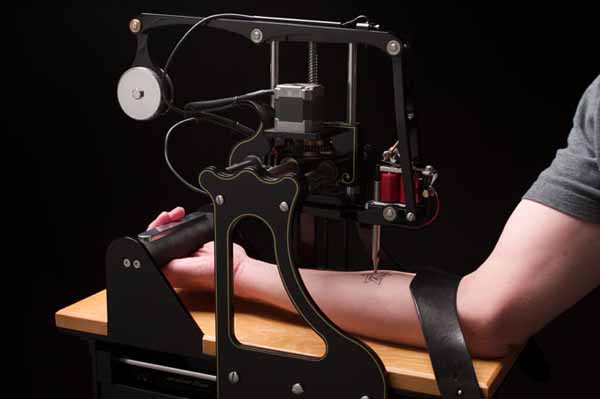
Are you by chance a directionless hipster? Someone who is into the body mods, but doesn’t much care what he/she gets or what ideology lies behind it? Then this might just be the product for you: a random religion-choosing tattoo machine.

The strongest indication of a person’s religion is geography. You are born into your religion. That doesn’t make it irrelevant or incorrect–religion provides a framework for basic morality that’s very powerful and it gives people a cultural identity that spans borders. I’ve attended mass in Dutch, German, French, and Spanish and I’ve always felt like I belonged. While my personal experience with religion is one of inclusion, a system that unites people from different regions and cultures, the public face of religion is often one of exclusion. Muslim, Christian, and Jewish zealots who know what God wants. More specifically they know what God doesn’t want and apparently God does not want me…or you. This public face of religion is always so certain, self-confident, even arrogant. That anyone could possibly know the “truth” when that truth is randomly assigned at birth is just funny.  Auto Ink is a three axis numerically controlled sculpture. Once the main switch is triggered, the operator is assigned a religion and its corresponding symbol is tattooed onto the persons arm. The operator does not have control over the assigned symbol. It is assigned either randomly or through divine intervention, depending on your personal beliefs.

Darn Abrahamic-centrism.

Shape

Shape published on 1 Comment on Shape

You know what the absolute worst part of not working out for a long time is?
The first time back. That’s when you’re slapped in the face with the fact of how utterly out of shape you are, and how far you have to go until you’re back at a point more closely resembling where you were a few years ago, when you worked out almost religiously–no fooling– and still didn’t consider yourself to be in good shape.

Yeah.

I went swimming this morning, because that’s my exercise of choice. And I started to feel like I was actually doing something, like my body was actually cooperating, toward the end. Tomorrow I’ll go earlier and do more.

Damnit.

Perspectives on the Huffington Post suit

Perspectives on the Huffington Post suit published on 1 Comment on Perspectives on the Huffington Post suit

A group of volunteer bloggers who have written for the Huffington Post have come together in a class-action lawsuit against the newly AOL-owned site to the tune of $105 million, headed by a journalist called Jon Tasini. Their argument is that HuffPo has taken advantage of them and owes them back pay for all of the work they’ve done with no contract for payment and from which the site made a profit. HuffPo is going to respond, I assume, by pointing out that a) there was no promise to pay them, b) they knew this, c) could leave at any point if this agreement was not satisfactory, and e) they nevertheless benefited from the arrangement through gained exposure.  But here are some opinions from people who are more informed on the matter than I:

Tasini himself:

“Arianna Huffington is pursuing the Wal-Martization of creative content and a Third World class of creative people,” Tasini said in a press release. “Actually, that is unfair to Wal-Mart because at least Wal-Mart pays its workers something for the value those workers create. In Arianna Huffington’s business model, economic gain is only reserved for her. Everyone else, apparently, is expected to work for free regardless of the value they create. Greed and selfishness is the order of the day.”

David Goldstein, former HuffPo contributor:

I wouldn’t mind getting a share of the $105 million class action lawsuit Jonathan Tasini is filing on behalf of exploited, unpaid bloggers like me. I mean, The Stranger only pays marginally more than Huffington Post, so, well, I could really use the money.  That said, I agree with Eli, in that as a writer giving away my work for free, I knew exactly what I was getting. Nothing. Zilch. Nada. At least in direct monetary compensation.  But it wasn’t exactly a one-way street. Arianna Huffington got free content from folks like me, and in exchange I got a larger audience and a slightly enhanced national profile. Furthermore, the bulk of my eighty-some posts at HuffPo were cross-posts, so they didn’t take much extra work, and they all linked back to HA, both bumping my traffic, and more importantly, my Google ranking.  All in all, not an entirely bad deal for me, and no hard feelings. It would have been nice if Arianna had shared the wealth of her AOL windfall with those of us who helped make it possible, if only a token gesture. You know, like a buck or two a post. Or maybe a gift certificate to Olive Garden. But I wasn’t expecting it.  In fact, if I have any ambivalence (if not downright regrets) over my career as a blogger, it’s got more to do with the way I sold myself cheap at my own blog, rather than the eyes-wide-open arrangement I had at HuffPo. For six years I obsessively covered Washington state and local politics for free, mostly full-time. How could that not help but contribute to the devaluation of the profession, negatively impacting not only my own finances, but those of my colleagues in the legacy press? 

 Radley Balko, criminal justice journalist newly hired by HuffPo, on his blog:

I realize this is going to look like I’m just shilling for my future employer, but really, what the hell am I missing about this Huffington Post controversy?  A bunch of people agreed to write for Huffington Post for free. Or rather, in exchange for a platform that gave them access to a pretty large audience. They did this knowing full well that the goal of Huffington Post has always been to eventually become profitable. If they agreed to sit behind their keyboards and voluntarily churn out free content, how exactly have they been exploited? And on what basis could they possibly argue that those prior agreements should change now that the site has been purchased by AOL?  I can’t tell you how many times I’ve written for free over the years. It’s how you get a foot in the door. It has never occurred to me to go back and sue all of those publications. Come to think of it, I’ve been writing for all of you for free for the last nine years. Expect a visit from my process server soon. 

Although I can sympathize with Tasini’s issue and Goldstein’s complaints, this can’t be about “fair.” If things were fair, all good writers would get paid well for their work and poor writers wouldn’t get hired for anything. But since contracts are what matter here and HuffPo made no agreement to pay these writers for their work (so far as I understand), there shouldn’t be any way for them to demand payment after the fact regardless of how much work they did. If they’re not happy about that, they’re free (again, so far as I know) to refuse to do any more writing without pay, and to bitterly condemn the HuffPo’s business model to anyone who will listen. Which is what they have been doing.

It’s as if they’re trying to give Colbert material…

It’s as if they’re trying to give Colbert material… published on 1 Comment on It’s as if they’re trying to give Colbert material…

Colbert has been tweeting all sorts of non-factual statements about Kyl today. A sampling:

Jon Kyl calls the underside of his Senate seat: “The Booger Graveyard.” #NotIntendedToBeAFactualStatement

Jon Kyl sponsored S.410, which would ban happiness.#NotIntendedToBeAFactualStatement

Jon Kyl has the world’s most extensive catalogue of snuff films.#NotIntendedToBeAFactualStatement

Jon Kyl once ate a badger he hit with his car.#NotIntendedToBeAFactualStatement

On being “gender atypical”

On being “gender atypical” published on No Comments on On being “gender atypical”

I’ve written before about how LGBT issues are ultimately about gender role conformity in general, and Dan Savage posted on that topic today in relation to the It Gets Better Project:

Got this question last night at Cornell University… 

Cornell professor Ritch Savin-Williams said in the New York Times that he’s concerned that it’s not about gay youth, but about gender-atypical kids. Is the “It Gets Better” campaign too narrowly focused?

The kids who suffer the most from anti-gay bullying—the prime targets—are the gender-nonconforming kids, i.e. the sissies and the tomboys, the kids who can’t pass for straight. And some of the kids who can’t pass for straight are straight. Most kids who are gender nonconforming, or gender atypical, are lesbian, gay, bi, or trans, and the IGBP was created to reach out to these queer kids. But the messages at the IGBP are relevant to straight gender-atypical kids, and we know that straight-but-gender-nonconforming kids are watching the videos, commenting on them, taking hope from them, and contributing their own videos. But, yes, we have to address issues around gender—gender expectations and stereotypes—to truly address anti-gay bullying. We can learn to recognize rough gender norms without stigmatizing or punishing kids who depart from those norms. 

Homophobia doesn’t just punish people who are actually gay, bi, or trans. It punishes everyone who doesn’t match a traditional idea of what maleness and femaleness are.  I was a tree-climbing short-haired tomboy through most of elementary and middle school, and was called a dyke more times than I’d care to remember by the same straight guys who punished each other regularly for deviating from a rigid standard of machismo in the slightest. I feel sorry for them in retrospect, because they were victims of the same rigid, idiotic standards of gender that they inflicted on me.

Jen McCreight channels her 13-year-old self to reply to Savage:

I like boys, and I have a huuuuge crush on one who I think likes me back. But I’m a tomboy and I always have been. . .  And that’s why everyone thinks I’m a lesbian. I don’t care if people are gay, but the way they say the word hurts so much. They whisper it like I’m dirty or broken. Girls don’t like changing by me in gym class, even though I’m more concerned that my underwear is dorky than what they look like in their underwear. I know it’ll probably stop when I get a boyfriend (if that ever happens, sigh) but that just makes me feel worse, knowing that the kids who really are gay can’t hide like that and have to put up with this forever. But when I’m feeling down, I can watch the It Gets Better Project videos and know I’m not alone. So this big letter was to say “thank you.”

“I have a suicide”

“I have a suicide” published on No Comments on “I have a suicide”

In Colorado Springs yesterday, an elderly man called police to report his own suicide:

At about 8:15 a.m. the 74-year-old man called 911 to report “he had a suicide,” according to the police report.  When a dispatcher asked for more information, he replied, “Hold your ears,” then the dispatcher heard a gun discharge, according to the report.  Police rushed to the home and found the man dead with a .38-caliber pistol in his hand, “along with several notes indicating funeral arrangements and desired disposition of his property,” according to the report.

There isn’t any information in the brief article about his mental history, but it does note that he had been treated for “several medical conditions.” Whether those conditions were the ultimate reason for his suicide, we just don’t know.

Dr. X recently posted about witnessing the reaction after someone had committed suicide by train– perhaps purposefully holding up a final metaphorical middle finger to strangers by opting to step in front of the train during Friday rush hour on a commuter track, thus traumatizing a lot of people, particularly the train’s unfortunate engineer. As I remarked there, I think it’s pretty easy to acknowledge that in a society where suicide and assisted suicide are illegal, there will inevitably be some inconvenience (at the very least) caused to others by a person who decides to go ahead and do it anyway. But people who do make that choice seem to exist on a continuum of concern. This man in Colorado Springs clearly put a good deal of thought into the decision to end his life, not just about whether or not to do it but how to do it…well, considerately. As much as that is possible, anyway.

Historical tweets

Historical tweets published on No Comments on Historical tweets

Scott Johnson at Extralife imagines what might have happened if Twitter had always been around:

I love this idea. I also love the fact that they’re all “tweeting” on whatever communication device might have been available at the time.

It made me immediately start to imagine tweets that could have been made by famous historical figures:

@Wilkesy: Lincoln’s totes going down tonight. 
@Wilkesy: Oops, my account is public, isn’t it? Omigod I hear knocking at the door. GTG
@marie_curie: Stupid professor gave me a drawer full of salt to analyze. Sigh, busy work. Not sure why it’s glowing, or why I feel so odd. LOL
@RFranklin: That bastard Watson GOT INTO MY DNA PHOTOS!!!111!! Wilkins is SO gonna pay. #younocanhasdoublehelix
@FCrick: RT @JWatson Hahahaha @RFranklin we’ll get the Nobel Prize and u won’t. #ownage

Getting fixed

Getting fixed published on No Comments on Getting fixed

Essure is a form of female sterilization or “permanent birth control” that a lot of women are choosing these days over tubal ligation. It’s a simpler procedure that isn’t as invasive and doesn’t require as much recovery time. I think that’s great, and will probably be getting it myself within the next year or two. But I’m not so sure about a particular method of promoting it– making men even more scared of getting vasectomies. Okay, that’s not the intended effect of this video. The intent is to show in a funny way that “men and women have something in common– both want to avoid the knife.” And it describes the process of coming around to being willing to get a vasectomy as “manning up,” as in, maybe you can’t wait for your man to do it. Really?

Showing guys cringing in sympathetic pain while watching a surgical procedure and belittling them for not being enthusiastic about getting it themselves = hilarious!

First of all, not everyone who is interested in curtailing his or her baby-making abilities is in a relationship. Not for everyone is it a decision about which party is going to get the permanent birth control. And with those for which it is, is it really best to encourage the idea that birth control is the woman’s problem by default by making vasectomy seem even more scary and horrible? Because you know, that impression is already pretty firmly entrenched. The idea that it makes you less of a man to be infertile is also already well-established. And I don’t think the best way to fight that is by saying that the real way to be less of a man is to be unwilling to get vasectomized. Because, umm…that would mean that the male partners of women who get Essure who don’t get sterilized themselves are not real men.Yeah, let’s leave the whole “manliness” thing out of it.

Essure might be far less of an ordeal than a tubal ligation, but it still isn’t a picnic. It also requires going back to your doctor three months after the initial procedure to get confirmation which involves inserting dye into the uterus and getting x-rayed, which is the worst part according to accounts I’ve read. Both Essure and a vasectomy may be covered by insurance, but the total cost for the former looks to be twice as much or more.  And it’s entirely possible that a couple might opt to be as safe as possible and get themselves both sterilized.

So how about not promoting one solution by denigrating the other? Both are legitimate answers to a question being asked by certain subsets of the population– “I’m not big on this whole fertility thing (anymore). What’s the best way for me to end that?” We don’t have to make it easier for men to abdicate responsibility for birth control in general in order to embrace a new form of it for women. In my humble view, the more options there are and the easier they are for anybody to get/use, the better.

Storm

Storm published on No Comments on Storm

The animated version of Tim Minchin’s nine minute beat poem “Storm” is finally out!

I first heard of Minchin when he was a guest on the Skeptic’s Guide to the Universe podcast a few years ago. He talked about this poem on the show, so I tracked it down on Youtube and immediately wanted to hear more of his stuff. Unfortunately very little of that was available on Youtube at the time, so I ordered both of his CDs from some British distributor and listened to them on repeat as we packed up my boyfriend’s house in preparation to move to a new one (BF liked it almost as much as I did, so didn’t mind this).

Now Minchin’s snarky and vehemently irreverent music is all over the place. I would not recommend listening to it if profanity or blasphemy bother you in the slightest. I would especially not recommend watching this bawdy video collaboration made in protest of the pope. But if those things don’t so much as make you raise an eyebrow, check his stuff out– especially this one, which can make me cry in the right mood. I think the animation of the “Storm” video is well done, though I can’t help being partial to the earlier version of it that Minchin recorded. The inflection just sounds better to me, though that could be because it’s what I’m used to hearing. One of the comments on the Youtube channel reads “I don’t get it.  Is he trying to rap?” Ah, kids.

ETA: An interview about the project with the film’s creators and with Minchin can be found here.

Suppositions

Suppositions published on No Comments on Suppositions
Human nature, by Junior Lopes

Here are a few…let’s call them suppositions I’ve reached in the process of doing a very cultural degree program followed by a very cognitive one:

1. Perspective always matters. None of us are truly objective, because we speak from a perspective by necessity. But by seeking out and being informed by the perspectives of others, we can come closer to objectivity. The truly objective is that which is true or existent independent of our perspectives, however, and cannot be determined by simply adding up subjective views. If nine out of ten people think Beck is the best musical artist ever, that’s useful information. It does not mean that Beck is objectively the best musical artist ever. You can’t vote on the sex of a rabbit, etc.

2. Perspectives often differ as a result of distributions of power. The more powerful often speak more loudly and are easier to hear. Power may come from many sources–sheer numbers, monetary wealth, physical strength, influence, and so on. While the perspectives of the less powerful are important because they can include insights that are simply overlooked by the powerful, they are not right simply by virtue of being relatively powerless. If you added up all of the kinds of non-privilege in the world and found them all existing in one person, that person would not be the wisest human being ever. But he/she would probably have a hell of a story to tell, and it’s one we should hear.

3. There is such a thing as human nature, but we are not biological robots. We are both natured and nurtured. Biological determinism and strict social constructivism are both telling partial stories which are thereby incorrect stories. A person who thinks a trait of the human mind is more biologically determined than you do is not necessarily a biological determinist, and a person who thinks the trait is more shaped by society is not necessarily a strict social constructivist. People who focus on culture tend to fixate on difference while people who focus on cognition tend to focus on commonalities. This does not make them enemies, but collaborators (that is, if they’re willing to be). “Biological” and “neurological” do not mean “permanent,” and “cultural” does not mean “easily/quickly mutable.”

4. Nor do those classifications mean the abdication of responsibility or legitimization of normativity.  Our minds are built by both biological evolution and the culture around us, and saying that a certain trait is adaptive no more confirms that it is good than does saying something is a message sent by society.  Neither evolution nor society have “wants.” They are both complex forces that shape people without purpose. We as individuals take what we’re given and decide what to do with it. We don’t hand responsibility over to either force, but share it with them. Free will– the kind of free will worth wanting– is created in the exchange.

These are all very general “planks” of my thinking about how minds work, but I thought it important to jot them down because holding these suppositions says a lot about what I do or don’t find surprising, likely, or moral. For example, you’re not likely to arouse outrage in me at the idea that rape is an evolutionarily adaptive trait. It might be completely untrue, but the very idea won’t offend me because I know that doesn’t remotely mean that rape is good, prudent, or hard to avoid committing. I’m already very familiar with the idea that war, sexual deception and jealousy, religion, and more biases than could possibly be conceived may well be adaptive, and those possibilities are interesting in terms of their explanatory value but hardly threatening. And to return to Stephen Pinker-think, nothing we discover about the human mind is going to legitimize rape.  If someone claims otherwise, they’re doing science wrong. Or not doing it at all.