Skip to content

The daughter test, in Egypt

The daughter test, in Egypt published on 2 Comments on The daughter test, in Egypt

From the Huffington Post’s list of 2011’s Most Absurd Quotes About Women– And Who Said Them:

An anonymous Egyptian general spoke to CNN about why female protestors arrested during anti-Mubarak demonstrations were strip-searched and forced to submit to virginity tests. “The girls who were detained were not like your daughter or mine. These were girls who had camped out in tents with male protesters in Tahrir Square, and we found in the tents Molotov cocktails and [drugs]…We didn’t want them to say we had sexually assaulted or raped them, so we wanted to prove that they weren’t virgins in the first place. None of them were.” 

Misogyny and changing the subject

Misogyny and changing the subject published on 5 Comments on Misogyny and changing the subject

Greta Christina preaches it:

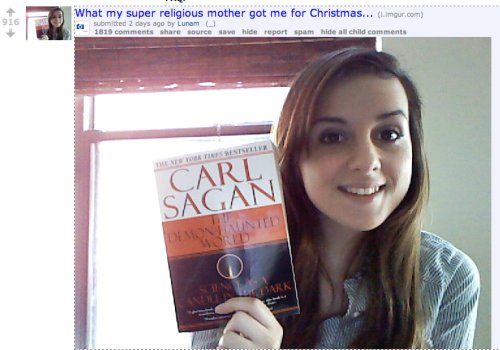
It’s depressingly predictable. When an instance of misogyny gets pointed out on the Internet, in a forum big enough to garner more than a couple dozen comments, you’re almost guaranteed to see some or all of these types of comments. It’s happening now. In case you haven’t heard, there was a recent incident on Reddit/ atheism, in which a 15-year-old girl posted a photo of herself holding a copy of Carl Sagan’s Demon-haunted World that her mother had given her for Christmas… and was almost immediately targeted with a barrage of sexualized, dehumanizing, increasingly violent and brutal comments. Including, “Well 15 is legal in many places, including my country, so I’ll only have to deal with abduction charges.” “Relax your anus, it hurts less that way.” “Blood is mother nature’s lubricant.” “Tears, natures lubricant.” “BITE THE PILLOW, IM GOIN’ IN DRY!” And including comments blaming the girl for posting a picture of herself in the first place. Rebecca Watson and others — including Stephanie ZvanEd BraytonJason Thibeault,Jen McCreightJohn Loftus, and Ophelia Benson — have been pointing out how revoltingly misogynistic this is and why. And the “Yes, but…”s have been coming thick and fast. It’s depressingly predictable. And it’s depressing that anyone should have to explain why this is a problem. It seems totally obvious to me. But apparently, it’s not so obvious. So I’m going to spell it out. When the topic of misogyny comes up, and men change the subject, it trivializes misogyny. When the topic of misogyny comes up, and men change the subject, it conveys the message that whatever men want to talk about is more important than misogyny. When the topic of misogyny comes up, and men change the subject to something that’s about them, it conveys the message that men are the ones who really matter, and that any harm done to men is always more important than misogyny. And when the topic of misogyny comes up, and men change the subject, it comes across as excusing misogyny.

Reddit makes Rebecca hate atheists and Ed hate men

Reddit makes Rebecca hate atheists and Ed hate men published on 3 Comments on Reddit makes Rebecca hate atheists and Ed hate men
Reddit thread here, if you’re interested

These discussions, while useful, take a toll. Sometimes they just seem…tiring. I admire people who are willing to run the “sexism on the internet/in skepticism/atheism” treadmill, but can’t help but wonder how they manage to remain sane. Especially while being attacked endlessly for their efforts, as Rebecca Watson has been. As she has shown, all you need do provoke the misogynistic ire of the internet is mention its existence disapprovingly. I really don’t think it has much to do with atheism/skepticism.

Sexism on the internet is a problem, and atheism/skepticism are predominant on the internet. So “sexism is a problem for atheism/skepticism,” because the internet is a primary conduit of interaction for such people. The internet helps people around the world who feel isolated come into contact with others of their kind, yes…and it also creates the impression that those who take advantage of this opportunity speak for everyone in their minority group. When, for example, PZ Myers and Greta Christina disagree, who should we listen to? Who is the representative of all atheist-kind? Well, neither of them, obviously. Atheists and skeptics have no popes, no bishops, no chain of command, because– this is important– atheism and skepticism are not belief systems. Atheism is a lack of belief in gods, and skepticism is a tool, an epistemological approach. Nevertheless prominent atheists can influence the beliefs of others, and lacking churches and being in disparate locations, they often do so on the internet. People want to group together with others of their kind, and when they do they like to have authorities. People outside of groups like for those groups to have authorities to speak for them, to encapsulate what they’re all about. It makes things easier, but in this case also distorts the picture grossly.

Bottom line: sexism is an internet problem. A world problem. The fact that atheists and skeptics on the internet are discussing its existence within their own ranks does not betray that atheism/skepticism “has a sexism problem.” It means that there are vocal people who are concerned enough about this ubiquitous problem to address it, and that quite naturally leads to a widespread ongoing discussion. It’s amazing how much easier it is to avoid having a “problem” with something when your community is either homogeneous, or the community is homogeneously in agreement on it (perhaps by silencing or just not listening to dissidents). Atheists/skeptics on the internet are willing and able to speak up, therefore they’re the ones with the problem. Hmm, not buying it.

Dramatic generalizations incoming. Ready? Here we go.

Dramatic generalizations incoming. Ready? Here we go. published on 1 Comment on Dramatic generalizations incoming. Ready? Here we go.
When it comes to women and political issues, conservatives will generally be the ones to attack women’s actions by attacking their appearance. Liberals, however, can be counted upon to respond by defending the woman’s appearance rather than her actions. 
The corollary is, of course, that when desiring to promote a woman politically conservatives will trumpet the virtues of her appearance, whereupon at least some liberals will respond by attacking it.

IIWAPBK and Privilege 101

IIWAPBK and Privilege 101 published on No Comments on IIWAPBK and Privilege 101

Cross-posted from State of Formation.

I think Gene Marks has now been thoroughly excoriated for his column “If I Were a Poor Black Kid” on the Forbes web site last week. In his effort to explain how it’s still possible for underprivileged kids to succeed, he succeeded only in displaying a shocking lack of empathy. By that I don’t mean that he demonstrated a lack of concern for the poor black kids of the world and their needs– I mean that he literally failed at perspective-taking, in such a spectacular way that it’s hard to believe that he was serious (though apparently he was), which has made the column a golden opportunity for mockery. Jenée Desmond-Harris writes in The Root:

Middle-aged, white Forbes contributing writer Gene Marks, in his recent piece, “If I Were a Poor Black Kid,” presented some now-infamous ideas for how he would personally rise to success if he suddenly found himself young, African American, and poverty-stricken.  Marks would “get technical,” learn software,” “learn how to write code,” “figure out where to learn more online,” “become an expert at Google Scholar,” and regularly peruse the CIA World Factbook. He would then get himself into a top school, and he would “succeed.” The end.

Oh. If only Marks had given out this priceless advice before, we would have eliminated racial inequalities long ago.

Not really.

As a curious side note, it’s unclear how this is any different from what he would do if he were a poor white kid. But also, there’s no word in the piece on how Marks imagines that he would, as a poor child, suddenly be infused with the perspective and sophistication of a middle-class adult. In addition, he, perhaps unintentionally, admits that his advice is useless to all but a select few gifted, mature, and lucky children. (He doesn’t have any thoughts on what he would do if he were not a “special kind of kid” who miraculously became aware of the admissions processes of magnet schools and the value of TED talks and the Khan Academy.)

Melanie Tannenbaum, on her blog psysocietyputs it this way:

My immediate reaction was to hate the article. I found it insulting, ignorant, and just plain short-sighted. As I commented in my own link on Facebook, “[To summarize], ‘This is what I would do if I were born into a completely different set of circumstances, a completely different family, a completely different social support system, a completely different school district, a completely different body with a completely different skin tone and a completely different way that people in public respond to me, yet I somehow still retained all of the benefits, knowledge, and access to resources as a middle-aged, middle-class white man.’”

Indeed. Marks’ column reads as if he was attempting to describe what would happen if he had body-swapped with a poor black child in a movie…the most boring body-swap movie ever, if what he says he’d do in this different body and environment is true. And, it goes without saying, not terribly useful when it comes to addressing what he was addressing, which are the opportunities available and likely to be utilized by people who are actually born in the bodies and environments in question. Having acknowledged this, however, Tannenbaum the doctoral candidate in psychology studying “the effects of power, status, and social class on attitudes and behavior” goes on to observe the following:

However, upon re-reading the article and giving it a little more thought, I’ve come to realize that the real issue with the article isn’t that the author, Gene Marks, is necessarily racist, or even really ignorant. After all, he acknowledges right off the bat that the system is unfair, and that children from other areas of town have it much harder than his own, privileged children do. Marks clearly has some knowledge of the unfairness of “the system.” So the real question is, how could he then go on to write such a short-sighted article, completely missing any sort of perspective on what it means to actually be a member of the community to which he is proselytizing?

What follows is essentially an unpacking of the psychology of privilege. And privilege, it seems, is what we’re talking about here– specifically, the unconscious ignorance of the ways in which advantage and power affect one’s perspective. Tannenbaum goes over two experiments in which subjects were primed with (prompted to have at the front of their minds) notions of self-empowerment, and shows how this actually causes people to assume that others know what they know:

In other words, powerful participants were more likely to overweight the special, privileged information that they had, and they subsequently predicted how other people would (or should) respond to certain situations as if the other people had access to that same, privileged knowledge as well.

Sound familiar?

To be momentarily blunt, powerful people often fail to correct for the fact that other people don’t have the same special knowledge that they do. When they think about how other people should respond to situations, they are significantly more likely to overweight the information that they happen to have (like, say, knowledge about the vast amount of educational technology that is available, assuming one knows where to look for it), and less likely to consider the fact that not everyone else has the same knowledge base.

Well, that’s not news, comes the reply from any of the not-so-privileged among us. The most powerful people are often members of the majority, which allows them to make their experience the “norm” which everyone else comes to know whether they want to or not, but there is nothing compelling them to come to know the experiences of minorities. The other important aspect of privilege is that the privileged are not forced by anything in particular to see through anyone else’s eyes, to acknowledge that their own experience in life is not universal.

Still, it’s one thing to think that what you know and experience is more important than what others know and experience. It’s quite another to be unconsciously ignorant of the fact that other people have different knowledge and experiences, which is what the experiments suggest. That’s what I mean by “failing at perspective-taking”– being unable to process that someone who is not you has a different perspective than you do, perhaps a very different one.

Most of us have had the experience of talking to someone about our problems and hearing that person say “Well, if it were me, I would…” followed by a description of some course of action that we would never pursue, assuming it is even possible for us. One has to wonder what exactly they believe the benefit of offering such an observation to be. That is basically what Gene Marks did in his column, causing its readers to collectively scratch their heads and wonder what the benefit of that was supposed to be.

There are two fundamental short-cuts to empathy (really understanding things from someone else’s point of view) that have proven themselves time and time again: similarity and familiarity.

If you’re very similar to the person in question, it’s not very much of a stretch to see things like they do because after all it’s almost how you yourself see things. Alternately, if the person in question is not much like you but you know him/her really well, it’s easier to see things from his/her perspective just because you’re used to doing so. Privilege means being similar to most people, or at least most powerful people. Never being the “other,” the one who is marked as different.

But that doesn’t mean empathy is impossible– the moral progress of a society is marked in part by the gradual realization by the privileged that they have this status to begin with, and this is accomplished by becoming familiar enough with the different experience of “others” that it is possible to see through their eyes and recognize how similar they actually are. Where this realization occurs, you will find members of majorities fighting for the rights and interests of minorities. Where it fails, you will find apathy and hostility born of that particular kind of ignorance that privilege conveys.

At the end of her post, Tannanbaum acknowledges the ways in which she herself is privileged. I have my own. One of them– access to education– is how I can afford to analyze the mechanisms by which privilege affects perspective in the first place, which might be ironic but hopefully does not invalidate such an analysis.

Empathy and sympathy are often conflated for a reason– the former can lead quite naturally to the latter in the process of understanding allowing for recognition of similarities, and it becomes harder to be angry and blame when you find yourself identifying with the target of such. But we can blame and empathize at the same time. We really can, and both are important for mutual growth– the blame so that the blamed can recognize their error, and empathy so that accusers don’t perceive themselves as errorless. In this way, the conversation can be elevated.
IIWAPBK and Privilege 101

IIWAPBK and Privilege 101 published on 1 Comment on IIWAPBK and Privilege 101

I think Gene Marks has now been thoroughly excoriated for his column “If I Were a Poor Black Kid” on the Forbes web site last week. In his effort to explain how it’s still possible for underprivileged kids to succeed, he succeeded only in displaying a shocking lack of empathy. By that I don’t mean that he demonstrated a lack of concern for the poor black kids of the world and their needs– I mean that he literally failed at perspective-taking, in such a spectacular way that it’s hard to believe that he was serious (though apparently he was), which has made the column a golden opportunity for mockery. Jenée Desmond-Harris writes in The Root:

Middle-aged, white Forbes contributing writer Gene Marks, in his recent piece, “If I Were a Poor Black Kid,” presented some now-infamous ideas for how he would personally rise to success if he suddenly found himself young, African American and poverty-stricken.  Marks would “get technical,” learn software,” “learn how to write code,” “figure out where to learn more online,” “become an expert at Google Scholar” and regularly peruse the CIA World Factbook. He would then get himself into a top school, and he would “succeed.” The end.  Oh. If only Marks had given out this priceless advice before, we would have eliminated racial inequalities long ago.  Not really.  As a curious side note, it’s unclear how this is any different from what he would do if he were a poor white kid. But also, there’s no word in the piece on how Marks imagines that he would, as a poor child, suddenly be infused with the perspective and sophistication of a middle-class adult. In addition, he, perhaps unintentionally, admits that his advice is useless to all but a select few gifted, mature and lucky children. (He doesn’t have any thoughts on what he would do if he were not a “special kind of kid” who miraculously became aware of the admissions processes of magnet schools and the value of TED talks and the Khan Academy.)  

 Melanie Tannenbaum, on her blog psysociety, puts it this way:

My immediate reaction was to hate the article. I found it insulting, ignorant, and just plain short-sighted. As I commented in my own link on Facebook, “[To summarize], ‘This is what I would do if I were born into a completely different set of circumstances, a completely different family, a completely different social support system, a completely different school district, a completely different body with a completely different skin tone and a completely different way that people in public respond to me, yet I somehow still retained all of the benefits, knowledge, and access to resources as a middle-aged, middle-class white man.’”

Indeed. Marks’ column reads as if he was attempting to describe what would happen if he had body-swapped with a poor black child in a movie…the most boring body-swap movie ever, if what he says he’d do in this different body and environment is true. And, it goes without saying, not terribly useful when it comes to addressing what he was addressing, which are the opportunities available and likely to be utilized by people who are actually born in the bodies and environments in question. Having acknowledged this, however, Tannenbaum the doctoral candidate in psychology studying “the effects of power, status, and social class on attitudes and behavior” goes on to observe the following:

However, upon re-reading the article and giving it a little more thought, I’ve come to realize that the real issue with the article isn’t that the author, Gene Marks, is necessarily racist, or even really ignorant. After all, he acknowledges right off the bat that the system is unfair, and that children from other areas of town have it much harder than his own, privileged children do. Marks clearly has some knowledge of the unfairness of “the system.” So the real question is, how could he then go on to write such a short-sighted article, completely missing any sort of perspective on what it means to actually be a member of the community to which he is proselytizing?

What follows is essentially an unpacking of the psychology of privilege. And privilege, it seems, is what we’re talking about here– specifically, the unconscious ignorance of the ways in which advantage and power affect one’s perspective. Tannenbaum goes over two experiments in which subjects were primed with (prompted to have at the front of their minds) notions of self-empowerment, and shows how this actually causes people to assume that others know what they know:

In other words, powerful participants were more likely to overweight the special, privileged information that they had, and they subsequently predicted how other people would (or should) respond to certain situations as if the other people had access to that same, privileged knowledge as well.   Sound familiar?   To be momentarily blunt, powerful people often fail to correct for the fact that other people don’t have the same special knowledge that they do. When they think about how other people should respond to situations, they are significantly more likely to overweight the information that they happen to have (like, say, knowledge about the vast amount of educational technology that is available, assuming one knows where to look for it), and less likely to consider the fact that not everyone else has the same knowledge base.  

Well, that’s not news, comes the reply from any of the not-so-privileged among us. The most powerful people are often members of the majority, which allows them to make their experience the “norm” which everyone else comes to know whether they want to or not, but there is nothing compelling them to come to know the experiences of minorities. The other important aspect of privilege is that the privileged are not forced by anything in particular to see through anyone else’s eyes, to acknowledge that their own experience in life is not universal.

Still, it’s one thing to think that what you know and experience is more important than what others know and experience. It’s quite another to be unconsciously ignorant of the fact that other people have different knowledge and experiences, which is what the experiments suggest. That’s what I mean by “failing at perspective-taking”– being unable to process that someone who is not you has a different perspective than you do, perhaps a very different one. Most of us have had the experience of talking to someone about our problems and hearing that person say “Well, if it were me, I would…” followed by a description of some course of action that we would never pursue, assuming it is even possible for us. One has to wonder what exactly they believe the benefit of offering such an observation to be. That is basically what Gene Marks did in his column, causing its readers to collectively scratch their heads and wonder what the benefit of that was supposed to be.

There are two fundamental short-cuts to empathy (really understanding things from someone else’s point of view) that have proven themselves time and time again: similarity and familiarity. If you’re very similar to the person in question, it’s not very much of a stretch to see things like they do because after all it’s almost how you yourself see things. Alternately, if the person in question is not much like you but you know him/her really well, it’s easier to see things from his/her perspective just because you’re used to doing so. Privilege means being similar to most people, or at least most powerful people. Never being the “other,” the one who is marked as different. But that doesn’t mean empathy is impossible– the moral progress of a society is marked in part by the gradual realization by the privileged that they have this status to begin with, and this is accomplished by becoming familiar enough with the different experience of “others” that it is possible to see through their eyes and recognize how similar they actually are. Where this realization occurs, you will find members of majorities fighting for the rights and interests of minorities. Where it fails, you will find apathy and hostility born of that particular kind of ignorance that privilege conveys.

At the end of her post, Tannanbaum acknowledges the ways in which she herself is privileged. I have my own. One of them– access to education– is how I can afford to analyze the mechanisms by which privilege affects perspective in the first place, which might be ironic but hopefully does not invalidate such an analysis. Empathy and sympathy are often conflated for a reason– the former can lead quite naturally to the latter in the process of understanding allowing for recognition of similarities, and it becomes harder to be angry and blame when you find yourself identifying with the target of such. But we can blame and empathize at the same time. We really can, and both are important for mutual growth– the blame so that the blamed can recognize their error, and empathy so that accusers don’t perceive themselves as errorless. In this way, the conversation can be elevated.
Pareidolia of the– hey, wait a minute….

Pareidolia of the– hey, wait a minute…. published on No Comments on Pareidolia of the– hey, wait a minute….

If you’re just too impatient to see Jesus or the Virgin Mary’s face appearing in bird poo, a cliff face, or a testicular tumor, for just $32 you can see one of them appearing reliably in an easily accessible location– your toast. Jesus and Virgin Mary toasters are apparently a hot commodity this holiday season, with 50 to 100 of the Jesus variety reportedly being sold daily by Vermont entrepreneur Galen Dively.

Fairly straightforward, huh? I thought the aura around Jesus’ head was a nice touch. Turns out the image is formed by an insert that slides into the toaster and can adjust the heat applied to imprint virtually any image on the surface of bread, from happy faces to peace signs (apparently the second most popular design after Jesus) to other religious symbols including the Star of David and the Hindu god Ganesh. I can’t help but think that in addition to most Americans not being Hindu, Ganesh doesn’t show up more often because it’s harder to detect an elephant face in a door or block of concrete than a human one. Hmmm…
Anyway, in CNN’s video interviewing people about the Jesus toaster, nobody appears offended by the product. Is that because they don’t view the deliberate placing of the face of the holy figure on a slice of toast as a mockery of the “real” incidences of it appearing in such places? Or because they do view it as such, but don’t care? I think it’s fair to call the toaster irreverent in that regard, but perhaps even more so in that as Ed Brayton points out, “nothing says religious piety like spreading peanut butter over your savior’s face.”
Don’t get me wrong; I love toast. But I think I’ll stick with plain ol’ boring evenly toasted bread, thanks.

Cycling through symbolism: Nitpicking the Rick Perry ad mockery

Cycling through symbolism: Nitpicking the Rick Perry ad mockery published on 1 Comment on Cycling through symbolism: Nitpicking the Rick Perry ad mockery

AKA The post about Rick Perry’s jacket.

If you somehow have missed seeing Rick Perry’s recent campaign ad, now one of the least liked videos on Youtube, here it is:

Yes, that is a real ad produced by a real candidate for president of the United States and long-time governor of the state where I live. It might seem like self-parody, but that didn’t stop a number of mocking videos from cropping up all over the place, including this satire which I quite like:

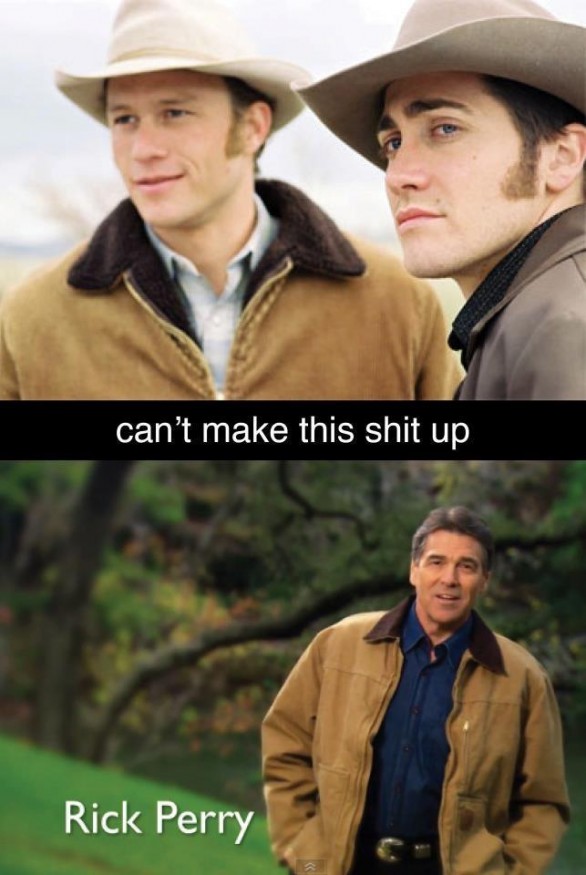
Another which is currently making the rounds:

Upon first seeing this, my reaction was basically “……so?” I still haven’t seen Brokeback Mountain, but am pretty sure I’ve heard every joke about it ever made, because if there’s one eternal truth of the universe it is this: People love joking about Brokeback Mountain. And oftentimes when they’re doing it, they’re using the reference to bring down something else by comparing it to the movie, which is hard to interpret as an endorsement of Brokeback specifically or support of homosexuality in general.

Take this example: Rick Perry is shown in his campaign ad bashing gays while wearing the same jacket as a gay character in a movie. Heehee, homophobe displaying unconscious homoeroticism! But is it, really? Perry is shown doing the George Bush thing, speaking to the heartland while outside enjoying the wilderness…or something…wearing a Carhartt jacket. Carhartt makes sturdy outerwear for sturdy people, and as Michael Heath explains it’s not at all an uncommon thing to see worn by pretty much anyone in the area Perry is addressing:

The Brokeback jacket wasn’t a Carhatt. And Carhartt clothing is associated with people who work outside in inclement weather, along with politicians who pander to them (e.g., Sarah Palin, and now Rick Perry). Their line has nothing to do with gays. It’s like politicians wearing John Deere hats or sporting Pabst Blue Ribbon decals . . . This clothing line is not defined by one mere movie about gays, where it wasn’t even featured. Carhartt is instead defined by its large popularity amongst those who Perry, Palin, Kid Rock, and Hank Williams direct their marketing efforts. I know of no other clothing line which can compete with their market share for outdoor work clothes you’re OK with getting dirty. They’re insulated overalls are especially dominant in my area since we have harsh winters here. You can make a good argument Perry’s pandering to rural populists by wearing work clothes which he’s never done a lick of work in himself. Most of us who wear this line of clothes are not worried about getting them dirty in a way you can’t launder out – as ZZ Top sang about their blue jeans, “you can tell by the oil and gasoline”. But you only embarrass yourself by pointing to one character in one movie and claiming Perry’s out of touch when in fact it’s those comparing this coat to a similar one worn in a movie who are out of touch, precisely because they validate their ignorance regarding its authentic popularity. This is not a close call.

I would add three comments to this:

  1. Heath Ledger’s character in Brokeback Mountain didn’t wear that jacket because he’s gay, but because he’s a cowboy. Duh, right? But this is important because cowboys are conceived as being rugged, tough, traditionally masculine, which is what Perry was going for.
  2. Suggesting that because this style of jacket was worn by a gay character in a movie, we should associate homosexuality with it when it’s worn by a political candidate really smacks of a kind of sympathetic magic. When any item of clothing is worn by a gay character, it becomes gay!  No straight man should wear it ever again if he doesn’t want people to giggle and call him a queer! Is that really the leap that we want to make?  
  3. It’s true that over the top masculinity is often construed as homoerotic. But Perry isn’t dressed as a Tom of Finland illustration here. He’s just a guy wearing an outdoorsy jacket. As more and more movies are made featuring gay characters, those characters are eventually going to wear every item of clothing under the sun. Heath Ledger also wore jeans in that movie, but we’re not saying “OMG jeans are gay!” because jeans are ubiquitous for most of us. Carhartt jackets are ubiquitous in certain parts of the U.S., and as Heath points out that makes the people who are unaware of that and pointing to Brokeback Mountain look rather ignorant. 
One final point, which I alluded to before– attacking homophobes by suggesting that they’re gay is not a compliment to actual gay people. Generally speaking, when people use an attribute that describes you as an insult to others, it doesn’t feel that great. There has been some speculation about Perry’s sexuality in the past, but if the future contains some revelation that he is actually bi or homosexual, two things will be certain: 1) any ensuing mockery should be for his hypocrisy, not his sexuality, and 2) having worn Carhartt outerwear in a campaign ad sure wasn’t a tip-off.  
Sometimes, a jacket is just a jacket.

ETA: Two more comments on the topic….

From scorinth:

“why are you all so sure that all liberal think Carhartts are gay jacket?” Because that’s what the joke is: “Doesn’t Rick Perry look like that gay guy?” Sure. Maybe. Possibly, he looks like that one gay character from a movie. Why? Because he’s wearing a tan Carhartt jacket in an outdoor setting. I dare you to give me some other reason somebody would make that connection. So what people who make that joke are saying is that Perry looks like that one gay guy from the movie, because of the jacket. So, the jacket makes the faggot, so to speak. PROTIP: The majority of people who work outdoors in the central and western US wear clothing that’s very similar to that same jacket. That’s not a small number. I’m talking hundreds of thousands. Probably millions. To completely gloss over their existence and jump straight to the gay character is offensive to me both as a gay man and as a Kansan.

From James Hanley:

Conservatives tend to think liberals are out-of-touch with rural American, and lord how liberals are demonstrating it here.  Look, my liberal friends, Rick Perry is a Texas farmer. You might be hard pressed to find a farm in Texas that doesn’t have a Carhartt’s jacket hanging in the mudroom. One Hollywood movie just ain’t sufficient to make Carhartt’s a symbol of gay culture in America.  Grow up. Deal with the offensive content of Perry’s ad. But stop making yourselves look like effete urban pansies to whom flyover country is a foreign land, a place where you need a passport and a series of shots before you travel there. If you want to win America, you’d do well not to openly show your disdain for such a large part of it.

Obama “daughter tests” young women out of sexual privacy and responsibility

Obama “daughter tests” young women out of sexual privacy and responsibility published on 1 Comment on Obama “daughter tests” young women out of sexual privacy and responsibility

A few months ago I wrote about Freakonomics author Steven Levitt’s “daughter test” for legality. Levitt didn’t invent the test; he just articulated it: “If I wouldn’t want my daughter to do it, I wouldn’t mind the government passing a law against it.” The inanity and offensiveness of this standard should be plain on its face, but I carefully unpacked it anyway because this rule is applied consciously or unconsciously in the thinking of many otherwise thoughtful, non-authoritarian people. People who just want things to turn out best for their daughters.

Such, I have to assume, was in the mind of President Obama when he used his own daughters as justification for overruling a recent FDA decision to allow the sale of emergency contraception pill Plan B over the counter to women of all ages:

President Barack Obama is defending his administration’s decision to stop plans to allow the Plan B morning-after pill to move onto drugstore shelves next to condoms. Obama says as a father of two daughters, the government should “apply some common sense” to rules when it comes to over-the-counter medication. Health and Human Services Secretary Kathleen Sebelius overruled scientists at the Food and Drug Administration, saying young girls shouldn’t be able to buy the pill on their own. Obama says Sebelius was concerned a 10- or 11-year-old could get the medication, which could have an adverse effect. Obama says “most parents would probably feel the same way.” For now, Plan B will stay behind pharmacy counters, available without a prescription only to those 17 and older who can prove their age.

So the FDA lacked “common sense” when they decided that there is no good reason to prohibit Plan B to women younger than that? Should we assume that none of them have daughters? I doubt it. More likely they refused to allow paternalism to affect their conclusions in light of the evidence that there is no legitimate health concern which could justify restricting the drug:

Emergency contraception is already available over the counter to women over 17; in response to a request from the drug’s manufacturer, the FDA researched safety and efficacy of OTC access for women under 17 and found that there is no reason not to lift the age limit. Studies found no adverse health effects with non-prescription use and that younger women were able to understand how to use the product, including, crucially, that it does not protect against sexually transmitted infections.

Here’s how you take Plan B: as soon as possible after unprotected sex or contraceptive failure, take one pill. A second pill is not necessary. Do not take it more than 72 hours (three days) after unprotected sex or contraceptive failure. That’s it. If a ten or eleven year old girl cannot grasp these instructions, we’re in trouble.

And of all people who might need an emergency contraceptive most in the world, ten or eleven year girls who might be pregnant seem like the best candidates! But really, they are not the ones most likely to lose out on the opportunity to have this pill when they need it. That honor will more likely go to older girls who are sexually active but not yet 17. As Katha Politt writes in The Nation,

Barack Obama says that as the father of two daughters, he wants the government to “apply common sense” to rules about over the counter medications. Well, I too have a daughter, and so many many pro-choice women. Who died and made Barack Obama daddy in charge of teenage girls? Would he really rather that Sasha and Malia get pregnant rather than buy Plan B One-Step at CVS? And excuse me, Mr. President, thanks to your HHS, acquiring Plan B is prescription-only not just for 11-year-olds but for the 30 percent of teenage girls between 15 and 17 who are sexually active, and is a cumbersome process for all women, who have to ask a pharmacist for it and, as many news stories have reported, be subjected to fundamentalist harangues and objections. Apparently, it’s okay with you if Michelle is treated like a sixth-grader. I’m trying to think if there are any laws or regulations affecting only men in which unfounded fears about middle-school boys deny all men normal adult privileges. Needless to say, no one suggests that underage boys get a prescription if they want to use condoms, or that grown men have to ask the pharmacist for them and maybe get a lecture about the evils of birth control and promiscuity.
This is politics. Pure politics.

It’s hard to disagree. If Obama doesn’t want to keep Plan B out of the hands of young women because he thinks they don’t have a right to sexual privacy and the ability to make their own reproductive decisions, his administration is certainly catering to people who do.

Wait a minute– a right to sexual privacy? Who says teenage girls should have that? Amanda Marcotte, very convincingly:

The only reason possible that condoms don’t come up is pure sexism; Plan B provokes anxiety about female sexuality, and the stereotypical (though not actual) image of who has condoms on their person in high school is male. Fill in jokes about the condom-shaped wear on the leather wallet, etc.  But most of all, the flaw is in assuming that there’s intrinsic value to outing a girl who is having sex to her parents, with the exception of abuse. But if you think about this argument, it assumes a lot that is not proved by a long shot. So, let’s walk through the standard, non-abuse discovery of sexual activity of a 15- or 16-year-old, which are the ages when the percentages of kids having sex grows rapidly. (Contrary to hysterical assumptions, younger teenagers just aren’t doing it that much.) People who are making the parental argument are literally assuming that a tearful girl comes forward to her parents and confesses shamefacedly that she’s been having sex with her boyfriend. Yelling, crying, and recriminations ensue. She gets her Plan B, but is perhaps grounded and her parents are very disappointed in her. They may or may not have a conversation about birth control going forward, but at every point in this process, her choice to have sex is considered less than ideal. What does this solve? How does this standard American situation improve life for anyone involved?  It doesn’t. The girl is highly unlikely to give up having sex, though now she may decide to be sneakier about it. She’ll probably be defiant and feel her parents don’t understand her; she will be right to think this. She may, correctly, see them as hypocrites, because they probably had sex as teenagers (that being what teenagers do), and it worked out well for them, but now they’re going to punish her for the same. She’s going to start counting the days when she can get out of the house with these unreasonable people and have a place of her own, where she can do what she wants. Meanwhile, the parents also have a worse go of it. If they really have absorbed prudish attitudes, they may think less of their daughter, even though she hasn’t actually done anything wrong. Even if they are just typical American hypocrites who remember their own sexual debuts fondly while enacting hostility towards their daughter in the same situation, they’re going to feel weird and out of sorts. They’ll always feel that there may be something else they should be doing to stop the sexual activity. They may worry that they failed somehow. They may want to offer advice, but it’s going to be filtered through the assumption that youthful sex is bad, and so it’s probably not going to be good advice.  Kids really do need their privacy, for the same reason that adults do. Even though I’m a grown ass adult and there’s no shame or recriminations there, I don’t talk about my sex life with my mom as a general rule. Because there’s no value in it. Everyone’s just happier minding their own damn business. I personally think there’s a lot of value in letting teenagers spend their high school years gradually gaining rights and responsibilities—including sexual privacy rights and responsibilities—instead of simply dumping them into adulthood at 18 and expecting them not to get overwhelmed.

In this case, the right is a responsibility. Opponents of reproductive choice complain that it allows women to escape the consequences of their actions. If this really isn’t just code for inflicting pregnancy and childbirth as punishment, then it needs to be acknowledged that a young woman who is sexually active and either makes a mistake or experiences an accident (or both) and wants to take Plan B is being responsible. She realizes that something potentially very bad has happened and is facing the consequence of needing to do something about it. And Obama’s administration does not want her to– at least, not on her own. That may seem like “common sense” to him, but playing Father Knows Best to the entire country makes unwilling daughters of us all.

The gay rights paradox

The gay rights paradox published on 1 Comment on The gay rights paradox

There’s an interesting discussion going on at Dispatches about Michele Bachmann’s recent statement to some Iowa high school students about gay marriage:

JANE SCHMIDT: Then, why can’t same-sex couples get married?
BACHMANN: They can get married, but they abide by the same law as everyone else. They can marry a man if they’re a woman. Or they can marry a woman if they’re a man.
JANE SCHMIDT: Why can’t a man marry a man?
BACHMANN: Because that’s not the law of the land.
JANE SCHMIDT: So heterosexual couples have a privilege.
BACHMANN: No, they have the same opportunity under the law. There is no right to same-sex marriage.
JANE SCHMIDT: So you won’t support the LGBT community?
BACHMANN: No, I said that there are no special rights for people based upon your sex practices. There’s no special rights based upon what you do in your sex life. You’re an American citizen first and foremost and that’s it.

Except, of course, that Bachmann fails to note that the “law of the land” allows gay marriage in several states, including Iowa. That’s one important flaw in her tautology. The other is, as Schmidt alludes, that if marriage is really about having the opportunity to marry from a select body of people (men for women, women for men), then gay marriage doesn’t grant a special right to anyone– on the contrary, it grants greater rights for everyone. Currently gays can marry opposite sex partners if they want to (though they generally do not), and where same-sex marriage is legal it has become possible for straight people to marry partners of the same sex if they want to (though they generally do not). Nothing “special” about it.

The added irony is, of course, that one definition of “privilege” entails that those who have it are unaware that they have it, and unwilling to acknowledge when it is pointed out. To them, when others who are not privileged ask for something everyone else has, they are demanding a special right. This is because the privileged live in a tiny world where “something everyone else has” literally means everything that privileged person personally has and wants. Not the ability to fulfill a desire that everyone has, but in a different way. “Freedom to do X” means “Freedom to do X how I do it, and that’s it.” This is how, as a recent article in Slate points out, freedom has been defined by social conservatives as the freedom to obey their religious morality, not to do anything with diverges from it. If that makes your brain hurt, you’re not alone. That is very likely how the mortal enemy of social conservatives in America, the Muslim theocrat, defines it as well. It’s no wonder that the “freedoms” that they cherish are so remarkably similar to those of people like Michele Bachmann.