In all of the horrific stories surrounding the killing of Renee Good by ICE officer Jonathan Ross, I haven’t seen much speculation about why he was not only filming her with his smartphone at the time, but did so while moving around the front of her car, and even using it to record himself in the act of shooting and killing her. Gun firing in one hand, phone recording in the other.
It has been held up as evidence that he didn’t feel in imminent danger, as it should. But recording himself yelling at, and then shooting a woman (while yelling at her again), feels like it has a straightforward explanation: he was planning to share the video with friends/co-workers, perhaps bragging about his deeds while doing so.
It didn’t occur to me that there might be another, even more disturbing reason, until I saw a piece published today by Ken Klippenstein called ICE Making List of Anyone Who Films Them, in which he points this out:
The Department of Homeland Security has ordered immigration officers to gather identifying information about anyone filming them and to “send that information to Intel who will do a ‘work-up’ on them,” a federal law enforcement official directly involved tells me.
“Meaning, trying to identify them via social media, running their license plates if available, and running a criminal history check,” the official explained.
The directive is part of a sweeping, nationwide effort by U.S. immigration authorities to identify anyone and everyone trying to film their conduct. This includes not just ICE but other Department of Homeland Security agencies like Border Patrol as well. The ultimate goal is to create a list of anti-ICE protestors, which the Trump administration believes are part of an organized network of domestic terrorists.
A loose-lipped ICE agent in Portland, Maine publicly hinted at the effort in an exchange on Friday that was captured on video. The video shows the ICE agent taking pictures of a car belonging to a woman who had been recording him, prompting her to ask why. The ICE agent replies: “‘Cause we have a nice little database and now you’re considered a domestic terrorist. So have fun with that.”
But the policy goes farther than just deterring people from filming ICE. As my source explained to me, the Department of Homeland Security is moving to collect intelligence on and watchlist protesters. . .
The practice can also be seen in the killing of Renee Good in Minneapolis earlier this month. Video of the incident shows ICE Agent Jonathan Ross holding up a phone and filming Good in her vehicle shortly before the shooting.
Klippenstein references a piece that David Bier, Director of Immigration Studies at the Cato Institute, published in mid-December called The Government Unconstitutionally Labels ICE Observers as Domestic Terrorists. In it, Bier provides a truly abhorrent list of instances where ICE or Border Patrol agents threaten people for simply observing their behavior in public— behavior previously endorsed by DHS Secretary Kristi Noem when she said, last July, that it’s “violence” to be “doxing” immigration enforcement officers.
On what basis? A misreading of federal guidelines best described as equal parts idiocy and mendacity:
Agents have apparently been instructed to threaten observers and protesters who follow them with arrest under “18 U.S.C. § 111—Assaulting, resisting, or impeding a federal officer.” Yet as the DOJ’s criminal resource manual clearly states, “Force is an essential element” of the crime of impeding an officer. Following and recording ICE agents does not limit their ability to perform their operations.
Blowing whistles does not limit their ability to perform their operations.
Yelling at them does not limit their ability to perform their operations.
Having the temerity to offer medical aid to a woman, shot multiple times by an ICE officer, who still had a pulse for eight minutes afterward, does not limit their ability to perform their operations.
In addition to being straightforwardly a violation of their first amendment rights to threaten violence against (much less inflict it on) bystanders in circumstances like these, there’s the unavoidable conclusion that if someone exercising their rights inhibits your ability to perform your operations, the problem is with your operations.
Reeling in the infinite irony of ICE labeling people as domestic terrorists for observing them in public while simultaneously gathering information on those people to enter it in a database, I ventured down a rabbit hole from Bier’s piece to Trump’s memorandum last September on “Countering Domestic Terrorism and Organized Political Violence,” published a few days after the executive order declaring Antifa to be a domestic terrorist organization. This memorandum boldly announces:
The National Joint Terrorism Task Force and its local offices (collectively, “JTTFs”) shall coordinate and supervise a comprehensive national strategy to investigate, prosecute, and disrupt entities and individuals engaged in acts of political violence and intimidation designed to suppress lawful political activity or obstruct the rule of law.
A memo allegedly distributed by Attorney General Pam Bondi to all federal prosecutors last December made the following proclamation:
Pursuant to Section 3 of NSPM-7, in the course of and as a result of the investigations directed by NSPM-7, the FBI, in coordination with its partners on the JTTFs, and consistent with applicable law, shall compile a list of groups or entities engaged in acts that may constitute domestic terrorism as defined by 18 U.S.C. § 2331(5) and provide that list to the Deputy Attorney General. The FBI and its JTTF partners must adopt strategies similar to those used to address violent crime and organized crime to disrupt and dismantle entire networks of criminal activity. The FBI, with the assistance of the Counterterrorism Division, Cyber Division, Criminal Investigative Division, and the Criminal Justice Information Service’s National Threat Operations Center, shall provide an initial report on this directive within 30 days of the issuance of this guidance, and updated reports every 30 days thereafter, or at the request of the Attorney General or Deputy Attorney General.
Thing is, that all sounds relatively innocuous, or at least, a normal thing for an entity called the Joint Terrorism Task Forces within the FBI to do. That’s because creating lists and filing reports on domestic terrorism is what the JTTFs have already been doing— it’s kinda their jam:
The FBI’s Joint Terrorism Task Forces, or JTTFs, are our nation’s front line of defense against terrorism, both international and domestic. They are groups of highly trained, locally based, passionately committed investigators, analysts, linguists, and other specialists from dozens of U.S. law enforcement and intelligence agencies.
The FBI’s page on investigating terrorism describes domestic terrorism as “Violent, criminal acts committed by individuals and/or groups to further ideological goals stemming from domestic influences, such as those of a political, religious, social, racial, or environmental nature.” Once again— pretty good. And given the circumstances, I want to go back over the words violent and criminal.
Turns out that page actually has a report, issued in 2023, titled Strategic Intelligence Assessment and Data on Domestic Terrorism. Its overview states “This report provides our strategic intelligence assessments on DT, a detailed discussion of our procedures and methods to address DT threats, as well as data on DT incidents and FBI investigations.” Sounds just like what Bondi asked for! And since she specifically requested a list of organizations “engaged in acts that may constitute domestic terrorism as defined by 18 U.S.C. § 2331(5),” it’s handy that this report gives that definition:
For the FBI’s purposes, “domestic terrorism” is defined by 18 USC § 2331(5), as activities
Involving acts dangerous to human life that are a violation of the criminal laws of the United States or of any State;
- Appearing to be intended to:
- Intimidate or coerce a civilian population;
- Influence the policy of government by intimidation or coercion; or
- Affect the conduct of a government by mass destruction, assassination or kidnapping; and
- Occurring primarily within the territorial jurisdiction of the United States.
(emphasis mine)
Wow, that doesn’t sound at all like Renee Good! Or indeed, any of the people Bier listed who were threatened by ICE! What else does the report have to say about the meaning of domestic terrorism?
Buckle up, here we go:
The FBI and DHS use the term “domestic violent extremism” to refer to DT threats. The word “violent” is important because the mere advocacy of political or social positions, political activism, use of strong rhetoric, or generalized philosophic embrace of violent tactics does not constitute violent extremism and is constitutionally protected.
Well, okay then. Even “generalized philosophic embrace of violent tactics” doesn’t count as domestic terrorist threats, not that a single person ICE has threatened in Minneapolis, or perhaps anywhere, has endorsed anything like that. “Mere advocacy of political or social positions, political activism, use of strong rhetoric” is literally what Renee Good was doing when they killed her. Not even “strong rhetoric,” in her case— she said “I’m not mad at you, bro.” Again, right before they killed her. And, by all accounts, deliberately allowed her to die.
But while we’re here, what else does the report say?
The FBI and DHS do not investigate, collect, or maintain information on US persons solely for the purpose of monitoring activities protected by the First Amendment. Under FBI policy and federal law, no investigative activity may be based solely on activity protected by the First Amendment, or the apparent or actual race, ethnicity, national origin, religion, gender, sexual orientation, or gender identity of an individual or group.
Meanwhile, ICE detains a U.S. citizen based on his accent. And everywhere they go, they’re accused of racial profiling. Not that accusations are always necessary.
But how do you characterize a domestic violent extremist?
A “domestic violent extremist” (DVE) is defined as an individual based and operating primarily within the United States or its territories without direction or inspiration from a foreign terrorist group or other foreign power who seeks to further political or social goals, wholly or in part, through unlawful acts of force or violence dangerous to human life.
Ah, okay. What’s a category of DVE?
Anti-Government or Anti-Authority Extremism-Other
AGAAVEs citing anti-government or anti-authority motivations for violence or criminal activity not otherwise defined include, but are not limited to, those motivated by a desire to commit violence against individuals or entities they perceive to be associated with a specific political party or faction thereof. AGAAVE-Others do not fit within the AVE, MVE, or SCVE threat subcategories. Threats from these DVEs have increased in the last two years, and any further increases in threats likely will correspond to potential flashpoints, such as high-profile elections and campaigns or contentious current events.
Example?
Investigations, arrests, and prosecutions related to the 6 January 2021 breach of the US Capitol are ongoing, and dozens of these subjects are categorized as AGAAVE-Other. For example, in March 2022, an AGAAVE-Other subject was arrested in Miami, Florida, for alleged activity related to the Capitol breach; in June 2022, he and four associates were charged in a superseding indictment with seditious conspiracy and other counts.
Oh dear. The terrorism is coming from inside the house! As in, the White House! And for that matter, the House of Representatives!
Well, hang on, then— what kind of domestic terrorism was Bondi saying should be investigated?
Particularly dangerous are those acts committed by violent extremist groups that threaten both citizens’ safety and our country’s ability to self-govern. These domestic terrorists use violence or the threat of violence to advance political and social agendas, including opposition to law and immigration enforcement; extreme views in favor of mass migration and open borders; adherence to radical gender ideology, anti-Americanism, anti-capitalism, or anti-Christianity; support for the overthrow of the United States Government; hostility towards traditional views on family, religion, and morality; and an elevation of violence to achieve policy outcomes, such as political assassinations. The recent attacks fueled by these agendas and ideological frameworks require a robust response. The JTTFs shall prioritize the investigation of such conduct.
What recent attacks? What violence or threat of violence?
Because it sure doesn’t sound like the attacks are the issue, so much as the “agendas and ideological frameworks.” That is the only possible conclusion to reach when this memo was issued by the same Justice Department now investigating Renee Good’s partner for domestic terrorism.
By the way it’s, um….not funny, but remarkable — we’ll say “remarkable”— how much Republicans in general pound on Democrats for “extreme views in favor of mass migration and open borders,” when Obama was known as “deporter in chief” for logging over 3.1 million ICE deportations over his two terms— an “accomplishment” that still outweighs Trump’s record.
There are literally no advocates in Congress for open borders, not anywhere close. And there haven’t been since…well, probably Ronald Reagan and George H.W. Bush.
Wait, what did I say?
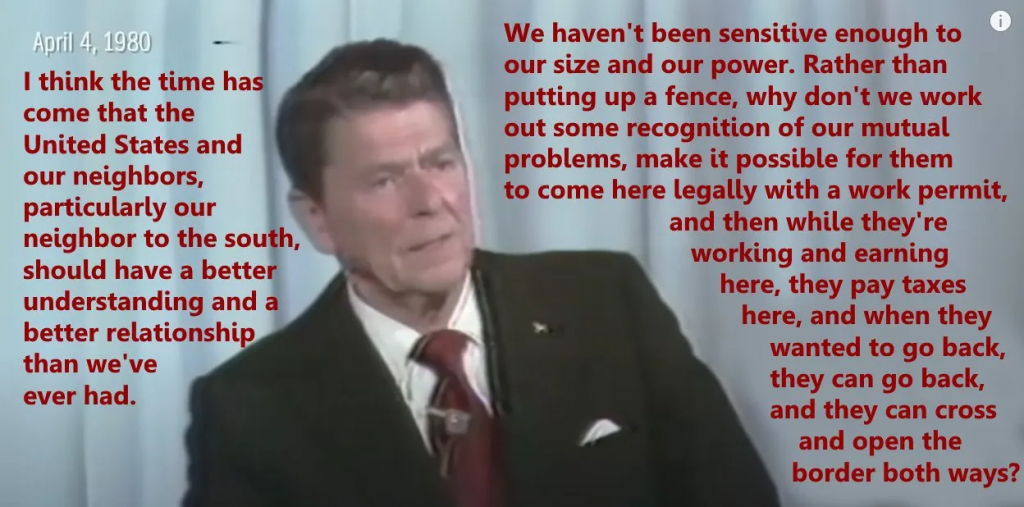
Yup, you can see it on Youtube— in 1980, Reagan and Bush had an actual face-off, at a debate hosted by the League of Women Voters, on who would be kinder to immigrants from the southern border.
Here’s what Reagan said:
And here’s what Bush said:
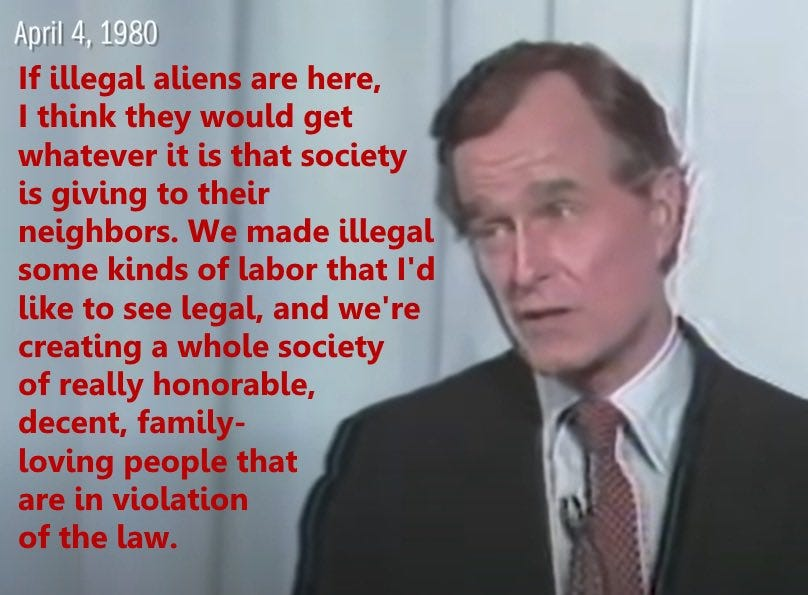
I especially like Bush’s quote here, because it gets at the arbitrariness of legality. Reminds me of an MLK quote from Letter from a Birmingham Jail:
You express a great deal of anxiety over our willingness to break law. This is certainly a legitimate concern. Since we so diligently urge people to obey the Supreme Court’s decision of 1954 outlawing segregation in the public schools, it is rather strange and paradoxical to find us consciously breaking laws. One may well ask, “How can you advocate breaking some laws and obeying others?” The answer is found in the fact that there are two types of laws: There are just laws and there are unjust laws. I would be the first to advocate obeying just laws. One has not only a legal but a moral responsibility to obey just laws. Conversely, one has a moral responsibility to disobey unjust laws.
I don’t know that immigrants have a responsibility to disobey immigration laws, but I know for a fact that obeying or disobeying immigration laws doesn’t determine whether they’re “really honorable, decent, family-loving” people. (Much less “the worst of the worst.”)
And pretending otherwise, in order to justify “committing acts dangerous to human life that are a violation of the criminal laws of the United States or of any State, appearing to be intended to intimidate or coerce a civilian population?”
Pretty sure that makes ICE the domestic terrorists.
Sicc ‘em, FBI!