Skip to content

Tardigrade parade

Tardigrade parade published on No Comments on Tardigrade parade

Why yes, I am watching Cosmos…why do you ask?

Actually I think I first time learned about extremophiles, including tardigrades, was while watching the BBC’s Blue Planet series…which I have on DVD, and have watched so many times. I’m looking forward to re-watching Cosmos too, because there are so many things to absorb that one viewing isn’t nearly enough.

I figure the the tardigrade in this parade is on a scale of about 10,000 times its normal size. It just amused me to think of blowing one up that large and using it like a Chinese dragon in a festival. Tardigrades are incredibly resilient (that’s an understatement), but they’re not the most attractive creatures out there– they look like a naked mole rat and a lamprey had a threesome with a trash bag which resulted in progeny. They are fascinating, though, because they seemingly can exist– and even thrive– anywhere. It’s amazing that the tardigrade isn’t any sports team’s mascot…at least, that I know of.  It’s definitely worthy!

How to be the creepiest nerd at the beach

How to be the creepiest nerd at the beach published on No Comments on How to be the creepiest nerd at the beach

Saw this in my email newsletter from Think Geek this morning, and…I had thoughts:

Main thought: This is creepy

The thing that creeped me out about it most is that it suggests that Princess Leia is wearing a bikini on purpose because she wants to lie on the beach and tan and look sexy or something.

I know that Star Wars fans who are all crazy about Slave Leia don’t spend much time thinking about the whole slave part of that, but…that’s kind of the point. That bikini is literally a shackle– she’s not wearing it on purpose. She’s chained to a giant alien slug who presumably has her dressed like that because it gets a thrill out of it, and…let’s not even get into whether she’s a sex slave or not, and precisely what that means.

Okay, let’s go ahead and get into it– realistically, she’s either a rape victim multiple times over or is about to become one.

That’s what “slave Leia” is celebrating.

That’s creepy.

And the degree of creepiness didn’t sink in for me fully, for whatever reason, until I saw her on a beach towel.

Silverman clarifies

Silverman clarifies published on No Comments on Silverman clarifies
sorta:

I was talking to a lot of press this week – I mean a LOT of press, and most of it hostile. When I was talking to Raw Story I gave them the same pitch I’d given so many times before: Conservatism is basically divided into two parts, fiscal conservatism, which is real conservatism, and Social conservatism, which is Christian theocracy masquerading as conservatism, with the latter holding down the former. Is [sic] the fiscals dropped the Christian social bullshit, I said, real conservatism would benefit from the influx of conservative atheists who avoid the movement due to the theocratic aspects.   I said that all of the social conservative agenda was religious in nature, to which the reporter eagerly countered that there was a secular argument for abortion. He clearly knew he was right, and so did I – there is a secular argument (one with which I firmly disagree) whose existence I cannot deny.  Rather than take the road to discussing abortion, I acquiesced to his correct counterpoint, returned to my point, and said that school prayer, LGBT equality, and Death with dignity were better examples of purely Christian positions (“it’s maybe not as clean cut as school prayer, right to die, and gay marriage”), and we went on with the discussion on why American Atheists was there.  There’s my scandal. The rest of what you may have read is reckless “positing” by people who didn’t do what you did – ask me. Thank you for being responsible.

Guilty of reckless positing, here. But in my defense, I did try to interpret correctly…

And I have my doubts about opposition to abortion being less of a “purely Christian position” than the others Silverman mentions, for reasons mentioned a couple of posts ago. But there are bigger hills to die on, and frankly I’m exhausted from climbing this one.

H/T to Shanon Nebo of Secular Sunshine.

Addendum — parsing libertarian-speak on abortion

Addendum — parsing libertarian-speak on abortion published on No Comments on Addendum — parsing libertarian-speak on abortion

Apparently part of the issue with David Silverman’s statements is that people think he brought up secular arguments against abortion out of nowhere. Trust me, he didn’t. Here’s how it works:

1. Silverman described social conservatism as theocratic, and he gave three examples of what he considers to be social conservatism: gay rights, the right to an abortion, and the right to die.
2. Silverman contrasted social conservativism with “real conservatism,” which is anti-big government.
3. Social conservatism, which is theocratic, is pro-big government because it entails opposing gay rights, the right to an abortion, and the right to die. That’s why social conservatism isn’t “real conservatism.”
4. The interviewer, Roy Edroso, challenged the notion that “the Right to Life guys” aren’t real conservatives.
5. Silverman, who thinks that social conservatism = theocratic = big government = pro-life, then replied that actually yes, secular argument against abortion do exist.

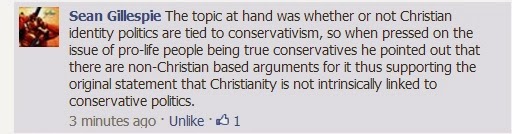
Or as Sean Gillespie put it on Facebook,

Here are the things I’m sure of:
1. Silverman was not trying to make a secular pro-life argument himself.
2. Nor was he saying that those arguments are any good.

Here’s what I’m not sure of:
1. Does Silverman then think that there’s a “real conservative” pro-life argument? That is, an argument against abortion which is not pro-big-government because it isn’t theocratic?

I dunno. But then, I have a hard time understanding what Silverman thinks is “big government,” specifically, or that he really understands what theocracy is. True theocracy is not simply trying to pass legislation which is based on religious beliefs, but literally trying to establish a religion via government. Christian Reconstructionists are theocrats. People who try to pass religion-based laws are better described as “First Amendment-resistant.” But that’s kind of splitting hairs in this discussion.

Rambling diatribe about atheism, politics, and the word “secular”

Rambling diatribe about atheism, politics, and the word “secular” published on No Comments on Rambling diatribe about atheism, politics, and the word “secular”

I don’t know American Atheists president David Silverman, but he strikes me as kind of a brash guy. The kind of person who thinks that atheist activism means pissing off religious people, and if you haven’t succeeded in that then you’re doing it wrong.

But apparently he’s now trying to get along with religious people, or at least with America’s political party most known for being religious, because he tried to get a booth for American Atheists at the Conservative Political Action Conference, or CPAC. The booth was denied, because it turns out (who knew?) that CPAC feels threatened by atheists. Silverman decided to attend the conference on his own anyway, where he was interviewed by The Raw Story’s Roy Edroso.

It’s not a long interview at all, so read the whole thing. If you do, you’ll see that Silverman initially characterized the positions that social conservatives commonly take on “gay rights, right to die, and abortion rights” as “theocratic” which means that they’re not “real conservatives” (real conservatives aren’t theocratic?) before being interrupted by Edroso, who said that the “Right to Life guys” would object to being told they aren’t real conservatives. At which point Silverman replied:

I will admit there is a secular argument against abortion. You can’t deny that it’s there, and it’s maybe not as clean cut as school prayer, right to die, and gay marriage.

 …which seems to have annoyed a few atheists into temporarily forgetting what “secular” means. At Skepchick, Sarah Moglia writes:

If by “secular argument,” you mean “a belief based on personal feelings,” then, sure, there’s a secular argument against abortion. There could be a “secular” argument against puppies, in that case. If you’re using “secular” to mean “a logical, science-based, or rational” belief, then no, there is no “secular argument” against abortion. The supposed “secular arguments” against abortion are rooted in misogyny, a lack of understanding of science, and religious overtones.

Which PZ Myers read and replied to with his own blog post entitled There’s a secular argument for wearing underpants on your head. So?  in which he says “I’m trying to figure out what this secular argument is.”

Really? Actually there are a lot of secular arguments against abortion. They include, among others:

  • A fetus is a human. It’s wrong to kill any human. 
  • A fetus is the property of the man whose sperm helped to create it as much as it is of the woman who carries it. Therefore no woman should be able to abort without the permission of the man who inseminated her.
  • Fetal pain
  • Abortions are expensive and hard on a woman’s body, therefore wrong. Something to be avoided if at all possible. 
Note: I didn’t say they were good arguments. 
This is because all that is required for an argument to be secular is that it not be based in religion. That’s it. It has nothing to do with “personal feelings,” which could be religious feelings just as easily as they could be non-religious, and a secular argument is by no means necessarily logical, science-based, or rational, let alone moral. So yeah, you could make a secular argument for wearing underpants on your head, which is why it’s sort of baffling not to be able to grok secular arguments against abortion. 
Something which, as we saw, Silverman only “admitted” when pressed. He clearly is not pro-life himself, so isn’t it a little odd to make a big deal about him acknowledging that secular arguments against abortion exist when he’s not even the one who brought it up? 
Maybe not too terribly odd. See, there are some other important things to consider.
The first is that of course, arguments that are phrased to be secular often come from non-secular motivations. See, for example, the entire Intelligent Design movement. There is no shortage of people on the religious right who see the strategic advantage in trying to Lemon Test their beliefs into law and classrooms by expunging all religious terminology from it, and “Fetuses are people” is the clearest example of that when it comes to abortion. “Person” is a legal category, but the notion of fetal personhood is generally endorsed by people who think God is the one who makes people, therefore when God puts a person in a woman’s uterus she has no business trying to get rid of it. 
You don’t have to believe in souls or even God to make this argument (that is, you can put it in secular terms), but people who make this argument almost inevitably believe in God and souls. The same is true for people who argue against gay marriage by complaining that it’s an aberration of “traditional” marriage, when “tradition” is merely code for “that’s the way God wants it” (and never mind that the Bible is absolutely brimming with nontraditional marriages if that’s what “tradition” means). 
Really, what underlies this reaction to Silverman simply acknowledging that there are secular arguments against abortion is anger at him for trying to market atheism to conservatives in the first place. For being rather conservative himself, albeit not your typical conservative, and then– here’s the kicker– claiming that he’s a true  conservative whereas abortion opponents, opponents of gay marriage– social conservatives– are not. Sorry Dave, but it comes off as a little ridiculous to play No True Conservative when the people you’re saying aren’t True Conservatives (TM) just got done booting your booth from their conference because they felt threatened by you. Surely he should be reserving these comparisons for when CPAC feels threatened by pro-lifers and homophobes. That is, ironically, when it’s no longer actually very conservative at all.

The Raw Story article goes on: 

But why is this his battle? Why not let conservatives be conservatives and just vote for the candidates he likes? “Because I want a choice,” said Silverman. “I don’t get a choice at the voting booth, ever.” He describes himself as a “fiscally conservative” voter who “owns several guns. I’m a strong supporter of the military. I think fiscal responsibility is very important. I see that as pretty conservative. And I have my serious suspicions about Obama. I don’t like that he’s spying on us. I don’t like we’ve got drones killing people…” In the final analysis, “the Democrats are too liberal for me,” he says.

It’s not unusual for libertarians– which is what Silverman actually is, so far as I can tell– to talk this way. Not at all. And it’s not so much that they’re wrong per se, as completely unaware that someone listening has no idea what they’re talking about. I don’t, for example, know what the words “fiscal conservative” mean when coming from the mouth of someone who just called himself a “strong supporter of the military.” There is nothing fiscally conservative about having a defense budget larger than that of the next ten most militarily spendy countries in the world combined.

The term “fiscal conservative” is a libertarian dog whistle, or actually I suppose just a whistle because everybody knows that’s what it means. Is supposed to mean. The problem, of course, is that nobody who calls him or herself a fiscal conservative actually is one, which makes it an even more aggravating theft of terminology than Republicans claiming ownership of the word “family.” Liberals don’t speak up about this more often because they don’t believe that government spending is bad by default and taxation is theft (nor should they; that’s quite sensible of them), but they also recognize that when someone calls him/herself a fiscal conservative what he/she generally means is that he/she is anti-welfare. Anti-government spending, when it might help out minorities, women, and the poor. And liberals don’t think it’s so gosh darned important to be fiscally conservative in the first place, so they rarely point out that ending the drug war, legalizing sex work, cutting back on the military campaigning, even giving out birth control for free (literally, as opposed to mandating that health insurance cover it), you know, the things that make conservatives scream? Would actually save the government boatloads of cash.

The existence of libertarian atheists is, you might say, vexing to liberal atheists. It’s vexing to me as well because libertarians are often morons, prone to doing things like complaining that a sexual harassment policy for a skeptical/atheist conference is a violation of their rights, said rights apparently entailing the freedom to be a sexist boor at a conference without repercussions. Discussions about topics like sexual harassment shouldn’t have to begin with explaining, for the 9,000th time, what’s wrong with sexual harassment in the first place, or how freedom of speech doesn’t apply to private venues where other people have spent good money to get together and exchange ideas and “Sleep with me or you’re a bitch” is not generally one of the ideas they have in mind.

So I can absolutely– totally– understand why someone who has worked for years to connect skeptical/atheist activism with social justice issues, actually improve the world instead of sitting around arguing about whether God does or doesn’t exist, would be infuriated by the notion of the president of American Atheists trying to, in effect, pour some white paint into the enormous black pool of “theocracy” that Silverman even acknowledges is “holding down” a brand of political conservatism that doesn’t involve stepping all over minorities and the poor and taking ownership of their reproductive capacities (since I seriously mixed metaphors there, just imagine the black pool holding things down is the goop that killed Tasha Yar in TNG).

However, differences of political opinion amongst atheists and skeptics also makes me very happy, because it forces us to confront some often inconvenient facts. Like the fact that “secular” only means “without a religious basis.” Like the fact that being right about some very important things does not make you right about everything, and conversely that being very wrong about some things doesn’t make you wrong about others. Like the fact that when you find yourself on the same side as someone you normally disagree with, there’s nothing wrong with acknowledging that and counting them as an ally to the extent that they’re willing to be one. Like that refusing to do this comes off as petulant and tribalistic, because it often is.

I want everyone who claims to be skeptical to actually be  skeptical. To make good arguments. To be civil, analytical, and willing to work together for the greater good. Needless to say, I don’t always get what I want. But come on, people…we can do better than this.


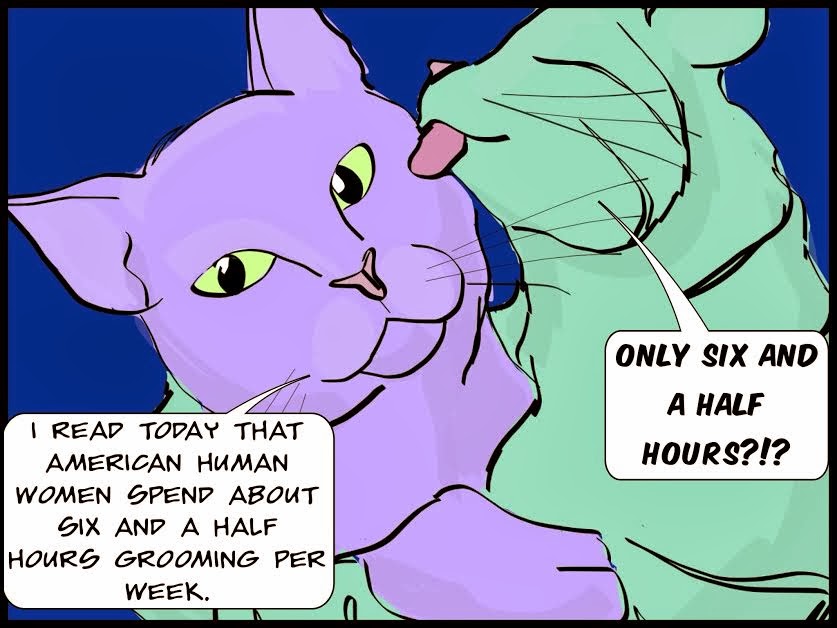
Cats discussing women grooming

Cats discussing women grooming published on No Comments on Cats discussing women grooming

Inspired by: http://www.today.com/health/stop-obsessing-women-waste-2-weeks-year-their-appearance-today-2D12104866

The original headline on NBC’s Today web site is still in the url, though the current headline no longer says that women “waste” this time on their appearances and rather than they “spend” the time, because presumably the former word sounded a tad too judgmental. Although the headline does still instruct us to “stop obsessing” over how we look, without really defining what counts as obsession. While I probably “waste” significantly less time per week on my appearance than that, I find Today’s framing of the issue rather problematic.

It’s written as though “obsessing” over our looks is something women just came up with and are wholly responsible for, and that it’s completely without justification. Just something some wacky women do, and we really should cut it out because it’s bad for our health, you know? After all, it’s not like to be a woman is to be judged on your appearance on a daily basis or anything.

They do quote one possible outside source for this “obsession”:

“We are constantly confronted with images,” said Ann Kearney-Cooke, director of the Cincinnati Psychotherapy Institute, who helped develop some of the questions on the TODAY/AOL survey. “It’s nonstop – you can sit on the subway, or anywhere, and you can also then be looking at this. And the ideals are totally unrealistic.”

Disregard that their chosen expert is a psychotherapist, if you can, and think about where these images where their unrealistic ideals are. It’s “nonstop,” which means it’s everywhere you look, in all kinds of media, in commercials and print ads, movies, and TV shows, including…..on NBC? Yes, I think so.

Their suggestions for overcoming our “obsession” with our appearance:
1. Distract yourself.
2. Accept yourself.

Yep, that’s it. Because those are things you can just decide to do, right?  And it’s up to you to stop worrying about how you look, because we’re sure not going to stop suggesting you should!

Cats discussing gay recruitment

Cats discussing gay recruitment published on No Comments on Cats discussing gay recruitment

Tropey criticisms of Tropes vs. Women

Tropey criticisms of Tropes vs. Women published on No Comments on Tropey criticisms of Tropes vs. Women

I am a blogger but not a vlogger, and the video below might be a good reason why.

I decided to make a video reply to Ashley Paramore aka healthyaddict on Youtube regarding her criticisms of Anita Sarkeesian’s video series Tropes vs. Women (sexism in video games, yanno). Ashley’s video here; mine here:

Edited to add: If you want to hear more about video games, agency in video games (and in general) and my thoughts on the first Tropes vs. Women video please read

Thoughts on the first Tropes vs. Women video

Repost: Equality worth working for

Repost: Equality worth working for published on No Comments on Repost: Equality worth working for

I have a dream that one day this nation will rise up and live out the true meaning of its creed: “We hold these truths to be self-evident: that all men are created equal.”  — Martin Luther King, Jr.

The true meaning, mind you– not merely what is reflected in the law, but in how we see each other.  How we evaluate each other’s worth, respectability, humanity.  Not by the color of each other’s skin, but the content of our characters.  That, in turn, will reveal our collective character.  

Dr. King’s foundation for his beliefs was unquestionably in his faith.  Being a Baptist minister, that is where he found his strength: “I have a dream that one day every valley shall be exalted, every hill and mountain shall be made low, the rough places will be made plain, and the crooked places will be made straight, and the glory of the Lord shall be revealed, and all flesh shall see it together.”  For him, the glory of the Lord could only be revealed when people of different colors could love and value each other as equals.  Jennifer Sanborn writes:

You see, for me, the Rev. Dr. Martin Luther King, Jr. is first and foremost a Baptist minister, and a child of the same. I imagine it is because I am also the child of a Baptist pastor (and grandchild of two others) that I take particular pride in placing “the Reverend” at the start of his name. “Reverend” is a title that he earned with his education and his occupation, but also a title to which he was called, bringing unparalleled dignity and relevance to what it means to serve society as a religious leader.

I’m sure many people feel similarly, now as well as when MLK originally gave that iconic speech, which was essentially a sermon to America on the meaning of loving one’s fellow man.  As a non-believer I find no conflict in welcoming that sermon, and only a slight bit of discomfort in wondering how he would have responded if asked whether atheists would be included in the pluralistic group exhorted to “sing in the words of the old Negro spiritual, ‘Free at last! free at last! thank God Almighty, we are free at last!'”  I won’t remotely pretend, however, that there is any comparing the lot of atheists to that of black Americans in 1963.  That isn’t the point.  The point is, from whence is a committment to equality derived for those who don’t believe it was God-given?

It would be a fair bet to say that prejudice almost always precedes rationalization, whatever that rationalization is.  I’m pretty sure that human nature, perhaps ironically, includes both the justification for equality as well as the explanation for why humans are so prone to denying it.  And that is because of two salient facts:

1. Both science and religion have, at many points and many places in history, been used to rationalize bigotry. 
2. And yet, neither one has ever or will ever come up with a good reason to treat people unequally.  

If either of the above points seems at all contentious, remember that the numerous mentions of slavery in the Bible were used as a  primary reason to believe that black slavery was part of God’s divine order in the South, as well as the legacy of Spencerian “social Darwinism” which maintained that certain races were inherently inferior.  After all, if it weren’t so, why were they doing so poorly?  Why were they so easily conquered and used for the purposes of the more powerful white Europeans and Americans, if not because they are inherently inferior by evolution or design, whichever your preference? 

I’m still in the midst of my very long quest to discover what exactly human nature is, anyway, but the revelation of the above facts in my life can be attributed primarily to the cognitive psychologist Steven Pinker around 2004.  You see, after (and before) publishing a book called The Blank Slate which used powerful data from experimental psychology to demolish both the idea that there is no such thing as human nature as well as various myths about exactly what that nature is, Pinker and every other psychologist who uses evolution as a means to explain why humans behave as we do has been hounded by accusations that their work will be used to justify prejudice. 

And you know what? That’s exactly what has happened.  And it still happens.  People think that if they can show differences between the psychology of men and women, homosexuals and heterosexuals, blacks and whites, they will be able to show that treating any one or more of those groups as inherently less human is justified.  I really don’t want to get into all of the specific attempts to show that, because it would take away from the fundamental point that there’s nothing we can discover about a specific group of humans that would justify, for example, slavery.  Nothing that would justify physical or cultural genocide, rape, internment, disenfranchisement.  And that is because the humanity of humanity doesn’t need to be determined by conducting some elaborate experiment– it is literally standing right before us. 

I believe that tribalism is instinctive– that people find an element of safety in clinging tightly to those who are like themselves.  They will certainly base that in-group/out-group association on ideology, but it’s even easier to base it on traits that are evident at a glance.  Familiarity and similarity are the primary triggers for empathy, which means that strangers and people not like us are the “best” enemies.  And that is why, again and again throughout our history, we have been able to deny the humanity of certain groups of people in order to persecute them.  Not by knowing them, looking them in the face, having a conversation…because that would demonstrate that they’re more like us than we thought. 

I suppose that’s where I find my fundamental belief in equality– the abject failure, despite our best and most heart-felt efforts, to show that any class of humans really doesn’t deserve the label of “human.”  Martin Luther King Jr. managed to punch through that barrier of prejudice for so many people because he emphasized how much we have in common, how similar we are fundamentally, and how different life could be if we were just willing to encounter each other as fellow human beings, fairly and honestly.  That’s why his speech had and continues to have such a tremendous impact, and why we continue working to make his dreams come true.

*This post first posted Monday, Jan. 17, 2011

Further adventures in learning to draw using layers — Blackbeard

Further adventures in learning to draw using layers — Blackbeard published on No Comments on Further adventures in learning to draw using layers — Blackbeard

Blackbeard is based on this image, apparently an entrant in a contest to be a card in Brain Vessel’s Kickstarter project to make a deck of Seven Seas Playing Cards. I saw it on Justin Robert Young’s Facebook page and had to draw it.