Skip to content

Canon fodder

Canon fodder published on No Comments on Canon fodder
The cocktail waitresses of Star Trek (2009)

So I was watching the 2009 film Star Trek, which annoyingly has no subtitle. No Nemesis, no Insurrection, no Into Darkness, no Into the Woods, nothing. So it will forever be known, to me at least, as “the 2009 Star Trek,” which is unfortunate given that it’s a decent film and immediately precedes Into Darkness, currently in theaters, which gets its own subtitle. Maybe they realized they messed up with the previous one? I don’t know.

Anyway, I watched it and couldn’t help but notice all of the female Star Fleet extras running around (literally, in more than one case because their ship was in danger of being destroyed) in those mini dresses and go go boots that the women wore in the original series, their hair more often than not up in what I guess was supposed to be a futuristic version of the beehive-like updos worn in TOS, a sort of vertical topknot, an oblong bun which sticks straight out of the tops of their heads. The choice to outfit them this way was presumably made in deference to the original garb that female officers wore in TOS, and to the reasoning it embodied, which– one can only guess– was so that nobody would accidentally take them seriously.

I watched this and thought about a recent blog post by Felicia Day on Into Darkness, discussing how it has no strong female characters. How even in instances where the leaders of the free galaxy, the decision-makers, were getting together and figuring out what to do, there were few women, especially appropriately aged women (you know, prime minister age or thereabouts) amongst them, and how weird and disappointing that was. Though Day doesn’t specifically mention the gratuitous underwear scene with Alice Eve for which screenwriter Damon Lindelof confusingly apologized (confusing because you don’t exactly trip and accidentally insert scenes like that into a script), she says

I kept waiting for her turn, waiting for her to not be the victim, to be a bit cleverer, to add to the equation in a “yeah you go girl” way but no, she was there to be sufficiently sexy that Kirk would acknowledge her existence, to be pretty, to serve the plot. I loved her bob. That’s it. What if she had been a less attractive woman, older, overweight? A tomboy? Wouldn’t have that been a tad more interesting choice? Or at least give her a moment where she’s not a princess waiting to be saved. From a director who is so amazing, who created wonderful female characters in Alias and Felicity, I was super bummed by this. A woman character CAN exist without having to be sexually desired by the guy. Oh, and she doesn’t have to be a lesbian either, OMG WHAT A SURPRISING IDEA!

Responses have ranged from the reasonable to the ridiculous on both the original Tumblr post and on her Facebook wall when she linked to it. It’s important to point out here that by “ridiculous,” I’m not referring to any comment which simply differed either with facts or the intent of Day’s post, or both. I’m referring to the kind of comment typical of any feminist critique of popular culture, which is some combination of “If it ain’t broke, don’t fix it” and “You’re just jealous,” or worse. Sometimes much, much worse.

There were plenty of people who agreed with Day that a) there are no strong female characters in Into Darkness (which, full disclosure, I haven’t seen….yet. That’s why I was re-watching the 2009 movie), and b) given the futuristic setting of the Star Trek universe where the Federation has been depicted as an egalitarian organization, it doesn’t make sense to portray events as though there are no women in charge of anything who possess formidable skills and commit acts of bravery and cunning with more or less the frequency that men do, and even with c) Day’s larger point that “it’s time to invent some new cliches” where women are concerned. There are people who agreed with all of these things, and yet ultimately disagreed with Day’s claim that this spoke poorly of the movie as a whole (which, incidentally, she says she enjoyed very much).
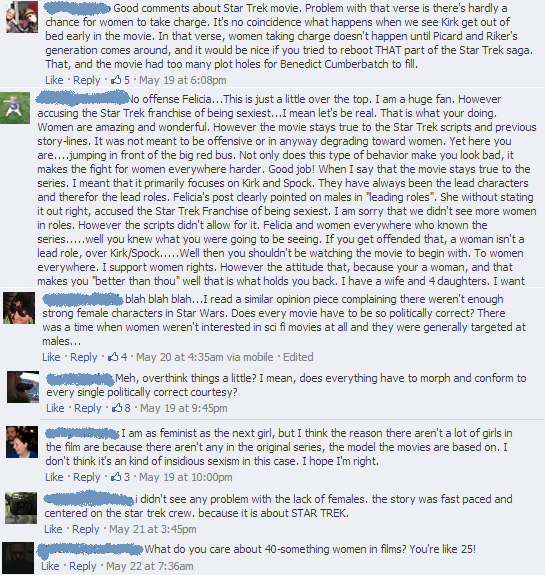
A sampling of replies 

Why do they disagree? Because of canon.

Because Kirk is notoriously a womanizer, so it makes sense to depict him womanizing.
Because in the original series of Star Trek (referred to as TOS, for…the original series), the stories told revolved mainly around men doing things, men like Kirk and Spock and Scotty and Bones and Sulu.

Even though the 2009 movie and this current one are reboots and have changed a lot of things, they cannot and should not change the fact that the story is not about women and their interests, so if you’re interested in that kind of story, find a different science fiction franchise already. One that didn’t originate in 1966. These are the stories we’ve committed to, and by golly we’ll be damned if they’re going to be changed! At least to be less overtly sexist, anyway– other things such as chronology or location of events and the circumstances of different characters dying or not dying, as the case may be, you can change and we’ll grudgingly accept it. But don’t take away our sexist stories, because we’ll have nothing left!  If you want strong women, go watch Xena: Warrior Princess or something, and leave TOS alone!

…they said. Basically.

In response to this position– that the absence of strong female characters in Into Darkness (or, for that matter, the 2009 Star Trek) is a feature; not a bug, because it’s simply the movie being true to canon– I have a few thoughts.

The first is that I can see the point of this objection. In spite of being reboots, these two movies resurrect very old stories from TOS and splice them together with a modernized perspective. If too many changes were made, the stories would not even be recognizable and they would simply be about a group of people with familiar names in a familiar-but-new setting doing completely unfamiliar things, in which case it might as well not even be the Star Trek universe.

However, this brings up all kinds of questions about what aspects of canon must be adhered to and why, in order to preserve the familiar setting and cast but also tell a story which isn’t identical to one the audience has already been told (in which case the movies would not be reboots but remakes, which is a different beast altogether). Of all of the things preserved for the new, 2009/2013 versions of stories originally told decades earlier, must one of them be the male-centric nature of those stories? And regardless of your answer to the previous question, would it really be worse to modify the story to make it less sexist, or to invent a new one?

This is especially relevant to ask when we’re talking about the Star Trek universe, given that this universe depicts a futuristic existence where human civilization has presumably progressed to the point that bigotry is no longer much of a thing, right? It’s inevitable that people who are trying to tell stories about future human civilizations which have progressed far beyond their own, will still project on those people their own prejudices and general small mindedness without even realizing it– so even as they’re giving people of the future things like teleportation and food synthesization, they’re still going to make those people reflect whatever backwards inclinations are common in the time of the writers– or rather, in the writers themselves. It’s pretty much ubiquitous in any movie or TV show which takes place hundreds of years from when it’s written. We just can’t help but think about how people might think in the future– especially a utopian rather than dystopian image of the future– by relying on how people think now. Then, when that actual year finally comes along, people can watch your movie or TV show (assuming they remember it exists) again and laugh their asses off.

But in this case it’s a little different. In this case, we’re talking about putting our own current spin on the stories that were previously told about those futuristic civilizations and yet not questioning, in fact transferring verbatim, much of the prejudices of that bygone era. Prejudices which don’t even apply to our own societies in some parts of the world (where female leaders are common), let alone a society in the year 2233. Isn’t it weird that we’d take an old depiction of a futuristic society and decide to re-depict it, and in doing so deliberately not make corrections which would render the depiction more realistically futuristic?  It’s as if someone had actually invented a teleporter which is both different from, and functions better than, the ones depicted in old episodes and movies based on TOS, but we went right on making new movies which showed people moving from one place to another by standing on a little circle and becoming fuzzy until they vanish. Because after all, that’s canon. You can’t change the story.

If that’s really the case, though…that story is boring and you shouldn’t expect people who are represented poorly (or not at all) in it to be interested. They may be, but you shouldn’t count on it.

There, I said it.

Yeah, yeah, I know– there’s no shortage of people who simply don’t care if women and minorities are interested in the movies and TV they love. You could keep right on making movies and TV shows based on comics, science fiction, or fantasy which cater to the interests of white male geeks only, and plenty of white male geeks would be just fine with that. Some of these people even react to complaints like Day’s by acting as if she wants to take over Star Trek– or Star Wars, or Doctor Who, or movies based on Marvel comics, or any other franchise which keeps churning out geek fodder– and make it all about women. Put women in charge of everything! No, that is not what she’s saying. That’s not what I’m saying, and it’s not what any feminist critique of these things that I’ve ever seen has been saying.

I’m saying that if you’re going to tell girls and women that it’s cool to be a nerd, you should also give them better reasons to be.

That is not at all a knock at Wil Wheaton, who is speaking in the video at that link– he’s actively doing this, in addition to giving that excellent speech. Felicia Day is actively doing it, by creating the Geek & Sundry channel on Youtube. She’s also asking where all of the women are, and she’s not the only one doing that. According to a recent article in the LA Times, appropriately titled Where have all the women gone in movies?,

Despite the success of recent female-driven movies such as “Bridesmaids” and the “Hunger Games” and “Twilight” series, female representation in popular movies is at its lowest level in five years, according to a study being released Monday by the USC Annenberg School for Communication and Journalism. Among the 100 highest-grossing movies at the U.S. box office in 2012, the study reported, 28.4% of speaking characters were female. That’s a drop from 32.8% three years ago, and a number that has stayed relatively stagnant despite increased research attention to the topic and several high-profile box-office successes starring women. “There is notable consistency in the number of females on-screen from year to year,” said USC researcher Marc Choueiti. “The slate of films developed and produced each year is almost formulaic — in the aggregate, female representation hardly changed at all.” When they are on-screen, 31.6% of women are shown wearing sexually revealing clothing, the highest percentage in the five years the USC researchers have been studying the issue.
For teen girls, the number who are provocatively dressed is even higher: 56.6% of teen girl characters in 2012 movies wore sexy clothes, an increase of 20% since 2009. The USC researchers said these trends persist because those working in Hollywood believe attracting a male audience is the key ingredient to box office success.

Well gosh, I guess I have some questions for “those working in Hollywood” then. Such as:

  • Do you think women also go to movies?
  • Do you think men will stop going to movies if they feature strong female characters, and the number of women who see them will be unaffected? In other words, do you think both groups only want to see men doing things, and women serving as eye candy or simply absent? 
  • Do you think that movie-goers are actually more sexist now than they used to be, and are continuing in that trend? Or is there just more money to be made in assuming they are? And in the end, what’s the difference?

Returning to science fiction/comic/fantasy movies specifically, there are so many movies in those genres which are either out currently, or coming up in the next couple of years, that geeks are downright giddy. The Wolverine. Iron Man 3. Man of Steel. Pacific Rim. Ender’s Game. Thor: The Dark World. The Avengers 2. Captain America: The Winter Soldier. The Amazing Spider-Man 2. Ninja Turtles. More Transformers, more Expendables, more X-Men, and so on. It’s a great time to be a geek– if you’re a straight white male geek, or don’t mind taking part in stories told mainly for and about same. And actually there are a lot of people in that latter category– there have to be, don’t they? Because the alternative is to just not watch the movies.

But geek movies have a woman and minority problem, and they have it because canon is considered so important.

Because geeks are so often gratified when something is just the same as it was when originally depicted in the  comic book/regular book it came from, and prone to throwing tantrums (AKA “nerd rage”) when it’s different. And the origins of the stories which formed these canons are old– sometimes very old. Given how quickly social contexts change, “very old” in this case could be any time before 1980. If the canon of your franchise of choice formed prior to that point– and most of the popular ones do, from Superman to Star Wars– it’s probably going to be sexist. At that point you have to stop denying it, and start figuring out what to do about it. Is preserving the canon more important than telling stories which include women and minorities as something other than bit parts and scenery? As actors– and by that I mean, people who act, rather than being acted upon?

And by “canon,” I know I’m not referring to every last detail of a franchise story. An aspect of the story is considered canonical or noncanonical based on how important it’s considered, how story-altering it would be to change. Yes, I know. I also know perceptions of what should be considered canonical tend to differ. Is Johnny Storm‘s race canonical, or not? How about Nick Fury‘s? Is Spider-Man’s web-shooting ability naturally derived or an invention? These are questions a lot of comic book geeks actually have opinions about, and those opinions are based loosely on two different factors: 1) whether there’s precedent you can point to in the comics, and 2) how cool the particular geek you’re talking to thinks the different options are. Degree of badassery has a remarkable effect on people’s concerns about canon– see, for example, every superhero costume which made a dramatic change from brightly-colored spandex to metallic and/or black armor upon arriving in a movie post….oh, probably 1989’s Batman. Some costumes just can’t be translated directly to real-world garb without looking ridiculous rather than menacing to our eyes. That fact might not change, but it should be clear by this point that what impresses us does, has, and will.

You could change the characters, along with the costumes.
And if that’s too disturbing to consider, why not come up with and/or use some new stories?

I actually don’t really care which route movie makers choose– either one could be amazing. And both have actually been done and continue to be done, over and over….just not in women’s favor. The movies I listed as coming out in the next couple of years are noticeably lacking in strong female characters. Just men saving the world and the girl, over and over, for the most part.

It doesn’t have to be that way. So why not change?
Give us women…and make them badass. I hear geeks are into that.

A-baby-ist.

A-baby-ist. published on 1 Comment on A-baby-ist.
Niall Ferguson

So, just as I’m finishing reading comedian Jen Kirkman’s book I Can Barely Take Care of Myself: Tales From a Happy Life Without Kids, historian Niall Ferguson goes and claims that people who don’t have children don’t care about society or the future. Or at least, he claims that about economist John Maynard Keynes, while suggesting that Keynes was gay:

Speaking at the Tenth Annual Altegris Conference in Carlsbad, Calif., in front of a group of more than 500 financial advisors and investors, Ferguson responded to a question about Keynes’ famous philosophy of self-interest versus the economic philosophy of Edmund Burke, who believed there was a social contract among the living, as well as the dead. Ferguson asked the audience how many children Keynes had. He explained that Keynes had none because he was a homosexual and was married to a ballerina, with whom he likely talked of “poetry” rather than procreated. The audience went quiet at the remark. Some attendees later said they found the remarks offensive. It gets worse. Ferguson, who is the Laurence A. Tisch Professor of History at Harvard University, and author of The Great Degeneration: How Institutions Decay and Economies Die, says it’s only logical that Keynes would take this selfish worldview because he was an “effete” member of society. Apparently, in Ferguson’s world, if you are gay or childless, you cannot care about future generations nor society.

That was on May 2nd. For two days the blogosphere discussed whether Ferguson is a homophobe, and on May 4th he apologized— kind of. He went to great lengths to disavow any possible homophobia, including suggesting that it would be impossible for him to be homophobic since he’d asked Andrew Sullivan to be godfather to one of his sons. The reader is treated to a lecture on how absurd and idiotic it would be to think that Ferguson of all people might harbor any bigotry toward homosexuals, as well as the fact that Keynes himself was not immune to such, being somewhat xenophobic toward Poles and Americans. Which is relevant because…I’ve no clue. The apology ends with a flourish of snark so abrupt it threatens rhetorical whiplash:

Shock, horror: Even the mighty Keynes occasionally said stupid things. Most professors do. And—let’s face it—so do most students. What the self-appointed speech police of the blogosphere forget is that to err occasionally is an integral part of the learning process. And one of the things I learnt from my stupidity last week is that those who seek to demonize error, rather than forgive it, are among the most insidious enemies of academic freedom.

Be warned! All who took offense to Ferguson’s remarks and fail to accept his apology given here are forthwith declared members of the self-appointed speech police of the blogosphere and enemies of academic freedom! Criticism is censorship! Free speech! The ability to speak one’s mind openly is in peril when people object too stridently to illogical and offensive smearing of widely respected economists! Geez, you’d think he was a comedian who made a rape joke.

And one common theme that exists in both Ferguson’s “apology” and the reactions of people who took exception to his remarks is this: the emphasis on homophobia. Being anti-gay is wrong. Nobody should suggest that gay people are selfish, impetuous, nihilistic, or otherwise deficient in character in any way because they are gay, say the detractors. I didn’t mean to suggest that, don’t believe it, and don’t attack me too much for accidentally claiming it or else you’re the speech police, says Ferguson.

Okay…but how about what he suggested about the childless?

Ferguson remarked on the added stupidity to his comments arising from the fact that Keynes’ wife did actually get pregnant but suffered a miscarriage, implying that it’s underhanded to criticize that particular couple for not having children because at least they apparently tried, and it would amount to pouring salt on the wounds of someone who has lost the baby they hoped for to claim that no such hope ever existed. Which, indeed, it would be…although considering that Keynes died in 1946 and his wife Lydia Lopokova in 1981, it’s safe to say that those wounds have long since scabbed over. More fundamental to the point, however, is the fact that Ferguson’s characterization of Keynes as selfish and shortsighted due to not being a parent is equally a catastrophic failure of logic and fairness whether he and his wife had attempted to procreate or not. This is because not only does not having children count as character flaw; neither does not wanting them.

Childless by choice, otherwise known as childfree, is not a bad thing to be. Really.

Jen Kirkman

I frequently make the same joke as Jen Kirkman makes in her book’s title– how could I be a parent, when I can barely take care of myself? But let’s be clear…it’s a joke. Mostly. In addition to being a quasi-memoir and thoroughly enjoyable read, Kirkman’s book tears to shreds a lot of popular misconceptions of what it’s like to not want children, as well as countering arguments– yes, arguments— people make for why you should have children, even though you don’t want to. Especially if you’re, you know, female. People without children don’t understand how precious life is. They won’t have anyone to take care of them when they’re old and infirm. They have no legacy to succeed them. They are doing a disservice to their parents and partners (who, presumably, not only want children/grandchildren themselves, but require them). They are not truly fulfilled and actualized women (not applicable to men, seemingly– they don’t tend to get this one, even from Niall Ferguson).

Along with revealing the extent and nature of homophobia in the United States, the culture war over gay marriage has revealed a lot of other kinds of prejudice and narrow-mindedness that tend to overlap with it. They’re like a Darwinian tree of bigotry, the root of which is basic sexism. From that root sprout a seemingly infinite array of stringent and ingrained beliefs about what men and women should do, say, and in general be, and one of the things they should be is parents. With a person of the opposite sex. Naturally. That is, by a combination of the man’s sperm and the woman’s egg achieved via sexual intercouse within the context of marriage, probably in the missionary position with the lights off. Not artificially, whether by adoption or in vitro, not outside of marriage, not with a partner who has the same type of genitals you do, and absolutely, positively, not not at all!

It’s sort of like atheism, in that a religious person would prefer that you be of the exact same religion that they are (after all, their belief is the Truth with a capital T)…but they can deal if you’re, say, of another denomination. Methodists can get along with Presbyterians when they need to get things done. And hey, when it comes right down to it, if you at least agree on a lot of traditions and have a similar basic history underlying your respective belief systems…okay, Protestants can get along with Catholics. And then, well, you know, in the spirit of ecumenicalism, they can also manage to get along with Jews and maybe even Muslims. And then, hey, I guess if we’re going to try and all be on the same page, in the end what matters is that we all worship God, right? In our own ways, but everyone has a different path up the mountain and what matters is that you get there.

But wait….you don’t even believe in God?
You don’t even want children? 

The brain seems to short-circuit here, as in a conversation Kirkman recounts having had at a wedding with someone she’d just met:

“I know you’re not even married yet,” Lucy lectured, “but at your age, you have to think about making a family while you’re planning the wedding.” Five minutes ago I was too young to know that I was going to change my mind and suddenly I’m too old to waste any time after my wedding to plan on making a family? Which age bracket am I in? Young and stupid or old and barren? And “making a family” is another expression that grosses me out. I pictured Matt standing over me in a lab coat with a turkey baster. Lucy took a big sip of her red win, wiped her lip, and leaned into me. She may have been a little drunk or a little dehydrated or a little both, because she had that dry “wine lip” that looks like someone poured purple paint into the cracks of a sidewalk. She leaned in close and whispered, “What would you do if you accidentally got pregnant?” I didn’t even understand the question. “Oh, I would never cheat on Matt,” I answered. “No, Jen, I mean what if you got pregnant, by accident, with Matt’s baby?” “Are you asking me, someone you barely know, at our friends’ wedding, if I would have an abortion?” “Well,” she said, “it’s something you have to think about if you don’t want kids. I mean, I personally think that abortion is something for teenagers who couldn’t possibly raise a child. But ever since I decided that I wanted to try to become a mother and I see how difficult it can be to get pregnant, I realize that it’s a gift to be pregnant and if a married couple who are both employed accidentally get pregnant, I don’t see how you can give that up.”  A total stranger tried to small-talk me about abortion. I have never had an abortion. I never want to have an abortion. I also don’t want to have a baby. 

And trust me…we’ve thought about it. We’ve heard all about how Jesus wants to be our lord and savior how great parenting can be, how fulfilling, how important, how necessary. And by “necessary,” I mean we’ve heard about how it’s necessary for everyone who is capable of procreating, especially the rational and intelligent ones, to partner up and make some babies already, for the sake of the human race!

But really…we don’t. We have our reasons. And it’s okay.

Why do we laugh at sexist jokes?

Why do we laugh at sexist jokes? published on 1 Comment on Why do we laugh at sexist jokes?
Post about stereotyping, cliche
thinking gets stereotyped,
cliched image

Let’s say you view love as a battlefield. Okay, more like a football field. Dating, sex, relationships, marriage– they’re all a series of skirmishes against the other team, aka the opposite sex. You compete with others on your own team as well, fellow Men players and Women players, but when push comes to shove it’s really your team against their team. When you get together with fellow teammates, you make fun of the other team with abandon. Sometimes you even do it in their presence. It’s expected; it’s normal– why wouldn’t both sides of a rivalry do that? And hey, it’s all in good fun. More or less. Because after all, you’re going to be playing on this field for your entire life. You will never stop playing, and neither will they. As a straight person, that’s what you’re expected to do– it’s all you can do. Right?

That’s what you’d call an adversarial model of sex and relationships– a zero-sum game, in which men and women are two sides in a conflict, each trying to get what they want from the other. Generally speaking, according to this model what men are trying to get is sex with the hottest women possible (and eventually marriage with the most virginal) while women are trying to get married to the wealthiest, most high-status men, and the behavior of both sexes can be read as performed in pursuit of this goal. Both the “is” and the “ought” here are taken as a given, and since the goals of men and women generally differ, they are eternally at odds with each other and can be expected to engage in various forms of manipulation in order to get what they want. Sure, at times this will result in love– but never complete trust, because the goals remain different even though they overlap. You’re in competition amongst (straight) people of your own sex because you all want the same thing, and also with people of the opposite sex because they also all want the same thing, and they want it from you. Hopefully.

If you don’t view relationships this way yourself, you probably know people who do. When there aren’t members of the opposite sex around they’ll talk about how crazy women are, or how stupid men are, secure in the belief that you not only won’t mind but will actually appreciate these comments, because after all you’re on the same team. You’re just one of the guys/gals, and we’ve got to stick together. Bros before hos, and whatever the female equivalent is. I’m pretty sure there isn’t one, or at least there isn’t an actual slogan that women employ for this mentality. We are not, however, exempt from that kind of thing.

I was thinking about this while reading Miri at Brute Reason’s excellent post discussing research on sexist humor. Her post covers studies which found a correlation between appreciation of sexist jokes and permissive attitudes toward sexual assault and rape, and it’s a must-read. The most interesting portion of it to me, however, was this:

Men who found the jokes funny also tended to score higher on a measure of adversarial sexual beliefs, which is basically the idea that men and women are “adversaries” in the game of love and that women will deceive and manipulate men to get what they want (therefore it’s also a measure of good ol’ sexism). The study had female participants, too, and for them, the degree to which they enjoyed the sexist jokes was also correlated with their endorsement of adversarial sexual beliefs, but not with their self-reported likelihood to rape or any measure of aggression.

It actually hadn’t occurred to me that if you’re one of these people– male or female– who views sex and love in adversarial terms, you’re not only likely to likely to appreciate sexist jokes, but likely to appreciate (or at least not be offended by) sexist jokes against your own gender. That is, if you go through life assuming that people of the opposite sex are in some sense the enemy, trying to manipulate members of your sex into getting what they want, you’re not likely to be surprised when they make jokes at your gender’s expense. In fact you’d expect this, because it’s not like you can have a battle with only one side fighting, can you? It’s all in good fun to trash people of the opposite sex because a) it’s so true (that’s why we’re laughing), and b) hey, they do it too.

Now, the studies Miri discusses weren’t conducted to examine adversarial thinking in relationship to sexist jokes specifically, so I’m extrapolating from this. But I would hazard to guess that if the jokes told had been sexist toward men rather than toward women, the men wouldn’t have been terribly bothered and might well have laughed, again in correlation with the extent to which they think in adversarial terms. And this makes quite a bit of sense when you consider that a lot of the jokes which poke fun at people based on their sex do so in both directions. It’s staggering to think about how many comedians have built their entire careers trading on such stereotypes, male and female, and they’re usually at least implying some not-so-flattering things about their own gender while appearing to attack the other. Often unintentionally, but still they are.

So if this is all true, it gives you something to think about when, for example, discussing why a woman would laugh at Seth McFarlane’s “We Saw Your Boobs” song at the Oscars. That song celebrated adversarial thinking, without a doubt. And when a public figure makes a joke, song, commercial, speech….really any sort of performance that transmits a message which turns out to offend people, the first thing those who enjoyed/agree with it do is find examples of people the performance supposedly mocked, hold them up, and say “Look at this– we found a woman/person of color/homosexual/citizen of that country/member of that religion who thinks it’s funny/true! Therefore it’s not offensive!” Every. Single. Time.

In the case of sexism, maybe this is the explanation for why. Not because the joke isn’t sexist, but because they share a mindset with the person making the joke which permits them to enjoy it along with them, even though it’s sexist in their direction. Because hey– it’s so true. And they do it too.

————————————–

In related news, it’s a travesty that this Kickstarter will almost certainly not be funded. If you’re interested in the general topic of offensive jokes, consider supporting it even if you don’t like this post from me. Even if you think I’m absolutely wrong– especially if you think so. Because if so, that documentary might bolster your case. 🙂

America: lousiest host ever

America: lousiest host ever published on No Comments on America: lousiest host ever

Okay, here’s the deal. How it should be.

If you’re in the United States for reasons beyond your control– that is, you didn’t decide to come here on your own, pay for it on your own, and physically get yourself here on your own– you’re entitled to the rights and responsibilities of U.S. citizenship. Additionally, if you’re in custody of the U.S. in some way or another, the same goes. If it’s a bunch of Americans who are patrolling outside the cell where you’re spending day after day, year after year, even decade after decade, you deserve the kind of rights that every native-born American, living out his or her entire life on American soil, enjoys or should enjoy (and can sue if he/she doesn’t receive). Like, you know, the right to due process.

All right? Because that’s how a civilized country behaves.

A civilized country does not act as if people from other places are inhuman because they weren’t lucky enough to burst into existence in a hospital room on American soil or haven’t yet gotten the chance to complete the lengthy, tortuous, and utterly capricious experience of becoming a naturalized citizen.

A civilized country does not capture people and lock them up for years without charge or trial, regardless of where it found them or under what circumstances. It finds the time to actually figure out what they supposedly did to merit being locked away from anyone they know or even anyone who speaks their language, officially tells them what it is, and determines whether they’re guilty of it. Then releases or punishes them accordingly.

A civilized country remembers that the tired and huddled masses yearning to breathe free are going to want to breathe its free air so long as such a thing exists. It does not respond by vacuuming all of it out and providing oxygen tanks to a selected few favored people, so that the undesirables can properly suffocate. It does not whine “They hate us for our freedoms” and proceed to eliminate those freedoms so that there’s nothing left to hate.

And a civilized country would never be so cruel, so inhuman, so devoid of any shred of empathy, that it would fight to deny the ability of people who were brought here without any intention of their own, as children, to remain in that country instead of sending them packing to go live in a location and culture that’s alien to anything they’ve ever known.

You got that, Kris Kobach?

A bit of mulling over

A bit of mulling over published on 3 Comments on A bit of mulling over

Following up on Sunday’s post, I can’t help but keep returning mentally to Dr. Darrel Ray’s talk at Skeptics of Oz last month, which you can see and hear (both are important in this case) here.

In a nutshell, the thesis of Ray’s talk (and, I assume, of his book Sex & God: How Religion Distorts Sexuality, although I haven’t read it) is that the essence of religion– in particular American Christianity– is sexual control via shaming. Shame and guilt, actually– Ray doesn’t differentiate between the two, although I find the distinction between them very important. He says that religion causes people to be filled with sexual shame to the extent that even as they grow up and live out their lives as mature, sexually active adults, they are compelled to lie about that sexuality to themselves, their friends and family, and especially their children. They lie about the fact that they masturbate. They lie about the fact that they have sex outside of marriage, whether before, during, or after. They lie about sexual attraction being a part of them that exists quite independently of the desire to create and raise children, and as such isn’t something which sprang into existence on their wedding day and exists only for the person they married.

In support of this position, Ray points to higher than average levels of divorce, pornography consumption, and teenage pregnancy in the more fundamentalist parts of the U.S. Sexual shame is the source of all this lying, he asserts, because we can’t escape from being sexual beings, and yet religious people– again, mainly American Christians– yearn to escape this aspect of our nature so badly that they are driven to simply deny it. This shame manifests itself even people who have deconverted, as a vestigial part of our moral thinking as adults, which can be observed when the more secular amongst us nevertheless engage in activities such as slut-shaming against others as well as when they turn it inward and deny their own impulses. In order to properly reject this, Ray says, we must be “secular sexuals,” embracing our own sexuality as well as that of other people– to admit publicly that we masturbate and have since we were kids, to refrain from slut-shaming and condemn those who do, and recognize that other people have their own preferences and these are their own business. In this way, we can subvert the popular assumption that sex sullies a person– particularly if she is female– and encourage education while discouraging ignorance and bigotry.
Okay, that wasn’t exactly a nutshell. Sorry.
Now, this was both a safe and audacious talk for Ray to give at a meeting like Skeptics of Oz. Audacious because those are some very strong claims– the original claim was that religion is a “sexually transmitted disease,” that religion is all about sexual control, religion is fundamentally about making people feel ashamed of their sexuality and deny it their entire lives even while dating, marrying, producing children, and in general living a typical adult sexual life. And religious people hearing this would think “No, that doesn’t remotely describe my experience.” Which, in America, for most religious people, is probably true. It’s possible that religion in America is as much about sexual control as veterinary medicine is about euthanizing peoples’ pets– a phenomenon which is a near-monopoly, but far from an all-consuming purpose. Which leads to why it was a safe talk for Ray to give at a conference for skeptics– because when it comes to conferences, “skeptic” generally entails, if not translates to, “atheist.” (See this excellent talk by Matt Dillahunty at this year’s American Atheists conference for what the distinction is, and why it’s important.)

He wasn’t likely to hear a lot of argument from the audience about religion’s role in sexual shaming and deceit– and in fact, there was none. And that is because, I feel comfortable in saying, we– not just secular, but anyone other than socially conservative Americans– are sick to death of social conservatism. And social conservatism, especially that relating to anything sexual, invariably comes with an appeal to religious sensibilities. Because this is America, Christian religious sensibilities. Abortion? God’s against it. Birth control covered by health insurance? Same. Pornography? Same. Gay rights? Same (but please don’t look at how many politicians and clergy have been caught having gay affairs). Sex outside of marriage? Same (but please don’t examine how many of us have stuck to that). Adultery? Same (but please don’t look at our divorce rates). We’re used to this, if anything but happy about it. It’s called the religious right, and it shows no sign of going away. So of course a group of secularists– sworn enemies of the religious right– are not going to speak up about a talk saying that religion (American Christianity) is, fundamentally, about sexual control.

I just think it’s overstating things. Just a tad.

To be continued.

The miseducation of Katelyn Campbell

The miseducation of Katelyn Campbell published on 1 Comment on The miseducation of Katelyn Campbell
Katelyn Campbell

Recently in West Virginia, a teenager objected to a particularly obviously problematic form of abstinence-only education. Wait, let me rephrase that– “Lying, slut-shaming diatribe” would be a better name for it. And the teenager in question, Katelyn Campbell, knew that’s what it was. She even used the word “slut-shaming,” which is just excellent. It’s like a teenager being taught to “consider the controversy” in her biology class when learning about evolution immediately saying “Intelligent Design, right? That’s really what you’re getting at. Right?” Only in this case, it’s as if Intelligent Design was the only thing being taught. And evolution was presented as a pack of lies. And students who believe in it were chastised, shamed, and told that their mothers probably hate them.

Yes, one of the things Pam Stenzel, Christian sex educator, said during her presentation was “If you take birth control, your mother probably hates you.” Other common statements in her “educational” talks include gems such as:

  • “I could look at any one of you in the eyes right now and tell if you’re going to be promiscuous.” 
  • “Ladies, you contract Chlamydia one time in your life, cure it or not, and there is about a 25 percent chance that you will be sterile for the rest of your life.” 
  • ”That drug, that hormone, that pill, that shot that this girl is taking has just made her 10 times more likely to contract a disease than if she was not taking that drug.”
  • ”Students, condoms aren’t safe. Never have been, never will be.”

And my personal favorite,

  • “if you have sex outside of one permanent monogamous – and monogamy does not mean one at a time, that means one partner who has only been with you – if you have sex outside of that context, you will pay. No one has ever had more than one partner and not paid.”
Campbell apparently knew about Stenzel and chose not to attend the assembly that she (Stenzel) would be speaking for at George Washington High School, where Campbell is a senior and student body vice president. Instead, she started speaking out about the issue and filed a complaint with the ACLU. This attracted the attention of the school’s principal, George Aulenbacher, who called Campbell into his office and proceeded to lecture and, according to Campbell, threaten her

Aulenbacher called Campbell to the principal’s office after she contacted media outlets about the assembly and said, “I am disappointed in you” and “How could you go to the press without telling me?” according to the complaint. He then allegedly threatened to call Wellesley College, where Campbell has been accepted, and tell them about her actions. “How would you feel if I called your college and told them what bad character you have and what a backstabber you are?” he said, according to the complaint.

In case you’re wondering, it’s all cool with Welleseley.

And it’s probably all cool with Katelyn Campbell as well. In addition to Wellesley issuing a public statement saying it is “delighted to welcome” her as a member of the class of 2017, people are clamoring to congratulate Campbell for her bravery and maturity in this matter. And she deserves every bit of it– she’s one of those rare high school students to whom it would even occur to consider that something like the tirade by Pam Stenzel at her school might not just be hard to sit through, not just unpleasant, not just wrong, but possibly illegal...and then actually do something about it. Become a student activist.

Jessica Ahlquist did the same thing, and endured endless harassment and threats for it. It doesn’t look Campbell is going to have the same experience, though there has been some backlash in the form of a Facebook group originating in support of her principal. Aulenbacher’s threat itself proved to hold no water, and from what I’ve read if he had been more familiar with Wellesley he should have known this himself, but the fact is…he didn’t. He thought he could intimidate a student into shutting up about her objections to an assembly, and that it would be a good idea to do so. If this is all true, he appears to be one of those public school administrators who clearly views his position as one of domination rather than education, and therefore should not be in that role. But it remains to be seen what happens there.

In the meantime, there’s so much discussion about Pam Stenzel and her message. In this instance, her visit to George Washington High School was funded by a local Christian organization called Believe in West Virginia, and probably cost between $3,500-5,000. She has a DVD called “Sex Still Has a Price Tag” which she sells to public schools for $30 a pop. She claims to speak to over 500,000 young people a year, at both public and private schools. She attended Jerry Falwell’s Liberty University, is supposedly a product of rape and then adopted (as described in her talks), and previously worked at crisis pregnancy centers (pseudo-clinics which are frequently run by pro-life groups and are known for providing pregnant women with false or misleading medical information to encourage them not to abort). The Sexuality Information and Education Council of the United States’ (SIECUS) says of Stenzel:

Pam Stenzel

Pam Stenzel was one of the first individuals that SIECUS became aware of who made a career of traveling from school to school providing abstinence-only-until-marriage assemblies and presentations. The influx of federal abstinence-only-until-marriage funding has meant that more schools are able to pay for these kinds of services (or receive them for free as part of a grant to a local community-based organization, crisis pregnancy center, or church), and Stenzel and her peers have been very popular in recent years. There is much to suggest that there is now a network of abstinence-only-until-marriage speakers that help promote each other’s work and materials.

This comes from a lengthy and comprehensive review of her “Sex Still Has a Price Tag” video, which includes several fact-checks of statements she makes concerning birth control and sexually transmitted diseases, and notes that

Pam Stenzel does not attempt to hide the fact that her performance is designed to scare young people. She begins by telling her teen audience, “If you forget everything else I told you today, and you can only remember one thing, this is what I want you to hear. If you have sex outside of one permanent monogamous—and monogamy does not mean one at a time—that means one partner who has only been with you— if you have sex outside of that context, you will pay.” The rest of the presentation hammers home this concept by telling young people exactly what form this payment may take from unintended pregnancy, to STDs, to emotional heartbreak, to death. Ms. Stenzel’s tone throughout her presentation can best be described as punitive, as though she knows that some of the teens in this world (and some members of her audience) have had or will have sex outside of her parameters, and she wants them to know that they will be punished. Moreover, by suggesting that these teens deserve punishment, Ms. Stenzel presents a world view in which virginity is the only measure of a person’s character and moral judgment, and sets up a dichotomy between those who are “good” and those who are “bad.”

The review is worth a full read, though if you’re anything like me, it will make you angry.

I can’t help but mentally compare it to the DARE program, in which I recall being told outright that consumption of any illegal drug will cause you to become immediately addicted to it, which means that all people who use illicit drugs recreationally are addicts. That’s an easily disconfirmable claim, even without consuming any such drug yourself– all one need do is observe some users of illicit drugs who are not, in fact, addicts. However, Stenzel’s “If you have more than one sexual partner, you will pay” lie is better and worse at the same time, because it’s so much more easily disconfirmable. This statement can be shown as nonsense by simply observing that practically all Americans have sex before marriage, and multiple sexual partners in their lifetimes, and yet they don’t appear to be “paying.” At least, not in any way that is causally distinct from the way in which those precious few one-partner-forever people (or, of course, the lifelong celibate) are not “paying.” As I’ve written before, waiting to have sex until you’re married doesn’t protect you from anything. And having a single sexual partner who has also had no other sex partner but yourself may protect you from STDs, but a) this describes practically no one, and b) Stenzel denies this, but condoms do work. Quite well, actually. These two facts together ruin her entire thesis. Further, the most common STD which most people get actually isn’t that bad. Most people who contract it won’t even know they have it. As SIECUS says,

In truth, the majority of HPV infections cause neither genital warts nor cervical cancer but, instead, resolve themselves spontaneously without medical intervention. Even HPV infections that cause warts can resolve without treatment. And, if young women do contract one of the strains of HPV that can cause cervical cancer, it typically takes 10–15 years once cervical cells begin to change before invasive cervical cancer develops.

So interestingly, in the process of de-stigmatizing premarital sex in response to people like Stenzel, we end up de-stigmatizing STDs as well. It’s not that STDs aren’t bad, of course, but they’re not as bad as people like Stenzel like to portray, and worst of all of course is the fact that she continually emphasizes (erroneously) how bad STDs are while also denigrating effective means of protecting against them. This is moralizing standpoint, not a fact-based standpoint. Clearly, facts are not the important thing here. You don’t tell people how to prevent house fires by telling them never to buy a house, or denying the efficacy of fire extinguishers.

In a few different places while reading about this story, I’ve seen people say that if you object to what Stenzel does, you must be fine with telling kids to have sex. You’re endorsing an “anything goes” mentality. I’m not doing anything of the sort– I know what I want teenagers to know about sex, and it isn’t “Go forth and screw without regard for the consequences.” At bare minimum, I want them to know the truth…yet I’m starting to wonder if that’s asking too much.

Not only is Stenzel hiding facts from the kids she supposedly teaches; she’s indoctrinating them with falsehoods. Harmful, counter-productive falsehoods. We really need to stop this practice of just inventing catastrophes and pretending that they’re inevitable for kids who do whatever we don’t want kids to do. Kids will see through this, because a) they’re not stupid, and b) they grow up. And when they do, they will come to question everything they’ve been taught because this particular thing has been shown to be so absurdly false. And while I’m all in favor of thinking critically and questioning authority, it would be nice for public school students not to be taught complete nonsense which forces them to eventually learn the value of such things for themselves, gradually and painfully. That isn’t education. Let’s not stand for it.

Repost: cultural relativism

Repost: cultural relativism published on 3 Comments on Repost: cultural relativism

Cultural relativism: a moral standard that which maintains that cultural norms are good simply because they are cultural norms, and a person cannot judge the norms of one culture by the standards of another.

 A standard that is, in my view, complete bullshit. And if you thought a little more about what its logical implications are, I suspect you’d agree with me. That is because in order to maintain it consistently you would have to agree that you have no grounds to judge the morality of things like female genital mutilation, child rape, foot binding, and slavery, because these have all been cultural norms. A cultural norm is simply what has become the norm within a culture. And norms are sometimes really, really messed up. But a cultural relativist may not say this, because projecting your cultural values and norms on another culture is wrong! 

Really? What about the people who are suffering because of those norms? Are you doing them any favors by refusing to judge the people harming them? What if they didn’t sign up to be subjected to this crap, and would just as soon not be treated as property, not be raped, not be mutilated, and so on? What if they would be better off living by your cultural norms, which lean more toward treating people as equals? Maybe your cultural norms are not just norms for the sake of it, but because some very compassionate and insightful people thought and then fought for a very long time to ensure that the weaker members of society are not subjected to the things that pass as norms in other cultures. Maybe cultural norms are not all created equal. 

Regarding the rural Ecuadorians– maybe encouraging them to spend their time, energy, and resources on developing and practicing medicine which actually isn’t medicine at all is not doing them any favors. Maybe, if they knew what real medicine was and had access to it, they would not be flattered by the fact that you considered their previous cultural practices so charming that you didn’t deem it necessary to help them understand what actually works as medicine and what doesn’t. After all, they’re long-lived and generally happy! Why not just let them keep slaughtering small animals if it makes them feel good? That’s just as good as modern medicine! I’m sure when one of them gets cancer he/she is perfectly fine bathing in bat blood and listening to incantations instead of having the tumor removed.

Of course most people are not, in fact, consistent cultural relativists– they pick and choose the ways in which it is okay to impose their cultural norms on other societies. Even if they wouldn’t support invading another country to stop women from being put to death for having pre-marital sex, they won’t hesitate to condemn the practice. That’s what a moral person does…condemn barbarism, wherever it takes place. The only people who are done a favor by the refusal to condemn are, of course, the barbarians.

I apologize for my vehemence here….I really do. And to be clear, I am not saying that members of any culture should go around trying to force other cultures to be like theirs. I’m saying that the idea that a person should not come to moral conclusions about behavior that goes on in a culture other than his/her own is not only gravely mistaken but dangerous, and immoral in itself. Human rights are called human rights because they belong to all humans, not some of them depending on what culture they happened to be born in. The people who define cultural norms are the ones with the power, and the ones with the power are very often wrong. We should feel no compunction about saying so, whether they’re powerful in our own culture or another. — Source: http://forum.myextralife.com/topic/40129-witchcraft-occult-devil-worship-andor-black-magic/page-3#entry645415

Will the real Islamophobes please stand up?

Will the real Islamophobes please stand up? published on No Comments on Will the real Islamophobes please stand up?
Richard Dawkins in a still from The Root of All Evil?

No, you don’t have to have read the Qur’an to have opinions about Islam.
Legitimate opinions.
Even scientific opinions.
There, I said it.

Look, I understand that there’s this common assumption that a religion can be summed up in its text. That all believers in a religion believe that the text is the true, unchanging word of God and therefore it can be assumed that the text dictates their beliefs in all regards, which means that adherents of a religion who don’t abide by (your interpretation of) their faith’s text are either renegades or hypocrites or both.

The problem with this is it’s not true.

It’s a myth perpetuated by religious believers who think that because their faith is based on a belief in the text of their religion, wholly and completely, and everybody else who either openly (by their words) or more implicitly (by their deeds) does otherwise is not a true insert-religion-here.

In reality, religion is as much about behavior as it is about belief. In reality, not everybody believes that religious texts are the end-all and be-all of their beliefs. And when they do believe this, it would be the understatement of the year to say that their interpretations of those texts differ (heck, some religions don’t even have texts). In reality, probably the worst thing someone could do when trying to evaluate the effects of religion would be to listen to what religious believers themselves say is a true representation of their faith, and only base their assessments on that. Because– apologies if this sounds harsh– they don’t get to decide what their religion is and does. At least, not for anyone but themselves. The fact of what self-proclaimed adherents say and do is what determines that. And what self-proclaimed adherents say and do is often not in line with what their texts say they should say and do. Sometimes unconsciously, and sometimes very deliberately.

Yes, I’m aware of how central the Qur’an is to Islam. I am aware of the belief that the Qur’an should not even be translated into a language other than Arabic, because Arabic is believed to be God’s own tongue and any reading of the text in another language is therefore inherently flawed and mistaken. I am also aware of the astonishing diversity of beliefs and behaviors on the part of self-professed Muslims regardless.

I am aware that text does not dictate what religion is.
I am annoyed by believers and atheists alike who pretend otherwise.

I also know, for that matter, what real Islamophobia is.
Real Islamophobia is a distortion of reality which makes Muslims inherently lesser by virtue of being Muslim. Real Islamophobia constructs conspiracies of what Muslims believe and do and shrieks about those, rather than things Muslims actually believe and do. Real Islamophobia is “creeping Sharia” in Oklahoma. It’s “Obama is secretly a Muslim.” It’s “Muslims don’t have the same rights as we do because Islam is not a religion; it’s a political agenda– so let’s ban the construction of a Muslim worship center anywhere near Ground Zero.” It’s “We should forbid Muslims from immigrating to our country, because they will take it over and ruin it.” It’s differentiating Muslims from “us” in the first place. It’s rampant in the US and the EU alike, and it’s disgusting. It is bigotry. It is wrong.

You know what doesn’t make you an Islamophobe? Criticizing Islam without having read the Qur’an.

Now, I should stipulate that I’m not saying that Richard Dawkins, Sam Harris, and Christopher Hitchens aren’t Islamophobes (wasn’t one, in Hitchens’ case). In fact, they may well be/have been. Failing to differentiate between Islam (belief) and Muslims (people) is a good sign of it, and I think all three have done that.

You shouldn’t treat beliefs like people, or people like beliefs, which is one of the reasons why focusing on the text of a religion is so problematic when you’re trying to discuss what the people who actually practice that religion are doing. Sure, you might accuse them of cherry-picking as a last resort if you find that they are actually friendly, polite, non-bigoted, genuinely decent people in spite of the nasty things you’ve found in the text to which they ostensibly adhere. But you can’t make them examples of the great evil that their religion purportedly inflicts on the world, and when talking about this great evil you are not only doing them an injustice but are factually incorrect when you implicate them in your accusation. That’s the problem.

I know it’s a little more complex than just parroting “He hasn’t read the Qur’an and yet says bad things about Islam; he must be a bigot.” But geez….in the interests of accuracy and arguing in good faith (sorry), try and get it right.

Oh, and try not asserting that all atheists (or even “New Atheists”) must agree. Not only do we not have a text; we don’t have clergy either…not being a religion, and all.

The most concise explanation of how marriage equality threatens the institution of marriage

The most concise explanation of how marriage equality threatens the institution of marriage published on No Comments on The most concise explanation of how marriage equality threatens the institution of marriage

…comes from James Sweet, in a comment on Dispatches:

For some people, marriage is still an institution that is defined by proscribed roles. The man has certain rights and responsibilities (mostly the former), and the woman has certain rights and responsibilities (mostly the latter), and these are handed down by God and should not be questioned — and even if you don’t agree with the theological angle, our culture has defined it that way, so you’ll be safe from Jeebus’ fig tree-hatin’ wrath either way.  Same-sex marriage, by not filling the “appropriate” genders, challenges the notion that proscribed gender roles are necessary for a successful marriage. If two men can have an effective relationship, and one of them fulfills the role that was “supposed” to be assigned to the woman (or, GASP, even more sinful, if they work out their own individual division of responsibilities in an equitable and loving way, that doesn’t necessarily conform to 1950s gender stereotypes — oh god I can’t believe I typed that GET THEE BEHIND ME SATAN!) then the next thing you know, women in heterosexual relationships will be wavering on the whole “unquestioned obedience” principle. It’s a slippery slope, you know?  Despite some sarcasm in that last paragraph, I’m not joking at all. Marriage equality poses a direct threat to the patriarchy. So in that sense, the wingnuts are dead-on accurate: If your definition of the institution of marriage inherently requires a patriarchal arrangement, marriage equality is corrosive towards that institution.

*applauds*

Bravo. I have nothing to add to that.

10 ways the opposition to gay marriage insults all of us

10 ways the opposition to gay marriage insults all of us published on No Comments on 10 ways the opposition to gay marriage insults all of us

What I didn’t mention in the previous post about the purpose of marriage, because I intended to discuss it in this post, is that marriage currently serves– for many people, at least– the purpose of cementing gender roles. The single biggest fear of gay marriage opponents honestly seems to be that if men are allowed to marry men and women are allow to marry women, both men and women will forget the paths in life which they were assigned by God himself, which will bring about the destruction of society itself. No, I’m not exaggerating. Let me give you some examples:

1. “A child has a right to his/her biological father and mother”
Who this insults:

No, my wife and I are not of the same sex; I am a man and she is a woman. But we are infertile. We did not procreate. For the past nine years, we have been the adoptive parents of our daughter; we are legally her mother and father, but not biologically, and since Tuesday have been surprised and saddened to be reminded that for a sizable minority of the American public our lack of biological capacity makes all the difference — and dooms our marriage and our family to second-class status.

  • And single parents, obviously– parents to 25% of America’s children. Children who are not necessarily doing any worse than those raised by two parents at once and in some ways might be doing better? Insulting to them, too.

2. “Young people just favor gay marriage because TV tells them to.” — Really? 
Who this insults: Anybody who is young, pro-gay marriage, and watches TV.

3. “Same-sex marriage would just allow feminists to marry each other and leach off the state. Men would be used for their sperm and money but otherwise unwanted.” — Yes, somebody actually claimed this
Who this insults:

  • Feminists, because supporting the radical notion that women are people does not make you a gold-digger. Or a lesbian.
  • Men, because they have more to offer than cash and sperm. 
  • People legitimately on welfare, because hey, apparently they could just get gay married and all of their problems would be solved!

4. “Gay marriage will lead to people marrying their dogs, goats, cows, etc.”
Who this insults: Anybody who doesn’t think of their spouse as an animal. Well, a non-human animal.

5. “Gay marriage cannot be legalized because homosexual relationships don’t produce children.”
Who this insults: Our intelligence.
Who else this insults:

  • People who know that sexual orientation is an orientation and not a legal mandate or a natural law– gay people have occasionally been known (as in, a significant portion of the time in which the stigma against homosexuality was sufficient to make it illegal) to have straight sex, which has been known to create babies. 
  • Adoptive parents, again. 
  • People who want to get married with no intention of having children, either because of physical inability or because they just don’t want to. The comfortably infertile. The childfree. The elderly. 
6. “Gay marriage will destroy marriage as an institution. Men and women will no longer want to marry each other.”
Who this insults: Straight men and women, who represent the overwhelming majority of people who are sexually and romantically attracted to each other, and always will. 
7. “Gay sex is icky.”
Who this insults: 
  • Straight couples whose sexual repertoire include mundane and commonplace practices such as anal sex (which, let’s be honest, is the only kind people who say this are thinking of).
  • Men specifically. Because certain sexual practices have been designated as off-limits to them, however enjoyable they might be, because of the association with homosexuality. Point of order: If a woman is doing it to you/with you, it’s not gay. 
8. “Marriage equality will lead to ‘sexual anarchy.'”
Who this insults: 
  • People who are aware that being gay is not the same as being polyamorous or a hedonist
  • Actual polyamorists and the hedonists
  • People who are in monogamous relationships and like it that way. 
9. “Legalizing gay marriage leads to the destruction of a nation.”
Who this insults:
Nations which have legalized gay marriage and yet somehow have managed to avoid destruction. Such as Denmark (the first country to recognize same-sex civil unions in 1989, which legalized gay marriage in 2012),  the Netherlands (legalized gay marriage in 2001), Mexico (2009), Portugal (2010), South Africa (2005), and many others. 
10. “Legalizing gay marriage would corrupt the institution of marriage.”
Who this insults:
Anyone who is married. Who wants to be married. Who has ever thought about being married. Because it suggests that their commitment to a (hopefully) lifelong relationship with the person they love could be “corrupted” by the fact that two people of the same sex are able to make the same commitment. 
If you have doubts about whether some of these arguments have actually been made, please see this list. Tom Junod, who wrote about how the supposed right to a biological father and mother is an affront to his relationship with his adopted daughter, says:

I was not the only one to reject out of hand the logical fallacy of what might be called the “zero sum” defense of traditional marriage, and before long I started hearing an argument based on biology or, as groups such as the National Organization for Marriage would have it, “nature.” For all its philosophical window dressing — for all its invocation of natural law, teleological destiny, and the “complementary” nature of man and woman — this argument ultimately rested on a schoolyard-level obsession with private parts, and with what did, or did not, “fit.” There was “natural marriage” and “unnatural” marriage, and it was easy to tell the difference between them by how many children they produced.

Fundamentally, the greatest fear of gay marriage opponents is something we all should be concerned about. It’s the fear of their losing the ability to tell men how to be men and women how to be women, which is what “rigid gender roles” means. Gay marriage opponents have planted a flag in the notion that men and women are not just different, but different in ways that make it a crime against nature and morality for there to be two husbands without a wife, or two wives without a husband….which says some very restrictive and unfortunate things about what they believe it means to be a wife or a husband. A man or a woman. Things we all should reject, if we don’t enjoy being told what to be.