Skip to content

I’d like a glue gun, some acrylic paint, and some birth control

I’d like a glue gun, some acrylic paint, and some birth control published on 2 Comments on I’d like a glue gun, some acrylic paint, and some birth control

A federal judge denied Hobby Lobby’s request for exemption from the federal requirement to provide health care coverage which covers contraception, especially (at least, this is what owner David Green claimed to be his basis for objection) the morning-after pill.

In a 28-page ruling, U.S. District Judge Joe Heaton denied a request by Hobby Lobby to prevent the government from enforcing portions of the health care law mandating insurance coverage for contraceptives the company’s Christian owners consider objectionable. The Oklahoma City-based company and a sister company, Mardel Inc., sued the government in September, claiming the mandate violates the owners’ religious beliefs. The owners contend the morning-after and week-after birth control pills are tantamount to abortion because they can prevent a fertilized egg from implanting in a woman’s womb. They also object to providing coverage for certain kinds of intrauterine devices. At a hearing earlier this month, a government lawyer said the drugs do not cause abortions and that the U.S. has a compelling interest in mandating insurance coverage for them. In his ruling denying Hobby Lobby’s request for an injunction, Heaton said that while churches and other religious organizations have been granted constitutional protection from the birth-control provisions, “Hobby Lobby and Mardel are not religious organizations.”

Well, they might be– they sound pretty darn religious to me. But I’m very glad they don’t get to impose that religion on their female employees by denying them health coverage.

Now to decide whether to end my personal boycott of Hobby Lobby…shopping for all of my craftsy stuff at Michael’s really bites.

Current reading and “reading”

Current reading and “reading” published on 2 Comments on Current reading and “reading”

One of the most enjoyable things about Skepticon was actually the drive there. I’m listening to the audiobook of Jeffrey Toobin’s The Oath, just as I listened to his The Nine on a long drive a few years ago. His writing lends itself particularly well to being read out loud. The former book (about the Rehnquist Supreme Court) was read by Toobin himself while the latter (about the Roberts SCOTUS) is not, which turned out to be fine as Robertson Dean is an excellent narrator. I didn’t quite reach the end by the time I returned home, but am almost there and I’ll be sorry when it’s finished. Definitely recommended.

After hearing about it on the Professor Blastoff podcast, I’ve pre-ordered and am looking forward to Jen Kirkman’s I Can Barely Take Care of Myself. Oh, and I’m halfway through Tina Fey reading Bossypants and need to finish that.

And after missing this year’s beginning of NaNoWriMo, I’ve resolved to read more fiction. Trouble is, it’s difficult to decide what to go with because a novel is always such an emotional investment. Got some possibilities in mind, but have yet to settle on one.

Dear Bill O’Reilly…

Dear Bill O’Reilly… published on 2 Comments on Dear Bill O’Reilly…

…no calculator, moral or otherwise, will make it less expensive to arrest people than to help them. Trust me on this. The more you deny it, the more ridiculous you are:

Is traditional America gone for good? That’s the question Bill O’Reilly tackled during his Talking Points Memo on Monday night. Criticizing “secular progressives,” O’Reilly called for the right kind of politician who will help us confront the “reality of our situation.” Traditional America can come back, O’Reilly said, with the right person to make it happen.
Specifically, he pointed to Mitt Romney‘s electoral loss among blacks, women and Latinos. “It was an entitlement election,” he said. The media would have you believing the election confirmed election ideology. While that’s not true, he said, secularism is “eroding traditional power.” “On paper, the stats look hopeless for traditional Americans,” O’Reilly said. “But they can be reversed. However, it will take a very special politician to do that. By the way, Mitt Romney didn’t even try to marginalize secularism. He basically ignored it.” Secular progressives don’t have the right approach, he argued, because they don’t want judgment on personal behavior. For examples, O’Reilly pointed to the issues of out-of-wedlock births, abortion and entitlements. Secular progressives “don’t want limitations on so-called private behavior,” he said. The majority of Americans can be persuaded, O’Reilly said, “that the far-left is dangerous outfit, bent of destroying traditional America and replacing it with a social free-fire zone that drives dependency and poverty.” We need to confront that, he added. But too many of our politicians are too cowardly to do so.

Refusing to place limitations on so-called private behavior…that’s called freedom, right? Yeah, sounded familiar. Those damn secular progressives and their desire for freedom.

O’Reilly for some reason doesn’t delve into the particular ways in which he’d like to limit private behavior, and how doing so would alleviate poverty and the need for “entitlements” and dependency. Probably because the only way he could suggest that his fans would actually get behind– banning abortion– would actually result in greater poverty and dependency. Not just because outlawing abortion would make criminals of women and their doctors, and criminals have to be identified, located, arrested, prosecuted, and punished, and that all costs money. But because childbirth costs money– a lot of money, far more than an abortion– and raising an unwanted child also costs money:

The women in the Turnaway Study were in comparable economic positions at the time they sought abortions. 45% were on public assistance and two-thirds had household incomes below the federal poverty level. One of the main reasons women cite for wanting to abort is money, and based on the outcomes for the turnaways, it seems they are right. Most of the women who were denied an abortion, 86%, were living with their babies a year later. Only 11% had put them up for adoption. Also a year later, they were far more likely to be on public assistance — 76% of the turnaways were on the dole, as opposed to 44% of those who got abortions. 67% percent of the turnaways were below the poverty line (vs. 56% of the women who got abortions), and only 48% had a full time job (vs. 58% of the women who got abortions). When a woman is denied the abortion she wants, she is statistically more likely to wind up unemployed, on public assistance, and below the poverty line. Another conclusion we could draw is that denying women abortions places more burden on the state because of these new mothers’ increased reliance on public assistance programs.

An abortion is a last ditch effort to prevent what other thing Bill O’Reilly is not fond of? Unwanted pregnancies. Actually, he doesn’t much care about pregnancies being unwanted; he cares about them being out of wedlock, because all babies born out of wedlock are going to be on welfare, and only unmarried women want abortions, because they’re a bunch of young sluts. Right.

The “young slut” argument is why O’Reilly and friends also stand firmly opposed to the single biggest thing in the way of unwanted pregnancies that government can actually do something about, which is of course contraception. Providing education about contraception and making it easier for people to access it would save loads of money and prevent abortions, but O’Reilly doesn’t like that because a) government spending money is wrong, at least if it’s to provide education or financial assistance to people rather than to arrest and prosecute them, and b) doing so would amount to the government implying that it’s okay to have sex without making a baby, and that’s only a message a secular progressive would want to send to the young sluts. The message Bill O’Reilly would send is, of course: Don’t have sex, until you get married. Then have sex, but without contraception, so you can have babies. But if you can’t afford to have babies, don’t come crying to me about abortions or welfare because you’re not getting them.

Let’s remember, nearly every American woman who is sexually active will use contraception at some point in her life. A typical American woman wants only two children. In order to accomplish this while having a normal sex life, she would have to be using contraception for roughly three decades. And 95% of Americans have had premarital sex.

So, Bill….tell me again how you’d propose to keep us out of poverty and independent by curtailing our personal freedoms? Oh, by being “traditional.”

Yeah, I think I’ll stick with being a “secular progressive.”

Internet antipathy, part 2….thousand

Internet antipathy, part 2….thousand published on No Comments on Internet antipathy, part 2….thousand

So, one of the people I was most looking forward to seeing (and talking with, if I could come up with something to talk about) at Skepticon was Matt Dillahunty, host of The Atheist Experience and president of the Atheist Community of Austin. As it was, I only got to see part of his talk on Sunday because I had to check out of my hotel and get out of town, and conversation was limited to Saturday night at Farmer’s Gastropub where Ed Brayton suggested that I’d said something about Dillahunty being banned from Freethought Blogs (a joke stemming from this non-joke, which unfortunately many don’t grasp as a joke and I didn’t want to be mistaken for one of them– clear as mud, right?).

Anyway. Dillahunty’s house was burgled yesterday, and he posted about it on Facebook. The thief or thieves  made off with some valuable jewelry, electronics, and other things. JT Eberhard responded to this by posting on his blog at Patheos that he really is short on cash (boy, I get that) but he would be donating any revenue resulting from hits on that post to Matt Dillahunty and his wife Beth in order to replace some of what was lost. Since that includes Beth’s wedding ring, not all of it is replaceable regardless of how much money is raised. But you get the intent of the gesture.  
Or at least, I got the intent of the gesture….some people on Reddit are having a hard time of it. The general thrust of their position is:
  1. Matt said on Facebook that he didn’t require donations, therefore it’s not just unnecessary but wrong and offensive to donate, 
  2. The stolen items were expensive, which means that Matt and Beth are filthy rich and it would be ridiculous to donate to replace such items when there are much needier people in the world,
  3. Matt and Beth’s insurance should cover the full cost, and if they don’t have insurance then this should just be a little lesson to them, and
  4. Who the hell is Matt Dillahunty, anyway?
These are reasons why Reddit has been labeled a “swirling pit of asshole.” One such troglodyte even took the opportunity call Dillahunty fat. It wasn’t enough to shrug and say “I’m not interested,” or just pass over the thread completely in a non-vernal expression of that same sentiment….they had to play “Dear Muslima” about it and try to shame someone for trying to be charitable and help out a friend and good guy who experienced something really horrible. That’s a serious case of empathy impairment, right there. 
Maybe it’s particularly salient to me because I’ve experienced a very similar thing a few years ago– some people broke into my apartment and stole things. And the things they stole were expensive– two laptops. They didn’t know that one of the laptops was completely non-functional, and had in fact been replaced by the other one but I couldn’t bring myself to trash the old one. Maybe they told themselves that my ownership of such things meant I was wealthy, and that if I could afford such things, I could afford to replace them. Wrong. And no, I had no renter’s insurance. And my MA dissertation was on the working laptop. 
But as with Matt and Beth, the worst thing about it was the feeling of violation– the broken window, the door left open, the knowledge that someone has been in your space. The feeling that can’t exactly be alleviated, but at least can be softened a bit by the knowledge that people care about you. And online, this is the form that care tends to take. 

Politics for creative types

Politics for creative types published on No Comments on Politics for creative types

Matthew Inman’s comic on the creative process (which you’ve almost certainly seen already because you already read The Oatmeal; and if you haven’t because you don’t, now’s the time to start) got me thinking about creativity and political leanings. I don’t know anything about Inman’s own politics, really, aside from the fact that he has a firm grasp of the notion of copyright, but I wouldn’t be surprised if he leans to the left at least a little bit. People who make a living– and people who wish they could make a living– producing creative content tend to, and I’ve been contemplating why that is.

I think it has something to do with just world bias and how utterly it conflicts with the creative market.

See, probably every creative person you know has at some point (probably many points) in their life had the thought about someone “That person produces complete crap, and yet people shower affections, praise, and cash upon him/her.” A creative person is intimately aware of how much of his/her success (or lack thereof) is based on a combination of the sheer caprice of public taste and plain’ old dumb luck. This does not mean that creative types who are successful didn’t earn their success, but rather that their success cannot be summed up simply as the reward of effort, and most of them know this. A creative person doesn’t want his/her success to be simply the reward for effort, because that totally discards the notion of talent. And how much of it they have. And how that makes them special.

Note: there’s nothing wrong with wanting to be special.

But what this means is that even the most full of him/herself, egotistical artist/writer/performer on the planet– and there’s no shortage of those– is at least tacitly aware that things could be very different, that he/she might not have been “discovered,” that his/her genius might have gone permanently unrecognized, and he/she could have become the proverbial starving artist. Or, in many cases, is one now. So the artist sees the importance of a social safety net, and doesn’t look down on those who find themselves needing to land in it. But, you could say, artists don’t have to starve– they could easily do something else! Many of them do do something else! Yes, but one of the things about creativity is that you have to do that, to be that. Creators gotta create. They find themselves doing it regardless of whether anyone’s paying attention, let alone paying them for it, and that takes time, energy, and other resources. Money that a non-creative person might spend on tickets to the Super Bowl (no, I’m not saying only non-creative people like football. But…well, hmm. Maybe I am) gets spent instead on paint, instruments, clay, fabric, microphones, and Photoshop. Etc.

But what does this have to do with being liberal, exactly? Well, conservatism is rife with just world bias– the assumption is “I built this,” or, when prompted to be religious, “I built this, with the opportunities God gave me.” A conservative’s success is his/her own, and a conservative’s lack of success is…temporary. Not necessary. A test of faith. Things along those lines. To a conservative, the market is not a matter of public taste– it’s a matter of public recognition of quality, and quality is produced through effort. Effort and know-how. The market approaches objectivity in that regard. Criticize a movie that won out big at the box office, and a conservative will be the first person to remind you of that fact. The existence of Jersey Shore is simply the public not knowing what quality is.

This is why, when a conservative talks about “personal responsibility,” he/she is talking about taking responsibility for the fact that you’re successful or not, and not bugging anyone else about it. You’re poor? Get a job. Got a job? Get another/better job. Do some work; work people will pay you for. Don’t take from others, you lazy grasshopper, when all of us ants are putting in an eight-hour day, every day, and providing goods and services the market wants. It might not be “fair” that the market doesn’t want whatever it is you are producing, but life ain’t fair. Suck it up.

The starving artist does have to suck it up. But they are very aware of the “have” in that sentence. This is why the expression “selling out” exists. This is why creative types can be suspicious of the notion of “property rights”– because it suggests that property is as important as people. Other rights we’re familiar with are about individuals and what individuals are allowed to say, think, and do…property rights are about what they’re allowed to have, and that’s suspicious. What we’re allowed to have has, after all, at some points included other people. The notion of a corporation has made what we have into a person, and liberals are not any happier about the thought of property becoming people than they are about people becoming property.

Property rights are important to me, but I had to learn why they should be. It wasn’t nearly as intuitive as the right to be creative, to produce things because you can and want to for your own pleasure and that of others.  I had to come to see property as the necessary condition for that that production, an extension of the individual which the denial of directly inhibits his or her pursuit of happiness. I think that’s how you sell the importance of the Fourth Amendment to liberals, to make them regard it as anywhere near as important as the First– you make it harder for a person to live, to create, to pursue happiness, when you take his or her things away. Creation is done via speaking and doing, and the speaking reduces to doing, and you can’t do without stuff. Artists are well-accustomed to doing with less than they’d prefer to have, making it work (because the alternative is to not create at all), but it’s possible to see the practical effect of taking away what a person needs, and recognize that the damage that does is similar to that done by attacking or silencing them. And creators are good at nuance, so they can recognize that this doesn’t mean taking someone’s stuff is identical to attacking or silencing them, though it can amount to the same thing or even be worse. Property rights aren’t just so that CEOs can live in enormous houses– they’re also so that your life savings doesn’t get confiscated by the police without so much as charging you with a crime, so that your privacy is not invaded for the sake of preventing you from ingesting materials which conservatives find morally objectionable, so that your autonomy is not taken from you because you were caught doing so.

The emphasis on autonomy is, incidentally, why I consider myself a libertarian, albeit a very left-leaning one. I support a safety net, but I also support the ability to do pretty much any kind of gymnastics you care to above it. My sense of personal responsibility doesn’t extend to being fully responsible for screwing up your life, and certainly not to others– or life itself– screwing it up for you. I strongly believe people should be allowed to make their own mistakes, but there’s a limit to how much suffering should be permissible as a consequence, and not everyone who finds themselves suffering made any mistake at all– certainly not one that the person looking down on them from the balcony of a mansion or the edge of a pulpit couldn’t have made just as easily him or herself, if things had gone slightly differently. Trading Places is a damn good movie.

And it was made by creative people. Probably liberals.

How Skepticon is and isn’t like going to church

How Skepticon is and isn’t like going to church published on 2 Comments on How Skepticon is and isn’t like going to church

Is: Skepticon is a gathering of like-minded people on specific dates.
Isn’t: The particular dates don’t matter, except that that also mostly encompass a weekend, but purely for reasons of travel and availability. There is no such thing as a skeptical Sabbath.

Is: Skepticon involves speakers getting up before an audience and issuing proclamations.
Isn’t: Those proclamations are not from an agreed-upon text. There is no official doctrine or dogma.

Hemant Mehta compares the drawings by an eight year old
in Sunday school of a good Christian boy (well-groomed,
carrying a cross) and an atheist boy (tattooed, drinking)

Is: Speakers talk about what’s important to them, and to members of the audience.
Isn’t: What’s important is not furthering belief in supernatural entities.

Is: There is a sacrament.
Isn’t: It’s beer.

Is: There is a lot of talk about religion.
Isn’t: Not generally in a favorable light.

Is: You get to hear “God” a lot.
Isn’t: It’s likely to be followed immediately by “damn.”

Is: It’s free.
Isn’t: Nobody passes a basket. At least, not literally.

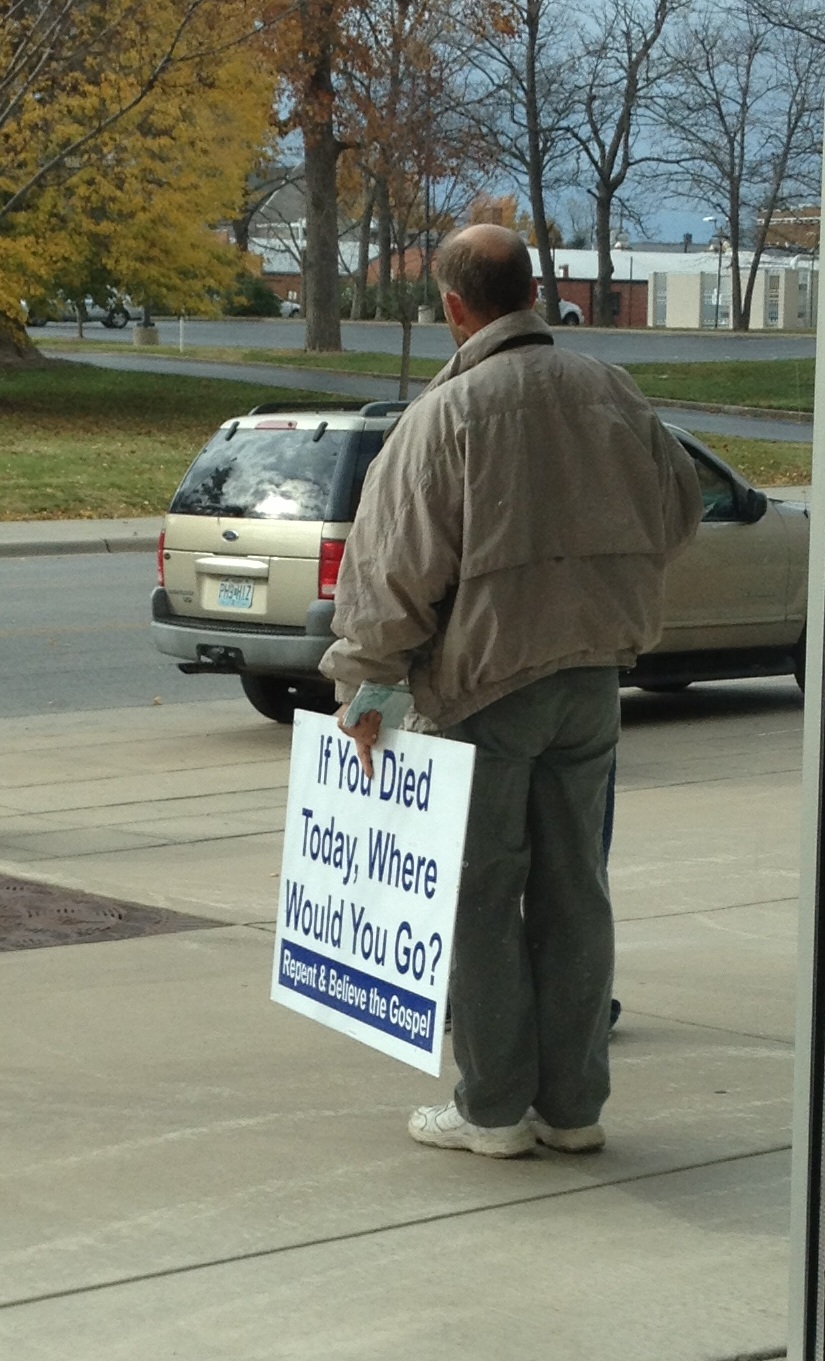
Is: There are protesters.

Text: “The Scientific Reliability of The Bible
Psalm 119:138
If the Bible is not true then nothing really
matters. If the Bible is true then nothing else
really matters. SouthCreekChruch.com [sic]
BornofHim.org”

Wait, wait, wait….that’s an “is”? Yes. Where (and when) I went to church, there were protesters.
Isn’t: Somewhat different kind of protesters. But not terribly different.

Sign: “If You Died Today, Where
Would You Go?”

Is: It happens on a regular basis.
Isn’t: Skepticon happens once year. People travel hundreds of miles to reach it, because there isn’t anything equivalent happening closer to them.

Is: It’s very segregated. You could make pretty accurate arrangements to meet up with someone by saying “I’ll see you by the black dude at 4:00.”
Isn’t: There was somebody making an issue of this. Unfortunately, a lot of people (including myself…I had to get on the road) weren’t around to hear it.

Is: People feel a surge of enthusiasm and joy from the knowledge that they are amongst others who sympathize on something very important to them. As one was quoted, “Hanging out with people who agree with me recharges and revitalizes me.”
Isn’t: Well…

This quote was mentioned by James Croft on Sunday morning (fittingly) during his talk on skeptical and atheist communities. In light of the fact that “non-religious” is the fastest-growing “religious” faction in America, with 1/3 of people under age 30 fitting that description, Croft was encouraging attendees of Skepticon to join and/or start local organizations for the non-religious in order to have that revitalizing and recharging sense of community more often, and to engage in the kind of proactive ethical pursuits that churches often do (collecting food, toys, etc. for the poor) as secular communities, all over the country, when conventions like Skepticon aren’t taking place. Croft was encouraging everyone to become more active, to translate that feeling of inward belonging into outward action, which– if we’re to be fair– is like pulling teeth to get church members to do. People who live fewer than two miles from their place of worship, from the supposed locus of attention of the ever-loving deity who created the universe. I guess they figure he’ll take care of it for them. Skeptics don’t have that to fall back on.

I think impatience in this case is easy, actually– particularly if you’re the sort of person who has no problem finding people who are very accepting of skepticism and secularism as an important or even necessary element of their day-to-day life, which is also your day-to-day life. It can be easy to discount the comfort that can be found in people who think similarly if you are not one of those (like a secularist in the midwest) who spends every waking moment around people who largely don’t.  

I know, I know, it’s a messy issue. Routinely, the community of skeptics/atheists/secularists runs up against such concerns, and runs up against them hard. Croft bent over backwards in his talk to make the idea of gathering together seem as palatable to secularists– who, incidentally, had already made quite a significant show of being willing to gather together at least once a year, for a couple of days, for the sake of common interest and the comfort that comes from that, and for some socialization. Like cons are known to be– gatherings of enthusiasts.

For me, it was an opportunity to socialize in particular with a friend I’ve known for a good fifteen years (thank you, internet!), but had never met in person.

Gretchen and Ed Brayton

Damn sure it’s not going to be another fifteen years.

Proximate pratfall

Proximate pratfall published on 1 Comment on Proximate pratfall

Regarding Richard Mourdock’s “rape babies are a gift from God” comment

It’s fun to see people all over the internet making fun of Mourdock saying that a pregnancy which results from rape should be considered a gift from God, because that life is something God intended to happen. They can see the obvious dishonesty of it, and are going to town drawing the logical conclusions of such a statement. Those logical conclusions are how we can know it was dishonest– if it wasn’t, then the most charitable thing that can be said is that Mourdock didn’t exactly think it through.

You see, the position that God intended for a pregnancy to have resulted from a rape can be interpreted in one of two ways:

1. Ultimate: Of course God intended for it to happen, because God intends everything! God is the author of the universe, the primary force behind everything and everything. He is the ground of being, or at least the first cause who set everything in motion. Therefore if something happens, it is by his intention.

Why Mourdock’s statement is ridiculous, if that’s what he meant: Rape pregnancies, then, are intended by God in the same sense as cancer, earthquakes, and car accidents. The implication of Mourdock’s statement is of course that a pregnancy resulting from rape is intended by God, therefore the woman should not have an abortion. But our response to disease, natural disasters, and human-caused mishaps is not to proceed about our day as if nothing happened, whether we regard those things as ultimately intended by God or not. When those things happen, we attempt to fix them– to put things right. Oftentimes, to a woman whose pregnancy resulted from rape, getting an abortion is putting things right (well, as much as she can). God intending the pregnancy is not an argument against her doing so any more than it is an argument against chemotherapy for cancer patients.

2. Proximate: A rape victim’s pregnancy is a result of special intervention on God’s part. For reasons known only to God– and apparently to Mourdock– God looked down on that woman who had recently experienced the suffering of sexual violation and said “Hey, that raped lady needs a baby.” And presto! He put one inside her.

Why Mourdock’s statement is ridiculous, if that’s what he meant: Because it makes God– and Mourdock– a sadist. Unfortunately Mourdock’s use of the word “gift” makes it much more likely that this is the sense in which his statement was made, and that’s why people are reacting so badly to it even though he still appears to have no clue of the enormity of what he said. That’s what is making people mentally dry heave.

And by the way, you can give a gift back. It might be rude, but you can do it. Just saying.

This lead me, though, to think of an earlier rumination I had about conservatives conflating God’s behavior in the proximate vs. ultimate sense, so I’m re-posting that here:

1. “Everything is caused by a higher power. I call that higher power God.”

2. “Natural disasters are acts of God– they are part of the structure of the world and we just have to deal with them as they come.”

3. “Now that (insert natural disaster) has happened, are the people of (insert region of the world) going to wake up and see that God has a message for them?  Are they going to see that God is not happy, and change their ways?”

Three very different statements. The third person is claiming that a natural disaster is a specific act of God, performed in reaction to the behavior of people in the area affected by it. This person is either too uneducated to know the reality of why natural disasters happen in certain times and in certain places, or does not mind appearing to be. To put it less delicately, if you claim that natural disasters are actually divine punishment you are not only stunningly lacking in empathy but can also safely be thought less than bright. I don’t expect people to stop doing that any time soon, but our collective willingness to call their statements ridiculous has increased.  Previously there would have been no need for Michele Bachmann’s PR person to declare that she was simply joking [when she said that Hurricane Irene was God “getting Washington’s attention”].

We still don’t– or at least, shouldn’t– want people who are willing to make statements like that running the country. We shouldn’t want governors who think that you solve problems like property rights violations and drought by appealing to God to solve them. We shouldn’t want a president who decided to run in the first place because he/she thinks God told him/her to run, or that God will tell him/her things like whether to go to war or not while in office.

Why? Because these put God in front of natural and human causes for things. They make him a proximate cause, rather than the ultimate one. God might indeed favor Herman Cain for president, but the rest of us should be primarily concerned with whether he’s what the country needs, and whether he’ll do a good job. God might be concerned about property rights, but since it’s the job of politicians to make things right in that regard, they should be doing it. God might have an opinion about whether the country should go to war, but hopefully it’s based on the same things a president should be concerned about– whether the war is just, how much suffering it will cause, and so on. God might have very firm opinions about how Obama’s handling the deficit, but if you consider Irene to be a sign of that you’re a cretin and shouldn’t be in an elected position of power.

Digital dualism enables internet idiocy; monism motivates meaning

Digital dualism enables internet idiocy; monism motivates meaning published on No Comments on Digital dualism enables internet idiocy; monism motivates meaning

First things first– if you haven’t already, go over to technosociology and read Zeynep Tufekci’s excellent post Free Speech and Power: From Reddit Creeps to anti-Muslim Videos, It’s Not *Just* “Free Speech.” You can probably glean the subject matter from that title, but the post is a very nuanced and careful (and even more careful after some edits) consideration of what free speech means on the many and varied private venues of conversation that compose the internet. I’m not really going to add to that– just go read.

What I want to talk about here is actually something mentioned in a specific part of her post, on the significance of what happens on the internet as opposed to “real life”:

Another variant of the argument has been that “it’s just the Internet.” Chill. This, of course, rests of on something I’ve long been railing against, the notion that the Internet is somehow not real, that it’s virtual or that it is “trivial.” (My friend Nathan Jurgenson coined the phrase “digital dualism” to refer to this tendency).

Mind/body dualism is the term for a belief that the mind and body are fundamentally separate, made of different stuff in some way. The most common version of this is belief in a soul, the locus of all of the “important” thinking– aka, the mental stuff, the stuff that makes you, you– which either wasn’t ever part of your body or will cease to be part of your body upon your eventual demise. Digital dualism, then, is the casual belief that what happens in the internet is not part of real life– that it is somehow fundamentally separate. The soul is separate and therefore more significant, but life on the internet is separate and therefore less so. It’s not part of “real life,” but a diversion from it, or at best, a tool to assist in maintaining it. Jurgenson writes regarding the genesis of this thinking:

The digital dualism versus augmented reality debate relates to another outmoded conceptualization that argues the Internet has the power to transcend and remove social locatedness. At its onset, the Internet seemed to promise the possible deconstruction of dominant and oppressive social categorizations such as gender, race, age and even species; as the cartoon goes, “online, no one knows you’re a dog”. We can trace this line of thought through the classic Hacker ethic that ‘all information should be free’ through the open-source movement behind Linux and in the philosophy of Wikipedia, an online encyclopedia that anyone can edit. Essential to these projects was the idea that the Internet can be created as a sphere separate from (perhaps even better than) the offline world. Digitality promised a Wild-West frontier built without replicating the problems of our offline reality, fixing the its oppressive realities such as skin color, physical ability, resource scarcity as well as time and space constraints. The new digital frontier was a space where information could flow freely, national boundaries could be overcome, expertism and authority could be upended; those old structures would be wiped away in the name of a utopian and revolutionary cyber-libertarian path blazed by our heroic cyber-punk and hacker digital cowboys (indeed, those were boy’s clubs). This dream could only be maintained by holding the digital as conceptually distinct from the physical. Perhaps this is understandable given this new space was literally being invented. However, the novelty of the new digital reality betrayed the ultimate reality that none of this digitality really existed outside of long-standing social constructions, institutions and inequalities. (Emphasis in original)

This blog’s name is due in part to digital dualism. I was trying to think of what sums up the significance and purpose of a blog most, and got stuck on the fact that a blog is a means of expressing something to the world  with little to no expenditure necessary on the part of the author, no requirement of means, let alone credentials. It requires time and effort, and that’s it. That makes a blog nearly the cheapest signal possible, but that cheapness only refers to the ability of any yahoo with an internet connection to make and maintain one. The messages transmitted can also be cheap, or they can be incredibly valuable– but that value depends on, is determined by, the messages themselves. If the messages are valuable and have an effect, that breaks from digital dualism and betrays at they are in fact part of the real world.

PZ Myers slaps away the notion that the ease of putting something out into the internet makes it less substantial or important:

The internet made publication trivial. It apparently diminished the substance of communication — no more crackling bits of paper that pile up on your desk. Media like twitter and facebook encourage you to blurt casually, with little attention to the words you write. It leads to the illusion that communication online is as insubstantial as the conversation you had with your cat. But it isn’t. In the vast howling noise of the internet, what you say has become more important — voices that babble and shriek don’t rise to prominence and become regular draws (they can be brief freak show sensations, though, and we do see a tendency for voices of minimal talent or intelligence striving to become louder through more extreme viciousness or stupidity). Because something is written in the intangible pattern of electrons doesn’t make it less substantial, but instead makes it easier to distribute, copy, and archive — you could burn an incriminating letter, but once it is on the internet, it is spread far and wide and, while not completely unerasable, is harder to remove…and actively trying to remove something tends to make it more noticeable and more widely disseminated. Meanwhile, I’m finding hardcopy to be less useful — I get dunned with so much junk mail, all those crackling bits of paper that offer me new credit cards at low low rates and advertisements for big screen TVs on sale and sweepstakes I must enter to win millions of dollars, that I increasingly devalue stuff that is written down. I used to photocopy journal articles every week and file them away in a cabinet — I’ve still got a huge pile of these things from 20-30 years ago — but now I rarely print anything, it’s far more useful to have a searchable, indexable, archived PDF that I can also instantly email to students and colleagues. Just because some old fogies don’t comprehend or appreciate the volume and content of all the communication that goes on by this medium doesn’t make it less real. The internet is not the place where a billion ghosts chatter over matters of no consequence — it’s the new reality, the tool that many of us use to make connections that matter. It’s the greatest agent of information and communication humanity has yet invented, and it deserves a little more respect than dismissal as something “unreal” where trolls can roam unchecked.

It’s not just “old fogies” who are digital dualists, though– it’s those same trolls, and everyone who agrees with them that degrees of anonymity make everything matter less. The old fogies are ignorant of the reality of the internet, but the trolls are not– they are living in denial in order to avoid accepting the responsibility of being trolls. The distance makes it easy to pretend that there are not actual other people on the end of every barbed forum post or abusive tweet. It’s baffling to me to see people actually use their Facebook accounts to express every kind of bigotry and hate under the sun both on Facebook itself and on all sorts of news sites and other fora which use Facebook for commenting. Don’t they know they’re using their real identities for that? Of course they do, but they don’t care– the distance makes it seem like it doesn’t matter.

My dissertation was, in part, about how belief in a soul can actually inhibit the ability to practice empathy by establishing the body and the physical/social environment as less important, as mundane and disposable, and then dehumanizing people to place them solidly within that realm as opposed to the company of the ensouled. Digital dualism is not an exact analog to this, but I can certainly see how empathy can be switched off by relegating others to the status of “internet people” and dismissing their concerns in a very similar way. Perhaps it’s even the same move gone one step further– if the soul is what binds us with eternity and makes us children of God in contrast to everything else in this worldly world of ours, then perhaps so-called “real life” likewise divorces us from the fake, transient, shallow world of the internet. Maybe we always need some kind of existence to subvert and make into a meaningless playground.

That certainly seems, anyway, to be the mentality on display whenever there’s a discussion of poor behavior anywhere on the internet, but especially in gaming, where people can ramp “It’s just the internet” up into “It’s just a game.” We don’t need to worry about unfairness, bigotry, or general douchiness here– it’s just a game! Because I guess people who play games cease to be people. Or maybe just all other people aside the one steadfastly defending the right and appropriateness of his being a douche.

I’ve written on the subject of empathy inhibition on the internet before, here and here. But in the former of those two posts, I also wrote about how online interaction can foster empathy to the point of creating tremendous opportunities to help people who have been observed suffering– observed via the internet. When people are well and truly convinced that what they do on the internet affects real people even if those people are strangers, some beautiful things can happen. That being the case, I can see no benefit in promoting the notion that the internet is not “real life.” I can see only downsides. Not only is digital dualism false– what we do online has tremendous effects, even if they are not immediately obvious or consistent– but it’s also harmful, because it encourages people to harm others without taking responsibility for it, because they do not acknowledge that those others are also people. And it impedes the opportunity for and practice of great acts of empathy.

So let’s discard the dualism. This is real life. Let’s act like it.

Demonology

Demonology published on No Comments on Demonology
Art by Sandro Castelli

It’s getting close to Halloween, so let’s talk about demons.

I’m going to define a demon as a non-human agent who works in the world– the existence we inhabit– to create evil. Now, yes, I’ve said that I don’t believe in evil, that evil is a problematic concept. I don’t, and it is. But I don’t believe in demons either. This definition is a description of what demons are to people who do believe in them, and people who believe in demons typically believe in evil.

There are all kinds of demons. There are other kinds of “real” demons in folklore across the world, and other kinds of intentionally fictional demons depicted all over movies, literature, gaming, and so on. The Dungeons and Dragons Monster Manual for example has a whole slew of them, each with their own characteristics, rank, and abilities. Demons as mythological characters are really fun, because they can look like virtually anything although they typically have horns and a tail at least, sometimes hooves. A tiefling is a humanoid with demonic ancestry, and they’re not even necessarily evil.

But the kind some Christians believe in? They’re evil. Their reason for existing is, in fact, evil. They exist to prevent humans from flourishing and achieving spiritual salvation. That is, demons serve Satan and work to prevent the souls of humans from being saved so that those humans will go to a heavenly afterlife. In the Bible, demons usually take the form of “unclean spirits” who possess people and can only be removed via exorcism. Jesus was, among many other things, an exorcist. Catholic clergy have performed exorcisms for centuries and do to this day, while specifying that the allegedly demon-possessed person must be examined by a doctor to ensure that it is not actually a case of mental illness. After all,

“Not everyone who thinks they need an exorcism actually does need one,” said Bishop Thomas J. Paprocki of Springfield, Ill., who organized the conference. “It’s only used in those cases where the Devil is involved in an extraordinary sort of way in terms of actually being in possession of the person. “But it’s rare, it’s extraordinary, so the use of exorcism is also rare and extraordinary,” he said. “But we have to be prepared.”

Indeed. A 2008 Pew Forum Landscape Survey found that 68% of Americans “believe that angels and demons are active in the world.” According to a 2009 Barna Group study, in America,

A majority of Christians believe that a person can be under the influence of spiritual forces, such as demons or evil spirits. Two out of three Christians agreed that such influence is real (39% agreed strongly, 25% agreed somewhat), while just three out of ten rejected the influence of supernatural forces (18% disagreed strongly, 10% disagreed somewhat). The remaining 8% were undecided on this matter.

So these people believe that there are other agents in our world– non-human but human-like agents– which have an effect on the world for good or for evil. I’m focusing on evil for now, because I think it’s more interesting in terms of moral responsibility. Namely, how demons function to add, take away, or otherwise mess with it. See, the notion of a non-human agent which can possess people and make them do evil works excellently for two purposes: 1) asserting that someone else is doing something wrong when you can’t come up with any real evidence of the wrongness of the act, and 2) exculpating oneself of actual or at least allegedly actual harmful acts by taking the blame. You’ve heard someone speak of his or her demons? Some people actually mean that literally.

Whether they appear in someone’s explanation for the reason for whatever they consider evil happening in the world, or in a movie designed to scare the hell out of us, there’s one feature of demons that is particularly salient to me: they don’t work voluntarily. And by that I don’t mean demons are slaves. I mean that they can take control of things without any consent on the part of the person or people for whom they are ruining existence. Frequently when a demon shows up in a movie, it’s because somebody summoned it by accident by performing some ritual (Ritual: A sequence of actions which produces a supernatural result as an emergent property, in addition to the expected physical consequence of those actions. Dunking someone in water gets them wet. Baptizing someone confirms them as a child of God.) which brings them into the world, completely involuntarily on behalf of the summoner. And when a demon is summoned on purpose, it’s generally without the summoner having a complete understanding of what he/she is doing, which tends to turn out very badly indeed for him/her. Demons: not big fans of consent.

I watched Hellraiser recently for the Film Sack podcast. I’d never seen it before. I wasn’t big on horror movies at all growing up because they’d seep into my dreams whether I recognized them as fake and ridiculous or not, so I just avoided them altogether. But over the past few years I’ve started watching both and old and new ones, good and bad, from The Omen to Poultrygeist, and the thing that sticks out to me the most is how they screw with moral responsibility. Sure, anybody who has so much as seen a horror movie or watched Scream knows this. But there’s a lesson about morality that horror movies can tell you. I’m not saying it’s a good or correct lesson, but it’s a pretty darn consistent lesson:

Horrible things will happen, perhaps to you. They will be worse if you’re a bad person. Whether it’s “cheated on your significant other” bad or “serial killer” bad (or just “had sex” bad, if you’re female) doesn’t matter. Being a good person will not save you. You do have to be a good person to survive, but you also have to have access to and seize upon an opportunity presented for no real reason and based entirely on luck. If you do that, you might survive.

In the case of Hellraiser there is plenty of Hell and demons, and fortuitous opportunity is a small wooden box. A box which apparently (the movie is not very clear) provides both the opportunity to inadvertently turn your soul over to the complete control of demons, or, under the right circumstances, to banish those demons. I won’t spoil the movie for you, but I bet you can guess which sort of people get controlled and which get the banishing power. The important thing is how unintentional it was in all cases. In both movies and popular conceptions of demons, the matter of whether you end up being controlled by them or whether you are in a position of chase them away has very little to do with what you actually will to happen. In popular conception, here are some ways you can worship and/or summon demons completely inadvertently:

This last was the focus of a recent radio show rant by Linda Harvey of Mission: America, who said:

The core of Halloween is glittering artificiality, you can pretend to be someone you aren’t’ for a night, you can flirt with danger, you can divine a different destiny, but it is all void of the presence of or will of God. It’s a seduction that says, ‘don’t be afraid, do whatever you want, there’s nothing to fear,’ it’s one of Satan’s oldest tricks. Costume parties are fun but these costumes may even disguise our very souls. Most Christians with a sincere faith acknowledge that there is a demonic realm and that Satan and his minions are at work in the world to deceive humans, so why wouldn’t Halloween provide an extremely useful tool? Mixed in with the fun and games are frightening and disturbing experiences that may leave some children with nightmares. Then there is the flirtation with occult practices that are forbidden in Deuteronomy 18:10-12 and elsewhere, Christians aren’t supposed to be consulting fortune tellers, Ouija boards or palm readers about our future but all are frequently a part of Halloween festivities. ‘But it’s just for fun,’ parents will say, ‘God understands my children are not serious.’ Really? Do your kids know how risky these practices are and that real contact with real demons is quite possible. Satan doesn’t care about our intentions; he will take any willing participant.

Putting aside the fact that that “There’s nothing to fear” was one of the profound messages of divine insight delivered in neurosurgeon Eben Alexander’s trip to paradise, the most important thing here is that the only intentions which matter are those of Satan and his minions. Not even God’s omniscient understanding of the content of the minds and hearts of men is apparently good enough to rescue what would otherwise be completely morally neutral acts of fun from actually being rituals to deliver souls into demonic control and presumably a very warm afterlife. Believing in Satan and demons means that there are evil agents in the world actively trying to pull your soul away from God’s embrace, and they can do by means which coincidentally look just like the ways to have the most fun.

The arguments that practicing yoga is demonic center around the notion that you’re actually practicing the rituals of another religion, and if you’re doing that (knowingly or unknowingly) then you’re obviously not conforming properly to your own religion. And since there are no other gods but God, you can’t actually be worshipping the gods of other religions by mistake. What you are doing, then, is demonic. Since it is not God-focused, it must be Satan-focused, since Satan wants you to turn your attention from God. As if there isn’t enough pain and suffering going on in the world occurring naturally, accidentally, and deliberately by the acts of the malicious, we have to worry about accidentally serving Satan by being influenced by demons to commit ungodly acts which don’t appear ungodly because they harm nobody and actually seem fun, helpful, and/or educational.

The lesson of demon-believing Christianity seems uncannily like the lesson of horror movies, doesn’t it? Evil is actively working in the world to cause you to suffer and die. You will likely suffer more if you’re even slightly bad, but being good– according to rather questionable rules we’ve made– is not enough to save you. You must also be lucky enough to be given an unlikely and seemingly arbitrary opportunity, and you must seize on that opportunity in order to have any hope of surviving. If you ignore these rules and this opportunity in favor of enjoying yourself and doing what you think is right, you will unwittingly serve the interests of the evil agents and ultimately become theirs.

I submit that this portrayal of moral responsibility is absolutely incompatible with free will, which shouldn’t be shocking at all (it may shock you that I believe in free will, but that’s another commentary altogether. Sufficed to say I’m persuaded by Daniel Dennett’s portrayal). I think that demon-belief is completely fatuous, which should also be unsurprisingly. But I also want to say that I consider it an immoral belief, because of this effect of completely distorting moral responsibility to make evil out of acts which are not just benign, but intended as benign and actually morally neutral or perhaps even positive. Demon belief is a cheap cop-out in terms of morality in a way that angel belief is not, which is why I didn’t feel compelled to address angels here at all. I don’t believe in angels, but consider the belief  mostly benign except when people credit angels for things like successful surgery rather than, you know, their surgeons.

I can’t get people to stop believing in demons. But I think I have offered a sound argument for not taking people seriously when they attempt to invoke demons as moral justification for….well, anything. Linda Harvey’s full rant included the suggestion that demons are responsibility for homosexuality and what she calls “gender confusion.” We should not listen to people like Linda Harvey. They are literally making up supernatural support for their morality, and in the worst, most damaging possible way.

Procotting

Procotting published on No Comments on Procotting

I can’t seem to find a word that denotes a deliberate decision to patronize a business in response to a boycott by others, so I’m going to say I’m procotting Home Depot. Here’s why:

The American Family Association has announced yet another boycott, or perhaps a continuation of an already existing one, and the target this time is Home Depot because it set up a booth to promote itself at a gay pride event in Atlanta.

 The Anti-Fags American Family Association complained that

One of the main purposes of “gay” pride events is to push for the legalization of marriage between men who have unnatural sex acts with other men. Rather than remaining neutral on the issue, Home Depot has taken the side of grown men who parade in public places dressed as drag queens and “fairies.”…AFA is promoting a boycott of Home Depot until it agrees to remain neutral in the homosexual culture war.

Because apparently, being neutral means treating gays like non-humans. I’m not sure if the AFA has noticed, but  homosexuals have home repair and improvement needs just like all other humans. Desiring romantic and intimate relationships with other people of the same gender does not, seemingly, absolve one of the need or compunction to paint the living room. Heck, it might actually further it.