Skip to content

The power of “Not cool”

The power of “Not cool” published on No Comments on The power of “Not cool”
“Dude, we don’t want to see that shit. Here, have a sip of
Douche-Be-Gone so you’ll stop being so…you know.”

Concerning the topic of online sexual harassment against women, atheist and otherwise, and what to do about it, Stephanie Zvan defends the use of social disapproval:

I’ve even seen a couple of people say things like, “Social disapproval is a technique used against atheists by theists. We shouldn’t be doing that ourselves.” All told, the consensus among those feeling challenged for doing nothing is that doing something is dangerously repressive–when that doing something is registering that one simply does not approve. They’re even a tiny bit right. Social disapproval is indeed a potent force. It strongly shapes our societies and our interactions with each other. Being outcast presents a form of stress that is bad for us all on its own. However, where these folks are a tiny bit right, they’re also a whole heaping lot wrong. The problem with this sort of social pressure isn’t that it is inherently wrong. As I mentioned, this is a big part of how we add order and structure to our societies. The problem is when we use to enforce pointless conformity, when we shame or cast out those who are doing nothing wrong, nothing that will harm our society. For the record, sexism, misogyny, objectification, normalizing rape through nudge-nudge-wink-wink humor, threats to bodily autonomy–these are all doing something wrong. They all hurt a substantial portion of our society, and I don’t just mean women. This is not comparable to not believing in a god. Those behaviors are all also prevalent in our society, though less than they used to be before we started confronting them. They are being held in place by a narrative that, while it can no longer claim that nobody at all is concerned by this behavior, the only people who are concerned are “thin-skinned pussies” and “irrational cunts.” That means that if you–yes, you–don’t speak up when something like this happens right in front of you, you feed that narrative. This is what “If you’re not part of the solution, you’re part of the problem” means. The only thing that can really cut through that narrative is more voices that come from within the groups where this behavior happens. No bullying or questing for bad behavior required. You don’t have to be any more eloquent than “Dude, don’t go there” or “It’s only a joke if it’s funny” or “I’m with X on this” to back up someone else already taking the heat for standing up. Or you can just use the brilliant line that should become a meme as of yesterday: “I am also the internet and I don’t want to see that shit.”

Absolutely right. There is nothing intrinsic to social disapproval that makes it a bad thing. It can be a very good thing when it comes to dissuading people from treating each other terribly, even in an atmosphere like the internet where people are often allowed to be anonymous or anonymous-but-trackable (using screen names). The problem with social disapproval of atheists isn’t the what but the why— the shaming and alienation of people for something about them which has nothing to do with their actual worth or moral standing. When what you are is a troll and/or a jerk, however, your moral standing goes down and calling you on it is entirely appropriate. Social pressure can simply be what happens when a bunch of people call you on it, and it works.

Online communities can and usually do also have systems of moderation in place, automated or warm-blooded, whose job it is to regulate and prevent obnoxious and hateful speech. But the most likely message someone who is being arsey gets from being penalized from one of these is “The Man is keeping me down! Violation of freedom of speech!” Which is bollocks, of course– no private community has an obligation to protect the dissemination of odious speech if the owners/ruling powers do not desire it. Still, I think if possible it’s always better to rely on the community at large to make it highly uncomfortable to express nasty sentiments, so that the perpetrators know that the negative reaction isn’t just from one person or a few who happen to be on a power trip or have it out for them personally.

The corollary to the rule of using social pressure to combat internet douchiness is, of course, that those employing it should be able to explain what’s wrong with the speech to which they’re objecting so strenuously. A Picard facepalm might seem sufficient:
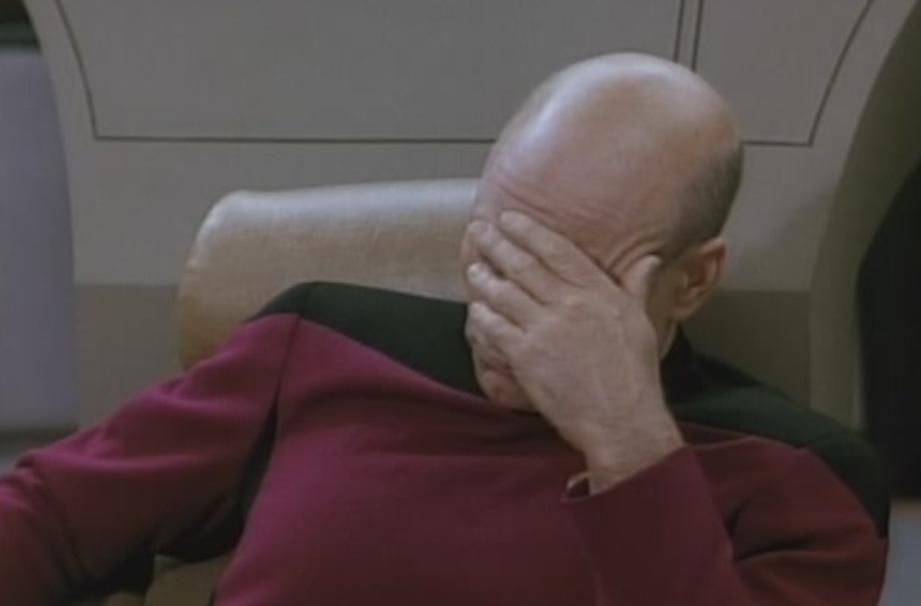
…but if not (and usually not), you should be able to articulate the problem, no matter how obvious it appears to you. For one thing, it makes the group disapproval amount to more than “There are a bunch of us who frown on that sort of thing” and create an opportunity for the jerk to comprehend the reason for the perception of his/her jerkiness.

This, in turn, creates an opportunity for him/her to correct the behavior. To maybe even apologize. It does happen! And when it does, that’s the cue to stop with the social disapproval. If the “Dude, that’s messed up”-ing doesn’t end even after the behavior has stopped and admitted fault, the message sent will instead be that he/she can’t do anything right, at least from now on, thereby negating any positive consequence of all of the disapproval. It will probably even counter-productively convey the impression that the disapproving crowd are irrational blowhards and there’s no point in listening to their exclamations. Our jerk in question may even nurse a messiah complex for him/herself as a result, thus becoming further bolstered against any future accusations of jerkiness. With great power comes great responsibility– so it is with the power of “not cool.”

One further thing to note is that online as well as in RL, the most effective social disapproval is likely to come from peers– the people most familiar and similar to the jerk. Yes, pro-active peer pressure! Don’t make the target of the jerkiness and his/her peers the only ones to speak up about it. It might not feel like the best thing, but the thoughts of people who are more like the jerk yet are willing to stick their necks out on the target’s behalf are probably going to carry more weight with the jerk, because they can’t be as easily dismissed as “whiners” or “killjoys” (or “thin-skinned pussies” or “irrational cunts”). Yeah, that’s not rational, but jerks often aren’t– that’s why they’re jerks. It’s also not rational to suddenly start listening to complaints about your behavior just because they start coming from someone you otherwise admire (even if they’re not exactly a peer), but damned if that doesn’t work pretty well too.

I do understand the complaint about misogyny being especially vexing to see in the atheist/skeptical community because they’re supposed to be so…well, skeptical. But though the same thing which makes a person mistrusting of stories about ghosts or Bigfoot should also make them doubt the premise that the most important thing about women is their appearance and general fuckability, justifying turning every internet discussion to that topic, all too often it doesn’t. As we have seen. So it’s high time to start calling out the people who pride themselves on rejecting the former but practice the latter as though it’s going out of style. And if you’ve been doing the calling out, the socially disapproving, all along…my hat’s off to you. Keep it up, please.


Bachmann does bioethics

Bachmann does bioethics published on No Comments on Bachmann does bioethics
Pictured: a human whose dignity is highly questionable

Said Michele Bachmann to members of Personhood USA on Tuesday night:

I want everyone to know that I recognize and respect the dignity of every human life from conception until natural death. This is not a check the box thing for me; this is the core of my conviction, this is what I would literally die for. We have a moral obligation to defend other people and the reason for that is because each human being is made in the image of likeness of a holy God.

Dignity, I think we can agree, is a state of being which makes an entity deserving of respect and ethical treatment. For Bachmann, this affordance is based on a fundamental belief about our relationship with and similarity to God. Every human was made by God and is in some way very like God, therefore it is wrong to end the life of one.

But…God created other creatures, and we end their lives all of the time. Yes, but those creatures were not “made in the image of likeness of a holy God.”

But…Bachmann is opposed to gay marriage, and telling people that they cannot marry the consenting adult of their choice denies their dignity, as surely does indefinite detention and torture. Yes, but defending the dignity of humans does not extend to protecting them from the consequences of immoral acts.

This is because for Bachmann, dignity is not a state that individual humans reach. It is something they are all afforded– whether they want it or not– by virtue of being members of a race specifically created by God to carry out his will. Killing people as punishment or in war is one thing, but in general the ending of a human life either in the womb or on the physician’s table is violating the will of God. It’s a violation of a covenant held with him, not with other humans. A human’s conduct can render it permissible to put him to death and subject to God’s judgment, but it cannot justify dignity– that comes from the fact of being God’s creation.

When the word “dignity” is invoked in conservative politics, you can bet the underlying message is a concern about messing with God’s product. This can take many manifestations, including abortion and euthanasia, but also stem cell research, cloning, and contraception. It has been a particular sticking point for former chair of the President’s Council on Bioethics Leon Kass, who famously cited sheer repugnance as an appropriate foundation for moral opposition to such things. In “Ew, gross! The prissy bioethics of Leon Kass,” Garance Franke-Ruta writes:

Man, to use Kass’s favored term, possesses a fundamental and irreducible dignity based on “the godlikeness of human beings” It is from this, he argues, that “the sanctity of human life” derives.  But it is the impact of the “dehumanizing challenges of the brave new biology” and technology on “ways of life” that concerns Kass, rather than the impact on living individuals: “We need to understand that there is more at stake in the biological revolution than just saving life or avoiding death and suffering. We must also strive to protect and preserve human dignity and the ideas and practices that keep us human,” he writes. The goal of bioethics should not simply be to solve technical problems involving specific procedures via the issuance of rules, but “concern for the moral health of our entire community.” Consequently, it is humane ideals, not just human individuals, that must be protected and defended “[i]n a world whose once-given natural boundaries are blurred by technological change and whose moral boundaries are seemingly up for grabs.”  Those boundaries have, he argues, been damaged by three decades’ worth of advocacy by feminists, relativists, liberals (and liberationists and libertarians of all stripes), and gays and lesbians. Abortion, the sexual revolution, contraception, and “the extramarital use of the Pill”–all these changes have threatened our ability to understand natural relationships, and hence have led to the easy acceptance of technological interventions, particularly in the reproductive sphere, that make us increasingly unnatural, “post-human” beings. 

When humankind takes control of its biological destiny in a way that gives someone like Bachmann or Kass moral qualms, you can count on the accusation of “playing God” to come up. As a rather heavily modified person myself (extensive dental work, LASIK surgery, a fervent dedication to birth control), I find this to be a head-scratcher. Would they prefer that we go without, for example, vaccines? In the case of the HPV vaccine almost certainly yes, because like the “extramarital use of the Pill” (I guess marital use of it is okay) it’s a means of manipulating the body to protect it from deleterious health effects resulting from immoral conduct, and hence undignified. Presumably people getting the MMR or shingles vaccine need not worry too much about being unnatural and post-human.

Patrick Lee and Robert P. George (the latter of which served on the President’s Council on Bioethics with Kass) presented a slightly more nuanced view of things in their essay The Nature and Basis of Human Dignity, while still relying on “nature” as their justification:

The dignity of a person is that whereby a person excels other beings, especially other animals, and merits respect or consideration from other persons. We will argue that what distinguishes human beings from other animals, what makes human beings persons rather than things, is their rational nature. Human beings are rational creatures by virtue of possessing natural capacities for conceptual thought, deliberation, and free choice, that is, the natural capacity to shape their own lives. These basic, natural capacities to reason and make free choices are possessed by every human being, even those who cannot immediately exercise them. Being a person thus derives from the kind of substantial entity one is, a substantial entity with a rational nature—and this is the ground for dignity in the most important sense. Because personhood is based on the kind of being one is—a substantial entity whose nature is a rational nature—one cannot lose one’s fundamental personal dignity as long as one exists as a human being.

So, what makes one worthy of dignity is rationality, and humans (and humans alone) have dignity because they are the kind of beings whose nature is rational, even if the specific human in question is not rational at all either permanently or at the time of consideration. He/she belongs to the rational community by virtue of being of the right species, and that’s good enough. This consideration, as Lee and George later note in their essay, is to make clear that it can’t become permissible to abuse the dignity of the mentally disabled, which is admirable enough. They clarify that

While membership in the species Homo sapiens is sufficient for full moral worth, it is not in any direct sense the criterion for moral worth. If we discovered extra-terrestrial beings of a rational nature, or learned that some terrestrial species have a rational nature, then we would owe such beings full moral respect. Still, all members of the human species do have full moral worth because all of them do have a rational nature, though many of them are not able immediately to exercise basic capacities.

So if one of us should happen upon a rational chicken one day, it apparently renders the entire species dignified because that would show that it is the “nature” of chickens to be rational, even if many of them (i.e., every single other chicken) are not able immediately to exercise basic capacities. Goodbye, KFC.

That’s not a very realistic consideration, however. What’s more realistic is that humans, like every other species we have encountered, are closer to a “rational nature” at some points of their lives than others. That is, they are differently capable depending on the point in their ontogeny, their development. Lee and George are prepared to declare that this period of a human’s life decides humanity’s “nature,” and therefore its dignity. But why? Are we any less human at those points in life when we have not yet become rational, or when we’ve left rationality behind, or if we never really were in the first place? How can something be your “nature” if it’s not even a trait that can accurately be attributed to you? Even traits that will eventually apply to every single one of us sound frankly bizarre to describe as our nature– we all will, for example, die. Is it then our nature to be dead? They reply:

I have understood that the one nature, subject to death, is entailed by the other nature, composite living being, and from that knowledge I then advert to the thought of the individuals which possess those natures.

Then would it not be more fitting to describe the nature of humans regarding reason as subject to being rational? It sounds a lot more tenuous that way, but it’s certainly more truthful.

Lee and George use all of the buzz words and rhetoric one would employ if one wanted to argue that there is something essential to humans which separates them from other species as deserving moral consideration, regardless of what kind of human a specific individual is– a soul. A soul which, again, does not really belong to us but is actually on loan from God, which explains why the intentional death of a fetus which has not developed the cognitive capacity to understand what “dignity” is, and the intentional death of a human in a mentally vegetative state who has long since permanently lost the capacity to understand the same are both nevertheless affronts to their dignity, whereas the natural death of either is not. This also explains why although a rational nature (whether you are actually rational, or not) makes one a person and therefore in possession of full moral worth and dignity, exerting that rational nature in order to decide to end one’s own life is not permissible. That just wouldn’t be dignified.

Do I think that Michele Bachmann has actually read Lee and George, or Kass, or anyone like them, in order to form the foundation of her unshakable defense of the inherent dignity of human life? Nah. But she’s read the Cliff’s Notes and pulled all of the relevant talking points, and while seeking the office of president but not having served on the President’s Council on Bioethics, she comes right out and says it’s because we’re made in the image of God. In that regard she is not making an argument palpably different from Lee and George or Kass, but one that is a lot less subtle and most likely a good deal more honest.

The daughter test, in Egypt

The daughter test, in Egypt published on 2 Comments on The daughter test, in Egypt

From the Huffington Post’s list of 2011’s Most Absurd Quotes About Women– And Who Said Them:

An anonymous Egyptian general spoke to CNN about why female protestors arrested during anti-Mubarak demonstrations were strip-searched and forced to submit to virginity tests. “The girls who were detained were not like your daughter or mine. These were girls who had camped out in tents with male protesters in Tahrir Square, and we found in the tents Molotov cocktails and [drugs]…We didn’t want them to say we had sexually assaulted or raped them, so we wanted to prove that they weren’t virgins in the first place. None of them were.” 

Misogyny and changing the subject

Misogyny and changing the subject published on 5 Comments on Misogyny and changing the subject

Greta Christina preaches it:

It’s depressingly predictable. When an instance of misogyny gets pointed out on the Internet, in a forum big enough to garner more than a couple dozen comments, you’re almost guaranteed to see some or all of these types of comments. It’s happening now. In case you haven’t heard, there was a recent incident on Reddit/ atheism, in which a 15-year-old girl posted a photo of herself holding a copy of Carl Sagan’s Demon-haunted World that her mother had given her for Christmas… and was almost immediately targeted with a barrage of sexualized, dehumanizing, increasingly violent and brutal comments. Including, “Well 15 is legal in many places, including my country, so I’ll only have to deal with abduction charges.” “Relax your anus, it hurts less that way.” “Blood is mother nature’s lubricant.” “Tears, natures lubricant.” “BITE THE PILLOW, IM GOIN’ IN DRY!” And including comments blaming the girl for posting a picture of herself in the first place. Rebecca Watson and others — including Stephanie ZvanEd BraytonJason Thibeault,Jen McCreightJohn Loftus, and Ophelia Benson — have been pointing out how revoltingly misogynistic this is and why. And the “Yes, but…”s have been coming thick and fast. It’s depressingly predictable. And it’s depressing that anyone should have to explain why this is a problem. It seems totally obvious to me. But apparently, it’s not so obvious. So I’m going to spell it out. When the topic of misogyny comes up, and men change the subject, it trivializes misogyny. When the topic of misogyny comes up, and men change the subject, it conveys the message that whatever men want to talk about is more important than misogyny. When the topic of misogyny comes up, and men change the subject to something that’s about them, it conveys the message that men are the ones who really matter, and that any harm done to men is always more important than misogyny. And when the topic of misogyny comes up, and men change the subject, it comes across as excusing misogyny.

Reddit makes Rebecca hate atheists and Ed hate men

Reddit makes Rebecca hate atheists and Ed hate men published on 3 Comments on Reddit makes Rebecca hate atheists and Ed hate men
Reddit thread here, if you’re interested

These discussions, while useful, take a toll. Sometimes they just seem…tiring. I admire people who are willing to run the “sexism on the internet/in skepticism/atheism” treadmill, but can’t help but wonder how they manage to remain sane. Especially while being attacked endlessly for their efforts, as Rebecca Watson has been. As she has shown, all you need do provoke the misogynistic ire of the internet is mention its existence disapprovingly. I really don’t think it has much to do with atheism/skepticism.

Sexism on the internet is a problem, and atheism/skepticism are predominant on the internet. So “sexism is a problem for atheism/skepticism,” because the internet is a primary conduit of interaction for such people. The internet helps people around the world who feel isolated come into contact with others of their kind, yes…and it also creates the impression that those who take advantage of this opportunity speak for everyone in their minority group. When, for example, PZ Myers and Greta Christina disagree, who should we listen to? Who is the representative of all atheist-kind? Well, neither of them, obviously. Atheists and skeptics have no popes, no bishops, no chain of command, because– this is important– atheism and skepticism are not belief systems. Atheism is a lack of belief in gods, and skepticism is a tool, an epistemological approach. Nevertheless prominent atheists can influence the beliefs of others, and lacking churches and being in disparate locations, they often do so on the internet. People want to group together with others of their kind, and when they do they like to have authorities. People outside of groups like for those groups to have authorities to speak for them, to encapsulate what they’re all about. It makes things easier, but in this case also distorts the picture grossly.

Bottom line: sexism is an internet problem. A world problem. The fact that atheists and skeptics on the internet are discussing its existence within their own ranks does not betray that atheism/skepticism “has a sexism problem.” It means that there are vocal people who are concerned enough about this ubiquitous problem to address it, and that quite naturally leads to a widespread ongoing discussion. It’s amazing how much easier it is to avoid having a “problem” with something when your community is either homogeneous, or the community is homogeneously in agreement on it (perhaps by silencing or just not listening to dissidents). Atheists/skeptics on the internet are willing and able to speak up, therefore they’re the ones with the problem. Hmm, not buying it.

Dramatic generalizations incoming. Ready? Here we go.

Dramatic generalizations incoming. Ready? Here we go. published on 1 Comment on Dramatic generalizations incoming. Ready? Here we go.
When it comes to women and political issues, conservatives will generally be the ones to attack women’s actions by attacking their appearance. Liberals, however, can be counted upon to respond by defending the woman’s appearance rather than her actions. 
The corollary is, of course, that when desiring to promote a woman politically conservatives will trumpet the virtues of her appearance, whereupon at least some liberals will respond by attacking it.

IIWAPBK and Privilege 101

IIWAPBK and Privilege 101 published on No Comments on IIWAPBK and Privilege 101

Cross-posted from State of Formation.

I think Gene Marks has now been thoroughly excoriated for his column “If I Were a Poor Black Kid” on the Forbes web site last week. In his effort to explain how it’s still possible for underprivileged kids to succeed, he succeeded only in displaying a shocking lack of empathy. By that I don’t mean that he demonstrated a lack of concern for the poor black kids of the world and their needs– I mean that he literally failed at perspective-taking, in such a spectacular way that it’s hard to believe that he was serious (though apparently he was), which has made the column a golden opportunity for mockery. Jenée Desmond-Harris writes in The Root:

Middle-aged, white Forbes contributing writer Gene Marks, in his recent piece, “If I Were a Poor Black Kid,” presented some now-infamous ideas for how he would personally rise to success if he suddenly found himself young, African American, and poverty-stricken.  Marks would “get technical,” learn software,” “learn how to write code,” “figure out where to learn more online,” “become an expert at Google Scholar,” and regularly peruse the CIA World Factbook. He would then get himself into a top school, and he would “succeed.” The end.

Oh. If only Marks had given out this priceless advice before, we would have eliminated racial inequalities long ago.

Not really.

As a curious side note, it’s unclear how this is any different from what he would do if he were a poor white kid. But also, there’s no word in the piece on how Marks imagines that he would, as a poor child, suddenly be infused with the perspective and sophistication of a middle-class adult. In addition, he, perhaps unintentionally, admits that his advice is useless to all but a select few gifted, mature, and lucky children. (He doesn’t have any thoughts on what he would do if he were not a “special kind of kid” who miraculously became aware of the admissions processes of magnet schools and the value of TED talks and the Khan Academy.)

Melanie Tannenbaum, on her blog psysocietyputs it this way:

My immediate reaction was to hate the article. I found it insulting, ignorant, and just plain short-sighted. As I commented in my own link on Facebook, “[To summarize], ‘This is what I would do if I were born into a completely different set of circumstances, a completely different family, a completely different social support system, a completely different school district, a completely different body with a completely different skin tone and a completely different way that people in public respond to me, yet I somehow still retained all of the benefits, knowledge, and access to resources as a middle-aged, middle-class white man.’”

Indeed. Marks’ column reads as if he was attempting to describe what would happen if he had body-swapped with a poor black child in a movie…the most boring body-swap movie ever, if what he says he’d do in this different body and environment is true. And, it goes without saying, not terribly useful when it comes to addressing what he was addressing, which are the opportunities available and likely to be utilized by people who are actually born in the bodies and environments in question. Having acknowledged this, however, Tannenbaum the doctoral candidate in psychology studying “the effects of power, status, and social class on attitudes and behavior” goes on to observe the following:

However, upon re-reading the article and giving it a little more thought, I’ve come to realize that the real issue with the article isn’t that the author, Gene Marks, is necessarily racist, or even really ignorant. After all, he acknowledges right off the bat that the system is unfair, and that children from other areas of town have it much harder than his own, privileged children do. Marks clearly has some knowledge of the unfairness of “the system.” So the real question is, how could he then go on to write such a short-sighted article, completely missing any sort of perspective on what it means to actually be a member of the community to which he is proselytizing?

What follows is essentially an unpacking of the psychology of privilege. And privilege, it seems, is what we’re talking about here– specifically, the unconscious ignorance of the ways in which advantage and power affect one’s perspective. Tannenbaum goes over two experiments in which subjects were primed with (prompted to have at the front of their minds) notions of self-empowerment, and shows how this actually causes people to assume that others know what they know:

In other words, powerful participants were more likely to overweight the special, privileged information that they had, and they subsequently predicted how other people would (or should) respond to certain situations as if the other people had access to that same, privileged knowledge as well.

Sound familiar?

To be momentarily blunt, powerful people often fail to correct for the fact that other people don’t have the same special knowledge that they do. When they think about how other people should respond to situations, they are significantly more likely to overweight the information that they happen to have (like, say, knowledge about the vast amount of educational technology that is available, assuming one knows where to look for it), and less likely to consider the fact that not everyone else has the same knowledge base.

Well, that’s not news, comes the reply from any of the not-so-privileged among us. The most powerful people are often members of the majority, which allows them to make their experience the “norm” which everyone else comes to know whether they want to or not, but there is nothing compelling them to come to know the experiences of minorities. The other important aspect of privilege is that the privileged are not forced by anything in particular to see through anyone else’s eyes, to acknowledge that their own experience in life is not universal.

Still, it’s one thing to think that what you know and experience is more important than what others know and experience. It’s quite another to be unconsciously ignorant of the fact that other people have different knowledge and experiences, which is what the experiments suggest. That’s what I mean by “failing at perspective-taking”– being unable to process that someone who is not you has a different perspective than you do, perhaps a very different one.

Most of us have had the experience of talking to someone about our problems and hearing that person say “Well, if it were me, I would…” followed by a description of some course of action that we would never pursue, assuming it is even possible for us. One has to wonder what exactly they believe the benefit of offering such an observation to be. That is basically what Gene Marks did in his column, causing its readers to collectively scratch their heads and wonder what the benefit of that was supposed to be.

There are two fundamental short-cuts to empathy (really understanding things from someone else’s point of view) that have proven themselves time and time again: similarity and familiarity.

If you’re very similar to the person in question, it’s not very much of a stretch to see things like they do because after all it’s almost how you yourself see things. Alternately, if the person in question is not much like you but you know him/her really well, it’s easier to see things from his/her perspective just because you’re used to doing so. Privilege means being similar to most people, or at least most powerful people. Never being the “other,” the one who is marked as different.

But that doesn’t mean empathy is impossible– the moral progress of a society is marked in part by the gradual realization by the privileged that they have this status to begin with, and this is accomplished by becoming familiar enough with the different experience of “others” that it is possible to see through their eyes and recognize how similar they actually are. Where this realization occurs, you will find members of majorities fighting for the rights and interests of minorities. Where it fails, you will find apathy and hostility born of that particular kind of ignorance that privilege conveys.

At the end of her post, Tannanbaum acknowledges the ways in which she herself is privileged. I have my own. One of them– access to education– is how I can afford to analyze the mechanisms by which privilege affects perspective in the first place, which might be ironic but hopefully does not invalidate such an analysis.

Empathy and sympathy are often conflated for a reason– the former can lead quite naturally to the latter in the process of understanding allowing for recognition of similarities, and it becomes harder to be angry and blame when you find yourself identifying with the target of such. But we can blame and empathize at the same time. We really can, and both are important for mutual growth– the blame so that the blamed can recognize their error, and empathy so that accusers don’t perceive themselves as errorless. In this way, the conversation can be elevated.

IIWAPBK and Privilege 101

IIWAPBK and Privilege 101 published on 1 Comment on IIWAPBK and Privilege 101

I think Gene Marks has now been thoroughly excoriated for his column “If I Were a Poor Black Kid” on the Forbes web site last week. In his effort to explain how it’s still possible for underprivileged kids to succeed, he succeeded only in displaying a shocking lack of empathy. By that I don’t mean that he demonstrated a lack of concern for the poor black kids of the world and their needs– I mean that he literally failed at perspective-taking, in such a spectacular way that it’s hard to believe that he was serious (though apparently he was), which has made the column a golden opportunity for mockery. Jenée Desmond-Harris writes in The Root:

Middle-aged, white Forbes contributing writer Gene Marks, in his recent piece, “If I Were a Poor Black Kid,” presented some now-infamous ideas for how he would personally rise to success if he suddenly found himself young, African American and poverty-stricken.  Marks would “get technical,” learn software,” “learn how to write code,” “figure out where to learn more online,” “become an expert at Google Scholar” and regularly peruse the CIA World Factbook. He would then get himself into a top school, and he would “succeed.” The end.  Oh. If only Marks had given out this priceless advice before, we would have eliminated racial inequalities long ago.  Not really.  As a curious side note, it’s unclear how this is any different from what he would do if he were a poor white kid. But also, there’s no word in the piece on how Marks imagines that he would, as a poor child, suddenly be infused with the perspective and sophistication of a middle-class adult. In addition, he, perhaps unintentionally, admits that his advice is useless to all but a select few gifted, mature and lucky children. (He doesn’t have any thoughts on what he would do if he were not a “special kind of kid” who miraculously became aware of the admissions processes of magnet schools and the value of TED talks and the Khan Academy.)  

 Melanie Tannenbaum, on her blog psysociety, puts it this way:

My immediate reaction was to hate the article. I found it insulting, ignorant, and just plain short-sighted. As I commented in my own link on Facebook, “[To summarize], ‘This is what I would do if I were born into a completely different set of circumstances, a completely different family, a completely different social support system, a completely different school district, a completely different body with a completely different skin tone and a completely different way that people in public respond to me, yet I somehow still retained all of the benefits, knowledge, and access to resources as a middle-aged, middle-class white man.’”

Indeed. Marks’ column reads as if he was attempting to describe what would happen if he had body-swapped with a poor black child in a movie…the most boring body-swap movie ever, if what he says he’d do in this different body and environment is true. And, it goes without saying, not terribly useful when it comes to addressing what he was addressing, which are the opportunities available and likely to be utilized by people who are actually born in the bodies and environments in question. Having acknowledged this, however, Tannenbaum the doctoral candidate in psychology studying “the effects of power, status, and social class on attitudes and behavior” goes on to observe the following:

However, upon re-reading the article and giving it a little more thought, I’ve come to realize that the real issue with the article isn’t that the author, Gene Marks, is necessarily racist, or even really ignorant. After all, he acknowledges right off the bat that the system is unfair, and that children from other areas of town have it much harder than his own, privileged children do. Marks clearly has some knowledge of the unfairness of “the system.” So the real question is, how could he then go on to write such a short-sighted article, completely missing any sort of perspective on what it means to actually be a member of the community to which he is proselytizing?

What follows is essentially an unpacking of the psychology of privilege. And privilege, it seems, is what we’re talking about here– specifically, the unconscious ignorance of the ways in which advantage and power affect one’s perspective. Tannenbaum goes over two experiments in which subjects were primed with (prompted to have at the front of their minds) notions of self-empowerment, and shows how this actually causes people to assume that others know what they know:

In other words, powerful participants were more likely to overweight the special, privileged information that they had, and they subsequently predicted how other people would (or should) respond to certain situations as if the other people had access to that same, privileged knowledge as well.   Sound familiar?   To be momentarily blunt, powerful people often fail to correct for the fact that other people don’t have the same special knowledge that they do. When they think about how other people should respond to situations, they are significantly more likely to overweight the information that they happen to have (like, say, knowledge about the vast amount of educational technology that is available, assuming one knows where to look for it), and less likely to consider the fact that not everyone else has the same knowledge base.  

Well, that’s not news, comes the reply from any of the not-so-privileged among us. The most powerful people are often members of the majority, which allows them to make their experience the “norm” which everyone else comes to know whether they want to or not, but there is nothing compelling them to come to know the experiences of minorities. The other important aspect of privilege is that the privileged are not forced by anything in particular to see through anyone else’s eyes, to acknowledge that their own experience in life is not universal.

Still, it’s one thing to think that what you know and experience is more important than what others know and experience. It’s quite another to be unconsciously ignorant of the fact that other people have different knowledge and experiences, which is what the experiments suggest. That’s what I mean by “failing at perspective-taking”– being unable to process that someone who is not you has a different perspective than you do, perhaps a very different one. Most of us have had the experience of talking to someone about our problems and hearing that person say “Well, if it were me, I would…” followed by a description of some course of action that we would never pursue, assuming it is even possible for us. One has to wonder what exactly they believe the benefit of offering such an observation to be. That is basically what Gene Marks did in his column, causing its readers to collectively scratch their heads and wonder what the benefit of that was supposed to be.

There are two fundamental short-cuts to empathy (really understanding things from someone else’s point of view) that have proven themselves time and time again: similarity and familiarity. If you’re very similar to the person in question, it’s not very much of a stretch to see things like they do because after all it’s almost how you yourself see things. Alternately, if the person in question is not much like you but you know him/her really well, it’s easier to see things from his/her perspective just because you’re used to doing so. Privilege means being similar to most people, or at least most powerful people. Never being the “other,” the one who is marked as different. But that doesn’t mean empathy is impossible– the moral progress of a society is marked in part by the gradual realization by the privileged that they have this status to begin with, and this is accomplished by becoming familiar enough with the different experience of “others” that it is possible to see through their eyes and recognize how similar they actually are. Where this realization occurs, you will find members of majorities fighting for the rights and interests of minorities. Where it fails, you will find apathy and hostility born of that particular kind of ignorance that privilege conveys.

At the end of her post, Tannanbaum acknowledges the ways in which she herself is privileged. I have my own. One of them– access to education– is how I can afford to analyze the mechanisms by which privilege affects perspective in the first place, which might be ironic but hopefully does not invalidate such an analysis. Empathy and sympathy are often conflated for a reason– the former can lead quite naturally to the latter in the process of understanding allowing for recognition of similarities, and it becomes harder to be angry and blame when you find yourself identifying with the target of such. But we can blame and empathize at the same time. We really can, and both are important for mutual growth– the blame so that the blamed can recognize their error, and empathy so that accusers don’t perceive themselves as errorless. In this way, the conversation can be elevated.

Pareidolia of the– hey, wait a minute….

Pareidolia of the– hey, wait a minute…. published on No Comments on Pareidolia of the– hey, wait a minute….

If you’re just too impatient to see Jesus or the Virgin Mary’s face appearing in bird poo, a cliff face, or a testicular tumor, for just $32 you can see one of them appearing reliably in an easily accessible location– your toast. Jesus and Virgin Mary toasters are apparently a hot commodity this holiday season, with 50 to 100 of the Jesus variety reportedly being sold daily by Vermont entrepreneur Galen Dively.

Fairly straightforward, huh? I thought the aura around Jesus’ head was a nice touch. Turns out the image is formed by an insert that slides into the toaster and can adjust the heat applied to imprint virtually any image on the surface of bread, from happy faces to peace signs (apparently the second most popular design after Jesus) to other religious symbols including the Star of David and the Hindu god Ganesh. I can’t help but think that in addition to most Americans not being Hindu, Ganesh doesn’t show up more often because it’s harder to detect an elephant face in a door or block of concrete than a human one. Hmmm…
Anyway, in CNN’s video interviewing people about the Jesus toaster, nobody appears offended by the product. Is that because they don’t view the deliberate placing of the face of the holy figure on a slice of toast as a mockery of the “real” incidences of it appearing in such places? Or because they do view it as such, but don’t care? I think it’s fair to call the toaster irreverent in that regard, but perhaps even more so in that as Ed Brayton points out, “nothing says religious piety like spreading peanut butter over your savior’s face.”
Don’t get me wrong; I love toast. But I think I’ll stick with plain ol’ boring evenly toasted bread, thanks.

Cycling through symbolism: Nitpicking the Rick Perry ad mockery

Cycling through symbolism: Nitpicking the Rick Perry ad mockery published on 1 Comment on Cycling through symbolism: Nitpicking the Rick Perry ad mockery

AKA The post about Rick Perry’s jacket.

If you somehow have missed seeing Rick Perry’s recent campaign ad, now one of the least liked videos on Youtube, here it is:

Yes, that is a real ad produced by a real candidate for president of the United States and long-time governor of the state where I live. It might seem like self-parody, but that didn’t stop a number of mocking videos from cropping up all over the place, including this satire which I quite like:

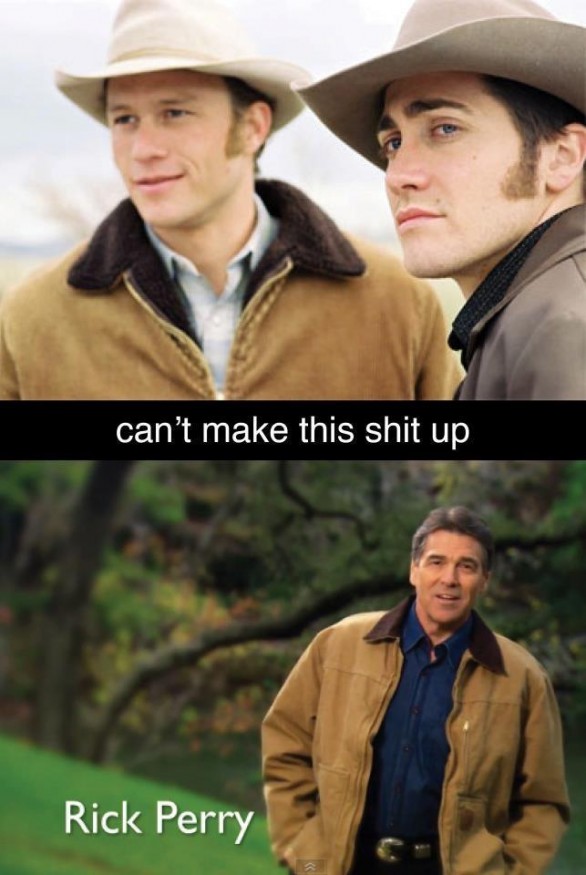
Another which is currently making the rounds:

Upon first seeing this, my reaction was basically “……so?” I still haven’t seen Brokeback Mountain, but am pretty sure I’ve heard every joke about it ever made, because if there’s one eternal truth of the universe it is this: People love joking about Brokeback Mountain. And oftentimes when they’re doing it, they’re using the reference to bring down something else by comparing it to the movie, which is hard to interpret as an endorsement of Brokeback specifically or support of homosexuality in general.

Take this example: Rick Perry is shown in his campaign ad bashing gays while wearing the same jacket as a gay character in a movie. Heehee, homophobe displaying unconscious homoeroticism! But is it, really? Perry is shown doing the George Bush thing, speaking to the heartland while outside enjoying the wilderness…or something…wearing a Carhartt jacket. Carhartt makes sturdy outerwear for sturdy people, and as Michael Heath explains it’s not at all an uncommon thing to see worn by pretty much anyone in the area Perry is addressing:

The Brokeback jacket wasn’t a Carhatt. And Carhartt clothing is associated with people who work outside in inclement weather, along with politicians who pander to them (e.g., Sarah Palin, and now Rick Perry). Their line has nothing to do with gays. It’s like politicians wearing John Deere hats or sporting Pabst Blue Ribbon decals . . . This clothing line is not defined by one mere movie about gays, where it wasn’t even featured. Carhartt is instead defined by its large popularity amongst those who Perry, Palin, Kid Rock, and Hank Williams direct their marketing efforts. I know of no other clothing line which can compete with their market share for outdoor work clothes you’re OK with getting dirty. They’re insulated overalls are especially dominant in my area since we have harsh winters here. You can make a good argument Perry’s pandering to rural populists by wearing work clothes which he’s never done a lick of work in himself. Most of us who wear this line of clothes are not worried about getting them dirty in a way you can’t launder out – as ZZ Top sang about their blue jeans, “you can tell by the oil and gasoline”. But you only embarrass yourself by pointing to one character in one movie and claiming Perry’s out of touch when in fact it’s those comparing this coat to a similar one worn in a movie who are out of touch, precisely because they validate their ignorance regarding its authentic popularity. This is not a close call.

I would add three comments to this:

  1. Heath Ledger’s character in Brokeback Mountain didn’t wear that jacket because he’s gay, but because he’s a cowboy. Duh, right? But this is important because cowboys are conceived as being rugged, tough, traditionally masculine, which is what Perry was going for.
  2. Suggesting that because this style of jacket was worn by a gay character in a movie, we should associate homosexuality with it when it’s worn by a political candidate really smacks of a kind of sympathetic magic. When any item of clothing is worn by a gay character, it becomes gay!  No straight man should wear it ever again if he doesn’t want people to giggle and call him a queer! Is that really the leap that we want to make?  
  3. It’s true that over the top masculinity is often construed as homoerotic. But Perry isn’t dressed as a Tom of Finland illustration here. He’s just a guy wearing an outdoorsy jacket. As more and more movies are made featuring gay characters, those characters are eventually going to wear every item of clothing under the sun. Heath Ledger also wore jeans in that movie, but we’re not saying “OMG jeans are gay!” because jeans are ubiquitous for most of us. Carhartt jackets are ubiquitous in certain parts of the U.S., and as Heath points out that makes the people who are unaware of that and pointing to Brokeback Mountain look rather ignorant. 
One final point, which I alluded to before– attacking homophobes by suggesting that they’re gay is not a compliment to actual gay people. Generally speaking, when people use an attribute that describes you as an insult to others, it doesn’t feel that great. There has been some speculation about Perry’s sexuality in the past, but if the future contains some revelation that he is actually bi or homosexual, two things will be certain: 1) any ensuing mockery should be for his hypocrisy, not his sexuality, and 2) having worn Carhartt outerwear in a campaign ad sure wasn’t a tip-off.  
Sometimes, a jacket is just a jacket.

ETA: Two more comments on the topic….

From scorinth:

“why are you all so sure that all liberal think Carhartts are gay jacket?” Because that’s what the joke is: “Doesn’t Rick Perry look like that gay guy?” Sure. Maybe. Possibly, he looks like that one gay character from a movie. Why? Because he’s wearing a tan Carhartt jacket in an outdoor setting. I dare you to give me some other reason somebody would make that connection. So what people who make that joke are saying is that Perry looks like that one gay guy from the movie, because of the jacket. So, the jacket makes the faggot, so to speak. PROTIP: The majority of people who work outdoors in the central and western US wear clothing that’s very similar to that same jacket. That’s not a small number. I’m talking hundreds of thousands. Probably millions. To completely gloss over their existence and jump straight to the gay character is offensive to me both as a gay man and as a Kansan.

From James Hanley:

Conservatives tend to think liberals are out-of-touch with rural American, and lord how liberals are demonstrating it here.  Look, my liberal friends, Rick Perry is a Texas farmer. You might be hard pressed to find a farm in Texas that doesn’t have a Carhartt’s jacket hanging in the mudroom. One Hollywood movie just ain’t sufficient to make Carhartt’s a symbol of gay culture in America.  Grow up. Deal with the offensive content of Perry’s ad. But stop making yourselves look like effete urban pansies to whom flyover country is a foreign land, a place where you need a passport and a series of shots before you travel there. If you want to win America, you’d do well not to openly show your disdain for such a large part of it.