Skip to content

You know…

You know… published on 1 Comment on You know…

…teaching about the various ways people believe in gods in public school is going to be a little difficult if they’re not even allowed to mention the word for someone who doesn’t.

Text at top: “Will not allow this because it could disrupt the
educational process at LPHS”

From Friendly Atheist:

the Secular Student Alliance group at La Porte High School in Texas wanted to put up flyers advertising their group. To make that happen, the school administration had to approve the design (a standard procedure at high schools).
When they submitted a design for approval, this is the message they got back from the principal

Could the principal have crossed out the definition of “atheist” more vehemently? On the post for this on LPHS’s Facebook page, someone commented “if [sic] his pen were a knife, the poster would be a victim of a crime of passion.”

Victims, skeptics, and politics, oh my

Victims, skeptics, and politics, oh my published on No Comments on Victims, skeptics, and politics, oh my

Jason Thibeault at Lousy Canuck has an interesting post up today on what he calls “hyper-skepticism” with regard to sexual harassment. What he’s referring to is the practice, when such harassment is described, of demanding unusual and unreasonable amounts of evidence for it or else denying that it happened. I say “unusual and unreasonable” because, as Thibeault points out, extraordinary claims may require extraordinary evidence but sexual harassment is not extraordinary. It is, actually and unfortunately, quite ordinary indeed. Not normal or acceptable, but common. It is also something rather hard to prove unless it happens in front of witnesses. I excoriated vagueness in accusations in my last post, but being vague when alleging harassment can be a good idea for the safety of both accuser and accused. For the accuser, because as we’ve seen all too clearly the backlash from people who sympathize with the accused can be immediate and severe. For the accused, because when someone is making a hard-to-prove statement of wrongdoing on your part it’s better if they’re not naming you directly!

Rebecca Watson has been raked over the coals again and again for not naming the person who propositioned her in an elevator at 4am, but I’m glad that she didn’t– for his sake. What he did was creepy but not a crime, and I’m sure that he would have received an inordinate amount of grief, if his identity had been revealed, by well-meaning vigilantes who would consider it their business to shame him on Watson’s behalf. Yes, being non-specific about the person she was accusing made it easier for Watson to have lied, if she so desired. She could have, conceivably, made the whole thing up. But let’s remember that this was originally an anecdote tacked on the end of a video about various topics, accompanied by a simple request: “Guys, don’t do that.” It was not part of some manifesto declaring that freethought conferences are places women should avoid, nor was it a police report. Generally speaking, the more serious an allegation is, the more specific it should be. Right? Watson’s description of the behavior she found objectionable was quite specific because her goal was to identify creepy behavior and encourage other people not to engage in it. It didn’t need to be more specific than that, however, because the behavior she was describing stopped at “creepy.” Creepy is bad, but it’s not the end of the world, either for the creeper or for the person who has to endure him/her. But let there be no mistake, every time someone mentions what she (almost always “she”) believes to be creepy behavior at a conference, a number of someones can be counted upon to rise up in defense of the creeper. I’m pretty sure at this point that someone could describe a stranger walking up and grabbing both of her breasts and squeezing, and somebody would reply “I can’t believe you were bothered by that! You should be flattered! Feminist cunt.”

Let’s go back to that word, actually– not “cunt” (I don’t have the patience to discuss that right now) but “feminist.” One of the things I didn’t particularly like about Thibault’s post, and that I am seeing all over the place, is that DJ Grothe has a problem with feminists. Thibault’s post reads

When the conversation was not going his way, DJ made some very pointed remarks about specific women who’ve worked on the problem of harassment before; including some women who had taken him personally to task for attacking feminists as contra the skeptical movement, and defending some rather indefensible folks (including the Epstein/Krauss flap) in the past.

Did he, in fact, “attack feminists as contra the skeptical movement”? That link goes to an entry on Stephanie Zvan’s blog Almost Diamonds, which quotes Grothe saying

This will be my last post on this topic. I’ll go back to believing what I have believed for a while now about some of these atheist blogs, now yours included: that fomenting movement controversy often seems to be prized over honest and sincere argument, that some folks are too quick to vilify and engage in destructive in-group/out-group thinking, that these online communities are exclusive rather than inclusive, and that unfortunately as a whole, the feminist and atheist blogospheres often operate quite separately from and counter the growing skeptical movement working to combat unreason and harmful pseudoscience in society.  

Answer: Nope. Just like he didn’t say that feminists, or women skeptics, are the reason that fewer women are planning to attend TAM this year. These distinctions are important. If it’s wrong to blame “feminists” for such things, it is also wrong to take umbrage on behalf of feminists in general when feminists in general have not been blamed. It assumes that everyone who is a feminist agrees with your particular brand, which is never a good thing to assume. Now, Grothe might have a problem with feminists in general, or more accurately what he perceives feminists to be. But that quote doesn’t justify saying so. I certainly don’t think that Grothe has a problem with atheists in general, considering that he is one. I’m a feminist– a feminist blogger, even– and could be the author of the above quote without accusing myself of countering the skeptical movement. I might be, if I were as exasperated at Grothe clearly was. He was certainly correct that atheism is not skepticism is not feminism, and it’s easily possible for a blogger writing in service of one to  counter the interests of another. Whether this happens “often” is difficult to evaluate.

Another worrisome message that I have seen repeated, over and over, is that any judgment of how a victim of sexual harassment reacts to such harassment is wrong and constitutes victim-blaming. This is generally made in response to “hyper-skeptics” (still not sure I’m a fan of that word– it implies that the problem is an over-abundance of skepticism, when really it’s highly selective skepticism) who declare that women who don’t report sexual harassment must not have actually felt harassed. This is a silly thing to say on the face of it, but even moreso given that most skepticism conferences haven’t had policies on sexual harassment until this whole dust-up happened, and TAM’s was established last year because of Watson’s experience. So reporting these incidents hasn’t really been an option, and Jen McCreight has an extensive post about risks to the victim that encourage her to be silent, vague, or anonymous. However, that does not mean that any reaction by the victim should be considered beyond reproach, and it doesn’t mean that Grothe should have known about harassment cases weren’t reported and weren’t mentioned in the survey conducted to find out how welcome people felt at TAM last year. After the topic of sexual harassment at skeptic conferences was tossed around post-Women in Secularism conference and some very stupid people decided that Zvan, McCreight, and Greta Christina are the new feminist Taliban determined to erase the very mention of sexuality from any freethought conference henceforth (no, I’m not kidding), Zvan told conference organizers that those who don’t have one should make a sexual harassment policy already, which seems eminently sensible and not at all Taliban-ish to me. However, as noted TAM did have such a policy already, unlike the apparently half dozen conferences who have created their own in response to this discussion.

If sexual harassment occurs at atheist and skeptic events– and clearly it does– it’s a problem that deserves attention. But it’s not an enormous problem, and it sure isn’t somehow a particular concern for such events as opposed to any other gathering of men and women. The problem is not that sexual harassment is rampant at skeptical conferences and DJ Grothe doesn’t care and refuses to do anything about it. The problem is that some people for whom feminism and skepticism are both big concerns (which should describe all skeptics, but sadly it doesn’t), have probably unintentionally made it sound as if it’s an enormous problem and also characteristic of skeptic conferences, which provoked the organizer of one such event to, without real evidence, accused these people of contributing to the very problem they fight on a daily basis– under/misrepresentation of women in skepticism.

So you can see why everybody’s pissed off.

I’ll just end by linking back to this very important reminder about causes and egos.

Oh, and to this comment, just posted, from Grothe to Watson. I am not quite sure why Grothe so often posts extensive and important messages to people in comment sections on blogs and Facebook, where you’d think they stand a much higher chance of vanishing into the ether, but he clearly put a lot of thought into this one.

Sexual harassment and TAM

Sexual harassment and TAM published on 11 Comments on Sexual harassment and TAM

No weekend web readin’ post this weekend, I think, because the majority of my web reading lately has been all about sexual harassment at skeptical/atheist conferences. I’ve been to a total of one such conference, but would be up for attending more, especially The Amazing Meeting (TAM), which is produced by the James Randi Educational Foundation (JREF) and takes place in Las Vegas every July. That remains the case in light of the current shit storm going on. What shit storm, you ask? Well, I’ll do my best to provide an executive summary.

See, sexism in the skepticism/atheism movement (I’m going to just pretend they’re the same for now, even though I know all of the problems with that) has been a hot topic for quite a while now, especially since elevatorgate. Then in mid-May of this year there was the Women in Secularism conference, which sparked a discussion on women being under-represented, harassed, and generally treated poorly at other conferences devoted to secularism, and that has been an ongoing topic in a lot of places, including the blogs of several people at Freethought Blogs (FtB). I’ve been reading these posts and the conversations in the comments that result from them, which is how I learned that Rebecca Watson (of The Skeptic’s Guide to the Universe, and founder of Skepchick) will not be going to TAM this year. Why is that? After all, Skepchick has established a fund to provide grants for women to attend TAM, officiated currently by Amy “Surly Amy” Davis Roth.

Well, Watson explains, it’s because she thinks JREF’s president, DJ Grothe, has said that she is the reason why women are being dissuaded from attending TAM. Or at least, a reason. Here’s what Grothe said:

Last year we had 40% women attendees, something I’m really happy about. But this year only about 18% of TAM registrants so far are women, a significant and alarming decrease, and judging from dozens of emails we have received from women on our lists, this may be due to the messaging that some women receive from various quarters that going to TAM or other similar conferences means they will be accosted or harassed. (This is misinformation. Again, there’ve been on [sic] reports of such harassment the last two TAMs while I’ve been at the JREF, nor any reports filed with authorities at any other TAMs of which I’m aware.) We have gotten emails over the last few months from women vowing never to attend TAM because they heard that JREF is purported to condone child-sex-trafficking, and emails in response to various blog posts about JREF or me that seem to suggest I or others at the JREF promote the objectification of women, or that we condone violence or threats of violence against women, or that they believe that women would be unsafe because we feature this or that man on the program. I think this misinformation results from irresponsible messaging coming from a small number of prominent and well-meaning women skeptics who, in trying to help correct real problems of sexism in skepticism, actually and rather clumsily themselves help create a climate where women — who otherwise wouldn’t — end up feeling unwelcome and unsafe, and I find that unfortunate.

Here’s some relevant context:

1. Watson has endured a hard-to-imagine-if-you-haven’t-watched-it deluge of attacks since she described an unwelcome and slightly frightening come-on she received during a conference in a video she posted in June of last year. This stream of attacks was, I’m sure, aided by a sneering dismissal from Richard Dawkins that I thought was fake at first, and felt like a bizarre betrayal of the humanistic stance that people who decry religion in the name of morality should be obliged to take.

2. Grothe has been active in discussions on FtB regarding this whole matter. When asked to be more specific about examples of “prominent and well-meaning skeptics” contributing to an unsafe climate by using misinformation, Grothe threw out several examples. He began with a comment Watson made to USA Today last year:

Off the top of my head, your quote in USA Today might suggest that the freethought or skeptics movements are unsafe for women. This is from the article:
“I thought it was a safe space,” Watson said of the freethought community. “The biggest lesson I have learned over the years is that it is not a safe space. . . ”
(http://www.usatoday.com/news/religion/story/2011-09-15/atheist-sexism-women/50416454/1)
If we tell people that our events or our movements are not safe for women, some women are bound to believe that. If I as a gay man had never attended a freethought or skeptic event and read in a national newspaper that that community wasn’t a safe space for gay people, I would certainly be reluctant to get involved.

3. Grothe is apparently mistaken about there having been no reports of harassment at TAM while he was president of JREF. Some say lying; I’m going to go with mistaken until it’s demonstrated otherwise. He says that JREF conducted a survey of TAM attendees last year to see how welcome they felt at the conference:

Of 800+ responses to this comprehensive survey, only two people reported feeling “unwelcome” at the event. Both of these respondents were men. One was a conservative who felt several speakers insulted his political beliefs. The other was a retiree who “hates” magic. 11 respondents to the survey did report a problem with an interaction with someone else that made them feel uncomfortable or unsafe (this was a difference [sic] question on the survey). 3 of them were men who did not elaborate on the interaction and 3 were from women who did not elaborate on the interaction. Another was a woman who reported a speaker was rude to her when she asked for a photo. Another was a woman who was made fun of for not being an atheist. Another was a woman was ridiculed for being a vegetarian. Another was a woman who reported no specific incident but claimed her enjoyment of the event was negatively affected by the “drama surrounding elevator gate” and “having to hear everyone talk about it.” Finally, one person did report feeling uncomfortable around an attendee, fearing future possible sexual harassment, and while we are concerned about such concerns, there was no complaint of any actual activity that had happened that the hotel or security or law enforcement or others could take action on. Importantly, every one of these 11 respondents nonetheless reported feeling welcome at TAM. It is inaccurate to say that “women do not feel welcome” at these sorts of events, judging by the 40% women attendance last year at TAM and these survey results. Similarly, I think it is an irresponsible message to tell people that women are “unsafe” at these events.

4. There is a greater context of accusations against Grothe, including demands that he resign as president of JREF.

5. Amy of Skepchick continues to promote grants for women who couldn’t otherwise afford it to attend TAM this year. She’s raising money by selling some of her ceramic jewelry, specially designed pendants for the cause.

6. There has been a lot of misinformation spread in the comments surrounding this issue. I have seen people claim that TAM never had a sexual harassment policy, when in fact it has had one for more than a year. I’ve seen people claiming that there is an organized effort by bloggers at FtB to remove women from skepticism conferences entirely. I’ve seen claims that they are forming a covert blacklist of speakers to pressure conference organizers into never inviting again, based on vague accusations of being “skeevy.” I’ve seen claim after claim after claim saying that Grothe was blaming people talking about harassment at conferences in general for the significant drop in women who have registered to attend TAM this year. That he’s blaming victims and trying to get them to shut up rather than authentically addressing a real problem.

Considering the fallout Rebecca Watson experienced from a really very benign and casual comment regarding a situation at a conference that made her uncomfortable, as well as several other unpleasant experiences she claims to have had at conferences, it’s entirely understandable why she would not choose to attend future such gatherings in the future. It is also understandable that other women who have experienced harassment at conferences would feel reluctant to report such, after witnessing the backlash against Watson that extended even to such a respected figurehead as Dawkins.

You know what’s also understandable? The fact that someone in DJ Grothe’s position would look at this outcry, and the fact that the female registration for TAM has dropped so significantly in the past year in spite of no official record that sexual harassment has occurred at the conference, let alone at a staggering rate, and conclude that a campaign of misinformation is responsible for at least some of that. In alleging such, he clarifies that he is talking about a “small number” of female skeptics who are “trying to correct real problems of sexism.”

Yes, declaring that the freethought movement in general is “not a safe space” for women is irresponsible. Vagueness might as well be misinformation, because a true statement that can just as easily be misinterpreted as a false one is of no help. This statement also suggests that the freethought movement is somehow less of a safe space, on the whole, than other movements or organizations, which is not true and definitely not a message anyone involved in it should want to send. I can entirely understand Watson concluding that the freethought movement is not a safe space for her, and it goes without saying that her grievance, and the attacks she has endured for her grievance, would not have happened were she not female. But that does not mean that any particular freethought conference isn’t a safe space for women.

I often disagree with PZ Myers, but in this case I found what he has to say very level-headed. From DJ, please fix this genuine problem:

It’s all well and good to have a piece of paper that you can wave around, saying that harassment will not be tolerated…but the next step is effective implementation, and that hasn’t occurred. Document everything: there should be a formal procedure for submitting a report in writing that gets filed away. There should also be an action taken — dismissing the offender from the conference, escorting someone out of the hall, giving a verbal warning, whatever — and that should be written down, too. Without all that, we get into these ugly situations where the victims experience these events, and then watch them get flushed down the memory hole — their concerns are simply dismissed. DJ needs to own up to the existence of a real problem, rather than closing his eyes to it and pretending it’s only a PR issue. He’s got to take TAM’s anti-harassment policy seriously, and give it some teeth and engage in some record-keeping. I do think he means well, but good intentions are not enough. There has to be some solid effort beyond drafting a list of dos and don’ts.

Why I’m a libertarian feminist atheist skeptic

Why I’m a libertarian feminist atheist skeptic published on 6 Comments on Why I’m a libertarian feminist atheist skeptic

…in four paragraphs:

Libertarian: I mistrust government, a whole lot. I believe that market forces are preferable to legislation when it comes to getting things done, because they are more voluntary (consent is always best) and more easily reversible. I believe that the pursuit of happiness is a personal thing and takes different forms for different people, and the government’s main job should be to allow us room to conduct our individual pursuits. It should prevent us trampling on each other in the process and enable those of us who by circumstances of birth or misfortune have been denied the ability, but otherwise stay the hell out of the way. I am a left-libertarian, not a paleoconservative, states’ rights, or Ayn-Rand-worshiping libertarian.

Feminist: Sexism is a bigotry that generally takes the form of explicit assertion or implicit suggestion that men must be one thing and women another, and that women exist for men (as ornamentation or care-givers, means of reproduction, and so on) rather than for themselves. I oppose any attempt to institutionalize this idea via law, and argue against the endorsement of it in culture. I am an individualist feminist, not a difference feminist or misandrist.

Atheist: I consider it highly unlikely that our great big messy very old universe came into being via the deliberate machinations of an infinite mind, much less the kind usually asserted to be responsible for doing so. And if the complexity of this universe, and of us specifically, requires explanation by appeal to such agency, then surely the agency itself demands such all the more. I believe that supernatural beings are neither required nor sufficient to supply existence with meaning or morality. I am a “good without gods” atheist, not a “believers are stupid” or “believers are evil” atheist.

Skeptic: Science is a tool for knowing the empirical world– the best one we have. Considering that, it would be a shame not to use it whenever possible and when we do forget to use it, it’s always to our detriment. I view mystery as a door to open and explore beyond rather than to hammer shut with nails marked cultural reverence, tradition, religion, or magic. I believe reality is always more fascinating than the myths we make up to replace it, but imagination is important because it’s our ability to wrap our minds around what is really real. I am a “let’s find out the truth” skeptic, not a cynic, pessimist, or “You must share my other ideologies or else you’re not really a skeptic” skeptic.

Note: This post brought to you by two discussions I’ve read recently in which at least two of the above were alleged to be incompatible. I am convinced that they are not, or at least don’t need to be.

The squeaky wheel will never be trusted…or something

The squeaky wheel will never be trusted…or something published on 2 Comments on The squeaky wheel will never be trusted…or something

I do not like Psychology Today. I’ll say that up front.

That’s primarily because “fluff” would be a gracious term to apply to most of its articles, and they have the annoying habit of presenting whatever trend or subject being discussed as a brand new phenomenon, accompanied by the inevitable cover advertising the preeminent story of the issue by manipulating an image of an attractive white woman’s face and/or body in some way– the newest issue (June) features a discussion on “difficult people,” so the cover image is of an attractive white woman’s face painted with a symbol for radioactive materials. Clever.

But my attention was drawn to that cover, not so much because of an urge to find out why difficult people resemble models dressed up as hazardous waste as because of another headline: “The Atheist in the Next Pew: A New Breed of Nonbelievers.” The article is actually called “The Atheist at the Breakfast Table,” which is behind a paywall at Psychology Today’s website but you can read the full version at the site of its author, Bruce Grierson. Grierson wrote an interesting overview of what life is like for “quiet atheists” who go about their daily lives being generally indistinguishable from theists, even attending church, and taking great pains to make sure their children are exposed to religion– to the point of hiding their own lack of faith so as to avoid “foisting” their atheism on them. And right on cue he portrays these quiet atheists as a new breed of nonbelievers that you really ought to get to know in order to avoid stereotyping the whole lot as being like those nasty, obstreperous, faith-trampling New Atheists we’ve heard so much about.

And what about them, anyway? Well, Grierson doesn’t use that term, but…

The kind you hear about are crusaders with a specific agenda: to challenge religious bigotry wherever it raises its head. Since 9/11 particularly, they have stepped up their campaign, galloping through the chapel with the guns-ablaze fervor of a persecuted minority, cataloguing the harms that have been done in the name of organized religion. That strategy, while it has definitely raised atheism’s profile — partly by polarizing the religious debate — hasn’t exactly endeared atheists to the majority of Americans. Indeed, polls consistently show that dislike and distrust for atheists goes wider than for any other identifiable group.

Hoo boy.

Okay, first of all…as has been pointed out already by commenters on Friendly Atheist, there is a bit of bitter irony in that description of atheists metaphorically “galloping through the chapel with the guns-ablaze fervor.” The “galloping” I am guessing is an oblique reference to the famed Four Horsemen of the Atheist Apocalypse, aka the “New Atheists” Daniel Dennett, Richard Dawkins, Christopher Hitchens, and Sam Harris. The bitterness comes in considering that there have been some literal guns blazing in chapels in the past few years, and it hasn’t been by atheists. The incident of which most near (again, literally) and dear to me being, of course, the murder of Dr. George Tiller in 2009. So, perhaps not the best mental image to evoke there.

Second, the “fervor of a persecuted minority”? Atheists are undoubtedly a minority, at the 15% of the population Grierson claims they represent after their numbers have doubled in the last twenty years. Are they persecuted? Well, let’s see. One openly atheist member of Congress, support groups for clergy who find that they’ve lost their faith and need help finding new employment and adjusting to the social fallout, teenage atheists being called horrible things and sent death threats, the majority of Americans by far deeming them untrustworthy, ranking below Muslims and homosexuals and about on the level of rapists…it depends on how you define persecution, I suppose.

But the big whammy comes in the final two sentences of that paragraph. “That strategy,” meaning all of this aggressive fussing– in particular since 9/11– has not endeared atheists to the majority of Americans, who dislike and distrust them more than any other identifiable group. Which mustn’t, I guess, be mistaken for persecution because atheists brought it on themselves. This is an obvious example of the post hoc ergo propter hoc fallacy in that Grierson makes no attempt to actually show that any “campaign” by atheists resulted in the popular animosity against them, and that’s a problem not just because it’s a highly questionable suggestion to make (and I’ll explain why in a moment), but also because Grierson’s article can be summed up as an attempt to introduce readers to a kinder, gentler, quieter form of atheist that is presumably more normal and likable, who don’t deserve the ill will that those loud obstreperous types…do? Which is quite like saying “Let me introduce you to some closeted gays, so that you don’t think all gays are flamboyant leather daddies like the kind that march down the street with the floats and the banners and the balloons.” True, maybe, and an important distinction to make, but not exactly the best way to honestly combat prejudice.

And prejudice is, frankly, what it is. It didn’t begin with the advent of the “New Atheists” (which I would tentatively date at mid-2004, when Sam Harris’ The End of Faith was published–  Breaking the Spell and The God Delusion came along in 2006, and God is Not Great in 2007). 48% of Americans said that they would not consider voting for an atheist for president in 1999, more than those who would refuse to vote for a Muslim, homosexual, Mormon, Baptist, or Jew (all of whom were below “Black,” by the way), which was evidence of a gradual improvement in esteem from 1958’s 75%. The majority of those polled have regarded atheists as “untrustworthy” for quite a while, plus there is the consideration that when confronted with thoughts of death (which a terrorist attack that annihilates two buildings and kills almost 3,000 people is likely to encourage), people tend to hold tightly to their ideologies of family, religion, nation, etc. and judge more harshly those who defy them. You would expect (and, if you’ve been paying attention, have seen) massive lashing out at Muslims in America since 2001, but the antipathy toward atheists was unanticipated. It makes sense, however, in light of a communal urge to join together on a meaningful basis. And an interfaith community (We all worship God, in our own way) is a short but cavernous step away from accepting those with no faith at all. Cavernous, as in that scene in The Fellowship of the Ring when the entire company is attempting to escape from the Balrog in the Mines of Moria by leaping from one precarious promontory of broken bridge to the next?

Yes, about like that.

Religion is and isn’t special

Religion is and isn’t special published on 1 Comment on Religion is and isn’t special
Passerotti, God the Father

The primary reason, it seems, that people are now telling Dan Savage that he shouldn’t have apologized– even in as qualified and precise terms as he did– is because it gives the impression that one should not criticize religious beliefs. And if one does so, and it offends, the appropriate thing to do is to relent and express sincere regret. The basic impression of someone who hasn’t dug into the details and/or prefers not to consider them is that Dan Savage insulted Christianity, Christian students were offended, and so Savage apologized to them. Examining the situation beyond that very superficial level reveals all three of these statements to be inaccurate, but people who are just fine with the idea of insulting religious beliefs are concerned to see Savage, ordinarily very much just fine with doing such himself, suddenly appear to acquiesce to those he disturbed. It looks like appeasement, like giving up legitimacy and rhetorical ground.

The “spell” referenced in the title of philosopher Dan Dennett’s book Breaking the Spell is not religion itself, but the protective aura of deference surrounding discussion of it. Dennett argues that if we aim to properly discuss the origins and effects of religion, we can’t be held back by barricades of etiquette which allow the description of religious beliefs and practices as true and/or moral, but not false and/or immoral. Further, we must reject the proposition that religion is a sui generis pursuit, noncontinuous with other kinds of human thought and behavior or even with other kinds of non-human animal thought and behavior. Does this mean saying religion is just like all other kinds of basic things humans– and even other animals– do? No, of course not. The fact that it has a name, constitutes a category, suggests that there are reasons for saying that some things people do, say, and believe are religious whereas others aren’t. However it’s also true that religious speech is a kind of human speech, religious behavior is a kind of human behavior, and religious beliefs are kinds of human beliefs. These are all things that humans conceive, live, and do with their human brains and their human bodies in their human societies and cultures. Studying the cognition of religion– the production and perpetuation of it in terms of how minds produce and perpetuate all other kinds of human activity– means starting with this recognition.

It sounds pretty basic and non-controversial, except when you consider that there are believers who are so certain of the one-of-a-kind, completely separate and special nature of their beliefs that they won’t even call them religion. Instead you get “I’m spiritual; not religious” or “Other people have religion; I have a personal relationship with Jesus.” To them, “religion” is the category of all of the failed, false, misguided attempts of humanity to reach the divine, whereas they have the real thing. To say otherwise is not only mistaken but offensive, precisely because this body of beliefs has been declared so very personal. You wouldn’t question out loud whether someone loves his mother, and for that same reason you shouldn’t question whether he loves his Lord– or how he knows he has a Lord in the first place. The problem is, of course, that loving someone is a highly subjective and emotional matter, whereas gods, spirits, ghosts, demons, souls, and any other entities which are supernatural but asserted to exist objectively are not. Whether God exists as creator of the universe and answerer of prayers, performer of miracles, and possible hater of gays is an objective proposition whose truth or falsity matters. The truth or falsity of the objective existence of all things matter, of course, but you’d think especially that of the supposed origin of life, the universe, and everything.

So claims of empirical truth that come from religion are just like all other empirical truth claims in terms of being subject to the same demands for evidence and justification. Atheists by definition are just people who don’t believe in any gods, but atheists who are also skeptics will point out that they disbelieve because they have searched for such evidence and justification and found them to be lacking. The case for God did not convince them. This is obviously not the entire story, however…atheists are not rational androids who simply  applied logic to the proposition that gods or the entirety of supernatural agents existing and then concluded that they don’t. Being human, atheists are subject to the same intuitions and biases that affect everyone else– and that’s where things get interesting.

See, there’s reason to believe that religion is intuitive….that we suspect and come to believe in the existence of “spiritual beings” because of ordinary features that come with being human. We are social animals, particularly keen to detect and discern the motivations of other creatures with agency. We anthropomorphize at the drop of a hat. We have an existential sense that makes questions like “What’s it all about, anyway? Why are we here?” seem not only sensical but important– especially in the face of crisis. We are incapable of knowing what it’s like to be dead, because there is no way to be conscious of complete non-consciousness (no, sleeping does not count), so accounts of life after death seem compelling and we speculate about what Grandma must be thinking and feeling or even doing right now, even though she passed on years ago. Participating in religious rituals makes other participants feel like family, even if they aren’t actually kin, and being willing to expend resources to do so presents a powerful signal to others of our commitment to the group. We tend to believe in a just universe— the idea that immoral acts must be punished and good ones rewarded, somehow in the fabric of existence if not through the justice systems humans have created. There is just all of this stuff that human brains are prone to do that makes belief in supernatural entities and moral codes likely, if by no means determined. And of course there’s the fact that each individual human born into the world doesn’t have to take on the responsibility of creating a religion from scratch– there is almost certainly one available for him or her, handed down from his or her parents virtually from birth.

Some recent research has indicated that more intuitive thinkers tend to be more likely to also believe in a personal god. An intuitive thinker is a person who tends to think with his or her “gut,” allowing feelings to guide conclusions about the rightness or wrongness or even truth or falsity of different propositions. Intuitive thinking is reflexive and quick, and– let’s be honest– how most of us think, most of the time. It’s not a bad thing; in fact without intuitions we would be utterly lost. We just don’t have the time to make all of the thousands of decisions we make in a day by taking a time out, sitting down, and pondering what to do while taking every possible factor into consideration, weighing the pros and cons, and making an inductively or deductively reasonable conclusion…which charitably but falsely assumes that that’s what we are inclined to do in the first place.

The human mind is designed to reason adaptively, not truthfully or even necessarily rationally.

It would be far too cut and dry to say that intuitive thinking is affective, feeling-based, whereas counter-intuitive thinking is…well, thinking-based, but let’s say that counter-intuitive thinking is more reflective. It’s slower and requires a little more effort. Well, a little effort, period, as opposed to simply allowing your first emotionally-laden conclusion to rule the day. It’s intuitive for a religious person to think about God as behaving more or less like a super-human— having amazing powers and knowledge, but still doing things like focusing on one thing at a time and using the most direct physical means to cause events. Having a gender, opinions, and emotions. That’s the “personal god” the most intuitive person is most likely to believe in. I like to say that religion is intuitive but theology is counter-intuitive– theology is where you will find descriptions of God as a genderless amorphous “ground of being” whose behavior (if you can call it that) is complex and ubiquitous. This god is ultimate, and by that I don’t mean “super awesome” but rather “distant and removed.” This is not a god who intervenes directly in human endeavors by means of causing either catastrophes or miracles in order to influence our behavior. That is a proximate, personal god, the kind of being Pat Robertson and the late Jerry Falwell would describe as punishing liberals every time a natural disaster or terrorist attack occurs. This is the god Rick Perry ordered Texans to pray to for relief from drought and threats to property rights, and who he, Michele Bachmann, Rick Santorum, and Herman Cain all believe told them to run for president. The god George W. Bush says told him to go to war.

You can probably guess the dangers I see in making God that personal, that proximate. But thoughtful theists generally recoil from it. They recognize the problems in claiming that God subverts human choices (“free will”) to specially punish or reward politicians, the enemies of fundamentalists, or football teams, not to mention directly cause or inhibit natural events such as tornadoes, tsunamis, or the processes of natural selection. Evolution is not a threat to a person who doesn’t demand that God be proximate. The plaintiffs in Kitzmiller v. Dover were mostly Christian, a couple of them even Sunday school teachers, but nevertheless they were branded atheists for supporting the teaching of evolutionary theory in public schools unqualified by disclaimers questioning its validity. From the perspective of someone who believes in proximate, personal, In-Your-Face God, everyone who isn’t might as well be a nonbeliever. And nonbelievers are the enemy.

This is the type of person who views critique of his or her religion as bullying or blasphemy, who places matters of faith off limits to critical discussion while simultaneously holding that God intercedes directly in world events in a perceptible ways on a regular basis– that is, that God’s existence, nature, and behavior are easily empirical matters. This is the type of person who, while virtually ubiquitous, must not be allowed to dictate the rules of the conversation. If they are, the definition of “respect” becomes “behave as though my beliefs are true,” when in actual fact a) it is possible to maintain that a belief– any belief– is false respectfully, and b) respect can and often should be abandoned when considering beliefs that are ridiculous and/or obviously harmful. It’s not a choice between understanding these beliefs and openly forming opinions about their truth or falsity, how morally acceptable or objectionable they are– we can and should strive to do all of the above. With these as a simultaneous goal, it becomes easier to identify when being critical crosses over into being an asshole and when being empathetic and understanding crosses over into being a doormat.

Religion is special.
And it isn’t.

How to be an atheist who doesn’t hate religion

How to be an atheist who doesn’t hate religion published on No Comments on How to be an atheist who doesn’t hate religion

Are you an atheist? Do you hate religion? “Well, I don’t hate it,” I can hear you say. “Or at least, I don’t hate religious people. I just think that fundamentally it’s better not to be religious, because religion isn’t true. And I do really hate a lot of what people do in the name of their religious beliefs, such as trying to pass laws to make me follow them. It’s not like I go around being a jerk to religious people and telling them their beliefs are wrong just for the hell of it.” I hear you. “I’m not even going to say that religion is a greater force for negative than positive in the world because clearly a lot of people have religious motivations for being moral.” I hear that too.

Let me give you two cases to consider of atheists who are not altogether opposed to religion, along with a suggestion of who to emulate.

Case #1: Jonathan Haidt
Jonathan Haidt is a psychologist who studies morality. His stance is that the vast majority of moral judgments are intuitive in nature, reached more because of gut feelings than deliberate reflection. In order to better understand the bases from which people from different political factions derive their emphasis, he has articulated separate domains of moral concern such as reciprocity, purity, and liberty and argues that the reason liberals and conservatives so often talk past each other is because they assume priorities for these domains differently. He says:

What’s an atheist scientist like me doing writing good things about religion? I didn’t start out this way. As a teenager, I had contempt for religion. I was raised Jewish, but when I read the Bible, I was shocked. It hardly seemed to me like a good guide for ethical behavior in modern times, what with all the smiting and stoning and genocide, some of it ordered by God. In college, I read other holy books, and they didn’t make me any more positive toward religion. In my 20s, I obtained a Ph.D. in social psychology and began to study morality. I ignored religion in my studies. We don’t need religion to be ethical, I thought. And yet, in almost every human society, religion has been intimately tied to ethics. Was that just a coincidence? In my 30s, I began to study the emotion of “moral elevation.” That’s the warm, fuzzy feeling you get when you see acts of moral beauty. When you see someone do something kind, loyal, or heroic, you feel uplifted. You can feel yourself becoming a better person — at least for a few minutes. Everyone who has watched an episode of Oprah knows the feeling, but there was absolutely no scientific research on this emotion. Studying moral elevation led me to study feelings of awe more generally, and before I knew it, I was trying to understand a whole class of positive emotions in which people feel as though they have somehow escaped from or “transcended” their normal, everyday, often petty self.

I was beginning to see connections between experiences as varied as falling in love, watching a sunset from a hilltop, singing in a church choir, and reading about a virtuous person. In all cases there’s a change to the self — a kind of opening to our higher, nobler possibilities. 

Now, one may or may not agree with Haidt about the importance of religious kinds of “moral elevation” (which you can read more about in his book The Happiness Hypothesis and apparently the newly published The Righteous Mind, which I haven’t read yet but am eager to). Haidt believes that the moral domains are evolved tendencies– and that includes the domain of purity, which is tied most directly to religion– and there is considerable room for disagreement there. However, Haidt recognized some things which really shouldn’t be a surprise:

  1. Religion is both causal (it makes things happen) and caused (things make religion happen), 
  2. We don’t understand nearly enough about how either one works, and
  3. The causes and effects of religion can’t be nearly summed up in the truth or falsity of religious beliefs
The latter proposition might seem questionable– isn’t it bad to believe false things, and good to believe true ones? Well, sure. But people reach beliefs for all sorts of reasons besides those beliefs being true– in other words, because of biases– in every part of life, in every culture across the world. Rather than thinking of biases as being deviations from our ordinary path of rationality, it would be more accurate to say that rationality is a deviation from our ordinary meandering path of bias. People have to be taught how to think critically, how to be skeptical, because it isn’t intuitive. Once Haidt discovered this about morality generally, he started applying it to politics and religion and suddenly disagreements about such things started to make a lot more sense. 
Case #2:  Alain de Botton
Alain de Botton is a Swiss philosopher. In contrast to Haidt, who came to understand the relevance of understanding religion scientifically, de Botton seems almost allergic to science. However, he doesn’t hate religion– in fact, he’s enamored enough of it to title his new book Religion for Atheists, and some statements he has made in it and elsewhere have a lot of atheists scratching their heads. Such as “Probably the most boring thing you can ask about religion is whether or not the whole thing is ‘true’.” This matter might be boring to de Botton and others who reside in countries where religious belief is more settled in the realm of the theological and less in public life, but it’s a top concern to theists and atheists alike in places where this is absolutely not the case, and it’s startlingly myopic for him not to recognize that. Further, de Botton’s characterization of the abandonment of religion and pitfalls that he alleges exist in the process are so bizarre that I’ve seen several question whether he is, in fact, an atheist:

In my book, I argue that believing in God is, for me as for many others, simply not possible. At the same time, I want to suggest that if you remove this belief, there are particular dangers that open up – we don’t need to fall into these dangers, but they are there and we should be aware of them. For a start, there is the danger of individualism: of placing the human being at the center stage of everything. Secondly, there is the danger of technological perfectionism; of believing that science and technology can overcome all human problems, that it is just a matter of time before scientists have cured us of the human condition. Thirdly, without God, it is easier to lose perspective: to see our own times as everything, to forget the brevity of the present moment and to cease to appreciate (in a good way) the miniscule nature of our own achievements. And lastly, without God, there can be a danger that the need for empathy and ethical behaviour can be overlooked. Now, it is important to stress that it is quite possible to believe in nothing and remember all these vital lessons (just as one can be a deep believer and a monster). I simply want to draw attention to some of the gaps, some of what is missing, when we dismiss God too brusquely. By all means, we can dismiss him, but with great sympathy, nostalgia, care and thought.

This sounds like a list of concerns of someone desperately trying to hang onto faith– not someone who has left it behind. There is no real evidence to support the idea that these are things to worry about, and arguably more showing that these tendencies, especially “placing the human being at the center stage of everything,” might be far more encouraged by religion than the lack of it. Describing atheists as “believing in nothing” is a good way to piss off many of them (there being all kinds of things to believe in besides gods, most of which are non-controversial), but more irritating to me is the unspoken assumption that in order to lose one’s faith properly, a person must take great care to do so with “great sympathy, nostalgia, care and thought.” How does one do that, exactly– pause for a few months in between concluding that there is no such thing as Hell and deciding that the same thing is probably true of Heaven in order to focus empathetically on the concerns of people who believe in both?  
That sounds nice…I suppose…but it’s not how making one’s mind up works. Not all atheists used to be theists, of course, but for many of those of us who did, the de-conversion process was long and emotional. It involved consideration of how religious people can behave so poorly, if God is the source of morality. How to know the truth, when so many religions claim to have it (accompanied by penalties for those who disregard their particular brand of truth) and faith as the only “evidence” offered. Whether to be open about our doubts when it could cause detrimental effects in terms of family alienation, the workplace, and possibly even backlash in the greater community (as happened for Jessica Ahlquist). Whether there actually is any argument out there in support of God’s existence that is easily logically refuted and has been, over and over and over (spoiler: nope). There really is nothing new under the sun when it comes to that– nobody seems to have been converted to theistic in the first place by the argument from design, Pascal’s Wager, the cosmological argument, and so on, but boy are those ancient arguments revived and reformulated to battle those philosophy text-pounding atheists! (After hearing Pascal’s Wager for roughly the 4,000th time, I became strongly tempted to just link to the episode on that topic of Logically Critical). Point being, telling people that they need to exercise great care in the process of leaving their faith behind is not only misguided and impractical but also patronizing and insulting– if there is something to think of, they have thought of it. 
Ed Brayton called de Botton a “concern troll” today, and I can see his point– a concern troll is a person who presents him/herself as aligned with whatever cause is being discussed, but makes suggestions and recommendations which purport to be helpful but actually sound like they’re coming from someone who is actually highly ignorant of and/or opposed to the cause. de Botton really does sound like if Ken Ham decided to re-brand himself as an atheist. 
So…quiz time! Which atheist-who-doesn’t-hate-religion is a better role model?

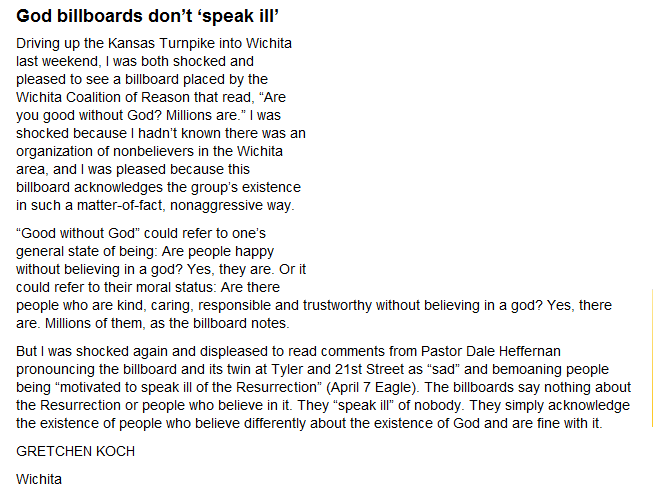
If I’m going to be in Wichita….

If I’m going to be in Wichita…. published on No Comments on If I’m going to be in Wichita….

…you can bet I will be writing letters to the editor:

If it’s not a battle, why make it one?

If it’s not a battle, why make it one? published on No Comments on If it’s not a battle, why make it one?

The ever-controversial American Atheists have erected billboards in Paterson, New Jersey (large Muslim population) and Brooklyn, New York (large Jewish population), respectively, with the following two messages:

Even though the CNN Belief Blog notes that AA president Dave Silverman says that the billboards are intended to reach atheists in these communities who feel pressured by those around them to conform to religious beliefs and customs, their title for the piece still claims that “Atheist group targets Muslims, Jews with ‘myth’ billboards in Arabic and Hebrew” and portrays the billboards as taking a step further in the “battle between atheists and believers.” Because that’s more exciting, I guess. Quote from Silverman:

“Those communities are designed to keep atheists in the ranks,” he says. “If there are atheists in those communities, we are reaching out to them. We are letting them know that we see them, we acknowledge them and they don’t have to live that way if they don’t want to.”

Hence writing the text both in English and in these languages. Reactions from Muslim and Jewish figures in these communities hover around irritation, amusement, and disdain, as you might expect:

Mohamed Elfilali, executive director of the Islamic Center of Passaic County, laughed when he learned the Arabic billboard would go up in the same town as his office. He says he’s surprised that someone is spending money on such a sign. “It is not the first and won’t be the last time people have said things about God or religion,” Elfilali says. “I respect people’s opinion about God; obviously they are entitled to it. I don’t think God is a myth, but that doesn’t exclude people to have a different opinion.” But Elfilali bemoaned the billboards as another example of a hyper-polarized world. “Sadly, there is a need to polarize society as opposed to build bridges,” he says. “That is the century that we live in. It is very polarized, very politicized.” The Brooklyn billboard is likely to raise eyebrows among Jews, in part because Orthodox Jews don’t write out the name of God, as the billboard does. “It is an emotional word, there will be an emotional response,” said Rabbi Kenneth Brander, dean of Yeshiva University’s Center for the Jewish Future. “People will look at it in a bizarre way. People won’t understand why someone needed to write that out.”

Except that the billboards aren’t intended for observant Jews and Muslims (ostensibly). They’re intended for atheists living in neighborhoods dominated by such people who are probably visibly indistinguishable from those who are observant, because they are afraid of backlash. I get it. In theory, at least, these are intended to be advertisements to give such people the message that they are not alone; that there are others out there who have seen fit to question and even abandon their religious faith. One major thing a lot of people wrestle with in this process is the feeling of having to give up the support structure that a religious community provides, and this is probably doubly, triply, a concern when your religion is a minority one. And, you know, when you live smack dab inside one of its enclaves. This is something that appears to have flown right by Elfilali and Brander, who can only interpret the billboards as directed toward the entire body of Muslims/Jews.

…Not that I can blame them, exactly, when the billboards say “You know it’s a myth.” I think that if the intent of the billboards is, as Silverman says, to reach out to specific people who have abandoned or are abandoning their faiths, the message would be made drastically more clear– and drastically less obnoxious– if it read “If you believe it’s a myth.” Here’s why:

1. It’s presumptuous, but more importantly often dishonest, to tell other people what they know. If you haven’t heard a prior statement from them claiming such, or witnessed them facing evidence that directly contradicts their belief, then you have no idea what they know regarding it. And even if you have been exposed to such things, you can’t quite be sure. Knowledge is justified, true belief. If people do not believe a thing, they cannot know it. If there is a possibility that a person is ignorant or mistaken, it is erroneous to claim that they know. People sometimes claim to believe what they know to be false, but to suggest that to an entire community simply because you believe (or even know) what they believe is false is an error. And an offensive one, because it accuses them of dishonesty in addition to ignorance/mistakenness.

2. “If you believe it’s a myth” sacrifices nothing in terms of epistemological grounding, and gains everything in terms of clarity and consideration. It doesn’t entail that the speaker loses any knowledge of whether the religion in question is a myth, but acknowledges that the listener (reader, in this case) may or may not believe it to be a myth. Indeed, that’s what determines whether the billboard is speaking to that particular individual or not. A person who does not believe that his/her religion is a myth might have use for an atheist organization according to the atheist organization, but probably not according to him/herself, so can safely ignore the message and– more importantly– need not be offended by it. After all, for every religious doctrine out there, there is someone who considers it mythological in the sense of not being true. A person who is offended by this fact would be just as offended by the existence of a billboard advertising for any other religion besides his/her own.

“If you believe it’s a myth” does not entail that a person can’t also know it’s a myth. After all, all of those who know also believe. But the use of the words “if” and “believe” would enable the billboard to more effectively pick out the members of these communities to whom it is ostensibly directed, and do so far less offensively without sacrificing its own viewpoint. Win-win, I’d say. And they should keep “And you have a choice,” because presumably that choice is about what to do regarding this view that the religion which predominates in one’s community is a myth. You believe it’s a myth; now what? Well, I guess you go to www.atheists.org and proceed from there, on your way to becoming a well-adjusted atheist.

JT Eberhard has a post up today saying that the billboards are an answer to “fatwa envy.” “Fatwa envy” is a term for the resentment some Christians voice when atheists are insufficiently (in the Christian’s view) critical of Islam, suggesting that the reason is that atheists refrain from such because they fear Muslims but not Christians. It’s masked as a complaint about inconsistency, but in this particular form is really a case of the Christian making the complaint ruing the fact that they aren’t as scary– that they can’t say “I’ll make you shut up” and have anything with which to back up that threat (whether that means Christian terrorists or laws against blasphemy, or both).

Sure, the billboards count as equal opportunity pissing off of religious people. I just don’t see any particular reason to piss them off in this case, view it to be a matter of incoherence of message and failure in logic, as well as counter-productive. Four counts against it, and none for it (at least, if you count this as an argument for altering the message rather than silencing it, which is the intent).

Eberhard then posts a couple of pro-religion billboards, one which depicts a boy with a gun aimed at you (the viewer) which reads “If God doesn’t matter to him, do you?”; the other simply asks “Where are you going? Heaven or Hell” with an enormous phone number underneath: 855-FIND-TRUTH (you can dial that; I sure am not going to). Yes, those are offensive– strangely enough, for much the same reason that the American Atheist billboards are. They all make unfounded, presumptuous assumptions about both the person reading the billboards and the beliefs (or lack of beliefs) they attempt to depict. There is no evidence whatsoever that if God doesn’t matter to a person, people don’t. None. Fail on that one, for a crap argument which offensively suggests that a person’s lack of belief makes them violent. The second billboard compounds the error of assuming what the reader knows with an outright (and ironically vague) threat: heaven or hell?  You’re going to one of them, for some reason, and we’re not saying why but we’re sure you know it! Or maybe I’m reading it wrong, and it’s a one-question quiz: Where are you going? A) Heaven, or B) Hell? That, I suppose, would make the acronym in the phone number at bottom make a lot more sense. However, in that case it assumes that you don’t know your eternal destination whereas whoever/whatever answers the phone can tell you.

So ultimately, bringing up those billboards amounts to a tu quoque: they’re doing it, so why shouldn’t we? The answer can be expected: Because two wrongs don’t make a right. Because not all offense is created equal. Some people are offended simply by being told that their beliefs are false, sure– the more important the beliefs are to them, the more offense is likely. But the A/A billboard claims that not only are religions myths, but that the person reading those words– who is more likely to be an actual observant Jew/Muslim than anything else– knows it. That’s justifiably offensive for reasons that I have already explained, and what’s more completely unnecessary. No better than telling someone they know that they are going to Hell, another version of asserting someone’s beliefs for them. Not nearly as bad as telling someone they’re likely to be a murderer because they don’t share your beliefs, or telling other people falsely that they are, I’ll grant. But still offensive, and pointlessly, counter-productively so. What’s to be gained from that, I really don’t know.

Jen McCreight has not rage quit

Jen McCreight has not rage quit published on No Comments on Jen McCreight has not rage quit

…though she has been tempted. It’s easy to see why:

Becoming a board member of a secular non-profit and being invited as a speaker to events has really opened my eyes. You start interacting with a diverse group of people who have been in the movement a long time, and you get a behind-the-scenes glimpse. Some organizations (like the SSA) are truly awesome and run by lovely human beings. Some… boy, if you guys only knew. The people are the same. Some are the most genuinely lovely individuals I have ever met. But some are manipulative, petty, passive aggressive, selfish, sexist, racist, homophobic, ablist, or just downright mean. Yes, I came to the shocking realization that atheists and skeptics are also human. The problem is that without this insider knowledge, it’s incredibly difficult to distinguish the lovely from the loathsome. The bigger problem is that I see no real solution, and am stuck cringing silently when someone is unwittingly praising a person who’s really a Giant Fucking Asshole. Because the politics involved between people or between organizations is enormous. I feel gross staying silent and playing the game, but I often have no choice. This isn’t because I’m afraid of losing readers – contrary to popular belief, I don’t just blog For Teh Hitz, and the money I make off blogging is not enough to float in swimming pools full of hundred dollar bills. This isn’t because I’m afraid of losing a potential writing career – my actual job is as a scientist, remember? It’s because there are people and organizations in the movement I genuinely care about, and stirring certain pots would cause them harm. I’m not sure why I’m even writing this post other than to get it off my chest. It probably comes off as totally vague and pointless to those of you who aren’t privy to the back stories and insider knowledge. But maybe that’s the message. That when some of us insiders rant and rave, and it comes off as vague and pointless…it’s probably because you’re just seeing the tip of the iceberg, and we forget your view. You can’t see under the water to glimpse the private emails, the angry phone calls, and the years of history. So many people think other bloggers and I do anything for controversy because we’ll occasionally speak up against big names. What should concern you are the things we can’t talk about.

They do concern me, but not that much. There are ways that significant figures in a movement can be Giant Fucking Assholes that matter in terms of the movement, and ways that don’t really. And when they don’t really, or when they do and you know but feel like you can’t talk about it, it’s an unpleasant thing to deal with. But deal with it we must.