Skip to content

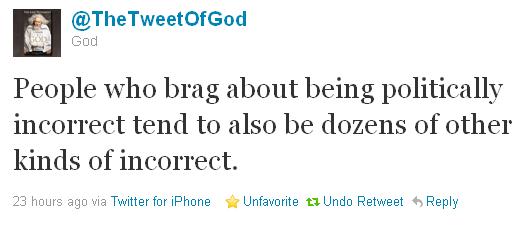
My favorite quote right now

My favorite quote right now published on 2 Comments on My favorite quote right now

TheTweetofGod is the Twitter account of David Javerbaum, author of The Last Testament: A Memoir By God. I follow it because somebody retweeted something hilarious he said one day and I decided that my day could do with some more ongoing hilarity. But he also makes some interesting observations, such as the one above. It seems especially relevant today, in light of this bit from a GQ interview with Herman Cain that everyone seems to be talking about:

Chris Heath: You’ve said that you find it hard to be politically correct. Why do you find it hard? Herman Cain: When you learn how to be politically correct, you sound like all of the other politicians. People like my directness and my bluntness. What happens when you become so worried about being politically correct, you find yourself not saying anything. Because you’re trying to offend the least number of people. I’m trying to attract the greatest number of people. Different strategy.

Does this count as “bragging”? I’d say so. Because Cain is contrasting himself positively to “all of the other politicians” who, presumably, are dishonest because they’re trying not to offend people. Whereas Cain is blunt and direct– he gives it to you straight, and people like that.

But people also like not being offended, don’t they? It sure seems that way. So are politicians who are politically correct mistaken about what will offend people? Or are they aware of what will offend people, but avoiding offending people requires dishonesty so it’s better to be direct and blunt?

The answer that most people who pride themselves on not being politically correct would give is: yes. That is precisely what they think. Because every time they are direct and honest, somebody gets offended.  And it couldn’t be the case that what they’re saying is legitimately offensive, so it must be that they’re simply politically incorrect. This is how “politically incorrect” as a label of pride has come to be a code word for “asshole.” It rests on the assumption that all attempts to avoid offending people are based in dishonesty. That if everybody  were honest, everybody would say things that are commonly considered offensive. A person who proclaims that he or she is politically incorrect, “just telling it like it is,” is in fact doing so because he/she assumes we’re all assholes too…it’s just that the rest of us insist on hiding it.

Political incorrectness that isn’t legitimately offensive usually takes the form of comedy. Making jokes out of things that would otherwise be considered horrible to say is an art form, and one of the things that makes a comedian excel in this is making it obvious that he or she doesn’t mean it. If your audience leaves a performance thinking that you are actually a bigot, they probably won’t be your audience again– unless, of course, they’re bigots themselves. I’m sure there are actual racists and homophobes who find Lisa Lampanelli funny, because they enjoy her jokes on a very base, literal, let’s just call it “moron” level of comedy comprehension and don’t understand that she’s actually making fun of them.

Non-comedic political incorrectness that is not legitimately offensive also exists. It must, if illegitimate offense can exist. It will always be tricky to clarify what should count as such and what shouldn’t, but it’s important to do so in order to avoid allowing people like Cain to claim that everything they say falls into that category. Whatever you might think about the ethics of using the word “niggardly,” for example, it shouldn’t be placed in the same category as a statement of belief such as branding Muslims in general as terrorists or declaring that a pizza with lots of vegetables on it is a “sissy pizza.” I have to use that example because it’s from the same interview with Cain quoted above, and it seems to be what people are talking about today. Advocate.com notes:

In an interview with GQ, Cain decries any adherence to political correctness and then uses a term that will probably offend. . .
Over a pizza lunch, Cain offered his take on what makes a “manly” pizza. The use of sausage was high on his list. But vegetables were “sissy” pizza.
“I’m very particular about the pizza that I eat,” he explained, saying men want a harmony of “abundance” and “taste.”
“What can you tell about a man by the type of pizza that he likes?” asked reporter Chris Heath.
“The more toppings a man has on his pizza, I believe the more manly he is,” Cain declared. “Because the more manly man is not afraid of abundance,” he added with a laugh.
“A manly man don’t want it piled high with vegetables! He would call that a sissy pizza,” Cain said.

Yes, we are talking about a presidential candidate with the sensibilities of a twelve year old boy.* Talking this way isn’t just “politically incorrect”; it’s offensive and frankly stupid. It is, to return to our initial quote, as sign that the speaker is also dozens of other kinds of incorrect. It is not a state of being of which a person should be proud, nor one for which he deserves respect and admiration except by others who are equally incorrect. Lisa Lampanelli is cleverer, funnier, and less offensive. Maybe she should run for president.

* Apologies to all of the bright, mature twelve year old boys out there who know better and would never say such things.

Pouncing on privilege, smack talking in/on sports

Pouncing on privilege, smack talking in/on sports published on 1 Comment on Pouncing on privilege, smack talking in/on sports

A commenter at Dispatches From the Culture Wars remarks, in response to conversation about Kobe Bryant’s recent $100,000 fine for calling a referee a “fucking faggot”:

Most people who fight for ‘equal rights’ do it because they, or people close to them, are members of the group being discriminated against. They fight – and this is tremendously cynical, I know, but probably accurate – they fight not for an end to discrimination as a concept, or for equal rights for everyone, but to gain the privilege for their group that other groups already possess. The civil rights movement of the 1960s was not about equal rights for everyone, black or white, male or female, gay, straight, or transgender – it was about giving straight black males the same privilege that straight white males possessed. And those straight black males (in, for example, black Christian churches) strongly fight against gay marriage, and are irritated by attempts to compare gay rights to the struggle for black civil rights, because they see, in the elevation of gay men and women from their underprivileged position, a threat to the privilege they have gained for themselves.

Cynical, yes, but I think true– well, except that I think he’s overstating the last part.  I don’t think black men need be guarding privilege to be against elevating gays or women. They just need to not care. If it’s true that most people everywhere don’t care about equal rights unless it directly affects them personally or those they love, that’s enough. It allows for a kind of tacit, rather than active, bigotry…the kind practiced by people who “don’t care” about gay marriage because they haven’t been slapped in the face by the lack of privilege confronted by gays. Fighting to protect a privilege requires awareness of that privilege, and one of the trademark qualities of privilege is that people aren’t aware of it. Because they don’t have to be.

I’m not going to really comment on the “As an athlete Kobe Bryant has a responsibility to be a good role model for the kids” thing. So far as I’m concerned professional sports amounts to paying a bunch of muscle-heads millions of dollars a year to wage a regular facsimile of tribal warfare. Then we are surprised and outraged every time when, instead of being models of decency for children, they engage in leisure-time activities such as dog-fighting, beating/raping women, and casual bigotry. 

Equality worth working for

Equality worth working for published on 1 Comment on Equality worth working for

I have a dream that one day this nation will rise up and live out the true meaning of its creed: “We hold these truths to be self-evident: that all men are created equal.”

The true meaning, mind you– not merely what is reflected in the law, but in how we see each other.  How we evaluate each other’s worth, respectability, humanity.  Not by the color of each other’s skin, but the content of our characters.  That, in turn, will reveal our collective character.  

Dr. King’s foundation was unquestionably based in his faith.  Being a Baptist minister, that is naturally where he found his strength: “I have a dream that one day every valley shall be exalted, every hill and mountain shall be made low, the rough places will be made plain, and the crooked places will be made straight, and the glory of the Lord shall be revealed, and all flesh shall see it together.”  For him, the glory of the Lord could only be revealed when people of different colors could love and value each other as equals.  Jennifer Sanborn writes

You see, for me, the Rev. Dr. Martin Luther King, Jr. is first and foremost a Baptist minister, and a child of the same. I imagine it is because I am also the child of a Baptist pastor (and grandchild of two others) that I take particular pride in placing “the Reverend” at the start of his name. “Reverend” is a title that he earned with his education and his occupation, but also a title to which he was called, bringing unparalleled dignity and relevance to what it means to serve society as a religious leader.

I’m sure many people feel similarly, now as well as when MLK originally gave that iconic speech, which was essentially a sermon to America on the meaning of loving one’s fellow man.  As a non-believer I find no conflict in welcoming that sermon, and only a slight bit of discomfort in wondering how he would have responded if asked whether atheists would be included in the pluralistic group exhorted to “sing in the words of the old Negro spiritual, ‘Free at last! free at last! thank God Almighty, we are free at last!'”  I won’t remotely pretend, however, that there is any comparing the lot of atheists to that of black Americans in 1963.  That isn’t the point.  The point is, from whence is a committment to equality derived for those who don’t believe it was God-given?

It would be a fair bet to say that prejudice almost always precedes rationalization, whatever that rationalization is.  I’m pretty sure that human nature, perhaps ironically, includes both the justification for equality as well as the explanation for why humans are so prone to denying it.  And that is because of two salient facts:

1. Both science and religion have, at many points and many places in history, been used to rationalize bigotry. 
2. And yet, neither one has ever or will ever come up with a good reason to treat people unequally.  

If either of the above points seems at all contentious, remember that the numerous mentions of slavery in the Bible were used as a  primary reason to believe that black slavery was part of God’s divine order in the South, as well as the legacy of Spencerian “social Darwinism” which maintained that certain races were inherently inferior.  After all, if it weren’t so, why were they doing so poorly?  Why were they so easily conquered and used for the purposes of the more powerful white Europeans and Americans, if not because they are inherently inferior by evolution or design, whichever your preference? 

I’m still in the midst of my very long quest to discover what exactly human nature is, anyway, but the revelation of the above facts in my life can be attributed primarily to the cognitive psychologist Steven Pinker around 2004.  You see, after (and before) publishing a book called The Blank Slate which used powerful data from experimental psychology to demolish both the idea that there is no such thing as human nature as well as various myths about exactly what that nature is, Pinker and every other psychologist who uses evolution as a means to explain why humans behave as we do has been hounded by accusations that their work will be used to justify prejudice. 

And you know what? That’s exactly what has happened.  And it still happens.  People think that if they can show differences between the psychology of men and women, homosexuals and heterosexuals, blacks and whites, they will be able to show that treating any one or more of those groups as inherently less human is justified.  I really don’t want to get into all of the specific attempts to show that, because it would take away from the fundamental point that there’s nothing we can discover about a specific group of humans that would justify, for example, slavery.  Nothing that would justify physical or cultural genocide, rape, internment, disenfranchisement.  And that is because the humanity of humanity doesn’t need to be determined by conducting some elaborate experiment– it is literally standing right before us. 

I believe that tribalism is instinctive– that people find an element of safety in clinging tightly to those who are like themselves.  They will certainly base that in-group/out-group association on ideology, but it’s even easier to base it on traits that are evident at a glance.  Familiarity and similarity are the primary triggers for empathy, which means that strangers and people not like us are the “best” enemies.  And that is why, again and again throughout our history, we have been able to deny the humanity of certain groups of people in order to persecute them.  Not by knowing them, looking them in the face, having a conversation…because that would demonstrate that they’re more like us than we thought. 

I suppose that’s where I find my fundamental belief in equality– the abject failure, despite our best and most heart-felt efforts, to show that any class of humans really doesn’t deserve the label of “human.”  Martin Luther King Jr. managed to punch through that barrier of prejudice for so many people because he emphasized how much we have in common, how similar we are fundamentally, and how different life could be if we were just willing to encounter each other as fellow human beings, fairly and honestly.  That’s why his speech had and continues to have such a tremendous impact, and why we continue working to make his dreams come true.

What’s a hate group?

What’s a hate group? published on No Comments on What’s a hate group?

From Dispatches From the Culture Wars:

 The Southern Poverty Law Center has added several “mainstream” religious right groups to their list of hate groups for their zealous opposition to equal rights for gays and lesbians, including the American Family Association and the Family Research Council. And the theocons are throwing quite a fit over it.

I’ve said many times that I think the SPLC sometimes paints with too broad a brush so it’s always a good idea to examine the evidence on which they base such conclusions. You can see their report on these anti-gay groups here and judge for yourself. I think they make a stronger case against some than against others.

“No organization better defines what a hate group is all about than the Southern Poverty Law Center,” said Robert Knight, Washington correspondent for Coral Ridge Ministries. “Smearing legitimate groups merely for disagreeing about homosexuality is a very hateful act.”

But the evidence is pretty good in some cases. The American Family Association, for example, has hired Bryan Fischer as one of their chief spokesmen and he has repeatedly offered views that are bigoted and hateful beyond any legitimate doubt. For example, he has argued for forcing gays and lesbians into “reparative therapy” to “cure” them. He has called gays “domestic terrorists.”

Most bizarrely, he has claimed that Adolf Hitler and all the leading Nazis were militant homosexuals, declaring, “[h]omosexuality gave us Adolph Hitler, and homosexuals in the military gave us the Brown Shirts, the Nazi war machine and 6 million dead Jews.” He claims that only homosexuals could be as savage as the Nazis were.

Is this bigotry and hatred? Of course it is. No reasonable person could conclude otherwise.

 I sifted through the SLPC’s list, and every group on it is doing far more than “merely disagreeing about homosexuality.”  Some are advocating that homosexuality be made illegal, not just by reversing Lawrence v. Texas but by making sodomy punishable by execution.  At the very least, every group on the list is actively lying about homosexuality in order to bolster its case, which I would say qualifies for the term “hatred.”   I know what a contentious statement this is, but I think it’s possible to be bigoted without being hateful.  To be bigoted, in my understanding, is to hold prejudices, and all it takes to hold prejudices is simple ignorance and the inability or refusal to think critically about that particular subject.  By that standard, I think people who disapprove of homosexuality because they think God disapproves of it could be called bigoted but not hateful.  The hateful ones are the ones who form organizations with wholesome names like the American Family Association which are in actuality specifically devoted to making homosexuals miserable.  The ones who made ridiculous distortions of the truth like claiming that to be gay is to secretly be a pedophile, or that gays have an organized agenda to convert everyone in the country to homosexuality, or that the Nazi Party was controlled by homosexuals.  People who make such claims aren’t simply ignorant or mistaken– they have lost touch with reality, because that’s something hatred tends to make people do.  As the SLPC’s statement says:

Generally, the SPLC’s listings of these groups is based on their propagation of known falsehoods — claims about LGBT people that have been thoroughly discredited by scientific authorities — and repeated, groundless name-calling. Viewing homosexuality as unbiblical does not qualify organizations for listing as hate groups.

People who insist on repeating falsehoods in order to justify their opposition to others are hard to reason with, which is what makes them scary.  It’s what makes them important to watch, which is why this list was made.   I think it’s important to point out that while ad hominem arguments (arguments “against the man”) are still fallacious, the marketplace of ideas can’t be allowed to keep viewing groups who have a demonstrated willingness to lie their asses off as credible.  Dan Savage has some commentary on this topic specifically relating to the SPLC’s list, but I think it’s definitely worth quoting from his post entitled When Will We Reach The Tipping Point?:

I’m old enough to remember when “objectivity” required that a racist troglodyte be included in any discussion about the civil rights of African Americans. I can remember—I can remember barely (I’m not that old)—when racist bigots were regularly invited on television and asked to write op-eds. They argued in favor of segregation and against interracial marriage and were treated like reasonable people who represented one side of an important political debate. (“African Americans: Are they human?”) Amazing but true: Within my living memory, a person could go on TV and argue against the basic civil equality of African Americans, or take a stand against interracial marriage (always out of “concern” for the poor “mixed-race children” of “selfish” interracial couples), and be invited back the next week to serve up more of the same. People made careers out of trafficking in what we now recognize as baldly racist hate speech.

But then a day came when the racist troglodytes weren’t welcome on television anymore. Our culture reached a tipping point. We decided, as a society, that discrimination based on race was wrong, full stop. There were still racists out there, of course, and there still are. But they were no longer treated like respectable people with a legitimate points of view. They were bigots, they were cut off, they were cast out.

For a few days after Tyler Clementi’s suicide, it looked like we might be reaching that same tipping point on LGBT civil rights—the same tipping point we reached on race and the equality of the sexes: bigots would no longer be welcome to pollute our airwaves, our op-ed pages, our culture, and our society with their hatred. Just as we had recognized the harm that racism was doing to our society and said “enough” (which didn’t end racism), and just as we had recognized the harm that sexism was doing to our society and said “enough” (which didn’t end sexism), maybe we were finally ready to recognize the harm that homophobia is doing to our society and were prepared to say “enough” (not that it would end homophobia).

In my flu-induced delirium I thought we were there. I was wrong.