Skip to content

What (I think) #TrustWomen means

What (I think) #TrustWomen means published on No Comments on What (I think) #TrustWomen means
Five years ago today, Dr. George Tiller was murdered.
In my family’s church in Wichita, the church we’d been members of since…’92? Something like that.  Before they moved into the newly built church at 13th and Rock, back when it was a smaller building on Kellogg next to Hooter’s.
My parents knew George and Jeannie Tiller, but I didn’t really.  The Tillers initially came to Reformation Lutheran because they had been rejected from their previous church, and the Reformation leadership wrestled with the issue a bit but the church population accepted them…in spite of the years of protestors showing up outside the church with their signs, and trucks emblazoned with pictures of bloody fetuses sourced from who knows where, and their bullhorns, shouting at people attending services….on Christmas Eve, in the snow. They were there, every Sunday.  For years.
After George Tiller was killed, this stopped. I try not to think too much about how much of a relief that might’ve been to some. The church now has a playground dedicated to Tiller’s memory, but there is no plaque proclaiming such. I think they’re concerned that it might be destroyed or defaced by vandals. They’re probably right about that.
On that Sunday morning, I was in town visiting my parents. They were at church, and I was at home moving a bed that was upstairs and needed to be downstairs (I’d stopped attending church regularly while in college).  
My mother was in choir, and my father was serving as an usher. George Tiller was serving as an usher too, and it was in doing so that he was killed—he was in the lobby, the narthex, on handing-out-bulletin duty when Scott Roeder (who’d begun attending services at Reformation some weeks before, specifically to scout out the territory) stepped outside the sanctuary, pulled a gun, and shot Dr. Tiller in the head.
Roeder then ran out, pursued by a couple of ushers who fell back when he threatened them with the same gun. (Approximately three hours later he was apprehended outside of Kansas City. He was later charged with first degree murder and two counts of aggravated assault. The jury deliberated quickly and declared him guilty on all three counts—the judge gave him the “hard 50,” fifty years without parole. )
My father came home from church and described what happened, how he’d guided members of the congregation out of the building past the blood on the floor. I sat down on the stairs and cried.
Later that day, my parents went to a service at Reformation which the Tiller family also attended. I went downtown to attend a candlelight vigil.
That’s how that day went.
The so-called Summer of Mercy happened in 1991, in Wichita….of course. I remember it, but at the time I was in middle school and not exactly sure what abortion was or how it worked, making me not too dissimilar from the majority of adult idiots sprawling themselves out on Bleckley Drive in front of Tiller’s clinic.

I had the defense of barely being a teenager, but wish I’d been more aware nonetheless.  I was a freshman in high school in 1993, when Tiller was shot by a protestor for the first time, in both arms.  I didn’t remember that he went to work the next day, citing a need and dedication to serve.
But he did.
I learned about this while watching the After Tiller documentary, which I’ve been simultaneously yearning and dreading to see since first hearing about it. I learned that Tiller had founded, and Julie Burkhart built and ran, a political action committee called ProKanDo when I attended the first anniversary party for South Wind Women’s Center recently.
South Wind is the women’s reproductive clinic started by Burkhart in Tiller’s former clinic. I had never seen the inside of the clinic before, but had the opportunity to do so during the event, and…it’s beautiful.  It’s an attractive, welcoming place, and quite extensive.  You can see some of the clinic, and some of the first anniversary party, in these short videos at MSNBC.  
Anyway, you’re probably thinking “ProKanDo? What about Trust Women?” That’s the name of the PAC that Julie Burkhart started in 2009, and echoes a button that George Tiller used to wear.  
I shared in this confusion wandering through the vigil downtown on that night five years ago, seeing people in Trust Women t-shirts. “Yes,” I thought, “You should trust women to make choices for themselves, but…where is this going?
Maybe you share my distrust of slogans. Maybe you don’t. Point being, I needed something more.
I found it watching After Tiller.
After Tiller tells the stories of four doctors—LeRoy Carhart, Warren Hern, Susan Robinson, and Shelley Sella—who all knew George Tiller, prior to his death,  in various ways, and continue on the controversial practice of performing third trimester abortions—the kind Tiller performed.  Few than 1% of abortions are performed in the third trimester, mind.  This is not how most abortions happen. But these are arguably the most mythical, because of abortion proponents’ biggest lie: that women who abort don’t think or care about their pregnancies, and doctors who perform abortions don’t care about them either.
Boy, does After Tiller dispel that myth.
“Because we’re sort of a court of last resort here,” says Robinson at one point. “If we’re not going to help her, she’s not going to get an abortion, really.” And then we have to watch an aide, who is clearly not enjoying the experience any more than we are, turning a prospective patient away.
After Tiller is maybe 1/4 homage to George Tiller, 1/4 discussion of the harassment and antagonism (legal and otherwise) that the four doctors have experienced in the process of trying to cover the needs of women throughout the country—and outside of it, in some cases—who find themselves past ordinary limit but in dire need of an abortion, whether by threat to the fetus or potential mother or both, and ½ coverage of meetings with actual patients, discussion of their particular situations, and comments from the respective doctors on why they do what they do and the cases in which they will and won’t do it.
This half of the documentary is informative, and brutal, and necessary.
Here’s the thing—if you are stridently pro-life, allergic to nuance, and want to mine this documentary for material which will support your position…you’ll find it. You’ll find doctors expressing moments of indecision and doubt. You’ll find desperate gambles, and patients trying to do the right thing for themselves that they might regret later.  You’ll find people acknowledging that all available options “suck,” and all they can do is pick the one that seems the best to them now.  You’ll find uncertainty. You’ll find a distinct and considered lack of stridence and dogmatism.
That’s the point, actually.
As Dr. Sella says at one point, it’s hard to understand or defend these abortions unless you can hear these womens’ stories and know what they’re going through.
You need to know the amount of suffering they and their children would experience, if the child were born. You need to understand how many women are aware of the fact that they will be unable to give a child up for adoption once giving birth, no matter how it might ruin them physically or financially to do so. You need to listen to a few women talk about the tremendous physical challenges their children will face if born, abnormalities you likely have never heard of, and hear them concluding that it’s better to end it now, before getting to know the child and having him/her ripped away from life at a very young age. In tears. In pain. 
As Dr. Robinson says, “We can’t protect people from regret.”
It’s torture, honestly.  It’s what these doctors deal with as a profession, and they deal with it carefully and consciously, every time. Again from Sella:

“I think for some providers, what’s difficult about third trimester abortion (and not just providers) is that a woman delivers a baby…and it’s a stillborn. And that’s hard to deal with. I think the reason I’ve struggled is because I think of them as babies. I don’t think of that as a fetus. To me, I think of that as a way to distance myself from what I do. I mean, it’s one thing when it’s a first trimester abortion and what you see is a little bit of tissue.   But if you go all of the way to the other extreme, you can’t say that’s a some tissue, that’s not tissue….that’s a baby. Then you have to think it. About what you’re doing. And, why are you doing it? Well, it’s inside the mother, and she can’t handle it. For many many extremely desperate reasons. What drives women to seek a third trimester abortion—unless people understand what’s going on for the woman—it’s impossible to support it. How could you, really? I mean, it’s barbaric, isn’t it?” 

Unless people understand.
Empathy is required.

Robinson says:

“Women come here having decided that this is not a pregnancy that they can or want to sustain. And where do I get to say ‘Oh yeah, well, why? Why do you want an abortion? You’ve got to explain to me!’? What if you’re just not a very good storyteller? Why would it be okay for me to say ‘No; you’ve got to tell me a better story than that’? Because what I believe is that women are able to struggle with complex ethical issues and arrive at the right decision for themselves and their families. They are the world’s expert on their own lives.” 

That’s what “trust women” means.

Why #WeNeedDiverseBooks

Why #WeNeedDiverseBooks published on No Comments on Why #WeNeedDiverseBooks

Or, why good storytelling requires good representation:

When the story doesn’t contain the “why,” the audience looks to the author.

Let me back up.

Writers are often advised to “write what you know.” That’s good advice, because you can’t write believably about what you don’t know. However, authors who took this advice to a logical extreme and wrote only about people just like themselves would suffer for it. They wouldn’t tell very interesting stories– or at least, they would have only one interesting story to tell, and it would effectively be a memoir.

Rather, fiction writers write what they know by research. If they want to write a story about a marine biologist, they would research marine biology. They would research what working as a scientist in that field is like, what kind of person goes into that field, what kind of education and training it requires, and so on.

Because even though it’s fiction, believability is key. Fiction writers create worlds that are not identical to this one for the entertainment of the reader, but those worlds contain things that exist in our own world– like people. If the people in the story don’t act like people do in the world world, and no reason is given for this, the audience is confused. The story falls flat. It’s bad storytelling.

So this is a kind of constraint on the author. When writing fiction it’s literally true that an author can write any story he or she wants– nobody is going to come in and hold a gun to his/her head and demand that he/she not write the story. However though the author is entitled to write whatever story he/she chooses, he/she is not entitled to the audience’s reaction. The audience is not required to think highly of the story. The audience is not required to think highly of the author.

As an example, imagine an author who writes a book whose story involves the sole white occupant of a town being lynched by the rest of the town’s population, which is black. If a believable explanation for this plot line can’t be found in the story, the audience is going to guess that either the story is satire, or the author has some serious issues with black people. Their likelihood to understand the story as satire is a blend of their own knowledge and the author’s adeptness at storytelling. Bad satire happens when the audience can’t be expected to have the knowledge that will tip them off to its satirical nature, or when the author doesn’t wink hard enough in the writing of the story to make it clear. Or both, of course. When the audience doesn’t detect satire (it doesn’t provide the “why,”) then they quite reasonably look to the author’s own beliefs for the explanation.

Good storytelling involves researching the elements in your story if you don’t know very much about them. Bad storytelling involves misrepresenting those elements or leaving them out altogether in a way that isn’t believable. An author who wants to tell a story about a world congress, in which multiple leaders from every country gather together to exchange ideas, isn’t practicing very good storytelling if his/her story depicts this congress as containing only white men, unless a reason is given for this. Was there some mass extinction of women and people of color? Did the white men totally take over the world, including the government of every country on the planet, and if so….how did that happen? The extraordinary event requires an extraordinary explanation. In fact in this case, it would be such an extraordinary explanation than it might as well be the story. If it isn’t, but is treated as a totally unremarkable circumstance by the characters in the story, the audience would rightly look to the author with a “WTF?” expression on its collective face.

These examples are extreme, but that’s on purpose– to illustrate how the content of a story can lead the audience to negative conclusions about the beliefs and prejudices of its authors. The less cut and dry it is, obviously the less justified the audience would be in reaching these conclusions. But the audience is not wrong to see an unbelievable depiction of people in a story and assume that the explanation lies in the author’s motives, and they’re going to do it regardless.

The first people to notice when certain groups of people are misrepresented in or left out of a story for no discernable reason are, quite naturally, people in those groups. But they’re not the only people who do notice or should notice. It might take a white guy a little longer to look at the “world congress” and think “Hey, wait a minute….why is it only people like me?” But he wouldn’t be very bright if he never got there. Not very bright, or else like the author in either prejudice or ignorance (or both).

People want to hear stories told about people like them– yes, of course. However, people also want to hear good, believable stories. If a story makes you stop and wonder why the author portrayed characters in a way that rings false, or leaves them out altogether when it seems like they should be there, that’s bad storytelling unless making you wonder these things is the author’s point– and even then, if you can’t tell whether it is or not, that’s a problem.

That’s why diversity matters in storytelling– not just because people want to hear/see it, and they do, but because it makes the story better. Because the story contains the “why.”

How to be the creepiest nerd at the beach

How to be the creepiest nerd at the beach published on No Comments on How to be the creepiest nerd at the beach

Saw this in my email newsletter from Think Geek this morning, and…I had thoughts:

Main thought: This is creepy

The thing that creeped me out about it most is that it suggests that Princess Leia is wearing a bikini on purpose because she wants to lie on the beach and tan and look sexy or something.

I know that Star Wars fans who are all crazy about Slave Leia don’t spend much time thinking about the whole slave part of that, but…that’s kind of the point. That bikini is literally a shackle– she’s not wearing it on purpose. She’s chained to a giant alien slug who presumably has her dressed like that because it gets a thrill out of it, and…let’s not even get into whether she’s a sex slave or not, and precisely what that means.

Okay, let’s go ahead and get into it– realistically, she’s either a rape victim multiple times over or is about to become one.

That’s what “slave Leia” is celebrating.

That’s creepy.

And the degree of creepiness didn’t sink in for me fully, for whatever reason, until I saw her on a beach towel.

Rambling diatribe about atheism, politics, and the word “secular”

Rambling diatribe about atheism, politics, and the word “secular” published on No Comments on Rambling diatribe about atheism, politics, and the word “secular”

I don’t know American Atheists president David Silverman, but he strikes me as kind of a brash guy. The kind of person who thinks that atheist activism means pissing off religious people, and if you haven’t succeeded in that then you’re doing it wrong.

But apparently he’s now trying to get along with religious people, or at least with America’s political party most known for being religious, because he tried to get a booth for American Atheists at the Conservative Political Action Conference, or CPAC. The booth was denied, because it turns out (who knew?) that CPAC feels threatened by atheists. Silverman decided to attend the conference on his own anyway, where he was interviewed by The Raw Story’s Roy Edroso.

It’s not a long interview at all, so read the whole thing. If you do, you’ll see that Silverman initially characterized the positions that social conservatives commonly take on “gay rights, right to die, and abortion rights” as “theocratic” which means that they’re not “real conservatives” (real conservatives aren’t theocratic?) before being interrupted by Edroso, who said that the “Right to Life guys” would object to being told they aren’t real conservatives. At which point Silverman replied:

I will admit there is a secular argument against abortion. You can’t deny that it’s there, and it’s maybe not as clean cut as school prayer, right to die, and gay marriage.

 …which seems to have annoyed a few atheists into temporarily forgetting what “secular” means. At Skepchick, Sarah Moglia writes:

If by “secular argument,” you mean “a belief based on personal feelings,” then, sure, there’s a secular argument against abortion. There could be a “secular” argument against puppies, in that case. If you’re using “secular” to mean “a logical, science-based, or rational” belief, then no, there is no “secular argument” against abortion. The supposed “secular arguments” against abortion are rooted in misogyny, a lack of understanding of science, and religious overtones.

Which PZ Myers read and replied to with his own blog post entitled There’s a secular argument for wearing underpants on your head. So?  in which he says “I’m trying to figure out what this secular argument is.”

Really? Actually there are a lot of secular arguments against abortion. They include, among others:

  • A fetus is a human. It’s wrong to kill any human. 
  • A fetus is the property of the man whose sperm helped to create it as much as it is of the woman who carries it. Therefore no woman should be able to abort without the permission of the man who inseminated her.
  • Fetal pain
  • Abortions are expensive and hard on a woman’s body, therefore wrong. Something to be avoided if at all possible. 
Note: I didn’t say they were good arguments. 
This is because all that is required for an argument to be secular is that it not be based in religion. That’s it. It has nothing to do with “personal feelings,” which could be religious feelings just as easily as they could be non-religious, and a secular argument is by no means necessarily logical, science-based, or rational, let alone moral. So yeah, you could make a secular argument for wearing underpants on your head, which is why it’s sort of baffling not to be able to grok secular arguments against abortion. 
Something which, as we saw, Silverman only “admitted” when pressed. He clearly is not pro-life himself, so isn’t it a little odd to make a big deal about him acknowledging that secular arguments against abortion exist when he’s not even the one who brought it up? 
Maybe not too terribly odd. See, there are some other important things to consider.
The first is that of course, arguments that are phrased to be secular often come from non-secular motivations. See, for example, the entire Intelligent Design movement. There is no shortage of people on the religious right who see the strategic advantage in trying to Lemon Test their beliefs into law and classrooms by expunging all religious terminology from it, and “Fetuses are people” is the clearest example of that when it comes to abortion. “Person” is a legal category, but the notion of fetal personhood is generally endorsed by people who think God is the one who makes people, therefore when God puts a person in a woman’s uterus she has no business trying to get rid of it. 
You don’t have to believe in souls or even God to make this argument (that is, you can put it in secular terms), but people who make this argument almost inevitably believe in God and souls. The same is true for people who argue against gay marriage by complaining that it’s an aberration of “traditional” marriage, when “tradition” is merely code for “that’s the way God wants it” (and never mind that the Bible is absolutely brimming with nontraditional marriages if that’s what “tradition” means). 
Really, what underlies this reaction to Silverman simply acknowledging that there are secular arguments against abortion is anger at him for trying to market atheism to conservatives in the first place. For being rather conservative himself, albeit not your typical conservative, and then– here’s the kicker– claiming that he’s a true  conservative whereas abortion opponents, opponents of gay marriage– social conservatives– are not. Sorry Dave, but it comes off as a little ridiculous to play No True Conservative when the people you’re saying aren’t True Conservatives (TM) just got done booting your booth from their conference because they felt threatened by you. Surely he should be reserving these comparisons for when CPAC feels threatened by pro-lifers and homophobes. That is, ironically, when it’s no longer actually very conservative at all.

The Raw Story article goes on: 

But why is this his battle? Why not let conservatives be conservatives and just vote for the candidates he likes? “Because I want a choice,” said Silverman. “I don’t get a choice at the voting booth, ever.” He describes himself as a “fiscally conservative” voter who “owns several guns. I’m a strong supporter of the military. I think fiscal responsibility is very important. I see that as pretty conservative. And I have my serious suspicions about Obama. I don’t like that he’s spying on us. I don’t like we’ve got drones killing people…” In the final analysis, “the Democrats are too liberal for me,” he says.

It’s not unusual for libertarians– which is what Silverman actually is, so far as I can tell– to talk this way. Not at all. And it’s not so much that they’re wrong per se, as completely unaware that someone listening has no idea what they’re talking about. I don’t, for example, know what the words “fiscal conservative” mean when coming from the mouth of someone who just called himself a “strong supporter of the military.” There is nothing fiscally conservative about having a defense budget larger than that of the next ten most militarily spendy countries in the world combined.

The term “fiscal conservative” is a libertarian dog whistle, or actually I suppose just a whistle because everybody knows that’s what it means. Is supposed to mean. The problem, of course, is that nobody who calls him or herself a fiscal conservative actually is one, which makes it an even more aggravating theft of terminology than Republicans claiming ownership of the word “family.” Liberals don’t speak up about this more often because they don’t believe that government spending is bad by default and taxation is theft (nor should they; that’s quite sensible of them), but they also recognize that when someone calls him/herself a fiscal conservative what he/she generally means is that he/she is anti-welfare. Anti-government spending, when it might help out minorities, women, and the poor. And liberals don’t think it’s so gosh darned important to be fiscally conservative in the first place, so they rarely point out that ending the drug war, legalizing sex work, cutting back on the military campaigning, even giving out birth control for free (literally, as opposed to mandating that health insurance cover it), you know, the things that make conservatives scream? Would actually save the government boatloads of cash.

The existence of libertarian atheists is, you might say, vexing to liberal atheists. It’s vexing to me as well because libertarians are often morons, prone to doing things like complaining that a sexual harassment policy for a skeptical/atheist conference is a violation of their rights, said rights apparently entailing the freedom to be a sexist boor at a conference without repercussions. Discussions about topics like sexual harassment shouldn’t have to begin with explaining, for the 9,000th time, what’s wrong with sexual harassment in the first place, or how freedom of speech doesn’t apply to private venues where other people have spent good money to get together and exchange ideas and “Sleep with me or you’re a bitch” is not generally one of the ideas they have in mind.

So I can absolutely– totally– understand why someone who has worked for years to connect skeptical/atheist activism with social justice issues, actually improve the world instead of sitting around arguing about whether God does or doesn’t exist, would be infuriated by the notion of the president of American Atheists trying to, in effect, pour some white paint into the enormous black pool of “theocracy” that Silverman even acknowledges is “holding down” a brand of political conservatism that doesn’t involve stepping all over minorities and the poor and taking ownership of their reproductive capacities (since I seriously mixed metaphors there, just imagine the black pool holding things down is the goop that killed Tasha Yar in TNG).

However, differences of political opinion amongst atheists and skeptics also makes me very happy, because it forces us to confront some often inconvenient facts. Like the fact that “secular” only means “without a religious basis.” Like the fact that being right about some very important things does not make you right about everything, and conversely that being very wrong about some things doesn’t make you wrong about others. Like the fact that when you find yourself on the same side as someone you normally disagree with, there’s nothing wrong with acknowledging that and counting them as an ally to the extent that they’re willing to be one. Like that refusing to do this comes off as petulant and tribalistic, because it often is.

I want everyone who claims to be skeptical to actually be  skeptical. To make good arguments. To be civil, analytical, and willing to work together for the greater good. Needless to say, I don’t always get what I want. But come on, people…we can do better than this.

Tropey criticisms of Tropes vs. Women

Tropey criticisms of Tropes vs. Women published on No Comments on Tropey criticisms of Tropes vs. Women

I am a blogger but not a vlogger, and the video below might be a good reason why.

I decided to make a video reply to Ashley Paramore aka healthyaddict on Youtube regarding her criticisms of Anita Sarkeesian’s video series Tropes vs. Women (sexism in video games, yanno). Ashley’s video here; mine here:

Edited to add: If you want to hear more about video games, agency in video games (and in general) and my thoughts on the first Tropes vs. Women video please read

Thoughts on the first Tropes vs. Women video

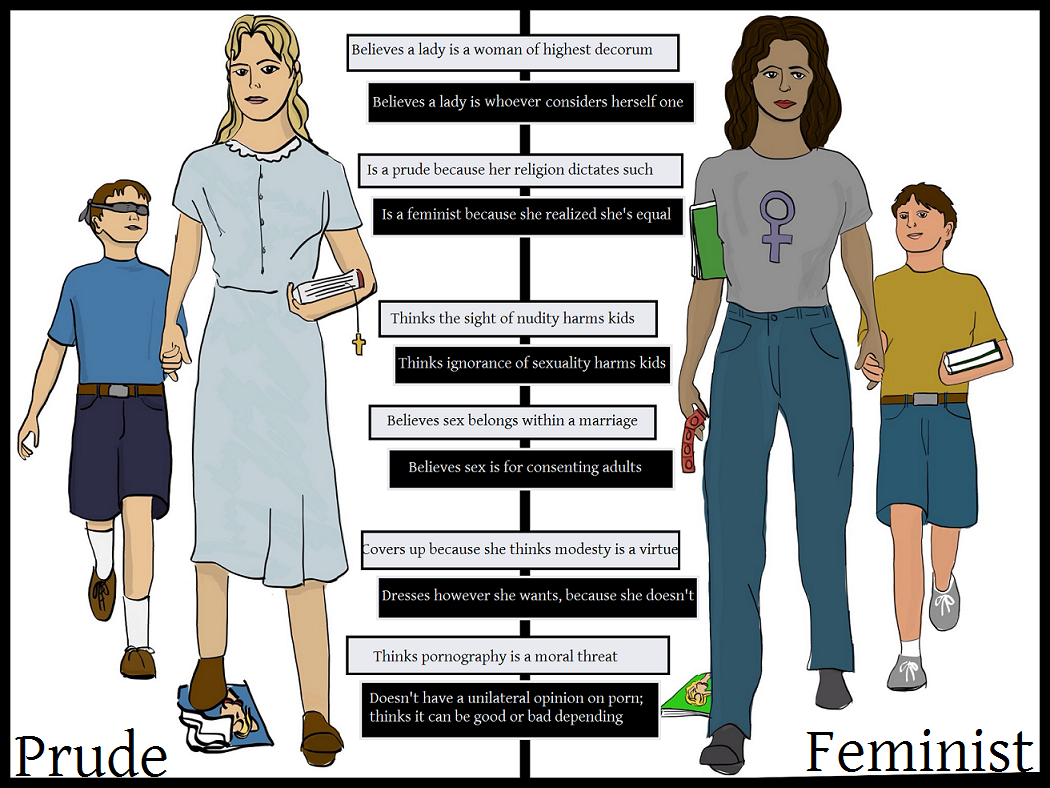
Prude vs. Feminist: A field guide

Prude vs. Feminist: A field guide published on 4 Comments on Prude vs. Feminist: A field guide

Obligatory disclaimer: This is a comic. It includes generalizations. Obviously there is significant variation among both prudes and feminists, and occasionally overlap between them.

I have, though, quite frequently seen the two confused. And I decided that “sex positive” and “sex negative” don’t do enough to describe the difference between them, so thought it would help to articulate those differences a bit more.

I know it can be confusing, the fact that both a prude and a feminist are likely to object to the following:

  • Being harassed on the street (or at work, or anywhere else)
  • Being exposed to porn without having expressed any interest in such
  • Depictions of rape, jokes about rape, rape itself
  • Etc.
However, the beliefs underlying the objections to these things are often quite different, which is not limited to the fact that the prude might have to first examine whether to hold herself responsible for acts such as harassment and rape based on her own immodest dress or actions before speaking out against them. 

So here’s a guide to some key distinctions– when confused, consult this handy chart. Good luck!

Feminism and male rape

Feminism and male rape published on 1 Comment on Feminism and male rape

Last night I made the worst decision ever about what to read right before bed: an article in the Guardian entitled The rape of men, on the practice of male-on-male rape as a weapon of war in Uganda. I think you should read it. I think everyone should read it, for many reasons. Unfortunately my attention was then taken by the discussion in the comments, which mostly revolves around the topic of how the suffering of these male victims of rape is not taken seriously, and they are not given the attention and help that they need, because feminism.

Yes, really.

Apparently this is feminism’s fault because feminists insist on seeing men– all men– as the enemy, the perpetrators while women are the victims. The notion of men as victims, even of other men, conflicts with that, so feminists pretend that men don’t get raped, or that it’s okay when they do.

Note: I have never seen a feminist say anything like this.

What I have seen is feminists speaking about rapists as male as a default,  because most rapists by far are male. I have also seen feminists speaking of rape victims as female as a default, which is a lot more problematic. It’s one thing to give most or all of your attention to one kind of rape victim; it’s quite another to speak as if no other kind exists.

Most feminists I know do not view men as the enemy; they view rigid enforcement of gender roles as the enemy. And rigid enforcement of gender roles is why the Ugandan men in this article have been made to suffer well beyond and after their actual rapes, by the utter lack of understanding, sympathy, and support they have been given:

Today, despite his hospital treatment, Jean Paul still bleeds when he walks. Like many victims, the wounds are such that he’s supposed to restrict his diet to soft foods such as bananas, which are expensive, and Jean Paul can only afford maize and millet. His brother keeps asking what’s wrong with him. “I don’t want to tell him,” says Jean Paul. “I fear he will say: ‘Now, my brother is not a man.'”   It is for this reason that both perpetrator and victim enter a conspiracy of silence and why male survivors often find, once their story is discovered, that they lose the support and comfort of those around them. In the patriarchal societies found in many developing countries, gender roles are strictly defined. “In Africa no man is allowed to be vulnerable,” says RLP’s gender officer Salome Atim. “You have to be masculine, strong. You should never break down or cry. A man must be a leader and provide for the whole family. When he fails to reach that set standard, society perceives that there is something wrong.” Often, she says, wives who discover their husbands have been raped decide to leave them. “They ask me: ‘So now how am I going to live with him? As what? Is this still a husband? Is it a wife?’ They ask, ‘If he can be raped, who is protecting me?’ There’s one family I have been working closely with in which the husband has been raped twice. When his wife discovered this, she went home, packed her belongings, picked up their child and left. Of course that brought down this man’s heart.”

A gender role is an expectation on the part of your society that you will behave, appear, exist in a certain way because of your gender, which is the category you have been assigned because of your biological sex. People who reject gender roles partially or completely resist the idea that these societal job descriptions are binding. People who enforce gender roles insist that they are, and reject anyone who appears to violate them, deliberately or accidentally.

Such people may be viewed with anything from confusion to suspicion to patronizing sympathy to outright hate. Why? Because they didn’t conform to an expectation. An expectation which may range from stereotypical to arbitrary, and yet all over the world is enforced via cultural norms and traditions, mandated by religious dogma, and codified in law.

That’s not why these men were raped, but it’s why they suffer in silence and continued fear.

It’s why people joke about prison rape rather than gasping in horror at the thought of it.

It’s at the root of homo- and transphobia, misogyny, and misandry. These are all forms of hatred and fear stemming from unfair to grossly inaccurate essentialist assumptions about what men and women are, and are supposed to be.

And it doesn’t have to be this way. That is what bothers me most of all. We don’t have to be this stupid and needlessly cruel. But clearly, whatever else you can say about it, gender essentialism certainly is popular.

We– feminists, opponents of gender-based bigotry of all stripes– want that to stop. Right? Don’t we?

If not….you’re not on my side. And I sure as hell am not on yours.

The Revenge of the Nerds trope

The Revenge of the Nerds trope published on 1 Comment on The Revenge of the Nerds trope
Pictured: Nerd revenge

First, a disclaimer: I’ve not seen a single episode of Big Bang Theory.

I did, however, read an article about it entitled Why Geek Girls Are Tired of ‘Big Bang’ Bullshit, and contains a lot of complaints about sexism on the show. One of them in particular caught my eye:

In the season two episode “The Panty Pinata Polarization,” Howard and Raj use NORAD satellites to locate the contestants of America’s Next Top Model. They stalk these women, show up at their door, and then pretend to be the satellite repair men in order to gain access to the house and gawk at the women wearing bathing suits. That is not funny. That is not clever. That is downright creepy, and even when this is pointed out to the characters, they don’t care. You get the sense that they feel entitled to these women, like it’s their right as men to go try to seduce and ogle them, even if it requires illegally using military spy aircraft.

It stuck out because it reminded me of re-watching Revenge of the Nerds a couple of years ago for Film Sack, and seeing the same sort of thing. In case you haven’t seen Revenge of the Nerds lately– and I would not blame you one bit for that– there is a scene in which the nerd fraternity decides to literally drill holes in the ceilings of a sorority and drop cameras in, so that they can spy on the sorority girls as they undress. This is not the worst thing they do to this sorority, considering that the movie also has a “panty raid” scene, and the covert cameras apparently captured image of one of the sorority members– Betty– topless which nerd hero Lewis copies and glues into the bottom of pie tins sold at a carnival. That is, of course, before he dresses up in a costume that Betty’s boyfriend Stan had been wearing in order to seduce her in a funhouse at that same carnival, eventually revealing that he’s not her boyfriend at all. So yep, rape by false identity– but Betty’s character is presented as being fine with it, because I guess having the movie end with Lewis being arrested and charged with sexual assault would’ve taken things out of the comedy category.

But in both cases what we have is nerds spying on attractive women using their nerdy skills of surveillance, with the explicit or implicit understanding that this is okay because those women wouldn’t date the nerds anyway, perhaps might even be mean to them, and therefore the nerds are justified in taking what they weren’t given. Getting revenge.

Yes, the Big Bang Theory scene doesn’t sound nearly as bad as the surveillance of the sorority in Revenge of the Nerds, but really it sounds like the only reason it wasn’t is because Revenge of the Nerds was an R-rated movie in 1984, when showing bare breasts was not just acceptable but practically obligatory. I don’t exactly get the feeling that it’s because Hollywood looks back at that movie with any particular feeling of revulsion or regret. As, you know, I did when watching it two years ago.

So I’m wondering– is this actually a trope? One alive and well, long after it had no business being so– nerds feeling wronged by the injustice of existing in a world where attractive women won’t sleep with them, and therefore being justified in doing whatever it takes to get a good look (or more) at those women, without their consent if necessary?

Gosh, I hope not. And if so, let it die already.

Canon fodder

Canon fodder published on No Comments on Canon fodder
The cocktail waitresses of Star Trek (2009)

So I was watching the 2009 film Star Trek, which annoyingly has no subtitle. No Nemesis, no Insurrection, no Into Darkness, no Into the Woods, nothing. So it will forever be known, to me at least, as “the 2009 Star Trek,” which is unfortunate given that it’s a decent film and immediately precedes Into Darkness, currently in theaters, which gets its own subtitle. Maybe they realized they messed up with the previous one? I don’t know.

Anyway, I watched it and couldn’t help but notice all of the female Star Fleet extras running around (literally, in more than one case because their ship was in danger of being destroyed) in those mini dresses and go go boots that the women wore in the original series, their hair more often than not up in what I guess was supposed to be a futuristic version of the beehive-like updos worn in TOS, a sort of vertical topknot, an oblong bun which sticks straight out of the tops of their heads. The choice to outfit them this way was presumably made in deference to the original garb that female officers wore in TOS, and to the reasoning it embodied, which– one can only guess– was so that nobody would accidentally take them seriously.

I watched this and thought about a recent blog post by Felicia Day on Into Darkness, discussing how it has no strong female characters. How even in instances where the leaders of the free galaxy, the decision-makers, were getting together and figuring out what to do, there were few women, especially appropriately aged women (you know, prime minister age or thereabouts) amongst them, and how weird and disappointing that was. Though Day doesn’t specifically mention the gratuitous underwear scene with Alice Eve for which screenwriter Damon Lindelof confusingly apologized (confusing because you don’t exactly trip and accidentally insert scenes like that into a script), she says

I kept waiting for her turn, waiting for her to not be the victim, to be a bit cleverer, to add to the equation in a “yeah you go girl” way but no, she was there to be sufficiently sexy that Kirk would acknowledge her existence, to be pretty, to serve the plot. I loved her bob. That’s it. What if she had been a less attractive woman, older, overweight? A tomboy? Wouldn’t have that been a tad more interesting choice? Or at least give her a moment where she’s not a princess waiting to be saved. From a director who is so amazing, who created wonderful female characters in Alias and Felicity, I was super bummed by this. A woman character CAN exist without having to be sexually desired by the guy. Oh, and she doesn’t have to be a lesbian either, OMG WHAT A SURPRISING IDEA!

Responses have ranged from the reasonable to the ridiculous on both the original Tumblr post and on her Facebook wall when she linked to it. It’s important to point out here that by “ridiculous,” I’m not referring to any comment which simply differed either with facts or the intent of Day’s post, or both. I’m referring to the kind of comment typical of any feminist critique of popular culture, which is some combination of “If it ain’t broke, don’t fix it” and “You’re just jealous,” or worse. Sometimes much, much worse.

There were plenty of people who agreed with Day that a) there are no strong female characters in Into Darkness (which, full disclosure, I haven’t seen….yet. That’s why I was re-watching the 2009 movie), and b) given the futuristic setting of the Star Trek universe where the Federation has been depicted as an egalitarian organization, it doesn’t make sense to portray events as though there are no women in charge of anything who possess formidable skills and commit acts of bravery and cunning with more or less the frequency that men do, and even with c) Day’s larger point that “it’s time to invent some new cliches” where women are concerned. There are people who agreed with all of these things, and yet ultimately disagreed with Day’s claim that this spoke poorly of the movie as a whole (which, incidentally, she says she enjoyed very much).
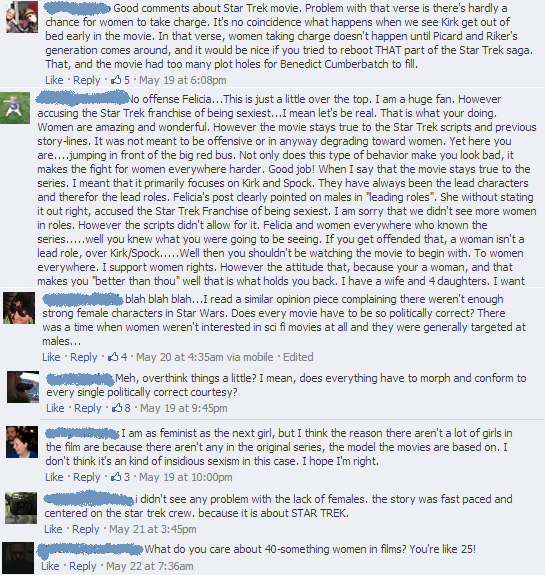
A sampling of replies 

Why do they disagree? Because of canon.

Because Kirk is notoriously a womanizer, so it makes sense to depict him womanizing.
Because in the original series of Star Trek (referred to as TOS, for…the original series), the stories told revolved mainly around men doing things, men like Kirk and Spock and Scotty and Bones and Sulu.

Even though the 2009 movie and this current one are reboots and have changed a lot of things, they cannot and should not change the fact that the story is not about women and their interests, so if you’re interested in that kind of story, find a different science fiction franchise already. One that didn’t originate in 1966. These are the stories we’ve committed to, and by golly we’ll be damned if they’re going to be changed! At least to be less overtly sexist, anyway– other things such as chronology or location of events and the circumstances of different characters dying or not dying, as the case may be, you can change and we’ll grudgingly accept it. But don’t take away our sexist stories, because we’ll have nothing left!  If you want strong women, go watch Xena: Warrior Princess or something, and leave TOS alone!

…they said. Basically.

In response to this position– that the absence of strong female characters in Into Darkness (or, for that matter, the 2009 Star Trek) is a feature; not a bug, because it’s simply the movie being true to canon– I have a few thoughts.

The first is that I can see the point of this objection. In spite of being reboots, these two movies resurrect very old stories from TOS and splice them together with a modernized perspective. If too many changes were made, the stories would not even be recognizable and they would simply be about a group of people with familiar names in a familiar-but-new setting doing completely unfamiliar things, in which case it might as well not even be the Star Trek universe.

However, this brings up all kinds of questions about what aspects of canon must be adhered to and why, in order to preserve the familiar setting and cast but also tell a story which isn’t identical to one the audience has already been told (in which case the movies would not be reboots but remakes, which is a different beast altogether). Of all of the things preserved for the new, 2009/2013 versions of stories originally told decades earlier, must one of them be the male-centric nature of those stories? And regardless of your answer to the previous question, would it really be worse to modify the story to make it less sexist, or to invent a new one?

This is especially relevant to ask when we’re talking about the Star Trek universe, given that this universe depicts a futuristic existence where human civilization has presumably progressed to the point that bigotry is no longer much of a thing, right? It’s inevitable that people who are trying to tell stories about future human civilizations which have progressed far beyond their own, will still project on those people their own prejudices and general small mindedness without even realizing it– so even as they’re giving people of the future things like teleportation and food synthesization, they’re still going to make those people reflect whatever backwards inclinations are common in the time of the writers– or rather, in the writers themselves. It’s pretty much ubiquitous in any movie or TV show which takes place hundreds of years from when it’s written. We just can’t help but think about how people might think in the future– especially a utopian rather than dystopian image of the future– by relying on how people think now. Then, when that actual year finally comes along, people can watch your movie or TV show (assuming they remember it exists) again and laugh their asses off.

But in this case it’s a little different. In this case, we’re talking about putting our own current spin on the stories that were previously told about those futuristic civilizations and yet not questioning, in fact transferring verbatim, much of the prejudices of that bygone era. Prejudices which don’t even apply to our own societies in some parts of the world (where female leaders are common), let alone a society in the year 2233. Isn’t it weird that we’d take an old depiction of a futuristic society and decide to re-depict it, and in doing so deliberately not make corrections which would render the depiction more realistically futuristic?  It’s as if someone had actually invented a teleporter which is both different from, and functions better than, the ones depicted in old episodes and movies based on TOS, but we went right on making new movies which showed people moving from one place to another by standing on a little circle and becoming fuzzy until they vanish. Because after all, that’s canon. You can’t change the story.

If that’s really the case, though…that story is boring and you shouldn’t expect people who are represented poorly (or not at all) in it to be interested. They may be, but you shouldn’t count on it.

There, I said it.

Yeah, yeah, I know– there’s no shortage of people who simply don’t care if women and minorities are interested in the movies and TV they love. You could keep right on making movies and TV shows based on comics, science fiction, or fantasy which cater to the interests of white male geeks only, and plenty of white male geeks would be just fine with that. Some of these people even react to complaints like Day’s by acting as if she wants to take over Star Trek– or Star Wars, or Doctor Who, or movies based on Marvel comics, or any other franchise which keeps churning out geek fodder– and make it all about women. Put women in charge of everything! No, that is not what she’s saying. That’s not what I’m saying, and it’s not what any feminist critique of these things that I’ve ever seen has been saying.

I’m saying that if you’re going to tell girls and women that it’s cool to be a nerd, you should also give them better reasons to be.

That is not at all a knock at Wil Wheaton, who is speaking in the video at that link– he’s actively doing this, in addition to giving that excellent speech. Felicia Day is actively doing it, by creating the Geek & Sundry channel on Youtube. She’s also asking where all of the women are, and she’s not the only one doing that. According to a recent article in the LA Times, appropriately titled Where have all the women gone in movies?,

Despite the success of recent female-driven movies such as “Bridesmaids” and the “Hunger Games” and “Twilight” series, female representation in popular movies is at its lowest level in five years, according to a study being released Monday by the USC Annenberg School for Communication and Journalism. Among the 100 highest-grossing movies at the U.S. box office in 2012, the study reported, 28.4% of speaking characters were female. That’s a drop from 32.8% three years ago, and a number that has stayed relatively stagnant despite increased research attention to the topic and several high-profile box-office successes starring women. “There is notable consistency in the number of females on-screen from year to year,” said USC researcher Marc Choueiti. “The slate of films developed and produced each year is almost formulaic — in the aggregate, female representation hardly changed at all.” When they are on-screen, 31.6% of women are shown wearing sexually revealing clothing, the highest percentage in the five years the USC researchers have been studying the issue.
For teen girls, the number who are provocatively dressed is even higher: 56.6% of teen girl characters in 2012 movies wore sexy clothes, an increase of 20% since 2009. The USC researchers said these trends persist because those working in Hollywood believe attracting a male audience is the key ingredient to box office success.

Well gosh, I guess I have some questions for “those working in Hollywood” then. Such as:

  • Do you think women also go to movies?
  • Do you think men will stop going to movies if they feature strong female characters, and the number of women who see them will be unaffected? In other words, do you think both groups only want to see men doing things, and women serving as eye candy or simply absent? 
  • Do you think that movie-goers are actually more sexist now than they used to be, and are continuing in that trend? Or is there just more money to be made in assuming they are? And in the end, what’s the difference?

Returning to science fiction/comic/fantasy movies specifically, there are so many movies in those genres which are either out currently, or coming up in the next couple of years, that geeks are downright giddy. The Wolverine. Iron Man 3. Man of Steel. Pacific Rim. Ender’s Game. Thor: The Dark World. The Avengers 2. Captain America: The Winter Soldier. The Amazing Spider-Man 2. Ninja Turtles. More Transformers, more Expendables, more X-Men, and so on. It’s a great time to be a geek– if you’re a straight white male geek, or don’t mind taking part in stories told mainly for and about same. And actually there are a lot of people in that latter category– there have to be, don’t they? Because the alternative is to just not watch the movies.

But geek movies have a woman and minority problem, and they have it because canon is considered so important.

Because geeks are so often gratified when something is just the same as it was when originally depicted in the  comic book/regular book it came from, and prone to throwing tantrums (AKA “nerd rage”) when it’s different. And the origins of the stories which formed these canons are old– sometimes very old. Given how quickly social contexts change, “very old” in this case could be any time before 1980. If the canon of your franchise of choice formed prior to that point– and most of the popular ones do, from Superman to Star Wars– it’s probably going to be sexist. At that point you have to stop denying it, and start figuring out what to do about it. Is preserving the canon more important than telling stories which include women and minorities as something other than bit parts and scenery? As actors– and by that I mean, people who act, rather than being acted upon?

And by “canon,” I know I’m not referring to every last detail of a franchise story. An aspect of the story is considered canonical or noncanonical based on how important it’s considered, how story-altering it would be to change. Yes, I know. I also know perceptions of what should be considered canonical tend to differ. Is Johnny Storm‘s race canonical, or not? How about Nick Fury‘s? Is Spider-Man’s web-shooting ability naturally derived or an invention? These are questions a lot of comic book geeks actually have opinions about, and those opinions are based loosely on two different factors: 1) whether there’s precedent you can point to in the comics, and 2) how cool the particular geek you’re talking to thinks the different options are. Degree of badassery has a remarkable effect on people’s concerns about canon– see, for example, every superhero costume which made a dramatic change from brightly-colored spandex to metallic and/or black armor upon arriving in a movie post….oh, probably 1989’s Batman. Some costumes just can’t be translated directly to real-world garb without looking ridiculous rather than menacing to our eyes. That fact might not change, but it should be clear by this point that what impresses us does, has, and will.

You could change the characters, along with the costumes.
And if that’s too disturbing to consider, why not come up with and/or use some new stories?

I actually don’t really care which route movie makers choose– either one could be amazing. And both have actually been done and continue to be done, over and over….just not in women’s favor. The movies I listed as coming out in the next couple of years are noticeably lacking in strong female characters. Just men saving the world and the girl, over and over, for the most part.

It doesn’t have to be that way. So why not change?
Give us women…and make them badass. I hear geeks are into that.

The miseducation of Katelyn Campbell

The miseducation of Katelyn Campbell published on 1 Comment on The miseducation of Katelyn Campbell
Katelyn Campbell

Recently in West Virginia, a teenager objected to a particularly obviously problematic form of abstinence-only education. Wait, let me rephrase that– “Lying, slut-shaming diatribe” would be a better name for it. And the teenager in question, Katelyn Campbell, knew that’s what it was. She even used the word “slut-shaming,” which is just excellent. It’s like a teenager being taught to “consider the controversy” in her biology class when learning about evolution immediately saying “Intelligent Design, right? That’s really what you’re getting at. Right?” Only in this case, it’s as if Intelligent Design was the only thing being taught. And evolution was presented as a pack of lies. And students who believe in it were chastised, shamed, and told that their mothers probably hate them.

Yes, one of the things Pam Stenzel, Christian sex educator, said during her presentation was “If you take birth control, your mother probably hates you.” Other common statements in her “educational” talks include gems such as:

  • “I could look at any one of you in the eyes right now and tell if you’re going to be promiscuous.” 
  • “Ladies, you contract Chlamydia one time in your life, cure it or not, and there is about a 25 percent chance that you will be sterile for the rest of your life.” 
  • ”That drug, that hormone, that pill, that shot that this girl is taking has just made her 10 times more likely to contract a disease than if she was not taking that drug.”
  • ”Students, condoms aren’t safe. Never have been, never will be.”

And my personal favorite,

  • “if you have sex outside of one permanent monogamous – and monogamy does not mean one at a time, that means one partner who has only been with you – if you have sex outside of that context, you will pay. No one has ever had more than one partner and not paid.”
Campbell apparently knew about Stenzel and chose not to attend the assembly that she (Stenzel) would be speaking for at George Washington High School, where Campbell is a senior and student body vice president. Instead, she started speaking out about the issue and filed a complaint with the ACLU. This attracted the attention of the school’s principal, George Aulenbacher, who called Campbell into his office and proceeded to lecture and, according to Campbell, threaten her

Aulenbacher called Campbell to the principal’s office after she contacted media outlets about the assembly and said, “I am disappointed in you” and “How could you go to the press without telling me?” according to the complaint. He then allegedly threatened to call Wellesley College, where Campbell has been accepted, and tell them about her actions. “How would you feel if I called your college and told them what bad character you have and what a backstabber you are?” he said, according to the complaint.

In case you’re wondering, it’s all cool with Welleseley.

And it’s probably all cool with Katelyn Campbell as well. In addition to Wellesley issuing a public statement saying it is “delighted to welcome” her as a member of the class of 2017, people are clamoring to congratulate Campbell for her bravery and maturity in this matter. And she deserves every bit of it– she’s one of those rare high school students to whom it would even occur to consider that something like the tirade by Pam Stenzel at her school might not just be hard to sit through, not just unpleasant, not just wrong, but possibly illegal...and then actually do something about it. Become a student activist.

Jessica Ahlquist did the same thing, and endured endless harassment and threats for it. It doesn’t look Campbell is going to have the same experience, though there has been some backlash in the form of a Facebook group originating in support of her principal. Aulenbacher’s threat itself proved to hold no water, and from what I’ve read if he had been more familiar with Wellesley he should have known this himself, but the fact is…he didn’t. He thought he could intimidate a student into shutting up about her objections to an assembly, and that it would be a good idea to do so. If this is all true, he appears to be one of those public school administrators who clearly views his position as one of domination rather than education, and therefore should not be in that role. But it remains to be seen what happens there.

In the meantime, there’s so much discussion about Pam Stenzel and her message. In this instance, her visit to George Washington High School was funded by a local Christian organization called Believe in West Virginia, and probably cost between $3,500-5,000. She has a DVD called “Sex Still Has a Price Tag” which she sells to public schools for $30 a pop. She claims to speak to over 500,000 young people a year, at both public and private schools. She attended Jerry Falwell’s Liberty University, is supposedly a product of rape and then adopted (as described in her talks), and previously worked at crisis pregnancy centers (pseudo-clinics which are frequently run by pro-life groups and are known for providing pregnant women with false or misleading medical information to encourage them not to abort). The Sexuality Information and Education Council of the United States’ (SIECUS) says of Stenzel:

Pam Stenzel

Pam Stenzel was one of the first individuals that SIECUS became aware of who made a career of traveling from school to school providing abstinence-only-until-marriage assemblies and presentations. The influx of federal abstinence-only-until-marriage funding has meant that more schools are able to pay for these kinds of services (or receive them for free as part of a grant to a local community-based organization, crisis pregnancy center, or church), and Stenzel and her peers have been very popular in recent years. There is much to suggest that there is now a network of abstinence-only-until-marriage speakers that help promote each other’s work and materials.

This comes from a lengthy and comprehensive review of her “Sex Still Has a Price Tag” video, which includes several fact-checks of statements she makes concerning birth control and sexually transmitted diseases, and notes that

Pam Stenzel does not attempt to hide the fact that her performance is designed to scare young people. She begins by telling her teen audience, “If you forget everything else I told you today, and you can only remember one thing, this is what I want you to hear. If you have sex outside of one permanent monogamous—and monogamy does not mean one at a time—that means one partner who has only been with you— if you have sex outside of that context, you will pay.” The rest of the presentation hammers home this concept by telling young people exactly what form this payment may take from unintended pregnancy, to STDs, to emotional heartbreak, to death. Ms. Stenzel’s tone throughout her presentation can best be described as punitive, as though she knows that some of the teens in this world (and some members of her audience) have had or will have sex outside of her parameters, and she wants them to know that they will be punished. Moreover, by suggesting that these teens deserve punishment, Ms. Stenzel presents a world view in which virginity is the only measure of a person’s character and moral judgment, and sets up a dichotomy between those who are “good” and those who are “bad.”

The review is worth a full read, though if you’re anything like me, it will make you angry.

I can’t help but mentally compare it to the DARE program, in which I recall being told outright that consumption of any illegal drug will cause you to become immediately addicted to it, which means that all people who use illicit drugs recreationally are addicts. That’s an easily disconfirmable claim, even without consuming any such drug yourself– all one need do is observe some users of illicit drugs who are not, in fact, addicts. However, Stenzel’s “If you have more than one sexual partner, you will pay” lie is better and worse at the same time, because it’s so much more easily disconfirmable. This statement can be shown as nonsense by simply observing that practically all Americans have sex before marriage, and multiple sexual partners in their lifetimes, and yet they don’t appear to be “paying.” At least, not in any way that is causally distinct from the way in which those precious few one-partner-forever people (or, of course, the lifelong celibate) are not “paying.” As I’ve written before, waiting to have sex until you’re married doesn’t protect you from anything. And having a single sexual partner who has also had no other sex partner but yourself may protect you from STDs, but a) this describes practically no one, and b) Stenzel denies this, but condoms do work. Quite well, actually. These two facts together ruin her entire thesis. Further, the most common STD which most people get actually isn’t that bad. Most people who contract it won’t even know they have it. As SIECUS says,

In truth, the majority of HPV infections cause neither genital warts nor cervical cancer but, instead, resolve themselves spontaneously without medical intervention. Even HPV infections that cause warts can resolve without treatment. And, if young women do contract one of the strains of HPV that can cause cervical cancer, it typically takes 10–15 years once cervical cells begin to change before invasive cervical cancer develops.

So interestingly, in the process of de-stigmatizing premarital sex in response to people like Stenzel, we end up de-stigmatizing STDs as well. It’s not that STDs aren’t bad, of course, but they’re not as bad as people like Stenzel like to portray, and worst of all of course is the fact that she continually emphasizes (erroneously) how bad STDs are while also denigrating effective means of protecting against them. This is moralizing standpoint, not a fact-based standpoint. Clearly, facts are not the important thing here. You don’t tell people how to prevent house fires by telling them never to buy a house, or denying the efficacy of fire extinguishers.

In a few different places while reading about this story, I’ve seen people say that if you object to what Stenzel does, you must be fine with telling kids to have sex. You’re endorsing an “anything goes” mentality. I’m not doing anything of the sort– I know what I want teenagers to know about sex, and it isn’t “Go forth and screw without regard for the consequences.” At bare minimum, I want them to know the truth…yet I’m starting to wonder if that’s asking too much.

Not only is Stenzel hiding facts from the kids she supposedly teaches; she’s indoctrinating them with falsehoods. Harmful, counter-productive falsehoods. We really need to stop this practice of just inventing catastrophes and pretending that they’re inevitable for kids who do whatever we don’t want kids to do. Kids will see through this, because a) they’re not stupid, and b) they grow up. And when they do, they will come to question everything they’ve been taught because this particular thing has been shown to be so absurdly false. And while I’m all in favor of thinking critically and questioning authority, it would be nice for public school students not to be taught complete nonsense which forces them to eventually learn the value of such things for themselves, gradually and painfully. That isn’t education. Let’s not stand for it.