Skip to content

To summon sexism, one need only speak its name

To summon sexism, one need only speak its name published on No Comments on To summon sexism, one need only speak its name

Sexism really is like the devil. If you have any doubts about its existence, you need only mention it and it will come skipping around the corner cheerily asking “You rang?” Well, except that the devil doesn’t exist and sexism does. But apart from that, they are just the same.

Anita Sarkeesian does the Feminist Frequency videos on Youtube, commenting on popular culture from a feminist perspective. I’ve only watched a couple of them, but have been impressed with what I’ve seen so far. Now she’s doing a Kickstarter project to fund a series of video commentaries on sexism in video games, which you should help fund if you’re interested in the topic. And who wouldn’t be interested in the topic?

Now, Youtube comment threads are notoriously cesspools of bigots and trolls, and bigoted trolls, of every stripe. So it’s not surprise that they came out in force when this video was posted, but the amount of bile spewed toward Sarkeesian, and women in general, is pretty shocking still. You can see a screenshot of some of it here, but I’ll warn you that reading it is pretty damn depressing. I am not going to say that they justify the claim that there’s sexism in video games, because they don’t. They just show clearly that there is sexism in people who comment on Youtube about videos discussing sexism in video games. However, I think it’s a safe bet that they’re watching this video in the first place because they are gamers, and sexism in gamers is known issue. As is sexism in video games, but judging by Sarkeesian’s previous discussions on sexist tropes in movies, and of course her outline of the topics she intends to discuss in this series, I’m betting she will have plenty of new and interesting things to say about it.

Her statement on the backlash received this far:

The intimidation and harassment effort has included a torrent of misogyny and hate speech on my YouTube video, repeated vandalizing of the Wikipedia page about me, organized efforts to flag my YouTube videos as “terrorism”, as well as many threatening messages sent through Twitter, Facebook, Kickstarter, email and my own website.  These messages and comments have included everything from the typical sandwich and kitchen “jokes” to threats of violence, death, sexual assault and rape.  All that plus an organized attempt to report this project to Kickstarter and get it banned or defunded.  Thankfully, Kickstarter has been incredibly supportive in helping me deal with the harassment on their service. The sad thing is this kind of backlash happens all the time whenever women dare to speak up about gender and video games. . .  What’s most ironic about the harassment is that it’s in reaction to a project I haven’t even created yet. I haven’t had the chance to articulate any of my arguments about video game characters yet. It’s very telling that there is this much backlash against the mere idea of this series being made.

Now, you might say “But look, this is only manufactured drama. Of course people are going to react badly to claims of sexism, because it’s just one woman complaining about nothing.” I hope you wouldn’t say that, but someone did in the comments on PZ Myers’ post on the subject:

Here’s an attractive girl, vastly more privileged than these “losers” who have no future and can’t just marry to be set up for life with a stable income, complaining about how downtrodden she is and expecting to be paid to play video games. There’s any number of worthy causes that go unfunded (remember “Dear Muslima”?), but here is this girl expecting to be paid so she can give us her opinion on video games.

Anita Sarkeesian has a Master’s degree in social and political thought and did her thesis on the role of women in science fiction and fantasy television. If the only things to be known about her were found in the Kickstarter video, it would be clear that she’s not a “girl” who wants to “complain about how downtrodden she is,” but they are not. It’s also about as obvious as an ice pick through the skull that she isn’t simply “expecting to be paid so she can give us her opinion on video games,” but even if that were the case it sure seems like a worthy thing to pay her for. Gosh, how dare a person with credentials and a track record of delivering informed and interesting views on things expect to be paid for it! And it’s not like Kickstarter is entirely about people offering to produce creative goods and services to interested parties who are willing to invest in advance, or anything. You’d think it was actually about marching up to their front doors, knocking them down, and demanding it.

Ultimately however, what’s lurking under that statement (and is made more clear further in the comment thread) is a fundamental misunderstanding of privilege and bigotry. This particular girl woman seems to be doing pretty well. After all, she’s attractive so she could marry someone for money and not have to work! Err…except that she probably wouldn’t, because being a gold-digger is supposedly a bad thing, and marrying for money tends to attract husbands who will treat you like you…married them for the money. Which is something that far more men can do than women, and that’s because of what, class? Correct– male privilege! The fact that some men can afford to buy wives is their privilege; not the privilege of women to be bought. But what about the fact that this woman remains attractive, which is a benefit, and educated, which is a benefit? How is she in a position to complain to anyone about how “downtrodden” she is?!

Well, she isn’t. Complaining about being downtrodden, that is. She might be downtrodden, but it’s impossible to tell from the video, and more importantly it doesn’t matter if she is or not. This complaint assumes that if you’re going to say that a privilege exists, it must benefit all members of Group Y to the detriment of all members of Group X. If there is a single member of the latter group who is obviously better off than any members of the former, then this “privilege” thing is bogus! Well, no. Privilege is a general and often unacknowledged advantage that members of a group have by virtue of being in that group, usually one that they had nothing to do with being a member of in the first place. The fact that there are individual members of minority groups who enjoy respect from others and a high standard of living does not mean that a majority privilege does not exist, and the fact that the majority privilege exists does not mean that every last member of that majority will enjoy such in a tangible way. It’s entirely possible to be a member of the privileged majority and still be…well, a loser.

Which is why the comment above misses the point so badly– yes, it’s probably true that a good number of the people now threatening violence against Sarkeesian over her audacity to propose making a series of videos about sexism in video games are males who are not doing so well, generally. Who thought life would bring them opportunities and benefits that they didn’t receive, and therefore are unable to see that many if not most of them are playing on life’s lowest difficulty setting, to use John Scalzi’s almost frighteningly prescient metaphor. If you want a more elaborate explanation of how being a straight white male is a privilege, as told by a straight white male using gaming terminology, accompanied by further evidence of exactly how unacknowledged it can be, check out that essay and some of the replies it has received.

It’s funny to think that a person would need to be “downtrodden” in order to justifiably speak about sexism in video games, anyway. How would mis- or under-representation of women in a game oppress women to the point of making them poor, unhealthy, hated, or otherwise leading a miserable existence? I can see an MRA (how unfortunate that “men’s rights advocate” has come to refer mostly to misogynists who deny the existence of misogyny) replying to this by saying “That’s the point. If it doesn’t oppress you, what are you complaining about?” (Actually, they would probably say “That’s the point, bitch.” But you get the idea.)

Well, fortunately that objection amounts to a false dichotomy. We don’t have to stop caring about things like the wage gap, rape victims being blamed for their own attacks, sex trafficking and so on in order to also care about how women are depicted in things like movies and video games. Isn’t that grand? It’s also important because media, including video games, both shapes and reflects how women are viewed in the culture where it appears. So women– so everybody— has an interest in presentation in media not being bigoted, whether it’s sexism we’re talking about, or homophobia, or racism, or any other form of slanted and unfair depiction of real people who exist in the world. And there’s also the fact that, as Sarkeesian notes, video games can help develop certain skills and are fun to play, and as a player it can really suck to play one that depicts people like you absurdly and insultingly. 47% of video game players are female so their impressions and comfort obviously matter, but not feeding male players distorted messages about women also matters. I can testify from my own experience that interaction between players often contains enough sexism, racism, and homophobia on its own without the game itself encouraging such.

I asked at the beginning of this post who wouldn’t be interested in the topic of sexism in video games. If your answer was “Me!” then I hope something between there and here might have sparked some. If not, well, I’m impressed you made it to the end regardless.

Victims, skeptics, and politics, oh my

Victims, skeptics, and politics, oh my published on No Comments on Victims, skeptics, and politics, oh my

Jason Thibeault at Lousy Canuck has an interesting post up today on what he calls “hyper-skepticism” with regard to sexual harassment. What he’s referring to is the practice, when such harassment is described, of demanding unusual and unreasonable amounts of evidence for it or else denying that it happened. I say “unusual and unreasonable” because, as Thibeault points out, extraordinary claims may require extraordinary evidence but sexual harassment is not extraordinary. It is, actually and unfortunately, quite ordinary indeed. Not normal or acceptable, but common. It is also something rather hard to prove unless it happens in front of witnesses. I excoriated vagueness in accusations in my last post, but being vague when alleging harassment can be a good idea for the safety of both accuser and accused. For the accuser, because as we’ve seen all too clearly the backlash from people who sympathize with the accused can be immediate and severe. For the accused, because when someone is making a hard-to-prove statement of wrongdoing on your part it’s better if they’re not naming you directly!

Rebecca Watson has been raked over the coals again and again for not naming the person who propositioned her in an elevator at 4am, but I’m glad that she didn’t– for his sake. What he did was creepy but not a crime, and I’m sure that he would have received an inordinate amount of grief, if his identity had been revealed, by well-meaning vigilantes who would consider it their business to shame him on Watson’s behalf. Yes, being non-specific about the person she was accusing made it easier for Watson to have lied, if she so desired. She could have, conceivably, made the whole thing up. But let’s remember that this was originally an anecdote tacked on the end of a video about various topics, accompanied by a simple request: “Guys, don’t do that.” It was not part of some manifesto declaring that freethought conferences are places women should avoid, nor was it a police report. Generally speaking, the more serious an allegation is, the more specific it should be. Right? Watson’s description of the behavior she found objectionable was quite specific because her goal was to identify creepy behavior and encourage other people not to engage in it. It didn’t need to be more specific than that, however, because the behavior she was describing stopped at “creepy.” Creepy is bad, but it’s not the end of the world, either for the creeper or for the person who has to endure him/her. But let there be no mistake, every time someone mentions what she (almost always “she”) believes to be creepy behavior at a conference, a number of someones can be counted upon to rise up in defense of the creeper. I’m pretty sure at this point that someone could describe a stranger walking up and grabbing both of her breasts and squeezing, and somebody would reply “I can’t believe you were bothered by that! You should be flattered! Feminist cunt.”

Let’s go back to that word, actually– not “cunt” (I don’t have the patience to discuss that right now) but “feminist.” One of the things I didn’t particularly like about Thibault’s post, and that I am seeing all over the place, is that DJ Grothe has a problem with feminists. Thibault’s post reads

When the conversation was not going his way, DJ made some very pointed remarks about specific women who’ve worked on the problem of harassment before; including some women who had taken him personally to task for attacking feminists as contra the skeptical movement, and defending some rather indefensible folks (including the Epstein/Krauss flap) in the past.

Did he, in fact, “attack feminists as contra the skeptical movement”? That link goes to an entry on Stephanie Zvan’s blog Almost Diamonds, which quotes Grothe saying

This will be my last post on this topic. I’ll go back to believing what I have believed for a while now about some of these atheist blogs, now yours included: that fomenting movement controversy often seems to be prized over honest and sincere argument, that some folks are too quick to vilify and engage in destructive in-group/out-group thinking, that these online communities are exclusive rather than inclusive, and that unfortunately as a whole, the feminist and atheist blogospheres often operate quite separately from and counter the growing skeptical movement working to combat unreason and harmful pseudoscience in society.  

Answer: Nope. Just like he didn’t say that feminists, or women skeptics, are the reason that fewer women are planning to attend TAM this year. These distinctions are important. If it’s wrong to blame “feminists” for such things, it is also wrong to take umbrage on behalf of feminists in general when feminists in general have not been blamed. It assumes that everyone who is a feminist agrees with your particular brand, which is never a good thing to assume. Now, Grothe might have a problem with feminists in general, or more accurately what he perceives feminists to be. But that quote doesn’t justify saying so. I certainly don’t think that Grothe has a problem with atheists in general, considering that he is one. I’m a feminist– a feminist blogger, even– and could be the author of the above quote without accusing myself of countering the skeptical movement. I might be, if I were as exasperated at Grothe clearly was. He was certainly correct that atheism is not skepticism is not feminism, and it’s easily possible for a blogger writing in service of one to  counter the interests of another. Whether this happens “often” is difficult to evaluate.

Another worrisome message that I have seen repeated, over and over, is that any judgment of how a victim of sexual harassment reacts to such harassment is wrong and constitutes victim-blaming. This is generally made in response to “hyper-skeptics” (still not sure I’m a fan of that word– it implies that the problem is an over-abundance of skepticism, when really it’s highly selective skepticism) who declare that women who don’t report sexual harassment must not have actually felt harassed. This is a silly thing to say on the face of it, but even moreso given that most skepticism conferences haven’t had policies on sexual harassment until this whole dust-up happened, and TAM’s was established last year because of Watson’s experience. So reporting these incidents hasn’t really been an option, and Jen McCreight has an extensive post about risks to the victim that encourage her to be silent, vague, or anonymous. However, that does not mean that any reaction by the victim should be considered beyond reproach, and it doesn’t mean that Grothe should have known about harassment cases weren’t reported and weren’t mentioned in the survey conducted to find out how welcome people felt at TAM last year. After the topic of sexual harassment at skeptic conferences was tossed around post-Women in Secularism conference and some very stupid people decided that Zvan, McCreight, and Greta Christina are the new feminist Taliban determined to erase the very mention of sexuality from any freethought conference henceforth (no, I’m not kidding), Zvan told conference organizers that those who don’t have one should make a sexual harassment policy already, which seems eminently sensible and not at all Taliban-ish to me. However, as noted TAM did have such a policy already, unlike the apparently half dozen conferences who have created their own in response to this discussion.

If sexual harassment occurs at atheist and skeptic events– and clearly it does– it’s a problem that deserves attention. But it’s not an enormous problem, and it sure isn’t somehow a particular concern for such events as opposed to any other gathering of men and women. The problem is not that sexual harassment is rampant at skeptical conferences and DJ Grothe doesn’t care and refuses to do anything about it. The problem is that some people for whom feminism and skepticism are both big concerns (which should describe all skeptics, but sadly it doesn’t), have probably unintentionally made it sound as if it’s an enormous problem and also characteristic of skeptic conferences, which provoked the organizer of one such event to, without real evidence, accused these people of contributing to the very problem they fight on a daily basis– under/misrepresentation of women in skepticism.

So you can see why everybody’s pissed off.

I’ll just end by linking back to this very important reminder about causes and egos.

Oh, and to this comment, just posted, from Grothe to Watson. I am not quite sure why Grothe so often posts extensive and important messages to people in comment sections on blogs and Facebook, where you’d think they stand a much higher chance of vanishing into the ether, but he clearly put a lot of thought into this one.

Sexual harassment and TAM

Sexual harassment and TAM published on 11 Comments on Sexual harassment and TAM

No weekend web readin’ post this weekend, I think, because the majority of my web reading lately has been all about sexual harassment at skeptical/atheist conferences. I’ve been to a total of one such conference, but would be up for attending more, especially The Amazing Meeting (TAM), which is produced by the James Randi Educational Foundation (JREF) and takes place in Las Vegas every July. That remains the case in light of the current shit storm going on. What shit storm, you ask? Well, I’ll do my best to provide an executive summary.

See, sexism in the skepticism/atheism movement (I’m going to just pretend they’re the same for now, even though I know all of the problems with that) has been a hot topic for quite a while now, especially since elevatorgate. Then in mid-May of this year there was the Women in Secularism conference, which sparked a discussion on women being under-represented, harassed, and generally treated poorly at other conferences devoted to secularism, and that has been an ongoing topic in a lot of places, including the blogs of several people at Freethought Blogs (FtB). I’ve been reading these posts and the conversations in the comments that result from them, which is how I learned that Rebecca Watson (of The Skeptic’s Guide to the Universe, and founder of Skepchick) will not be going to TAM this year. Why is that? After all, Skepchick has established a fund to provide grants for women to attend TAM, officiated currently by Amy “Surly Amy” Davis Roth.

Well, Watson explains, it’s because she thinks JREF’s president, DJ Grothe, has said that she is the reason why women are being dissuaded from attending TAM. Or at least, a reason. Here’s what Grothe said:

Last year we had 40% women attendees, something I’m really happy about. But this year only about 18% of TAM registrants so far are women, a significant and alarming decrease, and judging from dozens of emails we have received from women on our lists, this may be due to the messaging that some women receive from various quarters that going to TAM or other similar conferences means they will be accosted or harassed. (This is misinformation. Again, there’ve been on [sic] reports of such harassment the last two TAMs while I’ve been at the JREF, nor any reports filed with authorities at any other TAMs of which I’m aware.) We have gotten emails over the last few months from women vowing never to attend TAM because they heard that JREF is purported to condone child-sex-trafficking, and emails in response to various blog posts about JREF or me that seem to suggest I or others at the JREF promote the objectification of women, or that we condone violence or threats of violence against women, or that they believe that women would be unsafe because we feature this or that man on the program. I think this misinformation results from irresponsible messaging coming from a small number of prominent and well-meaning women skeptics who, in trying to help correct real problems of sexism in skepticism, actually and rather clumsily themselves help create a climate where women — who otherwise wouldn’t — end up feeling unwelcome and unsafe, and I find that unfortunate.

Here’s some relevant context:

1. Watson has endured a hard-to-imagine-if-you-haven’t-watched-it deluge of attacks since she described an unwelcome and slightly frightening come-on she received during a conference in a video she posted in June of last year. This stream of attacks was, I’m sure, aided by a sneering dismissal from Richard Dawkins that I thought was fake at first, and felt like a bizarre betrayal of the humanistic stance that people who decry religion in the name of morality should be obliged to take.

2. Grothe has been active in discussions on FtB regarding this whole matter. When asked to be more specific about examples of “prominent and well-meaning skeptics” contributing to an unsafe climate by using misinformation, Grothe threw out several examples. He began with a comment Watson made to USA Today last year:

Off the top of my head, your quote in USA Today might suggest that the freethought or skeptics movements are unsafe for women. This is from the article:
“I thought it was a safe space,” Watson said of the freethought community. “The biggest lesson I have learned over the years is that it is not a safe space. . . ”
(http://www.usatoday.com/news/religion/story/2011-09-15/atheist-sexism-women/50416454/1)
If we tell people that our events or our movements are not safe for women, some women are bound to believe that. If I as a gay man had never attended a freethought or skeptic event and read in a national newspaper that that community wasn’t a safe space for gay people, I would certainly be reluctant to get involved.

3. Grothe is apparently mistaken about there having been no reports of harassment at TAM while he was president of JREF. Some say lying; I’m going to go with mistaken until it’s demonstrated otherwise. He says that JREF conducted a survey of TAM attendees last year to see how welcome they felt at the conference:

Of 800+ responses to this comprehensive survey, only two people reported feeling “unwelcome” at the event. Both of these respondents were men. One was a conservative who felt several speakers insulted his political beliefs. The other was a retiree who “hates” magic. 11 respondents to the survey did report a problem with an interaction with someone else that made them feel uncomfortable or unsafe (this was a difference [sic] question on the survey). 3 of them were men who did not elaborate on the interaction and 3 were from women who did not elaborate on the interaction. Another was a woman who reported a speaker was rude to her when she asked for a photo. Another was a woman who was made fun of for not being an atheist. Another was a woman was ridiculed for being a vegetarian. Another was a woman who reported no specific incident but claimed her enjoyment of the event was negatively affected by the “drama surrounding elevator gate” and “having to hear everyone talk about it.” Finally, one person did report feeling uncomfortable around an attendee, fearing future possible sexual harassment, and while we are concerned about such concerns, there was no complaint of any actual activity that had happened that the hotel or security or law enforcement or others could take action on. Importantly, every one of these 11 respondents nonetheless reported feeling welcome at TAM. It is inaccurate to say that “women do not feel welcome” at these sorts of events, judging by the 40% women attendance last year at TAM and these survey results. Similarly, I think it is an irresponsible message to tell people that women are “unsafe” at these events.

4. There is a greater context of accusations against Grothe, including demands that he resign as president of JREF.

5. Amy of Skepchick continues to promote grants for women who couldn’t otherwise afford it to attend TAM this year. She’s raising money by selling some of her ceramic jewelry, specially designed pendants for the cause.

6. There has been a lot of misinformation spread in the comments surrounding this issue. I have seen people claim that TAM never had a sexual harassment policy, when in fact it has had one for more than a year. I’ve seen people claiming that there is an organized effort by bloggers at FtB to remove women from skepticism conferences entirely. I’ve seen claims that they are forming a covert blacklist of speakers to pressure conference organizers into never inviting again, based on vague accusations of being “skeevy.” I’ve seen claim after claim after claim saying that Grothe was blaming people talking about harassment at conferences in general for the significant drop in women who have registered to attend TAM this year. That he’s blaming victims and trying to get them to shut up rather than authentically addressing a real problem.

Considering the fallout Rebecca Watson experienced from a really very benign and casual comment regarding a situation at a conference that made her uncomfortable, as well as several other unpleasant experiences she claims to have had at conferences, it’s entirely understandable why she would not choose to attend future such gatherings in the future. It is also understandable that other women who have experienced harassment at conferences would feel reluctant to report such, after witnessing the backlash against Watson that extended even to such a respected figurehead as Dawkins.

You know what’s also understandable? The fact that someone in DJ Grothe’s position would look at this outcry, and the fact that the female registration for TAM has dropped so significantly in the past year in spite of no official record that sexual harassment has occurred at the conference, let alone at a staggering rate, and conclude that a campaign of misinformation is responsible for at least some of that. In alleging such, he clarifies that he is talking about a “small number” of female skeptics who are “trying to correct real problems of sexism.”

Yes, declaring that the freethought movement in general is “not a safe space” for women is irresponsible. Vagueness might as well be misinformation, because a true statement that can just as easily be misinterpreted as a false one is of no help. This statement also suggests that the freethought movement is somehow less of a safe space, on the whole, than other movements or organizations, which is not true and definitely not a message anyone involved in it should want to send. I can entirely understand Watson concluding that the freethought movement is not a safe space for her, and it goes without saying that her grievance, and the attacks she has endured for her grievance, would not have happened were she not female. But that does not mean that any particular freethought conference isn’t a safe space for women.

I often disagree with PZ Myers, but in this case I found what he has to say very level-headed. From DJ, please fix this genuine problem:

It’s all well and good to have a piece of paper that you can wave around, saying that harassment will not be tolerated…but the next step is effective implementation, and that hasn’t occurred. Document everything: there should be a formal procedure for submitting a report in writing that gets filed away. There should also be an action taken — dismissing the offender from the conference, escorting someone out of the hall, giving a verbal warning, whatever — and that should be written down, too. Without all that, we get into these ugly situations where the victims experience these events, and then watch them get flushed down the memory hole — their concerns are simply dismissed. DJ needs to own up to the existence of a real problem, rather than closing his eyes to it and pretending it’s only a PR issue. He’s got to take TAM’s anti-harassment policy seriously, and give it some teeth and engage in some record-keeping. I do think he means well, but good intentions are not enough. There has to be some solid effort beyond drafting a list of dos and don’ts.

Why I’m a libertarian feminist atheist skeptic

Why I’m a libertarian feminist atheist skeptic published on 6 Comments on Why I’m a libertarian feminist atheist skeptic

…in four paragraphs:

Libertarian: I mistrust government, a whole lot. I believe that market forces are preferable to legislation when it comes to getting things done, because they are more voluntary (consent is always best) and more easily reversible. I believe that the pursuit of happiness is a personal thing and takes different forms for different people, and the government’s main job should be to allow us room to conduct our individual pursuits. It should prevent us trampling on each other in the process and enable those of us who by circumstances of birth or misfortune have been denied the ability, but otherwise stay the hell out of the way. I am a left-libertarian, not a paleoconservative, states’ rights, or Ayn-Rand-worshiping libertarian.

Feminist: Sexism is a bigotry that generally takes the form of explicit assertion or implicit suggestion that men must be one thing and women another, and that women exist for men (as ornamentation or care-givers, means of reproduction, and so on) rather than for themselves. I oppose any attempt to institutionalize this idea via law, and argue against the endorsement of it in culture. I am an individualist feminist, not a difference feminist or misandrist.

Atheist: I consider it highly unlikely that our great big messy very old universe came into being via the deliberate machinations of an infinite mind, much less the kind usually asserted to be responsible for doing so. And if the complexity of this universe, and of us specifically, requires explanation by appeal to such agency, then surely the agency itself demands such all the more. I believe that supernatural beings are neither required nor sufficient to supply existence with meaning or morality. I am a “good without gods” atheist, not a “believers are stupid” or “believers are evil” atheist.

Skeptic: Science is a tool for knowing the empirical world– the best one we have. Considering that, it would be a shame not to use it whenever possible and when we do forget to use it, it’s always to our detriment. I view mystery as a door to open and explore beyond rather than to hammer shut with nails marked cultural reverence, tradition, religion, or magic. I believe reality is always more fascinating than the myths we make up to replace it, but imagination is important because it’s our ability to wrap our minds around what is really real. I am a “let’s find out the truth” skeptic, not a cynic, pessimist, or “You must share my other ideologies or else you’re not really a skeptic” skeptic.

Note: This post brought to you by two discussions I’ve read recently in which at least two of the above were alleged to be incompatible. I am convinced that they are not, or at least don’t need to be.

Q: Who whines more than a feminist?

Q: Who whines more than a feminist? published on 2 Comments on Q: Who whines more than a feminist?
Ji Firepaw: Reformed cad

A: Why, whiners whining about feminists, of course!

1. A calm, well reasoned but pointed piece runs on WoW Insider criticizing the fact that a male NPC quest-giver in the Mists of Panderia beta greets male players by complimenting them on their strength, but female players with “You’re some kind of gorgeous, aren’t you?”

2. Blizzard alters the quest text so that the character simply tells male and female characters alike that they appear fit for battle.

3. Players throw a raging fit on the game’s feedback forum declaiming the power of a few “PC” feminists to ruin everyone’s fun with their hypersensitivity. The first post in the thread is marked as “highly rated,” and the thread is currently at 45 pages and counting. All to bitch about a slight modification to make an NPC not sound like a lecher and strike a small blow against the male power fantasy/female sex fantasy dichotomy.

Yeah, I’m sure it ruined the game for you…this thing that you never would’ve missed if the dialogue had been different in the first place, and which doesn’t bother you so it must not bother anyone. At least, not anyone who isn’t a raging PC feminist, and we all know they don’t count. Well, except to get a good whine on– they’re excellent for that.

The video WoW Insider included with their commentary isn’t specifically related, but is awesome and deserves a watch:

More letter to the editor fun

More letter to the editor fun published on 1 Comment on More letter to the editor fun

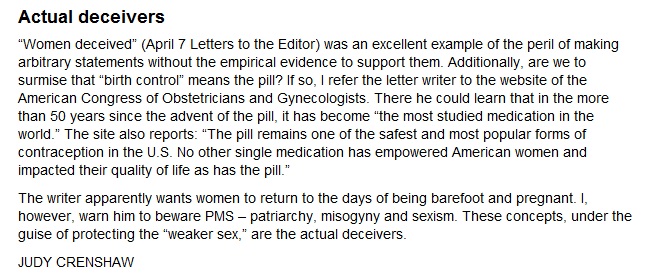
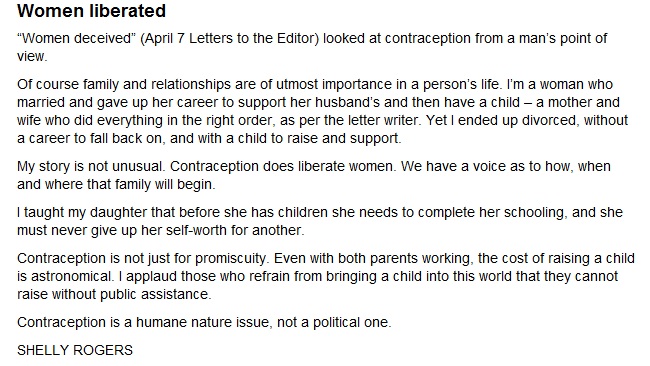
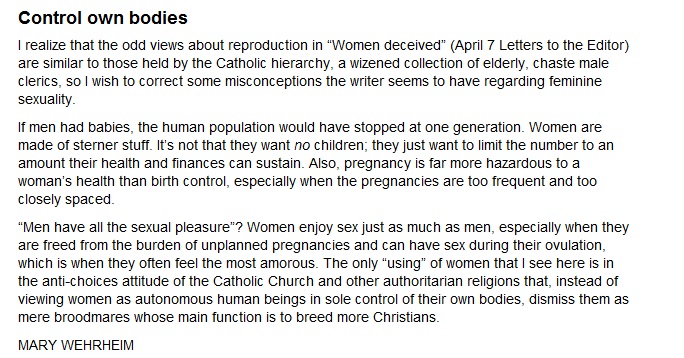
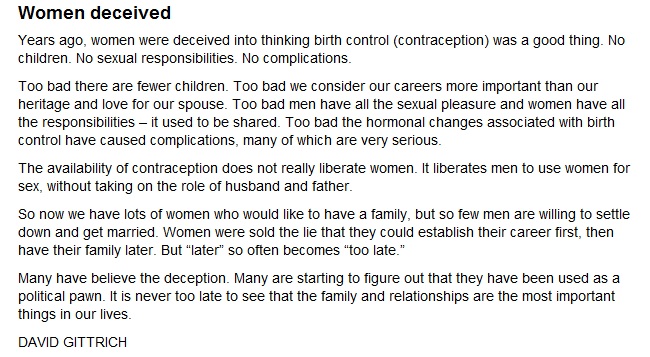
All from the Wichita Eagle:

April 7th:

April 10th:

April 12th:

Today:

I’ll be interested to see how long this goes on– also whether any letters will be published from men unhappy about being portrayed as tricking women into using birth control so they can get the milk for free. “They” meaning the men, of course. Women don’t like milk.

Cultural relativism in gaming

Cultural relativism in gaming published on No Comments on Cultural relativism in gaming

Here you go:

The specific subject that MovieBob talks about is an incident involving a man named Aris Bakhtanians, who was confronted for publicly verbally sexually harassing a female player who he was coaching in a video game reality show. In brief, Aris defended his actions by saying that sexual harassment is part of the fighting game community, and that if you remove sexual harassment, it is no longer the fighting game community. 

Here’s where MovieBob attains Super Bigot Fighting Hero status. MovieBob doesn’t take (much) time addressing the specific instance for which Bakhtanians was criticized. Instead he opens up a dialogue about the argument itself – its weakness, its lameness. He points out that this excuse is used to justify many forms of racism, sexism and homophobia. He takes to task similar arguments like “It’s just how things are” and “This is the last place that it’s okay to talk like this.”

Pamela Geller is vile

Pamela Geller is vile published on 1 Comment on Pamela Geller is vile
Previously I knew Pamela Geller as a “creeping Sharia” proponent, the kind of person who makes a living off making Americans as afraid of Muslims as possible to the point of encouraging us to refuse them the rights we would ordinarily recognize as existing for any American; for any human. She is that, but her reaction to the Fluke/Limbaugh matter shows that she is a female misogynist as well, past the ranks of Ann Coulter. There’s a special category of political commentator that should place them beyond consideration by anyone who strives to be rational. This category I called “unhinged,” and Limbaugh and Coulter have dwelt in it for a very long time. Now, Geller makes me wonder if another category is needed for the super extra unhinged, the kind who might need to be institutionalized but instead are treated as a relevant political voice by…well, some. It’s hard to tell how many. 

Exhibit A:

A 30-year-old poses as a 23-year-old, chooses a Catholic University to attend at $65,000 per year, and cannot afford ALL the birth control pills she needs… so she wants the US taxpayers to pay for her rampant sexual activity. By all accounts she is banging it five times a day. She sounds more like a prostitute to me. She must have an gyno bill to choke a horse (pun intended). Calling this whore a slut was a softball.

Exhibit B:

I have had it up to here with Fluke’s vagina. Seriously. Clearly she’s a plant. I don’t have to exalt or honor women who debase and lower themselves to meat status. I will not honor this pig. I will not teach children to debase themselves. I will not teach children that this is “empowerment.” I explain it to young girls this way. Go into any Wal-Mart or Target. There are hundreds of black handbags for sale in bins, hung on display walls, all cheap or moderately priced, and they can’t give them away. Now  go into Hermes. There is one black, gorgeous, impossible to get, crocodile Birkin bag. There are waiting lists for this bag. No one can get that bag. It costs a fortune and still everyone wants that bag.
Be that bag. I despise the women’s movement. I despise what they have done to women (and men). Just look at Fluke. She is a full-fledged activist and an embarrasment [sic] to decent young women. 

Note: Sandra Fluke is not the one who made this about her sex life. Sandra Fluke did not make any mention of her sexual activity, and it wouldn’t matter if she had. In no way did Fluke pretend to be anything other than what she is, and it’s not her fault if conservative commentators made assumptions which proven to be erroneous. And Sandra Fluke is not the one comparing women to merchandise.

Women aren’t an ideological group. We are a biological/cultural one, so there’s no sense in which the behavior of one woman should be considered an embarrassment to the rest of us. But if one should be considered such, it doesn’t seem like Fluke is that woman.

On what’s relevant if you’re female

On what’s relevant if you’re female published on No Comments on On what’s relevant if you’re female

1. At Camels With Hammers today, Daniel Fincke takes an admirable crack at a topic people have danced around quite a lot in discussing Rush Limbaugh’s ridiculous portrayal of why women want birth control: not only does it have nothing to do with promiscuity, but you don’t get to just assume there is something wrong with promiscuity regardless. That’s not something on which we’re all in agreement, okay? Never mind how difficult it is to define what counts as a “promiscuous” sex life as compared to a regular one, the problem with slut-shaming at its foundation is that it assumes there’s something wrong with being (whatever you define as) a slut! So Fincke’s post, No, You Can’t Call People Sluts, bluntly points out that “slut” is to begin with a term meant to cast shame on something not only nebulous but (surprise!) not necessarily shame-worthy:

In no way, shape, or form do I take promiscuity to be, in itself, an immoral thing. So, no, I don’t think there is any word that you can use that I would find morally acceptable. You call that controlling your thought by not allowing you whatever insult you want? Sorry, that’s morality. It controls some things. You don’t want to be subject to my moral standards? Well, I don’t want consensual, responsible, promiscuous people who do not harm anyone to be subject to yours. I have a lot of good moral reasons to think they don’t deserve derision and that such treatment of yours towards them is unfair and worth calling out. So I’m not allowing that any abusive word aimed at men or women over their promiscuity is copacetic. I don’t have to acknowledge your moral right to use insults to bully people who are not doing anything morally wrong. Legally, you may say whatever you want that does not cross the line into actionable harassment, threats, or libel, etc. But morally if I allow you to call people sluts as perfectly acceptable, then I’m approving your value judgment as perfectly acceptable. You’re entitled morally to argue for the wrongness of promiscuity if you like. Your “distaste” is not an argument and nor is it a justification for dictating to others or for denigrating them.

2. At her blog, Greta Christina talks about how last when when she was speaking at the University of Chicago on the topic of atheism and sexuality, someone defaced a promotional poster for the event by writing next to a photo of her that she is “the ugliest of all atheists!” Because….somehow, that’s relevant. Note: she admonishes readers not to attempt to reassure her that she’s not ugly (which is true– had to say that) because that undermines the point that it is, actually, not at all relevant. It’s not relevant to how well she writes, how well she speaks, how qualified or educated she is, whether what she has to say is well-reasoned or compelling or humorous or insightful or timely or fun or….anything. But because she’s female, people (both male and female) tend to think otherwise:

I’m reminded of something Tina Fey said in the New Yorker about show business. “I know older men in comedy who can barely feed and clean themselves, and they still work. The women though, they’re all crazy. I have a suspicion — and hear me out, because this is a rough one — that the definition of crazy in show business is a woman who keeps talking even after no one wants to fuck her anymore.” It’s not just show business. The definition of crazy is a woman who keeps talking even after no one wants to fuck her anymore. Or, indeed, a woman who keeps talking even if the person she’s addressing doesn’t want to fuck her. A woman who keeps talking even if the person reading the poster advertising the talk doesn’t want to fuck her.

Here’s Rachel Maddow yesterday…

Here’s Rachel Maddow yesterday… published on No Comments on Here’s Rachel Maddow yesterday…

…demonstrating why dummies are more dangerous than dicks: