Skip to content

Booth babes

Booth babes published on 2 Comments on Booth babes

Gizmodo takes ’em on:

At CES last week, in addition to all the gear and gadgets, there was something else on display: women. As with many trade shows—especially ones aimed at a male audience—CES was rife with booth babes. Yet when the BBC ran a story on the practice of hiring scantily-clad models to stand around booths and draw stares from wandering men, it found an interesting defender: Consumer Electronics Association president and CEO Gary Shapiro, the guy who puts on the biggest electronics trade show in the USA. “Well, sometimes it is a little old school, but it does work,” Shapiro tells the BBC. “People naturally want to go towards what they consider pretty. So your effort to try to get a story based on booth babes, which is decreasing rather rapidly in the industry, and say that it’s somehow sexism imbalancing, it’s cute but it’s frankly irrelevant in my view.” Cute? Irrelevant? “Imbalancing?” (Is that even a word?) I’m sorry. Would you care to try again, Gary? The reason his answer is so bothersome is because as the head of the CEA he is, in a very real sense, speaking for all of us in the technology industry. And that Mad Men bullshit doesn’t represent who we are as an industry anymore, and it certainly doesn’t represent what we should aspire to. Technology is about the future, and this attitude is from the past. Shapiro needs to retract those dismissive remarks. And if he’s smart, he’ll do more than simply that. He’ll get ahead of it. He’ll become the example of what to do, rather than what not. There are two issus at play here. First, there’s the gender issue. Women are under-represented in the tech sector. And while there are a thousand theories why that is, the one thing that is clear is that they aren’t underrepresented in society, and by extension, the marketplace. The argument that says CES should be geared towards men because men buy the most electronics ignores that women like gadgets too. If the industry keeps ignoring women in order to market towards men, it’s going to lose sales. If you can create a gadget that women like just as much as men (hello, iPhone) you have a hit on your hands. So why would you want to do anything that might discourage women from showing up? (And it’s abundantly clear that some women certainly are off-put by booth babes.) Why wouldn’t you want to know what a key demographic thinks of your product before it goes on sale? But the second issue is arguably more important. It’s the cluelessness. To demean the concerns about booth babes as “cute” and “irrelevant” shows a huge disconnect with, I dunno… this century. The drumbeat against booth babes grows louder every year. It isn’t going away, and will only get bigger. Other trade shows are at least addressing it, and the CEA should do the same before it finds 60 Minutes shoving a camera in Shapiro’s mug.

And this is right on the heels of a stereotype-debunking study that suggests women are more avid consumers of technology than men:

Women are more likely than men to purchase tabletslaptops and smartphones – three out of the four top consumer electronics categories, according to a new study.Parks Associates asked 2,000 consumers, ages 18 and older about their buying habits in the consumer tech space. The study, which was conducted in late 2011, asked men and women which products they intend to buy before January 1, 2012. Retailer HSN announced the findings on Monday at the 2012 Consumer Electronics Show. Women expressed more interest in tablets (18%), laptops (20%) and smartphones (20%). Only 15% of men planned to buy a tablet, while 14% sought a laptop and 17% intended to buy a smartphone. The only category in which men surpassed female interest was flat screen LCD TVs, with men (19%) favoring the sets over women (17%). “The tech industry has long been dominated by men — even at CES — but women are really the powerhouse in the household driving purchase decisions,” Jill Braff, executive VP of digital commerce for HSN, told Mashable. “Women are highly engaged with the latest and greatest gadgets and technology.”

PAX, the convention organized by Penny Arcade….founders? Authors? Guys? Jerry Holkins and Mike Krahulik, banned booth babes in 2010, while E3 (Electronics Entertainment Expo) appears to celebrate them.

Just speaking for myself…there might be more efficient ways to drive me away from wanting to learn more about and possibly buy a product than to have a “spokesmodel” promoting it, but that’s surely near the top.

The internet is a sad place, take 2,001

The internet is a sad place, take 2,001 published on No Comments on The internet is a sad place, take 2,001

Tracy Clark-Flory at Salon writes about what she calls “Slut-shaming 2.0,” web sites that exist for the sole purpose of identifying and shaming (mostly) women for their sexual behavior:

The content is submitted by scorned exes, former friends and total strangers. A typical post calls out a woman, using her full name and at least one photo, for either having too much sex or for being unattractive. A recent post headlined, “[Redacted] Should Think About Her Decisions In Life,” featured a semi-nude photo of the woman in question, along with this user-submitted gem:

This B*tch right here is [redacted], of Reno. She has been with 7 different guys in the past 2 week and I could not tell you what her total number is. She constantly brags about how drunk she gets a parties and how she sleeps with all these hot guys.

It goes on, but you get the idea.
Some posts name and shame women for allegedly being escorts – or, in the site’s charming vernacular, “porta potties.” Usually, Nik Richie, who runs the site, weighs in with a one-liner pointing out a highly specific physical imperfection — like, “muscular back thighs,” “sperm eyebrows” or “wrinkles in her wrists.” He has zero tolerance for knobby knees, round cheeks or – the horror! — thighs that touch.

She concludes “These are the new slut-shamers of the Internet. What’s most remarkable is that they manage to be both prudish and NSFW, all at once.”

I suppose it’s remarkable, if the hypocrisy of American prudishness is remarkable. But that hypocrisy is the very thing that makes slut-shaming possible in the first place. It’s kind of like being surprised that the girl who has sex in the first part of a horror film is also the first one to die.

Structurally unsound: video game women

Structurally unsound: video game women published on 2 Comments on Structurally unsound: video game women

I had a post started about a month ago about women in video games, but never finished so I’m going to revamp it now. I’ve been a gamer practically since birth, starting with a family-owned Atari 2600 (favorite game: Adventure) and continuing to present day (PC and Xbox). As with comic books, table-top games, and science fiction and fantasy in general (AKA geek culture), the video game genre has been largely produced by and for heterosexual men since…well, forever. There have always been some women involved on both ends and that number is ever-increasing, however. This means that the questions of how women should create games, how they should be presented in them, and how female gamers should be perceived and treated is being debated more and more. As are, in turn, the same questions about queer players of all kinds.

Straight male privilege in video games takes many forms. If you play a specific humanoid character, it will usually be a male and rippling with muscles. If you play a female, she will usually be curvaceous (sometimes impossibly so– we’ll get to that in a minute) and wearing revealing, impractical clothes. Any females depicted, for that matter, will most likely fit that standard. If the game offers opportunities to form relationships with NPCs (non-player characters), they will generally be heterosexual. If the game is online and offers the opportunity for players to chat, the chat will contain sexist innuendo, people calling each other “fag,” describing beating an opponent particularly badly as “raping” them, and either fawning over or harassing players discovered to be female. I am not saying these things are ubiquitous– I’m saying they are general trends that female players must tolerate if they want to play. They can complain, but they will meet resistance from the majority every time. That doesn’t mean complaining is futile, just that effecting any change means having to wade through a lot of bullshit along the way. Privilege is, after all, unacknowledged by its nature. The advice blog Dr. Nerdlove observes

Y’see, one of the issues of male privilege as it applies to fandom is the instinctive defensive reaction to any criticism that maybe, just maybe, shit’s a little fucked up, yo.  Nobody wants to acknowledge that a one-sided (and one-dimensional) portrayal of women is the dominant paradigm in gaming; the vast majority of female characters are sexual objects. If a girl wants to see herself represented in video games, she better get used to the idea of being the prize at the bottom of the cereal box. If she wants to see herself as a main character, then it’s time to get ready for a parade of candyfloss costumes where nipple slips are only prevented by violating the laws of physics. The number of games with competent female protagonists who wear more than the Victoria’s Secret Angels are few and far between. The idea that perhaps the way women are portrayed in fandom is a leetle sexist is regularly met with denials, justifications and outright dismissal of the issue. So regularly, in fact, that there’s a Bingo card covering the most common responses. Part of the notion of male privilege in fandom is that nothing is wrong with fandom and that suggestions that it might benefit from some diversity  is treated as a threat.

In that post, Dr. Nerdlove goes on to analyze some of the characters in Batman: Arkham City. Here are some other places to see analysis of female characters in video games and video game art:

Escher Girls — Addresses physically impossible body types and poses depicted
Boobs Don’t Work That Way — Self-explanatory
Women Fighters in Reasonable Armor — Show examples of female characters in attire that makes sense

Ryan at Mad Art Lab was inspired by the latter blog to make his own post with suggestions about how to dress female fighter characters called Fantasy Armor and Lady Bits, and then another post which was what actually stimulated me to revive and continue this one: Rubber Spines and Bent Space. In it he delves into a possible biological reason why people find images of humans with impossible proportions and posed in impossible (or very unlikely) positions not only comprehensible but attractive. The most important part of the explanation to me is this, which I’ll quote at length because frankly he nails it:

2: Supernormal Stimulus
Why is it that artists are consistently and purposefully going to extra effort to put biologically unlikely characters in physically improbable positions? Well, because it’s effective.
I have heard rather a lot of women and a few men say with conviction that these images are not attractive. I will hereby declare that they are incorrect, at least partly. They are wrong, because they are attractive to me. They are attractive to all of the young men that I know who have purchased / sought out these images simply for their titillating qualities. I will concede, though, that them being attractive doesn’t make good rational sense. That is because they’re not appealing to a rational sense.
The poses and figures of women in things like this: 

Soulfire, Volume 2, Aspen MLT Inc.

are deliberately attempting to exaggerate the sexual characteristics of the character to elicit a reaction beyond what should be possible with a real human. This effect is called supornormal stimulus. In short, it plays on what we find attractive and then extrapolates beyond what is physically possible. Apparently, you can get geese really excited about volleyballs painted like their eggs because that must be the biggest, healthiest egg that was ever laid. The same thing works for sexual characteristics. We like large perky breasts, so make them defy gravity. We like large eyes, make them too big to fit inside a skull. A narrow waist and round hips are appealing, so remove some of that lower intestine and kidneys and shave off some of that pelvic bone. An arched back is a signal of sexual readiness, so a very arched back must indicate an unprecedented level of randiness. Moreover, given the fact that we will fixate on certain details and happily ignore gaps, they can show all of these features at the same time. If you twist a body in such a way as to show off the eyes, legs, waist, hips, breasts, shoulders and butt, you can get hit all of the arousal points simultaneously. A human being can’t accomplish these things, of course. Physics and biology put some limits on these attributes so that they never get beyond a certain point. Partly because of that, we’re not trained to easily recognize when they’ve gone beyond the “healthy, youthful” look into the “structurally unsound” area. However, artists are not bound by the constraints of reality and can therefore abuse them for market appeal. 

He goes on to describe what he sees as the ramifications:

3: Unforeseen Consequences What’s the harm in producing these images? The artists are producing something that people are buying. It excites the audience and everyone knows that it’s not real. So is there a problem? I argue that there are a couple of problems. 3.1 Desensitization
As with any stimulus, too much of it and you will numb to the effect somewhat. It’s like walking by a Cinnabon: If you only do it on occasion, the smell is intoxicating. If you do it regularly, you find it satisfying. If you work there, you barely notice it. So too with imagery. The first time you see something erotic, it makes your brain leak out your ears. In order to keep that level of arousal up, the stimulus needs to vary or increase. Anything less will seem bland in comparisson.
So an occasional glimpse at this sort of thing wouldn’t be bad. It would be like an occasional guilty pleasure, like a fine wine or chocolate. But if you’re surrounded by it, then it becomes routine. The supernormal stimulus can become the baseline. 3.2 Personal Image
Humans can’t be comic book characters. However, those characters are presented as an ideal. They’re more human than human, better in every way. However, unlike a well-toned athlete or the hottest kid in school, they’re an impossible goal. Some people will strive to look like those cartoons and that isn’t healthy. 3.3 The Feedback Loop
We are attracted to what we’re used to seeing. We generally like partners who are similar to what we were raised with. Media reacts to that demand and provides it in an exaggerated state to get us interested. When we begin to expect the exaggeration, they have to push beyond that to keep our attention.  This push-pull effect can drag the expected, default image of women in impossible directions over time. Troublesome, no?

Video games which allow you to customize your character, usually RPGs (role-playing games) often don’t even make it possible to play a female character with a realistic body. And if they do, they also provide options which are so off the charts in terms of supernormal stimulus that they make the more realistic options appear chunky and ugly by comparison. It has been my experience that female gamers typically want to play a character which is attractive. But what happens when they are presented with options including character that are impossibly attractive? They want to play those as well, both because we are of course also susceptible to supernormal stimulus, and because choosing a more realistic option can actually earn negative attention.

Character options for RPGs typically include the chance to choose your class (the kind of powers your character will have) and your race. The former will most likely determine how you dress (melee fighters need armor, of course, whereas magic-wielders can get away with wearing fabrics only and will likely be restricted to such) but the latter will determine your appearance, including body type. In some cases it is literally impossible to make your female character fat and/or small-breasted, not that most people would choose to play such an option. What’s interesting though is if you get as close enough to that as possible, achieving a body that would be at least average in real life, females of the race you’re playing will be called ugly. If the body of the race you’ve chosen is muscular rather than slight, females of the race you’re playing will be called ugly. Never mind how bizarre would be for someone with a body like Gisele Bundchen (5’11”, 125 lbs) to swing an axe with enough force to decapitate a minotaur.

Gamer evaluation: “Nice for a barbarian, I suppose,
but can you make her breasts bigger?”

This creates an interesting quandary for game designers. Male gamers want to be able to play characters who are big and strong. A slight build is acceptable for a mage, but if you’re going to play a fighter than piling on the muscles to the point of absurdity is just fine. But for every race, there have to be both male and female counterparts, so there has to be a female option for every barbarian/orc/troll/demon/brute-type creature. Even if no one’s going to play her, because nobody wants play a woman who looks large, lumbering and muscle-bound compared to the more dainty-but-physically-impossible options. “Nobody” is of course an exaggeration– there are some people who are quite happy to do so. They’re a distinct minority, and require a thick skin to deal with the ribbing they’ll get from other players both in-game and in conversation about the game elsewhere.

My suggestion would be, then, to avoid the supernormal stimulus. Of course if you’re going to have distinct races in a game they should differ physically, but please don’t give us an option to play Barbie-like characters who literally could not function if they manifested in real life, because that means we’re less likely to be penalized for not choosing to play them.  That doesn’t mean characters can’t be sexy– the real world, after all, is full of people with real-life sexy bodies. Maybe Gisele couldn’t battle a yeti, but I bet Gabrielle Reece or Venus Williams could do some damage. Beautiful women who are not, to use Ryan’s awesome term, structurally unsound. 
Another issue is attire– please don’t dress my badass hunter who needs to scramble through dungeon tunnels, leap over barricades, engage in melee combat, and sneak down hallways in a bustier, thigh-highs, and five inch heels. She doesn’t need these things in order to be attractive, and putting them on her anyway makes her ridiculous. Plenty of games either force your character to start out in his/her underwear before acquiring armor or at least make it possible to strip down to that state, but the underwear doesn’t need to be Victoria’s Secret. It doesn’t need to take the form of garments that have the primary purpose of being impractical. Yes, a video game is a fictional world, and a fictional world of supermodels fighting evil would be pretty amusing. Just, you know, call it that. Let us acknowledge that that’s what it is, and laugh, and not pretend it’s anything else. 
I referred to actual behavior between players in-game toward the beginning, but discussion of that will have to wait for other posts. Women in video games is an enormous topic, so this one will have To Be Continued.

Slut-shaming 101

Slut-shaming 101 published on No Comments on Slut-shaming 101

…as explained quite eloquently by a thirteen-year-old girl. My friend Nick shared this with me, and I’m sharing it with you:

Slut-shaming takes away feminist cred (duh)

Slut-shaming takes away feminist cred (duh) published on No Comments on Slut-shaming takes away feminist cred (duh)

I’m in love with this post by Amanda Marcotte: Smart Girls Wear Short Skirts, Too, or “Why Lisa Belkin is wrong to condemn college girls for dressing sexy.” In it, Marcotte agrees wholeheartedly with some of the concerns Belkin voices in a New York Times article titled “After Class, Skimpy Equality.” Specifically, about the social environment in college: campus rape, the apparently real perception of some students that female students have too much power because they can legally refuse sex (!), and disappointment in some really disturbing behavior by fraternity members that has been in the news lately. But that’s where the agreement ends. “I have one strong desire that carries through life,” Marcotte begins her post, “which is that I never become one of those women who self-identifies as a feminist while conflating the problem of inequality with the non-problem of young women being sexual. Should I ever start assuming that young women who have sex are being had, or if I start hyperventilating about young women wearing miniskirts, I hope I at least have the good sense to give up the writing thing and go into real estate.”

I share this desire. However concerned feminists may legitimately be about the image of women in society, when it turns into slut-shaming it veers sharply toward the Dark Side. I know this is not a completely black and white issue, but condemning individual women for how they dress and behave sexually (with consenting adults), suggesting that they are somehow bad people and/or that they deserve to be sexually attacked or harassed is the antithesis of feminism. No ifs, ands, or buts about that. Marcotte continues:

Even more distressingly, Belkin conflates the problem of campus rape with the fact that young women like to look sexy, saying that the young women who wore sexy Halloween costumes to a Duke fraternity party “had mothers who attended more than one Take Back the Night March in their college days,” as if being opposed to campus rape and being willing to wear sexy clothes are in opposition to each other.  But as the organizers of Slutwalk know, that’s absolutely false.  In fact, you can and should argue that men can look at a woman wearing sexy clothes and think, “She wants to look sexy,” and not, “She’s asking to be violently assaulted.”  To Belkin, the fact that women dance in their underwear at parties is part of the same pattern that caused a fraternity to circulate an email explaining that women aren’t actually people, as if women could get their people status back by putting more clothes on.  But I think that men are perfectly capable of being turned on by a woman dancing in her underwear while never forgetting that said woman has a family that loves her, a mind of her own, and ambitions that are equal to his.  We don’t allow men’s sexuality to dehumanize them in our eyes.  If a young man spends his weekends partying and flirting with women, and spends his time in the classroom pulling down As, we don’t see that as a contradiction. The belief that female sexual expression is uniquely dehumanizing is a double standard, no matter how much you dress it up in feminist language.  Instead of condemning young women for the length of their skirts, why not use that energy for condemning anyone who would think that a woman is lesser-than because she wears a miniskirt?  

Emphasis mine. I think the thing most commonly misunderstood about Slutwalk is that it is essentially a freedom of expression movement. The point was that women should be able to dress and behave as they wish (both means of expression) without being attacked, even if that includes dressing and behaving in ways that some would label as “slutty.” Whether or not you think the word “slut” can be reclaimed, or whether you think there’s a reason to try, is really beside the issue. I vacillate on that, myself, but it doesn’t affect the essential point that the epithet “slut” says nothing about a woman’s worth or her right to express herself, sexually or otherwise, in public or private however she chooses if it brings harm to no one. “Slut” was the epithet of choice a Haredi man recently hurled at a young female soldier who chose to sit at the front of the bus in Jerusalem. It was, at its very essence, a word used to degrade a woman for not behaving as though she is inferior.

Sexual attractiveness, performance, and reproduction are functions of women. Reducing women to those functions is what misogynists do, and a collection of functions is not a person. Certainly not in comparison to someone who is capable of all of those but also of things like creativity, invention, logical analysis, will, bravery, authority, athleticism, wit, and eloquence– traits that are generally admired but whose existence is sometimes denied or ignored in females altogether. Objectification is the act of setting aside those things in order to appreciate appearance or behavior alone, and I don’t think it’s fundamentally a bad thing. Indeed, I think that people who claim to never objectify others are either lying or lacking in self-awareness. But there’s a difference between appreciating those aspects about someone and treating her as though that’s all she is, or that that’s all women in general are good for. Partial people. Inferiors. It’s no accident that an insult with a typically sexual connotation would be used for any woman who acts as though she is worth more than that short list of functions. As Marcotte says, we don’t treat men that way no matter how “slutty” they are. To close, she says

 Asking something of men seems to be the big taboo in our culture, even sometimes among feminists. In contrast, scolding women about what they wear is easy, even if it’s a red herring.

I often think about how counter-productive it is, from the perspective of a straight male who wants women to display their bodies and be available for sex, to punish them for doing so via shame, intimidation, and even outright attack. In reality, “modesty” is often a euphemism for plain old fear. Fear of being judged, by men and women alike. Fear of being treated as though allowing people to see your parts should remove any expectation of being seen as more than the sum of them. Fear of being penalized for acting in ways that no man would be penalized for. Women sometimes show themselves off and act sexually open out of perceived necessity or insecurity, yes….but they also do it when they feel safe. Why would anyone not want women to feel safe? Especially someone who thinks of him/herself as a feminist? And if you want them to feel safe, why not go after the ones shaming and attacking them, rather than the women themselves?

Jen McCreight has not rage quit

Jen McCreight has not rage quit published on No Comments on Jen McCreight has not rage quit

…though she has been tempted. It’s easy to see why:

Becoming a board member of a secular non-profit and being invited as a speaker to events has really opened my eyes. You start interacting with a diverse group of people who have been in the movement a long time, and you get a behind-the-scenes glimpse. Some organizations (like the SSA) are truly awesome and run by lovely human beings. Some… boy, if you guys only knew. The people are the same. Some are the most genuinely lovely individuals I have ever met. But some are manipulative, petty, passive aggressive, selfish, sexist, racist, homophobic, ablist, or just downright mean. Yes, I came to the shocking realization that atheists and skeptics are also human. The problem is that without this insider knowledge, it’s incredibly difficult to distinguish the lovely from the loathsome. The bigger problem is that I see no real solution, and am stuck cringing silently when someone is unwittingly praising a person who’s really a Giant Fucking Asshole. Because the politics involved between people or between organizations is enormous. I feel gross staying silent and playing the game, but I often have no choice. This isn’t because I’m afraid of losing readers – contrary to popular belief, I don’t just blog For Teh Hitz, and the money I make off blogging is not enough to float in swimming pools full of hundred dollar bills. This isn’t because I’m afraid of losing a potential writing career – my actual job is as a scientist, remember? It’s because there are people and organizations in the movement I genuinely care about, and stirring certain pots would cause them harm. I’m not sure why I’m even writing this post other than to get it off my chest. It probably comes off as totally vague and pointless to those of you who aren’t privy to the back stories and insider knowledge. But maybe that’s the message. That when some of us insiders rant and rave, and it comes off as vague and pointless…it’s probably because you’re just seeing the tip of the iceberg, and we forget your view. You can’t see under the water to glimpse the private emails, the angry phone calls, and the years of history. So many people think other bloggers and I do anything for controversy because we’ll occasionally speak up against big names. What should concern you are the things we can’t talk about.

They do concern me, but not that much. There are ways that significant figures in a movement can be Giant Fucking Assholes that matter in terms of the movement, and ways that don’t really. And when they don’t really, or when they do and you know but feel like you can’t talk about it, it’s an unpleasant thing to deal with. But deal with it we must. 

Rillion’s Law applied

Rillion’s Law applied published on No Comments on Rillion’s Law applied

I have my own law, devised under the screen name Rillion which I’ve used since about 2000. The law isn’t quite that old, but it has existed at least since 2005. Rillion’s Law states:

The amount of knowledge a person has about a particular subject is inversely proportional to his or her tendency to make universal, authoritative statements about it.

Yes, I know how pretentious it is to devise your own law– especially if you’re not remotely famous. And doing so is not an indication that I am in any way immune to the phenomenon in question. Quite to the contrary, the law exists in part to remind me to avoid it, and I don’t always succeed.

The reason that this phenomenon exists– generalizing grossly and erroneously with an air of authority about things you don’t really understand– is because people want to have opinions. They want to have a stance to offer when asked, or when they haven’t been asked, and lack of knowledge on a subject makes one incredibly susceptible to glossing over important distinctions within it. Generalizing itself is not a bad thing. It’s a necessary thing in situations when you need to focus on a small number of salient facts about a group to which other facts are irrelevant. Generalizing is important in science, where these situations are frequent. But it should always be done while ensuring that generalizing is what you’re doing, that the facts you consider salient are salient for your purposes but might not be for someone else, and that the facts you’re dismissing as irrelevant to the statements you’re making are in fact irrelevant. Otherwise you end up grouping things together for bad reasons and disregarding important causal factors. You become an example of Rillion’s Law in action. And when the universal, authoritative statements you’re making are about people and end up grossly misrepresenting them, those people are not going to be very happy.

Jason Thibeault, who blogs as Lousy Canuck at Freethought Blogs, posted yesterday asking something along these lines: Are universal statements always a problem? His answer: maybe. He says:

It occurs to me that many (“ALL!” “Shh.”) of our problems around these parts viz every new conflagration, from our recent conversation with Mallorie Nasrallah, to thestatement by DJ Grothe that we only blog about controversial topics for hits, to the pushback against a Rebecca Watson blog title as though it meant she hates all atheists, is the fact that we as skeptics seem to have a problem with blanket universals even when they are not intended as universals. They are the quickest single thing you can do to engender hatred amongst your commentariat. Much of the problem with Mallorie’s open letter to the skeptical community has to do with the universal statement that skeptics “shouldn’t change for anyone”. While she claims she wrote the letter solely for the purpose of expressing her own views of the community, she presented it in the midst of a number of controversies wherein people have been demonstrably misogynistic to bloggers like Greta Christina or new women in the community like the 15 year old Lunam on r/atheism. This caused some outrage in the context of the greater fight we’ve been waging — the fight against entrenched sexism in our communities. For context, I always use the plural for communities because neither atheism nor skepticism have a single overarching community, much less a greater community for either one. We have a set of loosely allied communities, each manifesting their own sets of values and beliefs. The commenters and bloggers at Freethought Blogs appear to have clustered around beliefs in humanism as well as skepticism and atheism, and will fight a misogynist comment as quickly as a creationist or woo-peddling one. I don’t believe that the levels of sexism in our collective online communities are very different from the background of the internet as a whole, no matter how much of a safe space we’ve carved out here. However, there are three things that are important and mitigating factors to that blanket statement about the levels of sexism. 1: The internet is, as a whole, a far cruder and crasser place than real life, owing largely to anonymity and the Greater Interent Fuckwad Theory.
2: Our real-life meatspace communities are very often being organized via the internet, so there’s a lot of overlap between what goes on in meatspace and what came from the internet to begin with.
3: we have experienced by my estimation a significant amount more pushback than most other communities built around other topics, against the very idea that people shouldn’t use sexist slurs at women, or treat women like they’re just there as dating pool material, because either of those are likely to result in women who might otherwise participate bleeding away from our communities. DJ Grothe described our fight against this pushback as being solely intended to drive controvery, to drive a wedge in the community, done solely for the hits. What makes this a short-sighted blanket statement is in part the misidentification of the problem, the misidentification of what it is we’re trying to do about it, and the misidentification of what’s actually being said about the community as a whole. Stephanie’s post itemizing the times when he’s exhibited this sort of blind spot for ongoing fights was met with doubling down, and DJ declared that the whole episode served as proof to him that that’s all the feminist bloggers in our community want to do is to tear other communities apart over sexism. 

Hasty generalization is, as we know, a basic fallacy. Rillion’s Law is really just an observation about what causes people to generalize hastily. And what Nasrallah and Grothe have done, it seems, is hastily generalize about both the problem of sexism in skeptical communities and the people speaking out about it. Greta Christina has a post up today about Grothe, doing her best to be fair and give him the benefit of the doubt, but it’s pretty damning nonetheless.

I have two questions for JREF President D.J. Grothe. They’re questions that I find unsettling and upsetting to even consider, questions I wouldn’t have thought I’d have to ask a leader of a major organization in this movement. But I’ve been reading some things Grothe has been saying recently… and apparently, I have to ask. Question #1: Do you really think there is any context in which making threats of gender-based, sexualized violence — towards a person of any gender, but especially towards a female writer and her readers — can be justified? Question #2: Do you really think that feminist bloggers in the atheist/ skeptical movements are writing about sexism and misogyny, and pointing out examples of it in our communities, primarily so we can manufacture controversy and draw traffic? I would like to think that the answers to both questions is an obvious and resounding “No.” D.J. and I have had some differences, but we’ve also had a largely cordial and even friendly professional relationship. I know he thinks of himself as an ally in the effort to make the atheist/ skeptical movements more welcoming to women. And I know that he takes pride — justifiably so — in, among other things, drawing more women to TAM, both as speakers and attendees. But I’ve been following the discussion on Almost Diamonds about him, and about an apparent pattern he has of defending sexist language and behavior in the atheist/ skeptical communities. I’ve been reading the things he himself has been saying in this conversation. And I am extremely distressed to realize that the answers to both these questions appears to be, “Yes.”

In essence, Greta Christina is saying “I think you’re making some universal authoritative statements without being aware of the ignorance that enables you to make them. Or at least, I hope you are, because it’s better than the alternative. And I’m giving you the opportunity to look around, understand, and amend your position on that new understanding.”  That’s a charitable reading. No doubt she’s extending it because Grothe has a reputation for being an understanding, charitable guy himself. Perhaps to a fault, and in the wrong direction, in this case.

It’s not fun for female bloggers, scientists, and activists to keep talking about the sexism thing, trust me. It’s a pain in the ass, in large part because it means getting dismissed as a mere attention-seeker in precisely the way Grothe appears to be doing. But the existence of sexism in communities that presume to be so rational and fair-minded in the first place is a roadblock to even being comfortable to participate in the first place, and– sorry– people who aren’t confronted with that on a regular basis can find it easy to forget, and dismiss as complainers people who do have to deal with it and speak up about it.

*removes needle from the broken record*

ETA: Grothe’s reply

The straw man boxing match

The straw man boxing match published on No Comments on The straw man boxing match

I love Penn Jillette. I do, very much. But he does tend to carry the denouncement of prudes and blowhards so far that it gets to the point of practically denying that authentic assholes exist. Let me explain.

Earlier this evening, Penn tweeted a link to this letter addressed openly to the “skeptical community from a fellow atheist, who just so happens to be female,” Mallorie Nasrallah. In it, Nasrallah describes herself as having been a member of this community for a very long time and having been welcomed, and now finds herself “distressed” to see that some people are raising the question of how to be more welcoming to women. She asks “Who made you think you weren’t?” The answers, one might suggest, can be found in incidents like thisthisthis, this, and this…if one is even half-heartedly keeping up to date on the situation. Nasrallah, it seems, is not. Ignorance of such is the charitable explanation I can come up with for her having declared to the skeptical community at large,

With all my heart I beg you to not make monsters of your gender. I like your jokes. I like your humor. I like the casualness and ease that no gender distinction has allowed us all over the years.

You have never hurt or insulted me, you have brought me years of joy, wonderful debate, and stimulating conversation. By forgetting to see me as a woman, you have treated me as an equal, as a comrade, as a friend.

If your jokes or teasing manner offend some people, so the fuck what? Someone will always be offended by jokes, never let them make you believe that you are guilty of something worse simply because of your gender. If you want to make boob jokes thats fine by me, you have after all been making dick jokes since you were old enough to make jokes. Plus they are funny as hell. If you want to go free and uncensored among a group of like minded people, if you want to try to acquire sex from a like minded person, awesome, do it, sex and friendship are amazing. You are not a monster for wanting these things.  You are not a monster for attempting to acquire them.  I type this with all of the warmth and sorrow of someone entangled in the most beautiful of bromances. I love you guys. And I’d like to slap the silly assholes who have given you the idea that you have mistreated me.

Because, you see….it’s all about how Nasrallah personally has been treated, and how she sees herself as having been treated. Her perception and interests are the only things that matter. Jenn McCreight and I’m sure many others joined in pointing this out.

Never mind that most of the people concerned about misogyny in skepticism are not saying anything like that

  • jokes and teasing are bad
  • boob and dick jokes are bad
  • people are guilty of something because of their gender
  • people who don’t like boob and dick jokes are trying to censor people
  • people who make boob and dick jokes are monsters
  • people who want sex from the like-minded are monsters
Rather, they’re saying things more like “Not cool,” in response to things like “Go fuck yourself with a knife you irrational cunt.” Which, I believe, does not generally fall into any of the above categories.  
What’s funny is that this is a reminder (among other things, needless to say) not to treat skeptical women as somehow different. Guys who love skeptical women, guys who are our “bros,” will feel comfortable to relax and make baudy jokes without assuming that the only point in having those women around is to sleep with them and/or or joke about how worthwhile it might or might not be to sleep with them. Or, you know, rape them. So here’s my open letter:
Hi Mallorie,
The people complaining about misogyny in skepticism clearly are not objecting to the treatment that you have received. It seems that you have been treated graciously, which is fortunate. That is not everyone’s experience. Please do not disparage their complaints about that experience by expressing a desire to “slap” them, or by misrepresenting the basis of their issues. If you see people making irrational complaints, try and identify them specifically so that people like Penn do not tweet about how right you are, because you’re his friend, while failing to acknowledge that the reality of conflict going on isn’t restricted to your personal experience. I’m not even saying that the bully is still a bully even if he treats you nicely. I’m saying that the fact that some people who sort of resemble the bully but treat you nicely exist doesn’t mean that the bully doesn’t exist. That’s a lot more nuanced and therefore convoluted, but the truth always is.  
And Penn, I’m saying that you need to look at the bigger picture before jumping behind someone’s decree to an entire community based on her personal experience.

For added reading: http://www.patheos.com/blogs/friendlyatheist/2012/01/02/pennjillette-your-friend-is-wrong/

The power of “Not cool”

The power of “Not cool” published on No Comments on The power of “Not cool”
“Dude, we don’t want to see that shit. Here, have a sip of
Douche-Be-Gone so you’ll stop being so…you know.”

Concerning the topic of online sexual harassment against women, atheist and otherwise, and what to do about it, Stephanie Zvan defends the use of social disapproval:

I’ve even seen a couple of people say things like, “Social disapproval is a technique used against atheists by theists. We shouldn’t be doing that ourselves.” All told, the consensus among those feeling challenged for doing nothing is that doing something is dangerously repressive–when that doing something is registering that one simply does not approve. They’re even a tiny bit right. Social disapproval is indeed a potent force. It strongly shapes our societies and our interactions with each other. Being outcast presents a form of stress that is bad for us all on its own. However, where these folks are a tiny bit right, they’re also a whole heaping lot wrong. The problem with this sort of social pressure isn’t that it is inherently wrong. As I mentioned, this is a big part of how we add order and structure to our societies. The problem is when we use to enforce pointless conformity, when we shame or cast out those who are doing nothing wrong, nothing that will harm our society. For the record, sexism, misogyny, objectification, normalizing rape through nudge-nudge-wink-wink humor, threats to bodily autonomy–these are all doing something wrong. They all hurt a substantial portion of our society, and I don’t just mean women. This is not comparable to not believing in a god. Those behaviors are all also prevalent in our society, though less than they used to be before we started confronting them. They are being held in place by a narrative that, while it can no longer claim that nobody at all is concerned by this behavior, the only people who are concerned are “thin-skinned pussies” and “irrational cunts.” That means that if you–yes, you–don’t speak up when something like this happens right in front of you, you feed that narrative. This is what “If you’re not part of the solution, you’re part of the problem” means. The only thing that can really cut through that narrative is more voices that come from within the groups where this behavior happens. No bullying or questing for bad behavior required. You don’t have to be any more eloquent than “Dude, don’t go there” or “It’s only a joke if it’s funny” or “I’m with X on this” to back up someone else already taking the heat for standing up. Or you can just use the brilliant line that should become a meme as of yesterday: “I am also the internet and I don’t want to see that shit.”

Absolutely right. There is nothing intrinsic to social disapproval that makes it a bad thing. It can be a very good thing when it comes to dissuading people from treating each other terribly, even in an atmosphere like the internet where people are often allowed to be anonymous or anonymous-but-trackable (using screen names). The problem with social disapproval of atheists isn’t the what but the why— the shaming and alienation of people for something about them which has nothing to do with their actual worth or moral standing. When what you are is a troll and/or a jerk, however, your moral standing goes down and calling you on it is entirely appropriate. Social pressure can simply be what happens when a bunch of people call you on it, and it works.

Online communities can and usually do also have systems of moderation in place, automated or warm-blooded, whose job it is to regulate and prevent obnoxious and hateful speech. But the most likely message someone who is being arsey gets from being penalized from one of these is “The Man is keeping me down! Violation of freedom of speech!” Which is bollocks, of course– no private community has an obligation to protect the dissemination of odious speech if the owners/ruling powers do not desire it. Still, I think if possible it’s always better to rely on the community at large to make it highly uncomfortable to express nasty sentiments, so that the perpetrators know that the negative reaction isn’t just from one person or a few who happen to be on a power trip or have it out for them personally.

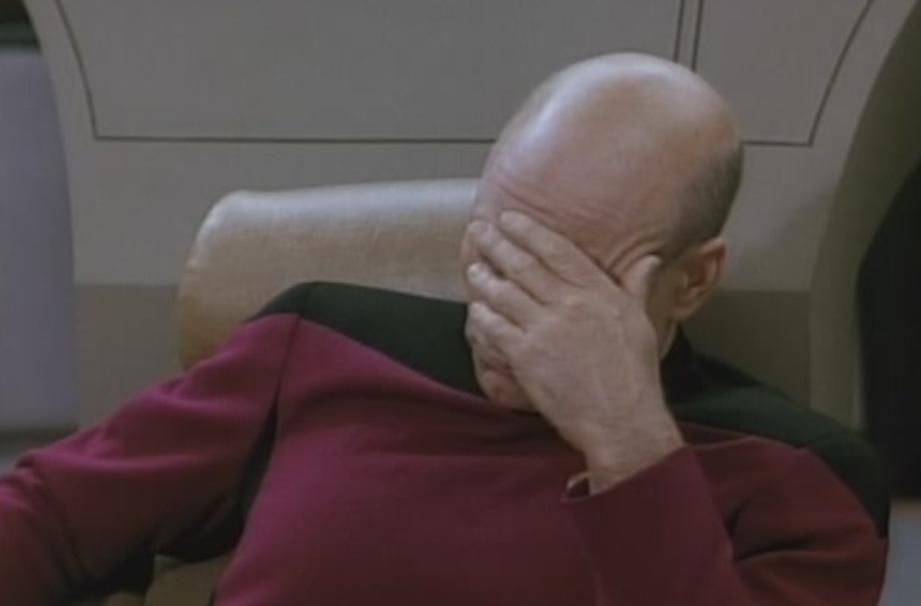
The corollary to the rule of using social pressure to combat internet douchiness is, of course, that those employing it should be able to explain what’s wrong with the speech to which they’re objecting so strenuously. A Picard facepalm might seem sufficient:

…but if not (and usually not), you should be able to articulate the problem, no matter how obvious it appears to you. For one thing, it makes the group disapproval amount to more than “There are a bunch of us who frown on that sort of thing” and create an opportunity for the jerk to comprehend the reason for the perception of his/her jerkiness.

This, in turn, creates an opportunity for him/her to correct the behavior. To maybe even apologize. It does happen! And when it does, that’s the cue to stop with the social disapproval. If the “Dude, that’s messed up”-ing doesn’t end even after the behavior has stopped and admitted fault, the message sent will instead be that he/she can’t do anything right, at least from now on, thereby negating any positive consequence of all of the disapproval. It will probably even counter-productively convey the impression that the disapproving crowd are irrational blowhards and there’s no point in listening to their exclamations. Our jerk in question may even nurse a messiah complex for him/herself as a result, thus becoming further bolstered against any future accusations of jerkiness. With great power comes great responsibility– so it is with the power of “not cool.”

One further thing to note is that online as well as in RL, the most effective social disapproval is likely to come from peers– the people most familiar and similar to the jerk. Yes, pro-active peer pressure! Don’t make the target of the jerkiness and his/her peers the only ones to speak up about it. It might not feel like the best thing, but the thoughts of people who are more like the jerk yet are willing to stick their necks out on the target’s behalf are probably going to carry more weight with the jerk, because they can’t be as easily dismissed as “whiners” or “killjoys” (or “thin-skinned pussies” or “irrational cunts”). Yeah, that’s not rational, but jerks often aren’t– that’s why they’re jerks. It’s also not rational to suddenly start listening to complaints about your behavior just because they start coming from someone you otherwise admire (even if they’re not exactly a peer), but damned if that doesn’t work pretty well too.

I do understand the complaint about misogyny being especially vexing to see in the atheist/skeptical community because they’re supposed to be so…well, skeptical. But though the same thing which makes a person mistrusting of stories about ghosts or Bigfoot should also make them doubt the premise that the most important thing about women is their appearance and general fuckability, justifying turning every internet discussion to that topic, all too often it doesn’t. As we have seen. So it’s high time to start calling out the people who pride themselves on rejecting the former but practice the latter as though it’s going out of style. And if you’ve been doing the calling out, the socially disapproving, all along…my hat’s off to you. Keep it up, please.

The daughter test, in Egypt

The daughter test, in Egypt published on 2 Comments on The daughter test, in Egypt

From the Huffington Post’s list of 2011’s Most Absurd Quotes About Women– And Who Said Them:

An anonymous Egyptian general spoke to CNN about why female protestors arrested during anti-Mubarak demonstrations were strip-searched and forced to submit to virginity tests. “The girls who were detained were not like your daughter or mine. These were girls who had camped out in tents with male protesters in Tahrir Square, and we found in the tents Molotov cocktails and [drugs]…We didn’t want them to say we had sexually assaulted or raped them, so we wanted to prove that they weren’t virgins in the first place. None of them were.”