Skip to content

The Revenge of the Nerds trope

The Revenge of the Nerds trope published on 1 Comment on The Revenge of the Nerds trope
Pictured: Nerd revenge

First, a disclaimer: I’ve not seen a single episode of Big Bang Theory.

I did, however, read an article about it entitled Why Geek Girls Are Tired of ‘Big Bang’ Bullshit, and contains a lot of complaints about sexism on the show. One of them in particular caught my eye:

In the season two episode “The Panty Pinata Polarization,” Howard and Raj use NORAD satellites to locate the contestants of America’s Next Top Model. They stalk these women, show up at their door, and then pretend to be the satellite repair men in order to gain access to the house and gawk at the women wearing bathing suits. That is not funny. That is not clever. That is downright creepy, and even when this is pointed out to the characters, they don’t care. You get the sense that they feel entitled to these women, like it’s their right as men to go try to seduce and ogle them, even if it requires illegally using military spy aircraft.

It stuck out because it reminded me of re-watching Revenge of the Nerds a couple of years ago for Film Sack, and seeing the same sort of thing. In case you haven’t seen Revenge of the Nerds lately– and I would not blame you one bit for that– there is a scene in which the nerd fraternity decides to literally drill holes in the ceilings of a sorority and drop cameras in, so that they can spy on the sorority girls as they undress. This is not the worst thing they do to this sorority, considering that the movie also has a “panty raid” scene, and the covert cameras apparently captured image of one of the sorority members– Betty– topless which nerd hero Lewis copies and glues into the bottom of pie tins sold at a carnival. That is, of course, before he dresses up in a costume that Betty’s boyfriend Stan had been wearing in order to seduce her in a funhouse at that same carnival, eventually revealing that he’s not her boyfriend at all. So yep, rape by false identity– but Betty’s character is presented as being fine with it, because I guess having the movie end with Lewis being arrested and charged with sexual assault would’ve taken things out of the comedy category.

But in both cases what we have is nerds spying on attractive women using their nerdy skills of surveillance, with the explicit or implicit understanding that this is okay because those women wouldn’t date the nerds anyway, perhaps might even be mean to them, and therefore the nerds are justified in taking what they weren’t given. Getting revenge.

Yes, the Big Bang Theory scene doesn’t sound nearly as bad as the surveillance of the sorority in Revenge of the Nerds, but really it sounds like the only reason it wasn’t is because Revenge of the Nerds was an R-rated movie in 1984, when showing bare breasts was not just acceptable but practically obligatory. I don’t exactly get the feeling that it’s because Hollywood looks back at that movie with any particular feeling of revulsion or regret. As, you know, I did when watching it two years ago.

So I’m wondering– is this actually a trope? One alive and well, long after it had no business being so– nerds feeling wronged by the injustice of existing in a world where attractive women won’t sleep with them, and therefore being justified in doing whatever it takes to get a good look (or more) at those women, without their consent if necessary?

Gosh, I hope not. And if so, let it die already.

Canon fodder

Canon fodder published on No Comments on Canon fodder
The cocktail waitresses of Star Trek (2009)

So I was watching the 2009 film Star Trek, which annoyingly has no subtitle. No Nemesis, no Insurrection, no Into Darkness, no Into the Woods, nothing. So it will forever be known, to me at least, as “the 2009 Star Trek,” which is unfortunate given that it’s a decent film and immediately precedes Into Darkness, currently in theaters, which gets its own subtitle. Maybe they realized they messed up with the previous one? I don’t know.

Anyway, I watched it and couldn’t help but notice all of the female Star Fleet extras running around (literally, in more than one case because their ship was in danger of being destroyed) in those mini dresses and go go boots that the women wore in the original series, their hair more often than not up in what I guess was supposed to be a futuristic version of the beehive-like updos worn in TOS, a sort of vertical topknot, an oblong bun which sticks straight out of the tops of their heads. The choice to outfit them this way was presumably made in deference to the original garb that female officers wore in TOS, and to the reasoning it embodied, which– one can only guess– was so that nobody would accidentally take them seriously.

I watched this and thought about a recent blog post by Felicia Day on Into Darkness, discussing how it has no strong female characters. How even in instances where the leaders of the free galaxy, the decision-makers, were getting together and figuring out what to do, there were few women, especially appropriately aged women (you know, prime minister age or thereabouts) amongst them, and how weird and disappointing that was. Though Day doesn’t specifically mention the gratuitous underwear scene with Alice Eve for which screenwriter Damon Lindelof confusingly apologized (confusing because you don’t exactly trip and accidentally insert scenes like that into a script), she says

I kept waiting for her turn, waiting for her to not be the victim, to be a bit cleverer, to add to the equation in a “yeah you go girl” way but no, she was there to be sufficiently sexy that Kirk would acknowledge her existence, to be pretty, to serve the plot. I loved her bob. That’s it. What if she had been a less attractive woman, older, overweight? A tomboy? Wouldn’t have that been a tad more interesting choice? Or at least give her a moment where she’s not a princess waiting to be saved. From a director who is so amazing, who created wonderful female characters in Alias and Felicity, I was super bummed by this. A woman character CAN exist without having to be sexually desired by the guy. Oh, and she doesn’t have to be a lesbian either, OMG WHAT A SURPRISING IDEA!

Responses have ranged from the reasonable to the ridiculous on both the original Tumblr post and on her Facebook wall when she linked to it. It’s important to point out here that by “ridiculous,” I’m not referring to any comment which simply differed either with facts or the intent of Day’s post, or both. I’m referring to the kind of comment typical of any feminist critique of popular culture, which is some combination of “If it ain’t broke, don’t fix it” and “You’re just jealous,” or worse. Sometimes much, much worse.

There were plenty of people who agreed with Day that a) there are no strong female characters in Into Darkness (which, full disclosure, I haven’t seen….yet. That’s why I was re-watching the 2009 movie), and b) given the futuristic setting of the Star Trek universe where the Federation has been depicted as an egalitarian organization, it doesn’t make sense to portray events as though there are no women in charge of anything who possess formidable skills and commit acts of bravery and cunning with more or less the frequency that men do, and even with c) Day’s larger point that “it’s time to invent some new cliches” where women are concerned. There are people who agreed with all of these things, and yet ultimately disagreed with Day’s claim that this spoke poorly of the movie as a whole (which, incidentally, she says she enjoyed very much).
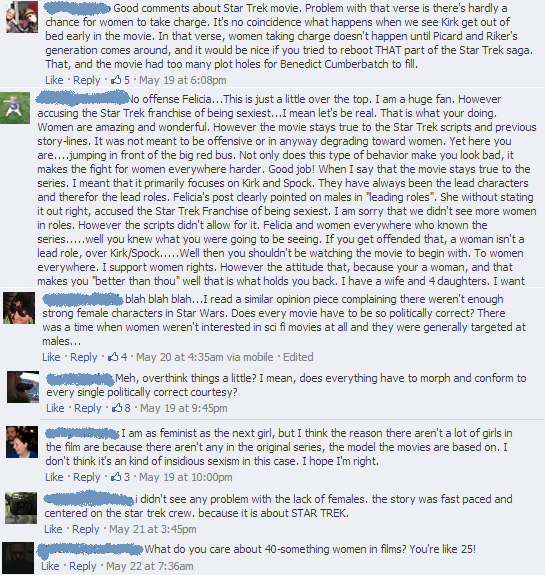
A sampling of replies 

Why do they disagree? Because of canon.

Because Kirk is notoriously a womanizer, so it makes sense to depict him womanizing.
Because in the original series of Star Trek (referred to as TOS, for…the original series), the stories told revolved mainly around men doing things, men like Kirk and Spock and Scotty and Bones and Sulu.

Even though the 2009 movie and this current one are reboots and have changed a lot of things, they cannot and should not change the fact that the story is not about women and their interests, so if you’re interested in that kind of story, find a different science fiction franchise already. One that didn’t originate in 1966. These are the stories we’ve committed to, and by golly we’ll be damned if they’re going to be changed! At least to be less overtly sexist, anyway– other things such as chronology or location of events and the circumstances of different characters dying or not dying, as the case may be, you can change and we’ll grudgingly accept it. But don’t take away our sexist stories, because we’ll have nothing left!  If you want strong women, go watch Xena: Warrior Princess or something, and leave TOS alone!

…they said. Basically.

In response to this position– that the absence of strong female characters in Into Darkness (or, for that matter, the 2009 Star Trek) is a feature; not a bug, because it’s simply the movie being true to canon– I have a few thoughts.

The first is that I can see the point of this objection. In spite of being reboots, these two movies resurrect very old stories from TOS and splice them together with a modernized perspective. If too many changes were made, the stories would not even be recognizable and they would simply be about a group of people with familiar names in a familiar-but-new setting doing completely unfamiliar things, in which case it might as well not even be the Star Trek universe.

However, this brings up all kinds of questions about what aspects of canon must be adhered to and why, in order to preserve the familiar setting and cast but also tell a story which isn’t identical to one the audience has already been told (in which case the movies would not be reboots but remakes, which is a different beast altogether). Of all of the things preserved for the new, 2009/2013 versions of stories originally told decades earlier, must one of them be the male-centric nature of those stories? And regardless of your answer to the previous question, would it really be worse to modify the story to make it less sexist, or to invent a new one?

This is especially relevant to ask when we’re talking about the Star Trek universe, given that this universe depicts a futuristic existence where human civilization has presumably progressed to the point that bigotry is no longer much of a thing, right? It’s inevitable that people who are trying to tell stories about future human civilizations which have progressed far beyond their own, will still project on those people their own prejudices and general small mindedness without even realizing it– so even as they’re giving people of the future things like teleportation and food synthesization, they’re still going to make those people reflect whatever backwards inclinations are common in the time of the writers– or rather, in the writers themselves. It’s pretty much ubiquitous in any movie or TV show which takes place hundreds of years from when it’s written. We just can’t help but think about how people might think in the future– especially a utopian rather than dystopian image of the future– by relying on how people think now. Then, when that actual year finally comes along, people can watch your movie or TV show (assuming they remember it exists) again and laugh their asses off.

But in this case it’s a little different. In this case, we’re talking about putting our own current spin on the stories that were previously told about those futuristic civilizations and yet not questioning, in fact transferring verbatim, much of the prejudices of that bygone era. Prejudices which don’t even apply to our own societies in some parts of the world (where female leaders are common), let alone a society in the year 2233. Isn’t it weird that we’d take an old depiction of a futuristic society and decide to re-depict it, and in doing so deliberately not make corrections which would render the depiction more realistically futuristic?  It’s as if someone had actually invented a teleporter which is both different from, and functions better than, the ones depicted in old episodes and movies based on TOS, but we went right on making new movies which showed people moving from one place to another by standing on a little circle and becoming fuzzy until they vanish. Because after all, that’s canon. You can’t change the story.

If that’s really the case, though…that story is boring and you shouldn’t expect people who are represented poorly (or not at all) in it to be interested. They may be, but you shouldn’t count on it.

There, I said it.

Yeah, yeah, I know– there’s no shortage of people who simply don’t care if women and minorities are interested in the movies and TV they love. You could keep right on making movies and TV shows based on comics, science fiction, or fantasy which cater to the interests of white male geeks only, and plenty of white male geeks would be just fine with that. Some of these people even react to complaints like Day’s by acting as if she wants to take over Star Trek– or Star Wars, or Doctor Who, or movies based on Marvel comics, or any other franchise which keeps churning out geek fodder– and make it all about women. Put women in charge of everything! No, that is not what she’s saying. That’s not what I’m saying, and it’s not what any feminist critique of these things that I’ve ever seen has been saying.

I’m saying that if you’re going to tell girls and women that it’s cool to be a nerd, you should also give them better reasons to be.

That is not at all a knock at Wil Wheaton, who is speaking in the video at that link– he’s actively doing this, in addition to giving that excellent speech. Felicia Day is actively doing it, by creating the Geek & Sundry channel on Youtube. She’s also asking where all of the women are, and she’s not the only one doing that. According to a recent article in the LA Times, appropriately titled Where have all the women gone in movies?,

Despite the success of recent female-driven movies such as “Bridesmaids” and the “Hunger Games” and “Twilight” series, female representation in popular movies is at its lowest level in five years, according to a study being released Monday by the USC Annenberg School for Communication and Journalism. Among the 100 highest-grossing movies at the U.S. box office in 2012, the study reported, 28.4% of speaking characters were female. That’s a drop from 32.8% three years ago, and a number that has stayed relatively stagnant despite increased research attention to the topic and several high-profile box-office successes starring women. “There is notable consistency in the number of females on-screen from year to year,” said USC researcher Marc Choueiti. “The slate of films developed and produced each year is almost formulaic — in the aggregate, female representation hardly changed at all.” When they are on-screen, 31.6% of women are shown wearing sexually revealing clothing, the highest percentage in the five years the USC researchers have been studying the issue.
For teen girls, the number who are provocatively dressed is even higher: 56.6% of teen girl characters in 2012 movies wore sexy clothes, an increase of 20% since 2009. The USC researchers said these trends persist because those working in Hollywood believe attracting a male audience is the key ingredient to box office success.

Well gosh, I guess I have some questions for “those working in Hollywood” then. Such as:

  • Do you think women also go to movies?
  • Do you think men will stop going to movies if they feature strong female characters, and the number of women who see them will be unaffected? In other words, do you think both groups only want to see men doing things, and women serving as eye candy or simply absent? 
  • Do you think that movie-goers are actually more sexist now than they used to be, and are continuing in that trend? Or is there just more money to be made in assuming they are? And in the end, what’s the difference?

Returning to science fiction/comic/fantasy movies specifically, there are so many movies in those genres which are either out currently, or coming up in the next couple of years, that geeks are downright giddy. The Wolverine. Iron Man 3. Man of Steel. Pacific Rim. Ender’s Game. Thor: The Dark World. The Avengers 2. Captain America: The Winter Soldier. The Amazing Spider-Man 2. Ninja Turtles. More Transformers, more Expendables, more X-Men, and so on. It’s a great time to be a geek– if you’re a straight white male geek, or don’t mind taking part in stories told mainly for and about same. And actually there are a lot of people in that latter category– there have to be, don’t they? Because the alternative is to just not watch the movies.

But geek movies have a woman and minority problem, and they have it because canon is considered so important.

Because geeks are so often gratified when something is just the same as it was when originally depicted in the  comic book/regular book it came from, and prone to throwing tantrums (AKA “nerd rage”) when it’s different. And the origins of the stories which formed these canons are old– sometimes very old. Given how quickly social contexts change, “very old” in this case could be any time before 1980. If the canon of your franchise of choice formed prior to that point– and most of the popular ones do, from Superman to Star Wars– it’s probably going to be sexist. At that point you have to stop denying it, and start figuring out what to do about it. Is preserving the canon more important than telling stories which include women and minorities as something other than bit parts and scenery? As actors– and by that I mean, people who act, rather than being acted upon?

And by “canon,” I know I’m not referring to every last detail of a franchise story. An aspect of the story is considered canonical or noncanonical based on how important it’s considered, how story-altering it would be to change. Yes, I know. I also know perceptions of what should be considered canonical tend to differ. Is Johnny Storm‘s race canonical, or not? How about Nick Fury‘s? Is Spider-Man’s web-shooting ability naturally derived or an invention? These are questions a lot of comic book geeks actually have opinions about, and those opinions are based loosely on two different factors: 1) whether there’s precedent you can point to in the comics, and 2) how cool the particular geek you’re talking to thinks the different options are. Degree of badassery has a remarkable effect on people’s concerns about canon– see, for example, every superhero costume which made a dramatic change from brightly-colored spandex to metallic and/or black armor upon arriving in a movie post….oh, probably 1989’s Batman. Some costumes just can’t be translated directly to real-world garb without looking ridiculous rather than menacing to our eyes. That fact might not change, but it should be clear by this point that what impresses us does, has, and will.

You could change the characters, along with the costumes.
And if that’s too disturbing to consider, why not come up with and/or use some new stories?

I actually don’t really care which route movie makers choose– either one could be amazing. And both have actually been done and continue to be done, over and over….just not in women’s favor. The movies I listed as coming out in the next couple of years are noticeably lacking in strong female characters. Just men saving the world and the girl, over and over, for the most part.

It doesn’t have to be that way. So why not change?
Give us women…and make them badass. I hear geeks are into that.

Does it get easier?

Does it get easier? published on No Comments on Does it get easier?

Gaming as Women has an excellent advice post up today. The letter-writer wants to know if it gets easier to be a feminist:

Right now it is very hard to be a feminist when I am constantly told that I shouldn’t be one, that I’m doing it wrong somehow, and that I’m ruining everyone’s fun. I can’t unsee misogyny or the kyriarchy anymore, and now I’m starting to hate myself for seeing problematic things all the time because no one I’m with ever sees it with me or even wants to. I work in the game industry so I’m immersed in sexism on daily basis, but some people aren’t and just simply can’t see why I am the way I am. How can I tell if I’m a bad feminist? Or is this just how it feels constantly? If so…does it ever get better?

Melody, Elin, Vivian, Jess, and Dympha all give very good answers to this, which you should read. Their answers include two important reality checks: 1) that in one sense being a feminist today in the West is far easier than it has been further back in history or elsewhere in the modern world where women have it a lot worse, and 2) we all have our biases and prejudices, which is good to keep in mind when addressing those of other people so that you can avoid shaming the whole person while talking about a particular thing they said or did that displays bias or prejudice. Right on the money with both of those. However I would also point out that the historical/cultural comparison shows how it can be more difficult to be a feminist in a modern Western context, because it’s much easier to see and acknowledge a disparity in how men and women are treated when, say, half of them can’t vote or own property than when half of them tend to be represented primarily as sexual objects. You often have to start by getting a person to agree that gender representation even matters, and head off the assumption that even discussing it means that you don’t care about those poor women in Saudi Arabia who can’t go out of the house without being completely covered and why don’t you care about them anyway? If you’re going to be all fired up about treatment of women, why not focus on that?

Well, we are. We’re capable of caring about more than one thing at a time, you know.

Once that hurdle is cleared– if it’s cleared– you can talk about representation, and face the accusation of wanting to ruin everyone’s fun. Because feminists, as you know, don’t like fun. They enjoy misery and want everyone to be miserable with them, which is why they’re even less funny than women are generally (thanks, Adam Carolla). Actually feminists like to have fun and laugh just as much as anybody, but as feminists they tend to notice when that “fun” is at the expense of women and feel compelled to say something about that. It’s understandable that making bigoted jokes and viewing the sex you’re attracted to as existing mainly for your own purposes is fun, but it’s also unfortunate that it’s fun, because eventually the people who have been made the butt of those jokes and the object of that…objectification are going to speak up. Because they want to have fun too, and that’s getting in the way.

This is an impossible thing to make people (yes, including women) understand if they can’t manage to switch perspectives a bit. You’re marching right up to people who are enjoying something just the way it is, and demanding that they change it, and they can’t see why. It seems unfair. It seems pushy and entitled. Nobody wants to view themselves as sexist, so they will fight tooth and nail against the mere suggestion that there’s some sexism present in the movie/TV show/video game/comic they’ve been enjoying so much for such a long time. And if you change it to rectify this “bias” you see, that will make it worse. It’s just fine as it is, leave it alone.

I get it.

In the discussion on feminism and sexism in all things geekish, I’ve seen a number of attempts to force empathy on people by getting them to see what it would look like if men in movies/TV/video games/comics were depicted like women are. Male superheroes wearing the costumes of female superheroes and posed all coquettishly, male characters on the covers of science fiction and urban fantasy novels posed and dressed like the female characters, and so on. I’m not sure if it really does any good, aside from providing amusement for many and pointing out with stark clarity that men who are depicted as wanting to look sexy will look ridiculous even if they’re not also dressed revealingly (and all the moreso if they are).

Which, now that I say it, should be helpful since the point being made is that women appear ridiculous if they’re trying to look sexy as a default. If they’re trying to look sexy while fighting demons on a burning countryside, or sneak past guards and break into an enemy’s compound, or bound through the jungle pursued by wild animals, or wage a battle against an aliens species, or just generally trying to save the world. It’s not a Revlon commercial; it’s more like the Army. Portraying women as if they have confused the latter for the former makes them look stupid and inept– they styled their hair, put on makeup, and wore their most revealing bustier and six inch heels to kick a cave troll’s butt in battle. What were they thinking? That doesn’t say “strong woman;” it says “When they said Dungeon, I thought they were talking about a night club.” This does not do women a favor. Sometimes they do want to dress in bustiers and six inch heels, and there’s nothing wrong with that, but making them do so inappropriately is not good. It says that their being sexy is the most important thing about them, all the time. It doesn’t have to be that way.

If you can get to this point and your fellow conversant is still listening, my hat’s off to you. Getting to this point is hard. That’s because of all the hurdles preceding it which have labels like “It’s just a game; get over yourself” and “We like it this way, and there aren’t as many of you” and of course our old friend “Don’t you have something more important to worry about?” That’s what our letter-writer is dealing with, and she has my sympathy.

But the question remains, though– does it get any better? My answer: We’ll have to see, won’t we?

Savage U

Savage U published on No Comments on Savage U

Long-time sex columnist, author, podcaster, advocate, and public educator Dan Savage now has a TV show. And it looks good.

I was a little concerned before watching the trailer that the show would be watered down, homogenized, and generally weaker than the typical frank, funny, pointed commentary we tend to get from Savage. And I’m still a little concerned, but not nearly as much. Savage has been doing Q&A presentations at universities and occasionally the odd appearance at stage venues in various parts of the country for years now, and it looks like the show is going to pretty much just show those appearances…along with some candid conversations with specific students about their particular concerns. But it’s MTV, so there’s still the potential for unexpected ruin. Nevertheless I’m keeping my hopes up and planning to watch. Hopefully a lot of non-collegiate teenagers will watch as well– the kind of people Savage needs to speak to directly even more, but can’t. And maybe, maybe, they will even watch with……their parents!

Yeah, probably not. But one can dream. The show premieres Tuesday, April 3.

Defending the female fuck-up

Defending the female fuck-up published on No Comments on Defending the female fuck-up

I really have no place writing this, considering that I have been anything but an avid consumer of new films and TV over, well, the past couple of years. But I really like Amanda Marcotte’s treatment of females in comedy productions engaging in behavior that reveals them to be petty, emotional, short-sighted, vindictive….you know, normal.

The recent explosion of prominent women in comedy has brought with it an unfortunate but predictable debate about whether or not the characters that have resulted from all these women scribbling and acting are Good For Women. Of course, the underlying assumption of the question is that women have a bad reputation in the general public and media should therefore portray us in uplifting ways to counter negative stereotypes, which in turn means that the question answers itself: If a female character has flaws, then that is Bad For Women. Indeed, that’s been the general consensus of all hand-wringing over this question. Silpa Kovvali, writing at Feministing, denounces Bridesmaids because some of the characters are insecure, some are unhappy, and some indulge at times in petty, vindicative behavior. Emily Nussbaum at The New Yorker rounds up similar concerns about the character Liz Lemon on 30 Rock, including Slate’s Sam Adams complaining that Liz Lemon has gone the way of Homer Simpson. This parade of female slobs, neurotics, and discontents is setting a lot of teeth on edge. Why can’t we have spunky heroines with inconsequential flaws, so we can all look up to them? Because that’s boring is why.

Boring, unrealistic, and unfunny. Insisting that the women we enjoy in comedy be well-behaved is like insisting that they be beautiful. Comedy is about relating to the imperfections that exist in all of us, and it’s hard to do any of that relating from atop a pedestal. Looking amazing and doing everything right is the opposite of funny, and insisting that women be such is like a mandate that they never succeed in comedy. Rare– non-existent actually, I think– is the family sitcom from the 80’s or 90’s in which the wife is the one who is ugly, slovenly, and/or messes things up all of the time. That role is for the comedian. That role is for the husband/man.

So even though I could do with some serious education on the shows/films in discussion here, I’m going to say that a feminist take on women in comedy these days should celebrate the female fuck-up, and consider her occurrence a mark of progress.

Miss? Excuse me, Miss? Someone wants you to “represent.”

Miss? Excuse me, Miss? Someone wants you to “represent.” published on 1 Comment on Miss? Excuse me, Miss? Someone wants you to “represent.”

Is it a bit hasty to write about a movie you’ve not yet seen? Perhaps, but this one I’m eager to see, and it will be televised again on November 12th so perhaps there will be an opportunity. Miss Representation is a documentary made by Jennifer Siebel Newsom on the subject of how women are portrayed in media, making a case that  both on and off-screen they are both under- and misrepresented. Newsom is an actress herself, and described some of that experience to Mother Jones in a recent interview:

Something I’ve learned myself in making this film is sometimes people have a hard time listening to what we have to say because they’re so concerned about how we look. I think that’s a challenge that women in particular have in our culture. . . I started acting at the age of 28, and my agent told me to lie about my age and take my MBA off my résumé. I didn’t do either, but that was like, whoa! I thought there was value in being smart. I thought there was value and wisdom in getting older. We’re challenging the culture in Hollywood that is all about youth, youth, youth, beauty. Because not even that’s healthy. I don’t care how much plastic surgery people have: At some point, they’re going to die. We’re all going to age somewhere on our body, and we may as well accept that and embrace it. I mean, aging is a beautiful thing; wisdom is a beautiful thing. Frankly, as a woman who’s getting older in our culture, I want to see stories about women who are before me, so I can be inspired—because someday I’ll be there. 

Older women. Smarter women. Diverse women. More women– I was rather shocked a few years ago to learn of the Bechdel Test, which first appeared way back in 1985 in a comic called “Dykes to Watch Out For” which described the rules of the author’s friend for being willing to see a movie:

  1. It has to have at least two women in it,
  2. Who talk to each other,
  3. About something other than a man.
  4. (Addendum: who have names)
Deceptively simple, right? You’d think that most movies would pass this easily. But not really:
Note that the word used here is not “conspiracy,” but “systemic problem.” The claim isn’t being made that male directors, producers, screen writers, and so on have a conscious agreement to keep women down. For that matter, Newsom’s stated concern in making Miss Representation is not solely about women. She notes that 

it’s really interesting now, being a mother raising both of a son and a daughter, in a culture that objectifies women and sees women’s value in their youth or beauty or sexuality, and not in their ability to lead. And in a culture that values a hypermasculinized version of what it is to be a man. At MissRepresentation.org, we’re about creating a dialogue about how we empower women and men, or girls and boys, to find their own path and to find value in a plethora of attributes and possibilities for who they can be.

You can’t say something about women without also saying something about men. Portraying women as helpless things that need to be rescued, for example, means portraying men as having to be powerful rescuers. Ideals of masculinity are constructed and enforced in media, too. It’s fun to unplug your brain and enjoy an action movie (which, needless to say, predictably fail the Bechdel Test), so long as you’re fully aware of how distant the impressions in it are from reality. But not everybody is, and it’s hard to expect them to be if they don’t have other images to look at. And so far as I know, there’s no law that says explosions and boobs have to go together. Just saying.

Speaking on that– Newsom says she’s fighting the objectification of women (boobs), and that can lead to some bad places. Conservatives and liberal feminists, as has often been noted, come together to make strange bedfellows when they decide that showing off bodies for aesthetic appreciation and titillation is inherently wrong. It would not encourage girls and women to “find their own path” and the “value in a plethora or attributes and possibilities for who they can be” if women who decide that their path is to show off their bodies are shamed and/or forbidden to do so. I believe that a feminist wagging her finger at an actress who opts to go topless in a film is no less moralizing than a fundamentalist who does it. So here’s hoping Newsom doesn’t intend to wag fingers so much as point to opportunities. We would be making progress if there are more women showing up in general as well as a decreased willingness to think less of them according to how much clothing they have on. Slut-shaming is not a feminist pursuit.

Having said all of this, I am eager to see Miss Representation when possible. If possible. If you have the means, you can catch it on the Oprah Winfrey Network at 11am ET on November 12th.

Another take on Ron Paul in the media

Another take on Ron Paul in the media published on No Comments on Another take on Ron Paul in the media

I came across a commentary by Brian Montopoli at the CBS blog Political Hotsheet which makes some interesting points. He notes that his own coverage of the Iowa straw polls has been criticized by Paul supporters who objected to the candidate not getting enough space, accompanied by the inevitable “RON PAUL 2012!” sign-off. Many commentators would and have stopped there, as if Ron Paul having a following with a large share of verbose and vehement supporters somehow makes up for the media ignoring him. But Montopoli goes on to consider things a little more carefully:

Critics of the media coverage of Paul have a point. Because many reporters see the Texas congressman as having little chance of winning the nomination, he is often left out of the discussion – even as an establishment figure like Jon Huntsman, who badly trails Paul in the polls, is included.  Here’s how political reporters see it: Paul is the only prominent candidate articulating a strong libertarian position. Though he is fairly well known, his support appears to top out at less than 20 percent. Ultimately, Republicans will likely coalesce around one of the other candidates, whose largely-similar positions represent more mainstream Republicanism. Paul’s relatively strong standing in early polls, this argument goes, will fade as the field narrows around one or two more mainstream candidates.  That’s almost certainly true. But here’s the problem: Most reporters also don’t expect Bachmann to win the nomination, either. Bachmann cannot compete with Romney or Perry in terms of fundraising, and she is widely seen as too far to the right to get nominated by a party where most voters’ primary concern is finding someone who can beat President Obama. Yet while Paul was shut out of the Sunday news shows after his near-straw poll victory, Bachmann was invited into almost all of them – and is now being treated by the media as one of the three frontrunners for the nomination.   Why? For starters, Bachmann has a better – though still slim – chance to take the nomination. But also, she’s simply a better story – controversial, telegenic, and relatively new to the national scene. Paul, meanwhile, is on his third presidential run, and he’s saying the same things he’s been saying for decades – which is admirable, but not ideal in a media landscape where freshness is what gets attention.

Poor Ron Paul. He’s been known as a libertarian nutter for so long, and now he’s not crazy enough!  Because his particular brand of controversial viewpoints is not fresh– it’s the same standard he’s been bearing for years. His consistency works against him rather than for him. As for being telegenic….yeah, I suppose not.  Paul is looking pretty decrepit these days and he has never been the best speaker. But I thought these reports were supposed to be about who the front-runners are; not who is prettiest. Is Montopoli saying otherwise? Not quite:

Paul campaign manager Jesse Benton, who described the coverage in the wake of the straw poll as “very disappointing,” told CBS News that the national media “have an obligation to present Dr. Paul fairly and robustly to the American people.”  “I realize that he has been saying the same things to the inner circle of the journalist elite, that’s not new, but it’s very, very new to the American people,” said Benton. While Paul has high name identification, he continued, “A lot of people still have not heard his message.” There’s an irony here: Paul may not be offering up new ideas, but he is the only mainstream candidate articulating significantly different policy positions than his rivals. Paul’s opposition to U.S. military intervention abroad has significant support within the GOP, and his live-and-let-live philosophy is the animating idea behind the Tea Party. Don’t those ideas deserve to be part of the discussion? The media’s focus on Bachmann and dismissal of Paul is a demoralizing illustration of the fact that members of the media – who, it should be noted, often make their coverage decisions based on audience demand – are often more interested in stylistic differences than substantive ones. All this doesn’t change the fact that Ron Paul is very unlikely to be the next president of the United States. Or that the straw poll itself is nearly meaningless – it’s an Iowa Republican party fundraiser in which the candidates, Paul included, essentially buy their votes. But if reporters are going to focus so aggressively on Bachmann – and treat her straw poll win as meaningful – then Paul deserves, at the very least, not to be ignored.

I understand that Michele Bachmann is interesting because she’s so…..bizarre. I do, really. But when bizarre people get attention on TV, it should be simply because of that. Hey, here’s this new crazy evangelical lady who doesn’t know what she’s talking about, running for president!  You can give bizarre people media attention without pretending that they’re more electable– look what happened to Howard Dean. Did anyone declare him a “front-runner” while incessantly playing clips his ill-chosen battle cry? Did they do so in the process of obscuring actual front-runners?  Not from what I recall.

So what’s different?  Has the media just become so thoroughly jaded about this particular election, so sure that the Republican race doesn’t matter, that they’re just no longer interested in portraying the facts when they could report on the crazy?  It’s looking like it.