|
| The cocktail waitresses of Star Trek (2009) |
So I was watching the 2009 film Star Trek, which annoyingly has no subtitle. No Nemesis, no Insurrection, no Into Darkness, no Into the Woods, nothing. So it will forever be known, to me at least, as “the 2009 Star Trek,” which is unfortunate given that it’s a decent film and immediately precedes Into Darkness, currently in theaters, which gets its own subtitle. Maybe they realized they messed up with the previous one? I don’t know.
Anyway, I watched it and couldn’t help but notice all of the female Star Fleet extras running around (literally, in more than one case because their ship was in danger of being destroyed) in those mini dresses and go go boots that the women wore in the original series, their hair more often than not up in what I guess was supposed to be a futuristic version of the beehive-like updos worn in TOS, a sort of vertical topknot, an oblong bun which sticks straight out of the tops of their heads. The choice to outfit them this way was presumably made in deference to the original garb that female officers wore in TOS, and to the reasoning it embodied, which– one can only guess– was so that nobody would accidentally take them seriously.
I watched this and thought about a recent blog post by Felicia Day on Into Darkness, discussing how it has no strong female characters. How even in instances where the leaders of the free galaxy, the decision-makers, were getting together and figuring out what to do, there were few women, especially appropriately aged women (you know, prime minister age or thereabouts) amongst them, and how weird and disappointing that was. Though Day doesn’t specifically mention the gratuitous underwear scene with Alice Eve for which screenwriter Damon Lindelof confusingly apologized (confusing because you don’t exactly trip and accidentally insert scenes like that into a script), she says
I kept waiting for her turn, waiting for her to not be the victim, to be a bit cleverer, to add to the equation in a “yeah you go girl” way but no, she was there to be sufficiently sexy that Kirk would acknowledge her existence, to be pretty, to serve the plot. I loved her bob. That’s it. What if she had been a less attractive woman, older, overweight? A tomboy? Wouldn’t have that been a tad more interesting choice? Or at least give her a moment where she’s not a princess waiting to be saved. From a director who is so amazing, who created wonderful female characters in Alias and Felicity, I was super bummed by this. A woman character CAN exist without having to be sexually desired by the guy. Oh, and she doesn’t have to be a lesbian either, OMG WHAT A SURPRISING IDEA!
Responses have ranged from the reasonable to the ridiculous on both the original Tumblr post and on her Facebook wall when she linked to it. It’s important to point out here that by “ridiculous,” I’m not referring to any comment which simply differed either with facts or the intent of Day’s post, or both. I’m referring to the kind of comment typical of any feminist critique of popular culture, which is some combination of “If it ain’t broke, don’t fix it” and “You’re just jealous,” or worse. Sometimes much, much worse.
There were plenty of people who agreed with Day that a) there are no strong female characters in Into Darkness (which, full disclosure, I haven’t seen….yet. That’s why I was re-watching the 2009 movie), and b) given the futuristic setting of the Star Trek universe where the Federation has been depicted as an egalitarian organization, it doesn’t make sense to portray events as though there are no women in charge of anything who possess formidable skills and commit acts of bravery and cunning with more or less the frequency that men do, and even with c) Day’s larger point that “it’s time to invent some new cliches” where women are concerned. There are people who agreed with all of these things, and yet ultimately disagreed with Day’s claim that this spoke poorly of the movie as a whole (which, incidentally, she says she enjoyed very much).
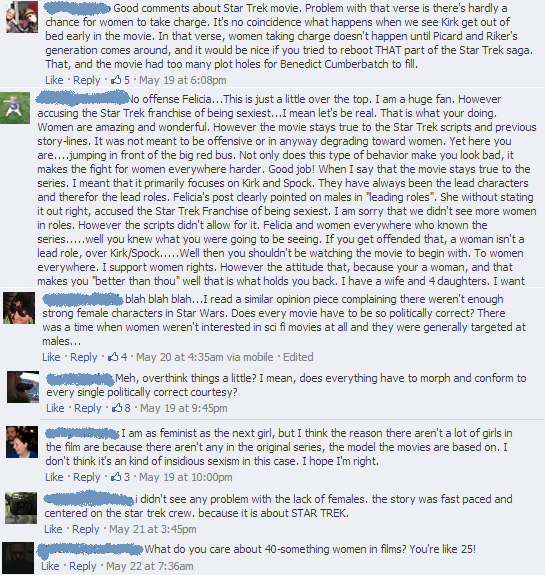 |
| A sampling of replies |
Why do they disagree? Because of canon.
Because Kirk is notoriously a womanizer, so it makes sense to depict him womanizing.
Because in the original series of Star Trek (referred to as TOS, for…the original series), the stories told revolved mainly around men doing things, men like Kirk and Spock and Scotty and Bones and Sulu.
Even though the 2009 movie and this current one are reboots and have changed a lot of things, they cannot and should not change the fact that the story is not about women and their interests, so if you’re interested in that kind of story, find a different science fiction franchise already. One that didn’t originate in 1966. These are the stories we’ve committed to, and by golly we’ll be damned if they’re going to be changed! At least to be less overtly sexist, anyway– other things such as chronology or location of events and the circumstances of different characters dying or not dying, as the case may be, you can change and we’ll grudgingly accept it. But don’t take away our sexist stories, because we’ll have nothing left! If you want strong women, go watch Xena: Warrior Princess or something, and leave TOS alone!
…they said. Basically.
In response to this position– that the absence of strong female characters in Into Darkness (or, for that matter, the 2009 Star Trek) is a feature; not a bug, because it’s simply the movie being true to canon– I have a few thoughts.
The first is that I can see the point of this objection. In spite of being reboots, these two movies resurrect very old stories from TOS and splice them together with a modernized perspective. If too many changes were made, the stories would not even be recognizable and they would simply be about a group of people with familiar names in a familiar-but-new setting doing completely unfamiliar things, in which case it might as well not even be the Star Trek universe.
However, this brings up all kinds of questions about what aspects of canon must be adhered to and why, in order to preserve the familiar setting and cast but also tell a story which isn’t identical to one the audience has already been told (in which case the movies would not be reboots but remakes, which is a different beast altogether). Of all of the things preserved for the new, 2009/2013 versions of stories originally told decades earlier, must one of them be the male-centric nature of those stories? And regardless of your answer to the previous question, would it really be worse to modify the story to make it less sexist, or to invent a new one?
This is especially relevant to ask when we’re talking about the Star Trek universe, given that this universe depicts a futuristic existence where human civilization has presumably progressed to the point that bigotry is no longer much of a thing, right? It’s inevitable that people who are trying to tell stories about future human civilizations which have progressed far beyond their own, will still project on those people their own prejudices and general small mindedness without even realizing it– so even as they’re giving people of the future things like teleportation and food synthesization, they’re still going to make those people reflect whatever backwards inclinations are common in the time of the writers– or rather, in the writers themselves. It’s pretty much ubiquitous in any movie or TV show which takes place hundreds of years from when it’s written. We just can’t help but think about how people might think in the future– especially a utopian rather than dystopian image of the future– by relying on how people think now. Then, when that actual year finally comes along, people can watch your movie or TV show (assuming they remember it exists) again and laugh their asses off.
But in this case it’s a little different. In this case, we’re talking about putting our own current spin on the stories that were previously told about those futuristic civilizations and yet not questioning, in fact transferring verbatim, much of the prejudices of that bygone era. Prejudices which don’t even apply to our own societies in some parts of the world (where female leaders are common), let alone a society in the year 2233. Isn’t it weird that we’d take an old depiction of a futuristic society and decide to re-depict it, and in doing so deliberately not make corrections which would render the depiction more realistically futuristic? It’s as if someone had actually invented a teleporter which is both different from, and functions better than, the ones depicted in old episodes and movies based on TOS, but we went right on making new movies which showed people moving from one place to another by standing on a little circle and becoming fuzzy until they vanish. Because after all, that’s canon. You can’t change the story.
If that’s really the case, though…that story is boring and you shouldn’t expect people who are represented poorly (or not at all) in it to be interested. They may be, but you shouldn’t count on it.
There, I said it.
Yeah, yeah, I know– there’s no shortage of people who simply don’t care if women and minorities are interested in the movies and TV they love. You could keep right on making movies and TV shows based on comics, science fiction, or fantasy which cater to the interests of white male geeks only, and plenty of white male geeks would be just fine with that. Some of these people even react to complaints like Day’s by acting as if she wants to take over Star Trek– or Star Wars, or Doctor Who, or movies based on Marvel comics, or any other franchise which keeps churning out geek fodder– and make it all about women. Put women in charge of everything! No, that is not what she’s saying. That’s not what I’m saying, and it’s not what any feminist critique of these things that I’ve ever seen has been saying.
I’m saying that if you’re going to tell girls and women that it’s cool to be a nerd, you should also give them better reasons to be.
That is not at all a knock at Wil Wheaton, who is speaking in the video at that link– he’s actively doing this, in addition to giving that excellent speech. Felicia Day is actively doing it, by creating the Geek & Sundry channel on Youtube. She’s also asking where all of the women are, and she’s not the only one doing that. According to a recent article in the LA Times, appropriately titled Where have all the women gone in movies?,
Despite the success of recent female-driven movies such as “Bridesmaids” and the “Hunger Games” and “Twilight” series, female representation in popular movies is at its lowest level in five years, according to a study being released Monday by the USC Annenberg School for Communication and Journalism. Among the 100 highest-grossing movies at the U.S. box office in 2012, the study reported, 28.4% of speaking characters were female. That’s a drop from 32.8% three years ago, and a number that has stayed relatively stagnant despite increased research attention to the topic and several high-profile box-office successes starring women. “There is notable consistency in the number of females on-screen from year to year,” said USC researcher Marc Choueiti. “The slate of films developed and produced each year is almost formulaic — in the aggregate, female representation hardly changed at all.” When they are on-screen, 31.6% of women are shown wearing sexually revealing clothing, the highest percentage in the five years the USC researchers have been studying the issue.
For teen girls, the number who are provocatively dressed is even higher: 56.6% of teen girl characters in 2012 movies wore sexy clothes, an increase of 20% since 2009. The USC researchers said these trends persist because those working in Hollywood believe attracting a male audience is the key ingredient to box office success.
Well gosh, I guess I have some questions for “those working in Hollywood” then. Such as:
- Do you think women also go to movies?
- Do you think men will stop going to movies if they feature strong female characters, and the number of women who see them will be unaffected? In other words, do you think both groups only want to see men doing things, and women serving as eye candy or simply absent?
- Do you think that movie-goers are actually more sexist now than they used to be, and are continuing in that trend? Or is there just more money to be made in assuming they are? And in the end, what’s the difference?
Returning to science fiction/comic/fantasy movies specifically, there are so many movies in those genres which are either out currently, or coming up in the next couple of years, that geeks are downright giddy. The Wolverine. Iron Man 3. Man of Steel. Pacific Rim. Ender’s Game. Thor: The Dark World. The Avengers 2. Captain America: The Winter Soldier. The Amazing Spider-Man 2. Ninja Turtles. More Transformers, more Expendables, more X-Men, and so on. It’s a great time to be a geek– if you’re a straight white male geek, or don’t mind taking part in stories told mainly for and about same. And actually there are a lot of people in that latter category– there have to be, don’t they? Because the alternative is to just not watch the movies.
But geek movies have a woman and minority problem, and they have it because canon is considered so important.
Because geeks are so often gratified when something is just the same as it was when originally depicted in the comic book/regular book it came from, and prone to throwing tantrums (AKA “nerd rage”) when it’s different. And the origins of the stories which formed these canons are old– sometimes very old. Given how quickly social contexts change, “very old” in this case could be any time before 1980. If the canon of your franchise of choice formed prior to that point– and most of the popular ones do, from Superman to Star Wars– it’s probably going to be sexist. At that point you have to stop denying it, and start figuring out what to do about it. Is preserving the canon more important than telling stories which include women and minorities as something other than bit parts and scenery? As actors– and by that I mean, people who act, rather than being acted upon?
And by “canon,” I know I’m not referring to every last detail of a franchise story. An aspect of the story is considered canonical or noncanonical based on how important it’s considered, how story-altering it would be to change. Yes, I know. I also know perceptions of what should be considered canonical tend to differ. Is Johnny Storm‘s race canonical, or not? How about Nick Fury‘s? Is Spider-Man’s web-shooting ability naturally derived or an invention? These are questions a lot of comic book geeks actually have opinions about, and those opinions are based loosely on two different factors: 1) whether there’s precedent you can point to in the comics, and 2) how cool the particular geek you’re talking to thinks the different options are. Degree of badassery has a remarkable effect on people’s concerns about canon– see, for example, every superhero costume which made a dramatic change from brightly-colored spandex to metallic and/or black armor upon arriving in a movie post….oh, probably 1989’s Batman. Some costumes just can’t be translated directly to real-world garb without looking ridiculous rather than menacing to our eyes. That fact might not change, but it should be clear by this point that what impresses us does, has, and will.
You could change the characters, along with the costumes.
And if that’s too disturbing to consider, why not come up with and/or use some new stories?
I actually don’t really care which route movie makers choose– either one could be amazing. And both have actually been done and continue to be done, over and over….just not in women’s favor. The movies I listed as coming out in the next couple of years are noticeably lacking in strong female characters. Just men saving the world and the girl, over and over, for the most part.
It doesn’t have to be that way. So why not change?
Give us women…and make them badass. I hear geeks are into that.