Skip to content

Sex without fear

Sex without fear published on No Comments on Sex without fear

“Consequence” is one of those words that has taken on a connotation of the negative, even though the denotation does not require it. Strictly speaking, a consequence is an effect, an outcome, a result. That’s all. Consequences are the reasons we do things– if our actions had no outcomes, there would be no point in performing them. Everything we do, we do for the consequences.

The consequences of Colorado recently making some forms of birth control, IUDs and implants, free or nearly free to low-income women through the Colorado Family Planning Initiative have been very good indeed:

The teen abortion rate dropped by 35 percent from 2009 to 2012 in counties served by the program, according to the state’s estimates. Young women served by the family planning clinics also accounted for about three-fourths of the overall decline in Colorado’s teen birth rate during the same time period. And the infant caseload for Colorado WIC, a nutrition program for low-income women and their babies, fell by 23 percent from 2008 to 2013. “This initiative has saved Colorado millions of dollars,” Governor John Hickenlooper said in a statement. “But more importantly, it has helped thousands of young Colorado women continue their education, pursue their professional goals and postpone pregnancy until they are ready to start a family.”

If you’re taking issue with my use of the words “free or nearly free” right now…stop. Yes, I know full well that “provided by the government” does not mean “free.” Nothing is free. However, please read that first statement by Governor Hickenlooper– providing birth control to low-income women has saved the state money. Quite a lot of money, to the surprise of absolutely nobody. Nobody, that is, who is familiar with the notion that when women can’t afford babies, they often can’t afford abortions either, and so become stuck with those babies they can’t afford to have. And then who becomes responsible for paying for those babies? The state– which means all of us, via welfare.

So between the cost of contraception, the cost of birth, and the cost of welfare, contraception is chronologically the first cost, which also happens to be the lowest cost, and also prevents the following two costs. That, in a nutshell, is how the state saves money by spending money. Spend a small amount now, save a large amount later. You could call that an “entitlement” if the notion of chronology is tricky for you, but for someone with no such difficulty, it just makes common fiscal sense.

You’d think.

But no, the same people who trumpet fiscal responsibility for the government most reliably are, astonishingly, not in favor of measures like this. That is, of course, because their dedication to ending abortion in America does not lead to the ardent support of contraception that one might logically conclude they should have. And that is, unfortunately, because the goals of ending abortion and encouraging fiscally responsible government are both ultimately supplanted by yet another goal: to prevent “consequence free sex.”
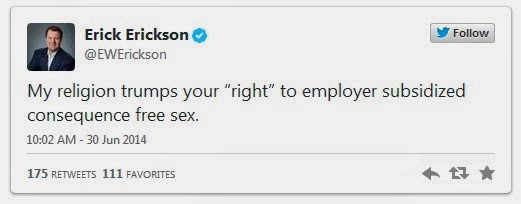
Now, let’s ponder this notion for a moment. “Consequence free”?

Sex using effective contraception such as an IUD (the objectionable form of birth control cited by Hobby Lobby in its Supreme Court case, which Erickson is addressing in the above tweet, and which Colorado made attainable for women on low incomes) is anything but consequence free. The consequences of sex using effective contraception potentially include:

  • Intimacy between partners without fear
  • Pleasure between partners without fear
  • Bonding between partners without fear
  • Enjoyment and creation of memories between partners without fear

The fear in question, of course, taking two possible forms:

  1. Unwanted pregnancy
  2. STDs
So since it’s clear that sexual intercourse using contraception doesn’t prevent consequences, and that there are certain consequences which are in fact the point of having sex using contraception, desirable, good consequences, it appears that actually Erickson’s tweet should have referred not to consequence free sex, but to fear free sex. As in, nobody should be able to have sex without fear of creating an unwanted pregnancy or contracting an STDs. 
Why should nobody be able to have sex without this fear? 

Because they don’t think people—young people, poor people, unmarried people, gay people—should be able to enjoy “consequence-free sex.” Because it’s sex that they hate—it’s sex for pleasure that they hate—and they hate that kind of sex more than they hate abortion, teen moms, and welfare spending combined. Knowing that some people are having sex for pleasure without having their futures disrupted by an unplanned pregnancy or having their health compromised by a sexually transmitted infection or having to run a traumatizing gauntlet of shrieking “sidewalk counselors” to get to an abortion clinic keeps them up at night.

Yeah, I’m inclined to think so.

So hey, conservatives? At least, social conservatives like Rush Limbaugh and Erick Erickson? Try just saying what you mean, okay?

You don’t think people– especially women and gays– should be able to have sex without fear. And it’s easier to makes sure poor women and gays can’t have sex without fear, because it’s easier to make sure that poor people don’t do anything that costs money. And contraceptives? They cost money.

Just say it. Sexuality should be controlled, and it’s best controlled by fear, so you want to preserve the fear.

It won’t happen, in the end…but hey, at least you can say you were honest.

Rambling diatribe about atheism, politics, and the word “secular”

Rambling diatribe about atheism, politics, and the word “secular” published on No Comments on Rambling diatribe about atheism, politics, and the word “secular”

I don’t know American Atheists president David Silverman, but he strikes me as kind of a brash guy. The kind of person who thinks that atheist activism means pissing off religious people, and if you haven’t succeeded in that then you’re doing it wrong.

But apparently he’s now trying to get along with religious people, or at least with America’s political party most known for being religious, because he tried to get a booth for American Atheists at the Conservative Political Action Conference, or CPAC. The booth was denied, because it turns out (who knew?) that CPAC feels threatened by atheists. Silverman decided to attend the conference on his own anyway, where he was interviewed by The Raw Story’s Roy Edroso.

It’s not a long interview at all, so read the whole thing. If you do, you’ll see that Silverman initially characterized the positions that social conservatives commonly take on “gay rights, right to die, and abortion rights” as “theocratic” which means that they’re not “real conservatives” (real conservatives aren’t theocratic?) before being interrupted by Edroso, who said that the “Right to Life guys” would object to being told they aren’t real conservatives. At which point Silverman replied:

I will admit there is a secular argument against abortion. You can’t deny that it’s there, and it’s maybe not as clean cut as school prayer, right to die, and gay marriage.

 …which seems to have annoyed a few atheists into temporarily forgetting what “secular” means. At Skepchick, Sarah Moglia writes:

If by “secular argument,” you mean “a belief based on personal feelings,” then, sure, there’s a secular argument against abortion. There could be a “secular” argument against puppies, in that case. If you’re using “secular” to mean “a logical, science-based, or rational” belief, then no, there is no “secular argument” against abortion. The supposed “secular arguments” against abortion are rooted in misogyny, a lack of understanding of science, and religious overtones.

Which PZ Myers read and replied to with his own blog post entitled There’s a secular argument for wearing underpants on your head. So?  in which he says “I’m trying to figure out what this secular argument is.”

Really? Actually there are a lot of secular arguments against abortion. They include, among others:

  • A fetus is a human. It’s wrong to kill any human. 
  • A fetus is the property of the man whose sperm helped to create it as much as it is of the woman who carries it. Therefore no woman should be able to abort without the permission of the man who inseminated her.
  • Fetal pain
  • Abortions are expensive and hard on a woman’s body, therefore wrong. Something to be avoided if at all possible. 
Note: I didn’t say they were good arguments. 
This is because all that is required for an argument to be secular is that it not be based in religion. That’s it. It has nothing to do with “personal feelings,” which could be religious feelings just as easily as they could be non-religious, and a secular argument is by no means necessarily logical, science-based, or rational, let alone moral. So yeah, you could make a secular argument for wearing underpants on your head, which is why it’s sort of baffling not to be able to grok secular arguments against abortion. 
Something which, as we saw, Silverman only “admitted” when pressed. He clearly is not pro-life himself, so isn’t it a little odd to make a big deal about him acknowledging that secular arguments against abortion exist when he’s not even the one who brought it up? 
Maybe not too terribly odd. See, there are some other important things to consider.
The first is that of course, arguments that are phrased to be secular often come from non-secular motivations. See, for example, the entire Intelligent Design movement. There is no shortage of people on the religious right who see the strategic advantage in trying to Lemon Test their beliefs into law and classrooms by expunging all religious terminology from it, and “Fetuses are people” is the clearest example of that when it comes to abortion. “Person” is a legal category, but the notion of fetal personhood is generally endorsed by people who think God is the one who makes people, therefore when God puts a person in a woman’s uterus she has no business trying to get rid of it. 
You don’t have to believe in souls or even God to make this argument (that is, you can put it in secular terms), but people who make this argument almost inevitably believe in God and souls. The same is true for people who argue against gay marriage by complaining that it’s an aberration of “traditional” marriage, when “tradition” is merely code for “that’s the way God wants it” (and never mind that the Bible is absolutely brimming with nontraditional marriages if that’s what “tradition” means). 
Really, what underlies this reaction to Silverman simply acknowledging that there are secular arguments against abortion is anger at him for trying to market atheism to conservatives in the first place. For being rather conservative himself, albeit not your typical conservative, and then– here’s the kicker– claiming that he’s a true  conservative whereas abortion opponents, opponents of gay marriage– social conservatives– are not. Sorry Dave, but it comes off as a little ridiculous to play No True Conservative when the people you’re saying aren’t True Conservatives (TM) just got done booting your booth from their conference because they felt threatened by you. Surely he should be reserving these comparisons for when CPAC feels threatened by pro-lifers and homophobes. That is, ironically, when it’s no longer actually very conservative at all.

The Raw Story article goes on: 

But why is this his battle? Why not let conservatives be conservatives and just vote for the candidates he likes? “Because I want a choice,” said Silverman. “I don’t get a choice at the voting booth, ever.” He describes himself as a “fiscally conservative” voter who “owns several guns. I’m a strong supporter of the military. I think fiscal responsibility is very important. I see that as pretty conservative. And I have my serious suspicions about Obama. I don’t like that he’s spying on us. I don’t like we’ve got drones killing people…” In the final analysis, “the Democrats are too liberal for me,” he says.

It’s not unusual for libertarians– which is what Silverman actually is, so far as I can tell– to talk this way. Not at all. And it’s not so much that they’re wrong per se, as completely unaware that someone listening has no idea what they’re talking about. I don’t, for example, know what the words “fiscal conservative” mean when coming from the mouth of someone who just called himself a “strong supporter of the military.” There is nothing fiscally conservative about having a defense budget larger than that of the next ten most militarily spendy countries in the world combined.

The term “fiscal conservative” is a libertarian dog whistle, or actually I suppose just a whistle because everybody knows that’s what it means. Is supposed to mean. The problem, of course, is that nobody who calls him or herself a fiscal conservative actually is one, which makes it an even more aggravating theft of terminology than Republicans claiming ownership of the word “family.” Liberals don’t speak up about this more often because they don’t believe that government spending is bad by default and taxation is theft (nor should they; that’s quite sensible of them), but they also recognize that when someone calls him/herself a fiscal conservative what he/she generally means is that he/she is anti-welfare. Anti-government spending, when it might help out minorities, women, and the poor. And liberals don’t think it’s so gosh darned important to be fiscally conservative in the first place, so they rarely point out that ending the drug war, legalizing sex work, cutting back on the military campaigning, even giving out birth control for free (literally, as opposed to mandating that health insurance cover it), you know, the things that make conservatives scream? Would actually save the government boatloads of cash.

The existence of libertarian atheists is, you might say, vexing to liberal atheists. It’s vexing to me as well because libertarians are often morons, prone to doing things like complaining that a sexual harassment policy for a skeptical/atheist conference is a violation of their rights, said rights apparently entailing the freedom to be a sexist boor at a conference without repercussions. Discussions about topics like sexual harassment shouldn’t have to begin with explaining, for the 9,000th time, what’s wrong with sexual harassment in the first place, or how freedom of speech doesn’t apply to private venues where other people have spent good money to get together and exchange ideas and “Sleep with me or you’re a bitch” is not generally one of the ideas they have in mind.

So I can absolutely– totally– understand why someone who has worked for years to connect skeptical/atheist activism with social justice issues, actually improve the world instead of sitting around arguing about whether God does or doesn’t exist, would be infuriated by the notion of the president of American Atheists trying to, in effect, pour some white paint into the enormous black pool of “theocracy” that Silverman even acknowledges is “holding down” a brand of political conservatism that doesn’t involve stepping all over minorities and the poor and taking ownership of their reproductive capacities (since I seriously mixed metaphors there, just imagine the black pool holding things down is the goop that killed Tasha Yar in TNG).

However, differences of political opinion amongst atheists and skeptics also makes me very happy, because it forces us to confront some often inconvenient facts. Like the fact that “secular” only means “without a religious basis.” Like the fact that being right about some very important things does not make you right about everything, and conversely that being very wrong about some things doesn’t make you wrong about others. Like the fact that when you find yourself on the same side as someone you normally disagree with, there’s nothing wrong with acknowledging that and counting them as an ally to the extent that they’re willing to be one. Like that refusing to do this comes off as petulant and tribalistic, because it often is.

I want everyone who claims to be skeptical to actually be  skeptical. To make good arguments. To be civil, analytical, and willing to work together for the greater good. Needless to say, I don’t always get what I want. But come on, people…we can do better than this.

Barney Frank, atheism, and representation

Barney Frank, atheism, and representation published on No Comments on Barney Frank, atheism, and representation
Source

So Barney Frank came out last night– again. This time as a “pot-smoking atheist” on Real Time With Bill
Maher, when Maher gave himself that label and Frank responded by jokingly asking Maher which one he meant:

Bill Maher: … you were in a fairly safe district. You were not one of those Congresspeople who have to worry about every little thing. You could come on this show, and sit next to a pot-smoking atheist, and it wouldn’t bother you…
Barney Frank: [Pointing back and forth to himself and Maher] Which pot-smoking atheist were you talking about?

Maher was saying this in the context of asking whether Frank felt “liberated” now that he’s no longer in Congress, which is apparently the only time a congressperson can be liberated– when he/she is an ex-congressperson. Presidents can be liberated when they’re ex-presidents. They can start claiming to honestly believe and support things they should have openly believed and supported while in office, but it was too “dangerous” to do so (read: it might damage their chances of re-election). Gay equality. Ending the drug war. Secularism. Etc. It can leave a person wondering if “no taxation without representation” still applies when elected officials will only represent you when they’re no longer in office, that is, when it no longer matters.

Okay, yes, there has been only openly atheist sitting Congressperson– Pete Stark, who was actually the second longest-serving congressman until he lost his seat last year to another Democrat. But given that people without religion are believed to comprise roughly 10-20% of the American population, depending on how you define things, shouldn’t we be at least a little better represented than that? Among 535 voting members…maybe?

Whenever discussion of representation of demographics in government comes up, there is an inevitable argument which comes from people who– quite frankly– seem to oppose a particular candidate and everything he/she stands for, regardless of whatever demographic is applicable, which goes something like this: elected officials should represent the people, which means they should represent everyone. We shouldn’t want officials who represent only those like themselves, which means that demographic shouldn’t matter which means…basically, shut up and be happy with more old white heterosexual Christian men. (I’d say “wealthy,” but that’s so beyond being a given it’s already given before it was given.)

When you hear people talk about the “other” or “othering,” and they’re not talking about Lost, this is what they’re referring to– the unspoken assumption that there is a default, and the default represents everyone, whereas everyone else, that is everyone who is not the default, represents only their specific factions– whatever those may be.  Women can only represent women, black people can only represent black people, gays can only represent gays, secularists can only represent secularists, but straight white old religious guys? They are generic; they are Everyman; they can represent all of us.

…..

In reality, we all have experiences, and those experiences teach us. And those experiences are shaped by our demographics. Our race, our gender identity, our sexual orientation, our religious affiliation (or lack thereof), our class. Etc. No matter how empathetic a white man is, unless he’s John Howard Griffin, he doesn’t know what it’s like to be a black man. Griffin did not know what it’s like to grow up as a black male. The reason that colorblindness is misguided and actually racist rather than racism-alieving is that it ignores the experience conveyed to a person growing up as a human being in their particular race. Experience gives perspective; colorblindness pretends that it has all of the perspective (or that perspective doesn’t matter) without the experience.

Wanting to be represented is wanting people who have shared your experiences, and therefore have the ability to understand your perspective, standing for you. Representation is standing-for. When it comes to government, it is also making-decisions-for.

Unfortunately when it comes to politics, the populist trend pretends that we only want people who have had similar experiences to ours (or at least, what we would like to pretend our experiences have been) representing us, and so you get ridiculous feats of pretension like George W. Bush dressing up as a cowboy. We often use the word “pretension” to refer to elitism, but actually it’s closer to just pretending, in this case pretending to be just folks. To, of course, white heterosexual Christian middle class folks. They want to be represented. In regard to three out of four of those attributes, they always have been and always will be. It would be nice if they’d notice and pay attention to the fourth, as well as the equal need and desire for representation by the rest of us.

Or at least…stop saying that it doesn’t matter.

It matters.

A-baby-ist.

A-baby-ist. published on 1 Comment on A-baby-ist.
Niall Ferguson

So, just as I’m finishing reading comedian Jen Kirkman’s book I Can Barely Take Care of Myself: Tales From a Happy Life Without Kids, historian Niall Ferguson goes and claims that people who don’t have children don’t care about society or the future. Or at least, he claims that about economist John Maynard Keynes, while suggesting that Keynes was gay:

Speaking at the Tenth Annual Altegris Conference in Carlsbad, Calif., in front of a group of more than 500 financial advisors and investors, Ferguson responded to a question about Keynes’ famous philosophy of self-interest versus the economic philosophy of Edmund Burke, who believed there was a social contract among the living, as well as the dead. Ferguson asked the audience how many children Keynes had. He explained that Keynes had none because he was a homosexual and was married to a ballerina, with whom he likely talked of “poetry” rather than procreated. The audience went quiet at the remark. Some attendees later said they found the remarks offensive. It gets worse. Ferguson, who is the Laurence A. Tisch Professor of History at Harvard University, and author of The Great Degeneration: How Institutions Decay and Economies Die, says it’s only logical that Keynes would take this selfish worldview because he was an “effete” member of society. Apparently, in Ferguson’s world, if you are gay or childless, you cannot care about future generations nor society.

That was on May 2nd. For two days the blogosphere discussed whether Ferguson is a homophobe, and on May 4th he apologized— kind of. He went to great lengths to disavow any possible homophobia, including suggesting that it would be impossible for him to be homophobic since he’d asked Andrew Sullivan to be godfather to one of his sons. The reader is treated to a lecture on how absurd and idiotic it would be to think that Ferguson of all people might harbor any bigotry toward homosexuals, as well as the fact that Keynes himself was not immune to such, being somewhat xenophobic toward Poles and Americans. Which is relevant because…I’ve no clue. The apology ends with a flourish of snark so abrupt it threatens rhetorical whiplash:

Shock, horror: Even the mighty Keynes occasionally said stupid things. Most professors do. And—let’s face it—so do most students. What the self-appointed speech police of the blogosphere forget is that to err occasionally is an integral part of the learning process. And one of the things I learnt from my stupidity last week is that those who seek to demonize error, rather than forgive it, are among the most insidious enemies of academic freedom.

Be warned! All who took offense to Ferguson’s remarks and fail to accept his apology given here are forthwith declared members of the self-appointed speech police of the blogosphere and enemies of academic freedom! Criticism is censorship! Free speech! The ability to speak one’s mind openly is in peril when people object too stridently to illogical and offensive smearing of widely respected economists! Geez, you’d think he was a comedian who made a rape joke.

And one common theme that exists in both Ferguson’s “apology” and the reactions of people who took exception to his remarks is this: the emphasis on homophobia. Being anti-gay is wrong. Nobody should suggest that gay people are selfish, impetuous, nihilistic, or otherwise deficient in character in any way because they are gay, say the detractors. I didn’t mean to suggest that, don’t believe it, and don’t attack me too much for accidentally claiming it or else you’re the speech police, says Ferguson.

Okay…but how about what he suggested about the childless?

Ferguson remarked on the added stupidity to his comments arising from the fact that Keynes’ wife did actually get pregnant but suffered a miscarriage, implying that it’s underhanded to criticize that particular couple for not having children because at least they apparently tried, and it would amount to pouring salt on the wounds of someone who has lost the baby they hoped for to claim that no such hope ever existed. Which, indeed, it would be…although considering that Keynes died in 1946 and his wife Lydia Lopokova in 1981, it’s safe to say that those wounds have long since scabbed over. More fundamental to the point, however, is the fact that Ferguson’s characterization of Keynes as selfish and shortsighted due to not being a parent is equally a catastrophic failure of logic and fairness whether he and his wife had attempted to procreate or not. This is because not only does not having children count as character flaw; neither does not wanting them.

Childless by choice, otherwise known as childfree, is not a bad thing to be. Really.

Jen Kirkman

I frequently make the same joke as Jen Kirkman makes in her book’s title– how could I be a parent, when I can barely take care of myself? But let’s be clear…it’s a joke. Mostly. In addition to being a quasi-memoir and thoroughly enjoyable read, Kirkman’s book tears to shreds a lot of popular misconceptions of what it’s like to not want children, as well as countering arguments– yes, arguments— people make for why you should have children, even though you don’t want to. Especially if you’re, you know, female. People without children don’t understand how precious life is. They won’t have anyone to take care of them when they’re old and infirm. They have no legacy to succeed them. They are doing a disservice to their parents and partners (who, presumably, not only want children/grandchildren themselves, but require them). They are not truly fulfilled and actualized women (not applicable to men, seemingly– they don’t tend to get this one, even from Niall Ferguson).

Along with revealing the extent and nature of homophobia in the United States, the culture war over gay marriage has revealed a lot of other kinds of prejudice and narrow-mindedness that tend to overlap with it. They’re like a Darwinian tree of bigotry, the root of which is basic sexism. From that root sprout a seemingly infinite array of stringent and ingrained beliefs about what men and women should do, say, and in general be, and one of the things they should be is parents. With a person of the opposite sex. Naturally. That is, by a combination of the man’s sperm and the woman’s egg achieved via sexual intercouse within the context of marriage, probably in the missionary position with the lights off. Not artificially, whether by adoption or in vitro, not outside of marriage, not with a partner who has the same type of genitals you do, and absolutely, positively, not not at all!

It’s sort of like atheism, in that a religious person would prefer that you be of the exact same religion that they are (after all, their belief is the Truth with a capital T)…but they can deal if you’re, say, of another denomination. Methodists can get along with Presbyterians when they need to get things done. And hey, when it comes right down to it, if you at least agree on a lot of traditions and have a similar basic history underlying your respective belief systems…okay, Protestants can get along with Catholics. And then, well, you know, in the spirit of ecumenicalism, they can also manage to get along with Jews and maybe even Muslims. And then, hey, I guess if we’re going to try and all be on the same page, in the end what matters is that we all worship God, right? In our own ways, but everyone has a different path up the mountain and what matters is that you get there.

But wait….you don’t even believe in God?
You don’t even want children? 

The brain seems to short-circuit here, as in a conversation Kirkman recounts having had at a wedding with someone she’d just met:

“I know you’re not even married yet,” Lucy lectured, “but at your age, you have to think about making a family while you’re planning the wedding.” Five minutes ago I was too young to know that I was going to change my mind and suddenly I’m too old to waste any time after my wedding to plan on making a family? Which age bracket am I in? Young and stupid or old and barren? And “making a family” is another expression that grosses me out. I pictured Matt standing over me in a lab coat with a turkey baster. Lucy took a big sip of her red win, wiped her lip, and leaned into me. She may have been a little drunk or a little dehydrated or a little both, because she had that dry “wine lip” that looks like someone poured purple paint into the cracks of a sidewalk. She leaned in close and whispered, “What would you do if you accidentally got pregnant?” I didn’t even understand the question. “Oh, I would never cheat on Matt,” I answered. “No, Jen, I mean what if you got pregnant, by accident, with Matt’s baby?” “Are you asking me, someone you barely know, at our friends’ wedding, if I would have an abortion?” “Well,” she said, “it’s something you have to think about if you don’t want kids. I mean, I personally think that abortion is something for teenagers who couldn’t possibly raise a child. But ever since I decided that I wanted to try to become a mother and I see how difficult it can be to get pregnant, I realize that it’s a gift to be pregnant and if a married couple who are both employed accidentally get pregnant, I don’t see how you can give that up.”  A total stranger tried to small-talk me about abortion. I have never had an abortion. I never want to have an abortion. I also don’t want to have a baby. 

And trust me…we’ve thought about it. We’ve heard all about how Jesus wants to be our lord and savior how great parenting can be, how fulfilling, how important, how necessary. And by “necessary,” I mean we’ve heard about how it’s necessary for everyone who is capable of procreating, especially the rational and intelligent ones, to partner up and make some babies already, for the sake of the human race!

But really…we don’t. We have our reasons. And it’s okay.

How to be a moralizing blowhard

How to be a moralizing blowhard published on No Comments on How to be a moralizing blowhard

Have you always aspired to be a moralizing blowhard, but just can’t seem to get your message down pat? Are you unable to find that mix of condescension, ignorance, and absolute certainty that together make the perfect blend of sanctimonious grandstanding fit to publish on the editorial pages of newspapers across the country? Well, let me instruct you on how to make it work, using the Cal Thomas patented method:

1. Pick something either totally harmless or potentially harmful only to the individual practicing it, what is often called a “victimless crime”– that is, if people think of it as a crime at all– and condemn it vociferously.

2. Pick a few more.

3. Never shut up about them. Ever.

4. Seize upon every incidence of great catastrophe to blame it on the particular behavior(s) you have chosen, without demonstrating the slightest concern for establishing any kind of causal link between them. Exercise special diligence in doing this when behaviors that are far more closely connected to the catastrophe in question happen to be things you consider God-given rights.

5. Now, seize upon absolutely anything in order to blame the behaviors you’ve chosen, especially if you can manage to connect them causally with other behaviors you consider objectionable, again without troubling yourself at all to show that there is any actual link between them.

6. Excellent! You are now well on your way to becoming an established moralizing blowhard, in the longstanding and grand tradition of luminaries such as Robert Bork, Pat Robertson, and Tony Perkins. Hoorah! Result:

There are no new arguments about abortion, and most of us can probably recite the old ones by heart. It’s a woman’s right. It’s her body. No, it’s a separate life that is initially dependent on the woman for nourishment, but is independent of her in that it is a separate human being. Who will take care of the unwanted child if it is born? Meanwhile, adoptive parents wait desperately for a child to love. If one adopts the utilitarian view, the 55 million abortions in the U.S. robbed America of potential taxpayers. New York Times columnist Nicholas Kristof wrote last week about the availability of guns in America. “When I travel abroad and talk to foreigners about the American passion for guns,” he wrote, “people sometimes express a conclusion that horrifies me: In America, life is cheap.” He doesn’t say why he thinks foreigners believe life here is cheap, but let me try to explain it. I believe it begins with the killing of unborn babies. Once the value of life is diminished in the womb, it seems to be a short step to devaluing life at other stages, such as killing people for their sneakers or gunning them down in the street for no reason. If one wishes to stretch the point even further, add easy divorce, neglected children, out-of-wedlock babies (which is better than aborting them), spousal abuse, sex trafficking and pornography. All of these – and more – contribute to a cheapening of life and of what it means to be human.

Read more here: http://www.kansas.com/2013/01/23/2646567/cal-thomas-schoolchildren-are.html#storylink=cpy

Never mind that it’s right there in the Kristoff quote why the foreigners he spoke with believe that Americans consider life cheap; Thomas is certain it’s abortion. And things like pornography, divorce, and single parenting, to which foreigners are also notoriously opposed. </sarc>

Never mind that there is no established causal link between the legality of abortion and high incidences of abuse, murder, suicide, or general violence– aka what normal, sane people would use as a means of measuring perception of the cheapness of life. Have America’s lately-rather-frequent serial killers been pro-choice as a pattern, let alone as any sort of rule? I haven’t checked, and I somehow doubt Cal has either.  I do know that there is no shortage of people willing to commit violence, even murder, who are “pro-life”…

Never mind that, generally speaking and notwithstanding these serial murders, America has become less violent since the 1960’s; not more. So in addition to there appearing to be no individual correlation between acceptance of abortion and propensity toward violence, there is no societal one either.

An important point in blowhardsmanship you would do well to learn before this lesson is over: Whatever you do, in the process of tying the behaviors which you’ve chosen as the focus of your moral scolding to the downfall of society, be sure that you don’t make claims which are anything near concrete, anywhere near falsifiable, anything that could easily be disproven! Because it tends to take a bit of hot wind out of the sails.

But only a little bit. Because if you’re like Cal Thomas, there’s no shortage of people willing to donate a few puffs to the cause.

“Governor brings religion into the public sphere”

“Governor brings religion into the public sphere” published on No Comments on “Governor brings religion into the public sphere”
KS governor Sam Brownback. Photo credit: Brent Wistrom, The Wichita Eagle

Fearing terms is odd. But in terms of terms to fear

I’d suggest “public square” and “public sphere.”
When it comes to church and state separation
these words are oft used for equivocation
of an individual’s right to express a thought
and a government’s ideological onslaught,
to swap the former for the latter.

The “public square” or “public sphere,” you see
can refer to a literal town square or public access TV
or to the podium where a governor stands
issuing edicts and waving his hands.
It’s not a difference of ideas transmitted
but the weight of actual law permitted
to enforce their content that matters.

A religious politician is no pioneer.
All people are religious in the public sphere
if they are religious, that is, and openly so.
No laws prohibit prayer in school, and no
rules forbid statements of faith in the street.
But you won’t hear this from theocrats you meet
who confuse gov’t endorsement with speech.

They say God has been forbidden from class
if the teacher can’t make you get off of your ass
and pray to a god you might not believe in
or a different version than you were conceiving.
Your personal faith, though, is perfectly kosher.
It’s mandated worship that we should be so sure
to avoid, for that’s overreach.

Likewise, pols wanting laws made at God’s behest
would do well to consider the lemon test:
legislation must have a secular reason.
This means that those who contemplate seizing
the power of office to make us obey
their faith fall afoul of what their own laws say;
their job is to govern, not preach.

I know when it comes to private and public
it’s hard to determine the best way to stick
to church/state separation. But really, these
efforts to conflate, trick, and tease
make it harder. Jurisprudence and God
must be distinguished. Brownback has trod
on a freedom that we now must teach.

Christian like me

Christian like me published on 1 Comment on Christian like me

[Religiously] Unaffiliated Americans are also less likely to vote in presidential elections than other religious groups. Although they make up 19% of the adult population, the AVS found that only 16% of unaffiliated are likely voters.

This quote, from The Evolution of the Religiously Unaffiliated Vote, 1980-2008, made me pause for a moment. Not to think about the importance or ethics of voting (or not voting, as the case may be). That is a fascinating topic, but one I don’t want to address right now. What I’m thinking about, actually, is what it says in terms of privilege.

Think about the fuss raised about Mitt Romney being Mormon, at least before he received the Republican nomination. It’s the exact same fuss that was raised in 2008, if you recall. Not the right kind of Christian. Not a Christian at all, according to some. Because, you see, Mormons aren’t real Christians. It was an uncanny echo of the objections raised to JFK, who also wasn’t a “real Christian” in spite of considering himself one. Obama, we hear, is also not a Christian. Sure, he might attend church. He might have written prolifically about his faith, and even belong to a Protestant denomination– United Church of Christ. But according to opponents who obviously know Obama’s faith more than he does himself, he’s actually, secretly, a Muslim. Or an atheist. Or both.

Evangelist Billy Graham’s career has been in large part about advising presidential candidates and presidents on how to be more Christian, or at least appear to be. According to With God on Our Side: The Rise of the Religious Right in America,* Graham (who is a registered Democrat, but opposed Kennedy because he was Catholic) began functioning in the role of adviser to the president on behalf of evangelical America with Richard Nixon, whom he advised to actually attend church every once in a while. Graham, for all of the legitimate criticisms one could make of his beliefs, was (and is, so far as I can tell– he’s still kicking around at age 94) at least earnest about them. He didn’t want to control the presidency or the government; he wanted a voice– according to Graham, Jesus did not have a political party (though he did, apparently, have opinions). In 1979 Graham refused to join Jerry Falwell’s so-called Moral Majority, saying:

I’m for morality, but morality goes beyond sex to human freedom and social justice. We as clergy know so very little to speak with authority on the Panama Canal or superiority of armaments. Evangelists cannot be closely identified with any particular party or person. We have to stand in the middle in order to preach to all people, right and left. I haven’t been faithful to my own advice in the past. I will be in the future.

It’s notable this same person supported Mitt Romney for president in 2012, and also that he has spent considerable time in his remaining years lending his name to causes opposing gay rights. Graham, who has been called “the Protestant Pope,” is a complicated man— his son Franklin much less so. The modern religious right is either less thoughtful or less honest, or both.

Now, I ask you to imagine…what if Billy Graham was Richard Dawkins? What if every president in America’s history had been a non-believer rather than a Christian, and a self-appointed advocate of secularism became powerful enough to advise every person aspiring to executive office on how to be properly atheist? And this person could decide for all of his followers whether they would join in allegiance in voting for the sufficiently atheistic presidential wannabe, or his/her opponent? I know of Christians who refused to vote in the 2012 election because they didn’t consider Romney a proper Christian, even though he represents their politics. Can you imagine if atheists did the same, from their own perspective?

Yeah, neither can I.

*Excellent book, by the way. Great for enhancing your own historical perspective. 

I’d like a glue gun, some acrylic paint, and some birth control

I’d like a glue gun, some acrylic paint, and some birth control published on 2 Comments on I’d like a glue gun, some acrylic paint, and some birth control

A federal judge denied Hobby Lobby’s request for exemption from the federal requirement to provide health care coverage which covers contraception, especially (at least, this is what owner David Green claimed to be his basis for objection) the morning-after pill.

In a 28-page ruling, U.S. District Judge Joe Heaton denied a request by Hobby Lobby to prevent the government from enforcing portions of the health care law mandating insurance coverage for contraceptives the company’s Christian owners consider objectionable. The Oklahoma City-based company and a sister company, Mardel Inc., sued the government in September, claiming the mandate violates the owners’ religious beliefs. The owners contend the morning-after and week-after birth control pills are tantamount to abortion because they can prevent a fertilized egg from implanting in a woman’s womb. They also object to providing coverage for certain kinds of intrauterine devices. At a hearing earlier this month, a government lawyer said the drugs do not cause abortions and that the U.S. has a compelling interest in mandating insurance coverage for them. In his ruling denying Hobby Lobby’s request for an injunction, Heaton said that while churches and other religious organizations have been granted constitutional protection from the birth-control provisions, “Hobby Lobby and Mardel are not religious organizations.”

Well, they might be– they sound pretty darn religious to me. But I’m very glad they don’t get to impose that religion on their female employees by denying them health coverage.

Now to decide whether to end my personal boycott of Hobby Lobby…shopping for all of my craftsy stuff at Michael’s really bites.

Dear Bill O’Reilly…

Dear Bill O’Reilly… published on 2 Comments on Dear Bill O’Reilly…

…no calculator, moral or otherwise, will make it less expensive to arrest people than to help them. Trust me on this. The more you deny it, the more ridiculous you are:

Is traditional America gone for good? That’s the question Bill O’Reilly tackled during his Talking Points Memo on Monday night. Criticizing “secular progressives,” O’Reilly called for the right kind of politician who will help us confront the “reality of our situation.” Traditional America can come back, O’Reilly said, with the right person to make it happen.
Specifically, he pointed to Mitt Romney‘s electoral loss among blacks, women and Latinos. “It was an entitlement election,” he said. The media would have you believing the election confirmed election ideology. While that’s not true, he said, secularism is “eroding traditional power.” “On paper, the stats look hopeless for traditional Americans,” O’Reilly said. “But they can be reversed. However, it will take a very special politician to do that. By the way, Mitt Romney didn’t even try to marginalize secularism. He basically ignored it.” Secular progressives don’t have the right approach, he argued, because they don’t want judgment on personal behavior. For examples, O’Reilly pointed to the issues of out-of-wedlock births, abortion and entitlements. Secular progressives “don’t want limitations on so-called private behavior,” he said. The majority of Americans can be persuaded, O’Reilly said, “that the far-left is dangerous outfit, bent of destroying traditional America and replacing it with a social free-fire zone that drives dependency and poverty.” We need to confront that, he added. But too many of our politicians are too cowardly to do so.

Refusing to place limitations on so-called private behavior…that’s called freedom, right? Yeah, sounded familiar. Those damn secular progressives and their desire for freedom.

O’Reilly for some reason doesn’t delve into the particular ways in which he’d like to limit private behavior, and how doing so would alleviate poverty and the need for “entitlements” and dependency. Probably because the only way he could suggest that his fans would actually get behind– banning abortion– would actually result in greater poverty and dependency. Not just because outlawing abortion would make criminals of women and their doctors, and criminals have to be identified, located, arrested, prosecuted, and punished, and that all costs money. But because childbirth costs money– a lot of money, far more than an abortion– and raising an unwanted child also costs money:

The women in the Turnaway Study were in comparable economic positions at the time they sought abortions. 45% were on public assistance and two-thirds had household incomes below the federal poverty level. One of the main reasons women cite for wanting to abort is money, and based on the outcomes for the turnaways, it seems they are right. Most of the women who were denied an abortion, 86%, were living with their babies a year later. Only 11% had put them up for adoption. Also a year later, they were far more likely to be on public assistance — 76% of the turnaways were on the dole, as opposed to 44% of those who got abortions. 67% percent of the turnaways were below the poverty line (vs. 56% of the women who got abortions), and only 48% had a full time job (vs. 58% of the women who got abortions). When a woman is denied the abortion she wants, she is statistically more likely to wind up unemployed, on public assistance, and below the poverty line. Another conclusion we could draw is that denying women abortions places more burden on the state because of these new mothers’ increased reliance on public assistance programs.

An abortion is a last ditch effort to prevent what other thing Bill O’Reilly is not fond of? Unwanted pregnancies. Actually, he doesn’t much care about pregnancies being unwanted; he cares about them being out of wedlock, because all babies born out of wedlock are going to be on welfare, and only unmarried women want abortions, because they’re a bunch of young sluts. Right.

The “young slut” argument is why O’Reilly and friends also stand firmly opposed to the single biggest thing in the way of unwanted pregnancies that government can actually do something about, which is of course contraception. Providing education about contraception and making it easier for people to access it would save loads of money and prevent abortions, but O’Reilly doesn’t like that because a) government spending money is wrong, at least if it’s to provide education or financial assistance to people rather than to arrest and prosecute them, and b) doing so would amount to the government implying that it’s okay to have sex without making a baby, and that’s only a message a secular progressive would want to send to the young sluts. The message Bill O’Reilly would send is, of course: Don’t have sex, until you get married. Then have sex, but without contraception, so you can have babies. But if you can’t afford to have babies, don’t come crying to me about abortions or welfare because you’re not getting them.

Let’s remember, nearly every American woman who is sexually active will use contraception at some point in her life. A typical American woman wants only two children. In order to accomplish this while having a normal sex life, she would have to be using contraception for roughly three decades. And 95% of Americans have had premarital sex.

So, Bill….tell me again how you’d propose to keep us out of poverty and independent by curtailing our personal freedoms? Oh, by being “traditional.”

Yeah, I think I’ll stick with being a “secular progressive.”

Politics for creative types

Politics for creative types published on No Comments on Politics for creative types

Matthew Inman’s comic on the creative process (which you’ve almost certainly seen already because you already read The Oatmeal; and if you haven’t because you don’t, now’s the time to start) got me thinking about creativity and political leanings. I don’t know anything about Inman’s own politics, really, aside from the fact that he has a firm grasp of the notion of copyright, but I wouldn’t be surprised if he leans to the left at least a little bit. People who make a living– and people who wish they could make a living– producing creative content tend to, and I’ve been contemplating why that is.

I think it has something to do with just world bias and how utterly it conflicts with the creative market.

See, probably every creative person you know has at some point (probably many points) in their life had the thought about someone “That person produces complete crap, and yet people shower affections, praise, and cash upon him/her.” A creative person is intimately aware of how much of his/her success (or lack thereof) is based on a combination of the sheer caprice of public taste and plain’ old dumb luck. This does not mean that creative types who are successful didn’t earn their success, but rather that their success cannot be summed up simply as the reward of effort, and most of them know this. A creative person doesn’t want his/her success to be simply the reward for effort, because that totally discards the notion of talent. And how much of it they have. And how that makes them special.

Note: there’s nothing wrong with wanting to be special.

But what this means is that even the most full of him/herself, egotistical artist/writer/performer on the planet– and there’s no shortage of those– is at least tacitly aware that things could be very different, that he/she might not have been “discovered,” that his/her genius might have gone permanently unrecognized, and he/she could have become the proverbial starving artist. Or, in many cases, is one now. So the artist sees the importance of a social safety net, and doesn’t look down on those who find themselves needing to land in it. But, you could say, artists don’t have to starve– they could easily do something else! Many of them do do something else! Yes, but one of the things about creativity is that you have to do that, to be that. Creators gotta create. They find themselves doing it regardless of whether anyone’s paying attention, let alone paying them for it, and that takes time, energy, and other resources. Money that a non-creative person might spend on tickets to the Super Bowl (no, I’m not saying only non-creative people like football. But…well, hmm. Maybe I am) gets spent instead on paint, instruments, clay, fabric, microphones, and Photoshop. Etc.

But what does this have to do with being liberal, exactly? Well, conservatism is rife with just world bias– the assumption is “I built this,” or, when prompted to be religious, “I built this, with the opportunities God gave me.” A conservative’s success is his/her own, and a conservative’s lack of success is…temporary. Not necessary. A test of faith. Things along those lines. To a conservative, the market is not a matter of public taste– it’s a matter of public recognition of quality, and quality is produced through effort. Effort and know-how. The market approaches objectivity in that regard. Criticize a movie that won out big at the box office, and a conservative will be the first person to remind you of that fact. The existence of Jersey Shore is simply the public not knowing what quality is.

This is why, when a conservative talks about “personal responsibility,” he/she is talking about taking responsibility for the fact that you’re successful or not, and not bugging anyone else about it. You’re poor? Get a job. Got a job? Get another/better job. Do some work; work people will pay you for. Don’t take from others, you lazy grasshopper, when all of us ants are putting in an eight-hour day, every day, and providing goods and services the market wants. It might not be “fair” that the market doesn’t want whatever it is you are producing, but life ain’t fair. Suck it up.

The starving artist does have to suck it up. But they are very aware of the “have” in that sentence. This is why the expression “selling out” exists. This is why creative types can be suspicious of the notion of “property rights”– because it suggests that property is as important as people. Other rights we’re familiar with are about individuals and what individuals are allowed to say, think, and do…property rights are about what they’re allowed to have, and that’s suspicious. What we’re allowed to have has, after all, at some points included other people. The notion of a corporation has made what we have into a person, and liberals are not any happier about the thought of property becoming people than they are about people becoming property.

Property rights are important to me, but I had to learn why they should be. It wasn’t nearly as intuitive as the right to be creative, to produce things because you can and want to for your own pleasure and that of others.  I had to come to see property as the necessary condition for that that production, an extension of the individual which the denial of directly inhibits his or her pursuit of happiness. I think that’s how you sell the importance of the Fourth Amendment to liberals, to make them regard it as anywhere near as important as the First– you make it harder for a person to live, to create, to pursue happiness, when you take his or her things away. Creation is done via speaking and doing, and the speaking reduces to doing, and you can’t do without stuff. Artists are well-accustomed to doing with less than they’d prefer to have, making it work (because the alternative is to not create at all), but it’s possible to see the practical effect of taking away what a person needs, and recognize that the damage that does is similar to that done by attacking or silencing them. And creators are good at nuance, so they can recognize that this doesn’t mean taking someone’s stuff is identical to attacking or silencing them, though it can amount to the same thing or even be worse. Property rights aren’t just so that CEOs can live in enormous houses– they’re also so that your life savings doesn’t get confiscated by the police without so much as charging you with a crime, so that your privacy is not invaded for the sake of preventing you from ingesting materials which conservatives find morally objectionable, so that your autonomy is not taken from you because you were caught doing so.

The emphasis on autonomy is, incidentally, why I consider myself a libertarian, albeit a very left-leaning one. I support a safety net, but I also support the ability to do pretty much any kind of gymnastics you care to above it. My sense of personal responsibility doesn’t extend to being fully responsible for screwing up your life, and certainly not to others– or life itself– screwing it up for you. I strongly believe people should be allowed to make their own mistakes, but there’s a limit to how much suffering should be permissible as a consequence, and not everyone who finds themselves suffering made any mistake at all– certainly not one that the person looking down on them from the balcony of a mansion or the edge of a pulpit couldn’t have made just as easily him or herself, if things had gone slightly differently. Trading Places is a damn good movie.

And it was made by creative people. Probably liberals.