Skip to content

Thinking cautiously on political affiliation and identity

Thinking cautiously on political affiliation and identity published on 2 Comments on Thinking cautiously on political affiliation and identity

If you had to vote for one of two hypothetical candidates for president, and one was a liberal Christian and the other was a conservative atheist, and that’s all you knew about them…who would you vote for?

This question, originally posed at Atheist Revolution, has been labeled a stupid question and an easy question by PZ Myers and Ed Brayton, respectively.

I don’t think it’s stupid. I do think it’s easy, but only because of the limited amount of information on offer for each candidate– religious affiliation (or lack thereof), and political leanings described in a single word. I find it discomfiting to be described as liberal or conservative, but the positions of people who are just fine with being labeled in one direction or the other are pretty simple to guess, and it’s just as simple to decide which one you’d prefer in the White House. It doesn’t mean you’re behind them in every way, but most of us have a general idea of which choice would make us less likely to wake up in a cold sweat in the middle of the night for having supported such a candidate.

Asking us how we feel about a person who is a member of our group (or not) being elected to the highest office in the land appeals to our desire to have that person empathize with us. That only works if we know literally nothing else about the person, other than whether or not he/she is a member of our group. A Christian, or an atheist? By all means, the atheist please. But when you add in other elements that not only are more likely to affect his or her policies, especially things that directly describe his or her policies…that changes the question entirely.

I want someone whose policies most closely align with mine, period. A person who shares other traits with me might be more likely to agree with me on policy, but not necessarily. So if you stipulate straight out that they don’t agree with me on policy, I could hardly care less how similar they are to me in other regards.

Generally speaking, a liberal candidate is far more likely to agree with me on policy than a conservative candidate. But there are individual liberal-leaning candidates who are further from me, ideologically, than certain individual conservative-leaning candidates. This is why limiting the information given by telling me only a candidate’s religious affiliation (or lack thereof) makes the decision easier, but it’s also made easier by expanding the information by telling me more about the particular ways in which a candidate leans liberal or conservative.

We speak critically of people who make their entire decision about who to vote for based on incidental traits of that person which were more or less unchosen, because that means weighing such traits over things that were chosen, and which have a much greater impact on that candidate’s potential behavior during his or her time in office. Whether the candidate is an atheist or a Christian is one such judgment– if it’s all you have to go on, then by all means go ahead choose the candidate who is more like you. But it’s never all we have to go on. Far from it.

That’s why these “who do you agree with?” quizzes are somewhat useful– they encourage you to think solely about what platform issues concern you most, to the exclusion of what party is endorsing them or how the candidate running on that platform is similar and/or familiar to you. They also can, for that very reason, show some manipulation in favor of showing that everybody is really a libertarian, so nobody should vote Democrat or Republican if they know what’s good for them! That’s a pitfall to avoid, but the general interest in discouraging partisanship and getting people to consider where they actually stand on issues, and who agrees with them, is a good one.

International Blasphemy Rights Day

International Blasphemy Rights Day published on No Comments on International Blasphemy Rights Day
https://www.facebook.com/events/440034722701608/

Blasphemy. Noun:
The act or offense of speaking sacrilegiously about God or sacred things; profane talk.

In other words, the act or offense of speaking about religion as though you are not religious. Speaking about a religion as if you are not an adherent of it. And all of us are at least non-adherents of all religions except our own. Some of us aren’t adherents of any religions.

Therefore we are all blasphemers.

Most of us try not to gratuitously insult the religious beliefs of others. This is considered a gesture of respect for the person, since religious beliefs and behavior are not regarded as ordinary beliefs and behavior, but as part of a person’s identity. Perhaps the most important part, to them. But belonging to an exclusivist religion means believing that other religions are not paths to God– at least, not as direct paths as yours is. So even if they don’t say so, adherents of these faiths believe that other faiths are wrong. Or at least mistaken. If you are a committed skeptic, you are aware that religions generally make empirical claims, and some of those empirical claims are false. They do not align with objective reality, so far as you can tell. And if you are an ethical and honest person, you recognize and are willing to acknowledge that sometimes adherents of religions commit grossly harmful acts, and that sometimes they even exalt as admirable figures people who have committed grossly harmful acts in the name of their deity or deities.

Therefore if you are an adherent of an exclusivist faith, a skeptic, and/or an ethical and honest person, you are a blasphemer.

And yet in some places in the world, blasphemy is either illegal or on its way to becoming so. In other places in the world it isn’t illegal, but people consider it grounds to physically attack someone. If you condemn the latter but approve of the former, you are like Shaykh Abdallah bin Bayyah, Vice Chairman of the International Union of Muslim Scholars who recently cautioned fellow Muslims to refuse to respond to depictions of Muhammad, even insulting ones, with violence. That was admirable, but in the same breath he also asked the U.N. and Western governments to make it criminal to “denigrate the religious symbols” of Muslims. As commenter Abby Normal eloquently put it, “He essentially wants to replace chaotic mob violence with orderly state violence.” It is not the job of the mob or the state to commit violence in order to protect religious feelings.

For these reasons I celebrate International Blasphemy Rights Day today. Not because I get a thrill in provoking or antagonizing, but because I recognize that doing so is both inevitable and necessary. And that religious feelings, while special to those who have them, cannot dictate the freedom of others to speak. If you want to join me in celebrating this day, you don’t need to blaspheme if you don’t want to (or at least, you don’t have to knowingly blaspheme, though you very likely will on accident). You can just think about it. And maybe tell someone else, so they will think about it. That in itself will benefit us all.

Enjoy family life…with parrots

Enjoy family life…with parrots published on 8 Comments on Enjoy family life…with parrots

Yesterday some Jehovah’s Witnesses came to the door. I was not available, but fortunately they left a pamphlet curled under the door handle. I say “fortunately” because while I would rather wash a battleship with a kitchen sponge than engage in five minutes’ worth of theological debate with any sort of evangelist, I do appreciate being kept abreast of the form that these attempts at conversion tend to take. It’s been a long time since a Chick tract was stuffed under my car’s windshield wiper one rainy day whilst I was attending a lecture given by Bishop John Shelby Spong at a Unitarian Universalist church, you see, and I was curious to learn about the form of a Jehovah’s Witness missive left when the party whose home is visited unannounced and uninvited proves to be curiously not at hand.
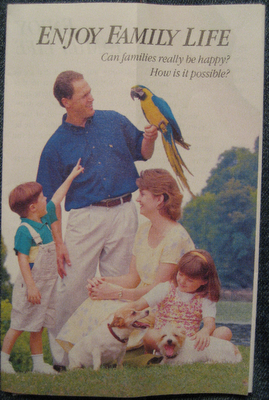
As an owner of two budgies, I was instantly charmed by the inclusion of a blue-throated Macaw in this cover image to signify family happiness. One can’t help but wonder how it gets along with the two overweight Jack Russell terriers being petted by a daughter who looks rather like I looked and dressed when I about six– in the early 1980’s. Son with the unfortunate bowl-cut hairdo could use some work on declarative pointing as he seems to be a little unclear on where the bird is (or maybe he finds Dad’s chin really fascinating), while Mom sits on…something and gazes adoringly at something out of frame, long past the object closest to her face which happens to be Dad’s crotch. “Enjoy Family Life” is the title, bizarrely enough, but the subtitles are even better: “Can families really be happy?” asks the first one. “How is it possible?” wonders the second. If you’re the sort of person to ask these questions, one of those folks who finds him or herself gobsmacked at the very idea of a family being something other than miserable, well here’s your solution…get a parrot.
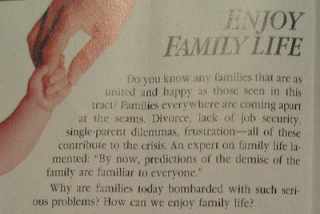
No, apparently that’s not the entire solution, as can be seen in the fact that the pamphlet continues. “Do you know any families that are as united and happy as those seen in this tract?” it asks. Well yes, actually, because I’ve been to a Sears portrait studio. I appear in several similar pictures, as do most Americans who have ever lived, judging by this site. And those are with our actual families! There’s no telling whether the Dockers clan above is actually related to each other, or whether they came from the Happy Family subdivision of Central Casting.
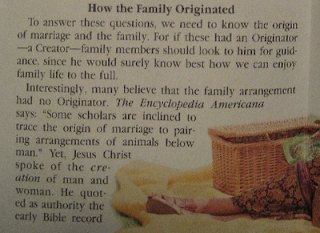
If we want to know how to have a Happy Family (TM), the pamphlet continues, you would think that the best way to go about doing so is to consult the originator of marriage and family, if such a being exists. But doeshe/she/it/they?
Actually, hold that question– because the pamphlet sure does– in favor of something else: “Interestingly, many believe that the family arrangement had no Originator [sic]. The Encyclopedia Americana says “Some scholars are inclined to trace the origin of marriage to pairing arrangements of animals below man.”

Wait, what?

I had to look this one up. I found a Google books result for The Encyclopedia Americana, and went to the listing for marriage. Under Marriage, it reads

In the natural history sense of the word marriage may be defined as a more or less durable union between male and female lasting till after the birth and rearing of offspring. In the ethical and legal sense marriage is a union between man and woman living in complete community of life for the establishment of family.   

In the natural history sense of the word marriage may be said to exist among many of the animals below man. Pair marriage is common among the birds and some of the higher mammals. It especially characterizes the anthropoid apes, the pair marriage of the chimpanzee being monogamous and durable, probably not unlike that of primitive man. The origin of marriage is therefore to be sought in the family, rather than the origin of family in the marriage.  

The function of marriage in human society is twofold: 1) to regulate the relations between the sexes and 2) to determine the relation of the child to the community. This latter function is often overlooked, but is quite as important in any scientific consideration of marriage as the former.

This edition of The Encyclopedia Americana was published in 1919…and boy, does it show. But all it’s really saying about the origin of marriage is that animals other than humans form lasting pair bonds, which it would be silly to deny– although the claim that chimpanzees form “monogamous and durable” pair bonds is overstating things, to put it lightly. Chimpanzees along with their notoriously sex-crazed and very non-monogamous cousins the bonobos have large testicles precisely because of their promiscuous ways, in order for males to engage in regular sperm competition with their rivals. And they’re equally related to “primitive man,” which is to say that they’re equally related to modern us.

The pamphlet uses this to claim that there are “scholars” who insist that the family has no Originator [sic], but while this is certainly true, you don’t find that claim in this passage of The Encyclopedia Americana— if anything, it would be logical to infer from said passage that the Originator is originator of all marriage and families; not just those of humans. I wonder if this even occurred to the Jehovah’s Witnesses. Probably not, because the temptation to use something published nearly a century ago in contrast to the more sensical-sounding religious doctrine was just too great to pass up. But if there’s one aspect in which they agree with the long-dead author(s) of that particular entry of The Encyclopedia Americana on Marriage, it’s that marriage functions to “regulate the relations between the sexes.”
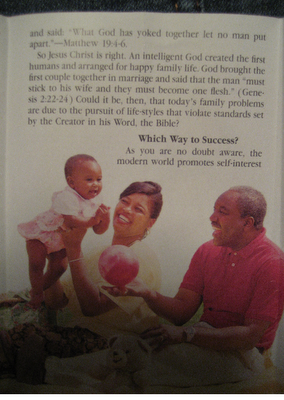
Why? Because the Originator– oh heck, let’s just let the cat out of the bag and call him Jesus, because lord knows that no other deity could be behind the creation of everything– set certain standards in place, standards which must not be violated! Under no circumstances must we pursue “life-styles” which contravene what Jesus wants for us, and if we do, the repercussions will take the form of Unhappy Families! Unlike these lovely people seen here, in which Father levitates a red rubber ball just above his palm for the benefit of Baby, who is not nearly old enough to psychically manipulate it herself. We know Baby is a “her,” incidentally, by the pink clothing–the relations between the sexes must be regulated. Repeat that to yourself, Borg-style, over and over: You will be assimilated. The relations between the sexes must be regulated. You will be assimilated. The relations between sexes must be regulated. These are the words Mother lovingly chants to Baby as she holds her aloft, and Baby stares into space away from both Mother and Father in order to concentrate on absorbing this important standard so that it will never be violated.
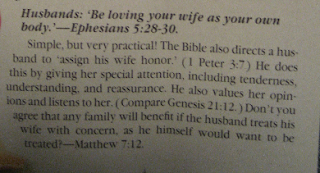
But what is the standard for regulation of relations between the sexes, exactly? Well, let’s see here…husbands, you must love your wife as your own body. Oh dear. Have you seen how little regard some husbands have for their own bodies? The husband is to “assign his wife honor,” by giving her “special” attention (I guess this means attention beyond that earned by the UPS guy), including tenderness, understanding, and reassurance, and valuing her opinion and listening to her. Wouldn’t any family benefit if the husband treats his wife with concern, as he would want to be treated? Well, yes…in fact, wouldn’t it save time to just note that since they both presumably want to be treated this way, they should treat each other this way?
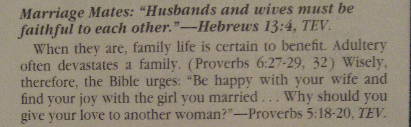

No, apparently not– you need to remind the husbands to love the “girl” they married, because otherwise they’ll forget and cheat on her.

Actually I’ll give this pamphlet props for the fact that it is remarkably even-handed when it comes to instructing spouses how to treat each other…and by that, I mean that it ignores the significant patches of the Bible which are not even-handed in that regard. Such as the most famous, Ephesians 5:22-24, over which the Anglican Church of Sydney Australia has received some grief lately:
Wives, submit yourselves to your own husbands as you do to the Lord. For the husband is the head of the wife as Christ is the head of the church, his body, of which he is the Savior. Now as the church submits to Christ, so also wives should submit to their husbands in everything.

1 Timothy 3:1-7 The saying is trustworthy: If anyone aspires to the office of overseer, he desires a noble task. Therefore an overseer must be above reproach, the husband of one wife, sober-minded, self-controlled, respectable, hospitable, able to teach, not a drunkard, not violent but gentle, not quarrelsome, not a lover of money. He must manage his own household well, with all dignity keeping his children submissive, for if someone does not know how to manage his own household, how will he care for God’s church? 

1 Peter 3:1-6 Likewise, wives, be subject to your own husbands, so that even if some do not obey the word, they may be won without a word by the conduct of their wives, when they see your respectful and pure conduct. Do not let your adorning be external—the braiding of hair and the putting on of gold jewelry, or the clothing you wear— but let your adorning be the hidden person of the heart with the imperishable beauty of a gentle and quiet spirit, which in God’s sight is very precious. For this is how the holy women who hoped in God used to adorn themselves, by submitting to their own husbands

Genesis 3: 16 To the woman he said, “I will surely multiply your pain in childbearing; in pain you shall bring forth children. Your desire shall be for your husband, and he shall rule over you.”

And so on and so on. If you want to find a biblical basis for separate-but-decidedly-not-equal in a marriage, there is no shortage of material. And as the Supreme Court has said, even separate-but-equal does not cut it– you cannot come back and say “But the bible tells husbands to be nice and loving and respectful and kind to their wives!” as if that makes everything okay. As we remember, the bible also tells masters to be kind to their slaves, and slaves to be obedient to their masters.

Basically, this pamphlet attempts to proselytize by picking out the most innocuous, bland, inoffensive-but-also-not-remotely-insightful passages in the bible about how spouses should treat each other, and how they should relate to their children and how their children should relate to them. The problem is, of course, the fact that 1) any of the advice cherry-picked is so banal and generic that it wouldn’t merit a mention in Marriage For Dummies, and 2) it’s cherry-picked from a document (the bible) which says a lot of things about how spouses should relate to each other than no (presumably secular) Marriage For Dummies guide would include, and 3) unfortunately, offering marriage and family advice from the Originator of the universe doesn’t carry much weight if you haven’t first shown that a) there is an originator of the universe, and b) he/she/it/they give a damn about how people conduct their marriages and families, and c) you know what he/she/it/they want. On that topic,  or, you know, any topic.

Imagine someone came to your door offering a guide called Marriage And Family According to Xenu. Would you care what was in it? At all?

My guess is no. And so, Jehovah’s Witnesses….

…I doubt it.

A rampage killer and the problem of “evil”

A rampage killer and the problem of “evil” published on 4 Comments on A rampage killer and the problem of “evil”

“The problem of evil” is the common term for a certain argument against the existence of God. Or at least, the existence of the so-called “omni god”: one who is omniscient (all-knowing), omnibenevolent (all-loving) and omnipotent (all-powerful). The argument goes, basically, that evil would not exist in a universe created by such a deity, because he would know about it, care about it, and be able to prevent it if he had these three qualities. For the purposes of this argument, “evil” is generally defined as suffering– pain and anguish, usually on the part of humans but sometimes in general. Responses to this argument, defenses of the belief that evil could exist in a universe created by such a god, are called theodicy. Generally an argument of theodicy will appeal to free will and assert that humans wouldn’t have it if we weren’t able to commit evil acts, and further that pain and suffering are certainly bad but they’re also the origin of virtues like compassion and altruism. Of course, not all pain and suffering is caused by human behavior– natural disasters are an enormous source for these, but they generally aren’t called “evil” because evil requires an agent. A person is needed to be evil and commit evil acts.

Arguments from either direction on this topic are not terribly convincing to me, in large part because I not only disbelieve in God but also in evil.

I believe in pain and suffering, certainly, but I believe that attributing them to evil explains precisely nothing. And that’s a problem, since it is frequently used to explain things, generally when the pain and suffering is particularly heinous, the speaker has no real idea why they have occurred, and the speaker is either the victim of this pain and suffering and/or sympathizes with the victims. It’s like a place-holder for the actual cause, but more importantly (and more significantly) it tends to stand in the way of identifying and articulating the actual cause. It essentializes the perpetrator of the heinous act, who is labeled the evil one, and therefore the explanatory buck stops with him/her. In order to portray this person as absolutely responsible for his or her act, the label of evil forestalls any explanatory circumstances in the mistaken belief that they would constitute exculpatory circumstances. This is why I call evil supernatural– it’s an idea that there’s some aspect of a person which is distinct and elevated from all causal factors which contributed to his or her behavior. I’m quite willing to say that people can be bad, be immoral, deliberately or mistakenly do things with disastrous consequences for others as well as themselves. But I won’t call them evil, because badness and mistakes can be explained while evil cannot.

Psychologist Roy Baumeister wrote a very important book called Evil: Inside Human Violence and Cruelty, in which he articulates what he calls the “myth of pure evil.” The myth entails the following:

  • Evil is the intentional infliction of harm on people.
  • Evil is driven primarily by the wish to inflict harm merely for the pleasure of doing so (or for no reason at all). Harm inflicted by evil forces is gratuitous and therefore unjustified.
  • The victim is innocent and good.
  • Evil is the other, the enemy, the outsider, the out-group.
  • Evil has been that way since time immemorial.
  • Evil represents the antithesis of order, peace, and stability
These are the characterizations we give the things and the people we want to call evil, because we want to distance ourselves from them and signify at once that we a) are not capable of committing such acts ourselves, and b) certainly didn’t commit any such act in this instance. The worse the act in question becomes, the stronger this impulse is. Suddenly it’s not only permissible but obligatory to use any words of condemnation possible to describe the act and its perpetrator, even if they are not accurate. Recall when Bill Maher lost his job as host of Politically Incorrect because he refused to call the 9/11 terrorists “cowards”? He wasn’t by any means refusing to say that what they did was wrong, and that they are bad people, but he would not describe their actions as cowardly given that they knowingly and willingly were doing something that would necessarily lead to their deaths. But because Maher refused to feed the myth of pure evil, he was viewed as excusing it and therefore at least a little bit evil himself. Describing someone as evil as an explanation for their behavior is a kind of fundamental attribution error— it attributes all responsibility for the act to the nature of the person rather than his or her situation– and people who openly refuse to commit this error risk being viewed as sympathetic to the perpetrator and even to the act itself.
In this context, I want to consider the words of Colorado governor John Hickenlooper about James Holmes, the 24-year-old suspect of Friday’s mass shooting in Aurora:

Colorado Gov. John Hickenlooper says the mass killing of a dozen people and wounding of another 58 at a movie theater may not have been political terrorism, but it was the act of a deranged, demonic person who wanted to create intense fear. The Democratic governor appeared on CNN’s “State of the Union” Sunday and says officers are getting a lot more evidence from suspect James Holmes’ apartment and are learning more about him moment by moment. Hickenlooper told ABC’s George Stephanopoulos on “This Week” that Holmes was diabolical and he would have found a way to create this horror even if he did not have access to guns. Hickenlooper says Holmes would have used explosives, poisonous gas or some other method to create the terror.

“Demonic?” Does Hickenlooper actually believe in demons, and that they caused Holmes to murder? I seriously doubt it, although if he does believe that he should be evicted from office as soon as possible. It certainly sounds as though he’s using the word to express the extent of his horror at the act, and it accomplishes that. But unfortunately it also accomplishes something else, an incorrect or at least far too hasty explanation for the killer’s actions. There is no way for Hickenlooper– for any of us– to know at this point whether Holmes is “deranged,” much less “diabolical.” Those two words create an interesting paradox, actually– if by “deranged” Hickenlooper means that Holmes is mentally ill, then that would effectively prevent him from being “diabolical,” since the myth of pure evil entails that the perpetrator commits his or her heinous acts with full knowledge and deliberateness, with a sound mind. That’s how we hold the person fully responsible, morally and legally. People with mental illnesses can certainly be responsible, but if mental illness drives a person to do something like go to a movie theater and open fire on its occupants then I think it’s safe to say that the person was not in full control of his or her faculties, however much thought he put into it beforehand. It is entirely possible to be both disturbed and calculating.

The last similarly horrible event that occurred in Colorado was the shootings at Columbine High School in 1999. Dave Cullen, the journalist who authored the book Columbine, has an editorial in the New York Times today advising extreme caution in interpreting the causes behind this one:

You’ve had 48 hours to reflect on the ghastly shooting in Colorado at a movie theater. You’ve been bombarded with “facts” and opinions about James Holmes’s motives. You have probably expressed your opinion on why he did it. You are probably wrong. I learned that the hard way. In 1999 I lived in Denver and was part of the first wave of reporters to descend on Columbine High School the afternoon it was attacked. I ran with the journalistic pack that created the myths we are still living with. We created those myths for one reason: we were trying to answer the burning question of why, and we were trying to answer it way too soon. I spent 10 years studying Columbine, and we all know what happened there, right? Two outcast loners exacted revenge against the jocks for relentlessly bullying them. Not one bit of that turned out to be true. But the news media jumped to all those conclusions in the first 24 hours, so they are accepted by many people today as fact. The real story is a lot more disturbing. And instructive. At every high school, college and school-safety conference I speak at, I hold up the journals left behind by the killers, Eric Harris and Dylan Klebold. The audience is shocked at what they learn. Perpetrators of mass murder are usually nothing like our conceptions of them. They are nothing like a vision of pure evil. They are complicated.

Complicated.

Evil is simple. Easy. Practically a write-off. And therein lies both its appeal, and its fundamental mistake.

When a cult rules a town

When a cult rules a town published on No Comments on When a cult rules a town

Two former members of the Fundamentalist Church of Latter Day Saints (FLDS) found a kitten, still alive, mostly buried in concrete inside a metal tube on one of the men’s property in Colorado City, Arizona. The tube was of one of six standing upright in the ground, intended for use in making posts to support a horse shelter. They worked to rescue the kitten– cut the tubing apart and hacked at the concrete– and managed to get it out, but it died a couple of days later. Andrew Chatwin was working on Isaac Wyler’s property, and was the one who initially discovered the cat. He says he has seen incidents of apparent deliberate animal abuse before, and believes that this was an act of intimidation by FLDS members telling Wyler (and presumably himself) to “get out.”

When Chatwin went to local police to report the incident, he says they laughed at him. Chatwin says that the police are themselves FLDS, and Colorado City is effectively a “theocracy.”:

The U.S. Justice Department recently filed a lawsuit against government officials in Colorado City, and the neighboring border town of Hildale, Utah, for alleged civil rights violations, including acting as de-facto agents for the church, denying ex-members and non-members of the FLDS Church access to everything from police services to housing and utilities, according to KSTU-TV.

Warren Jeffs may be in prison, but his people appear to still be going strong. According to The 21st Floor,

The FDLS [sic] is one of the largest fundamentalist Mormon denominations and split from the Church of the Latter Day Saints over their suspension of the practice of polygamy and its decision to excommunicate its members who would continue the practice. The sect believe that a man must have three wifes [sic] to get into heaven and a number of members have been convicted of abusing their spiritual wifes [sic] who were aged between 15 and 16. The FLDS Church is estimated to have 10,000 members and was formerly led by Warren Jeffs who is convicted of two counts of child sexual abuse and is currently serving life plus twenty years in Palestine Texas. The church believes that women should be subordinate to their husbands and in general, women are not allowed to cut their hair short or wear makeup, pants, or any skirt above the knees. It has been reported by former members that the FLDS Church has excommunicated more than 400 teenage boys for offenses such as dating or listening to rock music. Some former members claim that the real reason for these excommunications is that there are not enough women for each male to receive three or more wives. Six men, aged 18 to 22, filed a conspiracy lawsuit against Jeffs and Sam Barlow, a former Mohave County deputy sheriff and close associate of Jeffs, for a “systematic excommunication” of young men to reduce competition for wives. The church is considered a hate group because of it’s views on race. Former leader Warren Jeffs is quoted as saying: ”the black race is the people through which the devil has always been able to bring evil unto the earth.”

Richard Dawkins claims that at least a mild form of mental abuse is “inherent in a typical religious education,” and that threats of eternal suffering in hell are an extreme example. What about the abuse of telling young men that they must marry at least three women if they want to get into heaven, and then denying them any opportunity to do so? What about the abuse of telling women that they must acquiesce to sharing a husband with other wives if they want to get into heaven– and that they really have no say in who that husband may be, and must marry him as a teenager though he could be fifty years old?

I call FLDS a cult, but not because they having teachings I consider immoral– though they have loads of those. I call them a cult because they are an insular group which threatens and harasses defectors, and indoctrinates children with beliefs that render them unable to function within society outside of the group, terrified and guilt-stricken about trying to do so. I think Dawkins is definitely exaggerating to suggest that abuse is inherent in a religious education, but that it is abusive to tell children that their eternal fate rests on obeying the particular restrictions of your group, especially if doing so is nearly impossible.

And I think that torturing an animal on someone’s property as a means of intimidation counts as terrorism– what more effective way is there to say “We have absolutely no regard for your well-being” than to demonstrate a complete lack of such regard for a kitten? Even among farmers, who are at least accustomed to dealing with the suffering of animals even if they will never be exactly comfortable with it, that recognition seems clear. As Chatwin says “How else would you take the message?”

I didn’t tell him not to murder, that it would assuredly land him on death row…that would be mean.

I didn’t tell him not to murder, that it would assuredly land him on death row…that would be mean. published on No Comments on I didn’t tell him not to murder, that it would assuredly land him on death row…that would be mean.

Do you recall those pastors who made it into the news lately for making outlandishly bigoted statements about homosexuals from the pulpit lately in the wake of Obama’s statement of support for gay marriage, and were recorded doing so?

Well, you might be gratified to know that, as CNN’s Belief blog tells it, harsh anti-gay preaching alarms gay rights supporters and Christian conservatives alike. Yep, that’s right:

The incidents drew outrage and condemnation from gay rights supporters. But they also left many Christians uncomfortable – even those who call themselves conservative. One leading expert on American Protestantism has a simple explanation for why some pastors preach against homosexuality while others go further, encouraging violence against gay people.”There is a significant percentage who think it’s a sin,” Ed Stetzer said of homosexuality. “And there are a small minority who are stupid.”

Stupid, you say? Is that the problem?

Many conservative Christians would agree with pastors such as Worley and Knapp that homosexual behavior is fundamentally wrong, Stetzer said. But that doesn’t mean they support them or their sermons, he added. “If you asked, they would say that’s really unhelpful and stupid,” he said. 

Yes, stupid. Got it. Okay, but isn’t there more to it than that?

But the Rev. Robin Lunn said these preachers are much worse than that. She calls such pastors “genocidal.” “If someone is talking about rounding up me and all my kind in a pen, what is the difference between that and what is happening in Syria and Sudan and what happened in Germany and Poland during World War II?” asked Lunn, executive director of the Association of Welcoming and Affirming Baptists. “We are talking about people who believe somehow that the Second Coming is connected to a Final Solution,” said Lunn, a lesbian, using the Nazi term for the mass murder of Jews in the Holocaust. “I think these men expressed something that many Baptist preachers think,” Lunn said. “We need to stand up and denounce this powerfully.” Her group campaigns for lesbian, gay, bisexual and transgender inclusion across all Baptist churches. 

Oh, so not just stupid, but wrong. The problem isn’t in the fact that they said it, or how they said it, but that they think it in the first place. Is that it?

One of the most respected voices in conservative Christianity agrees with Lunn, up to a point. “The Gospel does not condemn homosexuals, it condemns homosexuality,” said R. Albert Mohler, president of the Southern Baptist Theological Seminary. “The Bible makes clear that homosexuality is a sin, in the context of making clear that every person is a sinner.” What preachers such as Worley and Knapp are doing wrong, he said, is that they are “not merely rendering a moral judgment on homosexuality but extending it to the condemnation of people. They are speaking with a certain venom and hatred.” He called their sermons “reprehensible.” And, he said, “they are doing grave harm to the cause of conservative Christianity by speaking messages of hate that obscure the message of the church.” “What you’re seeing here is a very dangerous fringe that does not represent conservative Christianity in America,” he said.

Hmm. Nope, it looks like the problem really is just that those pastors are stupid. Yes, homosexuality is a sin, but hey– we’re all sinners! So having sex with another man or another woman is just like one of the other bad things that humans do everyday, like lying or stealing! And yes, Christians who do these things know they’re sinful, so they repent for them, whereas homosexuals don’t believe that what they’re doing is sinful so they don’t repent, and hence presumably won’t be granted salvation and will be cast into hell when they die…but that’s all!  No need to get all hatey about it by actually concluding what any normal person would about someone who deserves eternal torture, and deeming it appropriate to condemn that person from the pulpit– that’s just reprehensible. What you’re supposed to do is keep your dedicated conviction that that these unknowing and unrepentant sinners will burn in eternal agony after they die as punishment for their behavior to yourself, rather than taking the logical action of speaking loudly about the horribleness of their lives and the grave peril their souls are in, because that would be hateful. Believing precisely that but keeping quiet about it, not proclaiming it for all who need to hear this very-important-if-true message, is the way to go.

After all, we wouldn’t want to be stupid.

The big bad atheist will blow your religion down?

The big bad atheist will blow your religion down? published on No Comments on The big bad atheist will blow your religion down?

Ronald Lindsay, president and CEO of the Center for Inquiry (CFI), wrote a piece for the Huffington Post comparing coming out as an atheist to coming out as LGBT. In it he urges atheists to reveal their existence to the world for much the same reason that it’s good for “queers” of all sorts to come out– for their own happiness and for the world to recognize their ubiquity and similarity to themselves. Just normal folks, as worthy and intelligent and moral and loving as anyone else. Recognition of this is the single biggest factor in social acceptance, and it’s good to encourage. But while making this comparison, Lindsay also draws what he sees as an important contrast:

I don’t think coming out will have the same level of success for atheists as it’s had for LGBT individuals. Why? Because even after we come out, some fear will persist. For some, the level of fear, the sense of being threatened, may actually increase. There’s a big difference between being gay and being an atheist. Someone can persuade you to be an atheist; no one is going to persuade you to be gay (no matter what the extremist anti-gay propaganda says). I don’t foresee a best-selling book entitled “The Straight Delusion” or “Heterosexuality Poisons Everything.” The LGBT community wants acceptance; they don’t want to persuade others to join their “team,” and even if they had that objective, they would strive for it in vain. By contrast, the amount of literature that has been produced in the last decade criticizing religious belief is extensive and continues to grow. Moreover, these critiques of religion seem to have had some effect. Of course, many atheists have little or no interest in persuading the religious to abandon their beliefs. They merely want to be treated as equals and to end the influence that religion has on public policy. That doesn’t matter. The realization that many atheists once were religious and then “lost” their faith has an unnerving effect on some of the religious. How far will atheism spread? Will I be next? Or my children?

Okay, so prejudice against atheists– in America, at least– has been demonstrated to exist. It takes the form of a distrust, a belief that atheists are different and mysterious, fundamentally “other,” and that they cannot be relied upon to support the same ideals, to “share the same vision of American society.” However, there are some interesting aspects to that. The first is that this impression of atheists as a threat to societal values can be significantly diminished by reminders of social controls– if people receive messages indicating a strong justice system is in place, their anxiety of wanting a supernatural form of police as backup seems to drop substantially. In addition to this, there’s a factor that runs counter to Lindsay’s suggestions:

In the third experiment, Gervais gave the subjects one of three passages to read and react to – one on food, an excerpt from The God Delusion in which Dawkins argues that belief is nonsensical, and a passage detailing the increasing numbers of atheists in the USA in recent decades. This last passage included the crucial fact that at least 20% of Americans aged 18-25 are atheists. For the religious, reading that atheism was rather more common than they previously believed had a remarkable effect. It effectively abolished their distrust of atheists. To me, this result strongly suggests that distrust of atheists is mostly due to fear of ‘others’. It suggests that the main reason for the distrust is that the subjects had not realised that many of their fellow students were, in fact, atheists. Once they learned that atheists were not a weird, alien group, but rather people just like them, they felt able to trust them. And I think this conclusion is supported by the experience of atheists in places like the UK, where overt atheism is much more prevalent and distrust of atheists is correspondingly lower.

How to say this? I think Lindsay is treating the issue a little too…rationally. And by that I mean, he seems to believe that the greatest threat that atheists present to theists is the fact of their having a different opinion about what would seem to be a foundational matter, the existence of a creator. And yes, clearly efforts to argue that matter such as The God Delusion are a turn-off for people of faith, and should be viewed much more as sources of reassurance for atheists, especially the new kind, than as tools of conversion for the religious. Given how many times I’ve seen the same refutations of the same arguments done more and less artfully in various forms in books and internet forums and chat rooms over the past couple of decades to no apparent avail, I don’t find that idea hard to swallow at all. Religion is far from a purely intellectual matter, and– let’s be honest– so is atheism. Acceptance seems far more likely to be dependent on tripping the right empathy triggers than anything else.

How to deal with science you don’t like: call it religion

How to deal with science you don’t like: call it religion published on No Comments on How to deal with science you don’t like: call it religion
Artist: Person who didn’t exist yet, according to nearly
half of Americans

The revelation that in 2012, 46% of Americans believe that humans were created in their present form by God in the last 10,000 years is a little staggering. Staggering but not shocking, considering that Gallup has been conducting a poll on evolution belief for the past 30 years with pretty much the same result. This answer was one of three possible, the other two being 1) humans evolved over millions of years from less advanced forms of life, but the process was guided by God, and 2) humans evolved in the same way, but God had no part in the process.

I don’t like these possible answers. For one thing, it doesn’t look like it was possible for respondents to simply say “I don’t know,” so the poll forces them to assert a belief that they may not actually hold. For another thing, “God had no part in the process” is a nebulous statement. It could mean that God didn’t specially guide the evolution of humans though he did put things in motion originally, which is a common belief of theists who accept evolution. But it sounds more like the respondent is asserting that God doesn’t exist. A person shouldn’t have to affirm God’s non-existence or complete irrelevance to evolution in order to express a belief in evolution as it actually occurs– that is, without any necessary guidance.

But let’s go back to that “present form in the last 10,000 years” thing. Humans have been around in their present form for the last 10,000 years, yes. For that matter, they’ve been around in their anatomically modern form for about the last 200,000 years, and have been behaviorally modern (capable of symbolic thought, language, culture) for about the last 50,000. The city of Jericho is 11,000 years old. 46% of Americans don’t even have their human history right.

What does this tell me? It tells me that evolution isn’t the problem. By that I mean, I don’t think the content of the story that conflicts with “We were specially made by God” is really an issue so much as the fact that it does conflict, and obviously so. It’s not as offensive a creation story as those produced by a lot of religions, because religious creation stories generally entail that humans were created by some god or another, more or less deliberately. Evolution doesn’t include that, so its creation story is abhorrent and false. Presumably it would be just as abhorrent and false if it asserted that we humans came into existence in some other very non-deliberate way, such as emerging from the earth like plants. Genesis says that God made Adam from dust, but he made him– formed him, in God’s own image. Special creation is the key…our existence must be on purpose, in order to have purpose.

That is, I expect, the kind of thinking behind Kansas school board member Ken Willard’s recent objections to the science standards the state is developing along with 25 other states and the National Research Council. Willard, a Republican (surprise) has in the past “supported standards for Kansas with material that questions evolution,” and now:

Willard said the draft embraces naturalism and secular humanism, which precludes God or another supreme being in considering how the universe works. He said he intends to raise the issue Tuesday. “That’s going to be very problematic,” Willard told The Associated Press in an interview. “They are preferring one religious position over another.”

Unfortunately the public review period for the science standards is now closed, however in a section on the site titled The Nature of Science in the NGSS, I see this:

What is central to the intersection of the practices, core ideas, and crosscutting concepts?  Or, what is the relationship among the three basic elements of The Framework for K–12 Science Education? Humans have a need to explain the world around them. In some cases, the need originates in potential dangers, sometimes it is a curiosity, and in other cases the promise of a better life. Science is the pursuit of explanations of the natural world. As a foundation for K–12 science education, the issue is explaining the natural world and especially the formation of adequate, evidence-based scientific explanations. To be clear, this sort of explanation should not be confused with how students engage in the practice of constructing explanations. Obviously, students in K–12 are not likely to construct new explanations of the natural world; they can understand and engage in the process scientists use to acquire scientific knowledge. 

Might this be the root of Willard’s objections– the assertion that science is for explaining the natural world? That explanations must be based on evidence in order to be scientific? That is “naturalistic,” in the sense that naturalism entails a belief that the universe obeys rules, and science is a means of discovering and explaining those rules. Naturalism also entails that nothing exists beyond the universe, or if it does it doesn’t affect the workings of the universe, but the science standards don’t appear to assert that this is true. I don’t see anything that “precludes God,” unless by that Willard simply means that the standards do not invoke God. His god, presumably– one gets the feeling that acknowledgement of a deistic god would not suffice at all.

The refusal to take a position on religion is not itself a religious position, but I am guessing Willard does not believe this. Either that, or he is trying to obscure that fact by clumsily slapping on philosophical labels in order to turn it into one, which is far from a new tactic:

One of the most robust and effective conspiracy theories on the right, the notion that “secularism” – or, just as often, “Secular Humanism” – is a religion is meant to be taken entirely literally: right wingers genuinely believe it refers to an actually existing religious practice. How do conservatives know? Because, they say, the Supreme Court said so. It was, as religious historian and Lutheran minister Martin E. Marty has written, “an instance where one can date precisely the birth of a religion: June 19, 1961.” That was the day the Court ruled in the case of Torcaso v. Watkins striking down the Maryland Constitution’s requirement of “a declaration of belief in the existence of God” to hold “any office of profit or trust in this state” — specifically, in atheist Roy Torcaso’s case, the office of notary public. In his decision, Justice Hugo Black, writing for a unanimous court, further asserted that states and the federal government could not favor religions “based on a belief in the existence of God as against those religions founded on different beliefs” – and, in a fateful, ill-considered, and entirely offhand footnote explained: “Among religions in this country which do not teach what would be generally be considered a belief in the existence of God are Buddhism, Taoism, Ethical Culture, Secular Humanism and others.”  From here, things get wacky. As unearthed by the outstanding scholar Carol Mason in her masterpiece Reading Appalachia from Left to Right, in 1974 a Jesuit priest and Fordham University law professor named Edward Berbasse argued that “since humanism is now considered by the court to be a religion , it must be prevented from being established by the government.” An activist asked him if that meant they could win their fight to ban the satanic textbooks being forced down their children’s throats in Kanawha County, West Virginia by taking the matter to the Supreme Court. “I think you may have the material if you can get a crackerjack lawyer,” Father Berbasse responded. A Supreme Court case was never actually attempted – not least because, as Chip Berlet and Matthew Lyons have pointed out, “While historically there has been an organized humanist movement in the United States since at least the 1800s, the idea of a large-scale quasireligion called secular humanism is a conspiracist myth.” In Kanawha County, the textbook fight was fought out with dynamite instead. Nationwide, however, the conspiracist myth took on a life of its own – even unto the halls of Congress. For Secular Humanism was not just an imaginary religion. It was, as the subtitle to a 1984 book still revered by religious conservatives, put it, The Most Dangerous Religion in America. How so? Because it held that man, not God, determines human affairs. From that, as Martin Marty explained, the ascendant religious right developed the claim that “when a textbook does not mention the God of the Bible … it necessarily leads to a void which it must fill with the religion of Secular Humanism.” (It’s a religion. Thus the Capital Letters.) And that any textbook which does not mention the guiding hand of God is rock-solid proof that the “secular humanist” conspiracists had written it; the absence was the presence.

Nobody honestly thinks that science in general is a religion. They just try to treat it as one when it comes to theories that they object to on religious grounds in order to make it constitutionally problematic to teach it. If it isn’t a violation of anyone’s religious freedom to teach that plants photosynthesize, it isn’t a violation to teach evolution.

Last Easter, Pope Benedict took the opportunity to misrepresent evolution with regard to humans specifically, claiming that the Catholic Church accepts evolution, so long as it entails that humanity was specially created. That is, not evolved. I wrote then:

I’m sure it’s possible to understand evolution and still find it depressing and threatening, but it’s remarkable how many people who find it depressing and threatening do not understand it.  A hard-liner could quibble about the idea that we evolved “to” do anything at all, but in the context of simple order of events it is quite true that we evolved rationality into the world, in the same way that Daniel Dennett wrote that we evolved free will into the world. At least our version of it, in our world. Richard Dawkins, probably the greatest proponent of evolutionary theory alive today, likes to dwell on the unlikelihood of each of our personal existences, however significant they are to us. In Unweaving the Rainbow he wrote:

We are going to die, and that makes us the lucky ones. Most people are never going to die because they are never going to be born. The potential people who could have been here in my place but who will in fact never see the light of day outnumber the sand grains of Arabia. Certainly those unborn ghosts include greater poets than Keats, scientists greater than Newton. We know this because the set of possible people allowed by our DNA so massively exceeds the set of actual people. In the teeth of these stupefying odds it is you and I, in our ordinariness, that are here.

The reaction I have to such thoughts is awe and wonder. The reaction that people like the Pope have is apparently revulsion and fear– we, you and I, could not have come into this world without an act of special creation. Life has no meaning otherwise.  Yet here all of us evolution-believers are, comfortably denying ourselves to be the product of a design independent of the process of natural selection, and yet somehow managing to not commit mass suicide in a fit of despair. Some of us believe that there is a god behind the whole process and others don’t, but the simple idea of being evolved individuals doesn’t shake any existential pillars and cause our sense of teleology to come crashing down. How is that? 

I want to call it humility. But that wouldn’t be at all humble, now would it?

Instruction on religion in public schools

Instruction on religion in public schools published on 1 Comment on Instruction on religion in public schools

Today my “faitheist” friend Chris Stedman wrote

In high school, I washed dishes and mopped floors at “Taste of Scandinavia Bakery & Café.” (I’m from Minnesota.) It was not a job that played to my strengths, but my manager—a supremely kind and intelligent young man—made it tolerable with his dry sense of humor and incisive commentary.  One day, after a discussion about LGBT activism and how he took his children to a gay pride event, he told me he was a Mormon. “Really? I’ve never met a Mormon before,” I said. “My old church told me that Mormonism is a cult.” A coworker, overhearing us, added: “A cult? Like in ‘Children of the Corn’?” He patiently explained more about his beliefs, but my coworker and I mostly pretended to listen because we both had a crush on him. (He was very handsome. He should probably do one of those “I’m a Mormon” ads.)  A few days later, my coworker pulled me aside and said she talked to her mom and, upon further reflection, didn’t really feel comfortable working for a Mormon. I didn’t know what to say, so I just took a bite of my cream cheese kolache. Public schools should offer religious literacy classes.

In a word, yes. Yes, they absolutely should. In the 1963 case Abington School District v. Schempp, when the Supreme Court declared that school-sponsored bible-reading was unconstitutional, they took great care to note why instruction on religion itself is not:

It is insisted that unless these religious exercises are permitted a “religion of secularism” is established in the schools. We agree of course that the State may not establish a “religion of secularism” in the sense of affirmatively opposing or showing hostility to religion, thus “preferring those who believe in no religion over those who do believe.” Zorach v. Clauson, supra, at 314. We do not agree, however, that this decision in any sense has that effect. In addition, it might well be said that one’s education is not complete without a study of comparative religion or the history of religion and its relationship to the advancement of civilization. It certainly may be said that the Bible is worthy of study for its literary and historic qualities. Nothing we have said here indicates that such study of the Bible or of religion, when presented objectively as part of a secular program of education, may not be effected consistently with the First Amendment. But the exercises here do not fall into those categories. They are religious exercises, required by the States in violation of the command of the First Amendment that the Government maintain strict neutrality, neither aiding nor opposing religion. Finally, we cannot accept that the concept of neutrality, which does not permit a State to require a religious exercise even with the consent of the majority of those affected, collides with the majority’s right to free exercise of religion.[10] While the Free Exercise Clause clearly prohibits the use of state action to deny the rights of free exercise to anyone, it has never meant that a majority could use the machinery of the State to practice its beliefs. 

(emphasis mine)

Pastors come up with creative ways to express how unequal gays are

Pastors come up with creative ways to express how unequal gays are published on 1 Comment on Pastors come up with creative ways to express how unequal gays are

Now, I’m sure that pastors denouncing homosexuality from the pulpit isn’t a new thing. It’s impossible to know how often this happens. But it’s hard to escape the notion that the recent three occasions of pastors doing so, so vehemently, are related to Obama’s recent profession of personal support for gay marriage. And for that reason, I have to admit that his endorsement means more than I’d previously thought it would. It’s easy as a long-time supporter of gay rights to observe the president saying something in an interview for a magazine that expresses the most tepid of support, while clarifying that gay marriage is something that is and should be decided by the states, to be…well, underwhelmed by that revelation. But clearly this milquetoast-in-my-eyes statement has put a fire in the belly of some preachers lately. And the result isn’t pretty.

First, Pastor Sean Harris of Barean Baptist Church in Fayetteville, North Carolina:

 “So your little son starts to act a little girlish when he is four years old and instead of squashing that like a cockroach and saying, “Man up, son, get that dress off you and get outside and dig a ditch, because that is what boys do,” you get out the camera and you start taking pictures of Johnny acting like a female and then you upload it to YouTube and everybody laughs about it and the next thing you know, this dude, this kid is acting out childhood fantasies that should have been squashed. Can I make it any clearer? Dads, the second you see your son dropping the limp wrist, you walk over there and crack that wrist. Man up. Give him a good punch. Ok? You are not going to act like that. You were made by God to be a male and you are going to be a male. And when your daughter starts acting to Butch you reign her in. And you say, “Oh, no, sweetheart. You can play sports. Play them to the glory of God. But sometimes you are going to act like a girl and walk like a girl and talk like a girl and smell like a girl and that means you are going to be beautiful. You are going to be attractive. You are going to dress yourself up.” You say, “Can I take charge like that as a parent?” Yeah, you can. You are authorized. I just gave you a special dispensation this morning to do that.”

Second, Pastor Charles Worley of Providence Road Baptist Church, also in NC:

I’ve never been as sick in my life of our President getting’ up and saying it was alright for two women to marry, or two men to marry. I can tell you right now, I was disappointed bad, I’ll tell you right there, it’s as sorry as you can get. The Bible is against, God’s against, I’m against and if you’ve got any sense you’re against!I had a way, I’ve figured a way out. A way to get rid of all the lesbians and queers, but I couldn’t get it past the Congress. Build a great big large fence, 150 or 100 miles long, put all the lesbians in there, fly over and drop some food. Do the same thing with the queers and the homosexuals. And have that fence electrified till they can’t get out. Feed them. And you know what? In a few years they’ll die out. You know why? They can’t reproduce.If a man ever has a young’en, praise god it will be the first em. All of these… You can say amen, I’m going to preach the hell out of all of them.Hey I’ll tell you right now, somebody say who you going to vote for? I ain’t gonna vote for a baby killer and a homosexual lover.You said did you mean to say that? You better believe I did.God have mercy it makes me puking sick to think about… I don’t even know whether you ought to say this in the pulpit or not. Can you imagine kissing some man?

Third, Pastor Curtis Knapp, of New Hope Baptist Church in Seneca, Kansas:

If there is a man who lies with a male as those who lie with a woman, both of them have committed a detestable act; they shall surely be put to death. They should be put to death. ‘Oh, so you’re saying we should go out and start killing them.’ No. I’m saying the government should. They won’t, but they should. You say, ‘Oh, I can’t believe you, you’re horrible. You’re a backwards neanderthal of a person.’ Is that what you’re calling scripture? Is God a neanderthal, backwards in his morality? Is it His word or not? If it’s His word, he commanded it. It’s His idea, not mine. And I’m not ashamed of it. He said put them to death. Shall the church drag them in? No, I’m not saying that. The church has not been given the power of the sort; the government has. But the government ought to [kill them]. You got a better idea? A better idea than God?