Skip to content

The only thing I hate about being a feminist…

The only thing I hate about being a feminist… published on 20 Comments on The only thing I hate about being a feminist…
Bill Bailey, hilarious feminist

…is that it’s still possible to make general statements criticizing them and be taken seriously. 

Richard Dawkins weighed in on the sex/gender dispute, pretty much attributing all of the consternation to a blanket disapproval of the “million dollar challenge” (an experiment intended to show that women are essentially sexual gate keepers by asking how many men would accept a million-dollar bet to find a woman who would sleep with them by the end of the day, versus how many women would) and the use of the word “females” to refer to women.  Missing the point rather grandly, I would say, in agreement with Jen McCreight’s comment here.

But what mainly irks me is this: he is able to say, honestly and truthfully, that “When the Million Dollar Challenge was offered at the American Atheists meeting, it deeply offended some feminists.” Which, of course, allows commenters who find the offense unjustified to immediately set upon the “feminists.” Oh, those darn feminists, always so outraged about the silliest little things.  No sense of humor or perspective.  Only a feminist would be bothered over this “hysterical twaddle” (as Dawkins put it).  I’m trying to imagine what would happen if an experiment regarding race was presented at a meeting, and he said that it “deeply offended some people concerned with racial relations.”  One would hope that everyone is concerned about racial relations, and so would find it rather ridiculous to say something like “People concerned with racial relations getting offended, nothing new to see here.”

Likewise, I would say that everyone should be concerned about gender relations.  It’s certainly open for debate whether feminism should be primarily about disposition (as in, “I believe firmly that women are equal in value to men and should have the same rights as far as is possible”) or disposition and interests (“I believe all of that, plus I’m specially concerned with how women are viewed socially by men and each other”).  There are plenty of people in the former group who don’t consider themselves feminists because they’re not also in the latter.  There are also, I’m sure, plenty of people who are in both groups but who don’t call themselves feminists because they associate them exclusively with those people who are irrationally outraged, however you might choose to define that.  I don’t like being associated with Andrea Dworkin, but that certainly isn’t enough to make me disavow membership in an entire body of people concerned with gender on the broader scale.

If Dawkins had said that when the Million Dollar Challenge was presented, it “deeply offended some women,”  it would have implied that women are the only ones, rightly or wrongly, who would be offended by the Challenge.  If the issue had been race, it would have been like saying that the experiment “deeply offended some black people.”  Even though the word “some” is in there, the assumption is that offense would only be felt by members of the specific group being discussed.  But aren’t we at the point now that that assumption is entirely unjustified?  That you don’t have to be a minority to be offended by racism, female to be offended by sexism, gay to be offended by homophobia? 

By asserting that the offended party are feminists, Dawkins is suggesting that feminists (however he defines them) are the only ones who would be offended. Since he does this as part of a dismissal of what he calls “hysterical twaddle,” it seems pretty clear that he thinks of feminists as being the type of people to get offended in the form of hysteria about twaddle. Some of them clearly are. But that has nothing to do with whether the offending object in fact is hysterical twaddle. People concerned about race issues often differ on whether a particular act or idea should be considered racist, and hence presumably worth getting bothered about. People concerned about gender often differ on whether a particular act or idea should be considered sexist or otherwise problematic in that regard, and hence worth getting bothered about. I happen to think that the most appropriate term for the latter group is “feminists,” and therefore that slamming feminists as a group makes a person look like an arse. And I don’t support enabling arses to proliferate in their arsiness. You don’t get to dismiss the legitimacy of offense about something by identifying the group offended by it, and certainly not by dismissing the group offended by it. That’s the essence of the ad hominem fallacy.
Also…

Also… published on 1 Comment on Also…

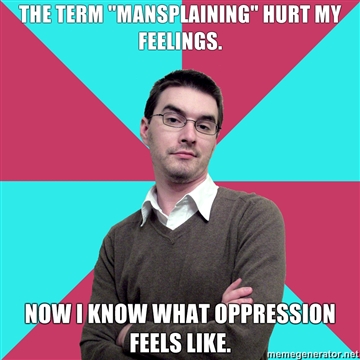
I really wish the term “mansplaining” would go away.  I understand the problem it’s meant to convey– a man assuming he knows more about something than a woman and condescending to her about it– but it’s an awkward portmanteau and just strikes me as juvenile.  Like there’s no way to effectively point out instances of this happening without coming up with a cute name for it.  It also makes it sound as if this is something all men do, or that women never do, or that there aren’t other varieties of prejudice and/or privilege-based condescension.  And if there are, do they all need clever names too?  Richsplaining?  Whitesplaining?  “Gaysplaining” sounds marginally better aesthetically, but a person who uses it would probably be called homophobic even if using it correctly because gays are not a privileged group.

I like the words “prejudice” and “privilege,” because they’re generally applicable to errors in rationality (the former) and perspective (the latter), and don’t suggest that mistakes about the abilities and values of different groups are all fundamentally different in kind.  Sexism already suffers from a good deal of confusion on that matter given that there are entirely legitimate statements that can be made about differences between sexes.  The illegitimate ones, however, can come from the same kinds of thought processes that produce any other kind of in-group favoritism and aren’t inherently any better or worse.   There are a million different ways to think sloppily, but I think it’s better that the commonality of these varieties of sloppiness be emphasized.

Some disjointed thoughts on “inclusiveness”

Some disjointed thoughts on “inclusiveness” published on 2 Comments on Some disjointed thoughts on “inclusiveness”

Claudia guest posts at Friendly Atheist on what she dubs “Femalegate“:

The situation: There’s a discussion and the subject of inclusion of woman in the movement comes up. The panel has 5 men and 1 woman. In the audience, men outnumber women two to one. The complaint that women are hit on too much at meet-ups is met with comments about it being “biological” (which can be easily read as, “So suck it up”). Eventually one woman, feeling belittled and passed over in favor of men in the audience, calls the panel out for the use of terminology. In return, she gets jeers and a sarcastic joke.
From here, the situation could have gone in various directions. As a community that prides ourselves on intellectual honesty and the ability to recognize (and even celebrate) nuance, we could have:

  • Had a conversation about how panel discussions on delicate topics should and should not be handled.
  • Discuss how a broad context of many different factors can contribute to making a minority feel unwelcome.
  • Recognize the importance of the original subject and start over brainstorming the kinds of concrete steps that can be taken to make the movement more welcoming to women.

All of these would have been mature, complex, yet worthwhile ways to take the conversation.
We chose none of these.
Instead we decided to spend the better part of a week debating whether the word “female” is offensive (though, to be fair, the guest posters themselves attempted, but failed, to take the debate elsewhere).
Virtually no attention was paid to the broader context. Most comments trying to explain how context matters were totally disregarded in favor of saying “female isn’t offensive!”
You know what can make you feel unwelcome? That when you try to explain why you find something unwelcoming, you are told (in no uncertain terms) that you don’t have the right to feel that way, you’re being oversensitive, or you have to get over yourself. There seem to be a lot of people who say they want to hear from women in regards to how inclusiveness could be improved, but they are absolutely unwilling to admit that they could possibly be doing anything wrong.

There’s a vulnerability in being offended that has been overlooked a bit. I think that non-believers can get used to being more often the offenders rather than the offendees, and can forget that it’s actually pretty taxing to experience feeling bothered about something you consider important, and risk being mocked or thought of as thin-skinned for speaking up about it. It shouldn’t be a point of pride to never be offended…”sucking it up” isn’t a virtue unto itself. Brave people don’t “suck it up;” they speak up.

It’s one thing to listen to the complaints of an offended party and disagree about their validity, and quite another to openly dismiss them as not worthy of any serious consideration. When someone complains about not feeling included, respect the fact that they are to some extent opening themselves up to being thought foolish. Take them seriously, even if you disagree.

Having said that, there is a certain incentive for women who are part of a “boys club” to keep things that way. The most non-inclusive comments can actually come from other women who want to solidify their position as being reasonable and unemotional, unlike those fragile hysterical women who are complaining. The same women who consider themselves feminists, proving that women are capable of cerebral pursuits currently dominated by men, will turn around and slap down other women with the same anti-feminist rhetoric that would drive them crazy if applied to themselves. This is something all of us women/females/whatever have a responsibility to hold ourselves accountable for avoiding.

The subject of men speaking up for female interests is a tricky one–it’s not always easy to tell whether it should be gratifying or annoying. It can be immensely gratifying to know that women aren’t the only ones who care about whether we’re included. It’s annoying, on the other hand, if those men appear to be speaking for us. I sometimes wonder if having “token females” on panels, or as the only ones giving talks about gender, is actually damaging to the interests of the rest of women involved by making it seem as if there’s a Single Female Perspective. Having a multiplicity of female (and male) opinions can relieve the burden of being expected to represent an entire gender and allow women to just speak openly as individuals.

Two very different accounts…

Two very different accounts… published on 1 Comment on Two very different accounts…

…of the same panel at a regional meeting of American Atheists in Huntsville, Alabama on the subject of gender relations:

One says it all went to hell and it’s no wonder a woman who stood up to ask a question ended up in the bathroom in tears with people consoling her.
The other says the woman who ended up in tears was melodramatic and self-righteous, demanding unreasonable special treatment.

Cue the resulting shitstorm.

Neither one sounds impossible, but neither one sounds like the whole truth either.  Not having been there, there’s no way I can know what parts of which were true and which were not.  What I can suspect is that sexism, or at least confusion regarding how people of different genders should treat each other, is not born of religion.  It might be fostered by religious creeds, but it certainly doesn’t require them to exist.

Jen McCreight, who blogs at Blag Hag, frequently writes about the problem of sexism in atheist organizations.  They do seem to attract men in greater proportions than women, which can lead to a “boys club” atmosphere which makes women feel uncomfortable and unwelcome, thereby causing the gender discrepancy to become a self-perpetuating problem (although at this particular meeting of AA the number of women was estimated at 30% by the first source, which is pretty good considering).  Then there’s the additional factor that atheists like to emphasize a commitment to science, and psychological discussions emerging from evolutionary research tend to emphasize differences between the sexes, which can sometimes be confused with pseudoscientific explanations or be misinterpreted even if it’s actually well-researched and presented, and…well…you can see how the opportunities for misunderstanding and discord tend to crop up like dandelions in springtime, especially when people try to use these explanations as justifications for their behavior.

The only solutions I know:
1.  Be mature and respectful.  In addition to facilitating communication, it highlights the fact that your opponent isn’t willing to exercise these capacities and makes them look like the villain.  😉
2.  Try to be objective.  Don’t take someone’s word for it regarding what happened just because you agree with them general or want to believe that what they say is true.  People who agree with you are still capable of being wrong.
3.  Listen to what people are saying; don’t misrepresent them– creating a straw man version of their thoughts for you to knock down just makes you look foolish.