Skip to content

Repost: cultural relativism

Repost: cultural relativism published on 3 Comments on Repost: cultural relativism

Cultural relativism: a moral standard that which maintains that cultural norms are good simply because they are cultural norms, and a person cannot judge the norms of one culture by the standards of another.

 A standard that is, in my view, complete bullshit. And if you thought a little more about what its logical implications are, I suspect you’d agree with me. That is because in order to maintain it consistently you would have to agree that you have no grounds to judge the morality of things like female genital mutilation, child rape, foot binding, and slavery, because these have all been cultural norms. A cultural norm is simply what has become the norm within a culture. And norms are sometimes really, really messed up. But a cultural relativist may not say this, because projecting your cultural values and norms on another culture is wrong! 

Really? What about the people who are suffering because of those norms? Are you doing them any favors by refusing to judge the people harming them? What if they didn’t sign up to be subjected to this crap, and would just as soon not be treated as property, not be raped, not be mutilated, and so on? What if they would be better off living by your cultural norms, which lean more toward treating people as equals? Maybe your cultural norms are not just norms for the sake of it, but because some very compassionate and insightful people thought and then fought for a very long time to ensure that the weaker members of society are not subjected to the things that pass as norms in other cultures. Maybe cultural norms are not all created equal. 

Regarding the rural Ecuadorians– maybe encouraging them to spend their time, energy, and resources on developing and practicing medicine which actually isn’t medicine at all is not doing them any favors. Maybe, if they knew what real medicine was and had access to it, they would not be flattered by the fact that you considered their previous cultural practices so charming that you didn’t deem it necessary to help them understand what actually works as medicine and what doesn’t. After all, they’re long-lived and generally happy! Why not just let them keep slaughtering small animals if it makes them feel good? That’s just as good as modern medicine! I’m sure when one of them gets cancer he/she is perfectly fine bathing in bat blood and listening to incantations instead of having the tumor removed.

Of course most people are not, in fact, consistent cultural relativists– they pick and choose the ways in which it is okay to impose their cultural norms on other societies. Even if they wouldn’t support invading another country to stop women from being put to death for having pre-marital sex, they won’t hesitate to condemn the practice. That’s what a moral person does…condemn barbarism, wherever it takes place. The only people who are done a favor by the refusal to condemn are, of course, the barbarians.

I apologize for my vehemence here….I really do. And to be clear, I am not saying that members of any culture should go around trying to force other cultures to be like theirs. I’m saying that the idea that a person should not come to moral conclusions about behavior that goes on in a culture other than his/her own is not only gravely mistaken but dangerous, and immoral in itself. Human rights are called human rights because they belong to all humans, not some of them depending on what culture they happened to be born in. The people who define cultural norms are the ones with the power, and the ones with the power are very often wrong. We should feel no compunction about saying so, whether they’re powerful in our own culture or another. — Source: http://forum.myextralife.com/topic/40129-witchcraft-occult-devil-worship-andor-black-magic/page-3#entry645415

Update on “contempt of cop” cases

Update on “contempt of cop” cases published on No Comments on Update on “contempt of cop” cases

People sometimes find my blog by searching for some variation on “Is it okay to be rude to a cop?” It leads them to the post Being rude to the police: dumb, not criminal, which is about the case of a Colorado man who gave the finger to a state trooper while driving by. The man was stopped and given a criminal summons to appear in court to face a charge of harassment, which carries a penalty of up to six months in prison. Six months in prison, for expressing something to a police officer something which you could express to any civilian with no penalty whatsoever. In this case, the ACLU went to bat for the man, arguing that what he did was protected under the First Amendment, and the charges were dropped.

There have been a couple of similar cases lately which have come to the same conclusion.

Last June in Ohio, a woman honked and gave police chief Roger Moore, who was driving his personal car, the finger after he’d attempted to change lanes into the one she was currently occupying. Instead of being embarrassed for his poor driving, Moore decided to pull the woman over and charge her with disorderly conduct. Moore’s lawyer argued in court that the woman’s behavior effectively constituted “fighting words,” but the judge ruled against that. The lawyer said she’s considering appealing.

Last week, the U.S. Court of Appeals for the 2nd Circuit ruled that giving a police officer the finger is not grounds for the officer to pull you over and arrest you. A married couple had both been arrested for– you guessed it– disorderly conduct after they’d driven by a police officer using radar, whom the husband flipped off. In its opinion, the court held that the “ancient gesture of insult is not the basis for suspicion of a traffic violation or impending criminal activity.”

So it appears the title of my previous post stands. Dumb, not criminal…and only dumb because it’s likely to get you treated as a criminal.

Business model

Business model published on 5 Comments on Business model

I have an idea for a business.

It’s a delivery service.

It delivers to hospital patients.

Not flowers. Not Mylar balloons. Not stuffed animals. Not baskets of waxy fruit. Those things are all well and good, and plenty of people like and appreciate them. But that’s not what my business would deliver.

My business would involve sending a person to a grocery store nearest to the hospital in question on the day of delivery, where they would pick up the following:

1. Three current issues of the recipient’s favorite magazines (commonly available– unless there’s a Barnes and Noble nearby, which could be visited for an additional fee if the recipient really wants his/her Skeptical Inquirer or Utne Reader).
2. Five assorted pastries from the bakery.
3. A bottle of red wine in the $12-15 price range, with a screw cap lid.
4. A deli tray. Something with an assortment of cheeses, possibly meats as well, and some nice crackers. If not all of these are available in one package, the runner could pick up a box of Wheat Thins.

The runner would then purchase these items, place them all in a big paper bag with the recipient’s name on it, and deliver them to the recipient– with a note from the sender explaining how much he or she would really like to be there, having picked up these things him or herself, but unfortunately distance, time, and/or finances are just too much of an impediment.

This service would be reasonably priced, to offset the latter concern.

It would be called Send-a-Friend.

Oh, and there would have to be an app for it. You know, because.

Consider the source– a PSA

Consider the source– a PSA published on No Comments on Consider the source– a PSA

This post’s title (the first part, anyway) is something my mother often said to me when I was a kid and I complained to her about someone insulting me. The meaning: Think about who said this. Are they really credible? Is it worth taking what they say seriously? If not, shrug it off. It’s not worth your time. Only take seriously the criticisms of someone equipped to criticize.

That’s good advice. You know what else is good advice, though, paradoxically? To consider the words while disregarding the source:

“The law, in its majestic equality, forbids the rich as well as the poor to sleep under bridges, to beg in the streets, and to steal bread.” “When you understand why you dismiss all the other possible gods, you will understand why I dismiss yours.”

These are good quotes, regardless of who said them. There are certainly many different occasions on which it’s important to note the origin of a quote– if it’s the insight of someone who discovered something, the emotional outlook of someone who experienced something extraordinary, a moral judgment from someone who was revealed to have done precisely the thing described (i.e. a hypocrite), an incidence of intentional or unintentional irony, and so on.

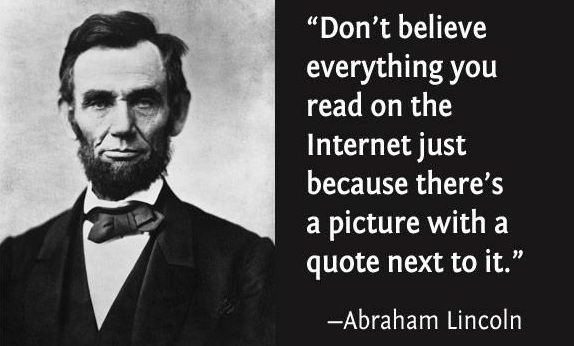
But if the quote is simply profound, witty, insightful, worth repeating for its own sake? Do so– absolutely do so! But cite the author in order to do credit to him/her, rather than to use that person as an authority whose gravitas or expertise is supposed to automatically render the statement true or meaningful.  And never just assume that whomever is attributed as a source necessarily is. Especially on Facebook.

I’m tripping over you, God

I’m tripping over you, God published on No Comments on I’m tripping over you, God

Cross-posted from State of Formation.

In a Newsweek article grandiosely (to put it lightly) entitled Proof of Heaven: A Doctor’s Experience With the Afterlife published yesterday, Dr. Eben Alexander recounts a story of what it was like to visit Heaven (apparently) and speak with God (apparently) which supposedly took place while he was in a coma due to bacterial meningitis.

Alexander’s sole basis for believing that this was an actual experience he had and not simply something his mind conjured up, like it might any dream (or drug trip), is the “fact” that it occurred during the coma, while his neocortex was shut down and conscious thought impossible.

What Alexander had was a mystical experience, no doubt. It fits William James’ still-very-useful criteria for such experiences:

1) Noetic quality — Alexander describes special knowledge as having been imparted to him, knowledge which he couldn’t have comprehended otherwise:

Each time I silently put one of these questions out, the answer came instantly in an explosion of light, color, love, and beauty that blew through me like a crashing wave. What was important about these blasts was that they didn’t simply silence my questions by overwhelming them. They answered them, but in a way that bypassed language. Thoughts entered me directly. But it wasn’t thought like we experience on earth. It wasn’t vague, immaterial, or abstract. These thoughts were solid and immediate—hotter than fire and wetter than water—and as I received them I was able to instantly and effortlessly understand concepts that would have taken me years to fully grasp in my earthly life. (Author’s note and spoiler: Alexander never says what these concepts were, or tries to explain them himself.)

2) Ineffability — Alexander does his best to describe the experience, but he can’t truly convey the majesty and meaning of it in words. Such a thing would be impossible. He wasn’t even able to comprehend himself for a very long time:

It took me months to come to terms with what happened to me. Not just the medical impossibility that I had been conscious during my coma, but—more importantly—the things that happened during that time.

3) Transience — Alexander doesn’t say how long the experience took. But it was definitely temporary. He’s not still floating around amongst the clouds and speaking to mysterious women in brightly-colored dresses:

“We will show you many things here,” the woman said, again, without actually using these words but by driving their conceptual essence directly into me. “But eventually, you will go back.”

4) Passivity — Alexander describes all of these things happening to him, without any real volition occuring on his part. Entities appearing to him. Things being shown to him. He describes the experience as a journey, but this journey is not a series of choices he makes– it’s a sensory experience, entirely about what he sees and hears.

So yes, mystical experience. Fine. Well and good. Those have happened throughout history, all over the world, in various forms. But Alexander is insistent that his mystical experience is real:

I’m not the first person to have discovered evidence that consciousness exists beyond the body. Brief, wonderful glimpses of this realm are as old as human history. But as far as I know, no one before me has ever traveled to this dimension (a) while their cortex was completely shut down, and (b) while their body was under minute medical observation, as mine was for the full seven days of my coma.

All the chief arguments against near-death experiences suggest that these experiences are the results of minimal, transient, or partial malfunctioning of the cortex. My near-death experience, however, took place not while my cortex was malfunctioning, but while it was simply off. This is clear from the severity and duration of my meningitis, and from the global cortical involvement documented by CT scans and neurological examinations. According to current medical understanding of the brain and mind, there is absolutely no way that I could have experienced even a dim and limited consciousness during my time in the coma, much less the hyper-vivid and completely coherent odyssey I underwent.

For all of the insistence that Alexander makes during his essay that he is a scientist, and his assurances that he approaches his understanding of the brain with skepticism and rigor, this is a bizarre thing to say. It overlooks several things that should be obvious to any person, let alone a neurosurgeon.

Namely:Alexander has no idea of the chronology of his experience. The only thing he knows is that it was over by the time he opened his eyes– and let’s note that his interpretation of his experience went on for months, while he was entirely conscious. He has absolutely no way of knowing whether his experience took place while his neocortex was “off.”

Our assessment of the duration of dreams during REM sleep is notoriously unreliable, but Alexander doesn’t even seem to consider the length of time that it might have taken for his brain to switch from “off” to “on,” and whether a malfunction just might have occurred during that time. That’s possible, but not likely I think. Alexander’s description of his experience is typical of mystical experiences, but not of near-death experiences (NDEs). Those are generally described as the experience of heading down a tunnel and/or “into the light” that you hear about. Alexander describes something more like a dream or a drug trip.

On the topic of dreams and drug trips– you don’t have to consume drugs to go on a drug trip. Chemical reactions can happen in your brain which cause you to experience fantastic visions for other reasons including severe fatigue and asphyxiation. Gee, can you imagine one of these being a factor in a person recovering from a coma? Mystics in many different religions induce religious visions by starving themselves, staying out in the hot sun, and/or keeping themselves awake for extended periods which might very well cause their brains to go into a state similar to Alexander’s when he was on his way back from coma-land.

So Alexander’s body was “under minute medical observation” for a week while he was comatose. How is this supposed to substantiate his belief that his NDE was authentic? Were the attending physicians supposed to have noticed a sudden change in his brain which indicated that his spirit had gone on temporary vacation? So far as I know there is no way to test for such a thing via fMRI, CT, PET, or EEG. Tests of these kinds have been performed on people supposedly having religious experiences at the time, and their results are very interesting.

But they’re not performed for a week, and they say nothing about whether the state of the person’s brain means that he has gone dimension-tripping while leaving his body behind, or whether he just thinks he has. Think about it– how easy would it be to catch someone at the precise time they’re having an out-of-body experience and get them into a scanner? Not very easy.

And even if/when you can do it, the information you gather is neutral regarding whether they actually spoke with God or whatever it is they claim to have experienced. Even if it turned out they have a brain tumor, hey– the brain tumor could’ve been put there by God as a means of communicating with them! A very morbid, tragic way of communicating, but still. “God made your brain that way/do that thing so that he could talk to you” is an untestable but still possible explanation.

Do I think that Alexander had a near-death experience? Sure, possibly. If the details of his explanation of the bacterial disease he contracted are correct– and there’s no reason to doubt that part– are true, then I see no reason not to believe that he had a profoundly beautiful experience that might or might not have resulted from him actually becoming literally brain dead, temporarily.

That doesn’t mean that I have to accept his interpretation of it as happening anywhere outside of his own head, or signifying the truth of anything he claims to have gleaned from it. And what’s more, having had time to think about this in the four years since he came out of this coma, I’d think the neurosurgeon himself would have some doubts as well. But no, he doesn’t. Because he does not think of it like a scientist. He thinks of it like a die-hard believer who thinks he found confirmation:

I know full well how extraordinary, how frankly unbelievable, all this sounds. Had someone—even a doctor—told me a story like this in the old days, I would have been quite certain that they were under the spell of some delusion. But what happened to me was, far from being delusional, as real or more real than any event in my life. That includes my wedding day and the birth of my two sons.
What happened to me demands explanation.

Modern physics tells us that the universe is a unity—that it is undivided. Though we seem to live in a world of separation and difference, physics tells us that beneath the surface, every object and event in the universe is completely woven up with every other object and event. There is no true separation.

Before my experience these ideas were abstractions. Today they are realities. Not only is the universe defined by unity, it is also—I now know—defined by love. The universe as I experienced it in my coma is—I have come to see with both shock and joy—the same one that both Einstein and Jesus were speaking of in their (very) different ways.

I’ve spent decades as a neurosurgeon at some of the most prestigious medical institutions in our country. I know that many of my peers hold—as I myself did—to the theory that the brain, and in particular the cortex, generates consciousness and that we live in a universe devoid of any kind of emotion, much less the unconditional love that I now know God and the universe have toward us. But that belief, that theory, now lies broken at our feet. What happened to me destroyed it, and I intend to spend the rest of my life investigating the true nature of consciousness and making the fact that we are more, much more, than our physical brains as clear as I can, both to my fellow scientists and to people at large.

No scientist holds that the universe is devoid of any kind of emotion. No good scientist, anyway– humans are part of the universe, and we’re pretty darn emotional. And no good scientist starts with a firm belief derived from something out of his own head and then assumes that it can be proven empirically, and sets about to find evidence which will confirm this to his peers.

One would hope that a neurosurgeon would have spent a good chunk of his life “investigating the true nature of consciousness” before being interrupted by a mystical experience, but perhaps not. If Dr. Alexander is really interested in this topic I can certainly recommend Daniel Dennett’s Consciousness Explained or Susan Blackmore’s Consciousness: An Introduction— heck, I’d recommend those to anybody– but he won’t find confirmation of his unconfirmable convictions in either of those. Quite to the contrary, he will find evidence that the brain really does generate consciousness.

In order to find someone who is willing to claim otherwise, you have to drop the pretense of talking about science. You have to drop the aspiration of convincing your fellow scientists, that is if you intend to convince them as a scientistrather than as a true believer. And Alexander is not even willing to speak as a non-Christian or at least Christianity-neutral, even though according to his own account there is nothing Christian-specific about what he experienced.

PZ Myers describes the story in a post called Newsweek panders to the deluded again, which isn’t an inaccurate label (it is indeed a delusion to say that the experience of one questionably conscious neurosurgeon “proves” anything, much less the existence of an afterlife) but I think he misconstrues the experience a bit:

But here’s the real killer for me. People who go through these fantasies often tell of awe-inspiring insights that they receive and are quick to tell us how brilliant they were in Heaven. Alexander is no exception.

That would be the “noetic” part of mysticism, and if we could manage to induce Myers to have a mystical experience whether by drug trip, brain damage, or ESB (as Julia Sweeney put it, “People who wore this helmet experienced a sense of transcendent understanding, an overwhelming peace and connectedness, and sometimes the presence of God. Or, of aliens”), he’d probably experience the same thing. He just hopefully wouldn’t go on to present that knowledge as real evidence of anything, as Alexander has.

If a person comes out of a mystical experience with, say, knowledge of how to build a perpetual motion machine, thenthere might be something to what they claim to have experienced. It wouldn’t prove the rest of their story, but it would at least be interesting! But what generally happens is that the person feels strongly as though he or she has been confronted with the greatest underlying truths of the universe, and yet…couldn’t tell you what they are. Or else gives you some rather banal messages like the ones Alexander mentioned:

“You are loved and cherished, dearly, forever.”

“You have nothing to fear.”

“There is nothing you can do wrong.”

I recall in one of Dan Savage’s books– Skipping Towards Gomorrah— he described how a friend of his kept a wicker basket of New Agey phrases printed on laminated slips of paper by the front door for visitors. These were intended to be self-esteem enhancers, pulled randomly from the basket whenever needed in order to create a feeling of empowerment

When my friend saw me picking through her little wicker basket of affirmations, she folded her arms across her chest, cocked her hip, and said “Go ahead, Dan, make fun of me.” She was asking for it. So I pulled out an affirmation, said “I’m Adolf Hitler,” and then I read Hitler’s affirmation. “I’m a good person, and I want good things.”

“That’s awful!” my friend said.

“I’m Pol Pot: ‘I strive to spread love and understanding.’”

“I’m Richard Speck: ‘I am respected and admired, and people want to be near me.’”

“I’m Trent Lott: ‘My inner beauty is like a bright light.’”

By now, my sensitive friend was, yes, crying. I know, I know, I’m a terrible person. Which is precisely my point. The problem with setting out a basket of affirmations is that you’re assuming each and every person who comes into your home or spa is a good person  who wants good things. With all the respect due a basket of laminated affirmations, I beg to differ.

It sure sounds to me like Dr. Alexander encountered that wicker basket in “Heaven.” Hmm…does everybody who goes on a similar trip? Is there nobody who catches a glimpse of the afterlife and is told “You’ve been a very bad person and have plenty to fear; step it up!” Ebenezer Scrooge-style? Yes, there are such cases. But I’m pretty sure they are vastly outweighed by the other variety.

There’s another important thing about the specific messages Eben (no, I’m not going to make a joke about that) Alexander says he received– they are themselves passive. They are the kind of messages it would be appropriate to give a person who is seeing a movie, especially a scary movie, for the first time ever. Don’t worry. There’s nothing to be afraid of. You can’t do anything wrong here. You can’t do anything wrong because you can’t do anything— the story is going to play out as it does regardless.

The only time it’s possible to not be able to do anything wrong is when nothing you do matters, which is when you’re experiencing something that’s not real. In the real world, there is plenty to fear. There are all kinds of things you can do wrong. And…there’s no guarantee that you will be loved, much less forever.

So I can see why a person would cling to such an experience, much like a security blanket. I can’t see why someone would wave that blanket around claiming that others must cling to it as well, much less why a magazine would declare that they should. Alexander, and Newsweek, should know better than that.
Thoughts on the Kate Middleton topless photos thing

Thoughts on the Kate Middleton topless photos thing published on 5 Comments on Thoughts on the Kate Middleton topless photos thing

She should show up at the next public appearance buck naked.

So should William, holding her hand.

A man of jeans

A man of jeans published on 1 Comment on A man of jeans

At Dispatches, Ed mocks Washington Post writer Jennifer Rubin for being aghast at an image of Barack Obama sitting on the desk in the Oval Office, conferring with a denim-clad staff adviser:

There are few things more ridiculous in politics than when some right wing shill cues up the righteous indignation machine over something utterly meaningless. Jennifer Rubin of the Washington Post, who has no business writing for any site more credible than the Worldnutdaily, shows how it’s done in reacting to an article that shows a picture of President Obama sitting on his desk and another man wearing — gasp! — blue jeans in the Oval Office! She tweeted:

Good grief Get you rear end off JFK desk, Mr. president .. And jeans in the oval office?! .. Slovenly inside and out

When a fellow conservative pointed out that Reagan and Bush both word jeans in the oval office, Rubin replied:

never ever in oval office.. bush made his chief of staff stand outside oval office on a saturday when not wearing a jacket

Really? Here’s a picture of Bush in the Oval Office without a jacket on. And here’s oneof Reagan with his rear end on that same desk. And here’s one of Reagan wearing jeans in the Oval Office. So we can expect Jennifer Rubin to Tweet a retraction any minute now, right? Or to declare that Bush and Reason were both “slovenly inside and out”? Of course not. And in her defense, there is an obvious difference; those presidents were Republicans. And white.

I’d just like to take a moment to reiterate the virtues of being casual. It doesn’t mean you’re right or wrong, better or worse– if it did, then surely Reagan/Bush and Obama would cancel each other out– or even that you’re necessarily more honest. Just that you’re not relying on formality to make the case for any of those things for you, and the ease of such reliance can be an indicator of privilege…there are false pretenses some of us literally can’t afford to make. And slovenliness sure doesn’t restrict itself to the relaxed, let alone those on a budget.

Just saying.

Don’t tell me to smile

Don’t tell me to smile published on 3 Comments on Don’t tell me to smile
This piece on Jezebel really struck some chords, both in itself and because of some of comments from women sharing their experiences. Really, guys, telling a strange woman– or even an acquaintance or co-worker– to smile is a creepy thing to do. No need to feel bad about it, just read for some explanation and then please try to not do it. Some perspectives:

Men who ask this question don’t want to know the answer. They want to disarm you. They want you to think, “Oh dear, I didn’t even realize that my sourpuss lips were putting a damper on this poor gentleman’s day” and guilt you into making a conscious effort to be nicer – ideally, to the man in front of you, who has shamed you into being nice in the first place. It’s Move #93 in the playbook for how men take advantage of women who have low self-esteem and that’s what pisses me off about it.

 —————

Also, fuck you, I look mad because my face is naturally downturned when I’m not smiling. (Thanks for the reminder, btw.) Plus, do you really expect me to have a perma-grin plastered on while I’m doing menial data entry on my computer?

 —————

I’m not smiling because I’m thinking about the fact that men think of women as decorations, without inner lives.

 —————

There was this one time where I’d just come from the doctor’s office where I’d been diagnosed with an ectopic pregnancy and injected with chemo drugs to “dissolve” that pregnancy. I’d just lost my fucking baby. I hailed a cab to get home, and the driver harassed me for at least 10 minutes, asking why I wasn’t smiling, to smile because I’d feel better. I told him I’d got some really bad news. Didn’t deter him in the least. It’s none of anyone’s damn business. Stop telling people to smile when you know nothing about them.

 —————

Sometimes I get this gem from guys at parties/work, and it was immensely satisfying when I came up with a response.
Creepy Guy: “You know, you’d be pretty if you smiled more.”
Me: “You’d be smarter if you kept your mouth shut.” 

The beauty of internet legal absurdity

The beauty of internet legal absurdity published on No Comments on The beauty of internet legal absurdity

If you don’t already read Matthew Inman’s webcomic The Oatmeal, or the group blog Popehat devoted to “law, liberty and leisure,” here’s an excellent reason to start. Ken of Popehat begins:

Yesterday afternoon, I started getting tweets and emails (to both my work and Popehat accounts) and Facebook messages tipping me to a bogus-lawsuit-threat-on-the-internet story. As of this writing I have received thirty-one tips and suggestions that I offer pro bono help to the recipient of the threat. For a while I was tempted to regard this as a reflection of my own notorious puissance, and my look-at-me-I’m-the-fucking-BATMAN attitude grew until it threatened to collapse into a noisy singularity of self-regard. Then I realized: the flood of mail is not a reflection of me. The flood of mail is a reflection of The Oatmeal being unspeakably awesome. I’m just the towel-boy they shout for to wipe the glistening beads of asskickery from The Oatmeal’s noble brow. Turns out I’m OK with that. People were writing me because they know, from reading this or this, or from seeing the Popehat signal, or from posts sparring with bogus-lawsuit-threateners, that I offer and coordinate pro bono help for bloggers faced with bogus defamation threats. The Oatmeal, unfortunately, is now the victim of such a threat. No, wait. That’s really not fair. Strike “victim” and “unfortunately.”

That is simply the beginning. You must go and read the rest, and make absolutely sure to read Inman’s shredding of the cease-and-desist-plus-give-us-lots-o’-cash letter he received. Also, at the end (currently) of Ken’s post, a hastily-drawn picture from me of Phoenix Wright as an Ewok.

ETA: Boing Boing reports that the lawyer threatening Inman, Charles Carreon, may be engaging in some defamation of his own, and there’s an editorial in The Guardian on the matter where Carreon’s wife (?) posted some rather uncharitable things about Inman in the comments.

Soldiers who died by their own hands

Soldiers who died by their own hands published on No Comments on Soldiers who died by their own hands

On this day we remember and honor soldiers who have been killed. Does that include those who killed themselves? I certainly hope so, given that the stress and horror of warfare is almost certainly responsible for creating the mental conditions that produce the desire to end one’s own life as much as they are responsible for physical injuries. At Big Think, Rin Mitchell writes:

In a recent blog post, Major General Dana Pittard described suicide as “an absolute selfish act.” The post came after Pittard attended the funeral of a soldier who had committed suicide. He later recanted his statement, but others believe that he is not the only one that probably views veteran suicide in this light. However, what draws concern for some is that no higher ranking army officials stepped in to publicly respond to Pittard’s comments. Pittard’s views in no way represent army policy and views, but now that it is out there—it raises the question as to whether senior military leaders and The Department of Defense will ever speak out about what suicide among veterans means—and determine some kind of perspective on it as a country. It was unacceptable and unfortunate for Pittard to take it upon himself to shed light on the subject, especially around the holiday when soldiers of the war are remembered the most—Memorial Day. It isn’t something people want to think about and probably should remain as it has remained—an “unseen tragedy.”

I don’t think the number of suicides in the Army has increased by 80% since the invasion of Iraq because at that point, Army soldiers became 80% more selfish. I also don’t think that the solution is to not think about it. Rather, I think we should acknowledge that depression and post-traumatic stress disorder (PTSD) are common in veterans, and it’s not at all unusual for a person experiencing such to contemplate ending his/her own life, and even to eventually follow through with it. To pretend otherwise is to deny the reality of psychological damage caused to soldiers, to count the harm of forcing them into combat in terms of how it breaks their bodies but not how it breaks their minds. A soldier who commits suicide is also a casualty, and should be remembered and grieved alongside his/her compatriots whose deaths were more directly caused and less easily dismissed.

ETA: Big Think has edited their article to note that it was authored by Mitchell and not Orion Jones, so I’ve edited my post accordingly.