Skip to content

Examining some gut reactions

Examining some gut reactions published on 1 Comment on Examining some gut reactions

I’m going to attempt to write this post, and then see if I’m too biased to even finish it.

You see, congresswomen Gabrielle Giffords was shot yesterday in front of a grocery story in Tucson Arizona, along with several other people.  I think the last time a member of Congress was shot was Leo Ryan at Jonestown in 1978, so this sort of thing does not happen often.  And this time when it happened, I perhaps made the mistake of looking to Twitter for quick updates.  The benefit of Twitter is that when something tragic happens, you can receive information on it far faster than you would by watching TV or listening to the radio, where newscasters typically announce that they have a breaking story and then, after revealing all they know about it, spin their wheels and go on and on about the most insignificant and tangential details until eventually they have something new to say.  Twitter, on the other hand, is a buzzing hive of nobodies as well as somebodies who will report whatever they know right this instant and then you can sift through what’s useful and what isn’t.  That also includes a lot of commentary, unfortunately often of the sort that is worse than useless. 

That commentary has given me a headache, and it would be foolish in the extreme to say that that’s because I’m somehow above drawing political inferences about the fact that someone apparently tried to assassinate a Democratic congresswomen whose enemies, according to her father, include “the whole Tea Party.”  I’m not– I’ve got political inferences up the wazoo, and they kick in reflexively.  The first is to be a rabid free speech defender against claims that Sarah Palin is criminally or at least civilly responsible to some extent for the shootings because she put Giffords on a map with crosshairs to signify that she should be voted out of office.  The second is to be rabid gun rights defender against the outcry for banning all guns that comes up any time that anyone notable in the U.S. is shot.  The third is– yes, this amazes me too- to be a rabid Tea Party defender because people are already taking the fact that the (apparently schizophrenic) shooter was a fan of the gold standard as a sign that he represents all of “Ron Paul libertarianism.”  And I’m sure there are more.  These are my biases, making themselves apparent by my hyper-reaction to specific kinds of reactions that other people have.

Investigation is ongoing about the alleged shooter, a 22-year-old named Jared Lee Loughner.  So far it looks pretty clear that he has mental problems of some sort, possibly schizophrenia.   We have no idea why he shot Giffords, federal judge John Roll, and several other people including a child.  And “He was just nuts” isn’t a satisfying explanation– there has to be some external reason.  Even if he is “nuts,” there had to be outside influences which pushed him to the edge and caused him to do this.  After all, not everybody with a mental illness is a murderer.  Right?  So let’s find someone else to blame.  

I guess that’s how the thinking goes, anyway.  But really, when something terrible happens, people want their enemies to have been the ones who did it.  If not directly, then indirectly.  And I’m not honestly sure that a single one of us is exempt from this.  Not only do we not want That Guy Who Did That Bad Thing on our side, we want him as far away as possible– if not actually on the team of the people we don’t like, then at least influenced by them, because that provides an explanation we can live with.  It’s all part of making the world more ideologically comfortable.

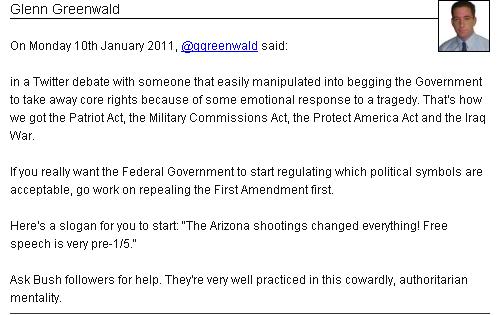
Which, actually, explains why I laughed with recognition at something retweeted by Radley Balko earlier today: “Liberals, when you make me want to defend Sarah Palin, you have gone too far.”  Blaming Palin for the shooting disrupts my ideological world…as does defending her.  I’d rather not talk about her at all, to be honest, which is what I foolishly believed we would all be able to do after Obama’s election in 2008.  And since we can’t, we now we have this:
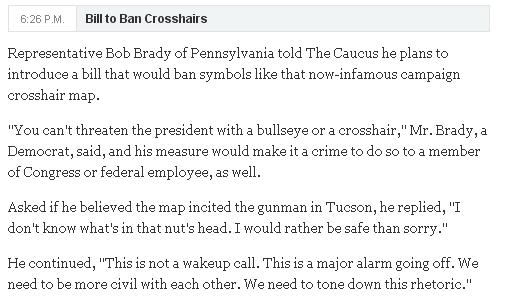
“We don’t know if the use of these symbols actually had anything to do with the shootings, and we don’t care.  We just want to do something, because the map was clearly bad in a way that should be so obvious that it doesn’t need to be articulated, bad enough that we need to start outlawing forms of expression that were previously legal.  Because, you know, it’s always better to be safe than sorry.”

And so it goes

Yep, I’m apparently too biased. Can’t seem to shake it, so I’d better go ahead and end here.  

2010: The year in photographers being harrassed by government officials

2010: The year in photographers being harrassed by government officials published on No Comments on 2010: The year in photographers being harrassed by government officials

Carlos Miller of Photography Is Not A Crime documents incidents throughout 2010 in which photographers and videographers were penalized by the government for recording incidents that took place in public. 

Photography Is Not A Crime is apparently currently in financial straits, as Miller has been paying for the project entirely on his own.  If you’ve got some spare cash, this would be a very worthy donation.

What have scientists learned about religion in 2010?

What have scientists learned about religion in 2010? published on 1 Comment on What have scientists learned about religion in 2010?

Tom Rees at Epiphenom has put together a brief review of the results of scientific papers published on religion this year.  Here’s an excerpt:

We learned some more about what religion can do for you. Religious people are less likely to smoke, but more likely to be overweight. Religion can also make you more attractive. Religious people have worse verbal skills and are worse at science (incidentally, Republicans are also unscientific). However it’s the study of literature, not science, that really seems to turn people off religion.  Religious prejudice seems to tap into the same neural circuits that drive racism. Religious fundamentalism can lead to right-wing authoritarianism and racism, as well as increased support for the death penalty. Religious priming can increase support for punishing wrongdoers. . . Religious people see the world differently to the non-religious. For example, Protestants are more likely to confuse thoughts with actions.And being raised a Calvinist Protestant may make you less likely to see the big picture.  Belief in the paranormal and fatalism both seem to be linked to fundamental errors in understanding the world around us.

Facepalm of the day

Facepalm of the day published on 1 Comment on Facepalm of the day
Yes, these are real shoes.

Skepticism and atheism

Skepticism and atheism published on No Comments on Skepticism and atheism

Lots of thoughts brewing on this subject during Skepticon.  I’ve posted many of mine on Hemant Mehta’s blog Friendly Atheist.

Odds and ends

Odds and ends published on No Comments on Odds and ends

I’m getting ready to go to Skepticon 3 tomorrow.  It doesn’t actually start until Friday, but it’s a good seven hours to Springfield, Missouri so I figured I’d allow a day for the drive and then hopefully wake up fresh and open-minded Friday morning.  I love a conference you can attend in a t-shirt and jeans– well, probably with a cardigan as it’s a little cooler up there. Living in Texas can spoil a person.  

Rather than addressing the TSA outcry going on right now about people having to choose between either a startlingly detailed full-body scan or a startlingly invasive full-body  rubdown if they want to fly, I’m going to link to two people who have provided full-throated, comprehensive rants on the subject:
Jennifer from Ravings From a Feral Genius with Sex Abuse Via The TSA: It’s Actually Come To This
and Ken from Popehat with Gropers to Gropees: Shut Up And Take It Or Hit The Road

Suffice to say that I’m very happy not to have to fly anymore, at least for the foreseeable future.  I will indeed hit the road. 

“Psychic” Kids

“Psychic” Kids published on No Comments on “Psychic” Kids

Well, this sounds like about the worst idea for a TV show ever.

Jen from Skepchick writes:

In summer of 2008, the American television channel A&E premiered a series called Psychic Kids: Children of the Paranormal and has just begun airing the second season this November. Presided over by professional psychic Chip Coffey, and a few other mediums and paranormal experts, the show finds kids, who tend to range in age from 12 to 18 and who have experiences with visions, demonic possessions and other assorted unexplained and disturbing phenomena. The gathered experts then teach these “children of the paranormal” how to use their psychic powers to resolve their problems while filming it for a weekly, hour-long television episode.I’ll start my serious commentary with an admission – I have not watched this show. I intended to, when I first saw the commercials for the second season and thought it would be a good topic to write about. But at my very first research stop – the official Psychic Kids website – I realized their own description gave me more than enough to work with:

PSYCHIC KIDS: CHILDREN OF THE PARANORMAL™, profiles children who live with an incredible secret: they have psychic abilities. Feeling scared and isolated, these kids have nowhere to turn…until now. Help is on the way in the form of psychic/mediums Chip Coffey, Chris Fleming and Kim Russo, who themselves grew up with these senses, and licensed psychotherapist Edy Nathan, who has more than 20 years experience.
In this intense journey, the experts draw on their own personal experiences, training and unique outlook on life to bring troubled kids together to show them how to harness their abilities and, ultimately, show them that they’re not alone in this world.

Okay. In case you don’t see what’s wrong with the above paragraphs, let me unpack it a bit. Basically, a group of grown adults are singling out children who are troubled, who feel scared and isolated, and who claim to be haunted by evil spirits and possessed by demons, and telling them their problems can only be fixed by learning how to use their psychic powers in front of television cameras for the financial benefit of said adults. Clearer now?
If there ever were a case that screams exactly what the harm is in letting psychics go unchallenged, this is it. Not only are kids and their parents getting sucked into believing things with no solid evidence, but targeting children with documented psychological problems and giving them bogus solutions precludes them getting professional medical therapy and assistance they obviously could use. Even worse, televising the entire process normalizes the idea for the audience, which might include other troubled kids and parents who decide to try the same “solutions” with even less-scrupulous paranormal experts who aren’t being held to even the low standard of honesty television documentation imposes.
Not only is there nothing redeeming about Psychic Kids, it’s not even harmless entertainment. It’s actively harmful, and the victims are not adults who made their own mistakes, but kids in need who are being deceived and exploited. In short, it’s repulsive. The only real solution to this show is to out it for what it is and level the critical thinking influence to starve it out of of existence.

Now, as already noted I’m not a parent.  But…..if I had a child who was feeling alone, scared, and troubled, I’m pretty sure that my first impulse wouldn’t be to hand him/her over to this guy to be on his television show.  Being on any show at that point sounds like a pretty bad idea, honestly.  And if the kids on this show are simply playing a role and don’t believe themselves to have psychic powers at all, that’s not a great deal better– they’re still conveying the idea to viewers that this is what you should do when you have kids or are a kid like the ones these people are presenting themselves to be.

The readers on Skepchick have started a letter-writing campaign to tell A&E what a spectacularly bad idea this show is.

ETA:  Also covered on She Thought and Pharyngula.  

The trip home

The trip home published on No Comments on The trip home

Our session at AAR yesterday was really interesting and I’ll try to post about it later, but don’t really have the time right now.  I’m just waking up in Oxford, Alabama, and will be driving through that state and Mississippi today listening to In Defense of Food: An Eater’s Manifesto by Michael Pollan.  Most likely flagrantly ignoring the advice of that book in my dining choices along the way.

Edited to add: That is an excellent book, one that I might be interested to hear rather than read even if I weren’t traveling because Scott Brick does such a good job as reader.  Definitely recommended. 

Test post

Test post published on No Comments on Test post

This post is a test to see if Blogger and my Twitter feed are friends.