Skip to content

Freezepeaching the WBC

Freezepeaching the WBC published on 3 Comments on Freezepeaching the WBC

Stephanie Zvan at Almost Diamonds came up with an excellent t-shirt idea: an image of a peach, half-frozen in a block of ice, with the slogan “Freeze Peach! Not sure what it is, but it’s mine.” This is in reference to the continual shouting of “free speech” in order to defend speech which is not in fact “free”– objectionable speech made on private venues by people who participate in those venues but do not own them, are not in charge of them. Speech like Michael Brutsch aka Violentacrez posting bigotry and photos of scantily clad minors on Reddit. Speech like hassling feminist bloggers on Freethought Blogs and then complaining that the network doesn’t actually support freethought if it bans you. Speech like sexual harassment at conferences.

The defense is so common that the words run together after a while (hence “freeze peach”): “Free speech! We have the right to say these things, so there’s nothing wrong with saying them!” “Free speech! Preventing speech you don’t like promotes a hive mind mentality and squelches reasonable debate!” The answers to these, of course, being: 1. No, you don’t, not on someone else’s blog or forum or at someone else’s conference, and 2. No, it doesn’t– not when the speech in question amounts to harassment  Harassment has a silencing effect on other people, people who actually have something useful to say.

“Freeze peach” is not a condemnation of actual free speech, of course, but a mockery of how people who clearly are a bit fuzzy on how the concept works try to manipulate it in order to justify…well, being douchebags. Basically, that’s what it boils down to. It encapsulates two unfortunate but very common conclusions:
1. Free speech is the concept of people being able to say whatever they want, when and wherever they want. People have an obligation to let us– if they don’t, they oppose free speech.
2. The law is a direct reflection of our societal morality. If something is wrong, it should be illegal. If something is not illegal, it must be okay.

I don’t think it’s necessary to explain why these two unfortunately very common notions are mistaken. I do think they illustrate, however, why it’s important to see that the people who make “freeze peach” arguments using these assumptions are not anarchists as they may seem, but authoritarians. They look to an authority– the law, in this case– to dictate right and wrong, and assume that what they’re doing is right if the law doesn’t forbid it and in fact seems to advocate it (“that which is not forbidden is compulsory”). That if something is entrenched in law, it is not only up to the government but individual citizens (as in bloggers, forum moderators, conference organizers, etc.) to support and uphold it.

But really, requiring that such private individuals should uphold freedom of speech does as much for the concept as requiring that individual citizens should uphold the Fourth Amendment would do for private property– that is, it would destroy all meaning in the notion. Any “search and seizure” of one person’s property by another (without consent) would indeed be unreasonable, and any use of another person’s private ability to express him/herself (regardless of media) without consent would be a violation of that person’s own freedom of speech. If you want to claim freedom of speech to say something reprehensible,  you can find a sympathetic place to express such a thing, do it via your own means, or don’t do it at all. Those are your options. You do not get to pirate someone else’s platform in order to proclaim some sentiment they don’t agree with.

Freedom of speech does not entitle one individual to use another individual’s mouthpiece (whatever it may be) to speak. It prevents the government from deciding what that individual may or may not say, regardless of how brilliant and useful, or offensive and pointless, that individual’s speech may be. Regardless of the content of the expression, we may not be prohibited from expressing it in public– unless, that is, it violates one of the tightly conscribed laws in place to protect intellectual property and, in some cases, prevent the expression of outright obscenity (I’m not a fan of obscenity laws, but they do exist).

This is what free speech means. This is what I passionately defend. But because there are so many Americans who either don’t understand or don’t agree with this (or both), I’m reluctant to don a “freeze peach” shirt. I don’t want to mock the people who think free speech defends their ability to be offensive wherever they want by appearing to support some form of government crackdown on offensive speech. Not when there’s no shortage of people who support exactly that.

Not when they are signing petitions asking for that:

Users of the White House’s “We the People” digital petition platform have flooded the site in support of an effort to officially designate the Kansas-based Westboro Baptist Church as a hate group.
The most popular petition was submitted on Dec. 14, the same day as the school shooting at Sandy Hook Elementary School in Newtown, Conn., an incident that Westboro responded to by announcing its intent to picket the funerals of the 26 victims, including 20 young children. This plan made them a prime target of hacktivist group Anonymous and eventually drew a well-attended counter-protest to block the church’s followers from disrupting the services.
The individual push has since received the support of nearly 250,000 signees, making it the most popular single petition ever created through the White House initiative. 

The thing is, there is no such thing as a federally recognized hate group. The Southern Poverty Law Center has a list of groups that it recognizes as hate groups, which is fine because– you can see this coming– it’s a private organization. But the government has no interested in determining whether a group is “hateful” or not– not officially, at least– because hate speech is not against the law. What they do have an interest in monitoring is possible terrorist tendencies, and WBC has bent over backwards to show that they have no interest in committing actual violence against anyone. They have succeeded in becoming almost a caricature of moronic spite, but that isn’t illegal. As a sad irony, one of the effects of Anonymous publishing the personal information of Westboro members online was that people took the opportunity to threaten them, which is illegal. And yes, I would say that threatening a hateful person (or who you assume to be a hateful person– not everyone who was threatened actually is a member of the WBC) with death is worse than being a hateful person.

Am I defending the WBC’s beliefs and actions? Not in the slightest. Not any more than the ACLU was defending white supremacy and antisemitism when they defended the right of neo-Nazis to march in Skokie IL in 1978, a move that cost them enormous support from people who confused the defense of freedom of expression with defense of the ideas expressed. It’s incredibly disturbing to see that when it comes to the WBC, at least a quarter of a million Americans are confused in just this way. Disturbing, but not surprising– it’s not at all uncommon to see people promote freedom only for those who are on their side, ideologically. Nor is it uncommon to see them go into authoritarian mode when an opportunity like this arises, asking the government to violate the rules it set for itself, so long ago, in order punish people they dislike. And no, it doesn’t matter whether that dislike is legitimate or not, or how fervently it’s held. It’s still called injustice when the law is violating someone’s freedom in your favor.

Their actions have been directed at many groups, including homosexuals, military, Jewish people and even other Christians. They pose a threat to the welfare and treatment of others and will not improve without some form of imposed regulation.

So people…stop demanding precisely that. You actually have more power than the government when it comes to the speech of hateful organizations, because you don’t have to allow them on your space. The government does, because its space is public. Its space is for all of us– including the morons and the bigots. If you don’t like it, take a deep breath and contemplate how many people would be happy to count you amongst the undesirables for your beliefs. Trust me, there are loads.

There are better ways to fight bigotry than by whittling away at the freedoms of bigots, because those are our freedoms as well. Let’s remember that.

*Yes, I did narrowly avoid titling this post “I could eat a freezepeach for hours” in honor of the worst Nicholas Cage movie ever.

Business model

Business model published on 5 Comments on Business model

I have an idea for a business.

It’s a delivery service.

It delivers to hospital patients.

Not flowers. Not Mylar balloons. Not stuffed animals. Not baskets of waxy fruit. Those things are all well and good, and plenty of people like and appreciate them. But that’s not what my business would deliver.

My business would involve sending a person to a grocery store nearest to the hospital in question on the day of delivery, where they would pick up the following:

1. Three current issues of the recipient’s favorite magazines (commonly available– unless there’s a Barnes and Noble nearby, which could be visited for an additional fee if the recipient really wants his/her Skeptical Inquirer or Utne Reader).
2. Five assorted pastries from the bakery.
3. A bottle of red wine in the $12-15 price range, with a screw cap lid.
4. A deli tray. Something with an assortment of cheeses, possibly meats as well, and some nice crackers. If not all of these are available in one package, the runner could pick up a box of Wheat Thins.

The runner would then purchase these items, place them all in a big paper bag with the recipient’s name on it, and deliver them to the recipient– with a note from the sender explaining how much he or she would really like to be there, having picked up these things him or herself, but unfortunately distance, time, and/or finances are just too much of an impediment.

This service would be reasonably priced, to offset the latter concern.

It would be called Send-a-Friend.

Oh, and there would have to be an app for it. You know, because.

Marching, not racing

Marching, not racing published on No Comments on Marching, not racing
Item #3, “Make you like us,” conspicuously absent.

So the Supreme Court has some consideration of gay marriage coming up, in two different forms. First there are a number of cases involving the constitutionality of the Defense of Marriage Act (DOMA) which may be added to the docket, which specifically would entail addressing whether the act violates equal protection guarantees under the 5th Amendment’s due process clause when applied to same-sex couples legally married under the laws of their own state. Then there’s Hollingsworth v. Perry which address Prop 8, the California ballot measure which denies legal marriage to same sex couples in that state. The issue there is whether such a provision on the part of an individual state counts as a violation of the Constitution’s 14th Amendment guarantee to equal protection under the law.

(Both of these case make me fervently wish that there was a Supreme Court channel. C-SPAN, make it happen. All SCOTUS, all the time. I’d watch it. I’d totally settle for a livestream, if it’s a good one. Just saying.)

Given the current makeup of the court, there’s little reason to be optimistic. They might declare DOMA unconstitutional, but they might not. And it’s very unlikely that they will declare that state measures banning gay marriage are a violation of equal protection across the board.

Some recent advances in civil rights which can be attributed to SCOTUS:

  • Desegregation: With Brown v. Board of Education in 1954, the court decided against racial segregation in schools. 
  • Interracial marriage: With Loving v. Virginia in 1967, the court declared that laws against miscegenation are unconstitutional. 
  • Abortion: In Roe v. Wade in 1973, the court ruled that there is a right to personal privacy which renders unconstitutional laws prohibiting abortion.
  • Homosexuality: With Lawrence v. Texas in 2003, the court ruled against state laws banning sodomy. 

And of course, along the way the court has had several misses– it has frequently ruled against civil liberties before it has ruled for them (see Plessy v. Ferguson, Pace v. Alabama, and Bowers v. Harwick). It will not be a surprise if it does so again in these cases. When it moves toward freedom, the court moves slowly. And it does not always move toward freedom.

Still, it’s disturbing to see a position like the following:

Here is a movie plot you have never seen and never will see: a disadvantaged athlete struggles against the odds, makes it to the Olympics by sheer force of grit and talent, and is ahead in the race for gold—when, with the finish line in sight, the referee calls off the competition, hands the hero a medal, and everybody goes home. Gay Americans are in sight of winning marriage not merely as a gift of five referees but in public competition against the all the arguments and money our opponents can throw at us. A Supreme Court intervention now would deprive us of that victory. Our right to marry would never enjoy the deep legitimacy that only a popular mandate can bring.I tell my gay friends: imagine if the Supreme Court had ordered gay marriage this past June, at the end of its 2011-2012 term. November’s game-changing electoral victories would never have happened. Gay marriage advocates would be forever stereotyped as political losers who won by running to mommy. Our opponents would mock and denigrate our marriages as court-created, legalistic fictions. The country would never have shown how much it has changed. If we have come that far in five years, imagine where we might be in five more. Imagine, then, the opportunities to extend and consolidate support that we will lose if the Supreme Court steps in now. Strange but true: a favorable Supreme Court intervention next year would make us weaker, not stronger.

This piece, by Jonathan Rauch at The New Republic, makes me wonder how Rauch’s gay friends haven’t strangled him.

So does desegregation not have “deep legitimacy”? Interracial marriage? Reproductive freedom? Because these rights were acknowledged by the Supreme Court, does that mean they’re less legitimate, and amount to being handed a prize by a referee before you’ve actually earned it?

Because we know, after all, that rights are earned by minorities. It should be a matter of popular opinion, because getting everyone to like you should be the foundation of “legitimate” personhood.

What?

This is an argument that could only be made by someone who doesn’t believe that marriage equality is a civil right. It is, for that matter, an argument I’ve heard many times over by opponents of marriage equality, because they think it is somehow up to gays and lesbians to convince the rest of us that they’re charming enough to be allowed to marry the person they love, just like anyone else. The way a minority “wins” is to win the affection of the majority, and eventually by popular appeal the majority will grant them the status of equals.

And yes, that would be great. Except you know what? The unwillingness of majorities to recognize the equality of minorities is called bigotry, and minorities shouldn’t have to cure bigots of their bigotry to get that acceptance in order for that to be the basis of their legal recognition as equals. In the Olympic race analogy, that would be like the runner having to stop along the way to make sure that a majority of the fans lining the track with their arms outstretched are willing to give him/her a high five, before the referee is willing to acknowledge that he/she made it over the finish line. For the race is not to the swift, but to the likable…

No. Gay rights are legitimate because they are civil rights, and civil rights should not be up to a popular vote. It would be nice if there was popular acknowledgement of the legitimacy of gay rights, but a) it’s not a requirement, and b) there is ample evidence that such acknowledgement can follow a SCOTUS decision rather than needing to precipitate it or render it unnecessary. In that regard, SCOTUS is more like a teacher who steps in and prevents all of the straight kids from bullying the gay kid. Sure, it would be great if the kids would just stop bullying the gay kid on their own, but…let’s not hold our breath that they will. They can go through catharsis and character development on their own time– it’s not the responsibility of the gay kid to make them.

Terror Management Theory

Terror Management Theory published on 1 Comment on Terror Management Theory

Terror management theory sounds like a government doctrine on how to combat suicide bombers. It is actually, however, the name for a discipline of psychology devoted to the study of how people deal with being…well, terrified. How they cope, mentally, with the knowledge that they are mortal– that they will eventually die, with reminders of this occurring regularly in the form of other people dying. Terror management theory asserts that mortality salience (being made to consider your own death) affects people’s decision-making on an individual and group level, which makes us different from every other species on earth because we are probably the only ones who can consider the possibility of our deaths. Many non-human animals can experience fear, but that instinctual avoidance of predators isn’t “death avoidance” per se. They don’t want to be eaten because being chomped on sucks, and being chomped on continually until there’s nothing left of you probably sucks even more. At least, they don’t want to try it and find out.

Humans? We also fear being chomped on– or shot, or stabbed, or infected, or run over, or anything else which causes pain and may end us in the process. But we also fear being ended for its own sake. The cessation of our individual lives. That’s scary, regardless of whether we believe another life is going to come after it. Terrence Deacon wrote in The Symbolic Species about how symbols define language use, and our ability as a species to do that amazing trick represents the co-evolution of language and the brains who use it.  In other words, symbols make us who we are– big brained apes with the capacity to entertain counter-factuals (things that could be true, or were true, or will be true, but aren’t true right this instant) and use them to communicate about things that aren’t right there in front of us (a symbol being something that stands for something else). We are so attached to this ability, he said, that we effectively have made symbols of ourselves, and we fear death because it represents the end of that symbol. If we end, all of the things we stand for will end. All of the significance, all of the meaning. That’s what we fear.

Which could explain why terror management theorists have found that mortality salience has a particular effect on us– it makes us want to preserve the cultural meanings we share with others in our group at all costs. When faced with something threatening, with the fact of others dying and the reminder that we ourselves could die and will die eventually, we become more insular. Less tolerant of dissent. More suspicious of defectors and traitors. More certain that our way is the right way, and more likely to adopt a “with us or against” us policy. The biggest example most Americans have of this is the aftermath of 9/11, but any tragic event can trigger these feelings. On the plus side, we can draw together with those who sympathize both emotionally and ideologically, and provide support for each other on both fronts. Unfortunately that comes with a corresponding desire to jettison, again ideologically or even physically, those who take a different view.

As with all biases, I don’t think that simply realizing the existence of one and learning about it can somehow shield you from experiencing and acting on it. But I think it helps.

Consider the source– a PSA

Consider the source– a PSA published on No Comments on Consider the source– a PSA

This post’s title (the first part, anyway) is something my mother often said to me when I was a kid and I complained to her about someone insulting me. The meaning: Think about who said this. Are they really credible? Is it worth taking what they say seriously? If not, shrug it off. It’s not worth your time. Only take seriously the criticisms of someone equipped to criticize.

That’s good advice. You know what else is good advice, though, paradoxically? To consider the words while disregarding the source:

“The law, in its majestic equality, forbids the rich as well as the poor to sleep under bridges, to beg in the streets, and to steal bread.” “When you understand why you dismiss all the other possible gods, you will understand why I dismiss yours.”

These are good quotes, regardless of who said them. There are certainly many different occasions on which it’s important to note the origin of a quote– if it’s the insight of someone who discovered something, the emotional outlook of someone who experienced something extraordinary, a moral judgment from someone who was revealed to have done precisely the thing described (i.e. a hypocrite), an incidence of intentional or unintentional irony, and so on.

But if the quote is simply profound, witty, insightful, worth repeating for its own sake? Do so– absolutely do so! But cite the author in order to do credit to him/her, rather than to use that person as an authority whose gravitas or expertise is supposed to automatically render the statement true or meaningful.  And never just assume that whomever is attributed as a source necessarily is. Especially on Facebook.

Review: Farmageddon

Review: Farmageddon published on No Comments on Review: Farmageddon
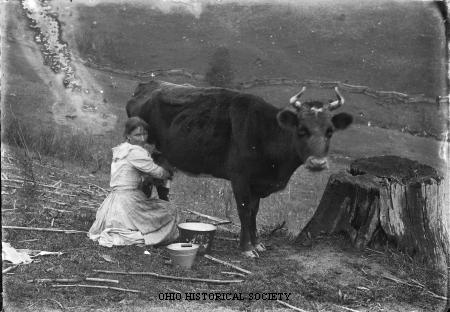
Woman Milking Cow. Albert J. Ewing, Ohio Historical Society

Farmageddon is a 2011 documentary now streaming on Netflix. I watched it last night, and will probably watch it again soon because there’s a lot to…err…digest there. I’d suggest watching Food Inc. first, except that unfortunately it is no longer streaming. Food Inc. is about how mass production of foodstuffs by corporations leads to it being less healthy to the consumer and the environment and less ethical in terms of treatment of livestock, whereas Farmageddon is more about the efforts of small farmers to make a living and produce what they consider to be healthy food, only to be thwarted by the same regulations that prop up those corporations depicted in Food Inc. One of the reviews I read for Farmageddon described it as “anti-government,” but that’s not exactly true. After all, one of the criticisms made is that government agencies are not regulating enough. The general criticism, however, is that they are not regulating well.

But what does “not regulating well” mean? It means, basically, that these agencies lack perspective, and injustice is born whenever perspective is absent. The argument is not against regulation generally, but it’s about what happens when regulation stops being about protecting people and becomes more about protecting interests. For example, both of these movies feature sustainable farmer Joel Salatin (whom I’ve written about before). He has written and speaks about how government regulations punish small farmers for being small farmers regularly, but one of the most striking examples I’ve seen of this was actually about a friend of his described in The Omnivore’s Dilemma who constructed a small-scale slaughterhouse to exacting USDA standards only to find, once it was built, that he couldn’t use it because there were no USDA standards which would allow for the necessary regular inspection and approval of a small-scale slaughterhouse. Which means, in other words, that he could raise livestock but not slaughter and sell it– not because there was anything wrong with the livestock, or with the means of slaughtering, but because the regulations themselves would not allow it.

Now, I’m pretty extreme when it comes to these things. One of my favorite causes is Keep Food Legal, because I basically believe that if you can produce something, you should be allowed to consume it. And if you can consume it (or do it), you should be allowed to sell it. That’s a very anti-regulation stance, except that I think that the government should be able to demand that if you hire people to produce food you should make it possible for them to do it safely, and that if the food you sell is poisonous or otherwise harmful in a way that isn’t made known to the consumer then you should be legally held responsible for that. In other words, I see a place for OSHA, the FDA, and the USDA– I just think that they’re doing too much in some places and too little in others, and they’re doing it too much in service of the profit motives of corporations instead of the public welfare.

If you watch Farmageddon, you will get ample examples of this. It’s heartbreaking and horrifying to see the privacy of a family farm invaded and their produce and animals seized by a load of men pointing guns around as if they’re wandering into a warzone rather than taking some vegetables and sheep from some people in pajamas. It’s even more ridiculous than a marijuana seizure, and I’m surprised to not yet have heard about SCOTUS debating whether it’s permissible to conduct no-knock raids on suspicion of raw milk possession (Scalia and Thomas, of course, would be in favor).

Raw milk, it should be noted, is a heavy point of this film. The director firmly believes that consumption of raw milk was the key to relieving her son’s allergies, and the health benefits of such are touted throughout the movie. I would strongly suggest ignoring all of that. Regulations preventing the production and consumption of raw milk would be equally unjust if it wasn’t a magical panacea, so let’s just assume it isn’t. It is, however, particularly illustrative of the inequity if everything being discussed is actually health food– if government regulations and subsidies favor the production of what will make you fat while inhibiting what will  make you healthy– so you can hardly blame the film for harping on that. I’m just saying it isn’t necessary. Chocolate isn’t good for you, but it would still be wrong to break into confectionaries in the early morning to wave guns around and confiscate everything containing more than 150 calories an ounce.

In the ongoing healthcare debate, the ethics of how to treat people who produce and consume food– any kind of food– is an important topic. I’d say that the message of Farmageddon, a correct and supported message, is Not like this. People who are trying to make and sell what they believe to be healthy food are not criminals, and should not be treated as such. Like a good documentary, this one illustrates the problem clearly.

Youtube time

Youtube time published on No Comments on Youtube time

My favorite show on YouTube, Tabletop, is currently on hiatus. So I’m catching up on Kid Snippets/Kid History on the BoredShortsTV channel, which reminded me to suggest them to you.

One of my favorite Kid Snippets (shorter): “Lunch”
One of my favorite Kid Histories (longer): “Babysitting”

Christian like me

Christian like me published on 1 Comment on Christian like me

[Religiously] Unaffiliated Americans are also less likely to vote in presidential elections than other religious groups. Although they make up 19% of the adult population, the AVS found that only 16% of unaffiliated are likely voters.

This quote, from The Evolution of the Religiously Unaffiliated Vote, 1980-2008, made me pause for a moment. Not to think about the importance or ethics of voting (or not voting, as the case may be). That is a fascinating topic, but one I don’t want to address right now. What I’m thinking about, actually, is what it says in terms of privilege.

Think about the fuss raised about Mitt Romney being Mormon, at least before he received the Republican nomination. It’s the exact same fuss that was raised in 2008, if you recall. Not the right kind of Christian. Not a Christian at all, according to some. Because, you see, Mormons aren’t real Christians. It was an uncanny echo of the objections raised to JFK, who also wasn’t a “real Christian” in spite of considering himself one. Obama, we hear, is also not a Christian. Sure, he might attend church. He might have written prolifically about his faith, and even belong to a Protestant denomination– United Church of Christ. But according to opponents who obviously know Obama’s faith more than he does himself, he’s actually, secretly, a Muslim. Or an atheist. Or both.

Evangelist Billy Graham’s career has been in large part about advising presidential candidates and presidents on how to be more Christian, or at least appear to be. According to With God on Our Side: The Rise of the Religious Right in America,* Graham (who is a registered Democrat, but opposed Kennedy because he was Catholic) began functioning in the role of adviser to the president on behalf of evangelical America with Richard Nixon, whom he advised to actually attend church every once in a while. Graham, for all of the legitimate criticisms one could make of his beliefs, was (and is, so far as I can tell– he’s still kicking around at age 94) at least earnest about them. He didn’t want to control the presidency or the government; he wanted a voice– according to Graham, Jesus did not have a political party (though he did, apparently, have opinions). In 1979 Graham refused to join Jerry Falwell’s so-called Moral Majority, saying:

I’m for morality, but morality goes beyond sex to human freedom and social justice. We as clergy know so very little to speak with authority on the Panama Canal or superiority of armaments. Evangelists cannot be closely identified with any particular party or person. We have to stand in the middle in order to preach to all people, right and left. I haven’t been faithful to my own advice in the past. I will be in the future.

It’s notable this same person supported Mitt Romney for president in 2012, and also that he has spent considerable time in his remaining years lending his name to causes opposing gay rights. Graham, who has been called “the Protestant Pope,” is a complicated man— his son Franklin much less so. The modern religious right is either less thoughtful or less honest, or both.

Now, I ask you to imagine…what if Billy Graham was Richard Dawkins? What if every president in America’s history had been a non-believer rather than a Christian, and a self-appointed advocate of secularism became powerful enough to advise every person aspiring to executive office on how to be properly atheist? And this person could decide for all of his followers whether they would join in allegiance in voting for the sufficiently atheistic presidential wannabe, or his/her opponent? I know of Christians who refused to vote in the 2012 election because they didn’t consider Romney a proper Christian, even though he represents their politics. Can you imagine if atheists did the same, from their own perspective?

Yeah, neither can I.

*Excellent book, by the way. Great for enhancing your own historical perspective. 

Can we all be introverts?

Can we all be introverts? published on 3 Comments on Can we all be introverts?

So I see that the Goodreads winner in non-fiction is Quiet: The Power of Introverts in a World That Can’t Stop Talking, by Susan Cain. I haven’t read it, but it’s now on my “want to read” list (meaning I’m now using Goodreads, so if you want to add me, feel free). Two things about this, however, make me wonder if introversion has become a “thing”: the fact that among the examples mentioned in the book’s blurb are a “high octane public speaker” and a “record-breaking salesman,” and the fact that this is the non-fiction winner of the 2012 Goodreads Choice Awards.

Far be it from me to tell anyone that they can’t be an introvert– I have a general reluctance to tell someone that they’re not what they say they are, up to the point of refusing to tell a fish that he’s not a monkey if he’s willing to wear the ears and tail. And, obviously, I haven’t yet read this book so I don’t know the stories of the people mentioned in this blurb. But to me, being an introvert doesn’t mean you need to “recharge in solitude” after giving your talks, high octane or otherwise– it means not being able to give them in the first place. Needing to recharge in solitude after (or before) a normal day at work. Putting off interactions that involve talking on the phone or meeting with strangers. That kind of thing. Maybe that’s just a more extreme kind of introversion, and time to yourself after a public performance really is a weird thing that most people, most non-introverts, don’t need.

Is it surprising that a book on introverts would be among the most popular on Goodreads? Not at all. A lot of extroverts, after all, simply don’t read. They’re too busy socializing to focus on more than a text or a Facebook update. A book is the perfect thing to be about introverts, when you think about it– a TV show about extroverts is more fitting, but really, every TV show is about extroverts. Except, okay, Hoarders.

But are all or most voracious readers, Goodreaders even, introverts? I doubt it. And I doubt that all of those who aren’t nevertheless have a strong academic interest in the topic, though some of them almost certainly do. So I suspect a bit of introvert…sympathy is going on. I’m not going to call it envy, because a strong aversion to attention from others isn’t an enviable thing, considering how much “Look at me”-ing is involved in life as a person (as opposed to, say, a tiger. Hunt by yourself, sleep by yourself, meet another tiger for temporary shenanigans, and then go back to being by yourself, maybe to raise some cubs which popped out of you mysteriously. By yourself). Amazon.com and self-checkout lanes are godsends to the introvert, but life is still full of minor performances like parties and major ones like job interviews and presentations. And introverts– as I understand them, anyway– are not performers.

But you know what? It’s okay to not like performing. It’s also okay to not like performing sometimes, or not like it very much, when you’re just not in the mood. It’s okay to hate small talk, find fellow patrons at the cinema who yell at the screen annoying rather than endearing, and not understand why people on reality shows tend to go WOOOO so much. That probably doesn’t make you an introvert, but it doesn’t matter. The introverts’ table is, I think, by definition not the cool kids’ table. Come sit there with me and have a beer.  We can have a good chat. Quietly.

Dear bigots considering parenthood…

Dear bigots considering parenthood… published on 4 Comments on Dear bigots considering parenthood…

I have some things for you to read.

First, please read about how Ashley Miller was disowned by her father for being in love with a black man.

Then, please read this post by Ed Brayton in response, which describes how a friend of his came out to his parents as gay, with rather unexpected results.

Then, consider this:

Don’t have children.

If there is a “type” that you would disown your adult child for being in love with, do that child and the rest of the world a favor and don’t reproduce.

Because you never know. You never know.

This crazy thing happens when people grow up, called developing a mind of their own. Even if they don’t manage to fall in love with precisely the “wrong” kind of person according to your standards, chances are extremely good that they will turn out to be non-bigots, or at least to reject the kind of bigotry you hold dear. And then your own children will be embarrassed of you. Not because you drove them to Homecoming in a pink smart car, but because they’ve grown as a person so much more than you managed to. And outgrowing your parents physically is normal, but outgrowing them in love and acceptance is painful.

Don’t set yourself up for heartbreak– your own and your adult daughter or son’s– by deciding to create a family, operating under the illusion that you’ll raise them “right” (i.e., inheriting your prejudices) so that they would never choose such a thing. That they will turn out just like you, and not better than you.

Don’t count on it.