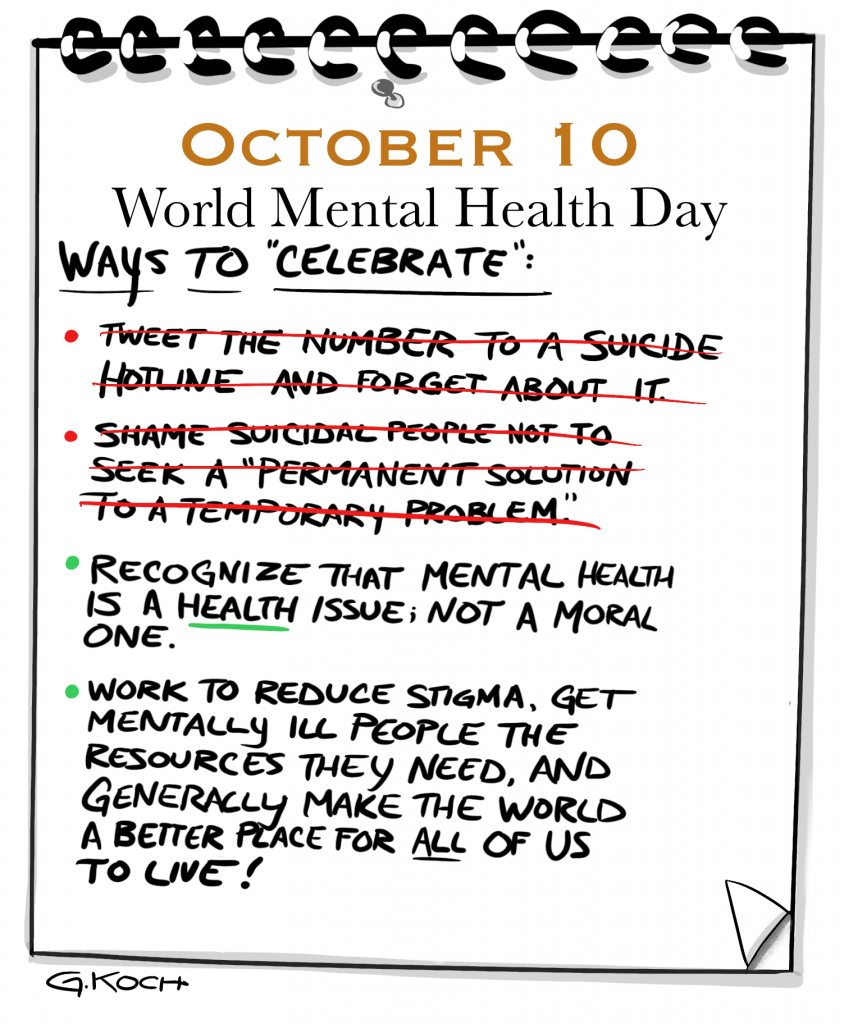
World Mental Health Day
It's a really, really big "if."

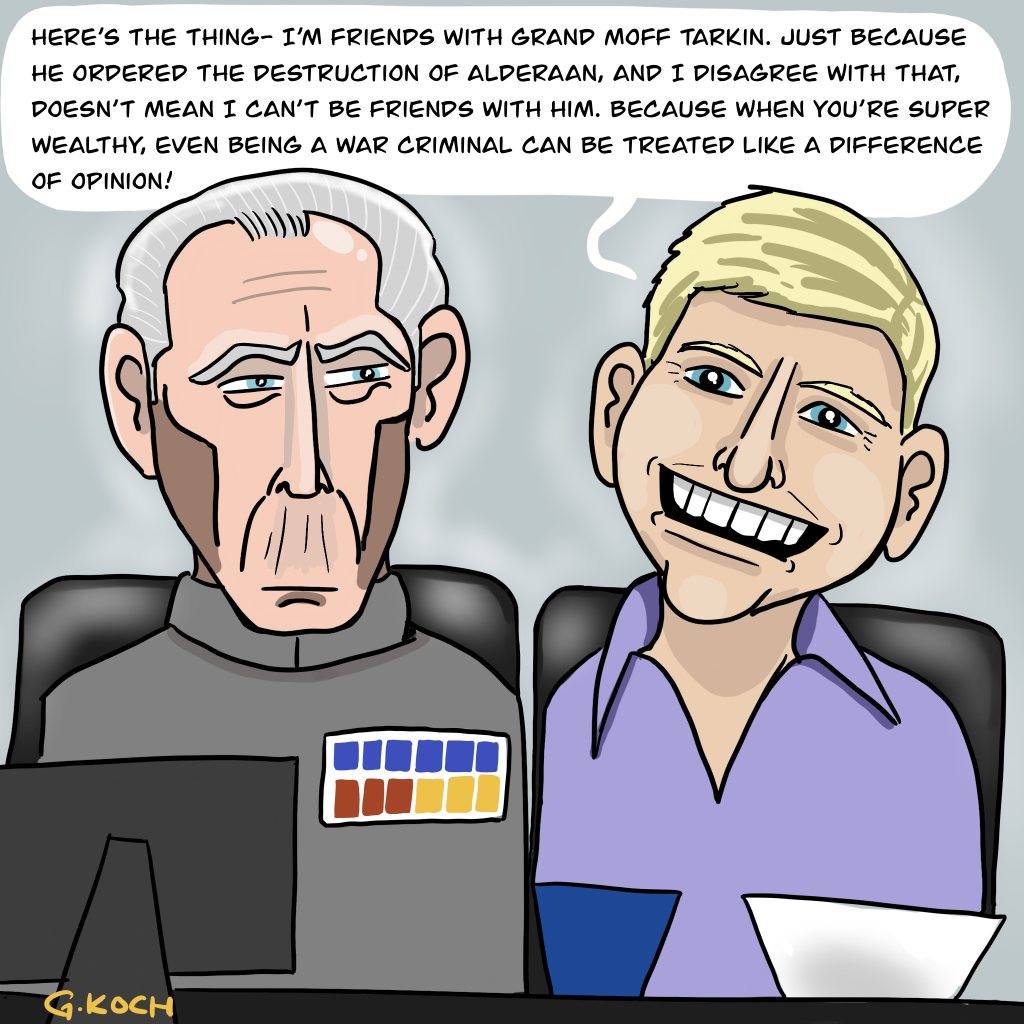
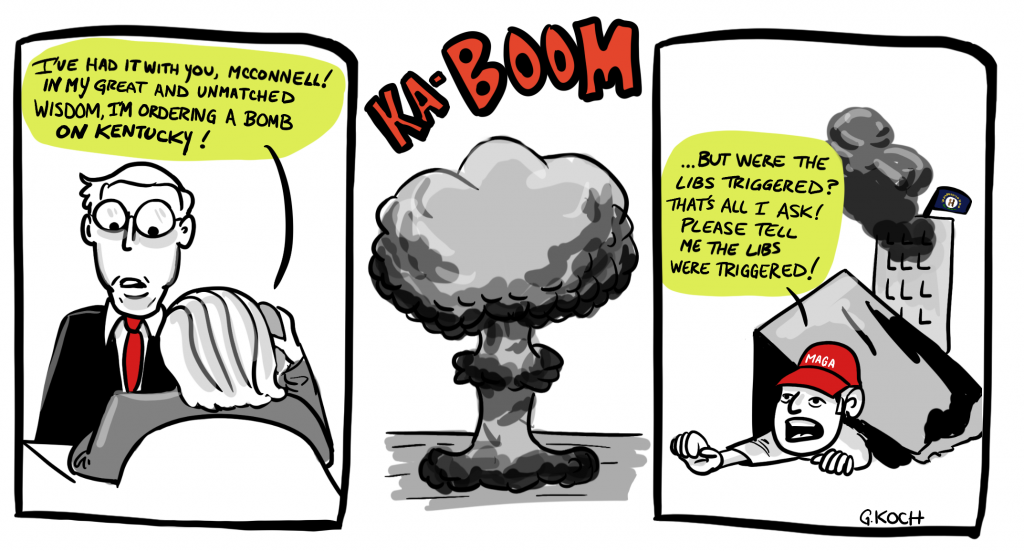
This post is a continuation of Part I– if you haven’t read that yet, click this link.
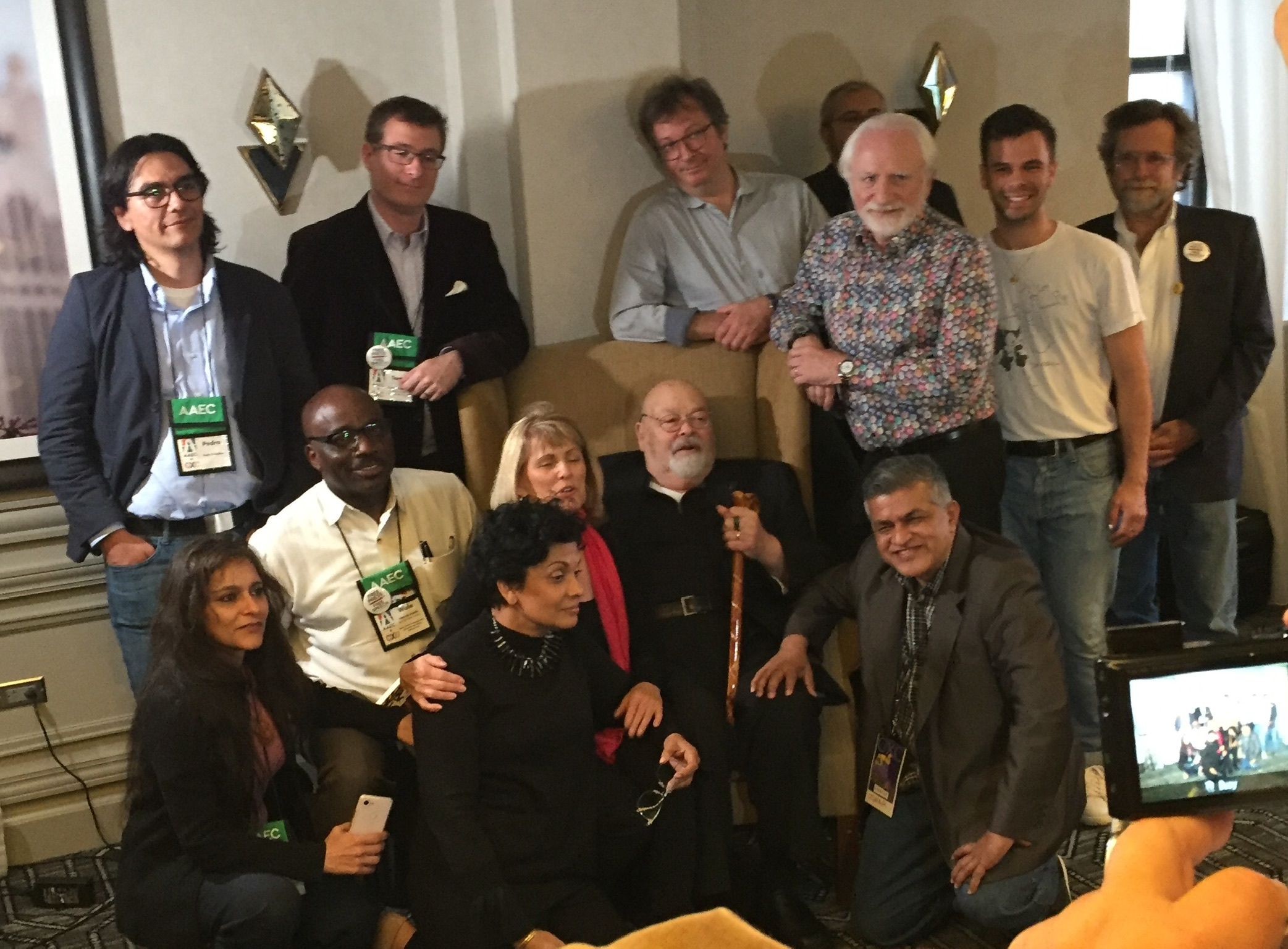
The panel “Cartoonists’ Rights and the Free Speech Situation Facing the World” was moderated by Terry Anderson (again, acting director of Cartoonists’ Rights International) and included Ritu Gairola Khanduri (board member of CRNI), Ann Telnaes, Zunar, Pedro Molina, and Charles Brownstein (of the Comic Books Legal Defense Fund).
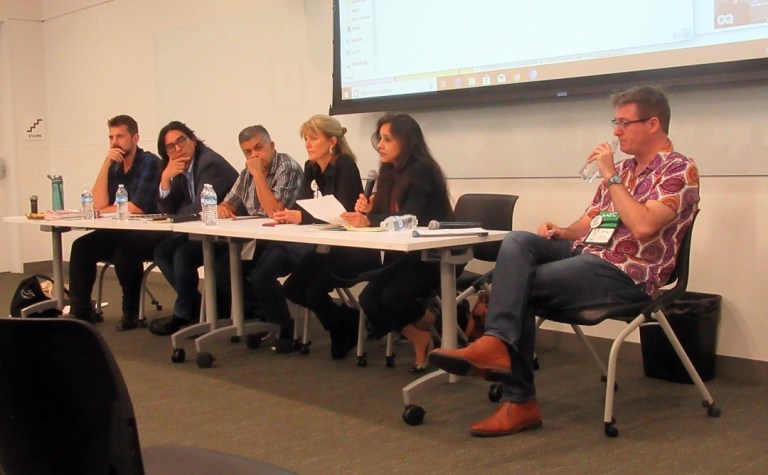
Ritu described the United Sketches Women Cartoonists International Award, and justification behind it– 5% of political cartoonists across the globe are women or nonbinary. (I submitted cartoons for this award. The deadline was September 15, and the judges are currently deliberating.)
Pedro told of the desperate state of political protest in Nicaragua, with newspaper offices and TV stations being raided and shut down. Pedro is a tireless advocate for independent journalism, even at great risk to himself, and that risk was evident in his talk. You can read more about him in this interview with the Knight Center for Journalism in the Americas or on his own site.
Malaysian cartoonist Zunar told stories of his repeated arrests in that country that were both horrific and hilarious, such as how once the police chief ordered his arrest by tweet, and Zunar’s cartoons for the next year or so all featured some tiny depiction of the police chief tweeting on his phone. Zunar is known for photos of him smiling in handcuffs during these arrests, though the risk has been significant considering that in 2015 he faced up to 43 years in prison for criticizing the Malaysian government. You can read more about Zunar at his site, where you can also find his new book recounting his experiences, Fight Through Cartoons.
Ann described the fallout in 2015 when she published a cartoon mocking Ted Cruz for using his daughters to promote his presidential campaign. You can see the cartoon here, as well as read the AAEC and CRNI reactions to the Washington Post’s decision to pull the cartoon after receiving complaints about it. Telnaes depicted Cruz’s daughters as performing monkeys, which (it seems painfully obvious to me) was not actually an attack on his daughters, but on Cruz for using them as props– something politicians do all of the time, and is off-putting every time and completely deserving of criticism. The title of the cartoon was literally “Ted Cruz uses his kids as political props.”
But after Cruz himself complained, and Marco Rubio joined him, the Post took the cartoon down and replaced it with an editor’s note (visible at the above link). That didn’t end things for Ann, however– she received a torrent of messages via email and social media that were abusive and sexist. To convey the nature of these messages, she played a video of similar harassment received by sports reporters Sarah Spain and Julie DiCaro. It is of course a good thing that the Washington Post didn’t react to complaints about a political cartoon in the same way that the New York Times would do four years later, but their capitulation in taking the cartoon down almost certainly enabled the harassment against Ann. That of course didn’t remove the ability of people to see the cartoon– all it did was tacitly agree, apparently without any consultation at all with Ann herself, that her cartoon was inappropriate.
Charles Brownstein described the power of social media influences in regulating content related to social justice issues. Charles is executive director of the Comic Books Legal Defense Fund.
 The next panel was titled “The Legacy of Trump,” discussing the impact of Trump’s presidency on political cartooning during his tenure and anticipated effects in the future. The moderator for this panel was Mike “Comic Strip of the Day” Peterson, and the panelists were Patrick Chappatte, Nick Anderson, and Nancy Ohanion.
This was more of a free-flowing discussion than the previous panel. If you read part I of this post or my previous post “On the death, dearth, and demographics of political cartoons,” then you know who Patrick Chappatte is. You may also recall that Nick Anderson is the founder of Counterpoint. He attended this meeting with his wife Angel, who I got to meet at the Billy Ireland museum and talk about life in Texas, how the two of them came to settle in Houston, and much bodices cost at the Texas Renaissance Festival, the largest (to my knowledge) ren faire in the country that takes place yearly in November just outside of Houston. (Answer: Yes, bodices cost a lot, but they’re kind of a ren faire staple and well worth the investment if you’re a ren faire junkie like I used to be.)
Anyway, Counterpoint! The condensed version of the origin of Counterpoint is that Nick Anderson, a Pulitzer Prize winner, was himself subject to the ongoing purge of political cartoonists, having been let go at the Houston Chronicle after eleven years of cartooning in 2017. Nick saw Rob Rogers undergo the same experience in 2018, recognized and was alarmed by the trend, and wrote up a statement for the AAEC board. Pat Bagley (Salt Lake Tribune, also at the AAEC meeting this time but unfortunately I didn’t get the chance to meet him), was president at the time and apparently brought the piece to the attention of Jake Tapper (occasional cartoonist himself) and therefore CNN, who published the piece on their Opinion page.
There it was read by Vivek Garipalli, venture capitalist and co-founder of Clover Health, who orchestrated a meeting of minds with Nick that resulted in the creation of a cartoon email newsletter with a theme of dialogue between cartoons and cartoonists with opposing viewpoints known as Counterpoint. Currently I believe subscribership is at something like 130,000, and the plan is to become self-sustaining with advertiser support in the future. Newsletters are emailed free to subscribers twice a week.
I’d gotten the chance to speak with Nancy Ohanion when we were tabling on the vendor floor, and learned that while she’d been doing political cartoons for decades (since before I was born) and is syndicated, she’d been doing all of it, including a full-time career in advertising, on her own until recently. Since I’d never so much as spoken to another cartoonist prior to this meeting, it was amazing and gratifying to talk to her about the community aspect of AAEC, and what it could become in the future.
In this panel, she noted that Donald Trump is not some kind of singular force in modern American politics– that he’s more like a symptom of a disease that leads people to seriously bring up the word “sedition” when talking about political dissent, that makes calling someone a “member of the media” a near-slur, and generally speaking makes the country a more dangerous place for the kind of critique and mockery that are essential, indispensable even, to editorial cartooning. And, as Nancy hastened to add, even when (please don’t say “if”) Trump goes away, this national attitude will not. So we need to decide how to respond to it. Post haste.
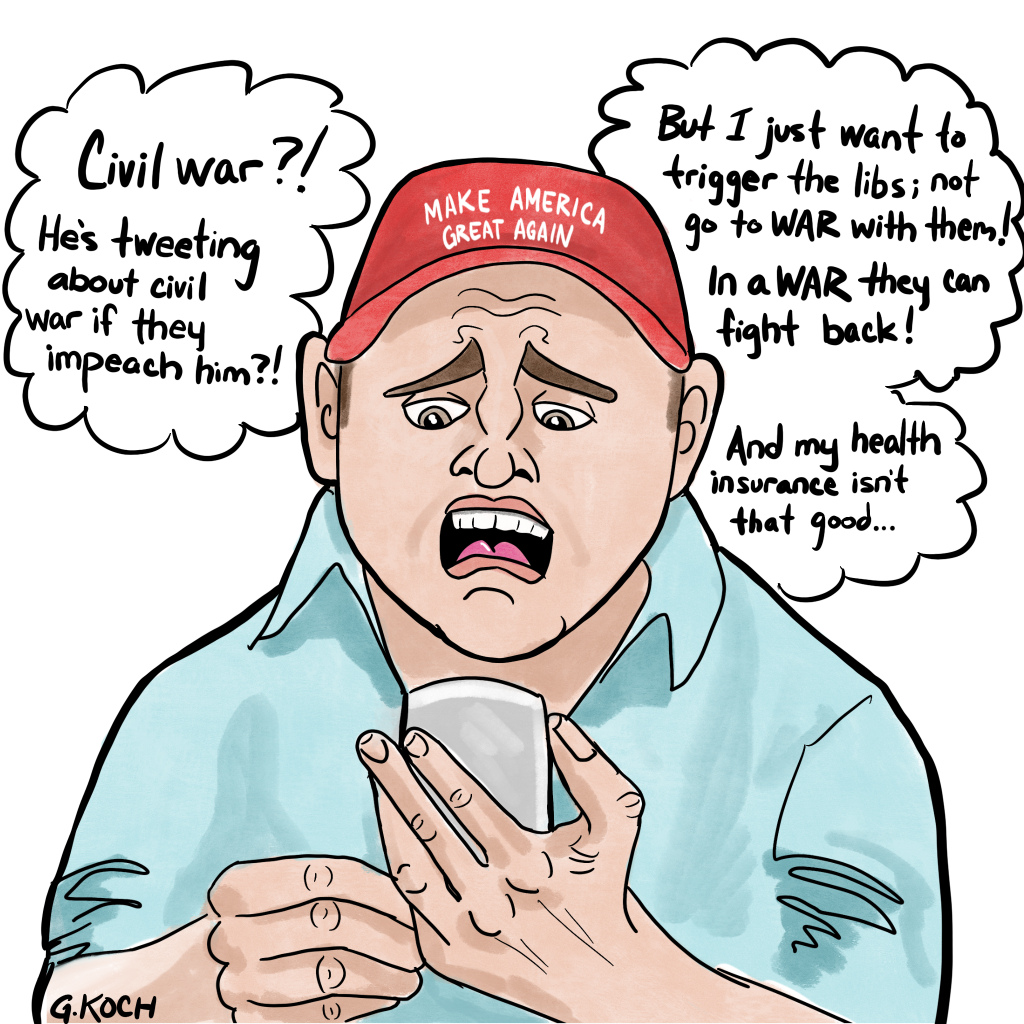
This panel also contained a lot of discussion about “offense” and its impact on cartooning, and I found myself pulling my iPad out of my bag and doodling a cartoon of my own as I listened.
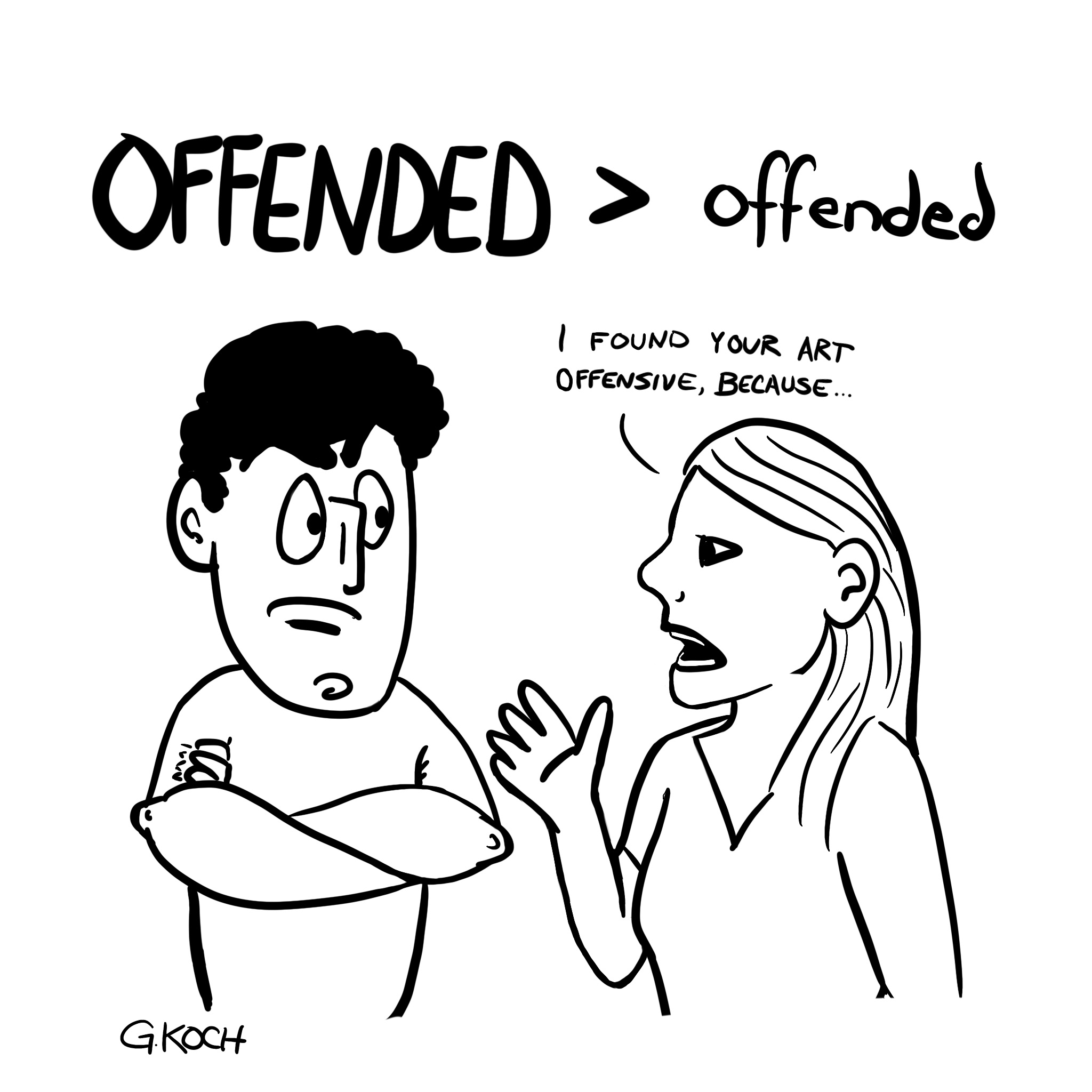
Because we should never forget, in the discussion about how oppressive offended people can be, that offense is not itself oppressive. Offense is simply the feeling of being bothered by something that seems to insult you, or someone you care about, or a principle that you hold dear. I’ve seen artists of many kinds– comedians, musicians, cartoonists, and others– react to criticism in really ugly ways. And it’s not entirely their fault, because we do live in a country, in a world, where offending the wrong people can be career-ending. Sometimes life-ending. But that isn’t the fault of the offended, generally. You cannot simultaneously say that cartoonists should be free to push boundaries (which I forever will maintain that they should), and also raise a fuss when people react to seeing those boundaries pushed. Nobody gets to be infallible. Everybody screws up sometimes.
One of my favorite quotes comes from Elbert Hubbard: “To avoid criticism, say nothing, do nothing, be nothing.” I do not, however, interpret this quote to mean that we should resent criticism, avoid it, or ignore it. Rather, we should distinguish it from harassment, attacks, abuse, trolling, etc. which are not criticism, and once we have identified it as authentic and made in good faith, we should wrestle with it. Sit with it. Consider it. That’s how we become better artists, and better people.
And there is of course a corresponding obligation for critics, to make their critiques in good faith, exercise charity, and recognize that even legitimately offensive speech is not necessarily an occasion to go beyond criticism into advocacy for more punitive measures (or, in case it needs to be said, harassment and death threats).
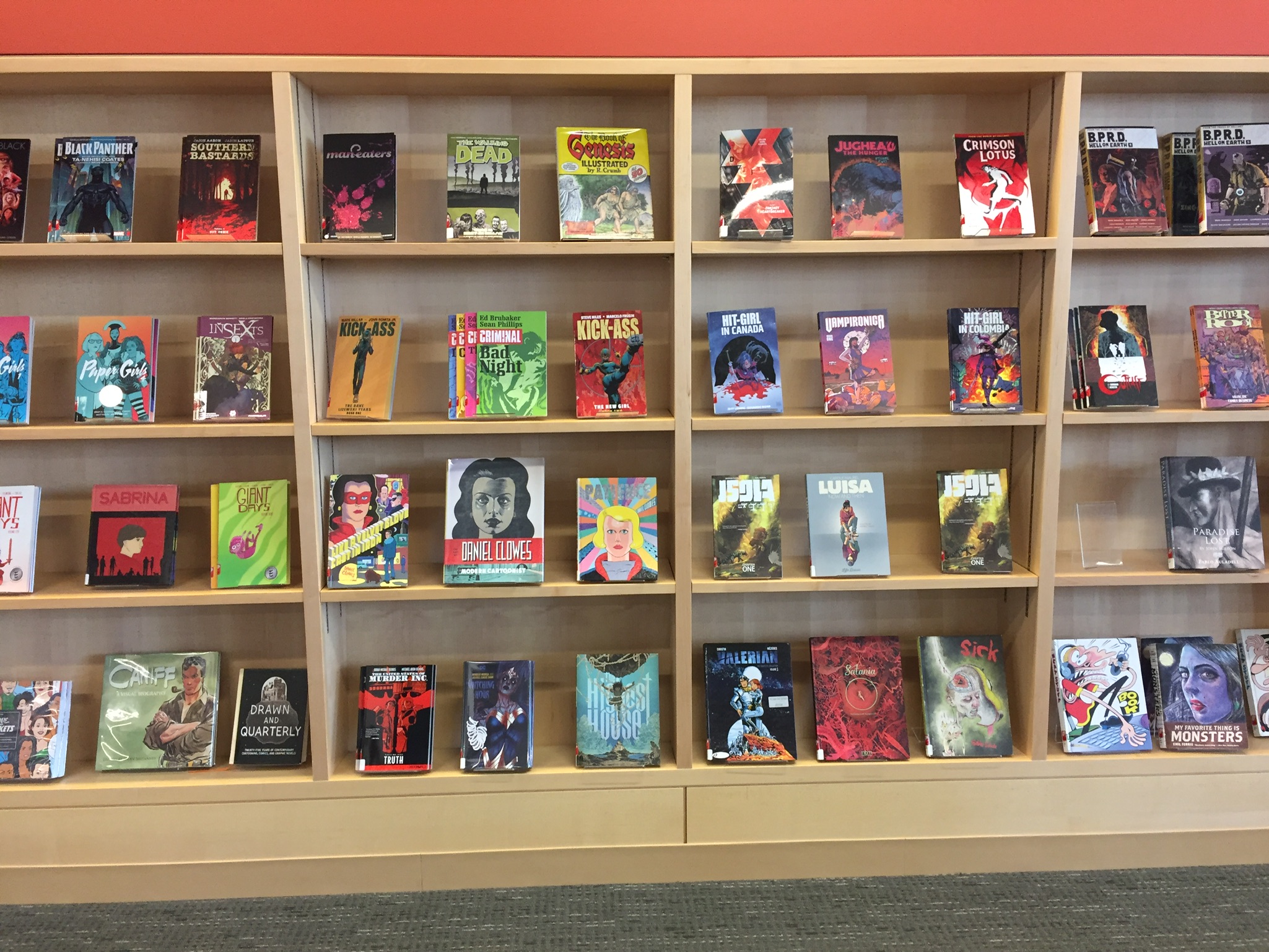 Since I already blathered on at length about this subject in the previous post, I will cease blathering here and show you this shelf at the metropolitan library next to the vendor floor. See that book on the lowest shelf on the left, Drawn & Quarterly: Twenty-five Years of Contemporary Cartooning, Comics, and Graphic Novels? I must have that book. But no, in case you’re wondering, I did not grab it and run from the library. I have more self-restraint than that.
That Saturday evening of Day 3 was the final evening for many of us. We converged on Hotel LeVeque for a reception and the AAEC awards, much of which I covered in Part I. In addition to the CNRI awards, however, there were some other highly important honors. Before the awards began, I briefly got to meet Liza Donnelly, cartoonist for the New Yorker (okay, actually meet again because I’d met her earlier in the day along with talented David G. Brown and not realized it), and enthuse over a piece she’d written in 2017 for Medium entitled Editorial Cartooning, Then and Now, which was excellent and really should’ve been part of the “Legacy of Trump” discussion earlier in the day.
The Rex Babin Award for local cartooning was presented by Jack Ohman to Kal Kallaugher, with Nate Beeler as finalist. Nate was a previous winner of the Locher Award, which you may recall was this year given to Chelsea Saunders.
The Ink Bottle Award for outstanding service to the AAEC and to the profession generally, was given to the very deserving Ann Telnaes. Ann’s acceptance of the award was predicated on her being able to share it with Signe Wilkinson, who also contributed immensely to this year’s meeting organization. I love Signe’s work and very much regretted not being able to meet her this year– circumstances prevented her from being there to accept the award along with Ann.
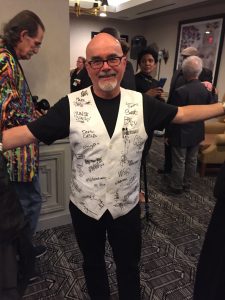
As a new member I hung back for most of this ceremony, delighted and touched by the camaraderie but reluctant to insert myself. I gravitated to fellow new member the immensely talented Tamara Knoss, with whom I’d had dinner the previous evening, along with NC cartoonist Ross Gosse and “Mr. Fish” Dwayne Booth, who had unfortunately been compelled to head back to New York by this time.
The evening was not nearly over with the reception, however– from there we proceeded to the Columbus College of Art and Design’s Canzani Auditorium for the Save the Nib event!
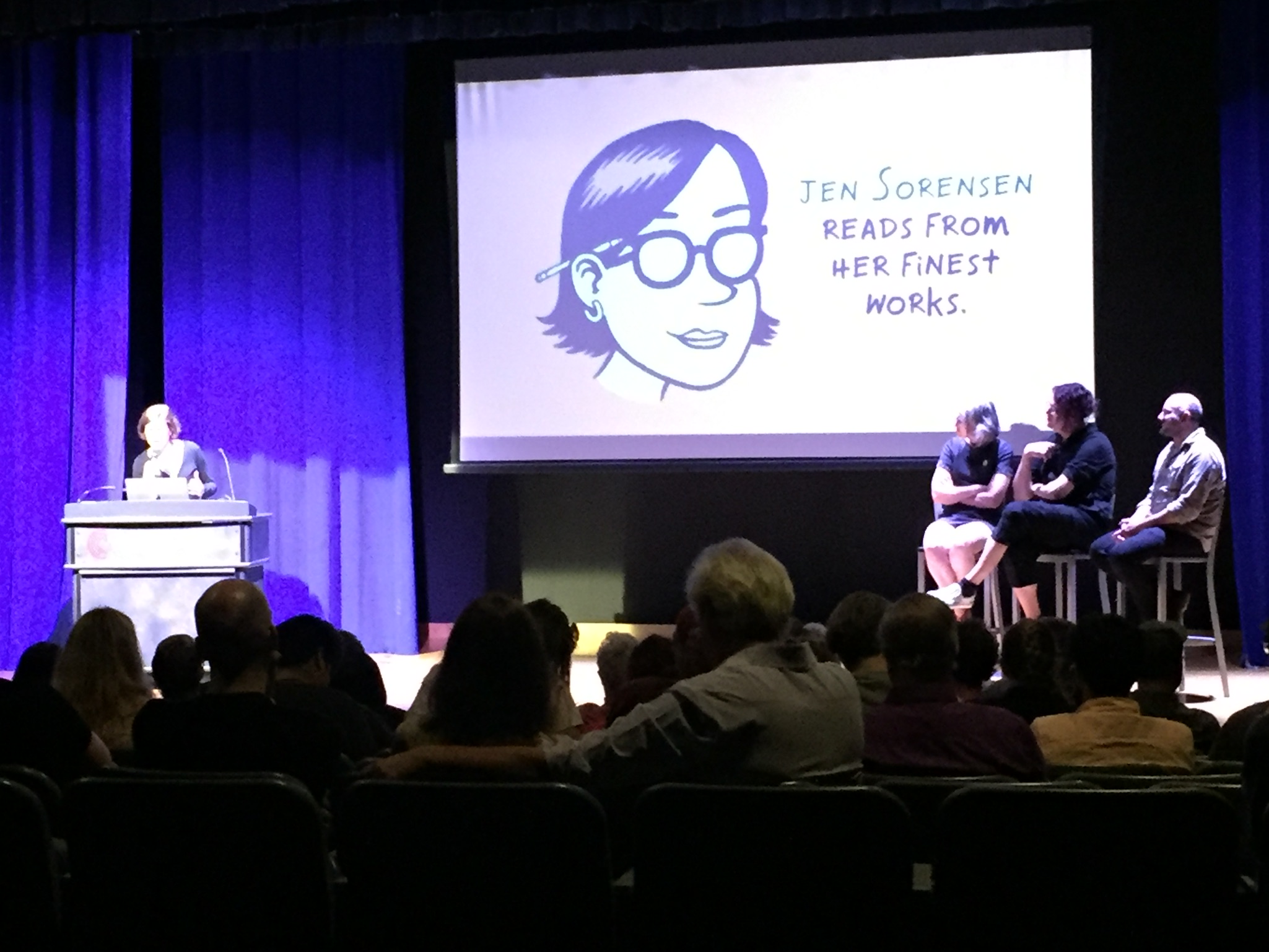
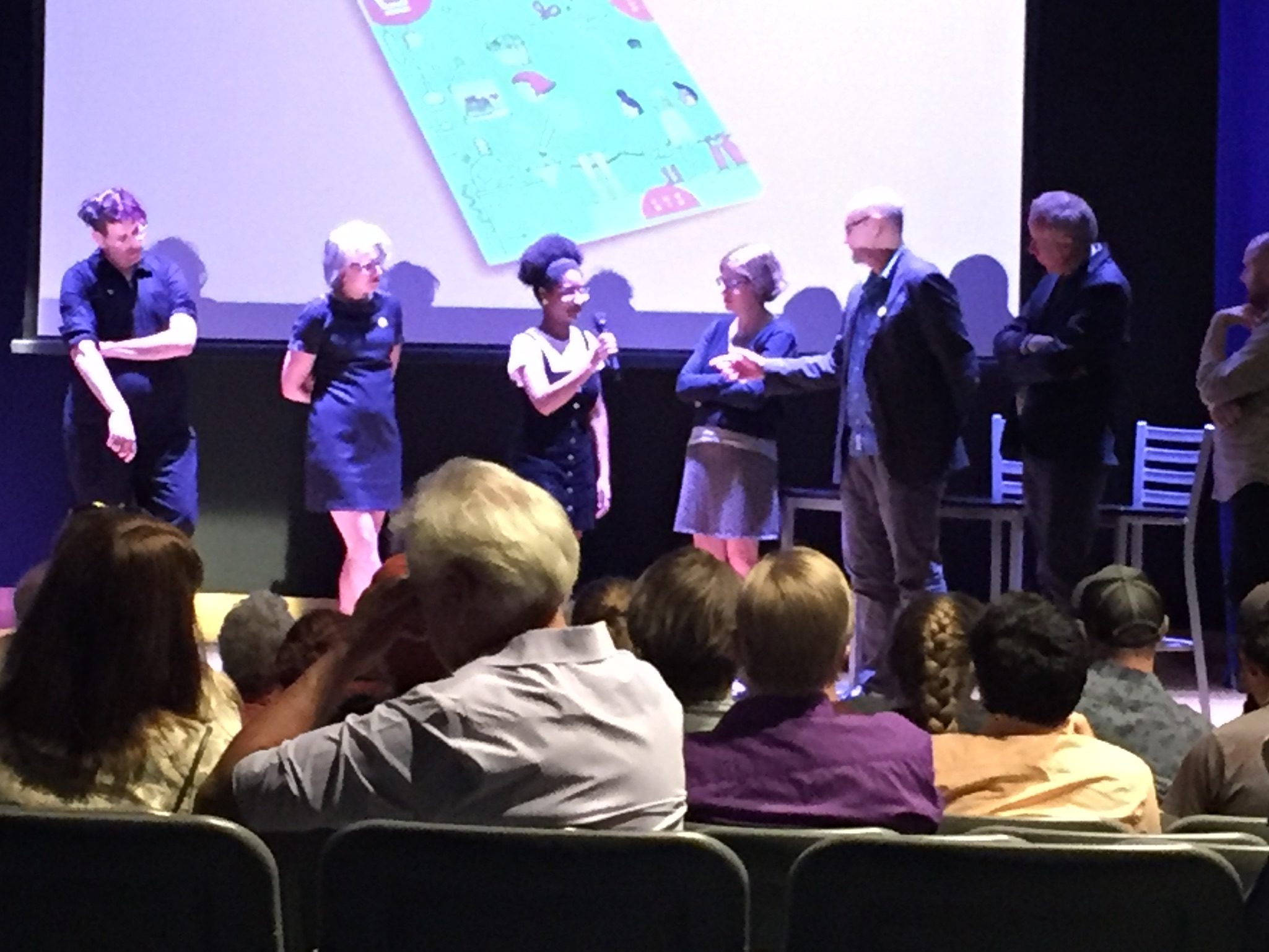
I don’t know that any of us truly knew what we were in for with this event. Seated next to Cullum Rogers, with Ann Telnaes and J.P. “Jape” Trostle behind me, AAEC members and college students throughout the audience, we witnessed what turned out to be a sort of live-action play/testimonial/Powerpoint presentation/tribute/fundraiser/stand-up act/Q&A performed by Nib editor Matt Bors, deputy editor Eleri Harris, associate editor Matt Lubchansky, contributor Chelsea Saunders, contributor Jen Sorenson, contributor Rob Rogers, and contributor Dan “Tom Tomorrow” Perkins.
Matt Bors, Matt Lubchansky, and Eleri Harris first told us the history of The Nib, its rocky excursion as a publication, gaining and then losing funding, repeatedly, until the most recent upheaval when First Look Media bailed and The Nib became Matt Bors’s reader-funded project earlier this year. They talked about story arcs in their comics, their venture into animation, and the emergence of themes such as “Gotcha Guy” and depictions of Trump as a quasi-“Immortan Joe” character in their imagined apocalyptic wasteland scenario in both comics and animated cartoons.
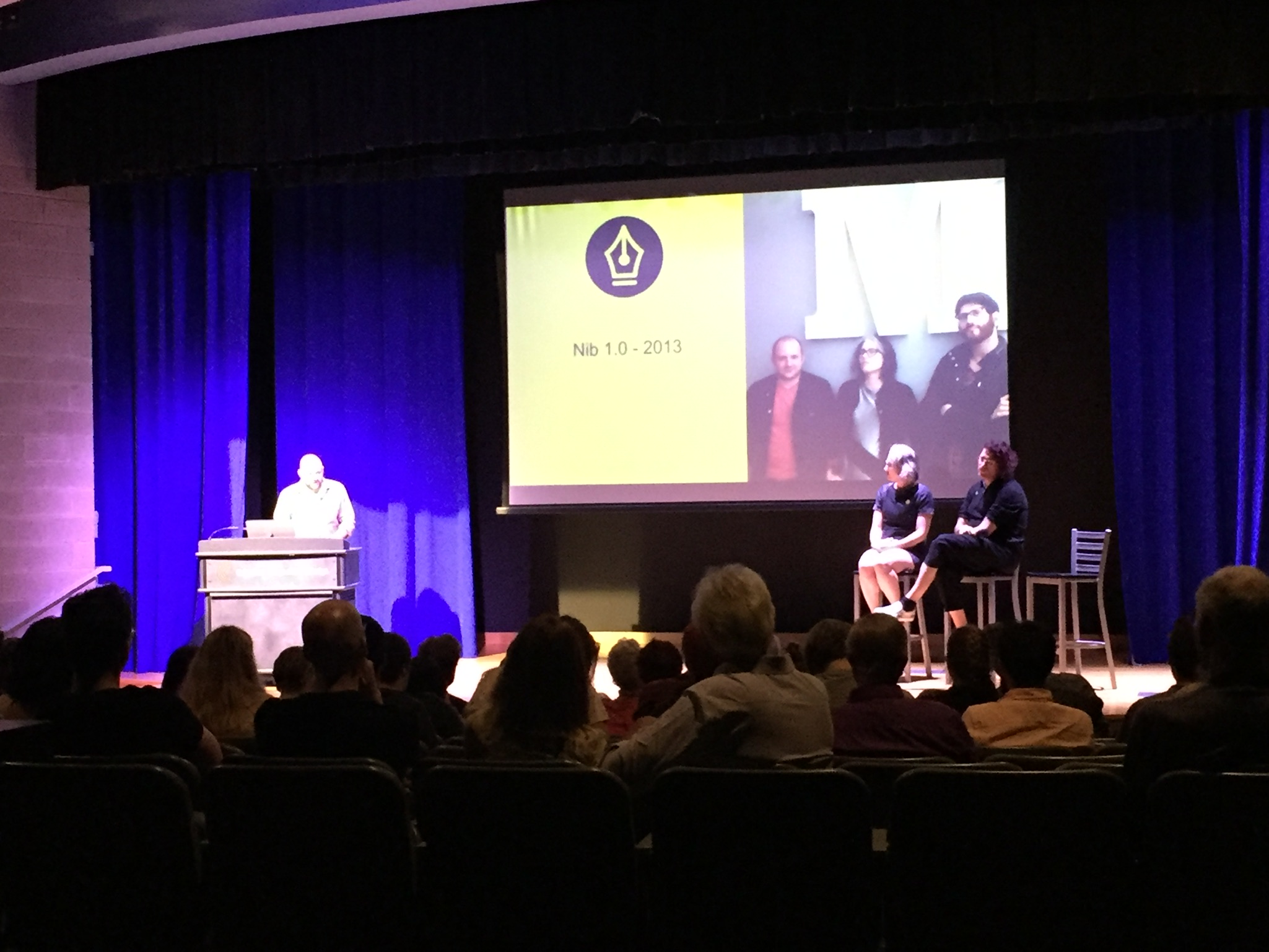
If anything became clear in the course of this presentation it’s that The Nib has been WORK. Blood, sweat, tears, and long periods without health insurance for everyone involved. This was, and is, a labor of love– that much is more than obvious.
They were dedicated to keeping the mood of the presentation light, in spite of the dire stakes that came through in the retelling, but things authentically lightened up even more when we proceeded into Chelsea Saunders, Rob Rogers, Jen Sorensen, and Dan Perkins each in turn describing their personal histories in cartooning and literally narrating selections of their comics. Rob Rogers read and commented on the entire comic he did on being fired from the Pittsburgh Post-Gazette for criticizing Trump for The Nib, which I’m sure was exponentially more fun to rehash as a result of his cartoon artistry than it was to go through as an experience.
That’s what cartooning can do– frame an experience as a story, told by a storyteller, for an audience viewing and listening to the story as much as for the teller him or herself. That’s something that all cartoons have in common, fiction or non-fiction, “political” or otherwise.
That is, it turns out, the ultimate reason why I don’t think political cartooning will go away– we humans will never get tired of being told stories about politics, about the exertion of power by some people over other people, mocking the “jerks in power” and sticking up for the little guy, the underdog.
I can’t say I know the future of these underdog stories, and it would be hubris to claim otherwise. But I can say that I’m invested in the telling of these stories, and probably will be for the rest of my life. That’s why I joined the AAEC. If you’re a cartoonist with a passion for politics who happened to come across this post, considering joining up. Then we can see, and perhaps play our own role in determining, what the outcome of this story will be.
After devoting myself to editorial cartooning at a rapidly increasing pace since the end of 2016, following the work of several cartoonists to the point of being able to identify a new cartoon’s artist without looking, and recording my reflections on the current state of the whole enterprise from an outsider’s perspective, I decided that maybe it was time to become an insider.
So in mid-August, anticipating the upcoming AAEC (Association of American Editorial Cartoonists) meeting in Columbus, Ohio, coinciding with CXC (Cartoons Crossroads Columbus), I submitted a membership application. Honestly, I didn’t know if it would be accepted considering that in spite of sending out the occasional pitch, I’m currently only published on my own site (this one), Patreon, and the various social media sites where I post my stuff.
But as it turns out, I was accepted. I would’ve attended the meeting even as a non-member, but it certainly helped to have membership established beforehand. It also helped tremendously that I received a job offer here in Wichita shortly before the trip, having spent several months unemployed. So I no longer had that hanging over my head and could make the trip with a lighter heart, although unfortunately with quite a light wallet as well.
I’ve attended multiple cons without knowing anyone very well beforehand, so in spite of my intense social anxiety, that part didn’t bother me so much. What bothered me was the possibility of not being heard– the chance that I might self-sabotage a very important networking opportunity, an opportunity for discussion, for being “with your own kind” in the way that people who attend cons much more frequently like to put it, by being too shy to meaningfully interact with anyone.
Turns out I needn’t have worried.
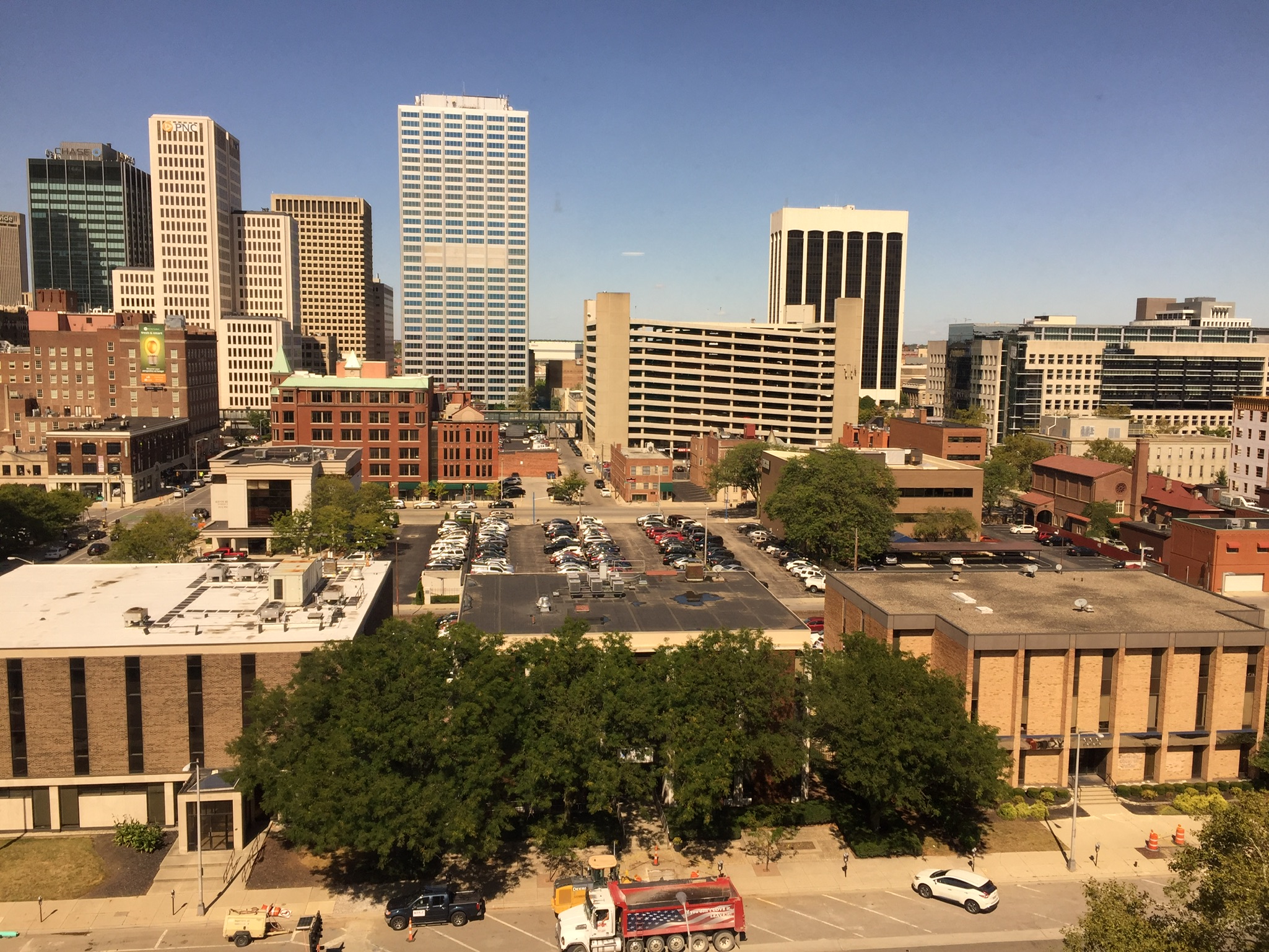
Although I didn’t actually interact with any cartoonists on the first day– and that was my fault. Since I had to be at the airport at about 3:30am for my 5:50am flight to Columbus from Wichita on the 26th, I’d opted to stay up the entire night beforehand, and so was basically running on fumes by the time of arrival at the Holiday Inn in downtown Columbus. As it happens, the designated locale for the first events that evening was also about a 30 minute walk away, and I had (to my knowledge) no other way to get there, so I sent regrets, did a little exploring of the area, and then went to bed.
(For a recap of what happened on Day 1 while I was wandering downtown Columbus in a daze/passed out, please see Mike “Comic Strip of the Day” Peterson’s take at this link.)
On Day 2 I was pleased to discover that the AAEC business meeting was being held close to my hotel, at the Columbus Metropolitan Library. I arrived at the meeting room on the second floor to find a gathering of cartoonists seated around a large U-shaped table, as if planning an international invasion, determining the fate of a captured prisoner, or discussing the fate of an organization dedicated to ensuring the future of political dissent in visual satire form. As it happens, only the latter turned out to be true.
Throughout the meeting, roughly 50% of my brain was devoted to thoughts along these lines: “Holy SHIT! Is that…..?” And yes, dear reader, it was. Here are some of the cartoonists I identified during that meeting:
I’ll try to be circumspect since I’m not entirely sure how much of what was discussed should be considered private business, but I think it’s fair and permissible to say that the AAEC is going through a bit of an identity crisis. Because really, editorial cartooning itself is going through an identity crisis. In 2019 cartooning in general is proliferating, and not just because of the nostalgia angle (most of us adults today being former children who grew up both delightedly reading comics on the “funny pages” of the newspaper at the kitchen table, and then moving to the couch to watch animated cartoons on TV). Traditionally, however, editorial cartoons are associated with the editorial section of the newspaper, and print media generally is suffering. All too frequently it appears that the first, easiest place to cut financial corners is to can the editorial cartoonist.
This, at least, appears to have been the thought process behind New York Times editorial page editor James Bennett deciding to cancel syndicated political cartoons from the international edition of the paper, after receiving considerable criticism for publishing a cartoon deemed antisemitic (which you can view here). Cartoonist Patrick Chappatte, who is a member of the AAEC and attended this meeting, was dismissed in this process despite his total lack of association with the cartoon in question. Chappatte gave numerous interviews and presentations about this incident, including a TED talk entitled “A Free World Needs Satire” which you can view here.
I won’t go through the litany of political cartoonists in America who have been fired, laid off, or had syndications cancelled over the last few years, but rest assured, it is lengthy and significant. And yet, as was repeatedly acknowledged at the AAEC meeting, cartoonists in other places have it much worse. Read the stories of Turkish cartoonist Musa Kart, Nicaraguan cartoonist Pedro X. Molina, and Malaysian cartoonist Zunar for examples.
I’m getting ahead of myself here, but near the end of this trip I had the chance to speak with Terry Anderson, acting executive director of Cartoonists Rights Network International— an organization affiliated with AAEC for the last twenty years (and many other cartoonist organizations around the globe) that works to defend political cartoonists against retaliation by the governments of the countries where they live, and whom they criticize.
I’d been following CRNI passively previously, but was truly walloped by the impact of their mission on Saturday evening when, at the AAEC reception, it was announced that founder of CRNI Dr. Robert “Bro” Russell would be retiring, and their annual award for courage in cartooning renamed to the Robert Russell Courage in Cartooning Award. You can read more about that at CRNI’s site here, and/or watch the video for yourself:
Dr. Robert Russell’s comments:
Very people in this room have not contributed in some way and to some degree and at some time to helping some cartoonists in a number of places in the world. It has been my great pleasure to do this job. I never have a problem looking in the mirror and saying ‘What good are you?’ and ‘What have you done lately?’ I have developed, as I’ve said a number of times before at these events, such an incredible admiration for the work that you do– the unique, unbelievable work that cartoonists do.
And as I was fishing around for what to say– one of my favorite expressions came from Abraham Lincoln’s first inaugural address. When the union was falling to pieces, there was no hope left at all. It was only a matter of days before something happened somewhere, and at Sumter it finally did. . . he appealed that the better angels of your nature. And while there are millions of Americans and billions of people all over the world who are these better angels, there are no better angels than those people in this room, and the fellows that we work with across the world, who approach life with a sense of righteous indignation, but how could I make that a little bit funny? [laughter: ‘You just did!’]
So I just want to thank you for being there. That I could work with so many of these better angels. And I will never forget you– I’m still around. . . [here he thanks several people, including his wife, and Kevin “Kal” Kallaugher, who was a past president at CNRI]. I just want to leave you with that– that you are magical people.
And even though you really need to leave this goddamn coalmine– it’s time for you to bail out of the coalmine, all of you canaries. Because your days are numbered. I wish you all of the best on developing and finding new models and new ways to survive. Who was it who said that the universe bends towards justice? Martin Luther King, but someone else may have said it as well. And I do hope that the universe bends a little bit towards justice, and you all will be rewarded as I have been. So thank you all.
The first recipient of the newly-named Robert Russell Courage in Cartooning Award was announced on October 2– Chinese cartoonist and dissident Badiucao. Here’s Terry Anderson’s comment:
Badiucao is an exemplary cartoonist of courage. He was specifically targeted by a censorious regime — in person, online and, most disturbingly of all, via pressure applied to family members — but has persevered and removed the leverage his adversaries thought they could exploit by actively dismantling the anonymity they assumed he cherished most.
Thankfully Badiucao is an Australian resident and so cannot be abused as readily as some other cartoonists seized by China in recent years, most notably Jiang Yefei and Zhang Dongning, both of whom have been arrested, criminalised and essentially disappeared. However he is not immune and believes he has been followed, hacked and even had his home invaded by agents of the state. As China celebrates the 70th anniversary of the founding of the People’s Republic it’s worth contemplating how far they have come in terms of economic development and international relations, weighed against the minimal progress made on fundamental and individual freedoms.
Reporters Sans Frontieres places China 177th of 180 nations on its Press Freedom Index. Committee to Protect Journalists places it 5th in its Top 10 Most Censored Countries. It is ironic that so many modern Chinese citizens enjoy the trappings of middle-class life — abundant consumer goods, lavish weddings, pampered pets and much foreign travel — while they are denied the simple act of expressing dissatisfaction with their government. China is mighty. It has nothing to lose and everything to gain by loosening its grip on discourse.
Badiucao has seen his cartoons removed from Instagram for supposedly violating community guidelines, and tweeted on the irony of this happening while death threats against him, also made on Instagram, had not been removed in spite of his reporting them.
So now it’s time to talk about freedom of expression and social media. You’ve got time for a little tangent on this, don’t you? Of course you do.
Social media companies– Facebook, Twitter, Instagram, Tumblr, and so on– are privately owned. They are not, despite the complaints of conservatives in America who have found themselves banned from such platforms, public utilities. And yes, in America it’s generally the conservatives (Alex Jones, Milo Yiannoppulos, etc.) we hear trying to make this argument, not in the slightest dissuaded by the clarity of First Amendment case law.
I would strongly recommend Ken “Popehat” White’s episode of his Make No Law podcast “Deplatformed: Social Media Censorship and the First Amendment” for an informative, authoritative discussion of this subject. I’ll give you a quick spoiler: moderation of content on social media by the companies who own those platforms is not a violation of anyone’s First Amendment rights.
HOWEVER (you knew a “however” was coming)…the subject is not that cut and dry, for several reasons.
Governments, such as the government of Pakistan recently, have been known to try pressuring private platforms to remove content that isn’t protected under the laws of their respective countries. Cartoonist Clay Jones experienced this when Pakistan demanded that WordPress remove one of his cartoons judged to be “blasphemous,” and leader of the South Asian Free Media Association Imtiaz Alam was threatened for tweeting a cartoon by Afghani artist Atiq Shahid mocking Saudi Arabia’s prince Muhammad bin Salman. Shahid also reported that he’d been suspended from Facebook (more information available on this at the above link).
While their right to moderate content is not in dispute (at least, not by me), social media sites tend to do so much in the way of your 4th grade teacher when a fight breaks out– they don’t care who started it or who is right and who is wrong; all they want to do is make things settle down. They operate by a heckler’s veto standard– whatever and whomever get the most complaints (or, in some cases, complaints from the most powerful and influential people) will be removed, regardless of the reasoning behind those complaints.
Sloppy algorithms also result in content intended to criticize hatred and bigotry getting removed along with actual hatred and bigotry, because the algorithm can’t distinguish between them. As you might expect, this is a particular problem for cartoonists because we rely on symbols as visual shorthand, and it’s often necessary to depict those symbols in order to say something about them. Obviously not all depictions of a thing are endorsement of that thing, but if your algorithm says “Person in a pointy white hood means racism, and racism is bad, so any depiction of a person in a pointy white hood is bad,” then say goodbye to any cartoons attacking racism by showing a guy in a pointy white hood.
And of course operating by a heckler’s veto standard enables the haters and bigots to be extremely effective hecklers, getting people and posts removed and videos on Youtube demonetized or taken off the site altogether. Sometimes an appeal by the content creator can get their work reinstated, but when your livelihood is literally dependent on links and shares, that’s not good enough.
Here is where, of course, I would expect a reader to say “Well, don’t make your livelihood on social media then.” To such a reader I would say– did you read the part above about how print media is dying, and cartoonists (being frequently the ones who get the most grief in response to their content, which is after all designed to provoke), are generally the first to be let go? If political cartoons are too controversial for print media, and also too controversial for social media, then where exactly is the cartoonist supposed to go?
Removal of content and cartoonists from social media may not be a violation of their right to freedom of expression, but it is censorship. It is silencing. It is suppression. Therefore it is important, and a threat that goes well beyond the individual artist’s funding. Open dissent is critical to the preservation of a democracy regardless of whether its platform is public or private.
To return, finally, to the AAEC meeting– see? I do have a link-up– after a hearty discussion on how to clearly establish the AAEC as an advocacy rather than just professional organization, whether to change its name and many possible suggestions about what to change it to, and how to attract new, younger, diverse membership to this gathering of “old white guys,” (hey, they said it, not me!) on Day 2, I found myself talking Jen Sorensen’s ear off about how frustrating it is to see the language of “triggering” and “safe spaces” used when talking about these subjects. Because like it or not, that’s the terminology used by someone who interprets criticism as censorship and whines in his next Netflix special, New York Times column, or best-selling book about how the humorless offended mobs have ruined his career.
The “humorless offended mobs” are not the problem. Sometimes they’re offended for a good reason– offense is not all created equal. And a “mob” in this context is simply a critical mass of people talking about the same thing. If we blame humorless offended mobs for cartoonists losing their jobs, then we are exculpating the people who are actually responsible (namely, the editors and other parties who did the firing), and tacitly suggesting that no one should speak up when they find a cartoon offensive, even legitimately, because then it would be their fault if the artist loses his or her job.
And this is a slightly more contentious subject, but I argued that even when offense is legitimate, anyone whose job is to issue statements on a daily basis, such as a political cartoonist, should be judged by their body of work rather than by what they produced on one specific day. I actually agree with disgraced former SNL actor Shane Gillis that we all occasionally have “comedic misfires,” and that the appropriate reaction to such is forgiveness and understanding. Where we differ is in his apparent belief that repeated racist and homophobic jokes over a lengthy period constitute “comedic misfires.”
I didn’t even argue that cartoonist Mike Lester of Counterpoint should be “fired” for this cartoon, published in edition 24 of the cartoon newsletter on August 22. I absolutely complained about it, though, noting that in 2015 Robert Lewis Dear killed three people and injured nine at a Colorado Springs Planned Parenthood, specifically citing their alleged agenda of performing abortions in order to profit from selling fetal organs. Counterpoint was founded with the mission of providing subscribers with cartoons expressing “strong opinions from the Left and the Right,” and promising that “One thing we never do is play it safe.” However, for any political issue there are generally far more than two sides, and often the most dangerous thing a cartoon can express is the truth.
Provocative lies are easy. Dangerous truths are hard. The two should never be confused. And no, in case you’re wondering, I am not proposing myself as the ultimate arbiter of which is which– just asserting, forcefully, that it is the eternal right of the cartoon-consuming public to make that determination for ourselves. And even if in America political cartoonists enjoy the relative luxury of being able to express themselves without government censure, we experience the same chilling effect as print journalists when the president declares that “the media” is the enemy of the people and suggests that the “liable [sic] laws” should be re-examined for the purpose of more effectively punishing purveyors of “fake news.”
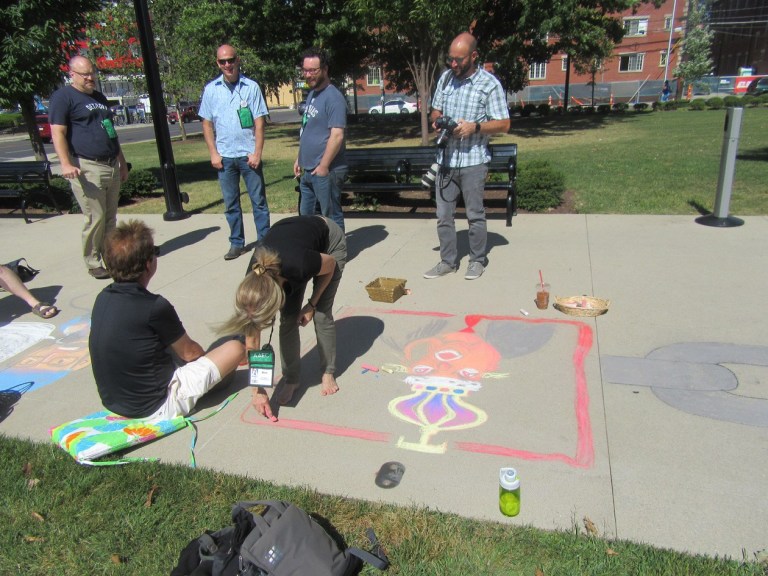
After the business meeting some of the cartoonists filed outside to participate in the “Chalk Slam” event sponsored by AAEC in conjunction with the Columbus Metropolitan Club, with a theme of “freedom of expression” for AAEC members. I found a spot on the sidewalk next to Ann Telnaes, currently absorbed in creating one of her trademark depictions of Trump. Jack Ohman was seated next to her providing entertainment and critical commentary.
In the afternoon we were treated to a screening of the documentary Mr. Fish: Cartooning from the Deep End, which really drove home for me how in spite of the “Intellectual Dark Web” and its fans and hangers-on making money hand over fist by claiming to distribute dangerous truths when they’re really just repeating stale conservative talking points, the actual dangerous truths are still…well, dangerous to tell. In it, Dwayne Booth (Mr. Fish) expressed frustration at how “sports team” partisanship in politics drives backlash against his work that criticizes corruption, warmongering, and bigotry regardless of the affiliation of the guilty party. His cartoons are frequently graphic because the violence of an authoritarian state is graphic, and he mocks the hypocrisy of the agents of that violence clutching their pearls over artistic depictions of tragic circumstances of their own making.
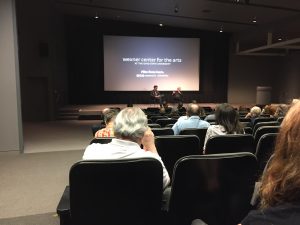 The other thing that Cartooning from the Deep End reiterated for me is that “cheap offense” is the other side of “cheap laugh” coin. It’s really not difficult to offend people, just as it’s really not difficult to make people laugh. That’s why satirists of all kinds who lazily rely on hackneyed bigoted tropes will always outnumber those who strive to say something revealing and thought-provoking. As author John Scalzi famously noted, the failure mode of “clever” is “asshole.”
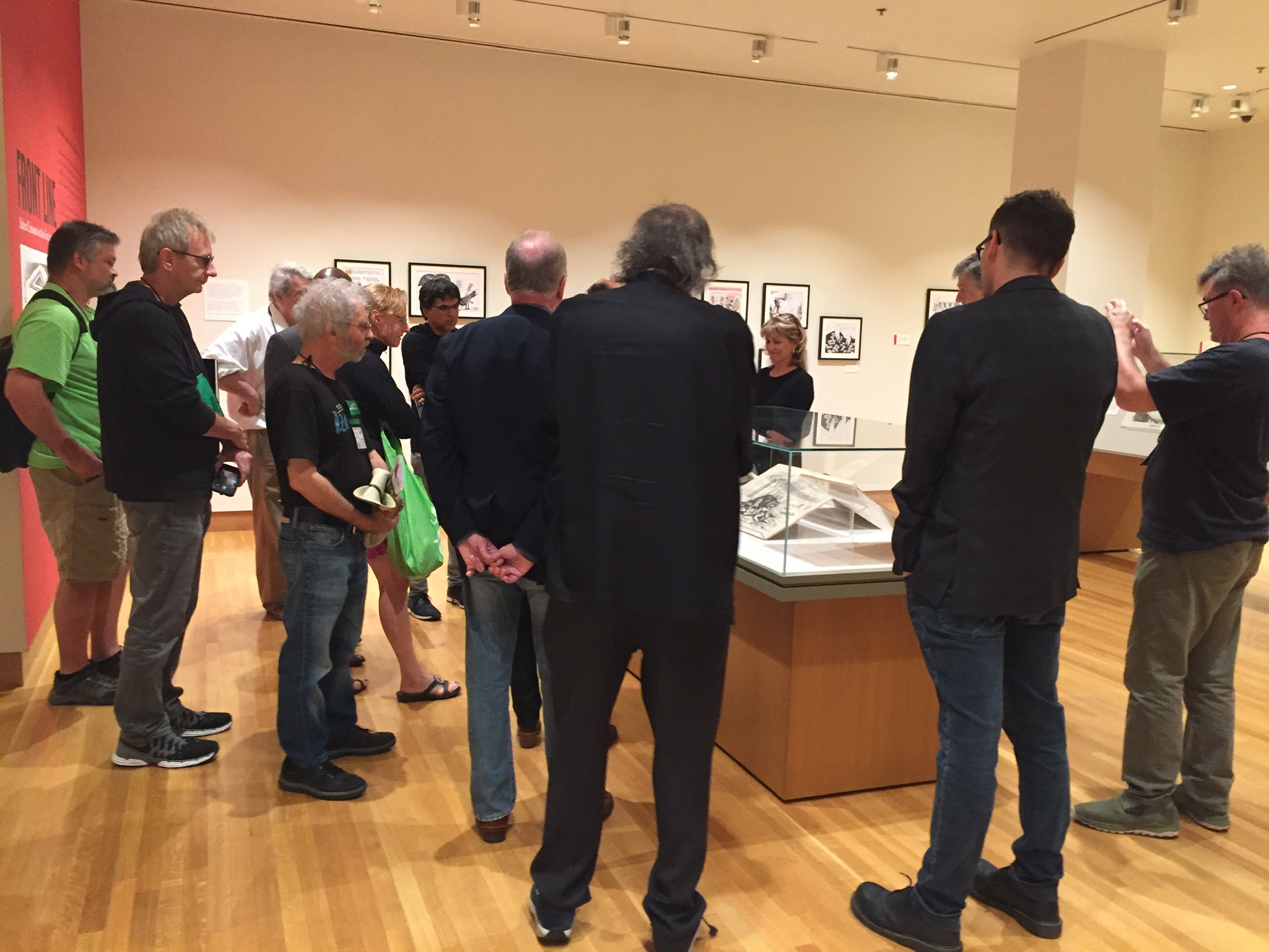
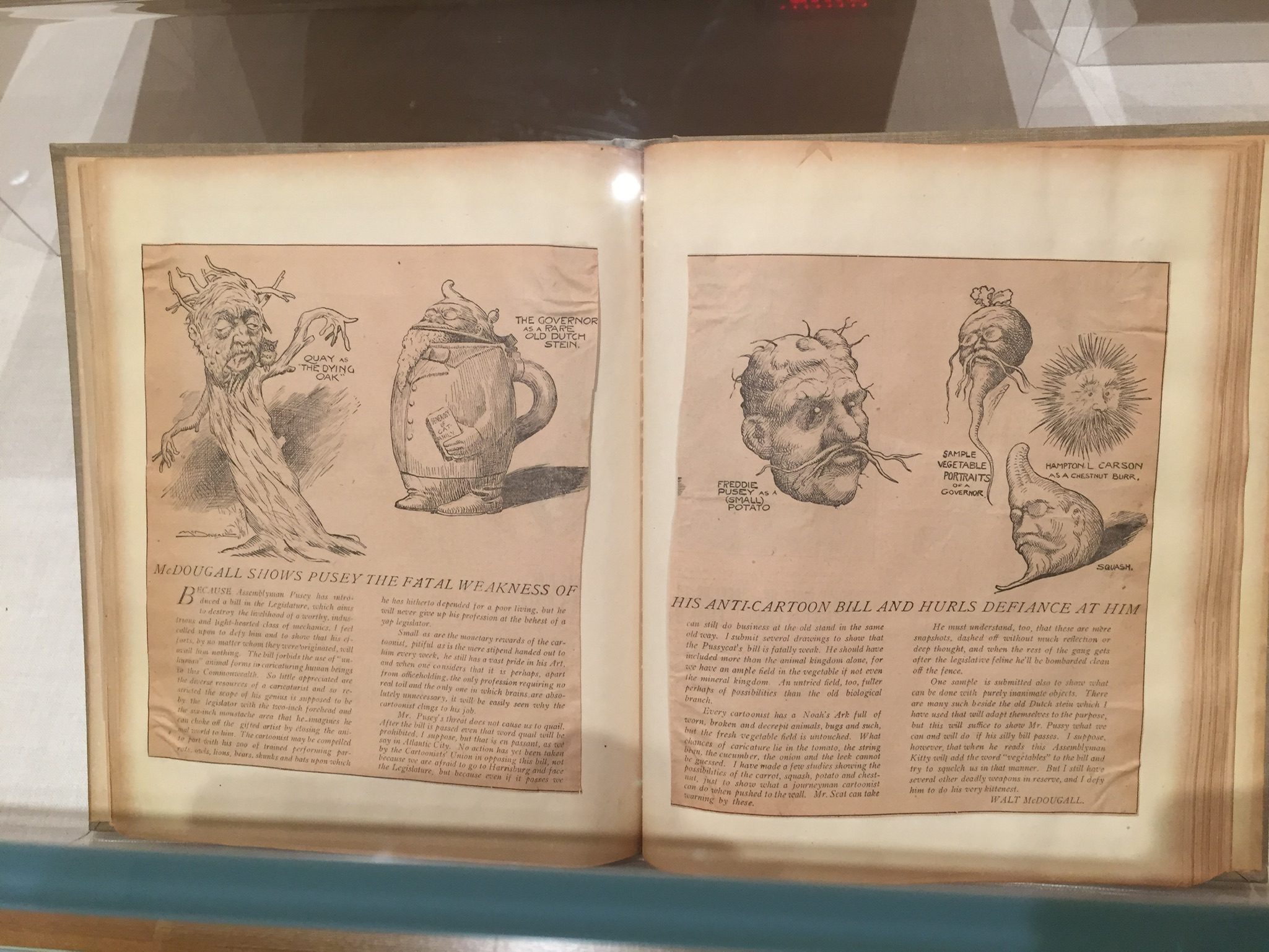
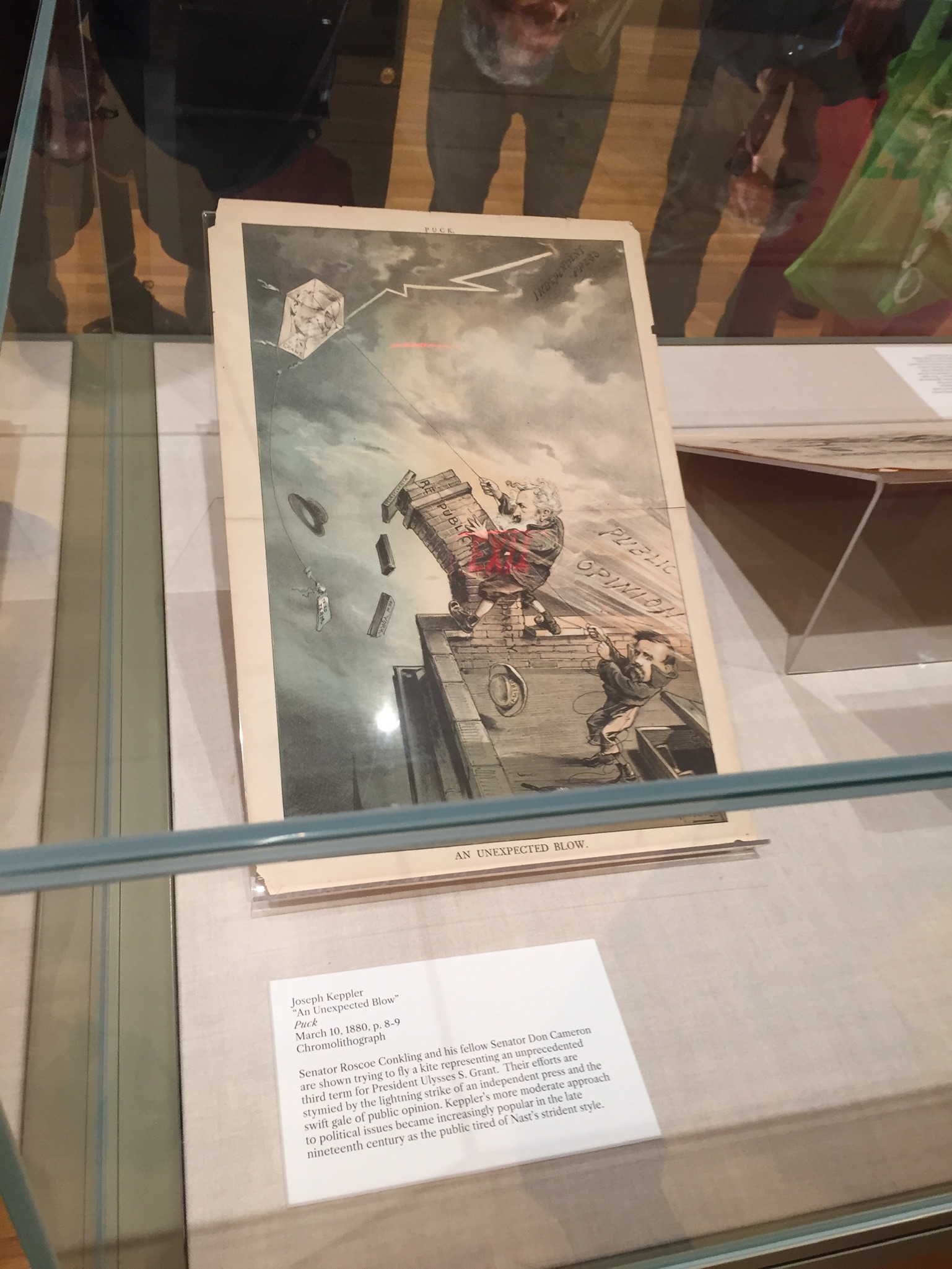

Let me repeat that– it’s the job of editorial cartoonists to mock, satirize, ruthlessly parody, and otherwise ridicule powerful people. Barry Deutsch, political cartoonist and sometimes mentor to me, says on his Patreon page:
I’m pissed off. I’m pissed off about so many things– about homophobia, about sexism, about racism, about transphobia…the list goes on and on. And when I get pissed off, I draw political cartoons.
Dwayne “Mr. Fish” Booth told the audience at his film screening:
I start with outrage and then I render what that outrage looks like.
My own Patreon page says:
And then the election happened, and I found myself furious. I went through the stages of grief, hit “anger,” and held onto that one while proceeding through the rest. I wanted to find a productive way to express that anger, and to play out the conversations that were going on in my head in case they resonated with anybody else.
So of necessity, the history of political cartooning in America– really, anywhere– is a history of artists speaking truth to power in cartoon form because injustice pisses a political cartoonist off, and the cartoon is their counter-argument. Their counterpoint, if you will. In retrospect, I realize that this is why Dr. Robert Russell called us canaries in a coalmine. This is why he called us magical people, filled with righteous indignation.
Phew. That’s some heady stuff, isn’t it? With great magic comes great responsibility, after all.
Responsibility carried faithfully by The Nib over the years, for which editor Matt Bors was recognized at a reception in the museum following our tour. The CXC gave him the Transformative Work Award, and Nib contributor Chelsea Saunders received the AAEC’s Locher Award for outstanding young cartoonists. I briefly met Bors and Matt Lubchansky at the reception and asked what was obviously the most important question of the evening– whether Bors had been forced to give up the Ignatz Award brick given to The Nib in mid-September for outstanding achievements in cartooning by small press creators. Bors had tweeted that he was challenged about it at the airport (which does kind of make sense– it’s a brick, after all) and not allowed to bring it with him onto the plane. Fortunately, as he told me at the reception, he was allowed to stow it in his checked bag, so the prestigious award was not, in fact, forcibly abandoned.
On Day 3 I rushed back to the Metropolitan Museum in the morning to complete my Chalk Slam drawing on the sidewalk, only to discover that the rain overnight had caused everything to fade considerably. It was poor planning on my part all around– I’d intended to contribute to the free speech-themed AAEC collection by drawing my friend, comedian Keith Lowell Jensen, accompanied by text from one of his performances:
In junior high I took band. The teacher was upset when I wouldn’t say the pledge of allegiance. He made a heartfelt speech about his visit to East Germany (which used to be a thing) and how sad and oppressive it was on that side of the wall, how they lacked the freedoms that I took for granted. I asked him “On what side of that wall do you think they’re more likely to force children to pledge their allegiance?” And that is the story of why I don’t know how to play the clarinet.
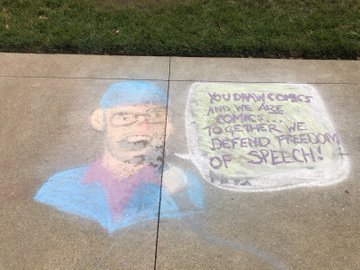 If you’ve done any sort of chalk drawing recently, you will immediate grasp the flaw in my plan– however hilariously apt for the occasion, that message is way too long. I managed to draw Keith and write the first part of the quote on the first day, but on the second day erased the text and replaced it with a much simpler (but hopefully still worthy) message. My apologies, Keith!
Inside the library, the AAEC meeting that morning began with nominations for office within the organization, which was followed by presentations by Middle Eastern cartoonists invited to the meeting. Unfortunately I had to duck out of the room early, as these presentations were just beginning, because I was scheduled to be among the first group to man the AAEC tables at the CXC vendor floor, but again I will link you to the CSOTD blog where you can read about these visiting cartoonists and see some of their work.
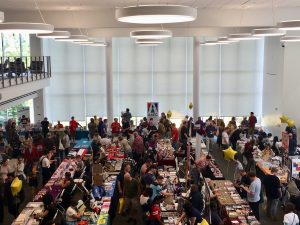
I’d never been to a comic con of any kind before, so the vendor floor of CXC took me by surprise– it seemed huge. I didn’t have anything to sell, but at the last minute managed to get some prints of four of my cartoons and brought them along with me to give away. Seated on my left was Mike Thompson of the Detroit Free Press, expertly inking a cartoon at the table, and on my right was Nancy Ohanion, selling prints of her beautiful “cut paper” style caricatures. Since I’d been silent during the business meeting on Day 2 and absent for much of it on Day 3, I took this opportunity to seek out Kevin Siers and give some suggestions on how the AAEC should find new, younger members. Those fell under three general categories:
Feedback and discussion: Starting out as a cartoonist is rough. All you have to go on are what you’ve seen from existing cartoonists, and it isn’t always obvious why they made the choices they made, and whether/when you should emulate them or try to strike a new path. So I suggested some kind of internal feedback mechanism on the new (sometime in the next couple of weeks) AAEC website, enabling cartoonists to comment on each other’s work and also see the existing comments for that work, allowing for a discussion. Kevin broached the idea of a private Facebook group for AAEC members instead or in addition to the commenting mechanism, which I enthusiastically supported. Community in some form or another is absolutely essential.
Publication: Given the state of print media, but also given the subject matter that young political cartoonists want to comment on, there is no real expectation of someday becoming a newspaper editorial cartoonist. To interest new members, the AAEC should suggest career paths outside of traditional print media. This is an excellent opportunity to name and praise alternative print and online media sources who do solicit and publish political cartoons.
Experimentation: Perhaps the AAEC could even create its own publication, similar to how comedians have certain clubs where they try out their new bits, and feel comfortable pushing the boundaries a little. For cartoonists, this would be a site where they’d have the freedom to be edgy, try out cartoons that mainstream publishers might not want to risk taking responsibility for themselves, but could view a cartoonist’s existing portfolio, both the stuff in the edgy category and otherwise, to have something to go on when considering whether to work with that cartoonist on future projects. I mentioned that as a blogger it can be difficult to pull people to your site on a regular basis, but group blogs with multiple bloggers tend to be much more successful in that regard, and an informal “alternative” group cartoonists blog might be something with considerable appeal.
I spent so long at the AAEC tables that I missed Kevin “Kal” Kallaugher’s presentation, which was disappointing because over the last couple of years I’ve fallen in love with his use of dimension and detail to create wild farcical scenes that make complete sense according to their own logic. Looking at a Kallaugher cartoon is like falling down the rabbit hole into an Alice in Wonderland scene where people have huge heads and expressive faces that look like they’re carved out of wood, and you might find yourself witnessing a court proceeding, assembly line, or pirate ship battle that analogizes real life but is equally a product of Kal’s ever-fertile imagination. Fortunately I did manage to speak with Kal later on at the AAEC reception (the one described completely non-chronologically at the beginning of this post).
There was, however, time to both peruse the CXC vendor tables and attend other presentations, so I made a beeline to Nate Powell’s panel discussion after hearing Kevin Siers recommend his three book series March, documenting the civil rights advocacy of Rep. John Lewis. Powell illustrated the graphic novels, and the writing was done by Lewis himself as well as Andrew Aydin.
Wandering around the vendor floor, I also came across a table with a familiar book– Monkey Chef, written and illustrated by Mike Freiheit. I remembered Freiheit from a comic on Steven Pinker that he illustrated for Current Affairs last year. At that time I remember adding Monkey Chef to my list, but wasn’t flush with cash so didn’t buy it. This time I wasn’t any better off, but buying the book in person gave me the chance to talk with Freiheit a bit as he doodled a charming drawing of a monkey in the front pages of the book for me. The Pinker comic was authored by Lyta Gold, and Mike commented that he actually wasn’t very familiar with Pinker, so I tried to offer a brief summary of how Pinker had been an intellectual hero of mine some years ago, but unfortunately he suffered from that tendency of American public intellectuals to hold forth on issues well beyond his actual area of expertise, which as it happens was the subject of the comic that Mike had illustrated (If I’d read Anand Giridharadas’s book Winners Take All: The Elite Charade of Changing the World, I might’ve been able to offer an even better take, but again– on the list).
So I’ve been binge-watching the show iZombie on Netflix recently. It’s a supernatural legal drama type show in which zombies exist, and the protagonist has been turned into one against her will. She’s not your typical mindless shambler, however, and actually is pretty much a normal human, apart from the incessant need to consume human brains, a penchant for spicy food, and her pallid appearance.
As a human, Liv was a doctor, which is beneficial to her in finding a way to continue existing as a zombie without murdering anyone, because she’s able to find a new “life” working in the morgue. There she can feast on the brains of the already-dead, and in doing so discovers that she experiences “flashbacks” of memories from the deceased, and also takes on some of their personality attributes.
Yesterday I got to an episode in which Liv does something that grievously upsets her romantic partner (also a zombie), and she “blames the brain”– she attributes her actions to the character remnants of the brain’s previous owner. Suddenly I was reminded of my dissertation, which examined how the concept of the soul works in moral psychology. I loosely defined the “soul” as an immaterial essence of a person which is the locus of moral responsibility, and spent some time discussing how intuitions about spirit possession work– “spirit possession” being (again, loosely) defined as any time someone’s soul is wholly or partially transferred to a different body.
So to my eyes, the effects of eating a human brain on iZombie appeared to be similar to the imagined effects of being possessed by a spirit. I decided to pull up my dissertation and revisit the discussion on spirit possession. The remainder of this post will be that excerpt.
—
Once we have acquired the ability to recognize others as having an identity which is separate and distinct from our own, we can begin to practice true cognitive empathy, imaginatively projecting characteristics of that person’s mind based on both our simulation of what we imagine they think and feel as well as our accumulated knowledge—our “theory”—of how other minds work. That being the case, I think it is important to consider for a moment how this projection works when it comes to separating a person from their body.
Possession—the occupation by one person of another person’s body—is a familiar concept to most people. The film Freaky Friday told the story of a mother and daughter swapping bodies and trying desperately to play it off so that no one would realize. In the television show Quantum Leap, main character Sam Beckett leaps through time to land in the bodies of random people, faced with the task of solving some problem in their lives. In Being John Malkovich, a nerdy puppeteer discovers a portal that leads directly into the mind of the famed actor, allowing him to take over Malkovich’s body and change his career. The term for this storytelling device when used in television and film is “body swap” and it is an easy concept for the viewer to grasp.
We can accept what has happened and move on with the plot without stopping to think “Wait a minute, so which traits of the original character will now be displayed in this other body?” We can easily understand what is happening when, in the 2003 version of Freaky Friday, the mother’s character (who now occupies the body of her teenage daughter) suddenly realizes that she can eat French fries with impunity despite having denied herself the pleasure before, since her daughter’s teenage body can metabolize them much faster and won’t put on weight like her mother’s body would.
Anthropologist Emma Cohen (now Emma Hathaway) has been investigating folk concepts of spirit possession from a cognitive standpoint, in order to find out where inferences about theory of mind come in when we think about people switching bodies. In order to do so, she traveled to the city of Belém in northern Brazil to study a community of Afro- Brazilian (culto afro) cultists whose rituals involve trance and possession. In these rituals, the mediums would become possessed by one of the orixás, or personal spirits, for a temporary period. Mediums are capable of channeling different orixás for different purposes.
Cohen was particularly interested in finding out if, during this period, the observers and the mediums themselves perceived the medium’s agency to be displaced by the possessing spirit, or if rather there is some fusion of the two which takes place. Cohen spoke to the pai de santo (the leader of the worship community where she was staying), who told her that when the spirit possesses a medium, it merges with the essence of that medium. This would explain why the same spirit could possess different people with differing results each time, as well as that if Cohen spoke to the spirit Ogum while he possessed person A, and then again the next day when he possessed person B, Ogum might not remember some of the things she had discussed with him.
When Cohen spoke with other mediums, however, who had been exposed to much less of the culto afro teachings than the pai-de- santo, the depiction of possession was notably different. Cohen reports that “a senior member clearly described possession as the joining of the body of the medium with the spirit of the entity. These two parts, he claimed, make up the new (possessed) person. Another senior ranking member described possession as the moment in which one’s own spirit withdraws ‘and another spirit comes and throws him/herself into your body.’ Drawing a clear demarcation between medium and spirit, another member describes her possession episodes as follows: ‘I don’t know where my spirit goes. I don’t know. I only know that I switch off. I don’t remain in me.’ Another person stated, ‘Possession for me is a state of unconsciousness… in which we are not answerable for our actions, our bodily movements …we don’t have control of our bodies anymore. It’s the total loss of control of the body and the mind. Something else controls – it is the spiritual being.’”
If you were unaware that a person was currently possessed, Cohen notes, and addressed them by the person’s name rather than the name of the entity possessing them, the person would say “I am not [person’s name]; I am [entity’s name].” Mediums spoke of their spirits lying down or dreaming while possessed, allowing the possessing spirit to take control and dominate them. This would seem to indicate that when speaking non-reflectively, the mediums viewed possession strictly as a matter their spirit being displaced, even if the more “theologically correct” version of the event said differently. After describing this, Cohen notes an intriguing aspect of possession as displacement from anthropologist Erika Bourguignon: “When the spirits take over, women can do unconsciously what they do not permit themselves to do consciously. The demands that are made, the orders that are given, are those of the spirits’ doings and sayings. They are neither responsible for nor aware of what is going on and do not remember it after the fact. They have ultimate deniability.”
Cohen and Barrett then decided to examine beliefs about minds and bodies in a community which does not (presumably) practice rituals involving possession—undergraduate university students in Northern Ireland. They wanted to find out if there was a strong inclination either way concerning which aspects of a person are subverted when possessed and which are not. The participants read ten different scenarios about two characters, Ann and Beth, in which hypothetical mind-switching takes place. One example: “Ann is very good at maths. She regularly gets excellent marks on 7-point quizzes – usually around 6 out of 7 of her answers are correct. Beth is very poor at maths. She regularly gets poor marks on 7-point quizzes – usually around 2 out of 7 of her answers are correct. Once when the girls were in maths class, somehow Beth’s mind went into Ann’s body. How well do you think that the girl will do in the maths test?” Each scenario included typical Ann behaviors and typical Beth behaviors, as in this example. Subjects could then give their answer to each question on a seven point scale.
What Cohen and Barrett found from this experiment appears consistent with what initiate mediums in the afro culto told Cohen about being possessed. They treated possession as a kind of displacement when talking about behaviors with a strong mental component (such as doing well on a math test). When asked about behaviors with a strong physical or biological component, such as seeing with precision, respondents were much less likely to treat that behavior as being subverted in the possessee by the possessor. “These results suggest a tentative conclusion,” reported Cohen and Barrett. “ Northern Irish young adults tend to spontaneously infer that when one person’s mind is transferred into another person’s body, the normal ‘host’ mind is displaced. Displacement was spontaneously inferred significantly more frequently than fusion, even though both options were equally available as valid responses. This suggests that participants’ responses were guided by a tacit one mind-one body principle.”
The reason for this, Cohen and Barrett went on to suggest, may be that dualism truly is intuitive and therefore children come to understand a principle that only one mind is responsible for the behaviors exhibited by one body. This might explain why displacement theories are advocated even by people who have been given authoritative teachings to the contrary.
Sources for this section:
Cohen, Emma
2007 The Mind Possessed. Oxford University Press
Cohen, Emma & Justin Barrett
2008 “When minds migrate: conceptualizing spirit possession.”
Journal of Cognition and Culture, Volume 8, No. 1-2, 23-48