Skip to content

Prude vs. Feminist: A field guide

Prude vs. Feminist: A field guide published on 4 Comments on Prude vs. Feminist: A field guide

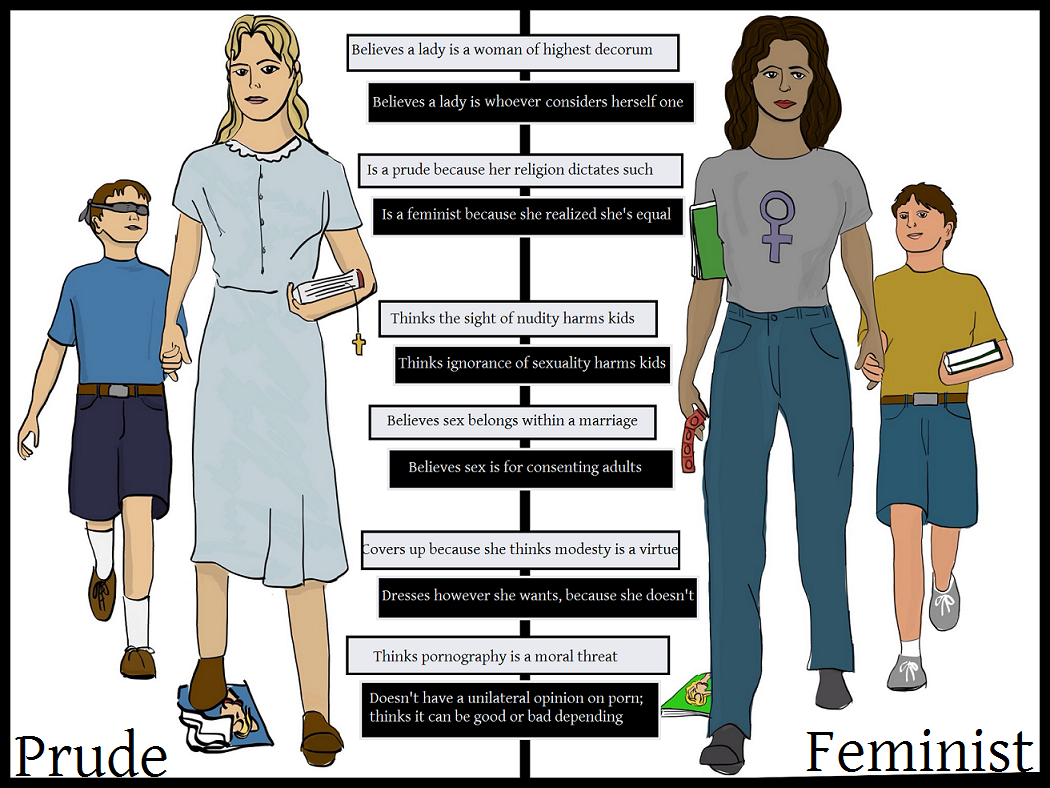
Obligatory disclaimer: This is a comic. It includes generalizations. Obviously there is significant variation among both prudes and feminists, and occasionally overlap between them.

I have, though, quite frequently seen the two confused. And I decided that “sex positive” and “sex negative” don’t do enough to describe the difference between them, so thought it would help to articulate those differences a bit more.

I know it can be confusing, the fact that both a prude and a feminist are likely to object to the following:

  • Being harassed on the street (or at work, or anywhere else)
  • Being exposed to porn without having expressed any interest in such
  • Depictions of rape, jokes about rape, rape itself
  • Etc.
However, the beliefs underlying the objections to these things are often quite different, which is not limited to the fact that the prude might have to first examine whether to hold herself responsible for acts such as harassment and rape based on her own immodest dress or actions before speaking out against them. 

So here’s a guide to some key distinctions– when confused, consult this handy chart. Good luck!

Common Ground

Common Ground published on No Comments on Common Ground

In formal logic, a premise is a plank of an argument. If your premises are true and the form of your argument is valid, then your argument is sound.

1. All men are mortal.
2. Socrates is a man.
3. Therefore, Socrates is mortal.

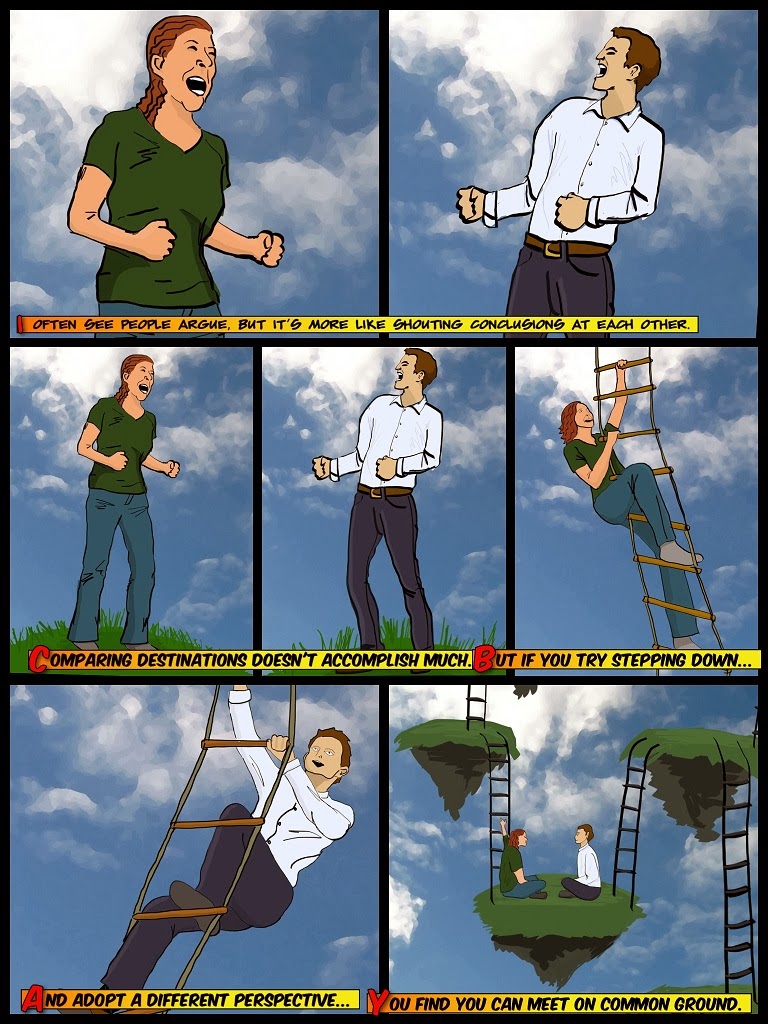
If you’re trying to persuade someone of your conclusion (“Socrates is mortal”), you’re not going to get anywhere if they don’t already agree with your premises (“All men are mortal” and “Socrates is a man”). The premises are the common ground on which you can meet your opponent and find what you can agree on.

If you can’t find any common ground– that is, agree on the premises– then you might as well not bother arguing. If you can find the common ground, then you have hope that your opponent will go along with you to your conclusion. Opting to shout across a chasm instead is a pastime that many people find satisfying for reasons that can be discussed elsewhere, but this is the real substance of argument.

Feminism and male rape

Feminism and male rape published on 1 Comment on Feminism and male rape

Last night I made the worst decision ever about what to read right before bed: an article in the Guardian entitled The rape of men, on the practice of male-on-male rape as a weapon of war in Uganda. I think you should read it. I think everyone should read it, for many reasons. Unfortunately my attention was then taken by the discussion in the comments, which mostly revolves around the topic of how the suffering of these male victims of rape is not taken seriously, and they are not given the attention and help that they need, because feminism.

Yes, really.

Apparently this is feminism’s fault because feminists insist on seeing men– all men– as the enemy, the perpetrators while women are the victims. The notion of men as victims, even of other men, conflicts with that, so feminists pretend that men don’t get raped, or that it’s okay when they do.

Note: I have never seen a feminist say anything like this.

What I have seen is feminists speaking about rapists as male as a default,  because most rapists by far are male. I have also seen feminists speaking of rape victims as female as a default, which is a lot more problematic. It’s one thing to give most or all of your attention to one kind of rape victim; it’s quite another to speak as if no other kind exists.

Most feminists I know do not view men as the enemy; they view rigid enforcement of gender roles as the enemy. And rigid enforcement of gender roles is why the Ugandan men in this article have been made to suffer well beyond and after their actual rapes, by the utter lack of understanding, sympathy, and support they have been given:

Today, despite his hospital treatment, Jean Paul still bleeds when he walks. Like many victims, the wounds are such that he’s supposed to restrict his diet to soft foods such as bananas, which are expensive, and Jean Paul can only afford maize and millet. His brother keeps asking what’s wrong with him. “I don’t want to tell him,” says Jean Paul. “I fear he will say: ‘Now, my brother is not a man.'”   It is for this reason that both perpetrator and victim enter a conspiracy of silence and why male survivors often find, once their story is discovered, that they lose the support and comfort of those around them. In the patriarchal societies found in many developing countries, gender roles are strictly defined. “In Africa no man is allowed to be vulnerable,” says RLP’s gender officer Salome Atim. “You have to be masculine, strong. You should never break down or cry. A man must be a leader and provide for the whole family. When he fails to reach that set standard, society perceives that there is something wrong.” Often, she says, wives who discover their husbands have been raped decide to leave them. “They ask me: ‘So now how am I going to live with him? As what? Is this still a husband? Is it a wife?’ They ask, ‘If he can be raped, who is protecting me?’ There’s one family I have been working closely with in which the husband has been raped twice. When his wife discovered this, she went home, packed her belongings, picked up their child and left. Of course that brought down this man’s heart.”

A gender role is an expectation on the part of your society that you will behave, appear, exist in a certain way because of your gender, which is the category you have been assigned because of your biological sex. People who reject gender roles partially or completely resist the idea that these societal job descriptions are binding. People who enforce gender roles insist that they are, and reject anyone who appears to violate them, deliberately or accidentally.

Such people may be viewed with anything from confusion to suspicion to patronizing sympathy to outright hate. Why? Because they didn’t conform to an expectation. An expectation which may range from stereotypical to arbitrary, and yet all over the world is enforced via cultural norms and traditions, mandated by religious dogma, and codified in law.

That’s not why these men were raped, but it’s why they suffer in silence and continued fear.

It’s why people joke about prison rape rather than gasping in horror at the thought of it.

It’s at the root of homo- and transphobia, misogyny, and misandry. These are all forms of hatred and fear stemming from unfair to grossly inaccurate essentialist assumptions about what men and women are, and are supposed to be.

And it doesn’t have to be this way. That is what bothers me most of all. We don’t have to be this stupid and needlessly cruel. But clearly, whatever else you can say about it, gender essentialism certainly is popular.

We– feminists, opponents of gender-based bigotry of all stripes– want that to stop. Right? Don’t we?

If not….you’re not on my side. And I sure as hell am not on yours.

And so #Inktober draws to a close

And so #Inktober draws to a close published on No Comments on And so #Inktober draws to a close

…Whew!

That was fun. And work. And fun.

I did a single ink-on-paper drawing every day for the month of Ink– I mean, October– for Inktober.

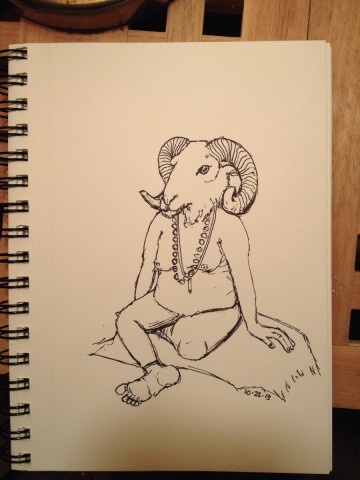
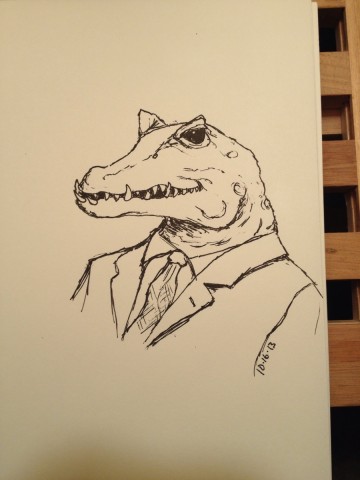
I had about an hour each day in which to do my drawing, which means on a few occasions I posted something with which I wasn’t completely happy. But hey, that’s part of the point– to create something without (much) fear, and just put it out there. In my case, by taking a photo using the Camera Plus app and posted it to Twitter and Facebook. Some examples below.

The entire month’s can be seen here: http://campl.us/user/GretchenKoch

Speaking of not valuing women

Speaking of not valuing women published on No Comments on Speaking of not valuing women

How I know this isn’t about freedom of speech

How I know this isn’t about freedom of speech published on No Comments on How I know this isn’t about freedom of speech

So, you want me to explain how I can tell that your Facebook page entitled “Should Miri Mogilevsky be murdered?” is not “an exercise in Free Speech”?

Okay, I can do that.

1. First of all, Facebook is a privately owned space on the internet, a web site. It’s not a public space, like a city park or sidewalk, where First Amendment protection of freedom of speech applies. Arguably there is no public space on the internet– only a very large collection of private spaces– but freedom of speech would also protect your right to express controversial beliefs on a web site, if that web site is your own. Is Facebook your web site? No.

It’s more like the internet equivalent of a meeting hall. The fact that you’re invited to camp out in the meeting hall and talk about interesting things with your friends, family, and total strangers does not mean you can do or say anything you want there– the owners still control the property since they, you know, own it, and can shut you down at any time, for any reason. They get to decide what kind of conversations you’re allowed to have, what kind of things you’re allowed to do in there. And they’re pretty lax about such things on purpose so that lots of different kinds of people feel welcome. That doesn’t mean they must put up with anything.  Right? Okay.

2. Secondly, it’s the responsibility of the organizers of any social gathering to put rules in place, if necessary– and when everybody is invited, it’s certainly necessary– which make it possible for people to meet and exchange ideas in an environment where they feel safe to do so. Right? Not only can you not yell “Fire” in a crowded theater; you can’t yell anything in most theaters, crowded or not, because it interrupts the show and makes it hard for people to participate in the thing they’re there to participate in. As do, amazingly, web pages asking whether a specific individual should be murdered.  So not only does Facebook have the perfect right to shut down such a page; as a site explicitly dedicated to social interaction it has a moral responsibility to do so.

3. Exercises in free speech are protests in speech form which entail speech a person has the right to make, but which is being threatened by an outside party, usually but not always the government. Generally, this speech entails sentiments which are critical of that outside party which said outside party does not want to be heard. This is why the first kind of free speech typically acknowledged to be protected by the First Amendment is speech critical of the government, political speech. However after that, the most obvious kind of speech that needs to be protected is speech critical of entities the government might want to squelch speech to protect, such as religious groups. As Voltaire reportedly said, “To learn who rules over you, simply find out who you are not allowed to criticize.”

Are you allowed, legally and socially, to criticize Miri Mogilevsky? Yep.

You may criticize her in a box. You may criticize her with a fox. You may criticize her with a dog. You may even criticize her on her blog, assuming you aren’t an asshole about it.

Death threats, on the other hand? Even death threats disingenuously phrased as a question?

You may not do those on her blog.
You may not do so on Facebook…anymore, though a lot of us were confronted with this before that came true:

Possibly because of how Facebook outsources its moderation duties?

And it has fuck all to do with free speech.

I know this because this is a threat against Miri, and not a response to any threats by her.

I know this because if you actually, for some weird reason, want to make a point that asking whether someone should be murdered is free speech, choosing a specific, real, private individual about whom to make that point on someone else’s private web site makes no sense at all, and simply obscures that goal beyond all recognition.

I know this because neither the form of speech nor the target of it make any sense at all, in terms of being an “exercise in free speech.”  All they accomplish is showing that the person who made this page (who is currently unknown, and who has made attempts via random IPs to avoid being known) doesn’t understand freedom of speech, or how it works, in the slightest.

In addition to being an asshole and a coward.

I really resent it when people hide behind ideals which I hold sacred and are genuinely threatened, in order to try and justify making others fear for their very safety. People like Miri, who, herself, actually does stand up for the freedom to espouse controversial ideas.

But not, unsurprisingly, for the freedom to threaten people’s lives on Facebook. Her own or otherwise.

Because that ain’t free speech.

#Inktober

#Inktober published on No Comments on #Inktober

According to Mr. Jake Parker.com, Inktober is:

Thirty-one days, thirty-one ink drawings.
 Are you ready?!
INKtober rules:
 1) Make a drawing in ink (you can do a pencil under-drawing if you want).
 2) Post it on tumblr (or Instagram, twitter, facebook, flickr, Pinterest or just pin it on your wall.)
 3) Hashtag it with #inktober
 4) Repeat (you can do it daily, like me, or go the half-marathon route and post every other day, or just do the 5K and post once a week. What ever you decide, just be consistent with it. INKtober is about growing and improving and forming positive habits, so the more you’re consistent the better.)
 That’s it!

Here are my drawings for the first five days, which I’ve been posting, and will continue to post, on my Facebook account and Twitter feed:

Fact and fiction on Minneha’s “Islam” bulletin board

Fact and fiction on Minneha’s “Islam” bulletin board published on No Comments on Fact and fiction on Minneha’s “Islam” bulletin board
Today’s editorial cartoon in the Wichita Eagle, drawn
by cartoonist Richard Crowson

Minneha Core Knowledge Magnet Elementary School is very close to where I live in Wichita, Kansas. The name “Core Knowledge” comes from the belief that there are culturally common things that students should learn about in order to be successful in life, which sort of makes you wonder why every school isn’t a Core Knowledge school.

Apparently some of what Minneha considers Core Knowledge is an understanding of the world’s major religions. I agree with that wholeheartedly, as did the Supreme Court in the famous 1963 case Abington School District v. Schempp, when Justice Tom Clark wrote for the Court:

[I]t might well be said that one’s education is not complete without a study of comparative religion or the history of religion and its relationship to the advancement of civilization. It certainly may be said that the Bible is worthy of study for its literary and historic qualities. Nothing we have said here indicates that such study of the Bible or of religion, when presented objectively as part of a secular program of education may not be effected consistently with the First Amendment.

The purpose of the dual religion clauses in the First Amendment is to prevent government institutions from advancing or inhibiting religion. The government, from the president down to the public school teacher, may not push religion on the public, and it may not prevent members of the public, private citizens, from practicing their own religions as they so choose, provided that such practice does not violate the law in any other regard.

Let’s keep this in mind while considering the flap at Minneha, where a bulletin board displaying the Five Pillars of Islam (five central acts of devotion for Muslim practitioners) was on display as part of the school’s effort to educate students on world religion…until a photo of the bulletin board was posted on Facebook apparently without context and with some very questionable comments. The bulletin board was then taken down until such time as the unit on Islam will be taught during the school year, when it will be….hung back up in the same place, with the same content?  A different place, and/or with different content? It’s hard to say at this point. I’m not sure Minneha knows. What’s cool about this case, though, is the fact that it presents an opportunity for Minneha to pass on some of that core knowledge to an audience that goes far beyond its student body– to their parents, to Wichita, to the members of our state governing bodies, and to the internet itself– about church/state separation and what it means. So in that spirit, let’s review some of the things that have been said about this event and sort them into two categories– fact and fiction– for the sake of education.

1. From the Take America Back Facebook page:

Verdict: Fiction
Seriously, guys, you couldn’t even spell the city’s name correctly? Wichita. Wichita. 

Yes, this is in fact an image of the bulletin board at Minneha. However, that’s where the truthy part ends. Minneha did not “ban all forms of Christian prayer.” No public school in America has “banned all forms of Christian prayer,” or all forms of any kind of prayer. It is perfectly legal to pray to Jesus, Allah, or Thor in public school if you want to. What isn’t legal is doing so on behalf of the school, using the school’s authority.

Abington v. Schempp was about this latter sort of prayer, more specifically about a ceremony Ellory Schempp’s school district held every morning in which students were required to hear or read from passages from the Bible. This effectively combined the school’s authority to educate with authority to indoctrinate, the latter purpose more appropriately belonging to Sunday than public school. Students may pray– or read the Bible– in public school of their own volition, if their doing so is not disruptive. The school may not do so for them, or encourage/compel them to do so.

2. From State Representative Dennis Hedke:

If you’re going to talk about Islam and make it sound like it’s another one of those religions that needs to be understood and contemplated by mankind, there’s a serious misunderstanding.

Verdict: Fiction.

Islam is a) a religion which b) needs to be understood and contemplated by mankind. At least, as much as any religion whose adherents make up about 20% of the world’s population does. Contrary to what Hedke seems to assume, it is in fact beneficial to understand belief systems which you yourself to not share. Firstly because they affect the behavior of others in the same way that your own beliefs affect your behavior, and secondly because every belief you currently have, you once did not have. If you had begun life with a strict policy against understanding belief systems you don’t currently share, you would literally believe nothing.

Most importantly, of course, the SCOTUS verdict I quoted above highlighted the difference between teaching religion and teaching about religion. Comparative religion is teaching about religions– saying “Here is what these people believe. Here are their rituals. Here are their traditions. Here’s the origin of their faith, according to them, and according to other people. This is a religion. This is a belief system which has causal effects in peoples’ lives, and therefore in our world. You need to know about it.” All of this is just as true of Islam as it is about Christianity, and yet I don’t think you’d hear Rep. Hedke complain that Christianity is not “one of those religions that needs to be understand and contemplated by mankind.”  I highly doubt that if the bulletin board had been about the Sermon on the Mount, it would have ever been posted on Take Back America’s Facebook page. The first big hurdle of comparative religion is, I suppose, acknowledging that there are people who believe in other religions as fervently as you might believe in yours. It’s definitely an important thing for mankind to understand.

3. From a hand-wringing blog post on PJ Media:

The questions presents themselves: First, why would a school in the middle of the Bible Belt present something like this? Second, will they give the same pride of place to Christianity? Judaism? Mormonism? Zoroastrianism? Third, where is the ACLU? They have been quick to sue over so-called establishment clause issues in school in the past, so why are they not hammering Minneha Core Knowledge Magnet Elementary School for this outrageous promotion of religion?

Verdict: Ignorant.

Sorry; I can’t declare these questions factual or fictional because they are, after all, questions. However they’re certainly leading questions, and they lead to an ignorance of how church and state separation works, and how the ACLU works. See, the ACLU is more than aware of Schempp, and they support it:

The history of religion, comparative religion, the Bible (or other scripture)-as-literature (either as a separate course or within some other existing course), are all permissible public school subjects. It is both permissible and desirable to teach objectively about the role of religion in the history of the United States and other countries. One can teach that the Pilgrims came to this country with a particular religious vision, that Catholics and others have been subject to persecution or that many of those participating in the abolitionist, women’s suffrage and civil rights movements had religious motivations.

Presumably the “same pride of place”– that is, bulletin board space– will be given to Christianity when that religion is discussed in Minneha’s instruction on religion. Judaism as well. Mormonism and Zoroastrianism probably not, because they are not considered among the big heavies of world religion. Zoroastrianism, no offense to Zoroastrians, barely exists at all at this point. It would be impossible to teach about all of the world’s religions, so Minneha teaches about the most significant ones worldwide. Seems reasonable to me.

Why would a school in the middle of the Bible Belt present something like this? Gosh, can’t you at least be pleasantly surprised that we did something right?

4. From the Wichita Eagle’s editorial board:

No, the misunderstanding is all Hedke’s. As President Bush said so often and so well after Sept. 11, Islam as practiced by the vast majority of people is a peaceful religion that respects others.

Verdict: Fiction.

Wait, wait, hear me out on this. I’m not saying that it’s fictional that Islam, as practiced by the vast majority of people, is a “peaceful religion that respects others.” I’m saying that this is not a defense of teaching about Islam in public schools, because it’s irrelevant. Public schools do not restrict themselves to teaching about egalitarian, ecumenical, “respectful” (whatever that means) ideologies. They teach about relevant ideologies, which depending on the course in question could include forms of racism, sexism, fascism, nationalism, etc.

If you want to teach about an ideology, you must make students understand why people believe (or believed) in it. That’s what it means to understand an ideology. It doesn’t mean that you must present the ideology as true or good, so it doesn’t matter whether the ideology is true or good– just that you represent it accurately and fairly. And do the same for Christianity, Judaism, Buddhism, and Hinduism, which I assume are the other religions to be taught.

There are two very good letters to the editor on the Wichita Eagle’s editorial page today on the matter of Minneha’s bulletin board, and I’ll conclude by quoting from them:

How does suppressing the study and understanding of the religion of about one-fourth of the world’s population, the majority of whom are not radicals, help our case? Aren’t we trying to expose our youths to all the knowledge they might need to critically consider the many facets of a problem? 

 William C. Skaer

 I’m sorry the school had to take down its display depicting the five pillars of Islam. I hope it will be able to replace it soon. The school staff and students know better than many adults that learning about different religions is a great way to move toward a peaceful world. They know that pretending religion doesn’t exist is a prescription for ignorance and bigotry later in life. They know that learning about a religion is not the same thing as believing. And the teachers know that the U.S. Supreme Court has upheld the right of public schools to provide education about religion at the same time that it rightly prohibits proselytizing. 

 Noelle Barrick

Barney Frank, atheism, and representation

Barney Frank, atheism, and representation published on No Comments on Barney Frank, atheism, and representation
Source

So Barney Frank came out last night– again. This time as a “pot-smoking atheist” on Real Time With Bill
Maher, when Maher gave himself that label and Frank responded by jokingly asking Maher which one he meant:

Bill Maher: … you were in a fairly safe district. You were not one of those Congresspeople who have to worry about every little thing. You could come on this show, and sit next to a pot-smoking atheist, and it wouldn’t bother you…
Barney Frank: [Pointing back and forth to himself and Maher] Which pot-smoking atheist were you talking about?

Maher was saying this in the context of asking whether Frank felt “liberated” now that he’s no longer in Congress, which is apparently the only time a congressperson can be liberated– when he/she is an ex-congressperson. Presidents can be liberated when they’re ex-presidents. They can start claiming to honestly believe and support things they should have openly believed and supported while in office, but it was too “dangerous” to do so (read: it might damage their chances of re-election). Gay equality. Ending the drug war. Secularism. Etc. It can leave a person wondering if “no taxation without representation” still applies when elected officials will only represent you when they’re no longer in office, that is, when it no longer matters.

Okay, yes, there has been only openly atheist sitting Congressperson– Pete Stark, who was actually the second longest-serving congressman until he lost his seat last year to another Democrat. But given that people without religion are believed to comprise roughly 10-20% of the American population, depending on how you define things, shouldn’t we be at least a little better represented than that? Among 535 voting members…maybe?

Whenever discussion of representation of demographics in government comes up, there is an inevitable argument which comes from people who– quite frankly– seem to oppose a particular candidate and everything he/she stands for, regardless of whatever demographic is applicable, which goes something like this: elected officials should represent the people, which means they should represent everyone. We shouldn’t want officials who represent only those like themselves, which means that demographic shouldn’t matter which means…basically, shut up and be happy with more old white heterosexual Christian men. (I’d say “wealthy,” but that’s so beyond being a given it’s already given before it was given.)

When you hear people talk about the “other” or “othering,” and they’re not talking about Lost, this is what they’re referring to– the unspoken assumption that there is a default, and the default represents everyone, whereas everyone else, that is everyone who is not the default, represents only their specific factions– whatever those may be.  Women can only represent women, black people can only represent black people, gays can only represent gays, secularists can only represent secularists, but straight white old religious guys? They are generic; they are Everyman; they can represent all of us.

…..

In reality, we all have experiences, and those experiences teach us. And those experiences are shaped by our demographics. Our race, our gender identity, our sexual orientation, our religious affiliation (or lack thereof), our class. Etc. No matter how empathetic a white man is, unless he’s John Howard Griffin, he doesn’t know what it’s like to be a black man. Griffin did not know what it’s like to grow up as a black male. The reason that colorblindness is misguided and actually racist rather than racism-alieving is that it ignores the experience conveyed to a person growing up as a human being in their particular race. Experience gives perspective; colorblindness pretends that it has all of the perspective (or that perspective doesn’t matter) without the experience.

Wanting to be represented is wanting people who have shared your experiences, and therefore have the ability to understand your perspective, standing for you. Representation is standing-for. When it comes to government, it is also making-decisions-for.

Unfortunately when it comes to politics, the populist trend pretends that we only want people who have had similar experiences to ours (or at least, what we would like to pretend our experiences have been) representing us, and so you get ridiculous feats of pretension like George W. Bush dressing up as a cowboy. We often use the word “pretension” to refer to elitism, but actually it’s closer to just pretending, in this case pretending to be just folks. To, of course, white heterosexual Christian middle class folks. They want to be represented. In regard to three out of four of those attributes, they always have been and always will be. It would be nice if they’d notice and pay attention to the fourth, as well as the equal need and desire for representation by the rest of us.

Or at least…stop saying that it doesn’t matter.

It matters.

The Revenge of the Nerds trope

The Revenge of the Nerds trope published on 1 Comment on The Revenge of the Nerds trope
Pictured: Nerd revenge

First, a disclaimer: I’ve not seen a single episode of Big Bang Theory.

I did, however, read an article about it entitled Why Geek Girls Are Tired of ‘Big Bang’ Bullshit, and contains a lot of complaints about sexism on the show. One of them in particular caught my eye:

In the season two episode “The Panty Pinata Polarization,” Howard and Raj use NORAD satellites to locate the contestants of America’s Next Top Model. They stalk these women, show up at their door, and then pretend to be the satellite repair men in order to gain access to the house and gawk at the women wearing bathing suits. That is not funny. That is not clever. That is downright creepy, and even when this is pointed out to the characters, they don’t care. You get the sense that they feel entitled to these women, like it’s their right as men to go try to seduce and ogle them, even if it requires illegally using military spy aircraft.

It stuck out because it reminded me of re-watching Revenge of the Nerds a couple of years ago for Film Sack, and seeing the same sort of thing. In case you haven’t seen Revenge of the Nerds lately– and I would not blame you one bit for that– there is a scene in which the nerd fraternity decides to literally drill holes in the ceilings of a sorority and drop cameras in, so that they can spy on the sorority girls as they undress. This is not the worst thing they do to this sorority, considering that the movie also has a “panty raid” scene, and the covert cameras apparently captured image of one of the sorority members– Betty– topless which nerd hero Lewis copies and glues into the bottom of pie tins sold at a carnival. That is, of course, before he dresses up in a costume that Betty’s boyfriend Stan had been wearing in order to seduce her in a funhouse at that same carnival, eventually revealing that he’s not her boyfriend at all. So yep, rape by false identity– but Betty’s character is presented as being fine with it, because I guess having the movie end with Lewis being arrested and charged with sexual assault would’ve taken things out of the comedy category.

But in both cases what we have is nerds spying on attractive women using their nerdy skills of surveillance, with the explicit or implicit understanding that this is okay because those women wouldn’t date the nerds anyway, perhaps might even be mean to them, and therefore the nerds are justified in taking what they weren’t given. Getting revenge.

Yes, the Big Bang Theory scene doesn’t sound nearly as bad as the surveillance of the sorority in Revenge of the Nerds, but really it sounds like the only reason it wasn’t is because Revenge of the Nerds was an R-rated movie in 1984, when showing bare breasts was not just acceptable but practically obligatory. I don’t exactly get the feeling that it’s because Hollywood looks back at that movie with any particular feeling of revulsion or regret. As, you know, I did when watching it two years ago.

So I’m wondering– is this actually a trope? One alive and well, long after it had no business being so– nerds feeling wronged by the injustice of existing in a world where attractive women won’t sleep with them, and therefore being justified in doing whatever it takes to get a good look (or more) at those women, without their consent if necessary?

Gosh, I hope not. And if so, let it die already.