Skip to content

Casual Sunday. Casual everyday.

Casual Sunday. Casual everyday. published on 4 Comments on Casual Sunday. Casual everyday.
Spotted at infidel753.blogspot.com

I am not one of those people who enjoys dressing up. I do not fault them for it, and wish them all the best, but I am not one of them. Sure, it can be fun for a wedding or fancy dinner, but generally speaking I am at my happiest in a t-shirt and jeans. Or better yet a tank top and jeans, because I like my arms to be as free as possible. There are particular brands of clothing that I like, but not because they are expensive– because they have a track record of producing durable clothes with nice textures. I rarely wear skirts and almost never wear heels, though again I don’t have a hard and fast rule against them. I just like to be comfortable. I spent the final two years in college barefoot about 80% of the time.

I would like to dispense with the notion that dressing formally conveys respect. Sure, you wear a nice black dress to a funeral. But I don’t think that occasions in which it is mandatory to dress up out of sheer tradition should be necessarily treated that way. For example, I’d love to have a president who never wears suits. If female, I’d love to have a president who doesn’t even wear dresses (but of course we’d have to get one first). I would love to see Congress convene casually, clad in attire that might have come from Target or even a thrift store. Hell, I’d like to see actors and actresses show up to the Oscars that way! Can you imagine? That might be the downfall of the fashion industry, but it would be a beautiful downfall indeed.

One good thing about dressing casually is that t-shirts and jeans don’t really go out of style. So you don’t have to buy a lot of them, though you could. Yes, trends in different styles of jeans come and go, but you can wear the same basic pair of Levis in 2012 that you wore in 1998, provided they still fit. Trying to be always on-trend and fashionable is a good way to spend a lot of money and acquire a lot of clothes that you won’t wear again after this year. Clothes that you have to look in the mirror while wearing, and think “Wow, I don’t look especially good in this…but at least I’m trendy!”

Lastly, dressing formally does not make you more virtuous, knowledgeable, or trustworthy. Unfortunately everywhere you look this myth is reiterated, and I would love to see it banished completely. Let’s have experts interviewed on the news while clad in shorts. Heck, news anchors clad in shorts…or I guess tank tops, since you don’t generally see their legs. Talking heads of all sorts being casual from the neck down. That would actually force us to consider what they’re saying by its content, rather than instinctively conclude without explicitly saying it to ourselves “This person looks nice; he/she must know what he/she is talking about and generally be a trustworthy person.”

That would be nice. But I’m not holding my breath– not for that to happen, and not to get my jeans on.

Weekend web readin’

Weekend web readin’ published on No Comments on Weekend web readin’

I’ve been slacking with the interesting articles sharing lately. Let’s fix that.

From The Raw StoryGlobal report: Decriminalization does not increase rates of drug use

Money quote:

The report, A Quiet Revolution: Drug Decriminalisation Policies in Practice Across the Globe, “looks at over 20 countries that have adopted some form of decriminalisation of drug possession, including some States that have only decriminalised cannabis possession.” The studies’ objective was to examine all existing research and attempt to establish whether communities that adopted decriminalization policies saw in an uptick in use. “The simple answer,” said the report, “is that it did not.” After examining the 21 countries and their “decriminalization profiles,” including the U.S., Mexico, Australia, the Netherlands, Estonia and more, the global study concluded that “many countries adopt models that are ineffective, unworkable, or in some cases which result in greater harms for those who use drugs and for society more broadly,” but that ultimately a country’s policies concerning drug legalization and enforcement have “little correlation with levels of drug use and misuse in that country.”

From Greta Christina’s BlogUnmixing Messages: Nudity, Sex, and Hooking Up at Atheist Conferences

Money quote:

So yes, if you’re interested in hooking up at atheist conferences, knowing which other people might share this interest — as an interest in general, or with you in particular — is not always obvious. So if you’re at a conference hotel bar, and you’re trying to figure out which people there also want to hook up — and which among those number might be interested in hooking up with you — how are you supposed to know? You ask them. Not right off the bat, of course. There are some settings in which etiquette permits introducing yourself to strangers by asking if they want to have sex with you — but hotel bars at conferences are, as far as I can tell, not among them. So you start by conversing on other topics. You see if you establish a rapport. You behave in slightly flirtatious ways, and see if these are met with a withdrawal or a response in kind. If it seems that things are moving forward with this, you behave in slightly more flirtatious ways. If this seems to be moving forward, and you want to try establishing physical contact — you ask them if they would be interested in that. This seems to be a tricky concept for some people. So I’ll spell it out again: If you are interested in having sex with someone, the person you need to consult about it is the person you’re interested in. You do not, however, consult the question of whether some atheist bloggers posed nude for a calendar. Or whether they participated in a mock scientific experiment designed to make fun of the hypothesis that female immodesty causes earthquakes. Or whether they title their quick-summary-of-interesting-links blog posts with the mildly double-entendre title of “quickies.”

From Gamasutra: Video games and Male Gaze – are we men or boys?

Money quote:

Male Gaze, then, has to do with the relationship between a heterosexual male viewer, and a female that is being viewed. The theory poses that in media like film, photography, and I would here add games, when a heterosexual male is in charge of the viewing of a female, the resulting media necessarily reflects that male’s gaze. In the case of games, this may be more of a collective gaze.  In cinema, for example, if a camera follows the curve of a woman’s body, or keeps her cleavage in primary screen real-estate, that is an example of Male Gaze. Or in games, consider the Golden Axe Beast Rider trailer in which the camera pans down from the protagonist’s butt to reveal enemies in the distance. This was a conscious choice someone made when creating this trailer. Note also that the two top-rated comments are in reference to this scene, which altogether should give you a pretty good idea of what Male Gaze means, and the simplest forms it takes. [Note: the original version of the trailer linked is this one which has more views, and has the mentioned top-rated comments. It was not viewable in the U.S., so was replaced. -ed.]Some folks argue that these women are strong, kill lots of men, and thus are positive characters. But take a look at these ladies from Tera Online. They may have crazy superpowers, sure. But they are nearly naked to the eye of the player, and the target player here is clearly male. All their power is stripped away; their primary function, the reason they were created, is to be sexy for a male gaze, to draw males to stare at them. When you look at that picture, do you see “powerful mage” or do you see “hot girl.” Let’s be honest here! I know what I see. 

From Dr. Nerdlove: On labeling women “crazy”

Money quote:

There are certain words that are applied to women specifically in order to manipulate them into compliance: “Slut”, “Bitch”, “Ugly/Fat” and of course, “Crazy”. These words encapsulate what society defines as the worst possible things a woman can be. Slut-shaming is used to coerce women into restricting their own sexuality into a pre-approved vision of feminine modesty and restraint. “Bitch” is used against women who might be seen as being too aggressive or assertive… acting, in other words, like a man might. “Ugly” or “Fat” are used – frequently interchangeably – to remind them that their core worth is based on a specific definition of beauty, and to deviate from it is to devalue not only oneself but to render her accomplishments or concerns as invalid. “Crazy” may well be the most insidious one of the four because it encompasses so much. At its base, calling women “crazy” is a way of waving away any behavior that men might find undesirable while simultaneously absolving those same men from responsibility. Why did you break up with her? Well, she was crazy. Said something a woman might find offensive? Stop being so sensitive.

From Dispatches from the Culture Wars:  SCOTUS Overturns Stolen Valor Act

Money quote:

The Stolen Valor Act punished such claims with a fine and up to a year in jail. The government argued that false statements do not have First Amendment protection and cited a long line of cases with language indicating that. But Justice Kennedy’s majority opinion, joined by Justices Breyer, Ginsburg, Roberts, Kagan and Sotomayor, notes that all of those examples “derive from cases discussing defamation, fraud, or some other legally cognizable harm associated with a false statement, such as an invasion of privacy or the costs of vexatious litigation.” The distinction should be obvious. A lie that deprives another person due process (perjury, for instance) or harms them against their will (fraud or defamation, for instance) is legally actionable, but that does not mean the government can, under the First Amendment, punish any and all false statements that do not harm others. By such reasoning, the government could police every personal interaction imaginable.

…Not yet

…Not yet published on No Comments on …Not yet

I often say that offense is a valuable thing– as appealing as it might seem, you really wouldn’t want to be a person who isn’t offended by anything, because that would mean losing your humanity. People who go through life being oversensitive are in a bad state because they’re suffering more than they really should, but people who develop a rock-hard emotional shell and take nothing seriously have trained themselves to be callous and uncaring, which isn’t good either.

Sometimes I re-think that, however. Such as when I see that someone created an interactive game allowing the player to beat up a woman for wanting to make a video series on sexism in video games.

Does it get easier?

Does it get easier? published on No Comments on Does it get easier?

Gaming as Women has an excellent advice post up today. The letter-writer wants to know if it gets easier to be a feminist:

Right now it is very hard to be a feminist when I am constantly told that I shouldn’t be one, that I’m doing it wrong somehow, and that I’m ruining everyone’s fun. I can’t unsee misogyny or the kyriarchy anymore, and now I’m starting to hate myself for seeing problematic things all the time because no one I’m with ever sees it with me or even wants to. I work in the game industry so I’m immersed in sexism on daily basis, but some people aren’t and just simply can’t see why I am the way I am. How can I tell if I’m a bad feminist? Or is this just how it feels constantly? If so…does it ever get better?

Melody, Elin, Vivian, Jess, and Dympha all give very good answers to this, which you should read. Their answers include two important reality checks: 1) that in one sense being a feminist today in the West is far easier than it has been further back in history or elsewhere in the modern world where women have it a lot worse, and 2) we all have our biases and prejudices, which is good to keep in mind when addressing those of other people so that you can avoid shaming the whole person while talking about a particular thing they said or did that displays bias or prejudice. Right on the money with both of those. However I would also point out that the historical/cultural comparison shows how it can be more difficult to be a feminist in a modern Western context, because it’s much easier to see and acknowledge a disparity in how men and women are treated when, say, half of them can’t vote or own property than when half of them tend to be represented primarily as sexual objects. You often have to start by getting a person to agree that gender representation even matters, and head off the assumption that even discussing it means that you don’t care about those poor women in Saudi Arabia who can’t go out of the house without being completely covered and why don’t you care about them anyway? If you’re going to be all fired up about treatment of women, why not focus on that?

Well, we are. We’re capable of caring about more than one thing at a time, you know.

Once that hurdle is cleared– if it’s cleared– you can talk about representation, and face the accusation of wanting to ruin everyone’s fun. Because feminists, as you know, don’t like fun. They enjoy misery and want everyone to be miserable with them, which is why they’re even less funny than women are generally (thanks, Adam Carolla). Actually feminists like to have fun and laugh just as much as anybody, but as feminists they tend to notice when that “fun” is at the expense of women and feel compelled to say something about that. It’s understandable that making bigoted jokes and viewing the sex you’re attracted to as existing mainly for your own purposes is fun, but it’s also unfortunate that it’s fun, because eventually the people who have been made the butt of those jokes and the object of that…objectification are going to speak up. Because they want to have fun too, and that’s getting in the way.

This is an impossible thing to make people (yes, including women) understand if they can’t manage to switch perspectives a bit. You’re marching right up to people who are enjoying something just the way it is, and demanding that they change it, and they can’t see why. It seems unfair. It seems pushy and entitled. Nobody wants to view themselves as sexist, so they will fight tooth and nail against the mere suggestion that there’s some sexism present in the movie/TV show/video game/comic they’ve been enjoying so much for such a long time. And if you change it to rectify this “bias” you see, that will make it worse. It’s just fine as it is, leave it alone.

I get it.

In the discussion on feminism and sexism in all things geekish, I’ve seen a number of attempts to force empathy on people by getting them to see what it would look like if men in movies/TV/video games/comics were depicted like women are. Male superheroes wearing the costumes of female superheroes and posed all coquettishly, male characters on the covers of science fiction and urban fantasy novels posed and dressed like the female characters, and so on. I’m not sure if it really does any good, aside from providing amusement for many and pointing out with stark clarity that men who are depicted as wanting to look sexy will look ridiculous even if they’re not also dressed revealingly (and all the moreso if they are).

Which, now that I say it, should be helpful since the point being made is that women appear ridiculous if they’re trying to look sexy as a default. If they’re trying to look sexy while fighting demons on a burning countryside, or sneak past guards and break into an enemy’s compound, or bound through the jungle pursued by wild animals, or wage a battle against an aliens species, or just generally trying to save the world. It’s not a Revlon commercial; it’s more like the Army. Portraying women as if they have confused the latter for the former makes them look stupid and inept– they styled their hair, put on makeup, and wore their most revealing bustier and six inch heels to kick a cave troll’s butt in battle. What were they thinking? That doesn’t say “strong woman;” it says “When they said Dungeon, I thought they were talking about a night club.” This does not do women a favor. Sometimes they do want to dress in bustiers and six inch heels, and there’s nothing wrong with that, but making them do so inappropriately is not good. It says that their being sexy is the most important thing about them, all the time. It doesn’t have to be that way.

If you can get to this point and your fellow conversant is still listening, my hat’s off to you. Getting to this point is hard. That’s because of all the hurdles preceding it which have labels like “It’s just a game; get over yourself” and “We like it this way, and there aren’t as many of you” and of course our old friend “Don’t you have something more important to worry about?” That’s what our letter-writer is dealing with, and she has my sympathy.

But the question remains, though– does it get any better? My answer: We’ll have to see, won’t we?

Operation: tweezin’ for a reason

Operation: tweezin’ for a reason published on No Comments on Operation: tweezin’ for a reason

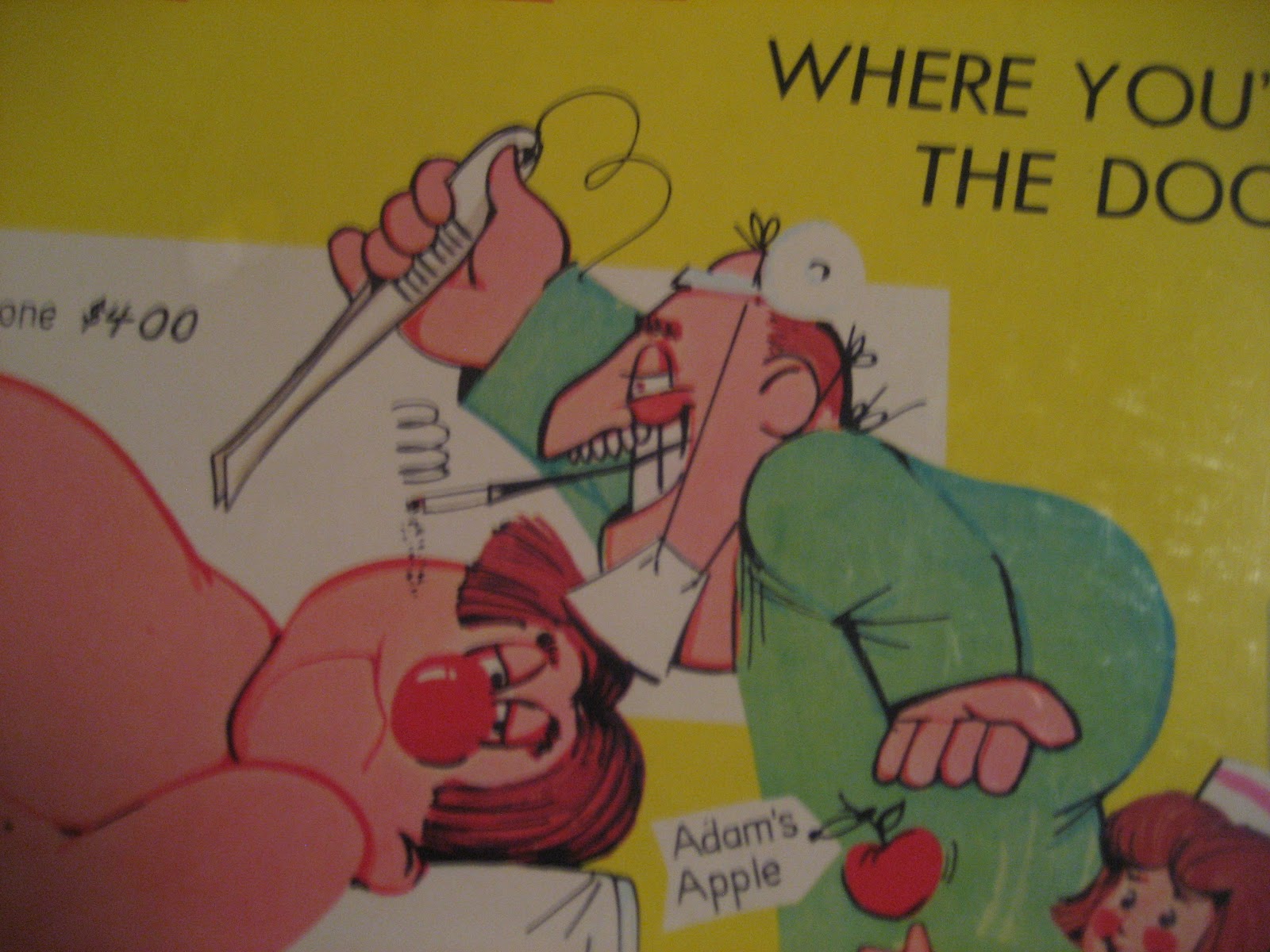
So my nieces are going to visit my parents soon, and my mother was thinking of games for them to play. She brought up the game Operation, which was in the basement. “Operation?” I said. “Yes, I got it for you and your brothers when you were kids, and I was keeping it in the basement but forgot where it was, so I ended up getting another one.” So the first one stayed in the basement, for about twenty seven years, unopened.

Einstein-looking doctor’s floof of white hair is obscured by the price tag:
$8.99 from TG&Y, a five and dime store that doesn’t exist anymore

You might be able to guess my response– I said “Don’t open it!” and went online to do some research. I am certainly no expert on collectibles, but if there was any sort of chance that the game might be one, I needed to investigate.

In addition to being unopened, the most interesting and “collectible” (as in, weird and different) thing about this edition is the fact that the image on the box includes a doctor who is smoking. And not just smoking, but smoking a cigarette in a long holder, the end of which is actually ashing down onto the face of the patient he’s operating on.

Clearly from a different time– but I guess if he has a literal
Adam’s apple, a little ash in the face is the least of his problems

If you look for Operation on eBay, you will see a number of copies of the game that market themselves as “smoking doctor” editions. At least one of these claims to also be a first edition, supposedly 47 years old– the game first came out in 1965. However, according to this guide that particular copy isn’t as old as that, and neither is my mom’s:

The first Operation game was designed by John Spinello for Milton Bradley and released in 1965. In this first release there is a smoking doctor on the box. BUT WAIT! Think that if the cover has a smoking doctor it’s an original? WRONG!! The original has a slanted key through the Milton Bradley Logo. It also says 1965 on both the box and the game board.  Also, on the original, the instructions are printed on the inside cover of the box, not in a paper pamphlet.  Another major characteristic of the original is that it says in green lettering; Electric Game where you are the doctor. The games that are not originals say in bold black lettering; Skill Game where you are the doctor.

Bummer. I’m not going to open it up and see if there’s a 1965 on the game board or where the instructions are, because it already fails the slanted key and the green “Electric Game” tests. And I know my mother didn’t buy the game before 1980.

Here’s something else you might not know about Operation– the game has been re-made for so many different things! Here are the ones of I’m (now) aware:

According to Wikipedia,

A Doctor Who version of the game was released in Great Britain, where players get to “operate” on a Dalek in order to (from the product description) “make it strong enough to take over the world. But be careful… if you damage it’ll quickly tell you with one of its terrifying phrases! Whether it’s the Targeting Sensor that you need to operate on, or the Manipulator Arm, you’ll need a steady hand and nerves of steel!”

Who knew? I knew it was a widespread game, but I didn’t know that kids would be encouraged to perform mock surgery on every popular character they’d see in movies and on TV.

No, it was never actually a favorite of mine…I was okay at it, but never properly appreciated the thrill of risking a battery-powered sudden vibration and loud buzzing noises if I failed to tweeze a plastic bit of something out of a hole just right, without touching any of the edges. I did however learn to be adept at tweezing, which is a skill anyone can benefit from. The game is still going strong, though it’s now sold by Hasbro rather than Milton Bradley. So if you’d like to get your tweeze on, there are many options available for you.

How to cash in on internet guilt giving

How to cash in on internet guilt giving published on No Comments on How to cash in on internet guilt giving

Note: In case, for some reason, it isn’t clear that I am not trying to disparage any of the people discussed here in the slightest, let me say that I am not trying to disparage anyone discussed here in the slightest. I’m going to describe a phenomenon and how I think it has worked or could work to their benefit, and how I think that happens.

Recently, I’ve seen some people being given a really hard time. Publicly, on the internet, where the world is watching. I don’t mean to diminish the amount of suffering any of them has experienced by comparison with the other two– that’s not the point. The point is that they’ve all been attacked in ways that witnesses recognize as obviously harmful, and what those witnesses have done in response.

  • Jessica Ahlquist is a high school student who realized that a prayer hung on the wall of her public school constitutes a violation of the First Amendment. She decided to sue the school district to have it taken down, and at that moment became hated by classmates, teachers, local politicians, and generally people who consider it a violation to have endorsements of religion removed from public schools. She received a deluge of harassment via Twitter and snail mail, including death threats. The sixteen year old endured a constant stream of hate both before and after she won her lawsuit last year, and probably still does today. A state representative called her an “evil little thing” on a radio show. That phrase was re-appropriated by humanists online who had been following Ahlquist’s story and sympathized with her, and placed on t-shirts sold to raise money on her behalf. The shirts raised $8,320 for a scholarship fund. A fund was also established to just donate money toward her education, which raised $48,353 in total (I don’t know whether that amount includes the t-shirt funding or is separate). 
  • Anita Sarkeesian, about whom I’ve written plenty already, began a Kickstarter project to do a video series on sexism in video games which was greeted with a furor not unlike that about the ending for Mass Effect 3. But in her case it was personal. The promotional video she did for the project was posted on Youtube, where it was blasted with sexist trolling. There were efforts made to cancel her account based on false allegations that it violated Youtube’s terms of service. Her Wikipedia page was defaced with sexist and racist language and  pornographic pictures, and– you could see this coming, right?– she received a torrent of insulting and hateful comments on Twitter, Facebook, some of which included threats of sexual violence. People who were already interested in her project were joined by those who were horrified to see the treatment it– and Sarkeesian herself– received. Ultimately Sarkeesian’s $6,000 Kickstarter project turned into a $158,922 one. 
  • Karen Klein is a 68-year-old bus monitor from New York whose bullying by a group of 7th-graders was caught on video and posted to Facebook, and then Youtube. In the video the students– four boys– call her fat and ugly, and basically suggest in all of the creative ways they can summon that she’s a worthless human being. The video of Klein spread like wildfire even though it’s commonly described as “hard to watch,” and Klein appeared on the Today Show to discuss her experience. A man named Max Sidorov (who doesn’t have any connection to Klein that I can tell) started a fundraising project on Indiegogo to send her on vacation. His initial goal was $5,000, but the project is currently at $677,046 and has nineteen days remaining. 

An article in Forbes by Todd Essig describes why raising so much money for Klein is so easy:

The genius of the “Lets Give Karen -The bus monitor- H Klein A Vacation!” page is the way it made use not of individual psychology nor group psychology but of emerging network psychology. It first created a psychologically aversive state and then provided a relatively frictionless path to feeling better. It’s impossible to watch the video and not feel poisoned and horrified. You watch it and inevitably feel compelled to do something, anything, to get rid of that horrible feeling inside. But what can one person do to improve the human condition? And then, right there on the side of the screen there’s a bright red-pink button shouting at you and everyone else, “CONTRIBUTE NOW.” With a single click you can join the network of the virtuous and be on your way to redemption.

No need to even pick up the phone. Just click, donate, feel good. Insta-altruism. Altruism creates a pleasant feeling in the person who gives as a result of having passed something tangible to the person in need, and that’s why we do it. Our feelings are triggered by the unpleasantness of witnessing someone suffering– even if not in real time– and improved by doing something to help them. End of story.

Except…well, all of the other stuff. Right? Even with the ability to help people instantly, there are certain triggers that make us more likely to instantly help some people rather than others. Neuroscientist Joshua Greene dug up some pretty interesting information on how people regard personal vs. impersonal moral dilemmas. He showed that according to our brain patterns, there’s a clear difference between our reactions to the two– that there’s evidence of a gut impulse which makes us pay more attention and be more sure about helping people in need who are right in front of us rather than distant, even if the distant party has a greater need. So it stands to reason that people are more inclined to help someone, even generously, when the evidence of that person’s suffering is right in front of your face. Greene theorizes that this tendency has evolutionary roots– that we simply didn’t have an adaptive incentive to empathize long-distance because it wasn’t necessary for our ancestors who only had to interact with members of their immediate group.

The internet certainly accomplishes making it seem as if people who are actually quite far away are in fact part of your immediate group, and therefore increasing the likelihood of you feeling the pull of sympathy when seeing them suffer, or seeing people act toward them in ways that would make you suffer. But the suffering–demonstrated or implied– needs to take a certain form in order to get a significant response, and here’s what I think the maximally effective form is:

  1. Be attacked. Have something horrible happen to you as a result of the deliberate actions of others, when you were either minding your own business or in pursuit of a goal that a select audience will find sympathetic. The target’s situation should be familiar or appeal to the audience’s sense of justice, but preferably both. 
  2. The target should be female. I’m sorry guys, but this seems to matter.
  3. The target should not be obviously well-off, so that it doesn’t seem as if she doesn’t need and wouldn’t appreciate financial help.
  4. Have someone set up a way for unconnected strangers who were made privy to this attack to help out financially. The easier the better, and it’s also better if that person is not the target. The fund-raiser should be as distantly connected to the target as possible. 
  5. Here’s what concerns me most– the distribution of the target’s experience, and the appeal by an objective third party, should not happen too often. Otherwise there’s a risk of desensitizing the audience and making them less willing to care, and hence to give. 
This last point is a big indicator of why internet guilt giving is not the solution to the suffering of most human beings. Even if we could videotape every last one as he/she is being attacked and made to suffer and post them all on Youtube, we would not succeed in getting most people perusing Facebook or Twitter in the morning to care. We would simply go into appeals-for-sympathy overload, and it would continue to not work as well for people who are suffering the most– and whose televised experiences Sally Struthers has narrated, which haven’t succeeded in providing for the care of children in third world countries by first world adults. 
I’m not trying to be cynical, and I’m not trying to shame. Really. Not even in the way Essig alludes to at the end of his article, which is to say

On one hand I say bravo. Karen Klein deserved a break. And she got one by winning the social media lottery. But on the other, for those who donated, those who may have taken an online simulation of human contact to be the same as the actual thing, I fear the benefit will be short-lived. I fear a crowd-sourced donation will feed the souls of those giving about as well as a Farmville harvest can feed someone’s body.

I can’t know this, of course, but I think this is the comment of someone who communicates online but doesn’t form relationships on it. The crops and animals you care for in Farmville are not real. The people you form relationships with online are. It might be tempting to focus the few dollars sent via Paypal and say “Relationship? That?” but that misses the point. The relationship is in what triggers a person to send that money in the first place, and the satisfaction he or she feels in having helped a real person in real life. Essig suggests that making such a donation is an act performed in lieu of helping someone in “meat space,” but I would say that this is actually evidence of the bias Joshua Greene describes– that in-person altruism is somehow superior to helping someone across a distance. There certainly isn’t any reason why a person can’t do both, or that his or her entire social life should be summed up in the decision to click a button and send a suffering stranger some cash.

Soul-starving? Souls are supposed to be immaterial, aren’t they? And yet the aid given by an online donation is tangible, based on real feelings and for the purpose of real benefit. I see nothing vacant or vacuous about that.

ETA: Hat tip to Dr. X

Why, when talking about minorities in gaming, you talk about WoW

Why, when talking about minorities in gaming, you talk about WoW published on No Comments on Why, when talking about minorities in gaming, you talk about WoW

This post is based on a comment I made on an article called “Women in the World of Warcraft: The Bigger Picture” by Will at Skepchick (yep, it’s not just chicks!). There were a lot of reactions to the piece, some of them quite…vehement, but a commenter going by the name of Sawhoof who described herself as a twenty-something lesbian fundamentally rejected Will’s decision to use World of Warcraft specifically as the focus for a discussion on diversity in video games, and it got me thinking. And then writing. I don’t necessarily agree with the criticisms Will makes regarding WoW, but absolutely agree with the decision to make it a focal point when talking about representation of minorities– specifically in this case LGBT people and women– in video games. What I said was…well, here. What follows is a slightly modified version of the comment:

Sawhoof wants to know why Will is bothering to write about WoW when WoW is, as Sawhoof sees it, not a very good game and one that is on its way out. She also says WoW is as “generic as a knights in shining armor game gets.” Sawhoof, as a lesbian who plays video games and WoW specifically, presumably agrees with Will on most of what he’s said here, yet with inexplicable hostility she asks why what he’s saying is relevant. Here’s why it’s relevant:

1. WoW is a living game, a game with an expansion coming out later this year, and one which 10.2 million people all over the world continue to play and enjoy. And they pay $15 a month to do it, making it for them what Mike and Jerry of Penny Arcade have described as a “WoW utility” (you pay for the phone, the heat, the water..the WoW). It is the MMORPG that people who don’t even know what an MMORPG is, or what it means, still know about. It is also in my opinion an amazing game and one I continue to enjoy playing, but even if that wasn’t the case it would still be obviously important. If you’re going to talk about how minorities are portrayed in a video game that matters, and you’re just going to talk about one game, there is no better choice.

2. If WoW is really as generic as it gets, that makes it even more important to talk about it because that means that what it presents is at least in some way normative. “Generic” meaning, after all, “representative of a genus.” If a game sets the standard for games of its type, you want the standards it sets to be good!

3. A video game is a fictional place, yes—it can be anything the writers want it to be. That’s why what the writers want it to be matters. Everything they create is on purpose! Nothing has to be other than the way they want it to be, in terms of content. So while there may be elements of the story that make it necessary to present minorities badly or not at all, we can identify the gratuitous instances of such and ask “Why does it have to be this way? And if it doesn’t, why not change it?”

4. Sawhoof’s answer to that question is “Capitalism.” That is, that Blizzard has no incentive to portray minorities better because it’s not good for their bottom line. This argument always mystifies me because it assumes that people who play its games are a bunch of bigots and won’t be as happy with a game that doesn’t encourage prejudice! What’s the evidence for this? Sure, lots of video game players are sexist/racist/homophobic etc., but that doesn’t mean that the games they play should cater to these positions, and don’t depress the living hell out of me by suggesting that it’s financially necessary for them to do so.

5. An MMORPG isn’t just a story; it’s a world. It’s right there in the name—World of Warcraft. It’s hard to change the world we live in, but a whole lot easier to change one that was deliberately created, and whose creation is ongoing. So the choices made about what players are allowed and encouraged to do and how their characters are allowed/encouraged to look, as well as how NPCs behave and look, are very important. Some people want to play a radically different character in a game than they are in reality, but a lot of people want at least the option of playing something closer to who they really are. They also want to see characters who don’t exist in reality, but if those fictional characters are going to resemble reality in every way except that they’re homogeneous in a way that reality isn’t, that’s a turn-off. Sure, make people who are humanoid pandas! I’ll play one, because I’m one of those people who never chooses to play a human if other, fictional races are available (my first main was a troll). But if you’re going to have humans, please make them as diverse as actual humans actually are, or have a good reason why you can’t. Otherwise it looks like you don’t like the diverse forms that humans actually come in, and people whose forms aren’t represented tend to be offended by that thought.

Template for my reaction to discussion threads on sexism

Template for my reaction to discussion threads on sexism published on No Comments on Template for my reaction to discussion threads on sexism

Look, a thread about an article addressing sexism in ______. Let’s read the whole thing through.

I see that participants in ______ took their time to read the article, avoided making pointless ad hominem attacks against the real or imagined authors of it, and carefully considered whether the criticisms made reflected the presence of a real bias in ______ which should be addressed and rectified, or whether perhaps they were well-intentioned but mistaken interpretations of _______ which deserve a thoughtful rebuttal rather than effectively saying “You’re complaining about sexism in ______? Well, I’ll give you some sexism to complain about!”

Oh wait…that’s not what happened?

What a surprise.

It’s very simple, really. Really.

It’s very simple, really. Really. published on No Comments on It’s very simple, really. Really.

So the conversation about sexual harassment at skeptical conferences continues on Freethought Blogs, and doesn’t show any sign of ending soon. And it has turned to the topic of what constitutes sexual harassment is generally, what people in charge can do about it, and how to avoid being guilty of it. That’s a good discussion to have…it’s just that it’s not a new discussion, and it’s not a radically different concept from how sexual harassment is handled in the workplace, though it’s kind of bizarre how many people are acting as if it is.

A new person was added to the network, Thunderf00t (no, I don’t know why he spells it like that) who makes Youtube videos on skepticism. In his second post ever as part of the network, what Thunderf00t did was effectively take a flying leap and land right in the middle of a very complex and lengthy discussion, and in doing so he splattered ignorance all over the place. Ignorance of the specific conversation about TAM and DJ Grothe, which is entirely understandable and which I don’t think anyone needs to have knowledge of in order to talk about sexual harassment and sexual harassment policies generally, but also a much less forgivable kind of ignorance– that of what sexual harassment is, and why it still is that even when you add 1) alcohol and 2) fun. Thunderf00t is, you see, quite certain that policies against sexual harassment will be the end of fun, especially while drinking alcohol. So basically he did a big cannonball dive of “I don’t care to even find out what you guys think or have been saying first” right in the deep end of rational discussion, and then he did so again with a follow-up post about PZ Myers after Myers pointed out what was wrong with the first one.

To wit:

And maybe most pertinently, PZ explaining why his policy wouldn’t be a killjoy.

 If you want to chew on some woman’s leg, no, you don’t have to consult the conference handbook.”
“You have to fucking consult the woman.”

Facepalm.  Yes this is exactly why you are killjoys to the VAST majority of civil, honest respectable folks.  IT WAS IN A BAR.  I enjoyed it, she enjoyed it (she left a comment specifically saying so, just to remove all doubt (see MyLegMYCHOICE!)), AND I NEVER HAD TO CONSULT HER, NOR APPLY FOR PERMISSION FROM THE CONFERENCE, IN ORDERS SIGNED IN TRIPLICATE SENT IN, SENT BACK AND BURIED IN SOFT PEAT FOR THREE MONTHS AND RECYCLED AS FIRELIGHTERS etc etc.  Indeed had I had to fill in the paperwork along with ‘permission to bite your leg in a horseplay photo’ form under conference interpersonal contact rule 144 b) 2, it would have probably kinda killed the moment, and neither I nor she would have got our mild thrills for the night.  It’s boys n girls have fun in bars! Look I’ll make it simple, the point of a bar isn’t to make everyone maximally safe (indeed if it were, they would ban bars, as it would be far safer if everyone just stayed at home and did nothing), it’s to let everyone have the most amount of fun.  The reason people don’t go to bars that are maximally safe, is because they are DULL, with folks always living in fear of crossing some random rule written by  some hypersensitive pencil-necked PC jockey.

Man, I hate caps for emphasis. Don’t do it– that’s what italics are for. Use them, so you don’t look like the Unabomber crossed with a chimpanzee. Kaczynski couldn’t help it because he was using a typewriter, but if you’ve got a computer, you have the capacity to use italics! Although if you italicized every word that is capitalized here, it would simply change what looks like a person screaming at the top of his lungs to someone hissing like Jack Nicholson in The Shining.

Okay, let’s go through the problems with this:

1. “Consult” obviously does not mean filling out documents, as Myers just got done pointing out– not with the conference, not with the woman, not with anybody. Consulting someone means (wait for it) obtaining consent. Yes, it’s that magical word again! And it’s really not a difficult concept. It’s so easy a concept, in fact, that I refuse to believe that Thunderf00t didn’t get it loud and clear from the woman whose leg he bit, and that it was even important to him at the time to get it so as not to come off like an obnoxious creep doing what is technically battery if the recipient is unwilling. You bite a stranger on the leg; you get arrested. There’s a reason for that. And hopefully nobody, including Thunderf00t, wants things any other way.

2. The fact that this is a bar we’re talking about changes precisely nothing. It’s still illegal to bite a stranger’s leg in a bar, regardless of how drunk you are or she is. Groping someone at a bar– any bar– is still not okay if they’re not willing. People go to bars for a lot of reasons, and for some of those people the reasons involve horseplay. For others it doesn’t, and last I checked both groups of people are allowed at most bars. You don’t just assume that a person is up for it without an indication from them, because that’s an excellent way to get booted out of the establishment and because it’s just, you know, wrong.

3. An interesting remark in the comment thread for a post at Almost Diamonds:

When you mention kink here, it just reminds me of another ironic aspect of all this. Thunderf00t is prattling on about how consulting women or setting boundaries (via harassment policies) is prohibiting ‘boys n’ girls having fun.’ But actual kink/BDSM–which I think would be clearly agreed upon by most is definitely one example of ‘boys n’ girls having fun.’–is founded on the idea of consent and boundaries. Because clearly defined consent and boundaries are what make it fun for all parties involved. (Didn’t Greta post something on exactly that subject recently, a kink/sexuality con that had very clear policies and guidelines?) And exactly how does ‘people letting their hair down’ prohibit making everyone ‘maximally safe’? Why does fun = unsafe? You know, I’m pretty sure that even bungee-jumping has safety rules and procedures. Why is there an assumption that respecting personal boundaries means eliminating flirtation and sexual innuendo? Why does being in a bar eliminate the need for consent? And why…ay. I can’t even begin to cover the fail. Why is so something so simple so difficult for people to comprehend?! 

Indeed– it shouldn’t be difficult at all, but the fact that safety is so heavily emphasized in kinky/swinger/BDSM circles is good to note. People who are involved in these groups generally take safety very seriously, because they know the risk of what could happen if they don’t. People could get hurt, physically or emotionally or both. Some people have more fun when the stakes are high, but what goes along with that fun is the necessity of making sure that everybody’s okay and enjoying what is happening. A lot of swingers’ groups don’t even allow single men to attend, because the ultimate concern is that the women who attend feel safe, and they’re not likely to feel safe if the men attending are radically more numerous (no, I don’t know this from experience…I read about it in Skipping Towards Gomorrah).

At the risk of sounding like a broken record yet again– safety isn’t the enemy of fun in a sexual context; it’s a requirement for fun for women, and should therefore be a requirement for men. If it isn’t, that’s the kind of man women fear rather than wanting to have fun with. A man who doesn’t give a damn about consent is bad news, and I wonder how the woman whose leg Thunderf00t bit– with her consent apparently, whether he asked for it or not– feels about the knowledge that he doesn’t consider it necessary to have. Actually, again as I said, he probably does. He just seems to be stunningly unaware of that fact, and how important it is.

Am I too hard on Psychology Today?

Am I too hard on Psychology Today? published on 2 Comments on Am I too hard on Psychology Today?

Honest question here. The suggestion was made by psychologist-I-admire-greatly Daniel Gilbert after I bitched to him on Twitter about an article he’d retweeted from that publication. The article is called The 7 Worst Things About Being a Male by psychologist Douglas Kenrick, and I have no objections to the existence of such an article. What I object to is this:

The cultural stereotype is that it’s great to be a man. Not only do we have shorter lines at the rest room, but we make scads more money and can reach things on higher shelves in the marketplace. We don’t have to deal with double standards or glass ceilings, and we’re raised to have confidence and high self-esteem, so we can all comfortably act like the Sean Connery version of James Bond. Cooly knock off a few bad guys in the afternoon, then drive our Aston Martins to our expensive hotel in Monte Carlo, where beautiful movie actresses are waiting to throw themselves into our arms.

But in truth, it ain’t like that down here in Kansas.

You know how democracy is the worst form of government, except for all others that have been tried? Being male is the worst form of gender, except for all others that have been awarded/foisted. And by that I obviously don’t mean that males are superior– I mean that being male is superior. It’s no “cultural stereotype;” it’s a fact. As Louis CK says, it’s a subscription you’d renew.

Or to put it philosophically, if prior to your birth your vision of the future was obscured by John Rawls’ veil of ignorance and you had to pick your gender randomly, you’d be hoping the card you pull has an X and a Y on it. There are some unfortunate things about being white, too– you should see how much high SPF sunblock I can burn through (literally) in a summer– but I sure am not going to open an article for a psychology magazine by saying that the claim that it’s great being white is a cultural stereotype. There may not be any Aston Martins or beautiful movie actresses (or actors, which others might prefer), but all things being equal you stand a far better chance of at least getting the former. If you’re going to denigrate aspects of being a member of the majority– even if all of the complaints you voice are entirely legitimate– you’d better not begin by thumbing your nose at the privilege that majority status conveys. It makes you look…well, privileged.

That’s my primary beef with Kenrick’s article, and it doesn’t make me particularly keen to read the book from which it was excerpted, called Sex, Murder, and the Meaning of Life. If you’re interested in that combination of topics in particular, I’d recommend David Buss’s book The Murderer Next Door instead. Buss has done so much research on the uglier side of romantic relationships, specifically sexual jealousy, that you wonder if he has daughters and if so whether they’re allowed to date. And yet he is wonderfully egalitarian in his treatment of the facts without attempting to either explain away any behavior or convict an entire gender based on it. There are other conclusions in Kenrick’s piece that cause me to wonder about his logic, namely:

Clark and Hatfield also had college men approach college women on campus using the same lines. The guys were reasonably attractive, as judged by the fact that over 50 percent of the women said “yes” to the request for a date. But the number of women who said yes to the sexual offer was precisely zero (the study was done twice, both before and after the AIDs epidemic, and the number was zero before as well as after). I heard a talk recently which revealed that it’s not all about sex at all – the researcher discovered that if women were not afraid of men, if women found men attractive, and if women thought they’d have more fun in bed with a strange man, the sex difference would go away! The researcher seemed to take the findings as a blow to what she called “essentialism.”  Perhaps that’s good news for Brad Pitt. But unfortunately, most real women essentially find most real men rather scary, unattractive, and unsexy, and they consequently say “No.”

Err, the guys in this study were judged attractive, as Kenrick notes by pointing out that plenty of women said yes to a date. So not looking like Brad Pitt is not the problem. Essentialism, as the female researcher (who might be Terri Conley, and who Kenrick seems to believe invented the word) is using it, is the portrayal of characteristics as inevitable. Gender essentialism is the portrayal of aspects of gender as inevitable when they really aren’t– the perception of strange men as unsafe and poor in bed to the point of precluding women from being willing to sleep with them is not inevitable, as can be seen by differing levels of promiscuity practiced by women in different societies, and how that promiscuity is perceived. These will probably always be factors that women consider, because frankly they have to. As I wrote about recently, women have good reason to be suspicious about sexual propositions from total strangers regardless of how they (the strange men) look.

Contrary to this commercial most women would not consider themselves “lucky” to wake up and discover that they’d had sex without their knowledge with even a very attractive man. I’m pretty sure that’s true even if it also involves being married to him and if that man is George Clooney, though I imagine both “unsafe” and “poor in bed” would be significantly lesser concerns– not because Clooney is necessarily either kind or talented in bed, but because if he sexually attacked a woman it would be all over the news in a heartbeat (by virtue of him being George Clooney) and because people in general are less likely to be sexually selfish in an ongoing relationship as opposed to a one-night stand. Kenrick offers no real evidence that “most real women essentially find most real men rather scary, unattractive, and unsexy,” and the fact that a bunch of women turned down a bunch of strange men offering an impromptu proposition for sex sure doesn’t cut it. Being physically attractive is not an issue, and it’s way too easy to change the circumstances to make the man in question sexy and un-scary, hence he is not “essentially” either one. And that’s fortunate, not unfortunate.

Back to Psychology Today generally. This is the third post in which I’ve criticized the magazine– the previous two concerned presentation of atheism and sexual harassment, respectively. I disliked the treatment of atheists as though they had done something to earn the very real prejudice that exists against them in America, and of women who dislike being propositioned by strangers (hey look, there’s that again) as being irrational and prudish. I also made fun of the tendency to illustrate the predominant psychological topic being addressed in so many issues of the magazine with a cover photo involving some kind of manipulation of an attractive white female model, and the theme of presenting every phenomenon discussed as being some kind of new revelation for psychologists. Gilbert suggested that I hold Psychology Today to too high a standard, that it’s not a journal, and it’s for people who know nothing about psychology. Fair enough, but are these psychology know-nothings a group comprised of white Christian straight men? I ask not because I’m opposed to fluffy articles in magazines, but because it sure seems like this particular fluff has that particular…well, flavor to it.

If you are a person who really knows nothing about psychology, I would encourage you to…keep reading my blog. No, I’m kidding– you should keep reading my blog because it’s just generally quality stuff. If you enjoy pop psychology because it’s fun and illuminating, there are a host of places to find it on the web– so many that I’d hardly know where to start in listing them. If you’re looking for brief and easily understandable stories on current psychological research in print, I would say to go with Scientific American: Mind. Only six issues a year, but every one of them packed with insights into psychology and neuroscience that are actually informative and comprehensible at the same time (though they really need to make an app of it). Again, there is nothing wrong with fluffy psychology— it’s just that you can’t, or shouldn’t, provide fun at the expense of accuracy or with the added “bonus” of bolstering prejudices. That’s alienating to readers who don’t share those prejudices or are even the target of them, and it’s irresponsible in terms of helping those who do have those prejudices get rid of them.