Skip to content

Top 10 Logical Fallacies in Politics

Top 10 Logical Fallacies in Politics published on No Comments on Top 10 Logical Fallacies in Politics

Wonder how he managed to narrow it down to ten…. 

This is a very good list explanations and examples of fallacies commonly made by politicians.  In the world according to Gretchen, all children would learn about logical fallacies in school at a young age and then go home and apply that knowledge when watching politicians speak on TV.  They and their parents would have animated discussions about which fallacies were made and how they know, and as they approached voting age the kids would have developed a sturdy sense of skepticism about everything coming out of the mouth of anyone who had either received votes or was asking for them.

I’d settle, however, for them learning about fallacies in school.

Iowa grandmother speaks in favor of gay marriage

Iowa grandmother speaks in favor of gay marriage published on 1 Comment on Iowa grandmother speaks in favor of gay marriage

I love this lady:

Testosterone and empathy might not be best buds

Testosterone and empathy might not be best buds published on No Comments on Testosterone and empathy might not be best buds

Via Dr. X’s Free Associations:

Research Shows Testosterone Reduces Mind Reading Abilities, Empathy Levels New research conducted by scientists from the Utrecht and Cambridge Universities has found that an administration of testosterone under the tongue in volunteers can negatively affect a person’s ability to “mind read”, an indication of empathy. Moreover, the effects of testosterone administration are predicted by the 2D:4D foetal marker of prenatal testosterone.
The study findings bear important implications for the androgen theory of autism, as testosteron is an androgen, and confirms previous rodent research findings showing that testosterone in early brain development organizes the activation of the hormone in later life. The study was designed by Professor Jack van Honk at the University of Utrecht and Professor Simon Baron-Cohen at the University of Cambridge, and was conducted in Utrecht.

Simon Baron-Cohen authored The Essential Difference, in which he proposed that autism could be characterized as having an “extreme male brain” due to the emphasis of people on the autism spectrum on systematizing rather than empathizing.  Obviously by that he doesn’t mean that autism is male-specific, though it does occur in males with a much higher frequency (about 4:1, from what I have read), but that it represents an extreme example of the traits that more often typify the brain of a man than a woman.   So this study would appear to support his theory, although it has come under fire from psychologists such as Cordelia Fine, who accuses Baron-Cohen of misrepresenting the findings of experimental research on the subject.  I haven’t read her book Delusions of Gender yet to see how well these accusations hold up, but am looking forward to it as it comes recommended by Uta Frith,* commonly regarded as one of the pre-eminent authorities on autism.  

Amanda Marcotte expresses some of her reservations about Baron-Cohen’s work toward the end of this talk, worth watching in full:

*When Uta was a visiting scholar at Aarhus I talked with her about doing a study to examine the relationship between autism and religious belief (or lack thereof), but unfortunately didn’t manage to get it off the ground before it was time for me to head back to the states.  That’s still a project that definitely needs to be done.

Also…

Also… published on 1 Comment on Also…

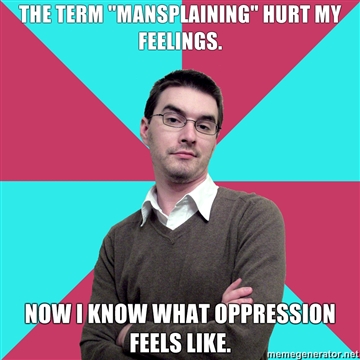
I really wish the term “mansplaining” would go away.  I understand the problem it’s meant to convey– a man assuming he knows more about something than a woman and condescending to her about it– but it’s an awkward portmanteau and just strikes me as juvenile.  Like there’s no way to effectively point out instances of this happening without coming up with a cute name for it.  It also makes it sound as if this is something all men do, or that women never do, or that there aren’t other varieties of prejudice and/or privilege-based condescension.  And if there are, do they all need clever names too?  Richsplaining?  Whitesplaining?  “Gaysplaining” sounds marginally better aesthetically, but a person who uses it would probably be called homophobic even if using it correctly because gays are not a privileged group.

I like the words “prejudice” and “privilege,” because they’re generally applicable to errors in rationality (the former) and perspective (the latter), and don’t suggest that mistakes about the abilities and values of different groups are all fundamentally different in kind.  Sexism already suffers from a good deal of confusion on that matter given that there are entirely legitimate statements that can be made about differences between sexes.  The illegitimate ones, however, can come from the same kinds of thought processes that produce any other kind of in-group favoritism and aren’t inherently any better or worse.   There are a million different ways to think sloppily, but I think it’s better that the commonality of these varieties of sloppiness be emphasized.

Some disjointed thoughts on “inclusiveness”

Some disjointed thoughts on “inclusiveness” published on 2 Comments on Some disjointed thoughts on “inclusiveness”

Claudia guest posts at Friendly Atheist on what she dubs “Femalegate“:

The situation: There’s a discussion and the subject of inclusion of woman in the movement comes up. The panel has 5 men and 1 woman. In the audience, men outnumber women two to one. The complaint that women are hit on too much at meet-ups is met with comments about it being “biological” (which can be easily read as, “So suck it up”). Eventually one woman, feeling belittled and passed over in favor of men in the audience, calls the panel out for the use of terminology. In return, she gets jeers and a sarcastic joke.
From here, the situation could have gone in various directions. As a community that prides ourselves on intellectual honesty and the ability to recognize (and even celebrate) nuance, we could have:

  • Had a conversation about how panel discussions on delicate topics should and should not be handled.
  • Discuss how a broad context of many different factors can contribute to making a minority feel unwelcome.
  • Recognize the importance of the original subject and start over brainstorming the kinds of concrete steps that can be taken to make the movement more welcoming to women.

All of these would have been mature, complex, yet worthwhile ways to take the conversation.
We chose none of these.
Instead we decided to spend the better part of a week debating whether the word “female” is offensive (though, to be fair, the guest posters themselves attempted, but failed, to take the debate elsewhere).
Virtually no attention was paid to the broader context. Most comments trying to explain how context matters were totally disregarded in favor of saying “female isn’t offensive!”
You know what can make you feel unwelcome? That when you try to explain why you find something unwelcoming, you are told (in no uncertain terms) that you don’t have the right to feel that way, you’re being oversensitive, or you have to get over yourself. There seem to be a lot of people who say they want to hear from women in regards to how inclusiveness could be improved, but they are absolutely unwilling to admit that they could possibly be doing anything wrong.

There’s a vulnerability in being offended that has been overlooked a bit. I think that non-believers can get used to being more often the offenders rather than the offendees, and can forget that it’s actually pretty taxing to experience feeling bothered about something you consider important, and risk being mocked or thought of as thin-skinned for speaking up about it. It shouldn’t be a point of pride to never be offended…”sucking it up” isn’t a virtue unto itself. Brave people don’t “suck it up;” they speak up.

It’s one thing to listen to the complaints of an offended party and disagree about their validity, and quite another to openly dismiss them as not worthy of any serious consideration. When someone complains about not feeling included, respect the fact that they are to some extent opening themselves up to being thought foolish. Take them seriously, even if you disagree.

Having said that, there is a certain incentive for women who are part of a “boys club” to keep things that way. The most non-inclusive comments can actually come from other women who want to solidify their position as being reasonable and unemotional, unlike those fragile hysterical women who are complaining. The same women who consider themselves feminists, proving that women are capable of cerebral pursuits currently dominated by men, will turn around and slap down other women with the same anti-feminist rhetoric that would drive them crazy if applied to themselves. This is something all of us women/females/whatever have a responsibility to hold ourselves accountable for avoiding.

The subject of men speaking up for female interests is a tricky one–it’s not always easy to tell whether it should be gratifying or annoying. It can be immensely gratifying to know that women aren’t the only ones who care about whether we’re included. It’s annoying, on the other hand, if those men appear to be speaking for us. I sometimes wonder if having “token females” on panels, or as the only ones giving talks about gender, is actually damaging to the interests of the rest of women involved by making it seem as if there’s a Single Female Perspective. Having a multiplicity of female (and male) opinions can relieve the burden of being expected to represent an entire gender and allow women to just speak openly as individuals.

Two very different accounts…

Two very different accounts… published on 1 Comment on Two very different accounts…

…of the same panel at a regional meeting of American Atheists in Huntsville, Alabama on the subject of gender relations:

One says it all went to hell and it’s no wonder a woman who stood up to ask a question ended up in the bathroom in tears with people consoling her.
The other says the woman who ended up in tears was melodramatic and self-righteous, demanding unreasonable special treatment.

Cue the resulting shitstorm.

Neither one sounds impossible, but neither one sounds like the whole truth either.  Not having been there, there’s no way I can know what parts of which were true and which were not.  What I can suspect is that sexism, or at least confusion regarding how people of different genders should treat each other, is not born of religion.  It might be fostered by religious creeds, but it certainly doesn’t require them to exist.

Jen McCreight, who blogs at Blag Hag, frequently writes about the problem of sexism in atheist organizations.  They do seem to attract men in greater proportions than women, which can lead to a “boys club” atmosphere which makes women feel uncomfortable and unwelcome, thereby causing the gender discrepancy to become a self-perpetuating problem (although at this particular meeting of AA the number of women was estimated at 30% by the first source, which is pretty good considering).  Then there’s the additional factor that atheists like to emphasize a commitment to science, and psychological discussions emerging from evolutionary research tend to emphasize differences between the sexes, which can sometimes be confused with pseudoscientific explanations or be misinterpreted even if it’s actually well-researched and presented, and…well…you can see how the opportunities for misunderstanding and discord tend to crop up like dandelions in springtime, especially when people try to use these explanations as justifications for their behavior.

The only solutions I know:
1.  Be mature and respectful.  In addition to facilitating communication, it highlights the fact that your opponent isn’t willing to exercise these capacities and makes them look like the villain.  😉
2.  Try to be objective.  Don’t take someone’s word for it regarding what happened just because you agree with them general or want to believe that what they say is true.  People who agree with you are still capable of being wrong.
3.  Listen to what people are saying; don’t misrepresent them– creating a straw man version of their thoughts for you to knock down just makes you look foolish.

A big bowl of super

A big bowl of super published on No Comments on A big bowl of super

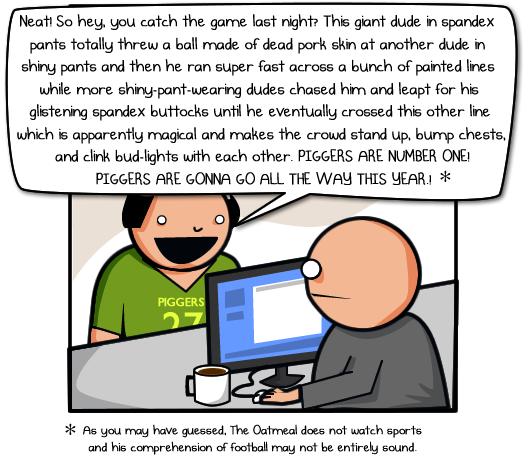
Oatmeal pretty well sums up my thoughts about football on this Super Bowl Sunday taking place in, of all places, Dallas:

In short: Don’t give a damn.  Never have.  Have a very hard time, actually, understanding why people do.

But I hope the people currently congregating by the hundreds of thousands at Cowboys Stadium, and the millions more watching them and–soon– the two teams of large men about to throw themselves at each other periodically interrupted by commercials that cost nearly $3 million for 30 seconds, have a wonderful time.  Yet again, I’m opting out.  Could still go for the beer and nachos, though.

GO PIGGERS!

The problem with “Jesus chicken.”

The problem with “Jesus chicken.” published on No Comments on The problem with “Jesus chicken.”

Cross-posted from State of Formation.

Those familiar with the Chik-Fil-A restaurant chain have known for quite a long time that the ownership is explicitly conservative Christian, which hasn’t meant much for people who like to eat there except that they must remember it’s closed on Sundays. But recently it has come out (pardon the expression) that the company also contributes significantly to anti-gay causes. The New York Times reports:

“Nicknamed ‘Jesus chicken’ by jaded secular fans and embraced by Evangelical Christians, Chick-fil-A is among only a handful of large American companies with conservative religion built into its corporate ethos. But recently its ethos has run smack into the gay rights movement. A Pennsylvania outlet’s sponsorship of a February marriage seminar by one of that state’s most outspoken groups against homosexuality lit up gay blogs around the country. Students at some universities have also begun trying to get the chain removed from campuses. . .
Over the years, the company’s operators, its WinShape Foundation and the Cathy family have given millions of dollars to a variety of causes and programs, including scholarships that require a pledge to follow Christian values, a string of Christian-based foster homes and groups working to defeat same-sex marriage initiatives.”

Hence a certain amount of outcry from gay rights groups. Change.org has created a petition asking Chik-Fil-A to stop funding anti-gay groups such as Focus on the Family which has so far received over 25,000 signatures, and many individual gay rights supporters have decided not to patronize the restaurant chain any longer. Alvin McEwen writes at Pam’s House Blend that “lgbts also have a right to decide where NOT to spend our money. Furthermore we and our allies have a right to make a stink in regards to a company who wants us to buy its product, but not afford us respect.”

In other words, a boycott. It’s a time-honored concept– a way for people to express their disagreement with the ethics of a company by refusing to do business with it. Otherwise known as “voting with your wallet.” The idea is that financial support for an institution enables it and therefore can be construed as an endorsement of its policies, therefore revoking such support while saying “Hey everybody! I’m revoking my support!” means that you’ve both ceased enabling that institution and attempted to make others aware of your reasons and encourage them to do the same. It’s a legal and peaceful way of making your views known. Right?

Not to Michelle Malkin, apparently. In these efforts the conservative columnist sees an “ugly war” waged by a “left wing mob”:

“Progressive groups are gloating over Chick-fil-A’s public relations troubles exacerbated by the nation’s politicized paper of record. This is not because they care about winning hearts and minds over gay rights or marriage policy, but because their core objective is to marginalize political opponents and chill Christian philanthropy and activism. The fearsome ‘muscle flexing’ isn’t being done by innocent job-creators selling chicken sandwiches and waffle fries. It’s being done by the hysterical bullies trying to drive them off of college grounds and out of their neighborhoods in the name of ‘human rights.’”

Gosh, you’d think that people were crowding the streets screaming and trying to use the law to prevent Chik-Fil-A from erecting a new establishment purely out of objections to its ideology! Oh wait, that’s what people did in reaction to the proposed so-called “Ground Zero Mosque.” What’s happening in this case is an objection to ideology, yes, but not just that. It’s an objection to political efforts on behalf of that ideology to oppose equal rights for a segment of the American population. And that objection is not taking place through violent means or legal enforcement– it’s taking the form of voluntary boycotts, and student efforts to encourage their universities to stop using Chik-Fil-A as a vendor. Essentially, they are asking universities to participate in the boycott as well.

During the protests in New York at Cordoba House, many of us were asking conservatives who opposed the Islamic community center why they oppose the property rights of the building’s owners. Now as gay rights advocates are boycotting Chik-Fil-A, I would ask Michelle Malkin why she doesn’t support the right of individuals to do business with whom they please. It’s one thing to say that while boycotts in general are fine, this one in particular is misguided and inappropriate because of x, y, and z. Then we could have a discussion on the merits of x, y, and z and would probably still disagree, but the basic understanding that everyone has a right to speak their mind both verbally and with their wallets would be there.

But that’s not what she wants to do. The objections Malkin is making could be applied just as easily to any boycott by conservatives of liberal businesses. The next time an organization like the American Family Association declares that it will boycott a automobile manufacturer or food producer for so much as advertising in a gay-friendly way, I wonder if she will call them “hysterical bullies,” or instead support them in speaking out against the fearsome left wing mob of…people who are okay with the idea that there are gays who want to do things like drive cars and eat soup.

Trying to decide who to do business with can be tricky for people who care about the political involvement of companies and corporations (and trust, they will go on being involved in politics whether we care or not). The most important part of minimizing that difficulty is freedom of expression. We have to be able to find out, to research, to exchange ideas, to act, to let others know of our actions, and to hear about theirs. The way to influence an entity whose primary concern is its profit margin is indisputably through our business choices– it’s the only power we as individuals have, which makes it sacred in a way. It shouldn’t be treated lightly, and it should never be denied.

The problem with “Jesus chicken”

The problem with “Jesus chicken” published on No Comments on The problem with “Jesus chicken”

Those familiar with the Chik-Fil-A restaurant chain have known for quite a long time that the ownership is explicitly conservative Christian, which hasn’t meant much for people who like to eat there except that they must remember it’s closed on Sundays.  But recently it has come out (pardon the expression) that the company also contributes significantly to anti-gay causes.  The New York Times says:

Nicknamed “Jesus chicken” by jaded secular fans and embraced by Evangelical Christians, Chick-fil-A is among only a handful of large American companies with conservative religion built into its corporate ethos. But recently its ethos has run smack into the gay rights movement. A Pennsylvania outlet’s sponsorship of a February marriage seminar by one of that state’s most outspoken groups against homosexuality lit up gay blogs around the country. Students at some universities have also begun trying to get the chain removed from campuses. . . Over the years, the company’s operators, its WinShape Foundation and the Cathy family have given millions of dollars to a variety of causes and programs, including scholarships that require a pledge to follow Christian values, a string of Christian-based foster homes and groups working to defeat same-sex marriage initiatives.

Hence a certain amount of outcry from gay rights groups.  Change.org has created a petition asking Chik-Fil-A to stop funding anti-gay groups such as Focus on the Family which has so far received over 25,000 signatures, and many individual gay rights supporters have decided not to patronize the restaurant chain any longer.  Alvin McEwen writes at Pam’s House Blend that “lgbts also have a right to decide where NOT to spend our money. Furthermore we and our allies have a right to make a stink in regards to a company who wants us to buy its product, but not afford us respect.”

In other words, a boycott. It’s a time-honored concept– a way for people to express their disagreement with the ethics of a company by refusing to do business with it.  Otherwise known as “voting with your wallet.”  The idea is that financial support for an institution enables it and therefore can be construed as an endorsement of its policies, therefore revoking such support while saying “Hey everybody!  I’m revoking my support!” means that you’ve both ceased enabling that institution and attempted to make others aware of your reasons and encourage them to do the same.  It’s a legal and peaceful way of making your views known.  Right?

Not to Michelle Malkin, apparently.  In these efforts the conservative columnist sees an “ugly war” waged by a “left wing mob”:

Progressive groups are gloating over Chick-fil-A’s public relations troubles exacerbated by the nation’s politicized paper of record. This is not because they care about winning hearts and minds over gay rights or marriage policy, but because their core objective is to marginalize political opponents and chill Christian philanthropy and activism. The fearsome “muscle flexing” isn’t being done by innocent job-creators selling chicken sandwiches and waffle fries. It’s being done by the hysterical bullies trying to drive them off of college grounds and out of their neighborhoods in the name of “human rights.”

Gosh, you’d think that people were crowding the streets screaming and trying to use the law to prevent Chik-Fil-A from erecting a new establishment purely out of objections to its ideology!  Oh wait, that’s what people did in reaction to the proposed so-called “Ground Zero Mosque.”  What’s happening in this case is an objection to ideology, yes, but not just that.  It’s an objection to political efforts on behalf of that ideology to oppose equal rights for a segment of the American population.  And that objection is not taking place through violent means or legal enforcement– it’s taking the form of voluntary boycotts, and student efforts to encourage their universities to stop using Chik-Fil-A as a vendor.  Essentially, they are asking universities to participate in the boycott as well.

During the protests in New York at Cordoba House, many of us were asking conservatives who opposed the Islamic community center why they oppose the property rights of the building’s owners.  Now as gay rights advocates are boycotting Chik-Fil-A, I would ask Michelle Malkin why she doesn’t support the right of individuals to do business with whom they please.  It’s one thing to say that while boycotts in general are fine, this one in particular is misguided and inappropriate because of x, y, and z.  Then we could have a discussion on the merits of x, y, and z and would probably still disagree, but the basic understanding that everyone has a right to speak their mind both verbally and with their wallets would be there.

But that’s not what she wants to do.  The objections Malkin is making could be applied just as easily to any boycott by conservatives of liberal businesses.  The next time an organization like the American Family Association declares that it will boycott a automobile manufacturer or food producer for so much as advertising in a gay-friendly way, I wonder if she will call them “hysterical bullies,” or instead support them in speaking out against the fearsome left wing mob of…people who are okay with the idea that there are gays who want to do things like drive cars and eat soup.

Trying to decide who do business with can be tricky for people who care about the political involvement of companies and corporations (and trust, they will go on being involved in politics whether we care or not).  The most important part of minimizing that difficulty is freedom of expression.  We have to be able to find out, to research, to exchange ideas, to act, to let others know of our actions, and to hear about theirs.   The way to influence an entity whose primary concern is its profit margin is indisputably through our business choices– it’s the only power we as individuals have, which makes it sacred in a way.  It shouldn’t be treated lightly, and it should never be denied.
LGoG

LGoG published on No Comments on LGoG

Listening to Julia Sweeney’s “Letting Go of God” for a bit of thought-farming on the relationship between imagination and science. I know that the quote I’m looking for is toward the end, but am listening to the whole thing anyway because I like to listen to Julia Sweeney when I’m moody.  She manages to discuss very serious subjects by making them funny but without removing the gravity.  I have this particular story on DVD as well as in iTunes.  My mother will not watch it– as much as she likes Julia Sweeney, she believes that it’s basically an attempt at atheist indoctrination and doesn’t wish to be converted.  I can’t really blame her for that.  I don’t think that converting anyone is the point, but it’s certainly a story of conversion in more than one regard.  To me it’s mainly a casual, funny monologue about how an intellectually curious person underwent a long, careful examination of beliefs she found very important, and emerged able to articulate her state of mind at each point in the process.  That’s valuable.  And make no mistake, she worked to reach these conclusions.  That’s admirable. An intellectual appetite is an enviable thing to have, but that doesn’t mean that satiating that appetite isn’t still a laborious and sometimes painful process, and listening to someone describe their own journey can inspire you to begin or make further progress on journeys of your own.

I like the honesty and the humility.  You can’t tear down your own fallacious constructions without those things, and having them is the surest way to avoid sounding preachy about the conclusions you’ve reached.