Skip to content

Reddit makes Rebecca hate atheists and Ed hate men

Reddit makes Rebecca hate atheists and Ed hate men published on 3 Comments on Reddit makes Rebecca hate atheists and Ed hate men
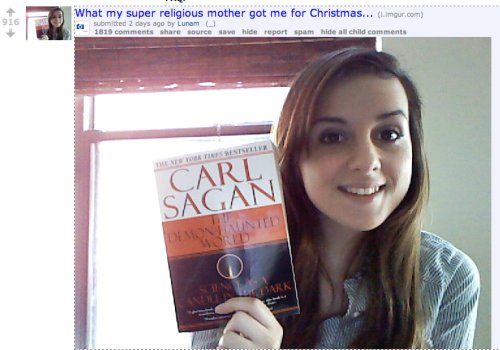
Reddit thread here, if you’re interested

These discussions, while useful, take a toll. Sometimes they just seem…tiring. I admire people who are willing to run the “sexism on the internet/in skepticism/atheism” treadmill, but can’t help but wonder how they manage to remain sane. Especially while being attacked endlessly for their efforts, as Rebecca Watson has been. As she has shown, all you need do provoke the misogynistic ire of the internet is mention its existence disapprovingly. I really don’t think it has much to do with atheism/skepticism.

Sexism on the internet is a problem, and atheism/skepticism are predominant on the internet. So “sexism is a problem for atheism/skepticism,” because the internet is a primary conduit of interaction for such people. The internet helps people around the world who feel isolated come into contact with others of their kind, yes…and it also creates the impression that those who take advantage of this opportunity speak for everyone in their minority group. When, for example, PZ Myers and Greta Christina disagree, who should we listen to? Who is the representative of all atheist-kind? Well, neither of them, obviously. Atheists and skeptics have no popes, no bishops, no chain of command, because– this is important– atheism and skepticism are not belief systems. Atheism is a lack of belief in gods, and skepticism is a tool, an epistemological approach. Nevertheless prominent atheists can influence the beliefs of others, and lacking churches and being in disparate locations, they often do so on the internet. People want to group together with others of their kind, and when they do they like to have authorities. People outside of groups like for those groups to have authorities to speak for them, to encapsulate what they’re all about. It makes things easier, but in this case also distorts the picture grossly.

Bottom line: sexism is an internet problem. A world problem. The fact that atheists and skeptics on the internet are discussing its existence within their own ranks does not betray that atheism/skepticism “has a sexism problem.” It means that there are vocal people who are concerned enough about this ubiquitous problem to address it, and that quite naturally leads to a widespread ongoing discussion. It’s amazing how much easier it is to avoid having a “problem” with something when your community is either homogeneous, or the community is homogeneously in agreement on it (perhaps by silencing or just not listening to dissidents). Atheists/skeptics on the internet are willing and able to speak up, therefore they’re the ones with the problem. Hmm, not buying it.

RPGs and skepticism (Sunday fun post)

RPGs and skepticism (Sunday fun post) published on 2 Comments on RPGs and skepticism (Sunday fun post)

If you really aren’t interested in video games at all, you….probably won’t bother reading this post. But if you’re somewhat interested in them but don’t know much about them, you might not know that this weekend has been BlizzCon, the annual convention held in Anaheim, California by Blizzard Entertainment. Blizzard’s most famous and far-reaching games are Diablo, Starcraft, and most importantly for this topic, World of Warcraft.

A role-playing game, or RPG, is any game in which you’re expected to adopt the role of a specific character and control him or her throughout, advancing him or her in ability by leveling– accumulating experience points which make that character stronger, smarter, faster, wiser, etc. and therefore able to accomplish more difficult tasks and battle stronger adversaries. Dungeons and Dragons is the most famous table-top RPG, and World of Warcraft, I think it’s safe to say, is the most famous video game RPG.World of Warcraft is also an MMO (massive multiplayer online game), which means that your character is always interacting with those of other people in real time. In that sense the character represents you– the faction, race, gender, class, and appearance you choose are all used as information about you. Having made all of those choices, you can decide whether to role-play (always speak and act in game as if you are actually your character) or whether to talk about your character with some degree of remove.  Most people opt for this, whether by speaking explicitly in third person (“He/she,” “my character/toon,” or “(character’s name)”) or by speaking in first person but using game terms and clearly speaking as a player rather than a character. It’s common to see the two combined, as with a person saying something like “Is it more important for my rogue to have attack power or a better critical hit chance? I’m trying to decide which pair of boots will get me a better bonus.”

So obviously the degree of immersion varies a great deal. And it’s not a new topic for RPG gamers at all– it has been discussed to death, including for the purposes of armchair psychoanalysis: do people who play a character of a different gender secretly want to be that gender? Do they play a race that is more attractive (by human standards) because they want to be accepted, or an uglier one because they like being non-conformists? If they pick a plain ol’ human to play rather than something like an orc, does it mean they lack imagination, or are people who play orcs afraid to be themselves? And of course– are people who play races like human, elf, dwarf, or gnome (the Alliance faction in WoW) good, and people who play orcs, trolls, undead, and goblins (the Horde faction in WoW) bad?

“Class” is the term for the means by which your character defends him/herself and others against the world. Do your powers come mainly from armor and big scary weapons? From your ability to melt into the darkness and evade attacks against you?  Or perhaps from your ability to manipulate magic? Magic generally comes from two distinct sources– arcane (from energy existing in the universe which can be focused and manipulated) or divine (from, quite simply, the gods). Again, people like to psychoanalyze this choice– are you a rogue because you enjoy stabbing people in the back? A warrior because you’re a control freak? A mage because you’re physically weak and like the thought of summoning power from something else?

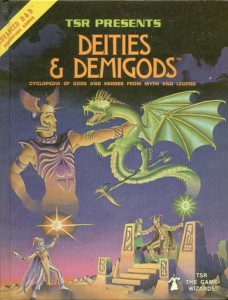
The magic aspect is what makes the Twitter exchange at the beginning of this post interesting. As you may be aware, PZ Myers and JT Eberhard are both atheists activists– very outspoken ones. Given that atheists joke all of the time about being evil to mock the public perception they are, it could be expected that they would be drawn to play the underdogs, the misunderstood, the commonly perceived as evil Horde. And given the rejection of supernatural powers of any kind, they could be expected to have no attraction at all to a class like Priest, who uses divine energy to heal other players but also to attack enemies. In Dungeons and Dragons when you play a priest– a cleric, as they are called there– you choose a god or goddess to serve, and those of us who have played remember fondly the book of Deities and Demigods which not only described and visualized countless gods both from existing mythologies and created especially for the game, but gave them in-game attributes and abilities. So, for example, you could decide to serve the Egyptian god Ptah, creator of the universe (alignment: lawful neutral), or perhaps the Norse goddess Freya, representing love and fertility (alignment: neutral good). I’m sure I’m not the only one whose interest in mythology as a kid was encouraged by this book.

In WoW, by contrast, the powers of a priest fall under the general category of Holy, and their description is as follows:

Priests are devoted to the spiritual, and express their unwavering faith by serving the people. For millennia they have left behind the confines of their temples and the comfort of their shrines so they can support their allies in war-torn lands. In the midst of terrible conflict, no hero questions the value of the priestly orders.

So in one RPG we have the existence of gods asserted, and their attributes described quite explicitly, whereas in the other it’s…well, a little more esoteric. WoW does have its own very complex assortment of demigods as well as some authentic deities, including Elune, goddess of the night elves. The races in WoW have their own cultural mythologies, but becoming a human priest (for example) does not require you to sign up for allegiance to anyone in particular. Nor does becoming a paladin (holy warrior), druid, shaman, or– in the next expansion– a monk. Mages and warlocks are also magic users, of course, but their powers come from either their own abilities specifically or harnessing the (often unwilling) assistance of demons. In this world, it’s more like a messy confluence of hierarchies of non-physical power….for basically everybody except warriors and rogues, and hunters for the most part, who rely either on either their own brute strength and agility or that of their pets.

So strictly speaking, ought not a skeptic who is determined to remain a skeptic in-game be suspicious of most of these classes?  Priests and paladins are the ones who connect their abilities most directly to divine power (because in the WoW universe, “healing” = “holy”), but almost everybody’s drawing on the supernatural in some way or another. The skeptic would, and should, ask: how do they know?

Well, it’s a game. A fictional universe– its terms are its own, and this game has gods, god dammit.

That’s one answer. Another answer is that in this universe, the power of spells has been repeatedly tested and applied, and found to exist, in one form or another. A skeptic, upon observing this happen or (ideally) performing the rituals and observing the results for him/herself, would be compelled to believe in the existence of….something. And of course, that “something” is the tricky part. How much would a scientifically-minded denizen of Azeroth be able to confirm, assuming he/she had the luxury to think on the matter intently in between fighting off incursions from the Horde or the Alliance (depending), as well as the multiple itinerant tribes, beasts, demons, elementals, and constructs roaming the land? His/her main concern, of course, is going to be for what works– what produces results. Most spells are performed to either damage an enemy or provide a buff (protection, fortification) to oneself or others. If the only way to achieve that effect is by using reagents and/or incantations in specific way, that can be tested and confirmed. Right?

But it can’t be confirmed as the result of divine power, and that’s the rub. Even in a world where mysteriously powerful beings exist, the infiniteness of their abilities still can’t be confirmed by finite beings. Which might be why, one could surmise, RPG designers (regardless of platform) don’t spend a lot of time or space proclaiming the “omni-ness” of the gods involved in them.
Un-toasted terrorist

Un-toasted terrorist published on 1 Comment on Un-toasted terrorist

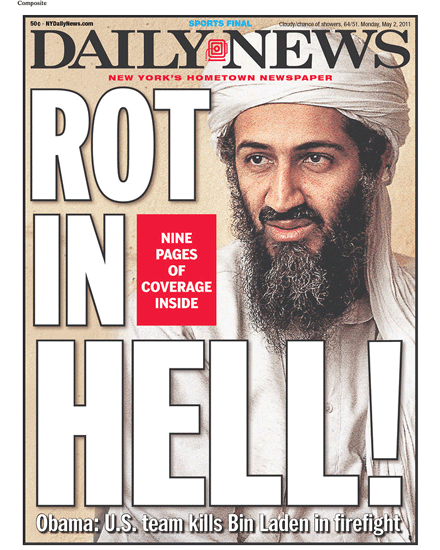
Hemant Mehta looks at the revenge party after Osama bin Laden’s killing in which t-shirts, political cartoons, and newspapers exult and proclaim that bin Laden is burning in Hell, which a CNN poll says a majority of Americans actually believe, and says simply:

Osama bin Laden is not in hell. Because hell doesn’t exist. Damn, it feels good to get that off my chest. 

 Heh.

And if it did exist, by the way, I would not wish him there.

Storm

Storm published on No Comments on Storm

The animated version of Tim Minchin’s nine minute beat poem “Storm” is finally out!

I first heard of Minchin when he was a guest on the Skeptic’s Guide to the Universe podcast a few years ago. He talked about this poem on the show, so I tracked it down on Youtube and immediately wanted to hear more of his stuff. Unfortunately very little of that was available on Youtube at the time, so I ordered both of his CDs from some British distributor and listened to them on repeat as we packed up my boyfriend’s house in preparation to move to a new one (BF liked it almost as much as I did, so didn’t mind this).

Now Minchin’s snarky and vehemently irreverent music is all over the place. I would not recommend listening to it if profanity or blasphemy bother you in the slightest. I would especially not recommend watching this bawdy video collaboration made in protest of the pope. But if those things don’t so much as make you raise an eyebrow, check his stuff out– especially this one, which can make me cry in the right mood. I think the animation of the “Storm” video is well done, though I can’t help being partial to the earlier version of it that Minchin recorded. The inflection just sounds better to me, though that could be because it’s what I’m used to hearing. One of the comments on the Youtube channel reads “I don’t get it.  Is he trying to rap?” Ah, kids.

ETA: An interview about the project with the film’s creators and with Minchin can be found here.

Religion going extinct? I doubt it.

Religion going extinct? I doubt it. published on No Comments on Religion going extinct? I doubt it.

The BBC reports on a paper recently presented at the American Physical Society meeting here in Dallas which makes claims about a decreasing level of religiosity in some parts of the world.  The paper, entitled “A mathematical model of social group competition with application to the growth of religious non-affiliation,” suggests that religion will effectively be extinguished in certain parts of the world just as certain languages die out due to lack of usage.  One of the paper’s authors elaborates:

“The idea is pretty simple,” said Richard Wiener of the Research Corporation for Science Advancement, and the University of Arizona. “It posits that social groups that have more members are going to be more attractive to join, and it posits that social groups have a social status or utility. “For example in languages, there can be greater utility or status in speaking Spanish instead of [the dying language] Quechuan in Peru, and similarly there’s some kind of status or utility in being a member of a religion or not.” Dr Wiener continued: “In a large number of modern secular democracies, there’s been a trend that folk are identifying themselves as non-affiliated with religion; in the Netherlands the number was 40%, and the highest we saw was in the Czech Republic, where the number was 60%.” The team then applied their nonlinear dynamics model, adjusting parameters for the relative social and utilitarian merits of membership of the “non-religious” category.

I’m skeptical.  The most obvious distinction that jumps out when comparing languages to religion is, at least to my knowledge, that at no point in history have people stopped using language.  They have stopped using specific languages in favor of other ones, just as they have stopped adhering to certain religions and converted to others.  But they haven’t cast religion aside. The study discusses how many people would answer that they are non-religious or have no religious affiliation, but that does not answer, as psychologist Bruce Hood points out, whether they have abandoned supernatural beliefs.  As I’ve mentioned before, there is a difference between being “non-religious,” being an atheist, and being a naturalist/materialist, and I don’t consider it accurate to say that religion has become “extinct” in a population unless its members fit the latter description.  Which, quite honestly, I don’t see ever happening.

Why be such a stickler about this?  Well, because when you talk to a person who says that she doesn’t consider herself to be religious (or worse, “non-affiliated”), digging a little deeper may reveal that she actually believes that the universe is God, that prayer and willpower cause wishes to come true, that everything happens for a cosmic reason, that casting spells works, and/or that everyone will be reincarnated after they die.  Her pantheism may disqualify her from being properly labeled an atheist, but the rest of it wouldn’t.  And even if she believes in none of those things she may well believe in ghosts, alien abduction, extra-sensory perception, Tarot-reading, and/or Reiki, which you might call secular supernatural ideas.  And to me, a god has more in common with a ghost than a cross has with a Tibetan prayer flag.  The latter two may both signify religious beliefs, but the former are both supernatural agents about which humans have a stunning number of intuitive beliefs in common.  That is, we use the same mental tools to conceive of and believe in them.

And if I’m right about that, then we will probably will carry on in these beliefs for as long as we have the kinds of minds that find them appealing.  I’m also not convinced that religious violence is fundamentally different in kind from any other violence which is rooted in a notion of a transcendent force which unifies one’s own group against whatever group(s) it views as threatening.  I don’t believe that it takes religion to make good men do bad things– or, for that matter, for bad men to do good.  I don’t see the extinction of religion specifically, even on a completely voluntary basis, as some kind of goal toward which we should all be striving.  Which is a good thing, considering that it probably won’t come to pass.

Unlike Hood, however, I do think we should strive toward rationality always, identify and eliminate bias wherever it can be found, and in general try to always have our skeptic’s hats on.  I consider supernatural thinking a mistake even if it’s an adaptive one. That doesn’t mean I have to single out people who think supernaturally as sui generis irrational, because we all do it occasionally.  And it certainly doesn’t mean I have to single out people who consider themselves religious as essentially thinking differently from, and/or worse or better than, everyone else.  

Real-life trolls, part 2

Real-life trolls, part 2 published on No Comments on Real-life trolls, part 2

The girl who made a Youtube video glorying in Japan’s earthquake, saying that it was God giving the country a “little shake” to send a message regarding his existence to atheists and arousing a lot of outrage…is apparently a troll.

To which I say, good. I’m glad that those (probably) weren’t honest statements. But still in really bad taste. Even Pat Robertson doesn’t attribute natural disasters to the wrath of an angry God with quite that amount of sheer pleasure, and I don’t see anything particularly funny or clever about making up a person who does.  Not when we’re talking about a real event in which thousands of people have died and are still dying.  No thanks.

TAM 9 speakers

TAM 9 speakers published on 3 Comments on TAM 9 speakers

The Amazing Meeting has announced its list of speakers for this year, its ninth meeting.  There are a lot of them, and quite a few– at least ten, from what I can tell– are people who can speak to the topic of how and why people believe weird things.  Or rather, why everyone isn’t skeptical all of the time.  That’s really encouraging.  If I were able to go, I’d make sure to attend those talks.  However accomplished a scientist or entertainer you are, I’m just not as interested in hearing how sure you are that ghosts and gods don’t exist and/or making fun of people who think they do.  That’s not to say that those topics don’t have their place, but they just don’t really grab me anymore.  Well, not unless the non-skeptical are trying to implement their non-skeptical beliefs via legislation or terrorism, in which case I’m definitely interested but it’s less about the lack of skepticism than about the use of force to push it.

But hey– it’s their meeting and I’m not going (can’t afford it), so who cares what I think?  It’s just nice to see skeptics being interested in the hows and whys regarding “woo” and not just the whats.

Sue Blackmore decides that religions are not, in fact, viruses of the mind

Sue Blackmore decides that religions are not, in fact, viruses of the mind published on 3 Comments on Sue Blackmore decides that religions are not, in fact, viruses of the mind

Sue Blackmore is one of the go-to voices in the UK on matters of religious thinking and consciousness. She is, believe it or not, an atheist with a PhD in parapsychology.  Originally a firm believer in the paranormal, she reached the conclusion in the course of her study that it doesn’t in fact have any scientific basis.  At that point she decided to find out what the mind really is capable of doing, which resulted in a number of books including the excellent (though steeply priced) Consciousness: An Introduction.

She is probably most famous for The Meme Machine, however, a book in which she takes the idea of the meme which Richard Dawkins proposed in his 1976 book The Selfish Gene (yes, it really was that long ago) and ran with it.  I don’t think most people who use the word “meme” these days really have any idea where the term originally came from and how it was formulated.  Some people don’t even know how to pronounce it, because they don’t realize it was intended to sound similar to “gene” in order to convey a similar means of propagation.  Genes, Dawkins wrote, have their own metaphorical interests which can be viewed as independent from ours in that they “desire” to be perpetuated  into the next generation.  In the same way, memes are ideas which “desire” to be spread as far and widely as possible.  Blackmore expressed this epidemiologically, comparing memes to viruses which need hosts that are most conducive to spreading them.  A memeplex is a conglomerate of ideas which are transmitted together because they are mutually supporting, such as a philosophical outlook or a religion.

As you can imagine, an idea’s interests that are independent from ours might well be also contrary to ours, which is what the word “virus” is intended to convey.  Viruses are not symbiotic with us– they manage to propagate at the expense of our health by making us sick.  In his 2006 book Breaking the Spell, Daniel Dennett compared religion to a lancet fluke which invades the mind of an ant, driving it to climb to the top of a blade of grass to be eaten by grazing animals, and didn’t seem to fully acknowledge how that analogy could be perceived as insulting to believers.  It smudged the line between being willing to die for worthy causes, of which martyrdom is perceived to be one, and being made to die pointlessly for someone/something else’s desires.  You might say “Well, that’s the entire point– the memes just make you think you’re doing something meaningful!”  Maybe so, but that’s assuming one’s conclusion.  Most of us would grant that some forms of self-sacrifices are in fact noble and not at all pointless, but both Blackmore and Dennett would say that those are caused by memes as well.  How do we determine which ones are virus- or fluke-like and which are not?

After attending an Explaining Religion conference at the University of Bristol, Blackmore says that she no longer views religions as viruses of the mind in the sense of being detrimental to their hosts. Why? Two main reasons:

1.  Michael Blume was able to show that religious people have far more children than non-religious people.
2.  Ryan McKay was able to show using experimental data that “religious people can be more generous, cheat less and co-operate more in games such as the prisoner’s dilemma, and that priming with religious concepts and belief in a ‘supernatural watcher’ increase the effects.”

To the first point a person could note that there are more important things in life than the number of one’s children.  True in a proximate sense, but not in an ultimate one.  If we’re evaluating the benevolence of a meme on an evolutionary scale, increasing reproduction is a clear advantage even if it’s not in the best interest of individuals or, indeed, the world itself.  To the second point, which is well-supported by a number of studies that have been performed over recent years, a person could dither about the degree to which being cooperative and honest should be counted as more a benefit to the individual or to the group, and then talk about whether it promotes in-group cooperation at the expense of creating inter-group hostility.

However, I’m not sure we really need to conduct either discussion.  Memetics is not the only way to examine religious ideas epidemiologically.  The advantage in looking at religion as a memeplex is that it emphasizes that religious ideas are transmitted between human minds just like any other ideas, but I think that Pascal Boyer manages to do that more effectively using his epidemiological approach because he doesn’t feel compelled to treat ideas as strict analogs to genes.  He tries to figure out first what should count as a religious idea, and then discusses which religious ideas are more likely to “stick” and which others are not, but not by attributing metaphorical interests to them.  That isn’t to say that Boyer doesn’t have his own ideas about whether religious ideas are on the whole more beneficial to us or more detrimental, but that question is not essential to his theorizing about what fundamentally makes an idea religious and likely to spread.  In fact, it’s quite irrelevant to that theorization.

I don’t think the matter of whether and when religion benefits humanity and when it harms us should be off-limits to scientific inquiry.  And even if I did, scientists are going to research those topics anyhow.  But it doesn’t seem appropriate to make a decision about the value of religion as a whole as part of your theorizing about how it works.  These studies which point out various ways in which being prompted to think religiously causes people to be better to each other are tightly circumscribed and specific.  I don’t think showing that people tend to behave better when they think they are being watched, for example, really says anything about the value of religious beliefs in general even if one function of religion is to perpetuate the idea that there is always someone watching.   This experimental data is important, but it’s also important to hold off on forming grand conclusions on the basis of a few studies.  It’s good that Blackmore has decided religion isn’t a mental virus, but that doesn’t mean it’s a mental panacea either.

Rock Beyond Belief

Rock Beyond Belief published on No Comments on Rock Beyond Belief

A secular-type person?  Going to be anywhere near North Carolina on April 2nd?  Then consider attending:

From a statement by the Military Associations of Atheists and Freethinkers (MAAF) on how the event originated:

On Sep 25th, 2010, Billy Graham Evangelistic Association held a concert on the Fort Bragg Main Parade Field. Attendance was projected by BGEA to be 10,000, but photos indicate closer to hundreds than thousands. Whatever the size, this event was specifically “evangelical in nature” according to the event site and letters sent to the community by the senior Ft Bragg chaplain. The photos also show that the Golden Knights parachute team performed at the event, which requires special military authorization. An included “Family Fun Event” has balloons and face painting targeted at children and the “God Rocks” children ministry. The prayer call associated with the event calls for soldiers to bring their “battle buddies”. The chaplain enthusiastically encouraged members of the local community to attend. New reports by the Freedom From Religion Foundation show the Army spent at least $50,000 of taxpayer funds on this event. . .On a positive note, the Ft Bragg commander’s letter offered “similar support to comparable events.” The fact is that only evangelical Christians would request an evangelical event, so there will be no request for a ‘comparable event’. MAAF would oppose an military promotion of religion or nontheist beliefs like atheism or Secular Humanism just as it does Christianity. That having been said, nontheists at Ft Bragg may request the opportunity to hold an event for themselves with no atheist “evangelical” purpose. The new Ft Bragg military group Military Atheists & Secular Humanists is planning an event titled Rock Beyond Belief. While any event held should not be a “me too” copy of this evangelical concert, nontheists do come together and local nontheists may accept the commanding general’s offer to host a nontheistic, non-evangelical event that has none of the Constitutional complications of Rock the Fort.

As noted on the poster, the event will be free for both military members and civilians.

The only thing I hate about being a feminist…

The only thing I hate about being a feminist… published on 20 Comments on The only thing I hate about being a feminist…
Bill Bailey, hilarious feminist

…is that it’s still possible to make general statements criticizing them and be taken seriously. 

Richard Dawkins weighed in on the sex/gender dispute, pretty much attributing all of the consternation to a blanket disapproval of the “million dollar challenge” (an experiment intended to show that women are essentially sexual gate keepers by asking how many men would accept a million-dollar bet to find a woman who would sleep with them by the end of the day, versus how many women would) and the use of the word “females” to refer to women.  Missing the point rather grandly, I would say, in agreement with Jen McCreight’s comment here.

But what mainly irks me is this: he is able to say, honestly and truthfully, that “When the Million Dollar Challenge was offered at the American Atheists meeting, it deeply offended some feminists.” Which, of course, allows commenters who find the offense unjustified to immediately set upon the “feminists.” Oh, those darn feminists, always so outraged about the silliest little things.  No sense of humor or perspective.  Only a feminist would be bothered over this “hysterical twaddle” (as Dawkins put it).  I’m trying to imagine what would happen if an experiment regarding race was presented at a meeting, and he said that it “deeply offended some people concerned with racial relations.”  One would hope that everyone is concerned about racial relations, and so would find it rather ridiculous to say something like “People concerned with racial relations getting offended, nothing new to see here.”

Likewise, I would say that everyone should be concerned about gender relations.  It’s certainly open for debate whether feminism should be primarily about disposition (as in, “I believe firmly that women are equal in value to men and should have the same rights as far as is possible”) or disposition and interests (“I believe all of that, plus I’m specially concerned with how women are viewed socially by men and each other”).  There are plenty of people in the former group who don’t consider themselves feminists because they’re not also in the latter.  There are also, I’m sure, plenty of people who are in both groups but who don’t call themselves feminists because they associate them exclusively with those people who are irrationally outraged, however you might choose to define that.  I don’t like being associated with Andrea Dworkin, but that certainly isn’t enough to make me disavow membership in an entire body of people concerned with gender on the broader scale.

If Dawkins had said that when the Million Dollar Challenge was presented, it “deeply offended some women,”  it would have implied that women are the only ones, rightly or wrongly, who would be offended by the Challenge.  If the issue had been race, it would have been like saying that the experiment “deeply offended some black people.”  Even though the word “some” is in there, the assumption is that offense would only be felt by members of the specific group being discussed.  But aren’t we at the point now that that assumption is entirely unjustified?  That you don’t have to be a minority to be offended by racism, female to be offended by sexism, gay to be offended by homophobia? 

By asserting that the offended party are feminists, Dawkins is suggesting that feminists (however he defines them) are the only ones who would be offended. Since he does this as part of a dismissal of what he calls “hysterical twaddle,” it seems pretty clear that he thinks of feminists as being the type of people to get offended in the form of hysteria about twaddle. Some of them clearly are. But that has nothing to do with whether the offending object in fact is hysterical twaddle. People concerned about race issues often differ on whether a particular act or idea should be considered racist, and hence presumably worth getting bothered about. People concerned about gender often differ on whether a particular act or idea should be considered sexist or otherwise problematic in that regard, and hence worth getting bothered about. I happen to think that the most appropriate term for the latter group is “feminists,” and therefore that slamming feminists as a group makes a person look like an arse. And I don’t support enabling arses to proliferate in their arsiness. You don’t get to dismiss the legitimacy of offense about something by identifying the group offended by it, and certainly not by dismissing the group offended by it. That’s the essence of the ad hominem fallacy.