Skip to content

Fact and fiction on Minneha’s “Islam” bulletin board

Fact and fiction on Minneha’s “Islam” bulletin board published on No Comments on Fact and fiction on Minneha’s “Islam” bulletin board
Today’s editorial cartoon in the Wichita Eagle, drawn
by cartoonist Richard Crowson

Minneha Core Knowledge Magnet Elementary School is very close to where I live in Wichita, Kansas. The name “Core Knowledge” comes from the belief that there are culturally common things that students should learn about in order to be successful in life, which sort of makes you wonder why every school isn’t a Core Knowledge school.

Apparently some of what Minneha considers Core Knowledge is an understanding of the world’s major religions. I agree with that wholeheartedly, as did the Supreme Court in the famous 1963 case Abington School District v. Schempp, when Justice Tom Clark wrote for the Court:

[I]t might well be said that one’s education is not complete without a study of comparative religion or the history of religion and its relationship to the advancement of civilization. It certainly may be said that the Bible is worthy of study for its literary and historic qualities. Nothing we have said here indicates that such study of the Bible or of religion, when presented objectively as part of a secular program of education may not be effected consistently with the First Amendment.

The purpose of the dual religion clauses in the First Amendment is to prevent government institutions from advancing or inhibiting religion. The government, from the president down to the public school teacher, may not push religion on the public, and it may not prevent members of the public, private citizens, from practicing their own religions as they so choose, provided that such practice does not violate the law in any other regard.

Let’s keep this in mind while considering the flap at Minneha, where a bulletin board displaying the Five Pillars of Islam (five central acts of devotion for Muslim practitioners) was on display as part of the school’s effort to educate students on world religion…until a photo of the bulletin board was posted on Facebook apparently without context and with some very questionable comments. The bulletin board was then taken down until such time as the unit on Islam will be taught during the school year, when it will be….hung back up in the same place, with the same content?  A different place, and/or with different content? It’s hard to say at this point. I’m not sure Minneha knows. What’s cool about this case, though, is the fact that it presents an opportunity for Minneha to pass on some of that core knowledge to an audience that goes far beyond its student body– to their parents, to Wichita, to the members of our state governing bodies, and to the internet itself– about church/state separation and what it means. So in that spirit, let’s review some of the things that have been said about this event and sort them into two categories– fact and fiction– for the sake of education.

1. From the Take America Back Facebook page:

Verdict: Fiction
Seriously, guys, you couldn’t even spell the city’s name correctly? Wichita. Wichita. 

Yes, this is in fact an image of the bulletin board at Minneha. However, that’s where the truthy part ends. Minneha did not “ban all forms of Christian prayer.” No public school in America has “banned all forms of Christian prayer,” or all forms of any kind of prayer. It is perfectly legal to pray to Jesus, Allah, or Thor in public school if you want to. What isn’t legal is doing so on behalf of the school, using the school’s authority.

Abington v. Schempp was about this latter sort of prayer, more specifically about a ceremony Ellory Schempp’s school district held every morning in which students were required to hear or read from passages from the Bible. This effectively combined the school’s authority to educate with authority to indoctrinate, the latter purpose more appropriately belonging to Sunday than public school. Students may pray– or read the Bible– in public school of their own volition, if their doing so is not disruptive. The school may not do so for them, or encourage/compel them to do so.

2. From State Representative Dennis Hedke:

If you’re going to talk about Islam and make it sound like it’s another one of those religions that needs to be understood and contemplated by mankind, there’s a serious misunderstanding.

Verdict: Fiction.

Islam is a) a religion which b) needs to be understood and contemplated by mankind. At least, as much as any religion whose adherents make up about 20% of the world’s population does. Contrary to what Hedke seems to assume, it is in fact beneficial to understand belief systems which you yourself to not share. Firstly because they affect the behavior of others in the same way that your own beliefs affect your behavior, and secondly because every belief you currently have, you once did not have. If you had begun life with a strict policy against understanding belief systems you don’t currently share, you would literally believe nothing.

Most importantly, of course, the SCOTUS verdict I quoted above highlighted the difference between teaching religion and teaching about religion. Comparative religion is teaching about religions– saying “Here is what these people believe. Here are their rituals. Here are their traditions. Here’s the origin of their faith, according to them, and according to other people. This is a religion. This is a belief system which has causal effects in peoples’ lives, and therefore in our world. You need to know about it.” All of this is just as true of Islam as it is about Christianity, and yet I don’t think you’d hear Rep. Hedke complain that Christianity is not “one of those religions that needs to be understand and contemplated by mankind.”  I highly doubt that if the bulletin board had been about the Sermon on the Mount, it would have ever been posted on Take Back America’s Facebook page. The first big hurdle of comparative religion is, I suppose, acknowledging that there are people who believe in other religions as fervently as you might believe in yours. It’s definitely an important thing for mankind to understand.

3. From a hand-wringing blog post on PJ Media:

The questions presents themselves: First, why would a school in the middle of the Bible Belt present something like this? Second, will they give the same pride of place to Christianity? Judaism? Mormonism? Zoroastrianism? Third, where is the ACLU? They have been quick to sue over so-called establishment clause issues in school in the past, so why are they not hammering Minneha Core Knowledge Magnet Elementary School for this outrageous promotion of religion?

Verdict: Ignorant.

Sorry; I can’t declare these questions factual or fictional because they are, after all, questions. However they’re certainly leading questions, and they lead to an ignorance of how church and state separation works, and how the ACLU works. See, the ACLU is more than aware of Schempp, and they support it:

The history of religion, comparative religion, the Bible (or other scripture)-as-literature (either as a separate course or within some other existing course), are all permissible public school subjects. It is both permissible and desirable to teach objectively about the role of religion in the history of the United States and other countries. One can teach that the Pilgrims came to this country with a particular religious vision, that Catholics and others have been subject to persecution or that many of those participating in the abolitionist, women’s suffrage and civil rights movements had religious motivations.

Presumably the “same pride of place”– that is, bulletin board space– will be given to Christianity when that religion is discussed in Minneha’s instruction on religion. Judaism as well. Mormonism and Zoroastrianism probably not, because they are not considered among the big heavies of world religion. Zoroastrianism, no offense to Zoroastrians, barely exists at all at this point. It would be impossible to teach about all of the world’s religions, so Minneha teaches about the most significant ones worldwide. Seems reasonable to me.

Why would a school in the middle of the Bible Belt present something like this? Gosh, can’t you at least be pleasantly surprised that we did something right?

4. From the Wichita Eagle’s editorial board:

No, the misunderstanding is all Hedke’s. As President Bush said so often and so well after Sept. 11, Islam as practiced by the vast majority of people is a peaceful religion that respects others.

Verdict: Fiction.

Wait, wait, hear me out on this. I’m not saying that it’s fictional that Islam, as practiced by the vast majority of people, is a “peaceful religion that respects others.” I’m saying that this is not a defense of teaching about Islam in public schools, because it’s irrelevant. Public schools do not restrict themselves to teaching about egalitarian, ecumenical, “respectful” (whatever that means) ideologies. They teach about relevant ideologies, which depending on the course in question could include forms of racism, sexism, fascism, nationalism, etc.

If you want to teach about an ideology, you must make students understand why people believe (or believed) in it. That’s what it means to understand an ideology. It doesn’t mean that you must present the ideology as true or good, so it doesn’t matter whether the ideology is true or good– just that you represent it accurately and fairly. And do the same for Christianity, Judaism, Buddhism, and Hinduism, which I assume are the other religions to be taught.

There are two very good letters to the editor on the Wichita Eagle’s editorial page today on the matter of Minneha’s bulletin board, and I’ll conclude by quoting from them:

How does suppressing the study and understanding of the religion of about one-fourth of the world’s population, the majority of whom are not radicals, help our case? Aren’t we trying to expose our youths to all the knowledge they might need to critically consider the many facets of a problem? 

 William C. Skaer

 I’m sorry the school had to take down its display depicting the five pillars of Islam. I hope it will be able to replace it soon. The school staff and students know better than many adults that learning about different religions is a great way to move toward a peaceful world. They know that pretending religion doesn’t exist is a prescription for ignorance and bigotry later in life. They know that learning about a religion is not the same thing as believing. And the teachers know that the U.S. Supreme Court has upheld the right of public schools to provide education about religion at the same time that it rightly prohibits proselytizing. 

 Noelle Barrick
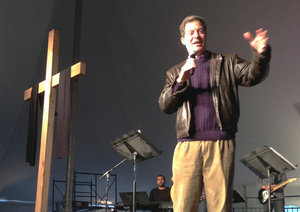
“Governor brings religion into the public sphere”

“Governor brings religion into the public sphere” published on No Comments on “Governor brings religion into the public sphere”
KS governor Sam Brownback. Photo credit: Brent Wistrom, The Wichita Eagle

Fearing terms is odd. But in terms of terms to fear

I’d suggest “public square” and “public sphere.”
When it comes to church and state separation
these words are oft used for equivocation
of an individual’s right to express a thought
and a government’s ideological onslaught,
to swap the former for the latter.

The “public square” or “public sphere,” you see
can refer to a literal town square or public access TV
or to the podium where a governor stands
issuing edicts and waving his hands.
It’s not a difference of ideas transmitted
but the weight of actual law permitted
to enforce their content that matters.

A religious politician is no pioneer.
All people are religious in the public sphere
if they are religious, that is, and openly so.
No laws prohibit prayer in school, and no
rules forbid statements of faith in the street.
But you won’t hear this from theocrats you meet
who confuse gov’t endorsement with speech.

They say God has been forbidden from class
if the teacher can’t make you get off of your ass
and pray to a god you might not believe in
or a different version than you were conceiving.
Your personal faith, though, is perfectly kosher.
It’s mandated worship that we should be so sure
to avoid, for that’s overreach.

Likewise, pols wanting laws made at God’s behest
would do well to consider the lemon test:
legislation must have a secular reason.
This means that those who contemplate seizing
the power of office to make us obey
their faith fall afoul of what their own laws say;
their job is to govern, not preach.

I know when it comes to private and public
it’s hard to determine the best way to stick
to church/state separation. But really, these
efforts to conflate, trick, and tease
make it harder. Jurisprudence and God
must be distinguished. Brownback has trod
on a freedom that we now must teach.

“In God We Trust” and the right not to speak

“In God We Trust” and the right not to speak published on No Comments on “In God We Trust” and the right not to speak

The state of Georgia is considering a bill which requires that “In God We Trust” be on the license plates of all registered vehicles, unless the owner pays to have the slogan covered up:

Georgia SB 293 would amend current law to mandate that, starting next summer, all plates would be imprinted with the religious declaration. If someone does not wish to exhibit this statement of faith, they would be required to purchase a sticker from the state displaying the name of their county that could be used to cover “In God We Trust.”  The bill text currently available on the legislature’s website really drives home the dramatic change in attitudes by the Assembly, as you can clearly see what has been crossed out and changed. While displaying the county name is the current “default” choice for Georgia drivers and alternatively they may purchase an “In God We Trust” sticker, this bill would directly swap the two, making the religious motto the routine option.  Mandating that individuals pay money to the government in order to not flaunt religious views is absolutely ridiculous. As the website Georgia Politico aptly puts it, “In other words, if you feel the government should not be establishing a religion, you are going to have to pay to prove it.”

  …and if you do decide to prove it, it’s possible you might be targeting yourself for retaliation by anyone who considers a refusal to display the message to be an offense. Regardless of whether your reason is an actual disagreement with the sentiment or a disapproval of the requirement to display it, observers are invited to form their own interpretations and make judgments on that basis. Being forced to decide whether it’s appropriate to take this risk is particularly strange, as Secular News Daily points out, because the “In God We Trust” plate was already one of the options available to Georgia drivers.

Over at Dispatches, chaosof99 notes that even though the statement in question is the nation’s motto, a person could make a legitimate (in the eyes of the court) objection to the plates based on a violation of First Amendment rights:

Wooley v. Maynard. Came across that quite by coincidence because for a reason I no longer remember I looked up “Live free or die” on wikipedia.  Anyway, it’s unconstitutional to force people to display an opinion or sentiment against their will. The Wooley v. Maynard case is already a Supreme Court precedent for this, and also pertains to slogans on license plates.

I had not previously heard of Wooley v. Maynard, but it’s definitely a story of having courage of one’s convictions. A Jehovah’s Witness couple (the Maynards) were unwilling to display the New Hampshire state motto on their license plate and opted to cover it up. Since a New Hampshire statute deems it an offense to obscure any figures or letters on a plate, they were cited for it. George Maynard showed up in court in 1974, represented himself, and plead not guilty, citing religious objections to displaying the motto. He was found guilty but a $25 fine was suspended due to “good behavior.” The following year when he was cited again, Maynard again showed up in court and plead not guilty. He was fined $50 and given a six month sentence in the Grafton House of Corrections, which was also suspended although the court ordered him to pay $25 for the first offense. Maynard explained that he would not pay either fine as a matter of conscience, whereupon the court sentenced him to fifteen days in jail, which he served.

The following year, the Maynards sued in New Hampshire’s district court against enforcement of the original statute under which George had been cited, in response to which the judge issued a temporary restraining order against any further arrest or prosecution of them. Because the couple’s suit sought an injunction against the state of New Hampshire on the grounds of unconstitutionality, the case went to the Supreme Court, who agreed with the Maynards in a 6-to-3 decision:

New Hampshire’s statute in effect requires that appellees use their private property as a “mobile billboard” for the State’s ideological message – or suffer a penalty, as Maynard already has. As a condition to driving an automobile – a virtual necessity for most Americans – the Maynards must display “Live Free or Die” to hundreds of people each day. The fact that most individuals agree with the thrust of New Hampshire’s motto is not the test; most Americans also find the flag salute acceptable. The First Amendment protects the right of individuals to hold a point of view different from the majority and to refuse to foster, in the way New Hampshire commands, an idea they find morally objectionable.

Well said. Let’s hope that, if necessary, the same will apply to people made to display this ideological message.

“Masculine Christianity” and the Penn State scandal

“Masculine Christianity” and the Penn State scandal published on 2 Comments on “Masculine Christianity” and the Penn State scandal

                                      . 

This is University of Nebraska Assistant Coach Ron Brown praying on behalf of his football team and that of Penn State prior to their game on November 12th, in the wake of the latter university’s scandal regarding former head coach Joe Paterno. Which you already know about if you haven’t been living under a rock for the past week and a half, so you don’t need any commentary on it from me. But Brown thought that God needed a comment on the matter, specifically regarding manhood and young boys:

There are a lot of little boys around the country, today, who are watching this game. And they’re trying to figure out what the definition of manhood is all about. Father, this is it right here. I pray that this game will be a training ground of what manhood looks like. And we will compete with fierce intensity. With the honor, and the gifts, and the talents that you’ve given us. And may we be reminded, Lord, as it says in John 1:14, that Jesus is full of grace and truth. May the truth be known!

Indeed– may the truth be known. And the truth is that a coach from a public university found it appropriate to use a scandal involving child molestation as an opportunity to teach little boys what manhood is, via a football and declarations about Jesus. I saw this, and thought “I can’t be the only person believes this to be very, very wrong.” And I’m not– it’s just that it’s hard to articulate all of the things wrong about it.

Hemant Mehta decided to re-write Brown’s statements to be something that is, in Mehta’s eyes, more useful:

Here’s what Ron Brown could’ve said to the teams — and the crowd of over 100,000 — that would’ve made a real difference — instead of the worthless tripe that came out instead:  

We’ve been through a lot this past week, but it’s nothing compared to what Jerry Sandusky’s victims have been through. We can never let something like this happen again.

 If any of you ever sees abuse taking place — on the field, off the field, after you graduate — it doesn’t matter who the abuser is, go to the police immediately.

If you’re ever the victim of such abuse, please tell someone you trust what happened. It doesn’t matter what you think about the person who did it to you, and no one will ever think less of you for turning them in.

If you had nothing to do with the situation but you still want to help, well, we need more people like you. Please encourage your fans, friends, and family members to make a donation to a child abuse prevention organization.

That will do more for these children that our god ever can. 

That would’ve taken real courage to say, so I’m not surprised we didn’t hear anything even remotely resembling that before the game.  

I suppose it would have taken real courage to say, but only because of the last line– and that line should be left out. Everything else is not particularly courageous, but it is certainly important. It’s what people need to hear and know, valuable information. It doesn’t exactly take the place of what Brown said, though, because it’s not ceremonial. It doesn’t address the communal mood, the event that is about to take place. It’s a comment that should be made in addition to something else, and here’s the important thing…that “something else” should not be a prayer. This is something overlooked in Sean O’Neil’s essay concerning what he calls “muscular Christianity”:

John Sandusky is an older man who used his prestige and power to abuse boys. Perhaps, then, Brown’s prayer about a redemptive display of masculinity merely reinforces a truism: that decent men would never abuse anyone. Since lines were transgressed in obviously horrific ways perhaps the boundaries of decency need to be reinforced in just as obvious a fashion. This still raises other questions, though: Who gets to re-draw these borders at such a sensitive time of (national) crisis? Also, what will young boys learn about gender from the dominant religious portrayals of manhood in muscular Christianity? Muscular Christianity refers to the wedding of traditional conceptions of masculinity—such as bravery, chivalry, and athleticism—with evangelical Christian emphases on personal conversion and biblical devotion. Tim Tebow is perhaps the quintessential muscular Christian, combining religious and athletic vigor on the most visible athletic platform in the country: the National Football League. Muscular Christianity is also developed in more pedestrian venues, on college campuses among groups such as the Fellowship for Christian Athletes. Evangelicals espousing some form of muscular Christianity (not a term that most would use) tend to interpret the Bible conservatively—especially with regards to sexual norms. Gay sex among consenting adults, for example, is usually labeled sinful in such evangelical contexts. There are few if any progressive religious voices in these settings. . .  If the only religious voices heard on the fields are the most conservative on issues of human sexuality, there may be few opportunities for athletes to combine vigorous athleticism, strong religious commitment, and fidelity to LGBT identities in the same breath.

Hoo boy. If you know me, you know what will be the sticking points here: 1) “traditional conceptions of masculinity” and 2) “religious voices heard on the fields.” Bin them both, please.

Why? Let’s start with the former. I hate to point out the obvious, but “LGBT identities” often do not conform to “traditional concepts of masculinity.” Nor is there any reason why they should, considering that “traditionally masculine” people are often outright phobic or hateful of those who are non-traditional. Just as much or more than being brave, chivalrous (ugh) or athletic, traditional masculinity entails being straight. And so far as I can tell, there is nothing about being non-straight, non-traditionally masculine, that inhibits one’s athleticism. So maybe when it comes to football or any other sport, it would be better to call a spade a spade and emphasize that. Those attributes of character that are desirable to have also– bravery, stalwartness, reliability, foresight, cunning, and so on– are by no means exclusive to the masculine. Especially not the traditional kind.

(I will also mention, though I hope it’s not necessary, the significance of focusing on how to tell/show young boys what it means to be a (traditional) man in the wake of scandal surrounding child rape. Just as with the scandals within the Catholic Church, there are plenty– perhaps Asst. Coach Brown is one of them– who interpret such an act as part and parcel of homosexuality. As something that gays just do, or that just gays do. This bigoted belief has no place on the football field or anywhere else.

Let it be emphasized: a decent person would not abuse anyone. Indecent people come in all sorts of gender and sexual configurations.)

As for religious voices on that field…why do we need those? Even disregarding the question of whether it constitutes a church/state violation to have a coach for a public university’s football team to deliver a prayer before a game, O’Neil’s grievance above illustrates precisely the problem with having a religious invocation in the first place– it creates a debate about whether it’s the right religion. Whose beliefs should prevail. Because for everyone who doesn’t worship Jesus and/or doesn’t appreciate the treatment of Jesus in the prayer given, the ritual becomes a period of discomfort rather than bolstering. And for many of those to whom the words about Jesus ring pure and true, any other religious message will seem either diluted or outright blasphemous. By all means, don’t prevent the players from practicing their faith as they see fit. But leading everyone in a massive group prayer such as this seems designed to be unnecessarily divisive and yet squelch any minority views.

I can’t help but wonder how many of those players kneeling around Assistant Coach Ron Brown feel resentful, silly, or confused. How many wish that a message acknowledging the situation but encouraging them to play a good game could be delivered without being wrapped in platitudes about what it means to be a real man and a real believer. How many of that group would never breathe a word about such sentiments, for fear that they would be ridiculed, hated, maybe even attacked by others.

How sad that is. And how completely unnecessary.