Skip to content

Failing to please

Failing to please published on No Comments on Failing to please

In the comments for a Pharyngula post about online harassment of women journalists, Rachel Kiernan wrote:

This insanity isn’t just levered against female writers. Female politicians receive even more vitriol than their male coworkers or females in other lines of work. Otherwise secular and liberal Germany is filled with men who have something pathological against Angela Merkel, usually about her appearance and based in an absolute hatred against any female politician. An Italian newspaper called her a “lard ass,” in spite of the fact she’s considered to be the de facto leader of the E.U. and has bailed out their banks. In addition to the problems associated with Dominique Strauss-Kahn, France has a problem with male politicians molesting their female staff members while female politicians must endure cat calls just to show up to work. Of course, the news also recently broke about a male politician in Bolivia raping a female politician at a party after she passed out from drinking. So… it would seem as though a photo equals consent, clothing equals consent and the inability to say “no” is also consent. The constant threat of rape is just one example of what can and will happen to women if they dare make themselves seen and heard.   The ugly reality is that “male machismo” is considered a basic human right for most of the world, including many liberal and secular countries. It’s meant to silence and hide women who otherwise might not “know their place” in society, reminding us all that if we ever fail to please, we can and will be humiliated, threatened, hurt and much worse.

The words “if we ever fail to please” stuck out to me. When trying to formulate a simple and coherent concept of everyday sexism– the kind practiced by generally good people, just people who have spent little to no time thinking about sexism as a concept to begin with– I end up falling into a Jeff Foxworthy-like game of “You might be sexist if…..” And what I often end up with is something like “You might be sexist if you think the most important thing about a woman is whether she’s sexy.” If you’re talking about a woman who is notable for something other than being sexy (such as, for example, winning an award, writing a book, running a business, inventing a product, etc.) and the main or even the only thing you can manage to say about her involves how attractive (or not) she is….you might be sexist. If you think a woman’s primary job is to be sexy and her actual job is something other than porn star, exotic dancer, or prostitute…you might be sexist. (Which is not at all meant to disparage actual porn stars, exotic dancers, and prostitutes)

But I like “failing to please” because that encompasses being sexy, but also leaves room for subservience. For the ways in which a woman who isn’t yet sexy, is long past being sexy, or never could be sexy might still yet please. You know, like being properly deferential– not presuming to argue with a man publically, or otherwise exert authority over men. Accepting one’s non-sexiness as a character flaw and attempting to make up for it in other ways, such as being a good cook. After all, ideally all women would be both sexy and good cooks, but if you have to choose between the two, go with the good cook because then you’ll get the best of her talents without having to fight your mates off to keep her! And so on.

So yes, “failing to please” is a good catch-all. It sums up very well the general notion that women must live for men rather than for themselves, or at least before themselves, and those who don’t are to be shunned and ridiculed if not worse– sometimes far worse.

Secret Agent Woman

Secret Agent Woman published on 3 Comments on Secret Agent Woman

Jennifer Shewmaker, a psychology professor at Abilene Christian University, has a blog post blaming the Steubenville rape case in part on objectification of women. You should go read it, but first read about the Steubenville matter if you haven’t already. I have some theories about what would possess teenagers to create videos of themselves mocking a fellow student for getting repeatedly sexually assaulted at a party and then post the videos online, but they’re half-baked. And right now I want to talk about the aspect Shewmaker focuses on.

First, I agree that objectification does contribute to this, but a “me too” isn’t good enough here. “Objectification” has become to pat a word, too cliche. It’s not wrong, but it’s so commonly used that I think the meaning has been largely sucked out of it and people’s eyes tend to glaze over when they see it. And I say this having written about objectification and the problems with it multiple times before, each time cringing a little internally while thinking about how the word, a very important word, has become a slogan.

So let’s focus instead on the opposite of sexual objectification– sexual agency. Or just, you know, agency to start.

An agent is a being with a will, desires, motivations, and responsibility. An agent does things for reasons, and can be blamed or praised when those things are wrong or right, respectively. In order to be a fully realized agent, you need to be capable, adult, mature.

An agent, when it comes to legality, is someone who can be party to a contract. We do not hold a person to a contract if important information was withheld from him or her in the contract’s arrangement (that would be fraud), or if the person him/herself was for some reason not mentally competent to enter into such an agreement, because these are factors that diminish agency. They make a person less capable of making an informed, responsible decision. And it’s wrong to deceive people into doing things against their best interest (that’s taking advantage of them), and it’s wrong to blame people for behavior that either wasn’t immoral or over which they had little or no control, or both.

When a child or someone with a severe mental disability does something bad, we temper our judgment according to their diminished agency. When an animal does something bad, we blame it scarcely at all. Children, the mentally disabled, and animals are placed in the care of rational, caring adults, fully-realized agents, who make decisions for them. Even though they are not fully-realized agents– especially because of this– we consider it wrong to abuse them. Though they are not moral agents, they are moral patients– beings we should treat morally, even though they may not be able to treat us in that same manner.

There are men who think that women are like children, the mentally disabled, or animals in this regard. No, they probably don’t think in terms of moral agents and moral patients, but to them the only people who can be fully responsible, mature actors are adult men. To this sort of person, sexually assaulting a woman is wrong– but primarily because it goes against the interests of whatever man is in charge of her, her husband or her father. A woman’s sexual “purity” (scare quotes here because having sex is not like dropping a bit of black paint into a can of white, or a fly into a pitcher of milk) is a commodity, the strength of which determines her value to these men. In that regard she hovers somewhere between child/mentally disabled person and animal, because children/the mentally disabled aren’t expected to provide a service, whereas animals often are. It would be more accurate to say, actually, that they are used for something– dogs for hunting or sniffing out drugs, horses for pulling carts, various livestock for eating, and so on. Women are used, to this mindset, for sex and baby-making. If they can no longer be used for these functions or nobody wants to use them for these functions, they are irrelevant. As Tina Fey said, “crazy” is a woman who keeps talking when nobody wants to fuck her.

To this mindset, rape is only as wrong as theft– and it’s theft not at her expense, but at the expense of another man. If no man is in charge of a woman, or if she’s been “used” too much, then….eh. If you take someone’s dog and beat it with a stick, you’re in serious trouble. If you take a stray dog and do the same thing, not nearly as big a deal.

A study performed earlier this year indicated that people, male and female, literally see women as more like objects and men as more like people. Of the images that Shewmaker used to accompany her blog post on objectification of women, the worst one to me is an ad depicting a woman in her underwear lying on a bed, with a Playstation controller lying nearby, its cord leading directly into her belly button. With this, you can control the woman, haha. The caption reads “Keep on dreaming of a better world.” Of all depictions of woman-as-sexbot in media– and there are so many the idea is well past cliche at this point– that’s certainly one of the clunkiest. Congratulations, Che Men’s Magazine– you’re even lousy at sexism!

But even so, even in spite of these, I find it easier to focus not on how women are turned into objects, but how they’re denied having agency. It seems more accessible to take what a man is generally considered to be, and then examine what is subtracted for a woman (“How do you write women so well?” “I think of a man, and I take away reason and accountability”). And then look at the ramifications.

There are people, and then there are women. 
There are two kinds of people: men and women.
There are people, and amongst them are men and women.

Yes, that’s better.

You fill in the harmony

You fill in the harmony published on No Comments on You fill in the harmony

The Atheist Experience posts that they received an email which reads:

Dillahunty is off his rocker if he thinks feminism is merely the idea that men are equal to women. Feminism is a paranoid leftist ideology with a whole slew of dogmatic principles. A person can believe in equal rights and oppose feminism, without said opposition being contradictory. If I had called into the show to argue about this, I would have easily torn Matt a new one on this topic. Screw you, Matt. I believe in equal rights and equal opportunity for EVERYONE. And I hate feminism with a passion. Are you going to argue that my belief in equal rights for women makes me a feminist? Then you’ll have to explain why I disagree with 99% of feminism’s core ideology. Feminism is a hate group that seeks to elevate women above men. 

R.E.M is probably my favorite band of all time, and one of my favorites of their songs is World Leader Pretend, which has lyrics that go:

I sit at my table
and wage war on myself
It seems like it’s all, it’s all for nothing
I know the barricades
And I know the morter in the wall breaks
I recognize the weapons
I use them well
This is my mistake
Let me make it good
I raised the wall
And I will be the one to knock it down

When I read that letter, I could not get this out of my head:

So, there. That’s a thing now.

Atheism Minus

Atheism Minus published on 3 Comments on Atheism Minus

…is my term for the collective group of idiots who contributed to Jen McCreight deciding that blogging is no longer worth the harassment she has faced on a daily basis. I wish they would form their own organization already. As soon as they hold a conference, the organizers of all other secular conferences could examine the attendees and speakers lists, and know who to forbid from future meetings of their own.

And this news comes only a week after Jen gave a very interesting and hopeful interview with Ed Brayton on his show Culture Wars Radio (available here, and in podcast form on iTunes). Give it a listen– the interview is in the latter half of the show, starting at 59:48.

Belaboring the obvious

Belaboring the obvious published on 3 Comments on Belaboring the obvious

Just a follow-up thought on my last post– you know, even if everyone’s personality matched their appearance exactly, and all beautiful people were good and wise while all ugly people were stupid and nasty, that wouldn’t justify being anti-feminist. Being good, wise, and beautiful all at the same time doesn’t make a person any more likely to appreciate being treated as though because she is also female, her primary job is to be sexy. Indeed, I think we could safely say that the more virtuous and intelligent she is, the more likely she would be to resent this.

Greta Christina made a post yesterday that could hardly be more illustrative of the futility of making being sexy the primary goal of your life. Someone actually posted on her blog that he couldn’t take her seriously because she once posed nude for a calendar. He said that made her a whore, and he “separates whores from women I take seriously.” And he said this while freely acknowledging that he had masturbated to the image of her. Now, Greta Christina is a lesbian, so I think she could hardly give less of a damn about whether any man got off looking at her naked. But this particular man made it very clear– because he found her sexually desireable, enough to masturbate to, that makes her a “whore” and her thoughts not deserving of any regard.

You sort of have to be happy when people admit that they think this way, because it’s like waving a nice bedsheet-sized red flag letting you know to give them a wide berth (because, as we know, a person’s appearance does not tell you his/her character, or every man who thinks this way would resemble an upright warthog). Literally– I’d like to be aware of this person while walking down the street, so that I could cross to the other side if I saw him coming. I’d like him to move to some other country, actually, such a perhaps Saudi Arabia where it’s acceptable to believe that men wanting to have sex with women is a flaw of womankind, permissable grounds for viewing them as lesser. But actually that’s not a good idea, because Saudi Arabia has enough people who think that way. I wouldn’t want to inflict any more upon the women who live there.

Greta Christina has balls of steel, by the way. I really should use a more appropriate expression, but that’s the one that evokes the proper reverence. There are all kinds of reasons to admire her, but that nude pic in particular is a reason to give respect, not deny it. Because she had to know that it would mean a future of periodically encountering douchebags like that guy, and she did it anyway.

And again, the fact that he found her photo arousing is only significant in that it conveys the fact that being arousing to someone does not earn his respect. Once that is understood, there’s an enormous freedom and power to be found in not seeking it.

Thanks for the confirmation

Thanks for the confirmation published on 6 Comments on Thanks for the confirmation

So you may remember a couple of weeks ago when I wrote about a particularly ridiculous blog post which claimed that the popularity of the GIF of Australian hurdler Michelle Jenneke doing a little warm-up dance before competing was due to the fact that men– in general, men– do not love feminists. How did the author of this post, Matt Forney, know this? Well, because he could see that Jenneke is a) attractive, b) apparently happy, and c) has accomplished something, all of which together indicate that she is the very opposite of a feminist. Because feminists are ugly, miserable, and do nothing aside from bitch.

I was very careful in my reply to note that there is absolutely nothing wrong with finding Jenneke attractive, but that my suspicion is that men do not, in fact, “love” her– that contrary to Forney’s suggestion, men who drool over Jenneke do not do so to the exclusion of enjoying porn, and almost certainly have not given up even a moment of porn viewing fun in favor of watching Jenneke bounce around suggestively-yet-innocently. They simply added it to their stable of wank material, alongside that GIF from several years ago but still going strong, French singer Alizee frozen in a single arousing dance move. And she (Jenneke, but also Alizee actually) achieved such status not because an ideological objection to the Bechdel test or a refusal to support the establishment of sexual harassment policies at conferences came shining through to all viewers of a four second GIF, but because because that GIF gets them hot. It’s as simple as that.

After noticing a number of hits here that came from Forney’s blog, I returned to see that he had written a follow-up post which talked about my post. Want to guess what it said? I’ll make it a multiple choice question:

A. You know what? I am actually reading too much into this, and should go with the simplest explanation rather than making other men’s attraction all about my particular ideological agenda.

B. You know what? I don’t think I was given a fair shake– there are actually differences in the appearance of feminists vs. non or anti-feminists, and while I didn’t go to much trouble to articulate these or why they should exist, that’s a factor that should be taken into account here.

C. You know what? It’s really weird that I didn’t bother to make any distinction between “attractive” and “attractive to me,” since I can only speak for myself, and since (as with everybody, whether they admit it or not) my own perception of what I consider attractive is shaped by my ideological convictions.

D. You know what? Gretchen’s ugly. And probably autistic.

I’ll give you a moment to think before answering.

Done? Yeah, I didn’t think it would take long. The answer is….D!

The idea that feminists/MRAs might be socially retarded first came to me when I read this feminist response to my Michelle Jenneke post. In particular, it was this passage that lit me up:

The best thing about this long discussion of how feminine, how confident, how accomplished, and how generally wonderful Jenneke is, is that Forney has no idea whatsoever if anything he’s saying about her character is true. All he knows, based on this commentary, is that she’s an athlete who looks graceful and happy. That’s it. Oh, and that she’s hot. […]

Now, in a strict sense, she is right: I’ll likely never meet Jenneke and thus I’ll never get to find out what she’s like. But she’s really pulling the tired “you can’t judge a book by its cover” line that fatties, uggos and other weirdos use to defend themselves. At our deepest levels, we all know it’s bullshit: a person’s outward appearance is a reflection of their soul in nine out of ten cases. A well-dressed businessman, a filthy bum, a scantily-clad woman; if you use your instincts to make snap judgments of people according to their appearance, you’ll be on the money most of the time. What got me thinking is that feminists may not simply be using that line as a defense mechanism: it might be that they legitimately can’t tell what people are like from looking at them. One of the defining characteristics—hell, the defining characteristic—of autism and Asperger’s is an inability to understand social cues. When Gretchen Koch watches that video of Michelle Jenneke’s “sexy” dancing, it may be that she honestly cannot read the social cues that Jenneke is inadvertently telegraphing through her behavior, cues that I and millions of socially adjusted men instinctively pick up on. To further drive the point home, Koch has a picture of herself on her blog’s sidebar. There are no good-looking feminists for a reason: when was the last time you met a good-looking person with autism?

Actually if you read through the literature, one of the oft-repeated descriptions of people on the autism spectrum is that they are unusually attractive. Something to keep in mind there is that autism is primarily a disorder of the male brain, and by that I mean both that it predominates in males and that it in females, it tends to make their brains more masculine, that is to say their minds are more focused on structures and organization and less on empathizing with other people (Simon Baron-Cohen writes about this extensively in his book The Essential Difference). Bear in mind that this attractiveness is a description of observers of people on the autism spectrum and seems to reflect a trait that people with autism have naturally, through no deliberate actions of their own. So if Forney doesn’t find people with autism attractive (something I’ll posit even though it’s a stretch to assume that Forney has actually seen many people on the spectrum), it’s quite possibly because a) most of them are male, and b) they are not as likely, male or female, to care about their appearance.

But they generally care somewhat. It’s fair to say that most of us– autistic or not, feminist or not– care about our appearances. Asexuals, who have no interest in sex with either gender, and ascetics, who have given up sex in favor of celibacy, probably are the most likely to not give the slightest damn whether someone finds them attractive. But the rest of us do, to varying degrees. We all have our particular limits for what we’re willing to do– the energy we’re prepared to exert, the money we’re prepared to spend, the pain we’re willing to endure– in order to appear sexually attractive, and some people’s limits are higher than others.

This may be because they want to be attractive more than others do, but it also may be because they just enjoy being sexy. Don’t ask a man driving a Maserati to quantify how much he’s doing it for it his own pleasure, and how much he’s doing it to attract smokin’ hot chicks. Don’t ask a woman wearing five inch heels how much of it is because she just loves looking smokin’ hot, and how much she’s doing it to attract the guy who drives the Maserati. For both of them it will be a blend of the two, and neither one is doing anything wrong. Here’s an important point, though– the guy not driving the Maserati and the lady not wearing the five inch heels? Also not doing anything wrong. Maybe he’s poor and she has ankle problems, maybe both of them just don’t get enough pleasure out of doing those things to make it worth it to them. It’s probably true that if you’re a feminist, doing things that make you more conventionally attractive to men are not going to be as important to you, especially if they require exertion or expenditure. This is because feminists, as I will loosely define them for the purposes of this post, are people who believe that women don’t exist for men. That their greatest ambition in life does not lie (ultimately) in their reproductive potential, or (proximately) their sexual appeal. Misogynists are people who do think in these terms, consciously or unconsciously– men who think the most important thing about a woman is whether she is sexually appealing to him constitute the lion’s share, but men and woman who see life as primarily about making babies, above and beyond what the woman involved wants for herself, also count.

I care about being perceived as attractive. Feminists generally care about being perceived as attractive. We just don’t see it as the end-all and be-all of our existence, or in the case of male feminists they don’t see it as the end-all and be-all of womens’ existence.

Amanda Palmer of The Dresden Dolls recently blogged in response to a journalist claiming that she’s either a non-feminist or a bad feminist because she was observed “cooing and gazing adoringly” at her “bestselling fantasy author husband [Neil Gaiman] for two hours in public.” As you might guess, Palmer was not pleased. She wrote

i’m not even sure what the journalist MEANT by this statement. did he mean “real feminists shouldn’t show open affection for their husbands?” or did he mean something else? the fact that i’m “internationally adored” and neil is “bestselling” seems to be part of the point he’s making, but….what’s the point? that if i were a real feminist i’d stand there screaming “I KNOW YOU THINK YOU’RE HOT SHIT, GAIMAN, WITH YOUR BEST-SELLING MAN-PENNED NOVELS AND ALL THAT CRAP, BUT I AM FAMOUS CABARET WOMAN! FUCK YOU MAN! I ALSO MAKE AN INCOME! I STAND HERE, EQUAL TO YOU, AND SHOWING YOU AFFECTION WOULD CLEARLY BE A SIGN THAT I KNOW I BELONG TO THE WEAKER SEX.” rawr. what? . . .as far as i’m concerned, the most powerful feminist can do WHATEVER SHE WANTS.
THAT IS WHAT DEFINES A TRUE FEMINIST. this includes: wearing heels, wearing combat boots, wearing nothing, sporting lipstick, shaving, not shaving, waxing, not waxing, being political, being apolitical, having a job, being homeless, gazing at men, gazing at women, gazing at porn of all sorts, glamming up like a drag queen, going in man-drag, being in a five-way polyamorous relationship, being childless, being a stay-at-home parent, being single, having a wife, having a husband, and gazing/cooing adoringly at those wives or husbands anywhere they fucking choose, including elevators, restaurants, puppet shows (well, maybe keep it g-rated if there are small children present), ….or on theatrical stages at fringe festivals. are we getting the picture here?? the most powerful feminist can do WHATEVER SHE WANTS. the minute you believe you’re a “bad feminist” because you said the wrong thing/wore the wrong thing/got married/chose to have children…or otherwise broke some unspecified ”code of feminism”: DON’T BUY IT. THERE ISN’T ONE. you can do ANYTHING YOU WANT. ANYTHING. THAT’S THE POINT.

Indeed. If feminism is fundamentally about empowering women, then it’s about empowering them to act, look, and think however they want. “Including anti-feminism?” my interlocutor would obviously ask here. Yes, although of course what that person is doing should be allowed by feminism, but not called feminism. As a free speech proponent I am occasionally accused of being (for example) racist because I advocate for the freedom of people to say racist things. I endorse the freedom, not what people might choose to do with the freedom. Likewise if feminism endorses freedom for women to make their own choices, it must do so in spite of not necessarily approving of those choices. The behavior of any individual within a group cannot be perceived as justifying stereotypes of that group– not if you agree that individuals are free to behave as they choose, and stereotypes are an error, an instance of sloppy thinking imposed on those individuals by virtue of their membership in that group.

It’s not clear whether Forney thinks I’m ugly because I fit his stereotype of a feminist, or whether because I’m a feminist he has decided that I’m ugly. But the good news is, it doesn’t matter because it’s irrelevant. As irrelevant as Forney’s own appearance (albeit ironic, in the sense of Rush Limbaugh calling someone fat).

I don’t have to agree that a person’s appearance tells you everything about them in order for it to tell you some things about them, and being unwilling to declare that the “some things” includes her position on whether being sexually attractive to men is a foremost concern in her life does not make a person autistic. It make them honest. Of course we women know that it’s hard to parse whether a particular guy is being a disrespectful asshole because he genuinely thinks that our sexual attractiveness and availability is the most important thing about us, or if he’s just… you know, a disrespectful asshole. And there’s no particular incentive to discern the ultimate truth– we just want him to go away. And sometimes, on the basis of such behavior, women are known to make grossly prejudiced statements about all mankind, which is wrong. Equally as wrong as it is for men to do the same. But nowhere near as wrong, I think, as treating a woman as though she only matters insofar as her sexual attractiveness and availability to you, and then when she (quite naturally and rightly) reacts badly to this, expand that judgment to feminists in general.

Which is, I can’t help but guess, precisely what happened here.

In her #mencallmethings posts in which she catalogs the various epithets and threats used against her, Greta Christina generally takes great care to suggest that her readers not bother reassuring her that she is actually a physically attractive person, because that amounts to buying into the myth that her appearance is more important than what she’s actually saying. That’s an admirable position to take, because it means voluntarily giving up the warm fuzzies she might get from people saying “You’re actually beautiful!” in favor of pressing home the point that an ad hominem fallacy is always an ad hominem fallacy. Attacking the person rather than their position is always a non-argument, even if the person is female and even if the topic is feminism. Yes, really.

Oh, on that sexism in atheism/skepticism topic…

Oh, on that sexism in atheism/skepticism topic… published on 1 Comment on Oh, on that sexism in atheism/skepticism topic…

If you only read one thing about it– or, more likely, if you’ve read plenty about it and are either borderline overwhelmed or so overwhelmed that you can hardly see “whelmed” from where you stand– read Natalie Reed’s post from a couple of days ago, “All In.” It’s long, but definitely worth reading in its entirety.

If you need some further explanation of the Thunderfoot thing, read this, but it really isn’t the central focus of Natalie’s post. More of a catalyst. I may not come down where she does on every issue, but can’t find a single thing in that essay that I out-and-out disagree with. And she lays it out with a depth and feeling that makes me ashamed of how glibly I summed up the problem in my last post.

There’s harassment going on in the X community. I’m an Xer. Now what?

There’s harassment going on in the X community. I’m an Xer. Now what? published on No Comments on There’s harassment going on in the X community. I’m an Xer. Now what?

The topic of sexual harassment in video games has received attention in Forbes, the New York Times, and NPR’s “Talk of the Nation” recently– if you’ve been actively following the topic at all you probably won’t hear anything new, but it’s good to see it being discussed in publications and programs like these. If you listen to the BBC’s “Assignment” on the topic of “Guns, Girls, and Games” you can get the added benefit of actually being able to hear what in-game sexual harassment sounds like, and it’s every bit as simultaneously disturbing and stupid as you might expect. The program also includes interviews with Grace of Fat, Ugly or Slutty and Jenny of Not in the Kitchen Anymore, two sites devoted to compiling experiences of in-game harassment, who describe (with a tone of “Can you believe this?”) how unprovoked and frequent it can be.

What Grace and Jenny talk about is mainly comments heard in voice chat while playing FPSs (first person shooters) online as well as private messages sent during or after playing these games, mostly but not entirely on Xbox Live. I don’t typically play these games, and when I do it’s only with people I know, so I’ve never personally had these experiences. It’s hard to imagine dealing with the simple awareness that you’re female being taken as permission to unload sexist abuse on you, again and again, and they do describe it as incredibly fatiguing– people play video games to relax, to escape from their everyday life, and the everyday life of a woman can include a lot of sexist nonsense that is the last thing she wants to encounter in her recreational time (not that there is a time when she wants to encounter it). But Grace and Jenny point out that this isn’t the norm for them– it’s regular and unending, but not the majority of what they have to listen to while gaming. I suppose that would have to be the case, in order to retain some sanity.

There’s an identity issue here– a lot of people play video games, and there has been some sniffing at the stated statistic of 47% of video game players being women because the classification is “so all-encompassing as to be meaningless, bundling Solitaire alongside Diablo III.” The people who just play games like Solitaire or FarmVille probably do not think of themselves as “gamers,” but the people who play Diablo III or Cross Assault almost certainly do, and almost certainly play other video games as well. I really like what The Mary Sue’s Becky Chambers has to say about what this discussion has done to her concept of herself as a gamer:

A lot of people (mostly men, it seems) have said that this sort of behavior makes them ashamed to be gamers, or that they want to stop calling themselves gamers altogether. A friend of mine — a man I met through a game, and who I have continued to be friends with thanks to multiplayer games — echoed this same sentiment last week. Though it’s encouraging to see that so many people won’t stand for harassment in any form, I don’t think that separating ourselves from the community as a whole is the answer. On some level, it doesn’t matter at all what label you give yourself. I don’t care if you call yourself a gamer, or a fan, an enthusiast, or whatever. What concerns me is not the label itself, but the underlying implication that the community behind that label is not one that people want to be associated with. This then further implies the bullying and harassment we’re witnessing is the gold standard for how gamers are supposed to behave. Yes, the guy who threatened me in WoW was a gamer, but so, too, were the guys who supported me afterward (and so am I, for that matter). The only commonality any of them had was their hobby. Their respective actions were markers of personal character, not of the pastime they all shared. To be fair, there are a few assumptions I will make about you if you tell me you’re a gamer. First, I will assume that you get excited about games, and that you will be happy to talk about them with me. I will also assume that there is at least one game that we both like very much. We will then be able to converse about this game, probably at length and with great enthusiasm. If by some rare occurrence we haven’t played any of the same games, then we’ll each recommend some of our favorites to the other. If we both play a specific multiplayer game, or at least play on the same platform, and if we’re getting along really well, we’ll probably exchange usernames. If the exchange doesn’t progress that far or if we don’t hit it off, we’ll have enjoyed sharing some geeky pleasantries with a kindred spirit. And that’s it. 

I see some useful similarities and differences between the discussion going on here and the one about sexual harassment at skepticism conferences.

Similarities: 

1. In both communities, women are a minority in terms of pure numbers as well as degree of power and influence.

2. In both cases, there are people who aren’t defending sexual harassment per se so much as claiming it’s just part of the atmosphere and reacting as though trying to remove it will destroy or at least damage this special community where people aren’t PC and you can say anything. They like things the way they are, don’t care if others are bothered, and fear what will happen if the people who are bothered obtaining any kind of power to change things because they think it will lead to the creation of a language police state where simply joking around will get them punished or banned.

3. In both cases, aspersions have been cast on the gaming/skepticism community as a whole because of incidents of harassment. Some people embrace this criticism with a sense of guilt or at least a feeling discomfort by association, while others angrily resent the suggestion that they have anything to do with it.

4. In both cases, there are status quo supporters–male and female– who think that the complainers are complaining over nothing and should either a) shut up or b) go away or c) shut up and go away. This includes “chill girls”/“cool chicks” who think “It was just a joke” means something (something vindicating), believe any kind of attention is good attention, and/or don’t believe that anyone else has been harassed because it hasn’t happened to them.

Differences: 

1. Skepticism/atheism is a cause, a movement, whereas gaming really is not. Gamers generally would prefer that the world look more positively upon them and not assume that they’re pathetic basement dwellers at best or serial killers and terrorists in training at worst, but they don’t really have a political battle to wage. And they don’t really have a PR problem on the scale of the majority of the country considering them immoral and untrustworthy people, the last minority they’d support for president.

2. Gaming is a community of consumers– the majority by far do not design and create games; they purchase them (and of course those who design and create games purchase them as well). Inevitably articles about sexual harassment in gaming will also include sexual harassment about gaming (such as that which Anita Sarkeesian received) and then address measures that game makers can take to make it more difficult to harass people in-game, and sometimes whether the game is itself designed in such a way as to encourage harassment. These are interrelated but distinct issues that deserve independent consideration, and too frequently I see the ball being dropped there. Gamers can be nasty, but that isn’t the fault of game designers. There’s a line between participants and creators that exists in gaming which isn’t nearly so much the case with skepticism/atheism. The discussion about what objectionable content there might be in a game should really be held separately from that of how players act, and are allowed to act. The “get more female speakers” discussion with regard to skepticism conferences is not the same as the “get more female developers” discussion in gaming.

3. Again when we’re comparing an interest (gaming) to an ideology (skepticism/atheism), the latter is going to have cases of people arguing against harassment from the ideology whereas the former isn’t– generally speaking, anyway. There is nothing in particular about enjoying video games which makes a person more egalitarian, more considerate, more generous, etc. even though participation in online gaming gives people who do have these traits endless opportunities to express them, as any social occasion would. People argue that a person who presumes to be a skeptic has an obligation to reject bigoted thinking, or claim that since there is so much sexism in religion then an atheist has a responsibility to repudiate that along with faith, though I’m not sure these arguments are actually convincing to anyone who doesn’t already agree. With gaming that proposition is basically a non-starter, and this will be pointed out by gamers who see absolutely no sense in having a discussion about harassment or sexism in gaming at all– “We’re having fun here. That’s the point, right? End of story!”

There are plenty of other things to compare and contrast that can be pointed out, and I couldn’t hope to list them all right now. But given that these two enormous discussions are going on in both community-specific and now in big name general publications, I think it’s important to see whether people engaged in these discussions in either community could perhaps learn from each other’s experience. There’s a lot of geek/nerd overlap between atheism/skepticism and gaming, and it would be cool to see more celebrities of both cultures speak out– and to each other– on this topic. Phil Plait and Wil Wheaton, I’m looking at you! “Don’t be a dick” could hardly be a more applicable message.

What we need is more conversation. Smart conversation, with both talking and listening. Given what I’ve seen so far, I’m optimistic.

I don’t exist for you

I don’t exist for you published on 3 Comments on I don’t exist for you

Ian Cromwell, aka Crommunist, tweeted a link today to this: Why Men Love Michelle Jenneke. You know, the 19-year-old Australian hurdler who was recorded doing a little warm-up dance before her event? Who isn’t even an Olympian, but somehow everybody in the world has seen this video of her? Well, apparently the fact that this rather ordinary, casual manipulation of her toned and attractive body for her own reasons is titillating enough to allow men to drool over a bit of sports footage– apparently that is best used by the blog’s author, Matt Forney, to illustrate how feminism is horribly misguided and women who want to be appreciated for anything at all, ever, more than they do for their sex appeal are not only delusional, but…well, cunts.

So what’s the big deal? Jenneke’s not hot: she’s cute yes, but not stunning. Her “sexy” dancing is barely PG rated. In a world where videos of superhot, plastic-titted bimbos getting triple-fisted while gagging on horse cocks are just a click away, why would men rather watch an Australian 7 jumping up and down while fully clothed? UTB’s got the answer: 

…Michelle Jenneke’s high-octane femininity triggers an instinctive male hormonal response vastly different from the one seeking stimulation via streaming clips of themed interracial gangbangs. No matter how far one strays from nature, what’s intrinsic is undeniable. Michelle Jenneke is undeniable. She is the scent of grilled meat in the nostrils of a dying vegan. Upon sight, every fiber of the male being tells him it is imperative to deposit his seed in her. In a world of entitled chubbies and pornographic lies, Michelle Jenneke, without saying a word, speaks truth to penis. 

That’s the operative word: femininity. Michelle Jenneke oozes with it. Her youthful beauty, her exuberance, her aura: these aren’t things that can be faked. Hundreds of thousands of years of evolution have honed men’s tastes for sweet, submissive, complimentary women. As much as feminists and their betaboy clit-suckers wail about “social conditioning,” when it comes down to brass tacks, all men want the same thing

Not only that, Michelle Jenneke has something else that few American/Western women possess: confidence. 

I’m going to keep harping on it until I’m blue in the face, but what most women think is confidence is actually cuntiness. The standoffish, arrogant attitude common to “strong” and “independent” women is a pose they adopt to hide their insecurities. The louder someone crows about having something, the less likely they actually have it. The Anna Assmasters and Jen McCreights of the world pose and front out of fear that people will see them for the neurotic headcases that they are. Michelle Jenneke, in contrast, looks at ease in her own skin. Unlike the aforementioned bittergrrls, she’s accomplished something real: training long hours and countless days to compete in a demanding sport on an international level. And yet, at the same time, there’s not a cunty bone in her body. She smiles like a normal person, radiating joy and happiness. Her movements are graceful and energetic rather than sulky and surly. Does she look like the kind of woman who would make cheap sarcastic quips or start arguments over leaving the toilet seat up? It’s inconceivable. McCreight, her fanboy castrati and feminists in general want young women (and men) to believe that you can’t be successful and confident without being an unlikable, combative harridan. Michelle Jenneke puts the lie to that claim, and that’s why men love her. Before feminism, just about every woman was Michelle Jenneke, or at least aspired to be. She’s the kind of girl I’d make sweet, tender love to, then dive in front of a bullet for with no regrets. Femininity soothes the savage male beast. Take note ladies: if you want a “real” man, you better be a real woman. Skip getting your master’s degree and go to charm school instead; you’ll be happier for it

Now, you might be thinking “This is transparent idiocy. Why even blog about it? There are plenty of people who can and do catalog transparent idiocy in their blogs on a regular basis, so why not let one of them tackle it?” Well, mainly because I think it’s funny. Yes, partially in a “You have to laugh or else you’ll cry, not from hurt feelings but from the stupid” way, but partly just on its own. It’s funny to see someone attempt to translate what arouses his boner into an assessment of character, and then turn around and use that assessment to try and shame people who are insufficiently stiffy-stimulating for whatever reason. I know this is obvious, but heterosexual woman– do not buy this. It isn’t even true for him.

There’s nothing wrong with thinking Michelle Jenneke is hot. Nothing at all. What’s wrong– crazily, obviously, hilariously wrong– about this particular commentary is how much it attempts to make out of that attraction. That basic, banal, generic tug of the loins is apparently not only the most important thing in the world, but sums up the entirety of what it means– or at least, what it ought to mean– to be a woman.

Wow, right? Who knew?

The best thing about this long discussion of how feminine, how confident, how accomplished, and how generally wonderful Jenneke is, is that Forney has no idea whatsoever if anything he’s saying about her character is true. All he knows, based on this commentary, is that she’s an athlete who looks graceful and happy. That’s it. Oh, and that she’s hot. From this, we are expected to understand that she must also be The Anti-Feminist, because she is attractive to our author and our author hates feminists. Feminists are “cunts,” so Jenneke is simply confident. Feminists do nothing except complain, so Jenneke is accomplished (accomplishment as an athlete is fine, but don’t go getting no master’s degree!). And Jenneke “smiles like a normal person,” and her moves are “graceful and energetic rather than sulky and surly,” whereas feminists are…cave trolls, I guess?

Kill the conveniently all-male collection of
hobbits, dwarves, and humans!

What would be even funnier as well as satisfying, of course, would be if Jenneke turns out to be a raging feminist. The kind of person to respond like 18-year-old Olympic weightlifter Zoe Smith did when Twitter trolls complained that she doesn’t look feminine enough:

As Hannah pointed out earlier, we don’t lift weights in order to look hot, especially for the likes of men like that. What makes them think that we even WANT them to find us attractive? If you do, thanks very much, we’re flattered. But if you don’t, why do you really need to voice this opinion in the first place, and what makes you think we actually give a toss that you, personally, do not find us attractive? What do you want us to do? Shall we stop weightlifting, amend our diet in order to completely get rid of our ‘manly’ muscles, and become housewives in the sheer hope that one day you will look more favourably upon us and we might actually have a shot with you?! Cause you are clearly the kindest, most attractive type of man to grace the earth with your presence. Oh but wait, you aren’t. This may be shocking to you, but we actually would rather be attractive to people who aren’t closed-minded and ignorant. Crazy, eh?! We, as any women with an ounce of self-confidence would, prefer our men to be confident enough in themselves to not feel emasculated by the fact that we aren’t weak and feeble.

Zoe Smith is not, by the way, a cave troll. She’s not even hulking or behemoth-like in the way that a weightlifter would have every reason to be. A Google image search shows her smiling most of the time, and I bet she’s at least somewhat graceful though I haven’t seen her perform (yet). It doesn’t matter, of course– smiling is not an obligation, and grace and energy are lovely traits to have but they sure as hell aren’t the end all and be all. Sarcastic quips? Sounds like she’s full of ’em…but cheap, they are not. At least not if “cheap” means “easily made and without value.”

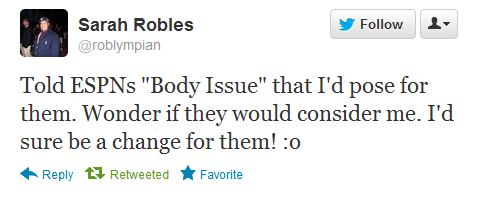
Fellow weightlifter Sarah Robles is smiling, graceful, energetic, and likewise in possession of some sarcasm:

Because you see, Robles– in addition to being the strongest woman in America– is 5’10” and 275 pounds, which makes her not conventionally attractive, with the tangible detriment of not being able to obtain the kind of sponsorships and endorsements she otherwise might:

“You can get that sponsorship if you’re a super-built guy or a girl who looks good in a bikini. But not if you’re a girl who’s built like a guy,” she says. The 23-year-old from California became the highest ranked weightlifter in the country last year after placing 11th at the world championships, beating out every male and female American on the roster. On her best day, she can lift more than 568 pounds — that’s roughly five IKEA couches, 65 gallons of milk, or one large adult male lion. But that doesn’t mean much when it comes to signing the endorsement deals that could pay the bills. Track star Lolo Jones, 29, soccer player Alex Morgan, 22, and swimmer Natalie Coughlin, 29, are natural television stars with camera-friendly good looks and slim, muscular figures. But women weightlifters aren’t go-tos when Sports Illustrated is looking for athletes to model body paint in the swimsuit issue. They don’t collaborate with Cole Haan on accessories lines and sit next to Anna Wintour at Fashion Week, like tennis beauty Maria Sharapova. And male weightlifters often get their sponsorships from supplements or diet pills, because their buff, ripped bodies align with male beauty ideals. Men on diet pills want to look like weightlifters — most women would rather not.

I think the title of Forney’s post– “Why Men Love Michelle Jenneke”– is self-evidently ridiculous, because it clearly isn’t love he’s talking about, however he might have deluded himself of such. But can you imagine him writing the exact same post about Robles? Neither can I, and it has nothing to do with whether she’s a feminist or not, how much she has or hasn’t accomplished, whether she’s upbeat and cheerful or sarcastic and argumentative. It has to do with a) being able to interpret what a conventionally attractive woman does publicly for her own purposes as b) somehow being for him personally by virtue of appealing to him sexually. Does Jenneke care in the slightest whether Forney would “make sweet, tender love” to her, much less “dive in front of a bullet for [her] with no regrets”? Almost certainly not, and just thinking of it turns the stomach (Guys? This is why the “I’d hit that” discussions are really about you, not the women you’re presumably discussing. And they’re gross) because it doesn’t take her perspective into account at all.

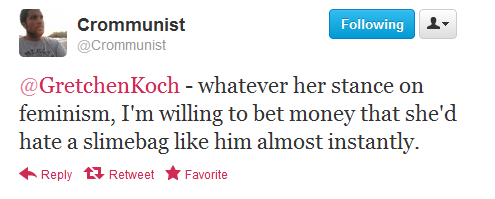
Crommunist replied to me saying:

Probably. There are women who don’t mind being “complimented” by the suggestion that they are attractive because their appearance is agreeable enough to a male observer that he’s able to construct fantasies about how she must be “feminine” (defined here as sexy but not overtly sexual, not powerful or attempting to gain power, smart and capable but no more of either than he is, and never disagreeable) enough for him, based on the most superficial of knowledge about her such as a few seconds’ worth of footage from a warm-up before a hurdle race. But nevertheless, I think this post would cause even the most flattered object to recognize that she’s being treated as just that. 
Objectification– that tired old feminist complaint? Yep, I’m going to go there. I kind of have to, having read all three parts of an article on the topic recently. The part that specifically comes to mind here is:

1) Stop seeking male attention.  Most women have been taught that heterosexual male attention is the Holy Grail and its hard to reject this system of validation, but we must. We give our power away when we engage in habitual body monitoring so we can be visually pleasing to others. The ways in which we seek attention for our bodies varies by sexuality, race, ethnicity, and ability, but the template is the “male gaze.” Heterosexual male attention is actually pretty easy to give up when you think about it. 

  • First, we seek it mostly from strangers we will never see again, so it doesn’t mean anything in the grand scheme of life. Who cares what the man in the car next to you thinks of your profile? You’ll probably never see him again.
  • Secondly, men in U.S. culture are raised to objectify women as a matter of course, so an approving gaze doesn’t mean you’re unique or special, it’s something he’s supposed to do.
  • Thirdly, male validation is fleeting and valueless; it certainly won’t pay your rent or get you a book deal.  In fact, being seen as sexy hurts at least as much as it helps women.

Lastly, men are terrible validators of physical appearance because so many are duped by make-up, hair coloring and styling, surgical alterations, girdles, etc. If I want an evaluation of how I look, a heterosexual male stranger is one of the least reliable sources on the subject. Fun related activity: When a man cat calls you, respond with an extended laugh and declare, “I don’t exist for you!” Be prepared for a verbally violent reaction as you are challenging his power as the great validator. Your gazer likely won’t even know why he becomes angry since he’s just following the societal script that you’ve just interrupted.

This is why I said earlier “It isn’t even true for him.” Even Forney wouldn’t be happy with a woman who satisfied his every criterion for being the ultimate in femininity, not that any woman should want to. When someone (male or female) honestly believes that the most important thing a woman is her ability to be sexy, that person will never be satisfied with any woman. It is never possible to be sexy enough, and the sexiest person in the world cannot maintain it for long. That doesn’t mean there is no point in trying to be attractive, much less that women who try to be sexually attractive are somehow traitors to feminism.

I don’t exist for you. That’s the important part. Everyone in a relationship exists in part for the other person in that relationship, regardless of what kind of relationship it is. People who want to be in a relationship exist in part for the person they want to be in a relationship with. But Zoe Smith does not exist for people who care less about any of her accomplishments or her actual character than whether she’s sexually appealing to them personally. Neither does Sarah Robles. And neither, I hope, does Michelle Jenneke.

We choose the people for whom we exist. It’s just fine to exist for plenty of other people besides ourselves, and all of us will in many different ways, but we must exist for ourselves first. And the ability to do that is awesome, right?

ETA: From John Scalzi’s post today on how not to be a creeper at conferences:

4. Acknowledge that other people do not exist just for your amusement/interest/desire/use. Yes, I know. You know that. But oddly enough, there’s a difference between knowing it, and actually believing it — or understanding what it means in a larger social context. People go to conventions and social gatherings to meet other people, but not necessarily (or even remotely likely) for the purpose of meeting you. The woman who is wearing a steampunky corset to a convention is almost certainly wearing it in part to enjoy being seen in it and to have people enjoy seeing her in it — but she’s also almost certainly not wearing it for you. You are not the person she has been waiting for, the reason she’s there, or the purpose for her attendance. When you act like you are, or that she has (or should have) nothing else to do than be the object of your amusement/interest/desire/use, the likelihood that you will come across a complete creeper rises exponentially. It’s not an insult for someone else not to want to play that role for you. It’s not what they’re there for.

Reddit’s rape thread

Reddit’s rape thread published on No Comments on Reddit’s rape thread

I had a whole blog post written about the Reddit thread discussing what it’s like to be a rapist, and now I don’t like it. It was supposed to be about the psychology of assigning moral responsibility to rapists and rape victims, but ended up being preachy and not scientifically supported to my satisfaction. So, in the trash can it goes. As I usually do when something like this happens, I’m going to try and walk it back and distill it into a simple list of observations. If I do this and still end up sounding preachy, well…I apologize.

1. That thread is very likely filled with a lot of deception. The very thing which encourages people to come out and actually admit to doing something horrendous like rape– anonymity– also allows them to tell a story with no truth in it whatsoever if they want to. So there are doubtless at least a few people in there getting their chuckles by telling a lurid and shocking tale that is also 100% fabricated.

2. Nevertheless, I don’t think reading it is a complete waste of time because even a person’s totally made-up characterization of a rapist is interesting. It’s interesting to see if they agree with the characterizations given by those who claim to be victims (who are also posting in that thread), and because a person who fabricates a story of what it’s like to be a rapist is likely telling you what he would in fact do and think if he decided to ever become a rapist.

3. The mentality of a perpetrator of rape, like the mentality of any perpetrator, is worth knowing about. It’s disturbing to learn, but necessary to understand. We must always listen to the explanations of victims, but when the victims are the only ones allowed to explain then we end up verging into the myth of pure evil— the perpetrator’s motivations are simplified (must be hate/desire for power) and isolated (must be deliberate and malicious) in order to maximize his responsibility. That isolation is a problem if it turns out to be mistaken, because as I wrote last month, you can’t really discourage people from doing something that they don’t view themselves as doing to begin with.

4. The self-proclaimed rapists and attempted rapists in the Reddit thread generally (with some major exceptions like this) describe themselves as realizing what they were doing and how wrong it was after the fact, unless they realized actually during, and had to stop themselves when they finally grasped that their female partner wasn’t willing. The closest they come to admitting malice is stating bluntly that the comfort and wishes of their partners weren’t any sort of priority for them– they simply disregarded them in favor of getting what they wanted.

5. That disregard is where the term “rape culture” begins to make sense for me. A rape culture is a culture in which women’s desires generally, but especially their desires regarding sex, are not regarded. Unfortunately most of the things I could say about this are prone to misinterpretation, by both people who agree and those who disagree, in the same way that statements I make about what it means to be a feminist can be misinterpreted. For that reason I don’t place a lot of stock in whether someone brands him or herself a feminist or not, or thinks “rape culture” is a fitting description for a phenomenon existing in the United States or not. What matters is whether we’re talking about the same thing. Do we have a culture in which women’s desires are commonly dismissed or viewed as subordinate to men’s desires? Yes. Does that mentality enable rapists to rape? Most likely, if their own descriptions of their motivations matter and are accurate. That’s minefield #1.

6. Minefield #2 is the characterization of rape victims, which goes right to the heart of why rape is wrong. Even the word “victim” is repudiated by some people, at least as a permanent status, because they reject the idea that the rapist continues to have power over them. A commenter on Salon’s article discussing the Reddit thread remarks:

As a social worker, I don’t find this comment/pronouncement [a description of a rapist being a cheerful, happy person who has traumatized a woman for life] particularly useful. These women are survivors, not victims. Some have moved on from the trauma by not making it the main narrative in their life story. This working through does not diminish the culpability of the perpetrator, and more importantly, it does not trivialise the gravity of the crime. What it does suggest is that women don’t have to make trauma central to their identity. Yes, it will inform who they are and affect them, but laymen and observers must refrain from condemning women to a life of suffering by not making ‘damaged forever’ forecasts. These include such misguided statements as, “She will never recover”, “It’s going to ruin her life” or “People never get over that kind of thing”. At the risk of sounding glib and simplistic, I am reminded of the quote “Life is ten percent what happens to you and ninety percent how you respond to it.”

To which another commenter responds:

Let me guess – you blame the ones who haven’t “moved on” for their suffering, because they are obviously simply choosing to “make [the trauma] the main narrative in their lives.” As both a child abuse and sexual assault survivor, and as someone who suffers from chronic complex PTSD as a result: SCREW YOU. Yes, it is great when a survivor can heal adequately enough to “move on,” but the timeline for that is different for every individual, and your severe lack of empathy on that point makes me think that either, a) you are lying about being a social worker, or b) you are one of the terrible social workers of the world. 

I can’t help but sympathize with that. Whether the (supposed) social worker does in fact blame women for not recovering from their rapes or not, the perverse attempt at self-empowerment that allows a person to describe those women who have recovered from a rape as having done so “by not making it the main narrative in their life story” certainly doesn’t make a clear distinction there. I think it’s possible to both congratulate and respect the work a person who was raped has done in order to improve her perspective on life and possibly grow as a person without suggesting that such an effort is both a) universally possible and b) merit-based, but the second commenter clearly doesn’t view the first as having done that. A rape victim is responsible for how she deals with the attack to the extent that she continues to have an obligation to be a moral person, but expecting her to be her own therapist and “fix” herself does, in fact, both “diminish the culpability of the perpetrator” and “trivialize the gravity of the crime.”

There’s a simple alternative to this, of course, and that is to not pretend that the damage of being raped is exactly the same for everyone. We don’t need to do that in order to avoid adjusting our view of the severity of the crime, any more than it’s necessary to say that child molestation isn’t such a bad thing because some children who have experienced it grow up to be well-adjusted adults. If you follow “how you respond to it” far enough around the circle of responsibility, you find yourself right back at “what happens,” since there is a point at which your response is simply a thing that happens. In failing to acknowledge this, doctrines of self-empowerment play a cruel joke– while trying to emphasize the ability to be happier by asserting “This is within your power,” they implicitly endorse the corollary, which is of course that if you fail to become happier that is also your fault. And that, as you might expect (and see in the second comment), tends to provoke some bitterness from people who are not happier.

7. Because of this thread on Reddit, fantasy author Jim C. Hines (whom you may remember from his awesome blog post in which he tried to pose like the women featured on the covers of books like his) decided to cancel an author Q&A session he was going to do for Reddit readers. I don’t blame him, though I wish he hadn’t. As many Redditors have pointed out, even if the “how rapists think” thread has no merit whatsoever and all who are involved in it should be ashamed (which I don’t believe), it hardly represents the community as a whole, much less the portion who were looking forward to his answering questions about how books. Hines is fully aware of this, but says that in canceling he wants to attract the attention of people who can “make a change” at Reddit. Unfortunately, I think he has simply made the change of providing Redditors with one less non-rape-related topic to discuss than they had before.