Skip to content

You want the blue pill; we’ll pay for it. You want the red pill; Rush Limbaugh owns your sex life.

You want the blue pill; we’ll pay for it. You want the red pill; Rush Limbaugh owns your sex life. published on 4 Comments on You want the blue pill; we’ll pay for it. You want the red pill; Rush Limbaugh owns your sex life.
In Limbaugh Land, consumption of these is
determined not by time but by sluttiness.

I’m a big believer– and try to be a big practioner– of giving people the benefit of the doubt in disagreements. Because it’s a nice thing to do, yes, but also because it’s way too easy to do things like assume the conclusion of a person’s position and then attribute that to them as if it’s what they have in mind and support (“You support legalization of marijuana, I think that legalization of marijuana means that teenagers will get stoned and run over small children at the drive-through,* therefore you must want teenagers running over kids at the drive-through.”) And there’s the additional fact that if you interpret what someone says in the best possible light, they are far less likely to complain that you put words in their mouth. In fact, you might even improve on what they were trying to say.

However….it’s hard to give Rush Limbaugh any benefits for making the following argument:

1. Women who want health insurance to cover birth control are asking to be paid to have sex.
2. Therefore, they are prostitutes, or at least sluts.
3. And if we’re going to pay them to have sex, we should get something out of it.
4. Therefore, they at least owe us video footage. So make with the sex tapes already.

Yes, this is the most charitable possible framing of what Limbaugh said on his radio show regarding the testimony of Georgetown University law student Sandra Fluke in Congress on the need for contraception coverage.
First:

LIMBAUGH: What does it say about the college co-ed Susan Fluke [sic] who goes before a congressional committee and essentially says that she must be paid to have sex. What does that make her? It makes her a slut, right? It makes her a prostitute. She wants to be paid to have sex. She’s having so much sex she can’t afford the contraception. She wants you and me and the taxpayers to pay her to have sex.

Then:

LIMBAUGH: So Miss Fluke, and the rest of you Feminazis, here’s the deal. If we are going to pay for your contraceptives, and thus pay for you to have sex. We want something for it. We want you post the videos online so we can all watch.

First of all, Fluke wasn’t even talking about herself– she was talking about a lesbian friend who stopped taking hormonal birth control because it was too expensive, and not covered by her university on religious grounds. She was on the birth control to stop ovarian cysts from forming, and after going off the pill a cyst formed that required surgery to remove the entire ovary.

But let’s say Fluke was talking about herself. And let’s say she’s heterosexual, and just wants to have sex with a man or men with a drastically reduced likelihood of getting pregnant. That seems like a good idea, right? That sounds like being careful. Responsible. And regardless of how much sex she has, and how many men she has it with, she’s going to require exactly the same amount of birth control as her lesbian friend (who might be having all kinds of sex herself, but presumably not with men): one packet every month. One pill every day. So the “she’s having so much sex she can’t afford the contraception” slam is blown out of the water, right there.

What about the claim that having insurance pay for birth control equates to taxpayers being made to pay people like Fluke to have sex? Well, again, people take the pill for a lot of reasons that don’t involve preventing pregnancy…like Fluke’s friend, who (again) could be having any amount of sex with any number of people. So maybe instead of telling women not to have sex if it requires using birth control, Limbaugh should tell them to become lesbians. But she wanted the pill to prevent cysts. Some women take it to control their menstrual cycle. Some women take it to minimize the symptoms of endometriosis. It is a multi-purpose medication, used for a number of very important purposes just like lots of other medication already covered by insurance. Like, you know, Viagra, which I’ve never heard of someone taking because he’s afraid of losing a testicle.

Additionally, of course, there is the fact that paying people to have sex without getting pregnant is cheaper than paying them to get pregnant, carry out the pregnancy, and give birth to a child they didn’t want and can’t care for. Limbaugh considers legal abortion a “holocaust” and women who fight for the right to have abortions “feminazis,” so it sure seems like he should be all in favor of any preventative measures women can take before conception to make sure that it…well, doesn’t happen. Nope. He’s a proponent of Santorum-backer Foster Friess’s method of aspirin-between-the-knees, which it’s hard to believe was funny when the FDA legalized the pill (for menstrual disorders first, note) in 1957. When I’m pretty sure people already knew that it’s possible to have sex with your knees together.

Limbaugh’s argument is fundamentally not financial; it’s moral: birth control is about making it possible for women to have sex without risk of pregnancy, and they shouldn’t want this. If they do, it’s probably because they’re having sex with someone they are not married to and don’t want to marry, which makes them sluts. Message to Limbaugh: most Americans by far either have used or will use birth control to avoid pregnancy. Most Americans by far have had or will have sex outside of marriage. Most Americans by far, I am guessing, do not want to risk creating a pregnancy every time they have sex, whether married or unmarried. Limbaugh himself is almost certainly one of these Americans in all three cases.

So why is he arguing so adamantly against this? Because it offers a chance to make a cheap shot at American women. All Americans benefit by having easy and cheap access to birth control, but Sandra Fluke’s testimony made for an opportunity to say that women who benefit from that access must be sluts.  As Rep. Jackie Speier said today in calling for a boycott of Limbaugh’s sponsors, it’s flat out misogyny:

“Shame on you for calling the women of this country prostitutes,” Speier said. “Ninety-eight percent of the women in this country at some time in their lives used birth control.” “So I say to the women in this country, do something about this,” she continued. “I say to the women of this country, ask Century 21, Quicken Loans, Legal Zoom, and Sleep Number to stop supporting the hate mongering of Rush Limbaugh and if they do not do that, then I ask them to boycott those companies.”

Yes. Yes to this, but I wish she hadn’t appealed specifically to women. It’s an issue that should be of interest to everyone, because it affects everyone, and…everyone should consider Rush Limbaugh a hateful moron for saying crap like this. Charitably, of course.

*The actual plot of a PSA that ran on TV for a while.

Defending the female fuck-up

Defending the female fuck-up published on No Comments on Defending the female fuck-up

I really have no place writing this, considering that I have been anything but an avid consumer of new films and TV over, well, the past couple of years. But I really like Amanda Marcotte’s treatment of females in comedy productions engaging in behavior that reveals them to be petty, emotional, short-sighted, vindictive….you know, normal.

The recent explosion of prominent women in comedy has brought with it an unfortunate but predictable debate about whether or not the characters that have resulted from all these women scribbling and acting are Good For Women. Of course, the underlying assumption of the question is that women have a bad reputation in the general public and media should therefore portray us in uplifting ways to counter negative stereotypes, which in turn means that the question answers itself: If a female character has flaws, then that is Bad For Women. Indeed, that’s been the general consensus of all hand-wringing over this question. Silpa Kovvali, writing at Feministing, denounces Bridesmaids because some of the characters are insecure, some are unhappy, and some indulge at times in petty, vindicative behavior. Emily Nussbaum at The New Yorker rounds up similar concerns about the character Liz Lemon on 30 Rock, including Slate’s Sam Adams complaining that Liz Lemon has gone the way of Homer Simpson. This parade of female slobs, neurotics, and discontents is setting a lot of teeth on edge. Why can’t we have spunky heroines with inconsequential flaws, so we can all look up to them? Because that’s boring is why.

Boring, unrealistic, and unfunny. Insisting that the women we enjoy in comedy be well-behaved is like insisting that they be beautiful. Comedy is about relating to the imperfections that exist in all of us, and it’s hard to do any of that relating from atop a pedestal. Looking amazing and doing everything right is the opposite of funny, and insisting that women be such is like a mandate that they never succeed in comedy. Rare– non-existent actually, I think– is the family sitcom from the 80’s or 90’s in which the wife is the one who is ugly, slovenly, and/or messes things up all of the time. That role is for the comedian. That role is for the husband/man.

So even though I could do with some serious education on the shows/films in discussion here, I’m going to say that a feminist take on women in comedy these days should celebrate the female fuck-up, and consider her occurrence a mark of progress.

The wife. The boy.

The wife. The boy. published on No Comments on The wife. The boy.

One of the stories I mentioned yesterday was Feministe’s take on a recent…err, presentation given by Virginia Delegate David Albo to his fellow members of the House on how a romantic evening with his wife Rita had been spoiled when the two of them came upon coverage on the Rachel Maddow show about Virginia’s Republican push to require a controversial invasive ultrasound for any woman who wants an abortion.

I wonder if Albo imagined that this light-hearted, laughter-rousing account of being spurned by his wife for a night because of a position on a very serious issue affecting female reproductive freedom would (in addition to the position itself) make national news and be tossed about on the internet. I wonder how much of the story is true, how his wife Rita feels about his having told it, and how it felt to be one of the delegates in that house listening to it. About their family life being portrayed for laughs as though it were a 1950’s sitcom.

If you don’t know what I’m talking about, read here…especially the comments.

What should the bus driver call you?

What should the bus driver call you? published on 3 Comments on What should the bus driver call you?
How would you feel if this man called you “babe”?

Here’s a sticky one…or maybe not so sticky. Jo Walters writes in the Guardian about her experience of being called “babe” by a bus driver, and then her experience of how she has been viewed and treated following making a complaint about that:

In the past week I’ve been to the cinema twice (The Artist, and The Descendants – both fairly good), stocked up my fridge (meatballs and pizza on the menu this week) and arranged to catch up with friends. Oh and I’ve been called “an irate woman”, “a daft woman”, a “silly, silly woman” told I “must look like the old back of a bus”, to “Get a life!” and that “I need an operation, to remove the chip from [my] shoulder” – all by people I don’t know and have never met. What is my crime? Just politely contacting my local bus company to let them know that I don’t like it when their bus drivers use terms such as “love”, “darling” and “babe”. I pointed out that I generally find their drivers friendly and courteous but that when some of them use that language I find it demeaning. I wasn’t angry, I didn’t ask to make a formal complaint, I wasn’t trying to get anyone into trouble, I’m not trying to get anyone fired, I didn’t threaten legal action – I just thought they might like to know how the actions of some of their staff made me feel. I received a prompt and friendly response agreeing that it wasn’t really appropriate language and not something the company would condone. They promised to let drivers know that this sort of language isn’t appreciated and I didn’t really think much more of it until my local radio station, Brighton’s Juice 107.2 mentioned on Facebook that drivers had been asked not to call people babe. From there I spotted it in our local newspaper, the Metro, the Mail Online, found it was discussed on Loose Women and various local radio stations. The thing I find weird is that I don’t really think this is news; I just sent some feedback to a company. It seems that people find the idea that language can affect others a bizarre concept and that it is “just political correctness gone mad” (that gem came up a few times). Much of the coverage and comments paints me as some angry woman who should be grateful for the apparent compliment. I didn’t make it a gender issue; the coverage and comments did.
The thing is though, I personally find terms like “babe” coming from men to be overfamiliar, sexist and patronising. I’m allowed to interpret their words in that way, it doesn’t make me irrational or oversensitive. It doesn’t mean I don’t have a sense of humour or that I should be grateful for the attention. It is interesting to note that lots of the critical comments are from men.

I don’t think it’s that people find the idea that language affects others bizarre– it’s more likely that they either fail to understand the concept of benevolent sexism, fail to recognize benevolent sexism when they see it, or simply don’t agree that this counts. Why would anyone but a cold, angry, PC-obsessed woman fail to see being called ________ (“babe,” in this case) as flattering, or at least benign? What kind of person is offended by a compliment or a nicety?

Context matters, naturally. In this case the entire discussion is about context, but it’s important to point out a cultural difference specifically. I think most Americans would see it as a no-brainer that public servants– or indeed, anyone who works in customer service– should not call patrons/customers “babe,” but in the UK it’s not just kind old ladies in department stores who will refer to you in diminutives; it’s everybody. I didn’t mind hearing “Ta, love” from a ticket-taker on the train, and in fact found it nice, because I knew it’s something practically every ticket-taker says to practically everyone. It would make me sad if “Ta, love” went away, even though I no longer ride trains in the UK. So in that regard I can understand people being miffed about a crackdown on the kind of language bus drivers are allowed to use, except that “babe” seems to me to be fundamentally different (in England) from “love.” Here in the states, hearing either one from a male bus driver would probably seem equally inappropriate.

A male bus driver? Yes, because of course it’s a gender issue. Being called “honey” or “dear” by the old lady at the department store is a different beast from being called the exact same by a man in the same place, much less for example the DMV (the former being far more elective than the latter). The division between between a nicety and an inappropriate remark depends on who it’s coming from as well as where you are. And everyone seems to treat the matter of where that division lies the way Oliver Wendell Holmes famously described identifying pornography: “I know it when I see it.” Or in this case, hear it. One commenter on the Guardian article wrote:

I like it when I get called ‘bach’ which means little but is used like ‘pet’, by Welsh speakers in my local shops.
Feels like an endearment.
The writer should keep her outrage for the important issues.
If a bus driver calls you a ‘ho’ then complain by all means, but babe is used in a positive way by many people, girls call other girls babe all the time.
Using words like love, bach, pet, dear all help oil the wheels of social intercourse.
Rebuffing something said with good heart is just downright rude.

I didn’t see anything in Walters’ piece that sounded like “outrage,” but it’s not surprising to see her comments portrayed as such. Along with the sexism-specific trope of “You should find it flattering,” I wouldn’t be surprised if the term “outrage” was used more often to portray complaints of offense as irrational and hysterical (yes, that word used intentionally) than to describe actual reactions to wanton cruelty or gross violations of decency. When reacting to a complaint by someone that something is offensive which you find innocuous, it seems that the immediate response is to magnify the offense far beyond what was originally stated. I’m guilty of doing this myself all of the time, and it’s a hard urge to control. Why am I not doing it now? Because I don’t see a complaint about being called “babe” as a threat. I see the complaint as legitimate, but even if I didn’t it wouldn’t threaten my self-image to learn that in this case, someone finds something unacceptable that I don’t. Re-examining my assumptions, or examining them for the first time, wouldn’t be painful. Being intellectually humble is comparatively easy. It’s harder to be humble that way when you, or people you agree with and/or care about, are the source of the offense.

Notice I haven’t said that offense can’t simply be illegitimate. I certainly think it can, but would point out that our conclusions about such tend to be shaped by the effect the conclusion holds for our self-images. Ethical dissenters— and by that I mean, people who disagree with the majority for ethical reasons– are a living, breathing, practicing condemnation of what most people regard as normal or at least uncontroversial, and many find that disturbing. Understandably so, but the problem comes when the next step is to misrepresent the dissenters in order to deflect their grievance. This can be counted on to happen regardless of whether said grievance is legitimate or not. Simply speaking up about it is enough to set the wheels in motion.

A few other tropes from the comments:

Let me give you a tip. You always have a choice to take offence or not to take offence.
I strive never to take offence unless I’m absolutely certain that offence is intended. 

AKA “Your offense is your own fault” coupled with “Your offense isn’t legitimate unless I’m offended too.” The feeling of offense absolutely is not a choice, but the expression of offense is, which the commenter conflates here. He/she has it precisely backwards in suggesting that one shouldn’t express offense if none is intended, because people who have been offensive inadvertently are the only ones who would care and want to change their behavior. People who have offended on purpose will be at best unaffected, and at worst gratified by the news that their arrows have hit their mark.

Spot on!
I can see that despite the friendly intentions behind it, the language is totally and utterly degrading.
Oh hang on a second… I can’t
You must be so much fun to be around!

AKA “Can’t you take a joke?” coupled with another “Intent is all that matters.” Certainly intention matters, but again– that’s why we kindly explain to Grandma that it’s not the best idea to use the word “negro” anymore, and to Junior that calling his gaming pals “fags” when he bests them in a game isn’t cool.

are you seriously expecting generations of people to re think how they speak?

Yes, she is. This is the essence of political correctness; any word that someone, somewhere might find offensive must be eliminated, however harmlessly it was meant.
It’s all covered by that maddening word “inappropriate”. Inappropriate to whom? Also “unacceptable”. Unacceptable to whom?
Some self-righteous prude, that’s who.

Merriam-Webster defines a slur as “a: an insulting or disparaging remark or innuendo, b: a shaming or degrading effect.” I like that this definition includes both intent and effect, and doesn’t require that they be coupled. And yes, the process of discovering that certain language has the effect of degrading, dismissing, shaming, or trivializing people– that is, it amounts to a slur– and asking that it not be used on that basis is expecting generations of people to rethink how they speak. That’s sort of the point. Congratulations first commenter, you have grasped it!

I’m going to make some assumptions about the second commenter, but would bet money that they’re true: 1) he’s male (okay, his name is “Howard,” but I promise I didn’t look at that first), 2) white, and 3) straight. The grand trifecta of potential for dedicated ignorance of privilege and griping about political correctness. Which, if I were less of a person, would make me wish that he will be referred to as “babe” by every hulking male bus driver to enter his life forevermore.

But I’m nicer than that.

ETA: Okay, stop dancing for a minute while I clarify: No, I was not saying that white, straight, men are the only people with unexamined privilege, the only people who complain about political correctness, and certainly not the only people who can be prejudiced. Prejudice is, ironically, an equal-opportunity pursuit. I’m saying that the people most ignorant about privilege tend to be the ones who have the most privilege, which means you guys sitting at the top of the privilege pyramid: straight, while, males. I’m actually least certain about race amongst those three traits, since we’ve seen ample evidence recently of sneering at political correctness by a certain straight black male.

By all means, please resume dancing now.

I’m fine with this rubber spine o’ mine

I’m fine with this rubber spine o’ mine published on 3 Comments on I’m fine with this rubber spine o’ mine
Really? Because it looks like that…hurts.

As a follow-up to this post, I feel compelled to share these:


R.K. Milholland’s Super Stupor! comic mocking such costumes and poses
Comics are almost certainly the most sexist medium in geekdom. By that I do not mean that a) all comics are sexist, b) all consumers of comics are sexist, c) all creators of comics are sexist, or d) there’s something inherent about comics that means they must be sexist. I’m saying that if you’re looking for a realm of geekery in which the value of women can be most clearly summed up in terms of T&A, comics– let’s be more specific; superhero comics– are it. Devoting a column to the most ridiculously sexist superhero costumes must have been hard work…like identifying the five most annoying contestants on Big Brother or the most painful Jackass experiments.
Why would this be the case? My best guess is that it’s because comics are about the most “fantasy” that you can get. Sure, other geeky things are fictional– you can give any amount of hit points to a monster that players must battle. You can dress a character on Star Trek however you want. You can make a character in a video game have breasts like beach balls. But in a comic, the character depicted is both a) visible and b) static. You can see her, but need not be concerned with how her body would move without violating the laws of physics in many directions. I’ve seen some grossly out of proportion characters in video games, but never one (for example) whose breasts faced the same direction as her backside. But that’s so common an occurrence in comic books that it has become cliche (ow ow ow, on that last one especially).

So having the ability to build a fantastic creation from the ground up plus the means to depict it clearly visually plus not being constrained in any way by physics is what makes it possible to dive head first into not only supernormal stimulus, but also fictitious and highly dubious psychology. Comic book women not only lack spines; they lack any concern about not having spines. They are quite happy to fight crime while clad in (sometimes only in) butt floss. Fiction’s handy that way– you can impose any condition on the characters and make them like it, because after all…you’re the story-teller.

In comparison, actual pornography seems comforting. At least those are real people (more or less), engaging in real activities that people can do in real life. But cross comics with porn and you get….animated pornography! No, I’m not going to link you to examples of such– you’ve got Google, and I don’t want to be responsible for introducing such a thing into anyone’s life.

(Hat tip to Pharyngula, where the following exchange took place:

P.Z.: I guess there’s a reason I haven’t read any mainstream comics in 30 years, too.
Antiochus Epiphanes: I can think of a better reason. Because you are a grown-up with access to actual books.
We Are Ing: Don’t hold your nose too much higher or you’ll fall over.
Ms. Daisy Cutter, Feral Fembeast:  Maus? Barefoot Gen? Fun Home? My Cancer Year? Fuck ‘em, they can’t be “actual books” because they have pictures an’ all. Antiochus said so.
Antiochus Epiphanes: To be fair, these are “actual” books, being bound printed matter. And one of them was awarded a Pulitzer prize. So there’s that. And you can read one in less than an hour which is pretty awesome if you don’t like to read.
stringer:  To be fair these are actual Scotsmen.

Fair cop. I’d recommend Maus, parts 1 and 2, to anybody.)

Benevolent sexism

Benevolent sexism published on No Comments on Benevolent sexism

A lot of people seem to have a hard time identifying bigotry when it appears to flatter. After all, isn’t bigotry supposed to be about hating members of a certain group?  Not really. It’s more about forming expectations about individual members of a group, based on a general assumption about the group as a whole. There doesn’t need to be anything wrong with enjoying fried chicken and watermelon in order for it to be bigoted to portray those as the favorite food of every black person. The phrase “soft bigotry of low expectations” refers to the act of being pleasantly surprised that people of a certain group are smarter, more well-behaved, more attractive, or otherwise better than you expected them to be, because you defied the low expectations they have for members of your group.

Being told “You’re not girly; you’re just one of the guys!” is not generally intended as a back-handed compliment– it just means “You’re more like what I’m familiar with and less like what’s foreign, and I like that.” But once that is actually spelled out, it’s easy to see where the problem lies. It’s not so much sexism as a subtle xenophobia– a fear of what’s different. Most bigotry probably amounts to that. But Melanie Tannenbaum’s recent blog post for Scientific American discusses how such “flattering” comments relate to sexism specifically:

In 1996, Peter Glick and Susan Fiske wrote a paper on the concept of ambivalent sexism, noting that despite common beliefs, there are actually two different kinds of sexist attitudes and behavior. Hostile sexism is what most people think of when they picture “sexism” – angry, explicitly negative attitudes towards women. However, the authors note, there is also something called benevolent sexism:

We define benevolent sexism as a set of interrelated attitudes toward women that are sexist in terms of viewing women stereotypically and in restricted roles but that are subjectively positive in feeling tone (for the perceiver) and also tend to elicit behaviors typically categorized as prosocial (e.g., helping) or intimacy-seeking (e.g., self-disclosure) (Glick & Fiske, 1996, p. 491).
[Benevolent sexism is] a subjectively positive orientation of protection, idealization, and affection directed toward women that, like hostile sexism, serves to justify women’s subordinate status to men (Glick et al., 2000, p. 763).

Essentially, there’s now a formal name for all of those comments and stereotypes that can somehow feel both nice and wrong at the same time, such as the belief that women are “delicate flowers” that need to be protected by men, or the notion that women have the special gift of being “more kind and caring” than their male counterparts. And yes, it might sound complimentary, but it still counts as sexism. Why is Benevolent Sexism a problem? Admittedly, this research begs an obvious question. If benevolently sexist comments seem like nothing more than compliments, why are they problematic? Is it really “sexism” if the content of the statements appears to be positive towards women? Well, for one thing, benevolently sexist statements often depict women as weak, sensitive creatures that need to be “protected.” While this may seem positive to some, for others – especially women in male-dominated fields, or those who simply want to be seen as strong – it creates a damaging stereotype. Second of all, by depicting women as homogenously different from men in any way not directly related to chromosomes or genitalia, benevolently sexist statements sometimes justify a climate where opportunities can be withheld from women because they are somehow “different.” Indeed, as Glick and Fiske themselves note in their seminal paper:   

We do not consider benevolent sexism a good thing, for despite the positive feelings it may indicate for the perceiver, its underpinnings lie in traditional stereotyping and masculine dominance (e.g., the man as the provider and woman as his dependent), and its consequences are often damaging. Benevolent sexism is not necessarily experienced as benevolent by the recipient. For example, a man’s comment to a female coworker on how ‘cute’ she looks, however well-intentioned, may undermine her feelings of being taken seriously as a professional (Glick & Fiske, 1996, p. 491-492). 

In a later paper by Glick and Fiske, they examined levels of hostile and benevolent sexism across 15,000 men and women in 19 different countries. First of all, they found that hostile and benevolent sexism tend to correlate highly across nations. It is not the case that people who endorse hostile sexism don’t tend to endorse benevolent sexism, whereas those who are benevolently sexist look nothing like the hostilely sexist people. On the contrary, those who endorsed benevolent sexism were also very likely to hold explicit, hostile attitudes towards women (although one does not necessarily have to endorse these hostile attitudes in order to engage in benevolent sexism). Secondly, they discovered that benevolent sexism was a significant predictor of nationwide gender inequality, independent of the effects of hostile sexism. Specifically, in countries where the men were more likely to endorse benevolent sexism, there were also significantly lower female participation rates in politics and the economy, and men generally had longer life expectancies, higher literacy rates, more years of education, and higher purchasing power than women. The warm, fuzzy feelings surrounding benevolently sexist statements come at a cost, and that cost is often actual, objective gender equality.

Rest assured: there is no need to claim that men and women aren’t different in any general or specific way in order to counter-act both hostile and benevolent sexism. The problem with benevolent sexism is that it’s a dubious kindness that is still based on bigotry. This is a fundamental problem I have with being called a “lady”– it implies that a certain treatment, often benevolent, is required for a person based on her gender. No thanks, I’d rather just be a person.

Not rape

Not rape published on No Comments on Not rape

A trigger warning is a notice posted at the top of an article that indicates that the subject matter may be disturbing, especially because it may describe abuse, molestation, and/or rape and people who have been victims of such may not want to read or to read with caution, in a place where they won’t have to worry about their emotions betraying them.

The Not Rape Epidemic is an article for which trigger warnings might as well have been invented. I don’t normally feel as though I need them, but it strikes me as a piece for which pretty much every woman might need one, and not a few men. That makes it important, because it doesn’t disturb for kicks but to discuss something painful yet common, and all too real: a pervasive, passively-accepted environment of sexual harassment that might not be rape (hence the title), but certainly marches right up to it and shakes hands.

I dislike the term “rape culture,” because I think it connotes a culture in which rape is openly accepted and rampant, which brings to mind Somalia. That’s a rape culture, if anything is. But I understand the desire to have a word for both the physical and cultural environment which lends credence to victim-blaming, sexual threats as a particular means of punishing women for disliked behavior or speech, and disdain for or dismissal of anyone who broaches the subject of such as a need for concern. Someone who threatens to rape someone on the internet because of what she had to say may not be a rapist, but they are (obviously) part of “the problem.” And the problem has many names. I’m going to stick with “sexism,” because it’s simple and encompasses a lot of things.

Anyway, go read the piece. If you’re feeling stable, and are in a place where it’s okay not to be if such a need arises. It aroused a lot of uncomfortable memories for me, and might for you as well. The comments are full of people sharing theirs.

No True Feminist

No True Feminist published on No Comments on No True Feminist
Disbelieving Tankard Reist is disbelieving

…is not my favorite game. I really dislike playing it, and not just because it’s a variation on an informal fallacy. I’m fully aware that groups need labels, and for the purposes of distinction we need some labels to fit some groups, and other labels to fit other groups. I just don’t like arguing about who fits in the Feminist group, because it’s not like it’s going to stop anyone from calling themselves feminists if they want to.

What am I talking about? The question of whether someone who is pro-life can legitimately be called a feminist. That’s what Anne Summers asks in The Age— or rather what she answers, since she comes down firmly on the side of “No”:

Maybe this is a strange question to be asking when we are supposedly living in a post-feminist era, when feminism is still mocked and trivialised by the media and (no coincidence) when young women famously assert, ”I’m not a feminist, but …”, meaning: I want the equality but not the label. But the question has come up recently in two very different examples. Meryl Streep said on 7.30 recently that former British prime minister Margaret Thatcher, who she plays so brilliantly in The Iron Lady, ”was a feminist whether she likes it or not”.

You could almost hear the shrieks of disavowal around the Western world: No! No! she’s not one of us. Then last week we had the brouhaha around Melinda Tankard Reist, the Canberra-based campaigner against porn and the sexualisation of girls, who has threatened to sue for defamation a blogger who commented on Tankard Reist’s failure to disclose her Christian beliefs in a recent magazine profile. The same article described Tankard Reist as one of several high-profile women who are ”redefining feminism – and making enemies in the process”. Sarah Palin was named as another. What these women have in common is their self-identification as ”pro-life feminists”. They are against abortion.

What makes Summers’ argument not actually fallacious in the discussion which follows is that she articulates exactly what constitutes feminism, in her mind: supporting women’s ability to be independent. There are two fundamental preconditions of this, she continues, and those are financial security and control over one’s fertility. Therefore, women should have the ability to regulate both for themselves:

Some women might choose periods of dependence on a husband or someone else while they raise children or write a book or whatever, but the key is that this is a voluntary state. Some women may abhor abortion and never choose that option themselves but they cannot deny the choice to other women. On these criteria, Thatcher is a feminist while Tankard Reist is not. Thatcher supported abortion rights (including, according to Streep, attacking president Ronald Reagan for using abortion as a political tool) and while she never identified with the women’s movement, nor it with her, she championed women’s economic independence, scorning the idea of women as mere washers of teacups. Tankard Reist, on the other hand, rails against the abuse of women and girls’ bodies through pornography but then sanctions the ultimate assault on a woman’s body: requiring her to carry a child she has decided she cannot have.

This is an individualist position based entirely on autonomy, and therefore one I support wholeheartedly. You will not get an argument from me that anything can be more feminist than supporting women’s individual freedoms.

The thing is, feminism is also about how women are viewed in society, including how women view themselves.  Someone who is passionate about eliminating racism is not just concerned about things like overtly racist laws and disproportionate numbers of minority races being imprisoned, but also whether minorities appear in media and how they are presented when they do. How advertising catering to them depicts and treats them. What people are saying about them, and their role in society. The same is true of people who are passionate about eliminating sexism– they want to convince the world, either by argument or by ordinance or both, not to be sexist. Tankard Reist no doubt believes that pornography makes the world more sexist, and therefore she is opposed to it. I don’t, and even if I did I wouldn’t want to fight such a thing using law because that would limit the autonomy of women as well as men. Like Summers, I believe that individual freedom is foundational to feminism. I think that the freedom to both be in and consume porn are part of a woman’s autonomy, her ability to be financially secure and retain control over her fertility. Summers may not agree, so I don’t want to put words in her mouth. But the point is that individual freedom trumps social perception, a position that Tankard Reist, anti-porn advocate, does not share.

Tankard Reist also does not share the position that abortion is an individual freedom. Or does she? According to another recent article in The Age,

Tankard believes that abortion is a form of “violence against women”, one that many find traumatic and laden with regret. “Abortion is often an excuse not to deal with the structural conditions that compel women to have abortions,” she told One Plus One. She draws the line at government regulation, she says, preferring to focus “on those women who would rather not choose abortion. What can we do to make it easier for women who would prefer to make another choice?” (In the ’90s, she co-founded Karinya House, an organisation providing support for pregnant women “in crisis”.)
But Melbourne-based ethicist and regular sparring partner Leslie Cannold is sceptical. “To get the wide reach she does, she is absolutely dependent on us not knowing the full extent of what she’s done in the past,” says Cannold. Tankard Reist worked as a media and bioethics adviser for former Tasmanian senator Brian Harradine for 12 years, during which time he successfully blocked and continued to campaign against the abortion drug RU486. She also personally opposed changes to legislation that would have required pro-life pregnancy-counselling services to disclose their affiliations in their advertising. For others, the discomfort is more philosophical. As high-profile second-waver Eva Cox puts it, it’s about the difference between “a view of feminism in which choices and opportunities are not determined by gender” (a group in which Cox includes herself) and “one that wants to protect women, whether it be from men, from sexuality or something else” – the world view Cox suspects Tankard Reist subscribes to.

Tankard Reist’s political activity is the practical manifestation of this difference in philosophy. It takes a paternal, protective disposition to work to ban a product or practice because you don’t trust people to choose it for themselves and use it responsibly.  I would say the notion that abortion is always foisted on women against their will rather than having been chosen of their own volition is delusional, but then people say the same thing about being in porn. No doubt Tankard Reist is one of them.

But it doesn’t seem that she opposes abortion on the grounds that a fetus is a person, which is what pro-life women generally bring up first when they want to claim both the label “pro-life” and “feminist,” or what anyone who is pro-life tends to bring up first when charged with sexism. This might be a cultural difference– Americans are powerfully swayed by the idea of people having rights, dammit, and if a fetus is a person then it stands to reason that it has rights. On the other hand, the idea that abortion (or pornography) is somehow an offense against women which subordinates them seems more likely to carry in Australia, forcing women who want abortions (or porn) to assert that they are capable of handling it.

There is a certain amount of “poor women aren’t able to make the decision to have an abortion; they’re pressured into it” mentality in American pro-lifers, but their paternalism is firmly right-wing. I doubt Sarah Palin cares a great deal about being considered a feminist, because here it seems like right-wingers of any kind are extremely reluctant to claim that label– that it belongs to the left. I don’t know for certain, but am guessing that in Australia the term “feminist” is rarely used as an epithet. In America, feminists of Tankard Reist’s brand and conservatives have banded together in fighting pornography, as noted in Pornography Makes For Strange Bedfellows:

But in the late 70’s, some radical feminists, lead by writer Andrea Dworkin and law professor Catherine MacKinnon, began to see pornography not as obscene or immoral but as a means of subordinating women and keeping gender inequality intact. This shall be referred to as the second wave of feminist critiques or the “radical feminist” critique. Moreover, they view pornography as a form of sexual violence, not just the cause of it. They do not make a distinction between erotica and pornography or even art for that matter. They accordingly support the suppression of these works as a way of dissolving gender inequality in society. The third wave of feminist critiques are a defense of pornography on free speech grounds in response to the preceding two waves of criticism. This diverse group of women contains every one from pioneering feminist Betty Friedan to ACLU president Nadine Strossen to syndicated columnist Molly Ivins to former porn star Annie Sprinkle. What they have in common is their support of pornography as protected speech. These “free expression” feminists don’t all agree on the value or harm of pornography to society but they do agree on the harm to free expression that the suppression of pornography would cause. . .Do the feminist anti-pornography critiques offer something new to the discussion of pornography as protected speech? Or are their arguments a reworking of previous arguments but with feminist terminology? The answer to both of these questions is “yes.” First, let us examine the first question: do the feminist anti-pornography critiques offer something new to the discussion of pornography as protected speech? The advent of the feminist voice to all discussion has been very healthy to the exchange of ideas in this country. The first and second wave anti-pornography feminists have brought a fresh critical eye to the examination of pornography as a social phenomenon. They ask who does the First Amendment protect? Pornographers? But what about the climate pornography fosters for women in our country? Isn’t pornography a form of group defamation towards women? Does it not teach men that women are sexual objects who enjoy being the object through which men get their sexual satisfaction. Second, let us examine the other question: are their arguments a reworking of previous arguments but with feminist terminology? Their criticism of pornography is interesting and healthy for the exchange of ideas but their remedies for it in the case of the second wave, suppression of it, presents more harms than the ones they are seeking to just. It seems contradictory that the same structures the radical feminists are trying to tear down are the same ones they are seeking to use to attack pornography. The Indianapolis Ordinance for example, a collaboration between conservatives and anti- pornography feminists, would have allowed people who are harmed by pornography to seek civil damages from the distributors and makers of it. But the American Booksellers Association filed a suit against it because its members feared that since they could not review every book they ordered they would have to not sell any books that relate to sexual matters for fee of violating the ordinance. The ordinance was found to be unconstitutional by the Supreme Court in a summary statement that agreed with lower court decisions.

I’m conflicted in applying this same sort of thinking to Tankard Reist’s stance on abortion. On the one hand, it seems that in saying she doesn’t deserve to call herself a feminist, Summers is saying that only (what in America would be called) leftists can be feminists, and Tankard Reist’s reasoning for being pro-life conforms very much to Dworkin/MacKinnon-style feminism which was leftist. On the other hand, Tankard Reist’s reasoning in opposing both pornography and abortion is clearly protection-focused over autonomy-focused, and that undermines what Summers and many other third-wave “sex positive” feminists see as foundational to feminism itself.

So I guess my conclusion is…Tankard Reist is a feminist, as much as Dworkin and MacKinnon were. Protective, paternal (maternal, I suppose), and ultimately so concerned with the representation of women in society that protecting women from themselves seems/seemed like the responsible, pro-woman thing to do.  That doesn’t mean that autonomy-focused third-wave feminists like Summers (and myself) need to approve of her thinking or what she stands for. We’re free to continue pointing out that treating women like children doesn’t amount to supporting them, and that the most important thing is to allow them to make their own choices even if they are wrong-headed, self-damaging, or even influenced by nefarious outside sources. In other words, that feminism might just be more about intentions than outcomes.  And that’s okay.

Nothing is worse than a princess who wants to hang out with you

Nothing is worse than a princess who wants to hang out with you published on No Comments on Nothing is worse than a princess who wants to hang out with you

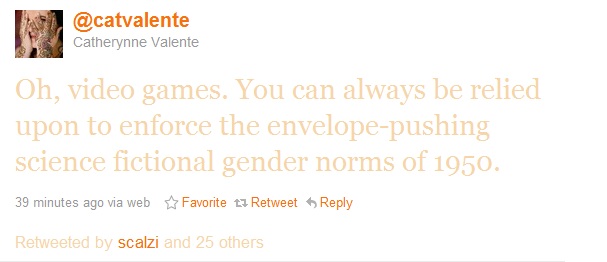
On the “women in video games” front, science fiction author John Scalzi retweeted the following comment today:

Naturally, I was curious. So I tweeted back to Valente, who is herself a fantasy/science fiction author, asking for some elaboration. And she linked me to this.

Excerpt:

Zelda cracked me up hardcore, because I, like many of you, I think, remember the Legend of Zelda animated TV show. In which, at the end of every adventure, Link tried to get Princess Zelda to kiss him and Zelda was so not into it. Not so this time! Girls are miserable harpies now, no one wants to kiss them! Ahahaha, ew. Link has his revenge in Skyward Sword! Link wakes up on the morning of his coming of age ritual (AGAIN) and a letter from Zelda arrives (AGAIN) reminding him that he has to fly his big bird thing in the ritual today, and that he promised to meet her on the roof beforehand. Link makes this face like OH MY GOD YOU GUYS NOTHING IS WORSE THAN A PRINCESS WHO WANTS TO HANG OUT WITH YOU. At which point he dicks around for awhile before going to the roof and meeting up with Zelda, who is naturally concerned because Link is a lazy shit who hasn’t practiced flying his giant bird even though he has a SUPER SPECIAL ONE and has known he’d have to do this bird flying ritual test for a long time. Zelda tells her father that Link is definitely going to die because he sucks at flying. This is a valid concern! Her father goes on this weird rant about Link’s SPECIAL BIRD ZOMG and how Zelda was so jealous when Link and the bird bonded! LOLZ. He clearly means that Zelda wanted to “bond” with Link, though I prefer to think Zelda was jealous because shitty lazy Link got an AWESOME RED GIANT BIRD and she was stuck with the magical psychic aviary equivalent of a Dodge Dart.

Awesome. Go read the whole thing.

How not to get raped: Always victim-blaming?

How not to get raped: Always victim-blaming? published on 1 Comment on How not to get raped: Always victim-blaming?

Zerlina Maxwell, writing for Ebony magazine, thinks so. In the bluntly titled “Stop Telling Women How Not To Get Raped,” she says:

New rule for 2012: No more ad campaigns and public service announcements targeted at women to teach them how to avoid rape.  It’s not effective, it’s offensive, and it’s also a lie. Telling women that they can behave in a certain way to avoid rape creates a false sense of security and it isn’t the most effective way to lower the horrible statistics which show that 1 in 5 women will become victims of a completed or attempted rape in their lifetime.  The numbers for African American women are even higher at nearly 1 in 4. We need anti-rape campaigns that target young men and boys.  Campaigns that teach them from a young age how to respect women, and ultimately themselves, and to never ever be rapists.  In addition, we should implore our men and boys to call out their friends, relatives, and classmates for inappropriate behavior and create systems of accountability amongst them. There are a number of men who do not understand what constitutes a “rape”, which is a consequence of the “stranger in the alley” falsehood presented in movies and popular culture.  You don’t need a mask and a gun to sexually violate a woman. The truth is that rape can happen with a woman you are dating whom you’ve had sex with previously, in a monogamous relationship, and even in marriage.  If one party withdraws consent at any time then it’s rape.  Consent can be withdrawn by the words “no “or “stop” and in many states, a woman doesn’t have to say no at all.  Consumption of alcohol can prevent a woman from being able to legally offer consent. Therefore, it is important for men and women alike to be very clear about their intentions and prioritize consent over the excitement of getting some. Our community, much like society-at-large, needs a paradigm shift as it relates to our sexual assault prevention efforts.  For so long all of our energy has been directed at women, teaching them to be more “ladylike” and to not be “promiscuous” to not drink too much or to not wear a skirt. Newsflash: men don’t decide to become rapists because they spot a woman dressed like a video vixen or because a girl has been sexually assertive. How about we teach young men when a woman says stop, they stop? How about we teach young men that when a woman has too much to drink that they should not have sex with her, if for no other reason but to protect themselves from being accused of a crime? How about we teach young men that when they see their friends doing something inappropriate to intervene or to stop being friends?  The culture that allows men to violate women will continue to flourish so long as there is no great social consequence for men who do so. And while many men punished for sexual assaults each year, countless others are able to commit rape and other crimes against women because we so often blame the victim instead of the guilty party.

Here’s where I agree: a lot of men and boys do not know what rape is, if they think it’s all about strangers in back alleys leaping on unsuspecting women. They do not know what rape is, if they think it can’t happen within a marriage or established relationship. They do not know what rape is, if they think it has to involve violence. Or if they think that it’s not rape if the word “No” or “Stop” hasn’t been spoken aloud. They need to learn. They need to be told by women, and also other men so that it doesn’t seem like women are the only people who are of an accord about preventing rape from happening.

Here’s where I disagree: teaching men not to rape and women how to avoid being raped are not mutually exclusive, and the fact that most rape is of the acquaintance variety does not mean that suggestions about how to protect oneself are absolutely useless and/or only amount to suggesting that a woman is responsible for her own rape if she doesn’t employ them. I think we can recognize that there is no fail-safe way to prevent oneself from being raped while simultaneously living a free, un-sheltered adult life, but also that it’s a good idea for somebody to know when and where you’re going on a date. That it might not be the best idea to bring a date home or go to his home, if you don’t know each other very well. That if you’re out drinking, it’s probably a good idea to keep an eye on your drink at all times and make sure you have a safe way of getting home.  A person can recognize value in these precautions without any transference of blame whatsoever.

So yes, let’s absolutely hold rapists accountable and tell men and boys (and women and girls!) what rape is in addition to how wrong it is. But I don’t think that equates to a moratorium on making suggestions for women on how to be safe. Victim-blaming is absolutely a problem and it needs to stop, but I’m not convinced that refusing to encourage caution is the way to do it.