Skip to content

Bachmann does bioethics

Bachmann does bioethics published on No Comments on Bachmann does bioethics
Pictured: a human whose dignity is highly questionable

Said Michele Bachmann to members of Personhood USA on Tuesday night:

I want everyone to know that I recognize and respect the dignity of every human life from conception until natural death. This is not a check the box thing for me; this is the core of my conviction, this is what I would literally die for. We have a moral obligation to defend other people and the reason for that is because each human being is made in the image of likeness of a holy God.

Dignity, I think we can agree, is a state of being which makes an entity deserving of respect and ethical treatment. For Bachmann, this affordance is based on a fundamental belief about our relationship with and similarity to God. Every human was made by God and is in some way very like God, therefore it is wrong to end the life of one.

But…God created other creatures, and we end their lives all of the time. Yes, but those creatures were not “made in the image of likeness of a holy God.”

But…Bachmann is opposed to gay marriage, and telling people that they cannot marry the consenting adult of their choice denies their dignity, as surely does indefinite detention and torture. Yes, but defending the dignity of humans does not extend to protecting them from the consequences of immoral acts.

This is because for Bachmann, dignity is not a state that individual humans reach. It is something they are all afforded– whether they want it or not– by virtue of being members of a race specifically created by God to carry out his will. Killing people as punishment or in war is one thing, but in general the ending of a human life either in the womb or on the physician’s table is violating the will of God. It’s a violation of a covenant held with him, not with other humans. A human’s conduct can render it permissible to put him to death and subject to God’s judgment, but it cannot justify dignity– that comes from the fact of being God’s creation.

When the word “dignity” is invoked in conservative politics, you can bet the underlying message is a concern about messing with God’s product. This can take many manifestations, including abortion and euthanasia, but also stem cell research, cloning, and contraception. It has been a particular sticking point for former chair of the President’s Council on Bioethics Leon Kass, who famously cited sheer repugnance as an appropriate foundation for moral opposition to such things. In “Ew, gross! The prissy bioethics of Leon Kass,” Garance Franke-Ruta writes:

Man, to use Kass’s favored term, possesses a fundamental and irreducible dignity based on “the godlikeness of human beings” It is from this, he argues, that “the sanctity of human life” derives.  But it is the impact of the “dehumanizing challenges of the brave new biology” and technology on “ways of life” that concerns Kass, rather than the impact on living individuals: “We need to understand that there is more at stake in the biological revolution than just saving life or avoiding death and suffering. We must also strive to protect and preserve human dignity and the ideas and practices that keep us human,” he writes. The goal of bioethics should not simply be to solve technical problems involving specific procedures via the issuance of rules, but “concern for the moral health of our entire community.” Consequently, it is humane ideals, not just human individuals, that must be protected and defended “[i]n a world whose once-given natural boundaries are blurred by technological change and whose moral boundaries are seemingly up for grabs.”  Those boundaries have, he argues, been damaged by three decades’ worth of advocacy by feminists, relativists, liberals (and liberationists and libertarians of all stripes), and gays and lesbians. Abortion, the sexual revolution, contraception, and “the extramarital use of the Pill”–all these changes have threatened our ability to understand natural relationships, and hence have led to the easy acceptance of technological interventions, particularly in the reproductive sphere, that make us increasingly unnatural, “post-human” beings. 

When humankind takes control of its biological destiny in a way that gives someone like Bachmann or Kass moral qualms, you can count on the accusation of “playing God” to come up. As a rather heavily modified person myself (extensive dental work, LASIK surgery, a fervent dedication to birth control), I find this to be a head-scratcher. Would they prefer that we go without, for example, vaccines? In the case of the HPV vaccine almost certainly yes, because like the “extramarital use of the Pill” (I guess marital use of it is okay) it’s a means of manipulating the body to protect it from deleterious health effects resulting from immoral conduct, and hence undignified. Presumably people getting the MMR or shingles vaccine need not worry too much about being unnatural and post-human.

Patrick Lee and Robert P. George (the latter of which served on the President’s Council on Bioethics with Kass) presented a slightly more nuanced view of things in their essay The Nature and Basis of Human Dignity, while still relying on “nature” as their justification:

The dignity of a person is that whereby a person excels other beings, especially other animals, and merits respect or consideration from other persons. We will argue that what distinguishes human beings from other animals, what makes human beings persons rather than things, is their rational nature. Human beings are rational creatures by virtue of possessing natural capacities for conceptual thought, deliberation, and free choice, that is, the natural capacity to shape their own lives. These basic, natural capacities to reason and make free choices are possessed by every human being, even those who cannot immediately exercise them. Being a person thus derives from the kind of substantial entity one is, a substantial entity with a rational nature—and this is the ground for dignity in the most important sense. Because personhood is based on the kind of being one is—a substantial entity whose nature is a rational nature—one cannot lose one’s fundamental personal dignity as long as one exists as a human being.

So, what makes one worthy of dignity is rationality, and humans (and humans alone) have dignity because they are the kind of beings whose nature is rational, even if the specific human in question is not rational at all either permanently or at the time of consideration. He/she belongs to the rational community by virtue of being of the right species, and that’s good enough. This consideration, as Lee and George later note in their essay, is to make clear that it can’t become permissible to abuse the dignity of the mentally disabled, which is admirable enough. They clarify that

While membership in the species Homo sapiens is sufficient for full moral worth, it is not in any direct sense the criterion for moral worth. If we discovered extra-terrestrial beings of a rational nature, or learned that some terrestrial species have a rational nature, then we would owe such beings full moral respect. Still, all members of the human species do have full moral worth because all of them do have a rational nature, though many of them are not able immediately to exercise basic capacities.

So if one of us should happen upon a rational chicken one day, it apparently renders the entire species dignified because that would show that it is the “nature” of chickens to be rational, even if many of them (i.e., every single other chicken) are not able immediately to exercise basic capacities. Goodbye, KFC.

That’s not a very realistic consideration, however. What’s more realistic is that humans, like every other species we have encountered, are closer to a “rational nature” at some points of their lives than others. That is, they are differently capable depending on the point in their ontogeny, their development. Lee and George are prepared to declare that this period of a human’s life decides humanity’s “nature,” and therefore its dignity. But why? Are we any less human at those points in life when we have not yet become rational, or when we’ve left rationality behind, or if we never really were in the first place? How can something be your “nature” if it’s not even a trait that can accurately be attributed to you? Even traits that will eventually apply to every single one of us sound frankly bizarre to describe as our nature– we all will, for example, die. Is it then our nature to be dead? They reply:

I have understood that the one nature, subject to death, is entailed by the other nature, composite living being, and from that knowledge I then advert to the thought of the individuals which possess those natures.

Then would it not be more fitting to describe the nature of humans regarding reason as subject to being rational? It sounds a lot more tenuous that way, but it’s certainly more truthful.

Lee and George use all of the buzz words and rhetoric one would employ if one wanted to argue that there is something essential to humans which separates them from other species as deserving moral consideration, regardless of what kind of human a specific individual is– a soul. A soul which, again, does not really belong to us but is actually on loan from God, which explains why the intentional death of a fetus which has not developed the cognitive capacity to understand what “dignity” is, and the intentional death of a human in a mentally vegetative state who has long since permanently lost the capacity to understand the same are both nevertheless affronts to their dignity, whereas the natural death of either is not. This also explains why although a rational nature (whether you are actually rational, or not) makes one a person and therefore in possession of full moral worth and dignity, exerting that rational nature in order to decide to end one’s own life is not permissible. That just wouldn’t be dignified.

Do I think that Michele Bachmann has actually read Lee and George, or Kass, or anyone like them, in order to form the foundation of her unshakable defense of the inherent dignity of human life? Nah. But she’s read the Cliff’s Notes and pulled all of the relevant talking points, and while seeking the office of president but not having served on the President’s Council on Bioethics, she comes right out and says it’s because we’re made in the image of God. In that regard she is not making an argument palpably different from Lee and George or Kass, but one that is a lot less subtle and most likely a good deal more honest.


The daughter test, in Egypt

The daughter test, in Egypt published on 2 Comments on The daughter test, in Egypt

From the Huffington Post’s list of 2011’s Most Absurd Quotes About Women– And Who Said Them:

An anonymous Egyptian general spoke to CNN about why female protestors arrested during anti-Mubarak demonstrations were strip-searched and forced to submit to virginity tests. “The girls who were detained were not like your daughter or mine. These were girls who had camped out in tents with male protesters in Tahrir Square, and we found in the tents Molotov cocktails and [drugs]…We didn’t want them to say we had sexually assaulted or raped them, so we wanted to prove that they weren’t virgins in the first place. None of them were.” 

IIWAPBK and Privilege 101

IIWAPBK and Privilege 101 published on 1 Comment on IIWAPBK and Privilege 101

I think Gene Marks has now been thoroughly excoriated for his column “If I Were a Poor Black Kid” on the Forbes web site last week. In his effort to explain how it’s still possible for underprivileged kids to succeed, he succeeded only in displaying a shocking lack of empathy. By that I don’t mean that he demonstrated a lack of concern for the poor black kids of the world and their needs– I mean that he literally failed at perspective-taking, in such a spectacular way that it’s hard to believe that he was serious (though apparently he was), which has made the column a golden opportunity for mockery. Jenée Desmond-Harris writes in The Root:

Middle-aged, white Forbes contributing writer Gene Marks, in his recent piece, “If I Were a Poor Black Kid,” presented some now-infamous ideas for how he would personally rise to success if he suddenly found himself young, African American and poverty-stricken.  Marks would “get technical,” learn software,” “learn how to write code,” “figure out where to learn more online,” “become an expert at Google Scholar” and regularly peruse the CIA World Factbook. He would then get himself into a top school, and he would “succeed.” The end.  Oh. If only Marks had given out this priceless advice before, we would have eliminated racial inequalities long ago.  Not really.  As a curious side note, it’s unclear how this is any different from what he would do if he were a poor white kid. But also, there’s no word in the piece on how Marks imagines that he would, as a poor child, suddenly be infused with the perspective and sophistication of a middle-class adult. In addition, he, perhaps unintentionally, admits that his advice is useless to all but a select few gifted, mature and lucky children. (He doesn’t have any thoughts on what he would do if he were not a “special kind of kid” who miraculously became aware of the admissions processes of magnet schools and the value of TED talks and the Khan Academy.)  

 Melanie Tannenbaum, on her blog psysociety, puts it this way:

My immediate reaction was to hate the article. I found it insulting, ignorant, and just plain short-sighted. As I commented in my own link on Facebook, “[To summarize], ‘This is what I would do if I were born into a completely different set of circumstances, a completely different family, a completely different social support system, a completely different school district, a completely different body with a completely different skin tone and a completely different way that people in public respond to me, yet I somehow still retained all of the benefits, knowledge, and access to resources as a middle-aged, middle-class white man.’”

Indeed. Marks’ column reads as if he was attempting to describe what would happen if he had body-swapped with a poor black child in a movie…the most boring body-swap movie ever, if what he says he’d do in this different body and environment is true. And, it goes without saying, not terribly useful when it comes to addressing what he was addressing, which are the opportunities available and likely to be utilized by people who are actually born in the bodies and environments in question. Having acknowledged this, however, Tannenbaum the doctoral candidate in psychology studying “the effects of power, status, and social class on attitudes and behavior” goes on to observe the following:

However, upon re-reading the article and giving it a little more thought, I’ve come to realize that the real issue with the article isn’t that the author, Gene Marks, is necessarily racist, or even really ignorant. After all, he acknowledges right off the bat that the system is unfair, and that children from other areas of town have it much harder than his own, privileged children do. Marks clearly has some knowledge of the unfairness of “the system.” So the real question is, how could he then go on to write such a short-sighted article, completely missing any sort of perspective on what it means to actually be a member of the community to which he is proselytizing?

What follows is essentially an unpacking of the psychology of privilege. And privilege, it seems, is what we’re talking about here– specifically, the unconscious ignorance of the ways in which advantage and power affect one’s perspective. Tannenbaum goes over two experiments in which subjects were primed with (prompted to have at the front of their minds) notions of self-empowerment, and shows how this actually causes people to assume that others know what they know:

In other words, powerful participants were more likely to overweight the special, privileged information that they had, and they subsequently predicted how other people would (or should) respond to certain situations as if the other people had access to that same, privileged knowledge as well.   Sound familiar?   To be momentarily blunt, powerful people often fail to correct for the fact that other people don’t have the same special knowledge that they do. When they think about how other people should respond to situations, they are significantly more likely to overweight the information that they happen to have (like, say, knowledge about the vast amount of educational technology that is available, assuming one knows where to look for it), and less likely to consider the fact that not everyone else has the same knowledge base.  

Well, that’s not news, comes the reply from any of the not-so-privileged among us. The most powerful people are often members of the majority, which allows them to make their experience the “norm” which everyone else comes to know whether they want to or not, but there is nothing compelling them to come to know the experiences of minorities. The other important aspect of privilege is that the privileged are not forced by anything in particular to see through anyone else’s eyes, to acknowledge that their own experience in life is not universal.

Still, it’s one thing to think that what you know and experience is more important than what others know and experience. It’s quite another to be unconsciously ignorant of the fact that other people have different knowledge and experiences, which is what the experiments suggest. That’s what I mean by “failing at perspective-taking”– being unable to process that someone who is not you has a different perspective than you do, perhaps a very different one. Most of us have had the experience of talking to someone about our problems and hearing that person say “Well, if it were me, I would…” followed by a description of some course of action that we would never pursue, assuming it is even possible for us. One has to wonder what exactly they believe the benefit of offering such an observation to be. That is basically what Gene Marks did in his column, causing its readers to collectively scratch their heads and wonder what the benefit of that was supposed to be.

There are two fundamental short-cuts to empathy (really understanding things from someone else’s point of view) that have proven themselves time and time again: similarity and familiarity. If you’re very similar to the person in question, it’s not very much of a stretch to see things like they do because after all it’s almost how you yourself see things. Alternately, if the person in question is not much like you but you know him/her really well, it’s easier to see things from his/her perspective just because you’re used to doing so. Privilege means being similar to most people, or at least most powerful people. Never being the “other,” the one who is marked as different. But that doesn’t mean empathy is impossible– the moral progress of a society is marked in part by the gradual realization by the privileged that they have this status to begin with, and this is accomplished by becoming familiar enough with the different experience of “others” that it is possible to see through their eyes and recognize how similar they actually are. Where this realization occurs, you will find members of majorities fighting for the rights and interests of minorities. Where it fails, you will find apathy and hostility born of that particular kind of ignorance that privilege conveys.

At the end of her post, Tannanbaum acknowledges the ways in which she herself is privileged. I have my own. One of them– access to education– is how I can afford to analyze the mechanisms by which privilege affects perspective in the first place, which might be ironic but hopefully does not invalidate such an analysis. Empathy and sympathy are often conflated for a reason– the former can lead quite naturally to the latter in the process of understanding allowing for recognition of similarities, and it becomes harder to be angry and blame when you find yourself identifying with the target of such. But we can blame and empathize at the same time. We really can, and both are important for mutual growth– the blame so that the blamed can recognize their error, and empathy so that accusers don’t perceive themselves as errorless. In this way, the conversation can be elevated.

Cycling through symbolism: Nitpicking the Rick Perry ad mockery

Cycling through symbolism: Nitpicking the Rick Perry ad mockery published on 1 Comment on Cycling through symbolism: Nitpicking the Rick Perry ad mockery

AKA The post about Rick Perry’s jacket.

If you somehow have missed seeing Rick Perry’s recent campaign ad, now one of the least liked videos on Youtube, here it is:

Yes, that is a real ad produced by a real candidate for president of the United States and long-time governor of the state where I live. It might seem like self-parody, but that didn’t stop a number of mocking videos from cropping up all over the place, including this satire which I quite like:

Another which is currently making the rounds:

Upon first seeing this, my reaction was basically “……so?” I still haven’t seen Brokeback Mountain, but am pretty sure I’ve heard every joke about it ever made, because if there’s one eternal truth of the universe it is this: People love joking about Brokeback Mountain. And oftentimes when they’re doing it, they’re using the reference to bring down something else by comparing it to the movie, which is hard to interpret as an endorsement of Brokeback specifically or support of homosexuality in general.

Take this example: Rick Perry is shown in his campaign ad bashing gays while wearing the same jacket as a gay character in a movie. Heehee, homophobe displaying unconscious homoeroticism! But is it, really? Perry is shown doing the George Bush thing, speaking to the heartland while outside enjoying the wilderness…or something…wearing a Carhartt jacket. Carhartt makes sturdy outerwear for sturdy people, and as Michael Heath explains it’s not at all an uncommon thing to see worn by pretty much anyone in the area Perry is addressing:

The Brokeback jacket wasn’t a Carhatt. And Carhartt clothing is associated with people who work outside in inclement weather, along with politicians who pander to them (e.g., Sarah Palin, and now Rick Perry). Their line has nothing to do with gays. It’s like politicians wearing John Deere hats or sporting Pabst Blue Ribbon decals . . . This clothing line is not defined by one mere movie about gays, where it wasn’t even featured. Carhartt is instead defined by its large popularity amongst those who Perry, Palin, Kid Rock, and Hank Williams direct their marketing efforts. I know of no other clothing line which can compete with their market share for outdoor work clothes you’re OK with getting dirty. They’re insulated overalls are especially dominant in my area since we have harsh winters here. You can make a good argument Perry’s pandering to rural populists by wearing work clothes which he’s never done a lick of work in himself. Most of us who wear this line of clothes are not worried about getting them dirty in a way you can’t launder out – as ZZ Top sang about their blue jeans, “you can tell by the oil and gasoline”. But you only embarrass yourself by pointing to one character in one movie and claiming Perry’s out of touch when in fact it’s those comparing this coat to a similar one worn in a movie who are out of touch, precisely because they validate their ignorance regarding its authentic popularity. This is not a close call.

I would add three comments to this:

  1. Heath Ledger’s character in Brokeback Mountain didn’t wear that jacket because he’s gay, but because he’s a cowboy. Duh, right? But this is important because cowboys are conceived as being rugged, tough, traditionally masculine, which is what Perry was going for.
  2. Suggesting that because this style of jacket was worn by a gay character in a movie, we should associate homosexuality with it when it’s worn by a political candidate really smacks of a kind of sympathetic magic. When any item of clothing is worn by a gay character, it becomes gay!  No straight man should wear it ever again if he doesn’t want people to giggle and call him a queer! Is that really the leap that we want to make?  
  3. It’s true that over the top masculinity is often construed as homoerotic. But Perry isn’t dressed as a Tom of Finland illustration here. He’s just a guy wearing an outdoorsy jacket. As more and more movies are made featuring gay characters, those characters are eventually going to wear every item of clothing under the sun. Heath Ledger also wore jeans in that movie, but we’re not saying “OMG jeans are gay!” because jeans are ubiquitous for most of us. Carhartt jackets are ubiquitous in certain parts of the U.S., and as Heath points out that makes the people who are unaware of that and pointing to Brokeback Mountain look rather ignorant. 
One final point, which I alluded to before– attacking homophobes by suggesting that they’re gay is not a compliment to actual gay people. Generally speaking, when people use an attribute that describes you as an insult to others, it doesn’t feel that great. There has been some speculation about Perry’s sexuality in the past, but if the future contains some revelation that he is actually bi or homosexual, two things will be certain: 1) any ensuing mockery should be for his hypocrisy, not his sexuality, and 2) having worn Carhartt outerwear in a campaign ad sure wasn’t a tip-off.  
Sometimes, a jacket is just a jacket.

ETA: Two more comments on the topic….

From scorinth:

“why are you all so sure that all liberal think Carhartts are gay jacket?” Because that’s what the joke is: “Doesn’t Rick Perry look like that gay guy?” Sure. Maybe. Possibly, he looks like that one gay character from a movie. Why? Because he’s wearing a tan Carhartt jacket in an outdoor setting. I dare you to give me some other reason somebody would make that connection. So what people who make that joke are saying is that Perry looks like that one gay guy from the movie, because of the jacket. So, the jacket makes the faggot, so to speak. PROTIP: The majority of people who work outdoors in the central and western US wear clothing that’s very similar to that same jacket. That’s not a small number. I’m talking hundreds of thousands. Probably millions. To completely gloss over their existence and jump straight to the gay character is offensive to me both as a gay man and as a Kansan.

From James Hanley:

Conservatives tend to think liberals are out-of-touch with rural American, and lord how liberals are demonstrating it here.  Look, my liberal friends, Rick Perry is a Texas farmer. You might be hard pressed to find a farm in Texas that doesn’t have a Carhartt’s jacket hanging in the mudroom. One Hollywood movie just ain’t sufficient to make Carhartt’s a symbol of gay culture in America.  Grow up. Deal with the offensive content of Perry’s ad. But stop making yourselves look like effete urban pansies to whom flyover country is a foreign land, a place where you need a passport and a series of shots before you travel there. If you want to win America, you’d do well not to openly show your disdain for such a large part of it.

Obama “daughter tests” young women out of sexual privacy and responsibility

Obama “daughter tests” young women out of sexual privacy and responsibility published on 1 Comment on Obama “daughter tests” young women out of sexual privacy and responsibility

A few months ago I wrote about Freakonomics author Steven Levitt’s “daughter test” for legality. Levitt didn’t invent the test; he just articulated it: “If I wouldn’t want my daughter to do it, I wouldn’t mind the government passing a law against it.” The inanity and offensiveness of this standard should be plain on its face, but I carefully unpacked it anyway because this rule is applied consciously or unconsciously in the thinking of many otherwise thoughtful, non-authoritarian people. People who just want things to turn out best for their daughters.

Such, I have to assume, was in the mind of President Obama when he used his own daughters as justification for overruling a recent FDA decision to allow the sale of emergency contraception pill Plan B over the counter to women of all ages:

President Barack Obama is defending his administration’s decision to stop plans to allow the Plan B morning-after pill to move onto drugstore shelves next to condoms. Obama says as a father of two daughters, the government should “apply some common sense” to rules when it comes to over-the-counter medication. Health and Human Services Secretary Kathleen Sebelius overruled scientists at the Food and Drug Administration, saying young girls shouldn’t be able to buy the pill on their own. Obama says Sebelius was concerned a 10- or 11-year-old could get the medication, which could have an adverse effect. Obama says “most parents would probably feel the same way.” For now, Plan B will stay behind pharmacy counters, available without a prescription only to those 17 and older who can prove their age.

So the FDA lacked “common sense” when they decided that there is no good reason to prohibit Plan B to women younger than that? Should we assume that none of them have daughters? I doubt it. More likely they refused to allow paternalism to affect their conclusions in light of the evidence that there is no legitimate health concern which could justify restricting the drug:

Emergency contraception is already available over the counter to women over 17; in response to a request from the drug’s manufacturer, the FDA researched safety and efficacy of OTC access for women under 17 and found that there is no reason not to lift the age limit. Studies found no adverse health effects with non-prescription use and that younger women were able to understand how to use the product, including, crucially, that it does not protect against sexually transmitted infections.

Here’s how you take Plan B: as soon as possible after unprotected sex or contraceptive failure, take one pill. A second pill is not necessary. Do not take it more than 72 hours (three days) after unprotected sex or contraceptive failure. That’s it. If a ten or eleven year old girl cannot grasp these instructions, we’re in trouble.

And of all people who might need an emergency contraceptive most in the world, ten or eleven year girls who might be pregnant seem like the best candidates! But really, they are not the ones most likely to lose out on the opportunity to have this pill when they need it. That honor will more likely go to older girls who are sexually active but not yet 17. As Katha Politt writes in The Nation,

Barack Obama says that as the father of two daughters, he wants the government to “apply common sense” to rules about over the counter medications. Well, I too have a daughter, and so many many pro-choice women. Who died and made Barack Obama daddy in charge of teenage girls? Would he really rather that Sasha and Malia get pregnant rather than buy Plan B One-Step at CVS? And excuse me, Mr. President, thanks to your HHS, acquiring Plan B is prescription-only not just for 11-year-olds but for the 30 percent of teenage girls between 15 and 17 who are sexually active, and is a cumbersome process for all women, who have to ask a pharmacist for it and, as many news stories have reported, be subjected to fundamentalist harangues and objections. Apparently, it’s okay with you if Michelle is treated like a sixth-grader. I’m trying to think if there are any laws or regulations affecting only men in which unfounded fears about middle-school boys deny all men normal adult privileges. Needless to say, no one suggests that underage boys get a prescription if they want to use condoms, or that grown men have to ask the pharmacist for them and maybe get a lecture about the evils of birth control and promiscuity.
This is politics. Pure politics.

It’s hard to disagree. If Obama doesn’t want to keep Plan B out of the hands of young women because he thinks they don’t have a right to sexual privacy and the ability to make their own reproductive decisions, his administration is certainly catering to people who do.

Wait a minute– a right to sexual privacy? Who says teenage girls should have that? Amanda Marcotte, very convincingly:

The only reason possible that condoms don’t come up is pure sexism; Plan B provokes anxiety about female sexuality, and the stereotypical (though not actual) image of who has condoms on their person in high school is male. Fill in jokes about the condom-shaped wear on the leather wallet, etc.  But most of all, the flaw is in assuming that there’s intrinsic value to outing a girl who is having sex to her parents, with the exception of abuse. But if you think about this argument, it assumes a lot that is not proved by a long shot. So, let’s walk through the standard, non-abuse discovery of sexual activity of a 15- or 16-year-old, which are the ages when the percentages of kids having sex grows rapidly. (Contrary to hysterical assumptions, younger teenagers just aren’t doing it that much.) People who are making the parental argument are literally assuming that a tearful girl comes forward to her parents and confesses shamefacedly that she’s been having sex with her boyfriend. Yelling, crying, and recriminations ensue. She gets her Plan B, but is perhaps grounded and her parents are very disappointed in her. They may or may not have a conversation about birth control going forward, but at every point in this process, her choice to have sex is considered less than ideal. What does this solve? How does this standard American situation improve life for anyone involved?  It doesn’t. The girl is highly unlikely to give up having sex, though now she may decide to be sneakier about it. She’ll probably be defiant and feel her parents don’t understand her; she will be right to think this. She may, correctly, see them as hypocrites, because they probably had sex as teenagers (that being what teenagers do), and it worked out well for them, but now they’re going to punish her for the same. She’s going to start counting the days when she can get out of the house with these unreasonable people and have a place of her own, where she can do what she wants. Meanwhile, the parents also have a worse go of it. If they really have absorbed prudish attitudes, they may think less of their daughter, even though she hasn’t actually done anything wrong. Even if they are just typical American hypocrites who remember their own sexual debuts fondly while enacting hostility towards their daughter in the same situation, they’re going to feel weird and out of sorts. They’ll always feel that there may be something else they should be doing to stop the sexual activity. They may worry that they failed somehow. They may want to offer advice, but it’s going to be filtered through the assumption that youthful sex is bad, and so it’s probably not going to be good advice.  Kids really do need their privacy, for the same reason that adults do. Even though I’m a grown ass adult and there’s no shame or recriminations there, I don’t talk about my sex life with my mom as a general rule. Because there’s no value in it. Everyone’s just happier minding their own damn business. I personally think there’s a lot of value in letting teenagers spend their high school years gradually gaining rights and responsibilities—including sexual privacy rights and responsibilities—instead of simply dumping them into adulthood at 18 and expecting them not to get overwhelmed.

In this case, the right is a responsibility. Opponents of reproductive choice complain that it allows women to escape the consequences of their actions. If this really isn’t just code for inflicting pregnancy and childbirth as punishment, then it needs to be acknowledged that a young woman who is sexually active and either makes a mistake or experiences an accident (or both) and wants to take Plan B is being responsible. She realizes that something potentially very bad has happened and is facing the consequence of needing to do something about it. And Obama’s administration does not want her to– at least, not on her own. That may seem like “common sense” to him, but playing Father Knows Best to the entire country makes unwilling daughters of us all.

#heblowsalot

#heblowsalot published on No Comments on #heblowsalot

Ah, the power of Twitter. It can help organize protests, keep people in contact in the midst of tragedy, spread news like wildfire, and allow governors to become aware of the fact that teenagers are saying mean things about them. And then take action!

Emma Sullivan is an eighteen year old student at Shawnee Mission East high school in Kansas. While making a visit to the state capitol of Topeka as part of a Youth in Government program, she made the following tweet:

“Just made mean comments at gov. brownback and told him he sucked, in person #heblowsalot.” 

She didn’t actually meet him– the tweet was a joke with friends. But that wasn’t a factor to Brownback staffers, who in scanning social media for mentions of him came across the tweet and proceeded to contact Sullivan’s school. The school’s principal, Karl Krawitz, called Sullivan into his office and proceeded to berate her for nearly an hour:

“I had no idea what it was about or why I was being called into the office,” she said. “I had never been in trouble before.”
Sullivan claimed that the principal “told me he needed to do damage control and was really upset.”
“He said I was an embarrassment to the school and the school district and that I had been disrespectful,” she added.

Krawitz followed this with a demand that Sullivan write a note of apology to Brownback for the tweet, to be turned in on Monday (today). Sullivan had decided by Sunday night, with the support of her parents, that she wasn’t going to do it. This became a non-issue today, however, when the school district decided it could not demand an apology:

“The district acknowledges a student’s right to freedom of speech and expression is constitutionally protected. The district has not censored Miss Sullivan nor infringed upon her freedom of speech,” said a statement. “She is not required to write a letter of apology to the Governor. Whether and to whom any apologies are issued will be left to the individuals involved.”

Sam Brownback himself responded by blaming his staff:

A statement issued by Brownback on Monday did not reference Sullivan by name or mention the prospect of any apology letter. He did emphasize his support for “freedom of speech,” while thanking “the thousands of Kansas educators who remind us daily of our liberties, as well as the values of civility and decorum.”
“My staff overreacted to this tweet, and for that I apologize,” the governor said. “Freedom of speech is among our most treasured freedoms.”

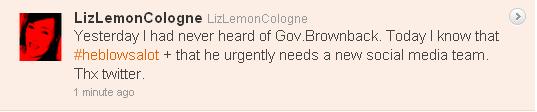
Meanwhile Sullivan’s Twitter following has jumped from 63 to almost 11,000 (as of now). Brownback’s is at about 3,000. And the #heblowsalot hashtag is being used constantly by Sullivan’s supporters. A representative tweet:

It’s unusual, I think, not to have heard of Brownback before considering that he was a U.S. senator from 1996 until this year, and ran for president in 2008. Still, there’s no question that awareness of him is exploding because of this…and doubtless not in a way he would prefer. Like the enormously successful campaign to re-define Rick Santorum’s last name, “heblowsalot” might become the phrase that comes to most people’s minds when considering Governor Brownback.

Now, here’s the question: would that be a good thing? Does Sam Brownback, in fact, blow?

Maybe not literally. But as those of us from Kansas–especially women– who are not right-wingers are more than aware, figuratively he most certainly does. If you want a quick idea, imagine Rick Perry and take away some reasoning ability and restraint. As Amanda Marcotte notes over at Slate,

I suppose it’s not that big a surprise that someone like Brownback, who has a strong belief that women should not be in control of their own ladyparts, would also find the notion that teenage girls have the legal right to make fun of him deeply threatening. First he comes for your abortions, then your contraception, and next any fancy electronic devices that could be used to register displeasure with dudely authority figures. The freakout over a teenage girl having a less-than-flattering opinion of him was also predictable if you look at Brownback’s long history with the C Street Family, a religious-political group that specifically promotes patriarchy and disdains the idea of women holding political power. (Though they have been known to make exceptions for the occasional woman who has economic goals in common with them.) To a large extent, Brownback has created a bubble around him that has a pleasing 19th-century cast to it, where young people and women knew their place, and men of privilege are protected from the opinions of those who are most subject to social control. No wonder a juvenile bit of tweetage caused such an oversized reaction.

This is not an exaggeration. Brownback has spent his years in office, both as senator and governor, doing everything he can to restrict reproductive freedom for women. He is also not a fan of state funding for art, having eliminated Kansas’ arts commission this year making it the only state without such an agency. He denies evolution and supports the Discovery Institute (intelligent design think tank), is relentlessly pro-war (supporting the occupation of Afghanistan and Iraq, as well as the suspension of habeas corpus rights under the Military Commissions Act of 2007), and is so adamantly opposed to gay marriage that in 2006 he blocked confirmation of federal judicial nominee Janet Neff because she had attended a same-sex commitment ceremony. He believes that the Constitution does not carry any guarantee of a right to privacy. His record on civil rights is rated– this will shock you– 20 percent by the ACLU. Pretty dismal. As is, no doubt, the outlook of any Kansan who cares about civil rights since Brownback assumed governorship, which I’m guessing includes Emma Sullivan.

But regardless of why Sullivan thinks Brownback blows, specifically, I think her handling of the issue has been excellent. She seems quite level-headed:

Emma Sullivan said Sunday that she thought the tweet “has turned into a good starting point to open up dialogue about this … free speech and the power of social media and the power that people my age could potentially have, that people will listen to us.”

Indeed, indeed. Although it’s unfortunate that this dialogue would not have opened up in the first place had Brownback’s staff and Sullivan’s principal (any bets on whether she’ll get an apology from him?) both not wildly overreacted to something said in that context.

This whole event could result in a bully pulpit for Ms. Sullivan, should she choose to use it. She said that she’s interested in getting involved in politics, and judging from the coverage this is getting not only on Twitter but ABC, CNN, HuffPo, and so on, this seems like a good start! I hope she takes advantage of it to go out and do something. Whatever she finds most appropriate to do in terms of combating the many ways in which Sam Brownback sucks. And blows.

Quote of the day

Quote of the day published on 1 Comment on Quote of the day

From Dr. X, discussing whether using “crazy” as a pejorative should be considered offensive to people with mental illnesses and therefore be stricken from the lexicon of a considerate person:

Political correctness most certainly is about passing tests of radicals who are more interested in group identity signifiers than substance and true decency. P.C is a greatly overused accusation by the right, but it’s a concept invented on the left to describe the use of signifiers as shackling rules that, IMO, are bristling with the narcissism of small differences.  Things aren’t much different on the right. Not using the signifier “God” in a Thanksgiving address can “offend” certain Christians. Signifiers divorced from awareness of common usages and context–from intent, from speaker, from audience, time, place, and attitude are really about identity politics. . .  Craziness and madness, one’s own and the insanity of the world, can render the best efforts to bring comforting coherence to our existence absolutely futile sometimes.  So despite not satisfying your club rules on the use of language, I will continue to refer to being driven mad with grief, crazy with rage, nuts, out of my mind with pain and whatever else I feel useful to explain that time in my life and my experience. Those words make flesh and blood out of the reality of a long period of unremitting agony. And I think those very frank words help people to empathize with the depth of suffering and disorientation I experienced. You don’t own those words. They have uses that help people know what the hell we’re talking about sometimes.  We live in a world that is often much more crazy than sane. We deal with people going nuts. We have crackpots in politics. I also won’t apologize for saying someone lacks a conscience or they’re a heartless bastard because it might offend psychopaths. They have a mental disorder too. So let’s not use any language that could offend them; they’re just victims of a brain disorder.  If you actually live an examined life, you’ll notice madness all around, in all the people who are deemed sane. There are no exceptions, only a certain amount of necessary denial to forge ahead in life, but crazy is on a continuum that is part of all humanity. 

My favorite quote right now

My favorite quote right now published on 2 Comments on My favorite quote right now

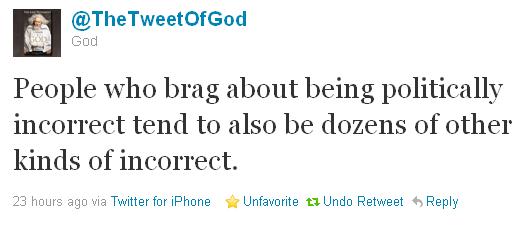
TheTweetofGod is the Twitter account of David Javerbaum, author of The Last Testament: A Memoir By God. I follow it because somebody retweeted something hilarious he said one day and I decided that my day could do with some more ongoing hilarity. But he also makes some interesting observations, such as the one above. It seems especially relevant today, in light of this bit from a GQ interview with Herman Cain that everyone seems to be talking about:

Chris Heath: You’ve said that you find it hard to be politically correct. Why do you find it hard? Herman Cain: When you learn how to be politically correct, you sound like all of the other politicians. People like my directness and my bluntness. What happens when you become so worried about being politically correct, you find yourself not saying anything. Because you’re trying to offend the least number of people. I’m trying to attract the greatest number of people. Different strategy.

Does this count as “bragging”? I’d say so. Because Cain is contrasting himself positively to “all of the other politicians” who, presumably, are dishonest because they’re trying not to offend people. Whereas Cain is blunt and direct– he gives it to you straight, and people like that.

But people also like not being offended, don’t they? It sure seems that way. So are politicians who are politically correct mistaken about what will offend people? Or are they aware of what will offend people, but avoiding offending people requires dishonesty so it’s better to be direct and blunt?

The answer that most people who pride themselves on not being politically correct would give is: yes. That is precisely what they think. Because every time they are direct and honest, somebody gets offended.  And it couldn’t be the case that what they’re saying is legitimately offensive, so it must be that they’re simply politically incorrect. This is how “politically incorrect” as a label of pride has come to be a code word for “asshole.” It rests on the assumption that all attempts to avoid offending people are based in dishonesty. That if everybody  were honest, everybody would say things that are commonly considered offensive. A person who proclaims that he or she is politically incorrect, “just telling it like it is,” is in fact doing so because he/she assumes we’re all assholes too…it’s just that the rest of us insist on hiding it.

Political incorrectness that isn’t legitimately offensive usually takes the form of comedy. Making jokes out of things that would otherwise be considered horrible to say is an art form, and one of the things that makes a comedian excel in this is making it obvious that he or she doesn’t mean it. If your audience leaves a performance thinking that you are actually a bigot, they probably won’t be your audience again– unless, of course, they’re bigots themselves. I’m sure there are actual racists and homophobes who find Lisa Lampanelli funny, because they enjoy her jokes on a very base, literal, let’s just call it “moron” level of comedy comprehension and don’t understand that she’s actually making fun of them.

Non-comedic political incorrectness that is not legitimately offensive also exists. It must, if illegitimate offense can exist. It will always be tricky to clarify what should count as such and what shouldn’t, but it’s important to do so in order to avoid allowing people like Cain to claim that everything they say falls into that category. Whatever you might think about the ethics of using the word “niggardly,” for example, it shouldn’t be placed in the same category as a statement of belief such as branding Muslims in general as terrorists or declaring that a pizza with lots of vegetables on it is a “sissy pizza.” I have to use that example because it’s from the same interview with Cain quoted above, and it seems to be what people are talking about today. Advocate.com notes:

In an interview with GQ, Cain decries any adherence to political correctness and then uses a term that will probably offend. . .
Over a pizza lunch, Cain offered his take on what makes a “manly” pizza. The use of sausage was high on his list. But vegetables were “sissy” pizza.
“I’m very particular about the pizza that I eat,” he explained, saying men want a harmony of “abundance” and “taste.”
“What can you tell about a man by the type of pizza that he likes?” asked reporter Chris Heath.
“The more toppings a man has on his pizza, I believe the more manly he is,” Cain declared. “Because the more manly man is not afraid of abundance,” he added with a laugh.
“A manly man don’t want it piled high with vegetables! He would call that a sissy pizza,” Cain said.

Yes, we are talking about a presidential candidate with the sensibilities of a twelve year old boy.* Talking this way isn’t just “politically incorrect”; it’s offensive and frankly stupid. It is, to return to our initial quote, as sign that the speaker is also dozens of other kinds of incorrect. It is not a state of being of which a person should be proud, nor one for which he deserves respect and admiration except by others who are equally incorrect. Lisa Lampanelli is cleverer, funnier, and less offensive. Maybe she should run for president.

* Apologies to all of the bright, mature twelve year old boys out there who know better and would never say such things.

Spokesgroups

Spokesgroups published on 2 Comments on Spokesgroups

Radley Balko got quite a lot of hate mail in response to an article he wrote for HuffPo on Occupy Wall Street. One letter hilariously complains

I am appalled by your lack of integrity. You quoted someone from the Cato Institute but didn’t reveal that you also worked for them. You also didn’t reveal that while they pretend to be conservatives, they are really George Soros peacenicks, homos, and potheads (your probably all three) who wear ties to disguise themselves.

Peacenicks, Homos, and Potheads Who Wear Ties. It has a nice ring to it, doesn’t it?

Ed Brayton picked this up and reprinted it on his blog, where the first posted response was “Not to forget that Cato is financed in large part by the Koch brothers…” Brayton replied:

So is the ACLU. That doesn’t mean they don’t do great work on many important issues. Nor does the fact that they’re wrong on some issues. I think some people just don’t get the point of a think tank that looks at a large range of issues. They have scholars who specialize in entirely different subjects. Their scholars working on economic regulation issues may be completely wrong and their scholars working on Fourth Amendment or eminent domain issues (or any number of others) may be completely right. Heck, the same scholar may be right on one issue and wrong on others, or right on the overall issue while wrong on some particular facet of it. Welcome to the real world, where no one is right on everything (you and me included).

Following from my recent post on spokespeople…..yes. Of course groups are more complicated. Of course money changing hands encourages bias. Of course we have to decide whether a non-profit/think tank endorses our goals enough to justify supporting them financially. These concerns are all relevant. But an organization receiving money from sources you dislike is not rat poo in your ravioli. It doesn’t irredeemably taint the group as a whole, and it doesn’t make their conclusions false. Good luck finding a politically active organization to support which is funded entirely by people who agree with you. People have different interests, different goals, and if we’re concerned with politics while too busy with life to be full-time activists ourselves, we have to figure out who is doing the closest thing to what we’d be doing if we were activists, and support them.  

If deciding that individuals in public life are your spokespeople and getting angry or denouncing them when they say something “wrong” is unreasonable and unrealistic, then surely doing the same thing with organizations is moreso. Actually thinking critically about the content of information disseminated and the value of acts committed is obviously more work, but it beats simply turning your brain off and putting your entire faith in a group or denouncing that group as evil in every way. Doesn’t it?

Biased ! = wrong

Biased ! = wrong published on 2 Comments on Biased ! = wrong

Let me say this, right from the start: I love biases. No, I don’t love that they exist, but I think they’re endlessly  fascinating. I love thinking about them, identifying them, figuring out where they come from. Studying biases is how I came to the realization that the way we generally think about human reasoning is mistaken. Humans are not rational creatures who occasionally succumb to a bias which perverts their ordinarily sound, logical thought processes. We are creatures who are practically made of bias, for whom attempts at objectivity (or as close as we can get to it) are counter-intuitive and require effort. A 2003 paper by psychologists Martie Hasleton and David Buss on biases in social judgment begins:

Humans appear to fail miserably when it comes to rational decision making. They ignore base rates when estimating probabilities, commit the sunk cost fallacy, are biased toward confirming their theories, are naively optimistic, take undue credit for lucky accomplishments, and fail to recognize their self-inflicted failures. Moreover, they overestimate the number of others who share their beliefs, demonstrate the hindsight bias, have a poor conception of chance, perceive illusory relationships between noncontingent events, and have an exaggerated sense of control. Failures at rationality do not end there. Humans use external appearances as an erroneous gauge of internal character, falsely believe that their own desirable qualities are unique, can be induced to remember events that never occurred, and systematically misperceive the intentions of the opposite sex

…to give just a few examples. Approaching the matter from an evolutionary standpoint, they then go on to suggest that these biases are not necessarily “design flaws,” (maladaptive traits) but actually features. A suggestion they make in that paper to agree with psychologists Leda Cosmides and John Tooby remains, in its simplicity, one of my favorite things to quote: “[An evolutionary perspective] suggests that the human mind is designed to reason adaptively, not truthfully or even necessarily rationally.”  What does that mean in practice? Well, that understanding the world as it really is, and thinking about it in the most logical possible way, is not necessarily the most efficient way to get your genes into the next generation. Rather, the specific lies we tell ourselves actually make it easier for us to get food, avoid being killed, find mates, and reproduce. If this is the case, we should expect to see people lying to themselves constantly…and we should expect to find ourselves doing the same.

That’s kind of a discomfiting thought. But you get over it. Reading Mistakes Were Made, But Not By Me, for example, had me grinning (though occasionally ruefully) to notice examples of self-justification bias and other means of avoiding cognitive dissonance that I’ve been guilty of numerous times. It still doesn’t remove the sting of being accused of bias by others, especially people who believe that sufficient to discredit what you’re saying. And that is what I’ve been getting to in this post.

See, Ben Radford has a very good essay up today at SheThought about the various accusations of bias he has received on behalf of virtually every group he has written about based on something someone found objectionable in his articles. Most recently it has been complaints about his discussion of a soon-to-be-published book for children called Maggie Goes on a Diet, accusing him of bias for not denouncing the book (before reading it, by the way– none of these commentators have had the opportunity to read it yet) as harmful to young girls’ health and self-image. Radford remarks

I don’t mind the criticisms, it’s the bias accusations that annoy me, and it’s instructive to briefly analyze them. When I question claims about aliens and UFO photographs, critics assert that the only logical reason I would do so is because I have a bias or agenda as part of a government conspiracy to keep the truth from the public. When I question claims about alternative medicine and homeopathy, it’s not because I have researched it and know a lot about it, but because I’m being paid by Big Pharma. When I question claims made by psychics, critics say it’s because I have a bias toward protecting the scientific status quo—or that if I were to accept the reality of psychics it would devastate my worldview. And when I question claims about the links between media images and eating disorders, it can’t be because I know something about it—having studied it for years and written a book about the mass media—but because I hate fat people.

Whether Radford actually is biased against fat people, or whether Maggie Goes on a Diet is, is not the point here. As I said the book isn’t out yet, but you can read his article about the protest against for Discovery here and the rest of his reaction to criticisms at the link above.

The point here is that we all have biases. And there is no harm in pointing them out– in fact, it’s always instructive and useful to do so. However, the simple fact of having biases does not make someone wrong. It might provide some useful psychological information in terms of why they’re wrong…or why they’re right. But it doesn’t tell you which one they actually are. From one of my favorite Ed Brayton posts:

Everyone is biased. If one’s bias leads them to make fundamental errors in reasoning, then point out the errors in reasoning. If it leads them to ignore relevant data or distort the nature of the evidence, then point those things out specifically. If you can’t do either of those things then the accusation of bias doesn’t tell you anything about the validity of the claims being made. This is merely a cognitive shortcut to dismiss someone out of hand rather than engage the arguments being made. So here’s the quote from CS Lewis that sums this up perfectly:  “You must show that a man is wrong before you start explaining why he is wrong… Suppose I think, after doing my accounts, that I have a large balance at the bank. And suppose you want to find out whether this belief of mine is ‘wishful thinking.’ You can never come to any conclusion by examining my psychological condition. Your only chance of finding out is to sit down and work through the sum yourself… If you find my arithmetic correct, then no amount of vapouring about my psychological condition can be anything but a waste of time. If you find my arithmetic wrong, then it may be relevant to explain psychologically how I came to be so bad at my arithmetic…”Spot on. And very useful. The point is that you must first engage the argument on its own terms. Once you’ve defeated the argument, then it’s reasonable to point out that the inaccuracy of the claims may have been due to bias, or wishful thinking, or fear. But until you defeat the argument, you’re not really saying much of anything.