I was all set to write a post on TERFS, right before Caitlyn Jenner came out. I had several paragraphs written, comparing trans-exclusionary radical feminism to regular transphobia, explaining how regular transphobia tends to be rooted in religious belief and social conservatism, whereas TERFism comes more from a second wave feminist idea of a sisterhood with common experiences of patriarchy, which rejects trans women based on their presumed lack of those experiences.
A trans woman, I was going to say, is seen by a TERF as a person who deliberately chose to move from a place of privilege to a place of relative non-privilege (male to female), and resented on that basis. Normal transphobia is much more blunt– women cannot become men, and men cannot become women, because biology is destiny in this regard and God doesn’t want it that way. Normal transphobia is more likely to get trans women and men physically attacked. However, transphobia among feminists aids and abets regular transphobia, and should not be tolerated.
Then Caitlyn Jenner appeared on the cover of Vanity Fair, and suddenly it wasn’t just the bloggers I follow and a few friends on Facebook talking about what it means to be transgender, but everybody. I stopped working on my blog post, because there was so much new conversation going on that I couldn’t keep up with it all. Instead I just kept reading.
Elinor Burkett complained in the New York Times that because Caitlyn Jenner was formerly Bruce and experienced male privilege as Bruce, the female identity she claims now “is not my identity,” and therefore, presumably, any feminism which includes Jenner isn’t her feminism. Ellen Goodman policed Jenner’s new appearance from the pages of the Boston Globe, demanding to know why Caitlyn couldn’t “come out as a 65-year-old woman rather than a 25-year-old starlet.” And Stephanie Zvan wrote a post called Let’s Stop Exercising Our Gender Anxieties on the Backs of Trans People which, while calm-headed and reasonable, appears to have been ignored by the majority of people involved in the TERF wars.
That post made me realize that I didn’t want to take part in those wars.
However, it was followed less than a week later by news that Rachel Dolezal, head of the Spokane chapter of the NAACP, a 37-year-old woman, was born to two white parents but is now passing herself off as black. And on note, the two cases were inevitably compared and the American internet began ruminating on gender anxieties and racial anxieties, at once. The American internet, which has already been anxious about race in the context of institutional racism and police brutality for a very long time. That American internet found this news absolutely fascinating. And largely abhorrent.
Dolezal’s attempted transition from white to black has benefited her personally, which has entailed a lot of what would legitimately be called fraud. Reportedly she posed with an older black man in a photo and claimed he was her father. She apparently claimed to be a mixture of white, black, and American Indian in an application to become chairwoman of Spokane’s Office of Police Ombudsman Commission.
According to the Washington Post her biological father Lawrence Dolezal says that predominantly black Howard University, “‘took her for a black woman’ and gave her a full scholarship,”which might or might not mean that her scholarship was based on the assumption or actual claim that she is black. Dolezal also allegedly reported being the victim of nine hate crimes, the validity of which has been called into question. However, it’s not really clear whether the doubt is that crimes were committed against Dolezal, or whether they constitute hate crimes in light of recent revelations.
The notion of “transethnicity” is not going over well with anyone I know of who is transgender. The analogy is viewed as insulting and dangerous, as illustrated in tweets today from Janet Mock, who is black and trans:
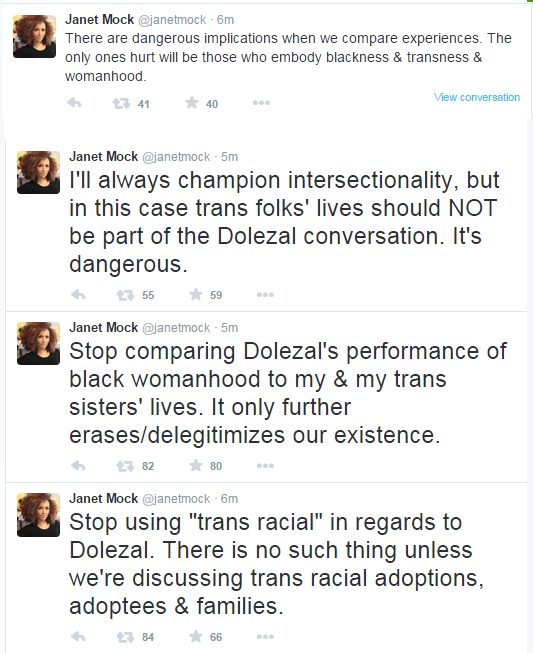 |
First tweet: “Stop using ‘trans racial’ in regards to Dolezal. There is no such thing unless we’re
discussing trans racial adoptions, adoptees & families.”
Second tweet: “Stop comparing Dolezal’s performance of black womanhood to my & my trans
sisters’ lives. It only further erases/delegitimizes our existence.”
Third tweet: “I’ll always champion intersectionality, but in this case trans folks’ lives should
NOT be part of the Dolezal conversation. It’s dangerous.”
Fourth tweet: “There are dangerous implications when we compare experiences. The only ones
hurt will be those who embody blackness and transness and womanhood.” |
Here’s the thing, though– if proponents of trans and black equality don’t openly consider the comparison, their opponents will.
In an inevitable column in The American Conservative called, with a particular lack of taste, ‘Call Me Rosa Parks’, Rod Dreher writes
But look, if Bruce Jenner can put on a dress and call himself a woman, even though he still has all his junk, and we’re all supposed to go along with it on pain of being denounced as bigots, why shouldn’t Dolezal have the right to expect us to do the same with her race fantasy? She has made a chosen blackness the core of her identity. Who are we to deny it?
It’s interesting that Dreher points out that Dolezal has “made a chosen blackness the core of her identity,” when he describes Caitlyn Jenner as Bruce in a dress. If you look at Jenner’s photos from Vanity Fair, she looks like a woman. For that matter, she looks so much like a conventionally attractive cisgender woman as to provoke reactions like Ellen Goodman’s above, calling her a “25 year old starlet.” No person with an understanding of the terms would call Caitlyn Jenner a cross-dresser, a man in drag.
Likewise, Rachel Dolezal does not seem to be in drag. She seems to have made her “transition” shortly after college, and maintained it until this day. Dolezal grew up with adopted black siblings, attended Howard University, and is a part-time professor of the Africana Studies Program at Eastern Washington University. Her father said that ever since getting the scholarship to Howard, “she’s been involved in social justice advocacy for African Americans. She assimilated into that culture so strongly that that’s where she transferred her identity.” I think that, given all of this, it’s difficult to say how much her identity as a black person was “chosen.”
And that right there is a big point of contention– perhaps the biggest. A persistent and damaging myth about transgender people is that they chose to become another gender. As in, a conscious choice, based on preference. It’s easy to see why this suggestion is offensive to a trans person when you consider the amount of risk and suffering that changing your gender can entail, and the amount of prejudice and ignorance that must be confronted from the moment of publicly acknowledging that you’re trans through the rest of your life.
One of the complaints voiced about Caitlyn Jenner was that because of her relative status and means, she could afford to undergo extensive physical changes that make it much easier to “pass” as female, whereas others are not so fortunate. In some cases, trans men and women undergo surgery and hormone therapy that drives them deep into debt. This is not a choice in the sense of waking up one day and deciding that you “find your your feminine side” and so will present as female, much as Mike Huckabee’s people would like to claim.
Dreher then quotes the reader who sent him the news about Dolezal:
Didn’t we just spend the last five years hearing that this is the civil rights issue of our time? That opposing gay and transgender rights is the same as racism? Oh hell. I can’t keep up.
 |
Pictured: People who would, today, be holding signs that
say “Adam and Eve, not Adam and Steve” |
See, I don’t think anybody has said exactly that opposing gay and transgender rights is the same as racism. Rather, they’re saying it’s like racism, because the two civil rights struggles have a lot in common, as is commonly revealed in arguments against gay marriage that sound, word for word (except for the words “gay” and “interracial,”), like the arguments against legalizing miscegenation back in 1967 when that right was finally won in Loving v. Virginia. You may have even heard someone say that those who oppose gay marriage are on the wrong side of history, just like the people who protested that “race mixing” was against the will of God back then.
And further, it’s just a bit of a stretch to claim that because comparisons exist between these two struggles for civil rights, the racial side of struggling for civil rights includes the right for white people to become black people.
Dreher finishes up by saying:
So, to recap, if Rachel Dolezal says she is a man, we must all agree, on pain of being publicly censured. But if Rachel Dolezal says she is black, it is fair game to challenge her claim. But LGBT status is exactly like race.
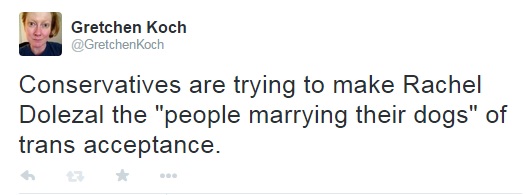
And that was the reductio ad absurdum/slippery slope argument that prompted me to tweet this:
Because we know perfectly well that Dreher doesn’t accept that people can be legitimately transgender or transethnic. He’s simply playing fast and loose with analogies by pretending that liberals hold a position that they actually don’t (LGBT status is exactly like race) in order to maintain that they must support X racial thing if they support Y gender thing. Just like so many social conservatives like to pretend that marrying someone of the same sex is so far out of the realm of moral acceptability that it leads inexorably to people marrying their dog….or car, or vacuum cleaner, or whatever. Given that liberals do tend to be supportive of animal rights, Dreher could’ve made that argument with as much validity– which is to say, of course, none.
Intersectionality is the study of interactions between systems of discrimination or oppression. To be intersectional in your activism is to pay attention and be active in more than one kind of struggle for equality. It’s fascinating, in a morbid kind of way, how often opponents of social justice try to portray this as a weakness. As if by simply recognizing that two (or more) different groups of marginalized people have things in common, similar things to fight for, you’re required to think about them and treat them exactly the same. As if those identities and the experiences associated with them must work in exactly the same way.
I don’t honestly know what to think of Rachel Dolezal. I’ve explained in a few different places that I think it’s possible to have at least a little bit of sympathy for her without in the slightest defending the real deception she has committed for personal gain. But I don’t think it was malicious, or that it has all been part of some big long-term con, and I don’t necessarily think “cultural appropriation” is the right term for what she did. But I’ll be damned if I know what is.