Skip to content

Follow-up: Jesus Chicken edition

Follow-up: Jesus Chicken edition published on No Comments on Follow-up: Jesus Chicken edition

I wrote before about how the conservative Christian-affiliated chicken chain Chik-Fil-A has received some very negative feedback about their contributions toward anti-gay political causes.  Here’s the latest on that:

Focus St. Louis and the Clayton Chamber of Commerce said today that they are canceling a planned presentation by Dan Cathy, president and COO of Chick-fil-A, following complaints that Cathy and his company are involved with anti-gay organizations. . .  The decision to cancel Cathy’s March 18 presentation here was made after PROMO, a statewide organization that advocates for lesbian, gay, bisexual and transgender equality, protested his appearance and asked Focus and the Chamber of Commerce to reconsider. Ellen Gale, the head of the chamber, said today that when the groups agreed to co-sponsor Cathy’s appearance, they had no idea he held controversial views.  “We are a pro-diversity culture here and certainly don’t want to offend anyone,” Gale said. “We didn’t know anything about this when he was booked.”  

Equality Matters replies (I paraphrase) “Damn skippy,” and lists extensive documentation of everything they dug up on Chik-Fil-A’s contributions and communications.

Religion going extinct? I doubt it.

Religion going extinct? I doubt it. published on No Comments on Religion going extinct? I doubt it.

The BBC reports on a paper recently presented at the American Physical Society meeting here in Dallas which makes claims about a decreasing level of religiosity in some parts of the world.  The paper, entitled “A mathematical model of social group competition with application to the growth of religious non-affiliation,” suggests that religion will effectively be extinguished in certain parts of the world just as certain languages die out due to lack of usage.  One of the paper’s authors elaborates:

“The idea is pretty simple,” said Richard Wiener of the Research Corporation for Science Advancement, and the University of Arizona. “It posits that social groups that have more members are going to be more attractive to join, and it posits that social groups have a social status or utility. “For example in languages, there can be greater utility or status in speaking Spanish instead of [the dying language] Quechuan in Peru, and similarly there’s some kind of status or utility in being a member of a religion or not.” Dr Wiener continued: “In a large number of modern secular democracies, there’s been a trend that folk are identifying themselves as non-affiliated with religion; in the Netherlands the number was 40%, and the highest we saw was in the Czech Republic, where the number was 60%.” The team then applied their nonlinear dynamics model, adjusting parameters for the relative social and utilitarian merits of membership of the “non-religious” category.

I’m skeptical.  The most obvious distinction that jumps out when comparing languages to religion is, at least to my knowledge, that at no point in history have people stopped using language.  They have stopped using specific languages in favor of other ones, just as they have stopped adhering to certain religions and converted to others.  But they haven’t cast religion aside. The study discusses how many people would answer that they are non-religious or have no religious affiliation, but that does not answer, as psychologist Bruce Hood points out, whether they have abandoned supernatural beliefs.  As I’ve mentioned before, there is a difference between being “non-religious,” being an atheist, and being a naturalist/materialist, and I don’t consider it accurate to say that religion has become “extinct” in a population unless its members fit the latter description.  Which, quite honestly, I don’t see ever happening.

Why be such a stickler about this?  Well, because when you talk to a person who says that she doesn’t consider herself to be religious (or worse, “non-affiliated”), digging a little deeper may reveal that she actually believes that the universe is God, that prayer and willpower cause wishes to come true, that everything happens for a cosmic reason, that casting spells works, and/or that everyone will be reincarnated after they die.  Her pantheism may disqualify her from being properly labeled an atheist, but the rest of it wouldn’t.  And even if she believes in none of those things she may well believe in ghosts, alien abduction, extra-sensory perception, Tarot-reading, and/or Reiki, which you might call secular supernatural ideas.  And to me, a god has more in common with a ghost than a cross has with a Tibetan prayer flag.  The latter two may both signify religious beliefs, but the former are both supernatural agents about which humans have a stunning number of intuitive beliefs in common.  That is, we use the same mental tools to conceive of and believe in them.

And if I’m right about that, then we will probably will carry on in these beliefs for as long as we have the kinds of minds that find them appealing.  I’m also not convinced that religious violence is fundamentally different in kind from any other violence which is rooted in a notion of a transcendent force which unifies one’s own group against whatever group(s) it views as threatening.  I don’t believe that it takes religion to make good men do bad things– or, for that matter, for bad men to do good.  I don’t see the extinction of religion specifically, even on a completely voluntary basis, as some kind of goal toward which we should all be striving.  Which is a good thing, considering that it probably won’t come to pass.

Unlike Hood, however, I do think we should strive toward rationality always, identify and eliminate bias wherever it can be found, and in general try to always have our skeptic’s hats on.  I consider supernatural thinking a mistake even if it’s an adaptive one. That doesn’t mean I have to single out people who think supernaturally as sui generis irrational, because we all do it occasionally.  And it certainly doesn’t mean I have to single out people who consider themselves religious as essentially thinking differently from, and/or worse or better than, everyone else.  

Update

Update published on No Comments on Update

I submitted a version of my “Helping vs. blaming in Japan” post to State of Formation, modified to include more commentary on the psychology of seeing supernatural agency in disasters.

Making sense of tragedy: was the earthquake a “divine punishment”?

Making sense of tragedy: was the earthquake a “divine punishment”? published on No Comments on Making sense of tragedy: was the earthquake a “divine punishment”?

Cross-posted from State of Formation.

Over at Religion Dispatches Levi McLaughlin, a professor of religion who specializes in East Asian traditions, writes about Tokyo’s governor Shintaro Ishihara describing the tsunami that struck Japan as “divine punishment”:

Ishihara, a prize-winning novelist, stage and screen actor, and a populist hero of the Japanese right, has gained notoriety for his willingness to court controversy, but his take on the tragedy in northeastern Japan offended even his staunchest supporters. On March 14, just three days into the crisis, Ishihara told reporters that he saw the tsunami as “divine punishment,” or tenbatsu, a term usually employed in Japanese to describe a righteous and inevitable punishment of the wicked. For Ishihara, the tsunami produced by Japan’s largest-ever recorded earthquake was a means of washing away the “egoism” (gayoku in Japanese) afflicting the Japanese people.

While the Tokyo Governor said that he felt sorry for the victims, he concluded that “We need a tsunami to wipe out egoism, which has rusted onto the mentality of Japanese over a long period of time.”

Ishihara, who will seek a fourth term as Tokyo Governor in a 2013 election, apologizedpublicly the next day, following comments by Miyagi Prefecture Governor Yoshihiro Murai, leader of the prefecture closest to the quake epicenter. Murai condemned Ishihara and urged sympathy for the hundreds of thousands of victims suffering in northern Japan. Despite Ishihara’s expression of regret, his “divine punishment” comment lingers as the most widely known religious sentiment yet expressed by a high-profile Japanese public figure in reaction to the current crisis. It resonates with similar remarks made in the United States following disasters, such as those by Pat Robertson in 2005, who described Hurricane Katrina as divine retribution for Supreme Court Chief Justice John Roberts upholding Roe vs. Wade, or the televised conversation between Robertson and Jerry Falwell on September 13, 2001 in which they characterized the attack on the Twin Towers as God’s punishment for American tolerance of “abortionists,” gays, feminists and the ACLU.

In his willingness to attribute this current natural disaster to divine influence, Ishihara joins the esteemed ranks of Glenn Beck, who was equally sure that a message was being sent but a bit less specific about what it was:
What God does is God’s business, I have no idea. But I’ll tell you this — whether you call it Gaia or whether you call it Jesus, there’s a message being sent. And that is, “Hey you know that stuff we’re doing? Not really working out real well. Maybe we should stop doing some of it.”

The need to believe that everything happens for a reason and that good will be rewarded with good while bad is punished by bad is called just-world bias, and it’s on full display here.  You could point out to Ishihara or Beck that the cause of earthquakes is actually plate tectonics which were set in place long before Japan was Japan, but the answer would almost certainly be “I know– and why do you think that was?  Why did it happen now?”

Well, for reasons someone with more geological knowledge than I could doubtless explain, but that simply pushes the question back another notch.  There has to be an ultimate explanation in this thinking, and “That’s the way the world is” isn’t good enough.  It’s not hard to sympathize with this desire to find reasons behind it all, because having reasons makes it easier for us to cope — or at least, it seems like it does. Psychologist Jesse Bering discusses in his new book The Belief Instinct how when life is uncertain and threats loom, people are not necessarily inclined to set aside supernatural reasoning simply because scientific reasons have been provided.  They can’t “turn off” the notion that events are the result of a cosmic will, especially when those events are special because of their rarity and enormous impact for the positive or negative.  Our means of conceiving of the thoughts and motivations of other people by taking their perspective is called Theory of Mind, and once it fully develops (for most people at about four years of age), it’s such a useful thing to have that we tend to, as Bering puts it, over-attribute agency.  We see it everywhere.  And when an unexpected tragedy happens, we scrabble for meaning and intention because that’s what we are so used to doing as a species.

For some of us, that translates into a literal belief that a specific agent–God– had a purpose in causing this particular catastrophe.  For others, that idea seems repellent.  We might be swayed by the idea that the event is all part of God’s plan, however, even if we don’t think he deliberately caused this disaster for a particular reason. Others have a vague sense of karma or of the universe testing us in some way.  As a non-believer I’m not immune to this sort of thinking.  I still think “Why me?” whenever something unusually positive or negative happens, as if there’s a reason aside from all of the physical events that led up to it.   But though most people are willing to reconcile things in their heads by interpreting something like an earthquake as part of the general workings of the world in some way (theistic or otherwise), attributing such a horrible thing to the deliberate machinations of God in response to human behavior is viewed by most of us as abhorrent.  And that, I would say frankly, is a good thing.

Again…tragedy + internet = outrage and nastiness.

Again…tragedy + internet = outrage and nastiness. published on 1 Comment on Again…tragedy + internet = outrage and nastiness.

A few days ago a UCLA student named Alexandra Wallace posted this charming racist rant about Asians in her university library:

If you’re one of the few people in the country who hadn’t seen that video previously, I’m sure you’re edified to have had the privilege now.  And can probably guess the response, if I haven’t given it away already– yes, outrage and nastiness.  The “outrage” part is good– it’s certainly better than apathy or agreement.  But the nastiness is a different story.  Jorge Rivas at Colorlines reports:

Alexandra Wallace’s now famous rant against Asian students at UCLA has been seen more than five million times.* Countless more people have seen or read about the video in the New York Times, Gawker, the UK’s Daily Mail and elsewhere. And in all these places, the video prompted outraged commentary from readers and viewers who told Wallace about her racism—and, in the process, slung mounds of misogyny her way, too. (Not to mention posting her address and, reportedly, sending her death threats.) Even on Colorlines.com and Jezebel.com, which targets a largely progressive female readership, many of the comments posted in response to Wallace were loaded with sexist name-calling. “I’m sure her mom also taught her to make sure you wear a tight tank top that exposes your boobs when ranting about Asian students on video,” a commenter wrote on Jezebel. On our site, the word “bimbo” thrived. Caroline Heldman at Ms. Magazine’s blog reminded readers that oppression comes in many different forms. She offers a hypothetical for comparison: “Imagine if an African American man posted a sexist video and commenters responded with a steady stream of racial slurs.” The point isn’t to equate race and gender. Rather, Heldman’s question offers a good place to start a discussion. What if Alexandra Wallace was black or Latina and people called her racial epithets? Would people be OK with that? Probably not. But some of the most popular comedic web videos of people of color sounding off against Wallace include starkly misogynistic language and ideas. . .  The Daily Bruin reports that Wallace, who issued an apology for the video, contacted university police on Sunday evening after receiving hundreds of threats via e-mail and phone. She’s been advised to reschedule her finals because her address and school schedule have been posted online.

*facepalm*

Channing Kennedy, also at Colorlines, summed it up well: “the Internet’s rebuttal to Wallace fought unexamined bigotry and hateful language with unexamined bigotry and hateful language.”  And death threats, because you can’t have footage of yourself doing or saying anything offensive on the internet anymore without death threats.  I’m sure that’s partially due to the tragedy factor, but other recent examples that have nothing to do with the tragedy include the Australian bully in a recent video who got smacked down by his victim and a British woman who put a cat in a trash bin.  The internet is full of hateful, hypocritical people who apparently see themselves as the agents of karma.  I know this has been the case for a long time, but the fact is making itself especially salient to me now.  

On the brighter side, Kennedy writes

a must-read thread on Facebook digs deep into the intersectionality of race and gender in Wallace’s video and in the responses. You should read the whole thing, but by way of an excerpt, here’s Sulekha Gangopadhyay: 

I didn’t find the misogynistic responses calling her a “slut”, “bimbo” or “whore” particularly empowering for me as a woman of color; men of color who rely on compensatory sexism have generally not been my allies.

Two different readers, Helen Lopez and Phoenix Activists, pointed us toward this response video by spoken-word artist Beau Sia, written from Wallace’s perspective. Phoenix says “Here’s the only non-sexist and most thought-provoking video response I’ve seen; it really makes us think how people like Wallace have the sentiments they have to begin with.”

They’re right. It really is an excellent video, and should be seen by everyone who has watched Ms. Wallace’s:

ETA:  There is some talk about what action UCLA could take against Wallace, whether she should be punished for violating their speech code.  I don’t know whether there are grounds or not, but also don’t care– I don’t think universities should have speech codes to begin with.  The chancellor has already made a public comment condemning what she said, which is rather silly considering that no rational person would assume that the racist beliefs of a college student somehow reflect the views of the university he/she attends. But to the point, universities should absolutely not punish students for bigoted speech on Youtube– and if they do, then they had better figure out whether all of those people who have made hateful videos about Wallace are bigots as well, and whether they’re also UCLA students so as to determine whether a mass expulsion is in order.  

Helping vs. blaming in Japan

Helping vs. blaming in Japan published on No Comments on Helping vs. blaming in Japan

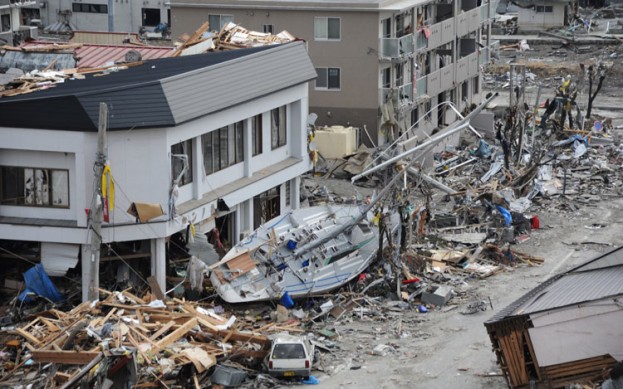
Over at Religion Dispatches Levi McLaughlin, a professor of religion who specializes in East Asian traditions, writes about Tokyo’s governor Shintaro Ishihara describing the tsunami that struck Japan as “divine punishment.”

Ishihara, a prize-winning novelist, stage and screen actor, and a populist hero of the Japanese right, has gained notoriety for his willingness to court controversy, but his take on the tragedy in northeastern Japan offended even his staunchest supporters. On March 14, just three days into the crisis, Ishihara told reporters that he saw the tsunami as “divine punishment,” or tenbatsu, a term usually employed in Japanese to describe a righteous and inevitable punishment of the wicked. For Ishihara, the tsunami produced by Japan’s largest-ever recorded earthquake was a means of washing away the “egoism” (gayoku in Japanese) afflicting the Japanese people.  While the Tokyo Governor said that he felt sorry for the victims, he concluded that “We need a tsunami to wipe out egoism, which has rusted onto the mentality of Japanese over a long period of time.”  Ishihara, who will seek a fourth term as Tokyo Governor in a 2013 election, apologized publicly the next day, following comments by Miyagi Prefecture Governor Yoshihiro Murai, leader of the prefecture closest to the quake epicenter. Murai condemned Ishihara and urged sympathy for the hundreds of thousands of victims suffering in northern Japan. Despite Ishihara’s expression of regret, his “divine punishment” comment lingers as the most widely known religious sentiment yet expressed by a high-profile Japanese public figure in reaction to the current crisis. It resonates with similar remarks made in the United States following disasters, such as those by Pat Robertson in 2005, who described Hurricane Katrina as divine retribution for Supreme Court Chief Justice John Roberts upholding Roe vs. Wade, or the televised conversation between Robertson and Jerry Falwell on September 13, 2001 in which they characterized the attack on the Twin Towers as God’s punishment for American tolerance of “abortionists,” gays, feminists and the ACLU. 

In his willingness to attribute this current natural disaster to divine influence, Ishihara joins the esteemed ranks of Glenn Beck, who was equally sure that a message was being sent but a bit less specific about what it was:

What God does is God’s business, I have no idea. But I’ll tell you this — whether you call it Gaia or whether you call it Jesus, there’s a message being sent. And that is, “Hey you know that stuff we’re doing? Not really working out real well. Maybe we should stop doing some of it.”

The need to believe that everything happens for a reason and that good will be rewarded with good while bad is punished by bad is called just-world bias, and it’s on full display here.  You could point out to Ishihara or Beck that the cause of earthquakes is actually plate tectonics which were set in place long before Japan was Japan, but the answer would almost certainly be “I know– and why do you think that was?  Why did it happen now?”  


Well, for reasons someone with more geological knowledge than I could doubtless explain, but that simply pushes the question back another notch.  There has to be an ultimate explanation in this thinking, and “That’s the way the world is” isn’t good enough.  It’s not hard to sympathize with this desire to find reasons behind it all, because having reasons makes it easier for us to cope– or at least, it seems like it does.  But when people try to draw a direct connection between a disaster and a punishment from some divine power it sounds an awful lot like blaming the victim, doesn’t it?  Strange how it’s so rare that you hear someone who has suffered due to a disaster saying “Yes, that was obviously God’s cosmic punishment for my behavior.”  No, it’s almost always somebody else’s suffering that was earned.  I wonder if Governor Ishihara counts himself amongst the “egotistical” people who needed to be taught this terrible lesson.  

On a brighter note, McLaughlin notes that the religious populations of Japan do not appear to be paying Ishihara much credence– they continue to help in relief efforts as they’re able:

Temples, shrines, and other religious facilities across the Tohoku region, and elsewhere, have been transformed into refugee centers. An article from March 16 on Asahi.com reports that the priest at the Rinzai Zen temple Jionji in Rikuzentakata village is housing 69 refugees who were treated by doctors and nurses from the Japan Red Cross. Seventy to eighty percent of the town’s 8000 households were wiped out by the tsunami. Jodo Shinshu, Japan’s largest traditional Buddhist sect, has cancelled plans for the 750th memorial of sect founder Shinran. Instead, the Shinshu priesthood has transformed head temple Higashi Honganji in Kyoto into a dispatch center for relief supplies. Temple staff members are loading water, food, and portable stoves into trucks to be sent to the afflicted Tohoku region, and they’ve turned their famous garden Shoseien into a center for fundraising; and this at a time when the 115 Higashi Honganji Jodo Shinshu temples in Iwate, Miyagi, and Fukushima Prefectures have been damaged, clergy in Sendai have been killed, and the sect is unable to make contact with seven temples. Meanwhile, leaders of the Pure Land Buddhist sect Jodoshu report that they’re unable to contact approximately twenty of the 300 sect temples in these prefectures; they’ve also assigned their headquarter staff to gather funds and supplies. Rinzai Zen headquarters in Kyoto have dedicated their staff to raising funds for emergency relief. The Soto Zen headquarters at Eiheiji reports that it has mobilized clergy to accompany members of its volunteer organization Shanti International Association who will travel to northeastern Japan to aid in relief efforts. Staff at the head temple of Nichirenshu, the largest sect of Nichiren Buddhism, is still contacting its temples in northeastern Japan, and it has cancelled all other activities in favor of fundraising. It’s likely that the leaders of every other traditional Buddhist denomination have dedicated their staff to raising money and gathering materials for earthquake relief. Shinto organizations have also pitched in. Shinseikyo, or the National Association of Shinto Youth, immediately established a “Disaster Policy Committee” responsible for fundraising and contacting Shinto priests in the disaster area. The Shinseiky message board is now filled with inquiries seeking contact with Shinto clergy in shrines that cannot be contacted and are most likely destroyed. Christians in Japan, who make up less than one percent of the country’s population, consistently initiate successful and high-profile social welfare activities, and they have leapt into action to provide relief. On March 12, mere hours after the quake and tsunami hit the Tohoku region, the YMCA in Kobe began soliciting relief funds; as an organization that survived the January 17, 1995 earthquake in western Japan and provided relief to residents in Kobe, they are eager to help victims of this latest natural disaster.

An observation

An observation published on No Comments on An observation

The video of TamTamPamela thanking God for the Japanese earthquake was all over the web yesterday.  I’m kind of disappointed in how willing people were to buy it without question.  Not because it’s a skepticism fail per se (I fall for Poes often– that’s the point of a Poe), but because they were so ready to believe that someone would be that hateful and already had their outrage pants on, good to go.

Guess I shouldn’t be surprised, as tragedy tends to magnify everything.  It’s probably unfair to think that there really are so many people out there who have no problem at all believing such a thing because their expectations of religious people are already that low, and it’s actually just that everyone’s nerves are on the surface.  I hope.

But we could do with a few less people pointing and saying “This is what religion does to you.”

Real-life trolls, part 2

Real-life trolls, part 2 published on No Comments on Real-life trolls, part 2

The girl who made a Youtube video glorying in Japan’s earthquake, saying that it was God giving the country a “little shake” to send a message regarding his existence to atheists and arousing a lot of outrage…is apparently a troll.

To which I say, good. I’m glad that those (probably) weren’t honest statements. But still in really bad taste. Even Pat Robertson doesn’t attribute natural disasters to the wrath of an angry God with quite that amount of sheer pleasure, and I don’t see anything particularly funny or clever about making up a person who does.  Not when we’re talking about a real event in which thousands of people have died and are still dying.  No thanks.

TAM 9 speakers

TAM 9 speakers published on 3 Comments on TAM 9 speakers

The Amazing Meeting has announced its list of speakers for this year, its ninth meeting.  There are a lot of them, and quite a few– at least ten, from what I can tell– are people who can speak to the topic of how and why people believe weird things.  Or rather, why everyone isn’t skeptical all of the time.  That’s really encouraging.  If I were able to go, I’d make sure to attend those talks.  However accomplished a scientist or entertainer you are, I’m just not as interested in hearing how sure you are that ghosts and gods don’t exist and/or making fun of people who think they do.  That’s not to say that those topics don’t have their place, but they just don’t really grab me anymore.  Well, not unless the non-skeptical are trying to implement their non-skeptical beliefs via legislation or terrorism, in which case I’m definitely interested but it’s less about the lack of skepticism than about the use of force to push it.

But hey– it’s their meeting and I’m not going (can’t afford it), so who cares what I think?  It’s just nice to see skeptics being interested in the hows and whys regarding “woo” and not just the whats.

More follow-up: the difference between neutrality and objectivity

More follow-up: the difference between neutrality and objectivity published on No Comments on More follow-up: the difference between neutrality and objectivity

Journalist Lauri Lebo wrote a book about Kitzmiller v. Dover Area School District, the 2005 creationism case which occurred in her home state of Pennsylvania.  Prior to the actual court battle she had been covering the situation locally in newspapers, reporting on what transpired at school board meetings and such.  During and after the trial, however, she was accused by her newspaper editor of failing to be properly objective because she noted when creationist members of the school board perjured themselves on the stand and when their arguments were blasted out of the water by legal and scientific authorities.  Her editor, you see, actually wanted her to be neutral— to present both sides as if they were equally legitimate.  But they weren’t, and writing as if they were would constitute a failure to present the story factually.  Journalists are supposed to gather different perspectives on the stories they tell, but they should not be expected to be neutral.  Lebo expresses this concept beautifully in The Devil in Dover: objective reporting is not treating both sources as legitimate if one source has the truth on its side and the other is full of crap.  Objectivity is not making sure you include some nonsense to balance out your sense, or vice versa.  It’s being as truthful as possible, no matter who that bothers.

That’s the problem I have with this response from the New York Times to the “outrage” about the original McKinley story on the gang rape in Cleveland, Texas– it acknowledges simply that the story “lacked a critical balancing element.”  That it contained no quotes of someone sympathizing with the victim rather than the perpetrators.  That it wasn’t neutral.  And yes, the story would have been better if it had included some of those quotes, rather than giving the impression that nobody in Cleveland cares about the girl who was raped, as I surely hope is not the case.  It would have come closer to representing the truth.  But the truth itself isn’t neutral.  The truth is that it’s called rape for a reason, and that is that the victim is never to blame, even slightly.  It seems extra abhorrent because the girl was only eleven years old, but this would be just as true if they had gang-raped a twenty-eight year old woman.  That’s a fact that might have escaped a number of people in the Cleveland area, but it ought to be expressed overtly by someone reporting on the situation objectively: “Somebody in this story suggested something that isn’t true.  Here are the actual facts.”  And don’t tell me that reporters have an obligation to keep their opinions out of their stories– that might be true, but the law is not a matter of opinion, and the law says that it doesn’t matter what the girl was wearing or how much makeup she had on, why she was in a dangerous part of town, or where her parents were.  If she was raped, she was raped, and that is entirely the fault of the men and boys who perpetrated it.  Period.

Should we, as a readership, have known this full well and not have needed to have it pointed out to us?  Yes, absolutely.  But clearly that’s not the case– not if anyone from Cleveland (for example) reads the New York Times.  I would say that they should, except that apparently they won’t find any corrections on their misconceptions there.  At least, not today.