Skip to content

Follow-up: New York Times responds to complaints about their reporting

Follow-up: New York Times responds to complaints about their reporting published on No Comments on Follow-up: New York Times responds to complaints about their reporting

poorly:

The Times responded Wednesday evening to The Cutline: “Neighbors’ comments about the girl, which we reported in the story, seemed to reflect concern about what they saw as a lack of supervision that may have left her at risk,” said Danielle Rhoades Ha, a spokeswoman for the paper. “As for residents’ references to the accused having to ‘live with this for the rest of their lives,’ those are views we found in our reporting. They are not our reporter’s reactions, but the reactions of disbelief by townspeople over the news of a mass assault on a defenseless 11-year-old.” 

With all due respect, Ms. Ha, I think you kind of missed the point.

More Savage loving

More Savage loving published on No Comments on More Savage loving

Conversation continues about interpretation of Dan Savage’s sexual ethics.  Savage himself responds to Lindsay Beyerstein thusly:

Terry and I wouldn’t describe ourselves as monogamous-apart-from-an-occassional because we wouldn’t—couldn’t—feel comfortable using the word “monogamous” in reference to ourselves, not even monogamous-with-an-asterisks, because technically we’re, you know, not. But we kindasorta hate the term non-monogamous because when a gay couple describes themselves as non-monogamous people—gay and straight—assume a degree of promiscuousness that 1. we wouldn’t be comfortable engaging in and 2. we’re not actually engaging in. People don’t make the same assumption about non-monogamous straight couples because it’s generally more difficult for straight people to get laid. That’s why we usually describe our loving, bill-paying, childrearing life partnership as “monogamish.” Mostly monogamous but stuff happens. Some other stuff. Sometimes. Not all the times. It’s a term that I’d like to popularize. Our monogamish relationship—and I suspect that we’re not the only monogamish couple out there—has allowed us to integrate “sexual fulfillment with the other good things in life” quite nicely, thanks.

On Big Think, Dueholm complains that Savage doesn’t hold up monogamy as an ideal.  He’s right– Savage doesn’t, because he clearly doesn’t think it is ideal.  He doesn’t say it’s something for which we all should strive, but if we fail it’s understandable.  He says that it isn’t necessarily something we should all strive for, period.  We should strive for what we want, and not everybody wants monogamy.

Sue Blackmore decides that religions are not, in fact, viruses of the mind

Sue Blackmore decides that religions are not, in fact, viruses of the mind published on No Comments on Sue Blackmore decides that religions are not, in fact, viruses of the mind

Cross-posted from State of Formation.

Sue Blackmore is one of the go-to voices in the UK on matters of religious thinking and consciousness. She is, believe it or not, an atheist with a PhD in parapsychology.  Originally a firm believer in the paranormal, she reached the conclusion in the course of her study that it doesn’t in fact have any scientific basis.  At that point, she decided to find out what the mind really is capable of doing, which resulted in a number of books including the excellent Consciousness: An Introduction.

Blackmore is probably most famous for The Meme Machine, however, a book in which she takes the idea of the meme which Richard Dawkins proposed in his 1976 book The Selfish Gene (yes, it really was that long ago) and ran with it.  I don’t think most people who use the word “meme” these days really have any idea where the term originally came from and how it was formulated.  Some people don’t even know how to pronounce it, because they don’t realize it was intended to sound similar to “gene” in order to convey a similar means of propagation.  Genes, Dawkins wrote, have their own metaphorical interests which can be viewed as independent from ours in that they “desire” to be perpetuated  into the next generation.  In the same way, memes are ideas which “desire” to be spread as far and widely as possible.  Blackmore expressed this epidemiologically, comparing memes to viruses which need hosts that are most conducive to spreading them.  A memeplex is a conglomerate of ideas which are transmitted together because they are mutually supporting, such as a philosophical outlook or a religion.

As you can imagine, an idea’s interests that are independent from ours might well be also contrary to ours, which is what the word “virus” is intended to convey.  Viruses are not symbiotic with us– they manage to propagate at the expense of our health by making us sick.  In his 2006 book Breaking the Spell, Daniel Dennett compared religion to a lancet fluke which invades the mind of an ant, driving it to climb to the top of a blade of grass to be eaten by grazing animals, and didn’t seem to fully acknowledge how that analogy could be perceived as insulting to believers.  It smudged the line between being willing to die for worthy causes, of which martyrdom is perceived to be one, and being made to die pointlessly for someone/something else’s desires.  You might say “Well, that’s the entire point– the memes just make you think you’re doing something meaningful!”  Maybe so, but that’s assuming one’s conclusion.  Most of us would grant that some forms of self-sacrifices are in fact noble and not at all pointless, but both Blackmore and Dennett would say that those are caused by memes as well.  How do we determine which ones are virus- or fluke-like and which are not?

After attending an Explaining Religion conference at the University of Bristol, Blackmore says that she no longer views religions as viruses of the mind in the sense of being detrimental to their hosts. Why? Two main reasons:

1.  Michael Blume was able to show that religious people have far more children than non-religious people.

2.  Ryan McKay was able to show using experimental data that “religious people can be more generous, cheat less and co-operate more in games such as the prisoner’s dilemma, and that priming with religious concepts and belief in a ‘supernatural watcher’ increase the effects.”

To the first point a person could note that there are more important things in life than the number of one’s children.  True in a proximate sense, but not in an ultimate one.  If we’re evaluating the benevolence of a meme on an evolutionary scale, increasing reproduction is a clear advantage even if it’s not in the best interest of individuals or, indeed, the world itself.

To the second point, which is well-supported by a number of studies that have been performed over recent years, a person could dither about the degree to which being cooperative and honest should be counted as more a benefit to the individual or to the group, and then talk about whether it promotes in-group cooperation at the expense of creating inter-group hostility.

However, I’m not sure we really need to conduct either discussion.  Memetics is not the only way to examine religious ideas epidemiologically.  The advantage in looking at religion as a memeplex is that it emphasizes that religious ideas are transmitted between human minds just like any other ideas, but I think that Pascal Boyer manages to do that more effectively using his epidemiological approach because he doesn’t feel compelled to treat ideas as strict analogs to genes.  He tries to figure out first what should count as a religious idea, and then discusses which religious ideas are more likely to “stick” and which others are not, but not by attributing metaphorical interests to them.

That isn’t to say that Boyer doesn’t have his own ideas about whether religious ideas are on the whole more beneficial to us or more detrimental, but that question is not essential to his theorizing about what fundamentally makes an idea religious and likely to spread.  In fact, it’s quite irrelevant to that theorization.

I don’t think the matter of whether and when religion benefits humanity and when it harms us should be off-limits to scientific inquiry.  And even if I did, scientists are going to research those topics anyhow.  But it doesn’t seem appropriate to make a decision about the value of religion as a whole as part of your theorizing about how it works.  These studies which point out various ways in which being prompted to think religiously causes people to be better to each other are tightly circumscribed and specific.  I don’t think showing that people tend to behave better when they think they are being watched, for example, really says anything about the value of religious beliefs in general even if one function of religion is to perpetuate the idea that there is always someone watching.   This experimental data is important, but it’s also important to hold off on forming grand conclusions on the basis of a few studies.  It’s good that Blackmore has decided religion isn’t a mental virus, but that doesn’t mean it’s a mental panacea either.


How not to represent rape: a report on a Texas travesty

How not to represent rape: a report on a Texas travesty published on 1 Comment on How not to represent rape: a report on a Texas travesty

A horrible crime happened in Cleveland, Texas.  A small town just northeast of Houston, it has a population of only 9,000 people, but that apparently includes up to 18 boys and men who were willing to take part in the gang rape of an eleven year old girl.  I imagine that the fallout from this event will be extensive and the investigation will take quite some time (it began just after Thanksgiving of last year), but the coverage in the New York Times has already come under fire because of how it chose to portray the story.  The offending passages:

The case has rocked this East Texas community to its core and left many residents in the working-class neighborhood where the attack took place with unanswered questions. Among them is, if the allegations are proved, how could their young men have been drawn into such an act?“It’s just destroyed our community,” said Sheila Harrison, 48, a hospital worker who says she knows several of the defendants. “These boys have to live with this the rest of their lives.” . . .Residents in the neighborhood where the abandoned trailer stands — known as the Quarters — said the victim had been visiting various friends there for months. They said she dressed older than her age, wearing makeup and fashions more appropriate to a woman in her 20s. She would hang out with teenage boys at a playground, some said. “Where was her mother? What was her mother thinking?” said Ms. Harrison, one of a handful of neighbors who would speak on the record. “How can you have an 11-year-old child missing down in the Quarters?”

After reading the article my first reaction was “Wow, blame the victim much?”  And I apparently wasn’t alone–  Jezebel, Feministing, and Slate all have commentaries about how the article appears to focus on how the men and boys in this community are going to suffer from this incident and what could have prompted them to behave in this way, up to and including the suggestion that the victim is actually to blame for what happened to her. It is of course worth being concerned about whether people who actually weren’t involved in the crime might have been accused unjustly, but that specific worry isn’t actually mentioned in the body of the article.  Nor are the obvious attempts by members of the community to find some way to pin responsibility for the rape on this young girl labeled for what they are– victim-blaming.  Libby Copeland wonders

How can the New York Times fail to frame these quotes properly, to point out the stunning cultural misogyny that allows a brutal gang rape to be reinterpreted as vigilante moral policing? To report these details bare, without context, puts the misogyny squarely in the voice of the Times.  The kindest reading of what makes people blame the victims of rape is fear. We don’t want to imagine that what happened to this 11-year-old could happen to us or to our daughters, so we rationalize that it couldn’t, that we are not like her. But there’s much more going on. There’s deep-seated fear of and disgust for women and female sexuality. We don’t have the same reaction to a boy getting beat up as we do to a girl getting raped; we don’t tend to wonder what the boy did to provoke the bully.Here’s the thing: Any attempt to gain emotional distance on rape by transferring just a tiny portion, just one percent, of the blame onto the victim is an absolute moral wrong. It subtracts from the agency of the individual doing the raping. He is completely culpable. It is his crime — or, in the case of 18 young men and boys, it is theirs.

Amanda Marcotte blames this strange story-telling on journalistic objectivity gone too far:

I was under the impression that gang raping children is generally assumed to be such a horrific crime that reporters don’t have to strike a studied neutral pose, as you would with more overtly controversial issues, but apparently not. I feel strongly there’s a missed opportunity here.  I grew up in a rural Texas town on the other end of the state, and have more than a passing familiarity with how common it is for these kinds of communities to be shockingly tolerant of gang rape.  I don’t think it’s radical to point out that victim-blaming and assailant-sympathizing in a community sends permission signals to would-be rapists and makes crimes like this likelier to occur.  This could have been an opportunity to write a story examining the relationship between victim-blaming attitudes and the rapes themselves, much in the way that the murder of James Byrd in nearby Jasper in 1998 became an occasion to look at how racism still thrives in the South and created the context for hate crimes.

I agree, but such a story wouldn’t have been less objective– it would have been more objective, because objectivity isn’t simply dutifully recording people’s opinions and representing them in print.  It requires actually telling the facts of the story, including the fact that blaming the victim is what your sources are doing.  The story pays almost no attention at all to what the girl who was attacked in this way might have experienced or how difficult it must be to survive it physically and emotionally, but instead discusses how men might have been “drawn into” attacking her and how this ordeal must be affecting them.  I’m not sure it’s possible to be excessively neutral or objective, but it’s certainly possible to write an article that gives a definite impression of sympathy for the perpetrators, and that’s what happened here.  Marcotte is willing to give the article’s author, James McKinley, the benefit of the doubt and assume that he had no intention of lending credence to Cleveland residents who saw fit to speculate on how the girl provoked her own victimization.  I would like to do so as well, but if that’s the case I’m still mystified as to why the piece was written in this way and these specific quotes used without comment.  That isn’t a “studied neutral pose;” it’s just bad and biased reporting.

ETA: I missed this sardonic comment by Mac Mclelland at Mother Jones.  Money quote:

This is the point at which, as the writer’s editor, I would send him an email. “Dear James,” it would say. “Thanks for getting this in! I have some concerns that we’ve only got quotes from people who are worried about the suspects (‘The arrests have left many wondering who will be taken into custody next’) and think the girl was asking for it, especially since, even if she actually begged for it, the fact that she is 11 makes the incident stupendously reprehensible (not to mention still illegal). We don’t want anyone wrongly thinking you are being lazy or thoughtless or misogynist! Please advise if literally no other kinds of quotes are available because every single person who lives in Cleveland, Texas, is a monster.” 

Dan Savage as sexual ethicist

Dan Savage as sexual ethicist published on 2 Comments on Dan Savage as sexual ethicist
As president?  Well, maybe not…but we could do
and have done a lot worse for that, too.

Lutheran pastor Benjamin Dueholm wrote an interesting and thorough article on this subject for Washington Monthly.  It’s definitely worth a read, though I disagree with some of his analysis.  So does Amanda Marcotte, who ripped into the article to some extent for sexist/heteoronormative bias, and Lindsay Beyerstein, who points out that Savage isn’t nearly as opposed to monogamy as he is generally portrayed.  It’s true; he isn’t– though he also doesn’t believe that everybody should be monogamous, or that people who cheat in a monogamous  relationship are necessarily the scum of the earth and should never be forgiven.

Dueholm’s careful description of Savage’s ethos points out that in relationships he emphasizes honesty, autonomy, reciprocity, and willingness to give, which I would characterize as a mature respect for one’s partner. Just as different things make different people happy, different relationships can flourish under varied conditions and one size definitely doesn’t fit all.  Savage’s willingness to acknowledge that and address individual relationships on their own terms is, I think, what has made and kept his column (and now podcast) so popular for so long.  If we as a country were going to appoint a sexual ethics czar, we could do a lot worse.

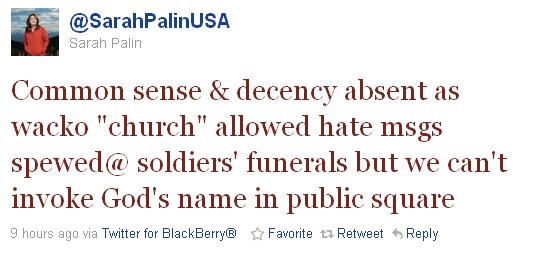
Palin clarifies– that she still doesn’t understand freedom of speech

Palin clarifies– that she still doesn’t understand freedom of speech published on No Comments on Palin clarifies– that she still doesn’t understand freedom of speech

From The Daily Caller:

Former Alaska Gov. Sarah Palin clarified remarks posted on Twitter this week in response to a Supreme Court ruling in favor of a church that demonstrates at military funerals, saying she was making a point about a double standard on free speech, not that the group shouldn’t have the right to protest.Her quote was interpreted by many news outlets, including The Daily Caller, to mean that she disagreed with the Supreme Court’s ruling, although in a new statement exclusive to TheDC, Palin said she agreed with the ruling in favor of the church.

“Obviously my comment meant that when we’re told we can’t say ‘God bless you’ in graduation speeches or pray before a local football game but these wackos can invoke God’s name in their hate speech while picketing our military funerals, it shows ridiculous inconsistency,” Palin told TheDC. “I wasn’t calling for any limit on free speech, and it’s a shame some folks tried to twist my comment in that way. I was simply pointing out the irony of an often selective interpretation of free speech rights.”

Oh, of course. Obviously when she said that “common sense and decency” were absent on the occasion of the SCOTUS ruling, that didn’t mean she disagreed with the ruling.  How silly of us to think that.  No, Sarah Palin doesn’t want to limit free speech– she wants more of it!  You know, the kind of free speech that allows public school officials to speak on behalf of students to express their religious convictions, whether the students actually hold those convictions or not.  But only Christian convictions, I assume– not to put words in Palin’s mouth, but I would tentatively guess that she wouldn’t be so enthusiastic about school officials offering Muslim prayers at graduation or before a football game.

The students, of course, retain their freedom to pray to whomever and invoke whichever god’s name they want on these occasions.  So yes, I suppose you could call that a “selective interpretation”– it selects in favor of the freedom of students rather than the “freedom” of government representatives (which is what public school officials are) to speak on their behalf.  It’s a pretty clear distinction, one would think.  But I guess we shouldn’t be surprised that Palin doesn’t quite get it, considering that she said Dr. Laura Schlessinger’s cancellation of her own radio show meant that Schlessinger’s First Amendment rights had “ceased to exist.”

So, for those keeping score– criticizing someone’s speech means that their right to free speech has ceased to exist.  Unless you’re Sarah Palin criticizing someone, in which case you are exercising your freedom of speech to question why there isn’t more freedom, including the freedom of governmental officials to make religious pronouncements on behalf of children, which for some reason is the same as “invoking God’s name in the public square.” Got it?

Speaking of what makes people laugh becoming a moral issue…

Speaking of what makes people laugh becoming a moral issue… published on No Comments on Speaking of what makes people laugh becoming a moral issue…

this is pretty much the definition of it.

I’m not sure if I want to write a full-fledged post on this topic or not.  As you can see from that timeline it’s a controversy that has been going on since August of last year with frequent twists and turns, and no shortage of different perspectives– but then that’s always the case, isn’t it? There are almost never just two sides. I think some timeless truths about online disputes can be drawn from it, though.  Such as:

  • It’s hard to overestimate the ability of gamers to be arses, particularly of the misogynistic variety.  And I say this as a person who loves to play the video games herself, but the community does have its share of misogynerds.  (I just learned that term today, and this will probably be the only time I use it.  But it’s fitting now, if ever)
  • Reasonable people may disagree, but they don’t threaten violence.  That’s an automatic and permanent revocation of one’s credibility card.  
  • As a debate about the value of something said on the internet continues, the probability that someone will interpret objections as threats to freedom of speech approaches 100%.  
  • Real or effective online anonymity plus an audience doesn’t turn everyone into total fuckwads, but it inevitably works like a charm for some.  

Should we be surprised?

Should we be surprised? published on No Comments on Should we be surprised?

So Rock Beyond Belief has apparently been canceled.  All of that time and effort put into creating a secular concert and expecting the military to honor its agreement to support the show to the same extent that it supported a Billy Graham evangelical event before, and it’s not going to happen.

“It’s heartbreaking,” said Sgt. Justin Griffith, who announced the cancellation in a Thursday letter to Col. Stephen Sicinski, the garrison commander at Bragg. “I’m personally invested in this, both in money and time. And now I feel like I’ve strung people along.” 

As Ed Brayton (scheduled to emcee the concert) says, Griffith didn’t string anyone along– Fort Bragg leadership did.

Plans for the Rock Beyond Belief concert, which was planned to include famed British atheist Richard Dawkins as its keynote speaker, began last fall, after an event on the post called Rock the Fort. That event, sponsored in part by the Billy Graham Evangelistic Association, was criticized by groups like Americans United for the Separation of Church and State as an attempt to evangelize not just soldiers, but civilians, who could also attend the show. Military leaders said at the time they would support similar events by non-Christian groups, a promise reiterated in a letter last month from the Office of the Staff Judge Advocate at Bragg to the Freedom From Religion Foundation. “Fort Bragg continues to be willing to provide the same level of support to comparable events proposed by non-federal entities,” wrote Lt. Col. Nelson Van Eck Jr. Griffith and other organizers say that changed abruptly this week, when they were told that they couldn’t have the large outdoor gathering with games and activities they had planned. Instead, they were told the event could take place at one of two indoor theaters, with the larger one accommodating about 700 people. In his letter to Sicinski, Griffith also says the base declined to cover any of the costs for Rock Beyond Belief, while it paid $54,500 toward the Christian event. Griffith also says he was told that any advertisements for the secular event would have to carry disclaimers that the concert wasn’t endorsed by Bragg, while the Christian event was explicitly endorsed by the post. A military chaplain, for example, had sent out letters on Army stationary to area Christian pastors asking for their assistance in running the Christian concert. Because of the disclaimer, the financial support and the venue change, Griffith said, the concert he planned wasn’t able to go forward, which has left him disappointed and frustrated. “This happened at the last minute,” he said. “I just don’t know how to pursue this further without litigation.”

Ed comments:

And litigation is being prepared by the Military Religious Freedom Foundation. The fact is that this was a test from the start, a test of the military’s promise that they would treat a non-Christian event the same as they treated the previous Christian one. And the military failed that test. We know from FOIA requests that the base paid tens of thousands of dollars in support for the Billy Graham event and they are now refusing to do the same for our event. I’m disappointed, of course, because I was really looking forward to hosting the show. But perhaps a lawsuit is what it will take to put a stop to the military’s constant promotion of religion.

SCOTUS rules in favor of Westboro on funeral protests

SCOTUS rules in favor of Westboro on funeral protests published on No Comments on SCOTUS rules in favor of Westboro on funeral protests

Cross-posted from State of Formation.

The Supreme Court ruling on Snyder v. Phelps was issued this morning– 8-1 in favor of Phelps, saying that the First Amendment protected the WBC’s right to protest the military funeral.  I couldn’t have imagined it going any other way, but there was still a niggling worry that it might.  The opinion, authored by Roberts with Breyer concurring, notes that the protest was taking place on public land, roughly a thousand feet from the church (as instructed by police), and none of the protesters entered the cemetery.  None of them interfered in the funeral in any way, and the plaintiff was not even able to read what their signs read until that evening when he saw them on a news broadcast.  The lone dissenter to the opinion, Justice Alito, disagreed mainly on the grounds that the protest took place at a time and location geared to garner maximal attention.  Which…isn’t that what protesters always do?

I’m very glad that this case went to the Supreme Court, and that this was the decision they delivered.  That doesn’t mean I have a shred of sympathy for Westboro or their supposed cause, but I do think that delivering a $5 million dollar judgment against a group protesting on public grounds without any violence or even cursing would set a very, very bad precedent in terms of freedom of speech.  From the opinion:

Westboro believes that America is morally flawed; many Americans might feel the same about Westboro. Westboro’s funeral picketing is certainly hurtful and its contribution to public discourse may be negligible. But Westboro addressed matters of public import on public property, in a peaceful manner, in full compliance with the guidance of local officials. The speech was indeed planned to coincide with Matthew Snyder’s funeral, but did not itself disrupt that funeral, and Westboro’s choice to conduct its picketing at that time and place did not alter the nature of its speech.

Speech is powerful. It can stir people to action, move them to tears of both joy and sorrow, and—as it did here—inflict great pain. On the facts before us, we cannot react to that pain by punishing the speaker. As a Nation we have chosen a different course—to protect even hurtful speech on public issues to ensure that we do not stifle public debate. That choice requires that we shield Westboro from tort liability for its picketing in this case.

Memo to Sarah Palin…

Memo to Sarah Palin… published on No Comments on Memo to Sarah Palin…

Umm, both your and Westboro’s wacko pronouncements in the public square (such as, for example, this very tweet) invoke God’s name on a regular basis.  They got sued for it; you didn’t.  It appears their liberty to be religious in public is more in danger than yours is.

First Amendment and irony comprehension fail.  But you have to love someone who complains that they’re not allowed to do something as they’re doing it.

The fallacy being applied by this particular politician is….. *drumroll*….. equivocation, combined with a bit of false analogy.  First of all, simply invoking God’s name in the public square hasn’t gotten either the WBC or Sarah Palin in any kind of trouble.   In fact, doing so is pretty much a requirement for both churches and conservative politicians alike, hmm?  Oh, I’m sorry– “church,” in scare quotes, says the woman whose own church invited a witch hunter to come and bless her.  Second, for Sarah Palin the word “can’t” means that somebody, somewhere, will have a negative opinion of her for doing something.  For Westboro, regardless of how you might view their beliefs and practices, it means they might be out $5 million.   A tiny bit of a difference, there?  Perhaps.