Skip to content

Content design for a nonprofit community makerspace: MakeICT

Content design for a nonprofit community makerspace: MakeICT published on No Comments on Content design for a nonprofit community makerspace: MakeICT

What even is a makerspace?

If you’re not familiar with makerspaces, here’s a definition: they’re spaces where people make things.

Literally, that’s it– you could make pretty much anything at a makerspace, with the primary constraints being your own imagination, and what you can get away with.

Makerspaces come in many varieties, from university fabrication labs to in-school makerspaces for kids to commercial enterprises. The MakeICT Institute, where (in full disclosure) I’m president of the board, is a 501(c)(3) nonprofit makerspace run entirely by volunteers. Our board is a “working board,” strategizing about MakeICT’s future while also being actively involved in meeting the organization’s needs on the premises.

MakeICT operates out of a former elementary school, with classrooms converted to shops dedicated to each domain of “making,” from a fabrication lab to a woodshop to a metal shop to textiles, and ceramics, and more. Each area has an area lead responsible for purchasing tools and supplies, and generally keeping the area in good working order. Committees exist to run events, process new memberships, tackle IT needs, and generally keep the place running.

As an organization, MakeICT functions as a community of makers with a mission to “innovate, learn, and build community at the intersection of art, technology, science, and culture.” It prides itself on being welcoming and accessible by keeping membership prices low, allowing 24/7 access to the space for members, and inviting members to teach classes at various levels of expertise, for which they receive 75% of the registration fees. MakeICT also hosts and organizes events for members and external organizations, offering makers a chance to display and sell their work.

Goal, audience, and scope

This is a content design and strategy proposed for MakeICT that has largely not yet been implemented.

Problem: MakeICT’s existing content was developed with care, but without organization. It’s difficult to navigate, inaccurate/outdated information sprinkled throughout, and in general it badly needs a makeover.

Goal: A mission statement is inspiring, but a content design strategy expands on that inspiration. The goal is to present unified content that establishes a brand/identity for MakeICT for use in promotional and educational materials.

Audience: Members and prospective members, partners and prospective partners, and donors and prospective donors.

Scope: The scope of this project extends to online content, presentations, and printed materials for the makerspace.

MakeICT’s online content includes:

  • Social media posts
  • Website
  • Wiki
  • Forum

MakeICT’s presentations include:

  • Internal training sessions (e.g. the “‘how to teach a class’ class” )
  • New member orientation sessions
  • “Maker Monday” presentations (members of the public are invited to tour the space, and are given a general overview of what MakeICT is)
  • Presentations for external organizations

MakeICT’s printed materials include:

  • Flyers
  • Brochures
  • Guides

Limitations

  • Shoestring budget – We get donations and sometimes discounted goods and services, but everything starts with spare time and the will to make something happen.
    • Compensation: It doesn’t take a lot of funds to makeover a website, for example, or shift the voice and tone of posts on social media. A dramatic change to printed guides and presentations is more of a financial hurdle, but getting people on board in advance of making changes will minimize the impact.
  • Volunteer authors/designers – No training is required. There’s a small Communications committee, but otherwise, any of active membership may contribute content.
    • Compensation: Enthusiasm makes the difference, and strategizing together makes people feel included and inspired to create content on their own. Holding a meeting or two to formulate a “plan of attack” would compensate for the lack of training.

Persona

The persona I see for MakeICT is The Friendly Guide. The Friendly Guide’s characteristics are:

  • Warm and welcoming
  • Passionate about sharing knowledge
  • Empathetic in addressing the varying skillsets and backgrounds of members
  • Passionate about innovating, broadening horizons, and pushing the limits of creativity
  • Eager to engage in collaborative projects with a playful and inclusive spirit

The Friendly Guide insulates you from the inherent risks of trying out a new hobby, which typically requires investing in expensive tools and materials, and then hunting down sources of expertise, before you’re even sure about getting in deeper. Minimizing these risks enables “hobby creep,” which is when the Friendly Guide nudges you and whispers “Hey, check this out!”

You experience “hobby creep,” for example, when suddenly you’re walking across the hall from Textiles, where you were quilting using the long-arm quilter that inspired you to join, and into Ceramics. Suddenly you’re centering a pot on one of the electric wheels, and you could swear that you you hear Unchained Melody playing in the background. Congrats! You’ve found a New Hobby.

The Friendly Guide lets you mess up on a project (repeatedly) using free materials, teaches a range of classes that introduce tools and skills, and steps in to prevent you from, say, electrocuting yourself while using the powder coating gun (ground it, silly).

The Friendly Guide knows you don’t have a lot of cash, and keeps membership prices low. The Friendly Guide knows you work weird hours, and lets you access the space 24/7. The Friendly Guide isn’t a teacher, a boss, or your dad, but rather a good friend who’s knowledgeable but also known for getting up to occasional hijinks and shenanigans.

Voice

Design Principles

MakeICT’s design principles are:

  • Collaborative
  • Dynamic
  • Accessible

Concepts

The concepts that support each of these design principles are:

Collaborative DynamicAccessible
Communal skill developmentExperimentationWelcoming to members of different backgrounds and experience
Cross-disciplinary projects and eventsPushing boundariesTeaching at multiple skill levels
Networking and supportInnovationLow-risk “hobby creep”
Celebration of achievements Creative explorationGuided introduction to new tools and skills

Project: New member orientation guide

After attending a Maker Monday (a tour of the space, open to the public), a prospective member can apply for membership and pay their first month’s dues. Once their application has been accepted, they are invited to attend a new member orientation session, which is composed of a) a more in-depth tour b) a Q&A session to get to know each other and existing members, and c) the opportunity to get a badge created which provides 24/7 access.

The new member orientation presentation contains a lot of new information, including off-the-cuff remarks by the presenter. This booklet supplements that presentation, gives new members a place to take notes, and provides a resource for them to take home, post-orientation.
That’s our logo, the little guy with his mind blown–literally– with ideas for things to make. ICT is Wichita, Kansas’s airport code (apparently federal regulations prohibited airport codes from beginning with “W” or “K,” reserving those for radio stations).

The gears and tools emerging from someone’s head via a hinged trapdoor gives a vibe of both “playful” and “industrial,” so I aimed to keep that tone throughout the guide.
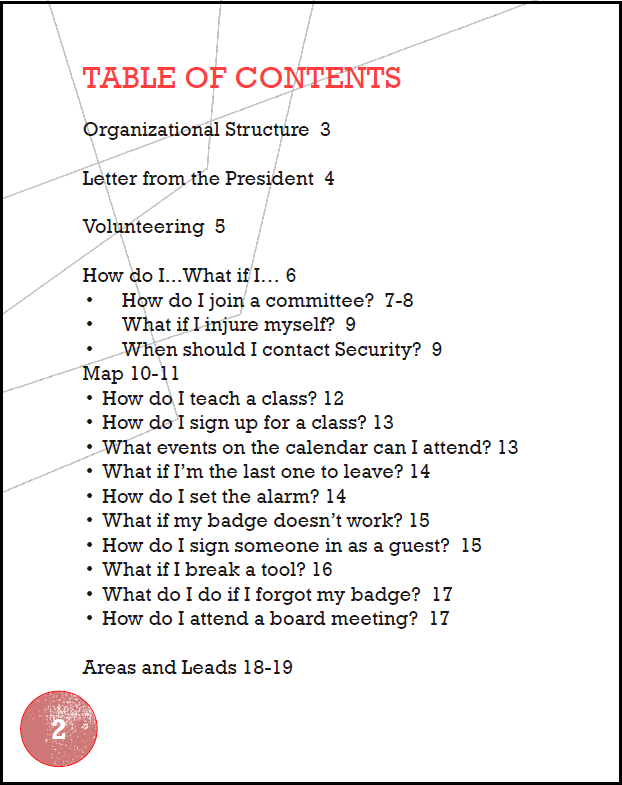
Table of Contents: What to include, and where (and why)?

Because MakeICT is entirely composed of, and run by, volunteers, it’s important to emphasize this fact from the outset, giving new members a sense of what “volunteering” means.

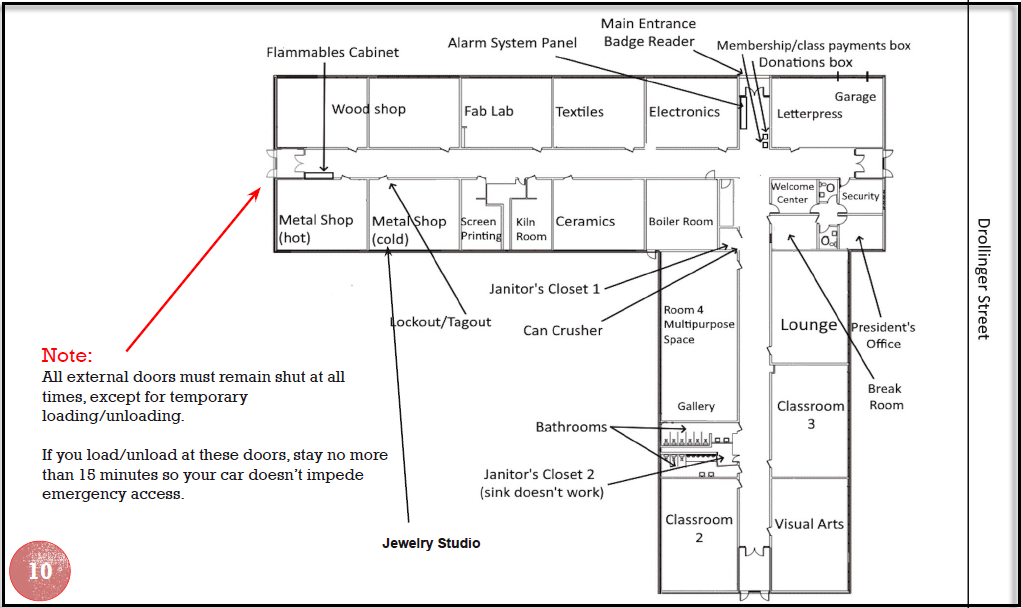
The next most important thing is the map, because MakeICT is a converted school and it can be easy to get lost, so the map gets the centerfold on pages 10-11.

The FAQs comprise the “meat” of the booklet– they’re its entire raison d’être.

Lastly, the list of areas and contact information for the leads is included as a resource.
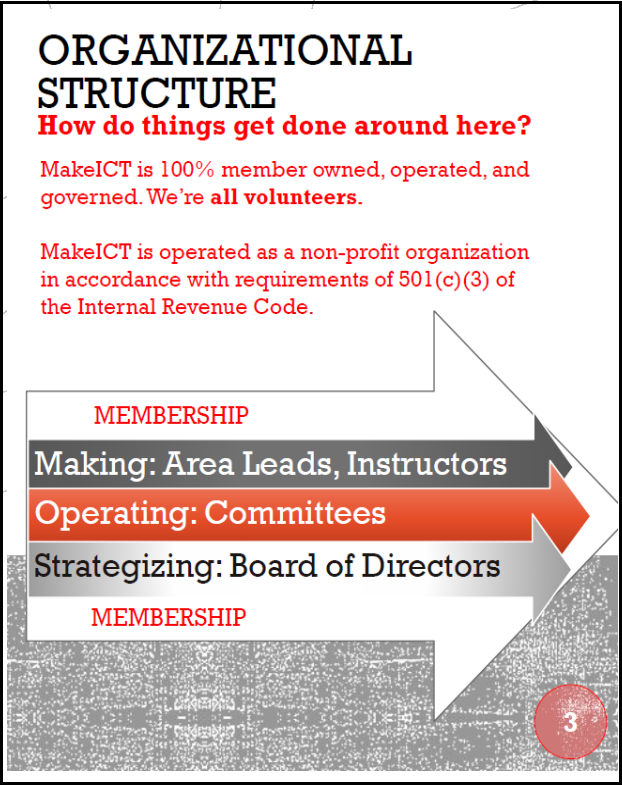
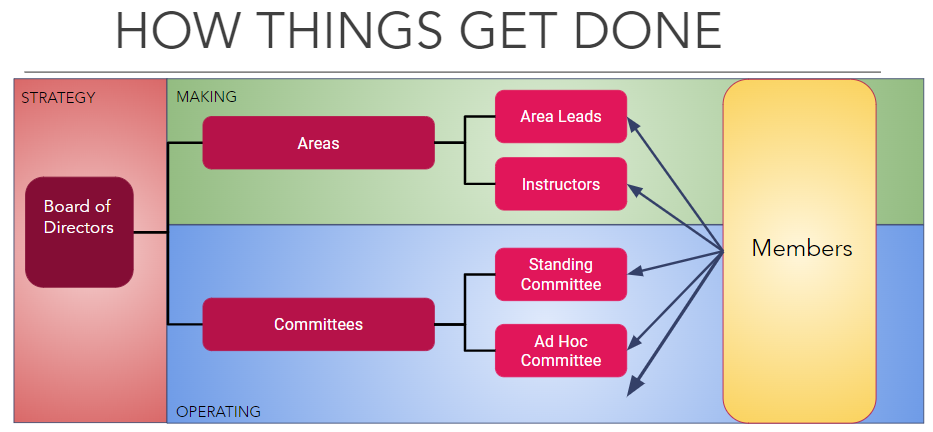
My mind is regularly blown by how an organization run entirely by volunteers manages to hold together from day to day, let alone expand and outgrow two prior facilities before moving into its current location.

I reworked the diagram showing the components that contribute to MakeICT’s trajectory. Below is the preexisting version, which I found confusing and too complex to convey the idea that membership encompasses all of the engines that power the organization.
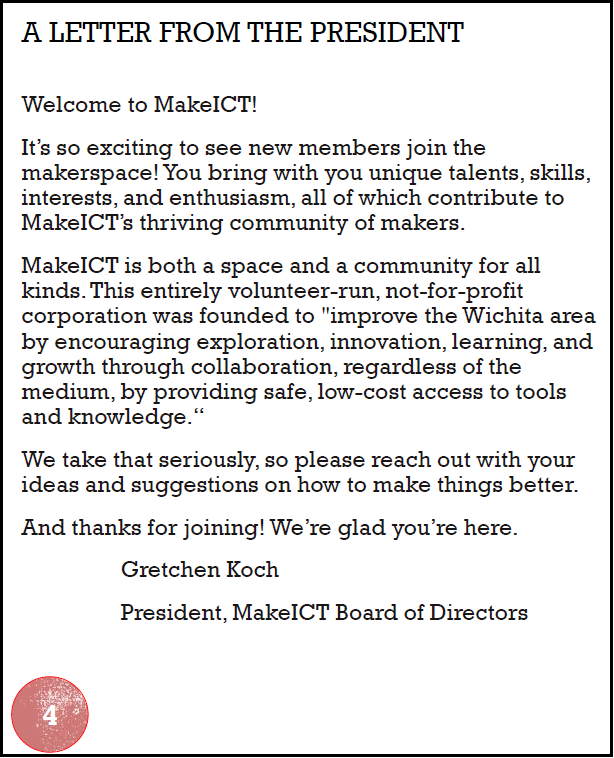
Practically speaking, a letter to new members from the sitting president means that the next president will need to swap in their own message next June, and that we can’t just print a billion of these guides with the expectation of using them forever.

But I think it’s important for the president to represent the makerspace up front, in print– to literally speak for the organization, and communicate in a friendly but sincere way that all are welcome, i.e. to be the Friendly Guide.
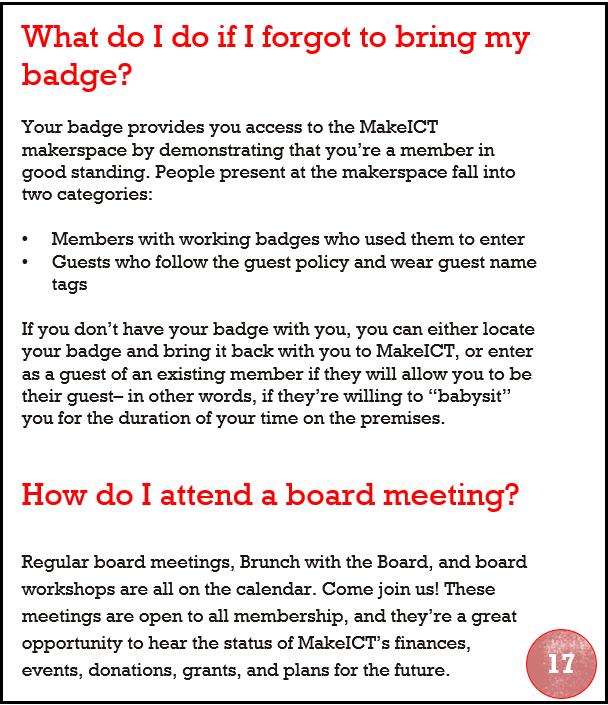
Most of the FAQs are in random order, and they all have the same look and feel, so I won’t go through all of them. However, it’s vital to have the “forgot my badge” question up front. It’s a leap of faith to allow someone 24/7 access to the space, and members justify that level of trust by acting as individual, informal security guards.

This is the Friendly Guide chiding members that they don’t get to skirt the rules, but giving them an “out” if a member with a badge agrees to “babysit” them (which I have done, by the way. It’s…boring, as babysitting often is.).
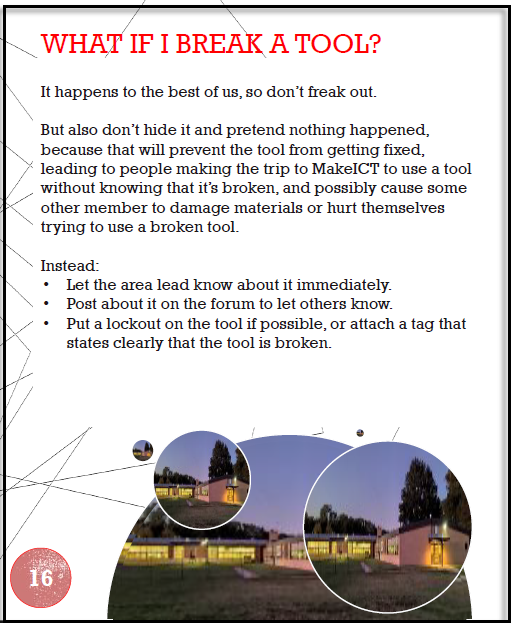
There’s also a huge amount of trust in giving unsupervised access to a broad variety of hand and power tools, some very dangerous and/or very expensive.

This is the Friendly Guide’s voice again, threading the needle by using a friendly and reassuring tone, deflecting the potential of shame to convey a necessary point about caution and responsibility.

The Friendly Guide wants you to have fun exploring how to powder coat metal– but not to drive you to the hospital because you electrocuted yourself while powder-coating.

We don’t have a “You are here” style map at the front entrance, though perhaps we should. There are also no staff watching over the Welcome Center, so members and guests are pretty much on their own to navigate the space. However, there is a computer at the Welcome Center, where you can do the following:

  • Fill out a waiver, which everyone must do before spending time in the building.
  • Fill out and print a guest badge, which guests must wear for the duration of their visit.
  • Check in students for classes and verify that they’ve signed waivers and paid the course fee.

That computer is hard to miss and space is limited, so I opted to point out that the main entrance is where the alarm system is managed, and where you can drop cash and checks to either donate or pay membership fees in person.

Each area has its own email address so that members don’t have to memorize the lead’s name. Lead turnover isn’t frequent, but it does happen, so this way the guide won’t need to be updated each time.
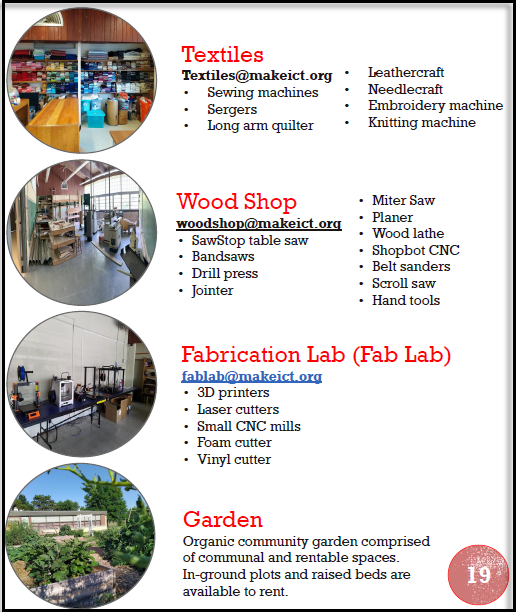
It can be tricky to remember what major tools exist, and what classes are offered, in each shop, and this handy list makes it simple to entice your friends to become members as well. There’s something for everybody!

Where to go from here?

Videos

The most immediate application of these design principles is creation of videos. The membership committee lead is also a Director At-Large, and he and the Vice President have expressed interest in creating videos– potentially one video per area, ideally with the area leads providing brief (30 seconds to a minute and a half) overviews of their respective areas. These videos can then be put to use in several contexts:

  • The videos could be uploaded to the wiki, so that–for example–visiting the Textiles wiki page would give a member the option to watch a brief video explaining what tools and materials are available, and which classes are taught in that area.
  • The videos could be included in a Maker Monday or orientation presentation, to give prospective or new members a chance to learn about a given area without area leads having to be on-site to personally give the same overview of their respective areas that they’ve given every other Monday, as long as they’ve been an area lead.
  • The idea of area-specific overview videos was sparked by a Director At-Large who is disabled, as a means for disabled members to become acquainted with various areas without having to make the physical trek between them, down the halls and back, and standing/sitting in the room for the duration of time required for the area lead to give an overview.

Web Site and Wiki Content

The Secretary of the board and some former members of the board are engaged in a project to revamp the site and the wiki, providing useful information that is easy to understand and navigate. With the web site in particular, the content is public-facing and should project the Friendly Guide persona and use its voice to communicate with curious prospective members, and- crucially– members of external organizations who seek to partner with MakeICT.

Internal and External-Facing Presentations

MakeICT partners with external organizations in different ways, from providing an event venue for community groups, to participating in offsite events to publicize MakeICT and provide opportunities to children to become “makers” themselves, to giving presentations for outside groups on what MakeICT is and does. These presentations will benefit from a unifying set of design principles that ensures consistency in content messaging across events and audiences.

Looking Forward

MakeICT was incorporated on December 13, 2012 as a Kansas not-for-profit corporation. It has maintained that rag-tag sense of spirit throughout, but there’s no necessary conflict between maintaining that image and creating more refined messaging that emphasizes community and innovation. For that matter, there’s arguably a symbiotic relationship between the two, and it’s embodied in the persona of Friendly Guide. The principles of being Collaborative, Dynamic, and Accessible can guide MakeICT’s mission to become a welcoming community that celebrates scientific and artistic exploration.

Being a maker is inherently exhilarating, because it means engaging in creation– bringing something new into the world. Creating content about the makerspace is part of that, because it’s also a form of making.

MakeICT has a huge appeal, but that’s not something to take for granted. You don’t want to just make friends, after all, but to stay friends. Creating content for a thriving community, to help it thrive, is an ongoing process that will only improve as we go, for as long as we’re driven to make that happen.
Letter to the U.S. House Homeland Security Committee regarding CBP One

Letter to the U.S. House Homeland Security Committee regarding CBP One published on No Comments on Letter to the U.S. House Homeland Security Committee regarding CBP One

Dear Committee Members, specifically Chairman Green,

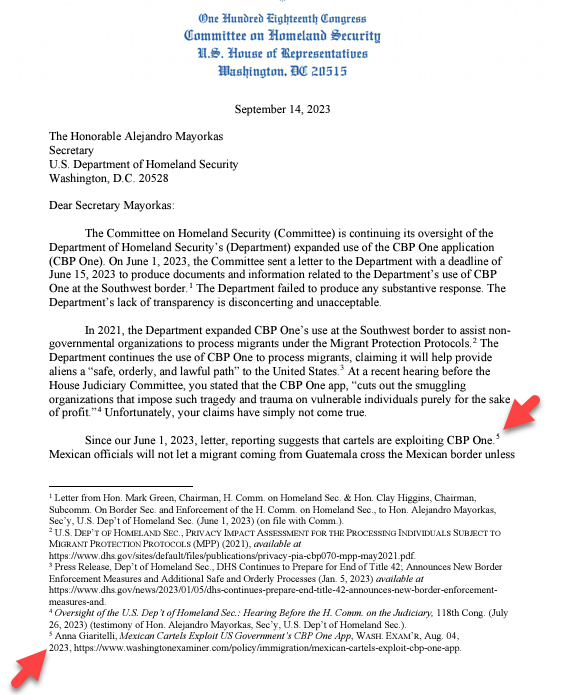
I would like to know why, in numerous published statements, Chairman Green has claimed that Anna Giaritelli published a “groundbreaking scoop showing that the criminal cartels had hijacked the CBP One app using virtual private networks (VPNs), and were exploiting the app to make even more money by scheduling appointments for migrants outside the geographical range.”

This is clearly and obviously false to anyone who reads the article. What Giaritelli wrote wasn’t a “groundbreaking scoop,” but rather a baseless claim. At no point in the article does Giaritelli cite a single source confirming that cartels are exploiting CBP One using VPNs.

She refers to “an extensive investigation” of DHS documents, but she doesn’t link to the documents, or quote them, or even say what they specifically address. That’s the closest she comes to providing any evidence whatsoever.

The one quote she provides from an actual DHS official (Erin Waters, Assistant Commissioner for Public Affairs) is refuting Giartitelli’s claim, stating that CBP One has actually been “bad for cartels and other criminal organizations seeking to exploit migrants.” Waters goes on to explain that CBP One rather relies on the location data supplied by devices used to access the app.

I would like to know if the Committee has ever spoken with Erin Waters on this issue– and if not, why not? Why rely on the bald assertions of a right-wing web site over a statement of fact from a DHS official?

At the very least, the obvious contradiction presented here should give the Committee pause, and encourage you to look into the claim further. But apparently the Committee had no time to even take a second look, in your rush to– again, repeatedly– make such a momentous claim, with such an extensive impact. You clearly think this matter is serious, so why are you relying on what amounts to rumors and gossip rather than statements of fact supported by evidence?

Could it possibly be that it’s because the rumors and gossip align with your pre-existing beliefs? That evidence be damned when it contradicts your desire to believe?

If so, that’s grossly irresponsible– not to mention dangerous– behavior on the part of a legislative committee. Misrepresenting the truth gets people killed, and yet you treat this reality with casual disregard.

I dearly hope that I’ve simply missed something here which exculpates Chairman Green’s statements about CBP One– and if I have, then assuredly I’m not the only one. So if you have actual evidence that doesn’t come from a vague and unsupported Washington Examiner article, please post it. I’d still be baffled to why you didn’t just provide that evidence in the first place rather than linking to the Examiner, but perhaps that’s a lesson that can be retained for future statements.

Thanks for your time and consideration on this matter.

For over a year now, the committee has been making hay about this so-called “bombshell report” that doesn’t show what they keep insisting that it shows. This line in particular is revealingly hilarious:

Since the Biden administration debuted the CBP One app in January, immigrants south of Mexico City had no reason to believe they would find a legal way to get into the U.S. if they crossed illegally.

  1. The app debuted in October of 2020 (under Trump, btw), not January of 2023.
  2. Using the app is, by definition, not crossing the border illegally.
  3. CBP One is a legal way– unfortunately for most migrants, the only legal way– to enter the United States.

Republicans are tossing around a lot of terminology to obfuscate 2 and 3. The term “otherwise inadmissible” is a fun one, because it suggests that migrants would fall afoul of other immigration restrictions and be denied entry without using the app.

What’s the basis for this? There is none, and in fact the app’s facial recognition engine is designed to be a screen to prevent such individuals from entering the country before they can even reach the border. It does this by comparing the face captured within the app to templates from DHS’s HART database, which includes records of an individual’s entire history of encounters at the border, as well as any crimes committed.

Once again, as I pointed out in CBP One™: The Border in Your Pocket: the app isn’t designed to let as many people through as possible; it’s designed to make the lives of CBP officials and agents easier. Their lives are easier if they can gather as much information about the migrants as possible, as soon as possible, to minimize the seemingly endless paperwork and stress that comes from trying to process the entirety of someone’s information on the spot, all at once, at the border.

(Yes, I sound very sympathetic to CBP agents here. Am I? No, but I can empathize with their openly acknowledged wish to automate things to the extent that they can be).

Last September, Chairman Green and Subcommittee on Border Security and Enforcement Chairman Clay Higgins “demanded answers” from DHS Secretary Alejandro Mayorkas about cartels “abusing the Biden administration’s expanded use of the CBP One app to enhance their human smuggling operations.”

Yes, relying on this one article from the Washington Examiner. They “demanded” that the DHS Secretary address the baseless claims of a right-wing rag in which a CBP spokesperson was already quoted saying it’s all BS.

It’s staggering, and if I’m not misconstruing any of the details here, it’s staggeringly stupid.

J.D. Vance’s weird, dumb, little racist jab at CBP One

J.D. Vance’s weird, dumb, little racist jab at CBP One published on No Comments on J.D. Vance’s weird, dumb, little racist jab at CBP One

Note: All quotes from the debate in this post are pulled from CBS News’s transcript, for which I am incredibly grateful.

In the vice presidential debate on Tuesday, J.D. Vance brought up the CBP One app out of nowhere, which has inspired a wave of misinformation spread by people who’d never heard of the app until it was mentioned on their TVs that evening.

One of the hosts, Margaret Brennan, pointed out that Springfield, Ohio, has a “large number of Haitian migrants who have legal status. Temporary protected status.” This was in contrast to Vance’s repeated characterizations of Haitian migrants in the Springfield area as consumers of other people’s pets (yes, you heard that right) in addition to being in the United States illegally.

The first characterization was made by Donald Trump in his debate with Kamala Harris, and swiftly fact checked by the moderators. But that apparently didn’t sway J.D. from hopping on that particularly virulent train of thought, and riding it straight into Racistville when he got his chance at the podium.

Vance had previously boasted, unrepentantly, that he felt the need to “create stories to bring attention to this” (which most of us would call “lying”) to support both clauses of the fraudulent claim. Not only did the Haitian migrants consume cats and dogs in Springfield, Ohio (Vance’s home state), he said, but they only had the opportunity to do so by obtaining resident in the country illegally.

Vance’s competitor Tim Walz referenced that “creating stories” quote, which he said was intended to “vilify a large number of people who were here legally in the community of Springfield.” The context was much back and forth concerning the bipartisan border security bill, which Walz described as “the fairest and toughest bill on immigration that this nation’s seen,” and which was blocked by Senate Republicans in May.

Despite Walz pointing out that Congress “controls the purse strings,” Vance employed a tactic that he used throughout the evening, though he didn’t really get called on it– he portrayed Kamala Harris as responsible for everything that happened, and didn’t happen, during the Biden administration.

Vance repeatedly referred to it as the “Kamala Harris administration,” which probably bummed out Biden to hear– his legacy, already usurped by his aspiring successor! Vance also labeled Harris as the “border czar,” a title that doesn’t actually exist, and which Harris never claimed. Nevertheless, it’s a title that Republicans assigned to Harris a mere two months into the Biden administration, when she was tasked to lead efforts to reduce problems at the border.

She was assigned to work with three Central American countries– El Salvador, Guatemala, and Honduras– to improve living conditions and thereby lessen the desire of individuals to becomes migrants, fleeing the violence of gangs and corruption. This idea seems like an absolute no-brainer, at least superficially. Don’t we live, after all, in a country whose founding myth revolves around the idea of individuals striking out a perilous path to a better life in a mysterious and distant land, searching for something better?

Needless to say (one would think), Harris is not in charge of the border. She has even acted in direct contradiction to the principle I described above, by adopting a “Stop that” approach to migration in lieu of improving living conditions in migrants’ respective countries of origin. “Do not come,” she said to Guatemalans in 2021. “If you come to our border, you will be turned back.”

The Haitian immigrants in Springfield may have been beneficiaries of the Biden administration’s CHNV (Cuba, Haiti, Nicaragua, Venezuela) program, which makes a number of slots available every month for migrants from these countries to seek entry to the county after they have secured a financial sponsor in the United States who applied for a I-134A form, aka a Declaration of Financial Support. These are the people who have agreed to fund a migrant entering country from one of these countries, specifically chosen for the miserable conditions in those countries, whether they’re due to natural, social, or political disasters.

Someone in the CHNV program may use the CBP One app to submit their immigration information from one of those countries to seek an appointment with immigration officials, to minimize the complications that could arise if they simply appeared at the border.

This is not intended as a defense of the app, which should be clear if you bravely waded through my previous overview of the CBP One app. However, the purpose of this feature should be obvious and clear-cut. Indeed, you’d think someone worried about congestion at the border would celebrate a feature that lets people stay at “home” until they’re allowed to come here, rather than congregating somewhere in between.

The other, more broadly applicable feature of the app, to which Vance was clearly referring, allows undocumented travelers arriving at the border by land to submit information prior to doing so– information that, according to the DHS, would be collected at the border during an in-person interaction anyway. Instead, the app benefits the DHS by making the process of gathering this information more efficient, and the benefit to migrants is that….they won’t get trafficked by a mule that way. Apparently.

Once again, please read my previous post for a full background of the app, because it’s just too much to go into here. This post is, at long last, a rebuttal of Vance’s weird choice to bring up the app during the debate. I say “weird” because of the context:

Host Margaret Brennan had just clarified that Springfield actually hosts a large number of Haitian immigrants who are there legally. The part of Vance’s reaction that has spread across the internet is his protestation that “The rules were that you guys weren’t going to fact check!” And yes, that’s indisputably hilarious. But this post is about what came next:

JDV: Margaret. The rules were that you guys weren’t going to fact check, and since you’re fact checking me, I think it’s important to say what’s actually going on. So there’s an application called the CBP One app where you can go on as an illegal migrant, apply for asylum or apply for parole and be granted legal status at the wave of a Kamala Harris open border wand. That is not a person coming in, applying for a green card and waiting for ten years.

First of all– if Kamala Harris has an “open border wand,” it must be gathering dust at the back of a closet somewhere– and if so, I would request that she kindly FedEx it to me.

Secondly, this quote touches on a fascinating phenomenon: the idea that immigrants are “illegal” by default, and that if they still somehow manage to enter the country– however that occurs– their legal status is either unchanged (still illegal) or changed deceitfully/incompletely (still illegal, but everyone’s pretending otherwise). How else could someone be an “illegal migrant” when they haven’t yet attempted to enter the country?

For that matter, in a move that’s kind of darkly absurd in this context, the rule implemented by the Biden administration making use of the CBP One app to secure an appointment before crossing the border all but mandatory has the working title “Circumnavigation of Legal Pathways.” As in, the “legal pathway” is using the goddamn app.

Circumnavigating (or avoiding) the legal pathway, then, is not using the app, or one of the other few ways to enter the country legally:

Under the final rule, noncitizens who cross the southwest land border or adjacent coastal borders without authorization after traveling through another country, and without having (1) availed themselves of an existing lawful process, (2) presented at a port of entry at a pre-scheduled time using the CBP One app, or (3) been denied asylum in a third country through which they traveled, are presumed ineligible for asylum unless they meet certain limited exceptions. 

I talked about item 3 elsewhere– basically, it puts the onus on other countries, especially Mexico, to evaluate each migrant’s information to determine whether they should receive asylum status or not, which both places the whole thing out of the migrant’s control and seems bizarre in that it assumes they should expect to receive timely and accurate record-keeping from the government of a country they already have determined isn’t stable enough for them to settle and become residents.

Item 1 is kind of a catch- all that actually includes using the CBP One app, as can be seen from the statement’s prior mention of “putting in place a mechanism for migrants to schedule a time and place to arrive in a safe, orderly, and lawful manner at ports of entry via use of the CBP One mobile app.”

Before proceeding to the obvious conclusion, let’s take a moment to consider the word “parole.” In the context of immigration, parole isn’t criminal justice term. “Parole” is the term for the basis for a migrant’s legal entry into the United States. The CHNV program, for example, is a program that grants parole deferentially (but neither perpetually nor all-inclusively) to citizens of those countries.

As such, the term “parole” indicates that the migrant’s entry into the country is legal. A migrant who uses CBP to secure an appointment at the border is no more an “illegal migrant” than you are an “illegal consumer” for seeking the title confirming that you’ve bought a car. By definition, your receipt of that title is how you acquire ownership of the car legally. You might, by contrast, “circumnavigate legal pathways” by stealing the car. But until or unless you’ve committed actual larceny, you’re not an “illegal” anything.

Asylum has extremely strict requirements, and– by the way– is not something you can specifically request within the CBP One app. It was once possible to do so in order to claim exception to Title 42, the hideous rule that the Trump administration used to exclude all migrants under the guise of defending the country from Covid 19. At that point, you could use the app to specify the “vulnerability criteria” that you meet, which included age, illness, etc. in addition to fear of imminent violence in your nation of origin. But the vulnerability criteria were removed when Title 42 was lifted, and asylum seekers using the CBP One still had to openly state such a fear of returning to their homeland in interviews with CBP and USCIS officers in order to be considered for asylum.

Lastly, we have “the wave of a Kamala Harris open border wand.” This is an objectively insane statement to make, but I wonder if it even carries any impact at this point, after Republicans have complained about an “open border” during the administrations of Democratic presidents (but not Republican ones, which is odd since they pretty much have the same policies on immigration) since time immemorial. We haven’t had a truly open border since the 1800s (and here I use the term “we” very loosely), and even then, the most open of borders were for people like J.D. Vance.

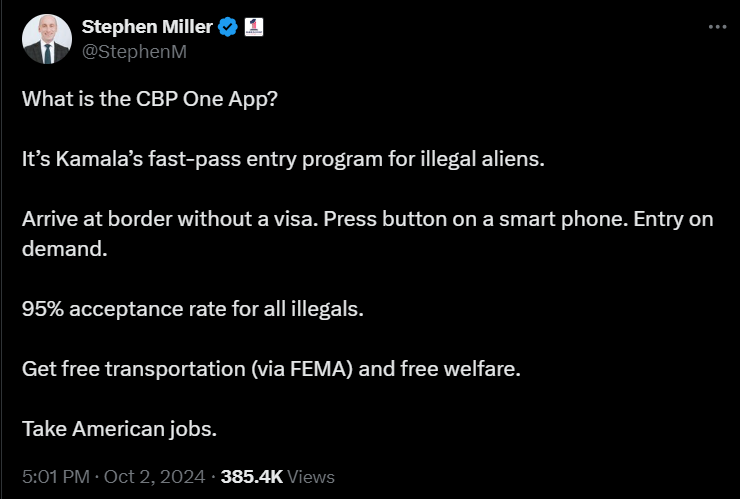
Vance, and people like Stephen Miller, Trump’s favorite aspiring white supremacist, who took the opportunity to tweet the following:

“What is the CBP One App?
It’s Kamala’s fast-pass entry program for illegal aliens.
Arrive at the border without a visa. Press button on a smart phone. Entry on demand.
95% acceptance rate for all illegals.
Get free transportation (via FEMA) and free welfare.
Take American jobs.”

The app was, in fact, developed during the Trump administration– it launched in October of 2020. Kamala Harris hasn’t had anything to do with its development, which was done in-house by CBP.

The app’s use of facial recognition technology has made it incredibly difficult for some migrants to use, whether for legitimate or illegitimate reasons.

The app doesn’t “accept” or “reject” anything, so who knows where that 95% rate comes from? You have to create an account on Login.gov before you can even use the app, which pretty well prevents “entry on demand.”

Free transportation and free welfare? Via the app? Taking American jobs…via the app?

Wow, this app is more powerful than I, or for that matter its developers, had ever imagined! But not Kamala Harris. Kamala Harris imagined it all along.

Of course.