Skip to content

Calling it justice doesn’t make it just

Calling it justice doesn’t make it just published on No Comments on Calling it justice doesn’t make it just

Apparently in the uproar over beheadings committed by ISIS, some have noticed that America’s ally Saudi Arabia has committed quite a few of them as well:

The escalation of the war against the Islamic State was triggered by widespread revulsion at the gruesome beheading of two American journalists, relayed on YouTube. Since then, two British aid workers have met a similar grisly fate. And another American has been named as next in line by his terrorist captors. Yet, for all the outrage these executions have engendered the world over, decapitations are routine in Saudi Arabia, America’s closest Arab ally, for crimes including political dissent—and the international press hardly seems to notice. In fact, since January, 59 people have had their heads lopped off in the kingdom, where “punishment by the sword” has been practiced for centuries. 

In an article published today, a representative of Saudi government actually attempted a defense of this:

Interior Ministry spokesman Maj. Gen. Mansour al-Turki told NBC News that Saudi criminal punishments were legitimate because they were based on “a decision made by a court” rather than ISIS’ “arbitrary” killings. . . “When we do it in Saudi Arabia we do it as a decision made by a court,” he said. “The killing is a decision, I mean it is not based on arbitrary choices, to kill this and not to kill this.”

ISIS regularly hands down brutal sentences based on Shariah law.

Al-Turki said that “ISIS has no legitimate way to decide to decide to kill people,” adding that “the difference is clear.”

 “When you kill somebody without legitimate basis, without justice system, without court, that is still a crime whether you behead them or kill [them] with a gun,” al-Turki said, referring to ISIS’ killings.

“Arbitrary” means “random, without reason.” If ISIS “regularly hands down brutal sentences based on Shariah law,” then ISIS’s killing are not arbitrary– they are based on Shariah law. When the Islamic State murdered French mountaineer Herve Gourdel in the mountains of Algeria, it was to threaten the French into ceasing airstrikes on the area. That is not arbitrary. When they beheaded beheaded Raad al-Azzawi, a TV Salaheddin cameraman, east of Tikrit in Iraq, it was claimed to be in retaliation for the TV station “distorting the image of Iraq’s Sunni community.” That is not arbitrary.

Is it legitimate? Is it just? No, of course not. It’s barbaric and inhuman. But is that because it doesn’t take place within a “justice system”? Within a court?

Saudi Arabia’s “justice system,” as it happens, is also based on Shariah law. As it happens, it also hands down brutal sentences.

Now, Mansour al-Turki does have a point– when you kill someone without legitimate basis, it’s still a crime regardless of how you kill them. Although in Saudi Arabia, it’s not at all uncommon for people to be killed by the “justice system” without legitimate basis. But for just a moment, let’s look at a case where someone wasn’t killed:

A Saudi Arabian man suspects his five year old daughter of losing her virginity. He forces her to get an examination, then brings her home, where he repeatedly rapes her, and beats her to death with a cane and cables. He crushed her skull, broke her back, ribs and left arm, and burned her in several places. The Saudi royal family prevents him from being released after only a few months in jail and a fine, and a court eventually sentences him to 8 years in prison and 800 lashes. However, he pays her mother blood money ($270,000 – a boy would have been worth double that price), and is released after only a couple of years.

This case is intended to be in contrast to another case of another person who wasn’t killed– at least, not yet– but has been sentenced to 10 years in prison and 1,000 lashes with a whip, for the “crime” of apostasy. Raif Badawi. According to Philip Luther, Director of Amnesty International’s Middle East and North Africa Programme,

Badawi – who founded “Saudi Arabian Liberals”, a website for political and social debate – has been in detention since June 2012 on charges including “setting up a website that undermines general security” and ridiculing Islamic religious figures. . . “Raif Badawi’s trial for ‘apostasy’ is a clear case of intimidation against him and others who seek to engage in open debates about the issues that Saudi Arabians face in their daily lives. He is a prisoner of conscience who must be released immediately and unconditionally.”

Barbaric? Yes. Inhuman? Absolutely. Exceptional in any way to Saudi Arabia’s “justice system”? Nope.

Whatever the reason for the timing, the wave of executions at the same time as jihadis in Iraq and Syria were beheading captives has brought new scrutiny to the practices of a country whose values are so different from those of its Western allies. While Saudi Arabia has joined U.S.-led air strikes against Islamic State in Syria and has deployed its senior clergy to denounce militant ideology, its public beheading of convicts, particularly for non-violent or victimless crimes like adultery, apostasy and witchcraft, is anathema to Western allies. “Any execution is appalling, but executions for crimes such as drug smuggling or sorcery that result in no loss of life are particularly egregious,” said Sarah Leah Whitson, Middle East and North Africa director for Human Rights Watch.

So if ISIS were to establish its own courts, and refer to the proceedings of those courts as “justice,” and claim that this makes their own barbarism “legitimate,” could we expect the Major General Mansour al-Turki to agree?  I suspect not.

I suspect that even he knows that.

Maybe somewhere, in the back of his mind, he knows that barbarism is in how you kill someone and what you kill them for.

That torture is barbaric regardless, but especially in judgment of the content of a person’s speech.

That legality is not morality, and just because an appointed group of human beings in a particular society says that something is wrong, doesn’t mean that it is. That appointed groups of people are not, all things being equal, necessarily any better arbiters of morality than any individual human being on his/her own– and in fact, sometimes they’re worse.

That enforcing religious rules as laws may not inexorably lead to barbarism, but it will always punish apostasy over immorality, and therefore the enemies of that faith rather than those of the state.

Okay, yes, he wouldn’t agree to that. But nevertheless, the contradiction is clear. Don’t even try to defend it, Mansour al-Turki. You cannot.

And neither can we Americans. If Saudi Arabia is our ally, we will be judged by the company we keep.

In the virtue stakes, reverence leaves empathy at the starting line

In the virtue stakes, reverence leaves empathy at the starting line published on No Comments on In the virtue stakes, reverence leaves empathy at the starting line

In France, individual citizens run a satirical magazine, the Charlie Hebdo, which publishes cartoons making fun of Muhammad among countless other current world leaders and historical figures.

In retaliation, terrorists storm the office and murder 12 people at that office, as well as five more at a kosher market. As far away as Sudan, angry mobs attempt to swarm French embassies, and people call upon the government to expel their French ambassador.

In Saudi Arabia, people are imprisoned, tortured, and even beheaded by the government for such victimless offenses as apostasy and “sorcery” on a regular basis. That same government arrests a blogger, Raif Badawi, for blasphemy and he is sentenced to suffer ten years of imprisonment and 1,000 lashes with a whip, at a rate of 50 per week.

In retaliation, Americans trickle out to the Saudi Arabian consulate in Houston and politely wave signs asking for Raif Badawi to be freed. Nobel laureates from various places around the world gather to jointly ask Saudi Arabian academics to join them in vocally condemning Badawi’s imprisonment and torture.

Now, I’m absolutely not saying that we should adopt the tactics of terrorists and ransack and pillage Saudi Arabian embassies, or anything like that. I am, rather, asking the following:

Why the hell can’t the West seem to muster even a fraction of the same outrage concerning the ongoing torture and murder of human beings for exercising their freedom of speech, as some Muslims are able summon concerning the fact that some people, somewhere in the world, feel that the same freedom protects their right to make the occasional joke at the expense of religion?

Watching Charlie

Watching Charlie published on 1 Comment on Watching Charlie

The manhunt for the terrorists continues.

At least three mosques in various French cities have been attacked.

News sources deliberate whether to repost the covers of various Charlie Hebdo magazines which were offensive to Muslims, unsure whether doing so would be simple news coverage, or construed as support for freedom of speech, or support for the presumed sentiments behind the images, or what. 

No matter what they choose, they will be criticized.

People argue, again, whether criticism of Muslims can be racist even though Islam isn’t a race. They argue about whether the Charlie Hebdo images were/are racist. They argue about what satire means. They are argue about hate speech laws. They argue about whether enough Muslims have apologized, authentically and tearfully enough, for crimes committed by people who have no relation to them aside from sharing a religion.

They have all of the same arguments, again and again and again.

Perhaps Charb and the others would be happy these arguments are happening. Perhaps they would see it as something of a tribute toward their efforts to be irreverant, controversial, brave truth-speakers.

Perhaps they would be right.

I don’t know. I just feel tired and sad, reading all of this. And yet I can’t stop.

The rich and the poor alike are forbidden to stand on dogs

The rich and the poor alike are forbidden to stand on dogs published on No Comments on The rich and the poor alike are forbidden to stand on dogs

On New Year’s Day, a group of photos showed up in my Facebook news feed. It turned out to be a
holiday greeting from Sarah Palin. “Happy New Year!” she said. “May 2015 see every stumbling block turned into a stepping stone on the path forward. Trig just reminded me. He, determined to help wash dishes with an oblivious mama not acknowledging his signs for ‘up!,’ found me and a lazy dog blocking his way. He made his stepping stone.”

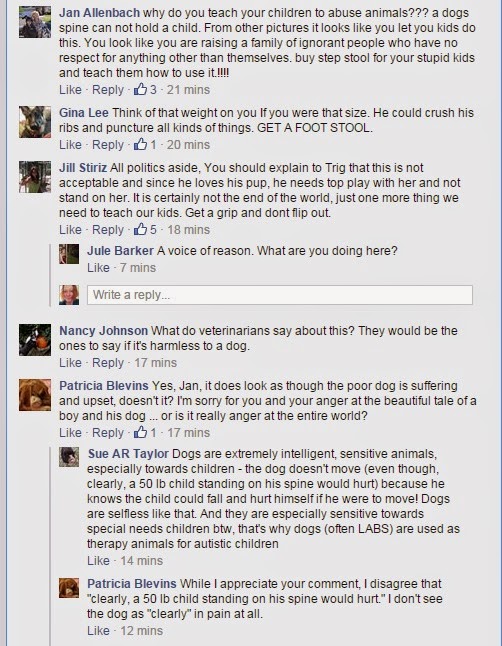
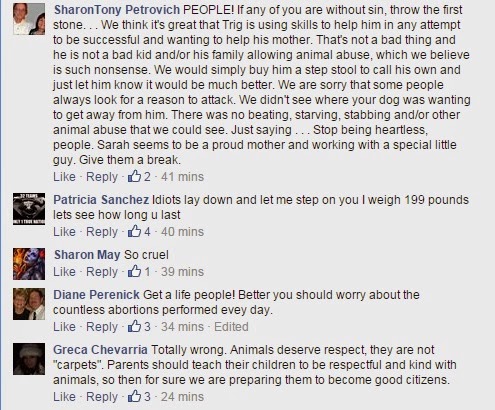
No, I’m not Facebook friends with Sarah Palin– I don’t even follow her. The post showed up in my feed because one of my friends had commented on it. I clicked over without any real expectation of finding their comment, but rather to skim the comments the other several thousand people, already by that point, had made. Because if there’s one thing the internet hates, it’s cruelty to animals. I wanted to see if that hatred could be counterbalanced by political and/or religious affiliation, and my answer was…yes, apparently. At least, for some.

Didn’t bother commenting, and didn’t think any more about it until I saw this article this morning by Sarah Palin, TODAY contributor (hey, it’s what the byline says):

PETA needs to chill. At least Trig didn’t eat the dog. Where have they been all these years? Maybe enjoying a good steak when their Woman of the Year, Ellen DeGeneres, posted the exact same sweet image of a child with her dog. Or maybe they were off moose hunting when their Man of the Year, Mayor Bill de Blasio, dropped and killed a critter at a political photo op? Who knows what they were doing when their Man of All Time, Barack Obama, admitted to actually EATING dog, and enjoying it! C’mon PETA — where’s the beef? . . . Again, I’m thankful these double standard bearers proved my entire point in that post: do they think their threats and efforts to shut me down are a stumbling block? Nah, this is a stepping stone for any American with common sense and love for kids and dogs — we just proved the haters’ double standard nonsense, and, thus, their irrelevance. — Sarah Palin P.S. Should Jill Hadassah [Palin’s dog] have not enjoyed Trig’s playing with her, guess it would have reminded us another important lesson – sometimes life jumps up and bites you in the okole, but you don’t stop moving and baby you just Shake It Off.

“Okole” apparently is a Hawaiian word for “ass” or “butt.” I had a moment of wondering why on earth Palin would use a Hawaiian word before realizing– oh, of course. It’s a way for someone who
thinks even “butt” is a bad word to avoid saying it, but be able to express exactly the same sentiments generally expressed using the word, by borrowing it from another language. I guess God doesn’t understand Hawaiian.

So I looked up what Ellen Degeneres did, and found myself looking at a site called Conservatives 4 Palin, which was kind enough to host a photo which supposedly appeared on the Facebook account for The Ellen DeGeneres Show six months ago. It shows what appears to be a three (?) year old girl brushing her teeth while standing on top of a large adult labrador, accompanied by the caption “Well, that’s one way to reach the sink.” That little girl wasn’t Ellen’s daughter, btw, and the online appears to also have been largely negative.
response to the picture

Whitney Pitcher, author of this article entitled “PETA Woman of the Year Posts Photo of a Child Standing on a Dog,” has the grace to note, “My post is neither a condemnation or an approval of the photos shared by Governor Palin or Ellen Degeneres.” Which is good, I suppose, because presumably it would be bad form for a web site called Conservatives 4 Palin to say anything that would amount to a “condemnation” of her, even for something so obviously stupid and abusive as allowing a child to stand on the back of the family dog– a special needs dog, who is “lazy” according to Palin (what, for not getting up when a toddler tries to use her as a stepstool?) — and then share the photos with the world as part of an exhortation to enjoy their new year.

If Jill Hadassah the dog had in fact objected to a boy (who is now seven years old, according to Wikipedia) standing on her back, stood up, and bitten him in the “okole,” what do you think the response would’ve been? Do you think everyone involved would have learned a lesson that sometimes “life” jumps up and bites you, but you don’t stop moving and just Shake It Off? You know, “life.” (Hey, they say life’s a bitch…) Yeah, me neither.

So I have a few conclusions on this subject:

  • Sarah Palin, and the parents of that little anonymous blonde girl, need step stools. Many of them. In the kitchen, the bathroom, and any other place there’s a counter that a small child might need to reach. Maybe a charitable organization can supply them with a couple.
  • PETA needs to stop being the banner organization for giving a damn about animal suffering. They do not speak for everyone with concerns on the subject. They’re not even good at representing the cause, themselves. I seriously doubt most of the people expressing concern about the welfare of Jill Hadassah the dog on Facebook had or have any affiliation whatsoever with PETA. The internet, perhaps, is guilty of caring way, way, way too much about animal cruelty, but PETA doesn’t speak for the internet in that regard. 
  • Tu quoque, also known as an “appeal to hypocrisy,” is a logical fallacy. It refers to an attempt to legitimize, or at least distract from, a critique aimed at yourself by pointing out a similar crime (or endorsement of such) made by the person or group making the criticism.

    Not one word of Palin’s essay on Today: Pets amounted to anything like an apology or an acknowledgment of wrong-doing. On the contrary, her standpoint is made abundantly clear: “we just proved the haters’ double standard nonsense, and, thus, their irrelevance.” She honestly thinks that the arguments of critics (excuse me, “haters”) are proven irrelevant by her pointing out the presumed acceptance of said critics haters of a similar crime perpetrated by someone they approve of.

    Of course, we don’t even know whether PETA even saw, much less approves of, the photo posted on The Ellen DeGeneres Show’s Facebook wall. We don’t know whether the people who criticized Palin’s New Years wishes post on Facebook ever saw it, much less approve of it. Or de Blasio supposedly shooting a dog. Or Obama supposedly eating one. We certainly don’t know whether everybody who thinks it’s wrong to allow a seven year old boy to stand on a dog’s bag and post “cute” photos of it on Facebook has seen and approve of those things. 

    And if we did, that still wouldn’t make it okay. That’s what tu quoque means. 

Sarah Palin, take a logic class. Everybody else, class dismissed. 

Things you should read

Things you should read published on No Comments on Things you should read

The NYPD’s ‘Work Stoppage’ Is Surreal. Matt Taibbi describes the strange twist of New York’s Police Benevolent Association (which becomes a more and more ironic title by the minute) deciding to start making arrests “only when they have to” in order to try and stick it to Mayor Bill de Blasio by depriving the city of needed revenue.

Is this considered abuse? Leelah Alcorn (the chosen name of a transgendered teen formerly called Josh who committed suicide at age 17 on December 30th by stepping in front of a truck) started a Reddit thread asking for help two months ago. Some good advice and comfort was offered, but it obviously wasn’t enough.

On Nerd Entitlement. Laurie Penny’s patient, compassionate, but also poignant and pointed explanation to Scott Aarsonson of what it’s like to be a bookish, awkward, nerdy girl in response to his depiction of being a bookish, awkward, nerdy boy, and how the latter does in fact have privilege in comparison to the former.

Dollree Mapp, 1923-2014: “The Rosa Parks of the Fourth Amendment.” It’s interesting that when we consider the hallmark cases in which the rights outlined in the Constitution were asserted and argued in front of the Supreme Court, it isn’t always an immediate realization that for any violation of rights you can name, members of minority underclasses have experienced it more. That when it comes to civil rights, overt racism (for example) isn’t the only indignity people of color in America have to face. Institutionalized bigotry means that every violation of rights felt by the privileged classes is felt more by the non-privileged. But Dollree Mapp fought hard for her right to be secured in her person, house, papers, and effects– and for all of our right to the same– and should be remembered for this.

Odds and ends– blog redesign/freeze peaches for sale

Odds and ends– blog redesign/freeze peaches for sale published on No Comments on Odds and ends– blog redesign/freeze peaches for sale

So, two things to mention here.

First, hey look! New blog design. I’ve been wanting to change it for quite some time to something more clean and minimalist, and am pretty happy with how things are now. Though I do talk about personal issues from time to time, this isn’t Livejournal and I wanted to veer away from that “diary” appearance where the set dressing can distract from the performance. Please let me know if there are problems with the font style (although I really like Calibri and would hate to change) or size in terms of readability.

Second, I have finally placed freeze peach pendants for sale on my Etsy store. In fact, they’re currently the only thing for sale on that store– I’m hoping to add new items in the next month or two. At Skepticon 7 in November people really seemed to like them, which made me resolve to go back home and make more. But December was fraught with holidays and travel and financial issues, as always, so it took a while longer than expected to get my stuff together. But now it is– kinda. Anyway, we’ll see how they sell and if they’re popular enough I’ll make more batches. Here’s what they look like:

They’re all made individually, so each one is unique– the peaches face different directions, sometimes there are small bubbles, etc. But each comes in a one inch “ice” cube of cured epoxy resin, with a cadmium/nickel bail on the back attached to a 17″ black rubber cord with a molded clasp. That’s a length I like– not too long and not too short– but you can swap it out of course for something else if you’re so inclined. This is so that if you’re just dying to wear your freeze peach the instant it arrives, you can. Hope you like.

How many fallacies can one shirt hold?

How many fallacies can one shirt hold? published on No Comments on How many fallacies can one shirt hold?

Let me count the ones I see.

1. Obey the law, and you have nothing to fear.
2. Break the law, and you deserve to be tortured to death.
3. Rules #1 and #2 are applied equally to all Americans.
4. Police never break the law themselves.
5. When they do, they are never protected in ways civilians wouldn’t be.

Oh wait, I get it…this shirt is for police officers!

Breathe easy, cops– and hey, don’t break the law. But if you do, and murder one civilian after another in horribly gruesome ways, breathe easy…you won’t suffer the fate they did.

Especially if they’re black.

When doxing is okay

When doxing is okay published on No Comments on When doxing is okay

Doxing (from dox, abbreviation of documents), alternatively spelled doxxing, is the Internet-based practice of researching and broadcasting personally identifiable information about an individual. — Wikipedia

In some cases, this “research” involves simply looking at the email address from which a message came, and including it rather than expunging it when you publish (“broadcast”) the content of that email. Many bloggers have a stated policy of doing this– if you email them, you accept that the content of your message and the email address might be made public on their blog.

Alanah Pearce, an Australian video gamer reviewer (via video blog), recently gained international attention by tracking down and contacting the mothers of the frequently underage boys who were sending her rape and death threats via email, Facebook messages, Twitter, etc.

I’m okay with these things.

I think what Pearce is doing is awesome, actually. Frequently when I see someone saying horrible things on the internet, I wish there was a way to find out if their loved ones could see it. Whether they know that their family member is, in their spare time, using that time to harass people, espouse bigotry, and in general be a despicable human being. I feel simultaneously a sympathetic horror for what this woman is going through, and a desire that couples generally would hang out in the same sorts of internet spaces as their spouses, and parents as their children.

But I would never try to enforce such a thing, because sometimes privacy and anonymity are very important and must not be violated. If you’ve been following Gamergate, you know that quite well. You might know that Felicia Day’s personal information was published on the internet shortly after she wrote an essay expressing concern about that exact thing. You might know that Brianna Wu and Anita Sarkeesian have both fled their homes after internet harassers published their home addresses and expressed an interest in paying a visit.

Some people refrain from even sharing their names online, because they are whistleblowers or fear other kinds of recrimination from their employers, because they are trans or gay but not openly so, because they are atheists but not only so…..there are all kinds of reasons why a person might not be doing anything wrong, but not want every aspect of his or her identity made known.

That’s why doxing such individuals is wrong.

Rebecca Watson, noted skeptic and feminist who has been experiencing harassment and threats online for years because of these things, published an essay on Friday entitled Why I’m Okay with Doxing. That’s not the type of doxing she was talking about.

The type of doxing she was talking about is the kind I mentioned earlier– publishing the name and/or email address of people who made this information available themselves in the process of insulting, harassing, and threatening others.

The distinction seems quite clear to me, but perhaps that’s because I actually read her essay. Several other people seem to have not made it past the headline.

Ken White of Popehat had an amusing exchange on Twitter with such a detractor, also on Friday, which I summed up thusly:

Accuse someone of breaking the law. When questioned, scramble frantically to find the law you accuse someone of breaking, which you didn’t know existed when you made the original accusation. When questioned further, admit that it’s not against the law. When asked for a moral basis for condemnation, scramble frantically to find one of *those*. Fail completely. Take ball. Go home.

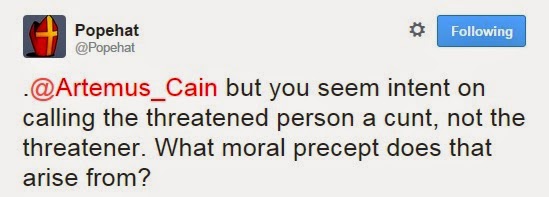
The detractor charmingly and repeatedly referred to Rebecca as a cunt, which prompted the following tweet from Ken:

Which really addresses the crux of the issue.

Rebecca is talking about publishing the names and/or email addresses of people who are sending insulting and threatening material to her. Threatening people, whether over the phone, via email, in blog comments, via Twitter, etc., is not only immoral but also illegal. In spite of this illegality, going to the police about these threats is frequently a worthless and even counter-productive pursuit, which means that publishing the information of these people is, effectively, the only thing she can do.

Let me repeat: making the identities of people who harass and threaten her public, in the hopes that the public will become more aware of these threats and people making them, is really the best tactic at the disposal of people like Rebecca Watson. It is, arguably, the only tactic at their disposal.

I wouldn’t have thought that “disclose your identity to someone in the process of threatening them, and you cannot morally or legally expect them to keep this information private” was such a hard line to take. It seems stupidly obvious to me. But apparently it isn’t, and that’s why I’m writing this post.

Doxing is sometimes okay. Such as when someone is harassing you, actively reaching out and sending messages to and about you which are libeling and/or threatening you, and you respond to them by publishing their name and/or email address, contacting their family (especially if they’re underage), etc.

Doxing is sometimes not okay. Such as tracking down personal information of someone who is not harassing you and publishing it in detail, including contact information such as a home address which give the impression that you either intend or wish to encourage others to take physical action against this person.

Context, for chrissakes.

How to be more attractive to John Smith

How to be more attractive to John Smith published on No Comments on How to be more attractive to John Smith

A man who is sexist against women is also sexist against men, because he assumes, falsely, that all or most men are likewise sexist against women.

Is this a rule? I feel like this should be a rule. At least, I have not yet seen a counter-example.

This essay on Thought Catalog, non-encouragingly titled 13 Things a Woman Can Do to be More Attractive to Men, certainly isn’t one. In fact, it should probably also be a rule that every such list should drop the “n” from “Men” and change it to “Me.”

It’s not worth bothering to take apart in its entirety, but I just want to examine one item to illustrate the sexist projection of the author, the not-at-all-pseudonymously-named-I’m-sure John Smith.

13. Stop Hoarding Guy Friends 9 out of 10 of your guy friends just want to sleep with you anyway. Men know how other men think. The first guy that comes to comfort you after a big fight will also be the first one to say “he’s not good enough for you” in order to sabotage the relationship, and then he’ll be the first one to try to get into your pants after he convinces you that your man is a creep. It’s not about having trust issues. It’s about knowing how people act. Trust is earned, not immediately granted.

He says that 9 out of 10 guy friends just want to sleep with you, which would mean that they’re not actually friends at all — just one-night-stands-in-waiting.

Which tells you two things:

  1. John Smith is extremely unlikely to be an actual friend to a woman, but is simply a one-night-stand-in-waiting himself, and 
  2. John Smith assumes that every other heterosexual man on the planet is like him in this regard (statistically speaking, the 1/10 male friend could be gay). 

Now, sure, plenty of male friends of women want to sleep with them. But wanting to sleep someone doesn’t disqualify most people from being able to be that person’s friend in addition to the sexual interest. Women do it all the time, gay men do it all the time, and I’m sure straight men do it all the time as well. John Smith, apparently, does not.

John Smith is probably also insanely jealous (like hell it’s “not a trust issue”), because of the aforementioned projection of his own “sex-only” motivation onto every other guy on the planet.

It’s really interesting how the same people who are most likely to apply rigid generalizations to entire other groups of people are so often just as willing to apply those same generalizations to their own group. Generalizations applied rigidly are called prejudices, and ingrained prejudices are called bigotry. John Smith’s bigotry against women, ironically, makes him bigoted against men as well.

Though he assuredly doesn’t see it that way– he thinks his belief that other guys see women in exactly the same way he does is just the Truth. His entire list would be more appropriately called 13 Things A Woman Can Do To Be More Attractive To John Smith. But then nobody would read it, because nobody gives a shit about what would make them more attractive to John Smith. And he probably knows that.

So many questions about what Jim Garlow knows

So many questions about what Jim Garlow knows published on No Comments on So many questions about what Jim Garlow knows

From Right Wing Watch:

Earlier this week, Jim Garlow called in to the “Point Of View” radio program to discuss his participation in the Vatican’s recent summit on marriage. During the course of the conversation, Garlow offered up a rather interesting argument against the acceptance of gay marriage. “All the people who advocate for so-called same-sex marriage ought to have to live in homes in which the plumbers who built them, or the electricians who built them, didn’t understand the difference between the male and female end of piping or plumbing or of electrical as well,” he said, “and see how that home works out for them.” “It doesn’t work,” he concluded.

Does Jim Garlow know…

  • that plumbing and electrical outlets aren’t literally gendered?
  • that while people didn’t invent water or electricity, we invented the means of conveying them– and named those means? In other words, that people precede plumbing rather than being modeled after it?
  • that people are, themselves, neither plumping nor electricity?
  • that it will always sound utterly creepy for homophobes to talk so obsessively about genitalia?
  • that countless same-sex couples have managed to make it “work” quite well, all over the world and throughout time, in our species as well as others?
  • that “Make it work” is in fact the catchphrase of a famous gay man with his own considerably larger and more fabulous congregation?
  • that if corresponding connectors and fasteners had been instead named “America” and “Gay Marriage,” it would be an equally valid analogy?
  • that he has the moral reasoning skills and existential aptitude of a five year old child?

Actually on that last point I should be asking– does this pastor’s congregation know? And if they do know…do they care?