Skip to content

Letter to the editor

Letter to the editor published on No Comments on Letter to the editor

Justice system ignored facts  I don’t know whether to feel saddened or enraged from reading about the man choked to death on a New York City street. The sources indicate this type of restraint by law enforcement officers was banned 20 years ago, yet a Staten Island grand jury saw no problem with the outcome of the officer’s action (Dec. 4 Eagle).  Quite a few years ago, I was hired to be the summer school librarian at an alternative high school in Wichita. An African-American student came in frequently to finish up his homework, so we began to share stories. One day he revealed that the glasses he wore were just plain glass. He said he wore them so he would look less threatening. On more than one occasion when he entered an elevator, a woman would get off rather than share the space with him. He hoped the glasses would render him less aggressive-looking.  I have never forgotten his story. Evidently, after all these years, we haven’t made much progress in seeing past a person’s color. I see myself as a problem solver, but I cannot come up with a solution to the problem of a justice system that can ignore facts with such a degree of capriciousness.  SUZANNE KOCH
 WICHITA

Suzanne Koch is my mom. Did I mention that my mom is amazing?

Dawkins leads charge, is startled by army

Dawkins leads charge, is startled by army published on No Comments on Dawkins leads charge, is startled by army

We Hunted the Mammoth is a good site to read if you don’t know what the men’s rights movement is. If you’ve ever heard the acronym “MRA” and not understood what it means, that’s where I’d suggest you go (hint: the “A” stands for “activist”).

So I guess it’s only fitting that Dave Futrelle, author of WHtM, be the one to chronicle the fact that Richard Dawkins has never heard of the men’s rights movement. And that Paul Elam, founder of MRA web site A Voice for Men and commonly recognized unofficial leader of the men’s rights movement, was shocked to hear this.

Frankly I’m a little shocked, myself. See, it’s not really that unusual to not know about the men’s rights movement, or especially about Paul Elam, if you’re the average person. But Richard Dawkins is very far from the average person in this regard. He has a dog in this fight, you see, and it’s a little jarring to realize that he doesn’t seem to know which dog is his.

Not only is Dawkins a self-proclaimed feminist who issues proclamations about what “true feminism” is, but he’s a self-proclaimed feminist who has angered feminists again and again by making comments which are tone-deaf at best, and unquestionably anti-feminist at worst, on Twitter and in other places. He’s a self-proclaimed feminist who is apparently a big fan of another self-proclaimed feminist who seems to specialize in anti-feminism these days, Christina Hoff Sommers.

Now, it seems to me that the difference between anti-feminism and MRA is a very small one, indeed. It’s as if Dawkins found himself a hole in the side of a mountain and moved into it, making friends with the bats and the blind fish and what-not, only to emerge one day and be utterly astonished when somebody asks “So Richard, what’s it like to live in a cave?”

I’m not angry about Matt Taylor’s shirt

I’m not angry about Matt Taylor’s shirt published on No Comments on I’m not angry about Matt Taylor’s shirt

Nope, I’m not.

Matt Taylor apologized– apparently sincerely. Nobody I actually know is angry at him now, if they were before.

 I’m angry at the horde of people who are:

  • Shrieking on Twitter and any other social media site that he shouldn’t have apologized, because he did nothing wrong and they need him to be leader of their Fuck the Feminists Who Hate Sex and Freedom parade
  • Demanding that Rose Eveleth be fired for criticizing Taylor’s sartorial choices
  • Apparently totally unaware that sexual imagery in the workplace constitutes evidence— not conclusive, case-making evidence, but evidence– of a hostile workplace in sexual harrassment cases
  • Drawing a sharp line between people who care about scientific achievements and people who care about not sending the message that the only thing that matters about women is how they look naked, and pretending that these are two separate and mutually exclusive groups. To the contrary, most of the complaining I’ve seen about Taylor’s shirt is that it that it marred what otherwise should’ve been a celebratory occasion for everyone.
  • In general, reacting, whenever feminists speak up about anything whatsoever to say “Hey, that’s not cool,” as if they actually said “BAN THIS IMMEDIATELY AND SEND ALL RELATED PARTIES TO THE GULAG WITH THE POWER WE OBVIOUSLY WIELD BECAUSE WE RUN THE COUNTRY OR SOMETHING”

That’s what I’m angry about.

The Overwatch girls

The Overwatch girls published on 37 Comments on The Overwatch girls
Note: Follow-up posts here, here, and here.

————————————————-

Yesterday at BlizzCon, Blizzard Entertainment’s annual conference in Anaheim, Blizzard unveiled a new game.

Yeah, I know, so what? New games are announced all the time. Heck, Blizzard announces new games all the time. So what was it this time– a new expansion for World of Warcraft? Starcraft 2? Diablo? Maybe something new for Hearthstone (a TCG offshoot of WoW in app form) or Heroes of the Storm (a multiplayer online battle arena, or MOBA game, still technically in technical alpha, based on all of the previous)?

Nope.

Well, okay, yes– new developments for many of these things were announced. But also a new game, as in an actual new franchise, and it is called Overwatch. Overwatch, to sum it up in one sentence, is a 6 vs. 6 team-based FPS (first person shooter) which takes place in various settings on a futuristic Earth, is cartoonishly-styled, and the playable characters are all….well, superheroes, basically. They’re heroes with super abilities and traits, which I’d categorize as much more sci fi than fantasy (as in, mutations and rocket launchers, not dragons and magic).

In terms of character design, this opens up some huge possibilities. This is an entirely new game world which means that anything is possible, and it’s a futuristic world in which the playable characters (at least, the ones revealed so far) are—mostly—human. And a couple of robots. And one bespectacled gorilla, who is already a big favorite.

During the Q&A period following the reveal of Overwatch, the sole female audience member who addressed Jeff Kaplan (game designer for Overwatch) and Chris Metzen (senior vice president at Blizzard) asked about representation in character design. First, she complimented Overwatch’s diversity in terms of color, nationality, and body type of the characters introduced thus far. Then she wanted to know if skins would be available for the various characters to swap their genders around—that is, she wanted to know if it might be possible to play a male version of a character originally presented as female, or vice versa. Kaplan’s reply to this was (to paraphrase): “That’s not something we planned for—it sounds awesome, but we have no plans to do it” which means, effectively, “That’s never going to happen.”

Which is unfortunate, because the available characters for Overwatch aren’t actually very diverse, despite this being a sorta kinda stated goal. Kotaku, PC Gamer, Polygon, and probably other sites have articles up today describing a press conference for Overwatch which took place at BlizzCon, in which Metzen made comments to that effect:

“We’ve heard our female employees,” he said. “And my daughter tools me out about it. She saw a World of Warcraft cinematic of the Dragon Aspects, and my daughter was like, ‘Why are they all in swimsuits?’ And I was like, ‘I don’t know. I don’t know anymore.'” “I think we’re clear we’re in an age where gaming is for everybody. We build games for everybody. We want everybody to come and play. Increasingly people want to feel represented from all walks of life, everywhere in the world. Boys and girls—everybody. We feel indebted to do our best to honor that.” 

He then elaborated regarding the new game:

“Specifically for Overwatch over the past year we’ve been really cognizant of that, trying not to oversexualize the female characters. I don’t know if we oversexualize the male characters. But it’s something we’re very sensitive to. We want that to be part of who we are, what our brand is. I think [Blizzard president] Mike [Morhaime] talked in a roundabout way to that in his speech [at the start of BlizzCon]. It’s something we’re very cognizant of. We want girls to feel kick-butt. Equally represented.” 

At BlizzCon, Blizzard revealed twelve characters for Overwatch, all of whom have character profiles at the game’s web site. You can see them all here in as much detail as you like, but I’m just including some images here so we know who we’re talking about.

The dudes:

Now, you’re thinking– wait a minute, that’s only five. I thought she said twelve total.

I left out one genetically modified gorilla (Winston, male) and one robot (Bastion, no gender). Zenyatta is also technically a robot, but I included him with the male characters because a) he’s wearing clothes, male clothes, and b) he was referred to as a “he” during the Overwatch panels at BlizzCon.

Reaper and Reinhardt, first and second from the left of the dudes, are presumably human. Reaper (age: unknown) has a tiny bit of visible Caucasian skin on his arms, and Reinhardt’s description on the Overwatch web site lists him as being 61 years old and previously a “highly decorated German soldier.” Presumably that armored suit of his which makes him a hulking behemoth compared to everyone else is not just a suit of armor but also some sort of mech contraption– that would also explain why each of his hands are roughly three times the size of his head.

Torbjorn, the munitions expert whom you’d swear was a dwarf if this had been World of Warcraft, is 57 years old, making him and Reinhardt the only currently known characters on Overwatch who are eligible for AARP benefits. Hanzo is a comparatively youthful 38, and Zenyatta is listed as a seemingly-meaningless-because-he’s-a-robot 20 years old.

The chicks:

From left to right: Mercy (34), Pharah (32), Symmetra (28), Tracer (26), and Widowmaker (33).

That’s right; the oldest of the female characters has not reached her thirty-fifth birthday.

Other things to note:

  • The only women not wearing high heels are Tracer (futuristic sneakers) and Phara (armored boots, to match her armored everything else).
  • Tracer and Pharah are also the only ones not wearing boob-shaped armor. Tracer has on a bomber jacket which was apparently molded to her exact cup size, and Pharah has…well, regular armor that happens to be electric blue. 
  • The faces of all female characters are visible, though Pharah has a helmet that she’s just not wearing in this picture.
  • The racial diversity of the characters has apparently been left to the women– Pharah is Egyptian and Symmetra Indian. None of the characters revealed yet are (known to be) black or east Asian.

Has Escher Girls seen this? 

And no, “blue” for Widowmaker doesn’t count as a race, especially considering the way she acquired her color, which is– I’m not making this up; it’s on the web site— because “her physiology was altered, drastically slowing her heart, which turned her skin cold and blue and numbed her ability to experience human emotion.”

I can think of a couple of changes to one’s physiology which would accomplish those things,
hypothermia and death from hypothermia, but neither of those works very well toward the end of making someone a sociopath assassin, as it did for Widowmaker. Presumably having cold blue skin makes clothing unnecessary as well, so she’s wearing very little of it, and it also apparently renders possession of a normal human spine completely optional.

A commenter named StingRay02 on Polygon’s story created the following image of the silhouettes of all twelve characters:
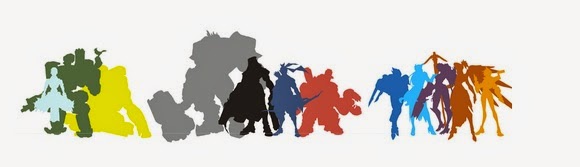
Sexual dimorphism wasn’t the goal; it was the starting line
Pictured: “Cowboy Man,” “Katana Man,”
and “Tattooed Enormous Belly Man”

The slight, very similar-looking frames on the right are all of the female characters. The highly varied and significantly chunkier figures on the left are the males (with the two on the extreme left being robots Zenyatta and Bastion).

So the take-away here is that if you’re a female character you must be young, thin, conventionally
attractive, and dressed to accentuate your figure (unless you’re Pharah), but if you’re a male character none of these things must apply. In the poster for Overwatch currently for sale on the Blizzard store, there are three additional “mystery” characters which haven’t been introduced. All three are male, all are relatively large, and two are completely covered in armor while a third standing behind them is less so– and also apparently hugely fat.

In the comments from the Polygon article I saw the following exchange:

pictor
I call shenanigans anytime a character has high heels in a combat setting. That is pandering to the male gaze, not crafting a cool character. Window maker is the worst with her broken spine, but Mercy and Symmetra are also doing that popped hip pose every time I see them. Tracer isn’t so bad, still tight clothes, but that is not inherently a bad thing, but more combat sensible poses, practical footwear….she and Pharah look more practical and combat ready.
They may be taking steps…but they are also still indulging in a little creative sexism.

T_K85 
“I call shenanigans anytime a character has high heels in a combat setting.”
I think that’s a design choice to distinguish it’s a woman more than anything. I don’t look at heels and get a boner. I look at heels and think of them as something a woman would wear instead of a man.
My two cents.

Mr_McGrumpypants 
I can see your point, but high heels are specifically made to accentuate leg muscles. I think if you want me to take your female characters seriously from a design standpoint, you need to leave the thighhigh boots, heels, and weird boob-exposing outfits on the cutting room floor. Any time I see a female “knight” wearing a breast plate that basically accentuates boobs instead of looking like actual protection, I die a little inside.
I mean, you can design your female characters however you want. I just reserve the right to think they’re stupid when you’ve got your female fighters trying to do shit in heels.

T_K85 
There’s an ape running around in a mech suite. I don’t think anything in this game is meant to be taken seriously.

pictor
No, it doesn’t need to be realistic, but I also appreciate when design choices are made that don’t pander to the male gaze. Pharah isn’t realistic at all, but by god she looks like she is ready for battle, doesn’t she? That’s what I want. Sell me that this person is geared for a fight. Not a real fight in the real world, but a fight all the same.

T_K85 
Fair enough. I personally don’t give two shits either way. Difference in opinion.

In case it needs to be pointed out, the “ape in the mech suit” is not sexualized. T_K85 has missed the point rather spectacularly, but pictor and Mr_McGrumpypants managed to nail it. Perhaps because they do give two shits (or maybe even more) about having options for playable female characters in a game which aren’t limited to a very conscribed range of variations on a fashion model holding a massive gun.

To return to that Chris Metzen quote: “Specifically for Overwatch over the past year we’ve been really cognizant of that, trying not to oversexualize the female characters. I don’t know if we oversexualize the male characters. But it’s something we’re very sensitive to.” I wonder which “we” he’s talking about there, and whether it includes himself. Presumably not, because how could you be “very sensitive” to not oversexualizing female characters, but then a) do it anyway, and also b) not know whether you oversexualize male characters?

Let me just answer that question: No, Blizzard does not oversexualize its male characters. It barely, if ever, sexualizes them at all. To sexualize a character is to make it look as if it is one of that character’s primary goals to be sexually attractive. I can’t think of a single male character in any Blizzard game who fits that description. It’s hard to think of a female character who doesn’t fit it. Okay, yes, Pharah (who originally, according to either Kaplan or Metzen– I don’t recall which– was a male character called “Rocket Dude”).

Why does any of this matter? Why am I harping on this so much?

Well, for the same reason that Metzen gave– representation is important. It might not be “serious,” but important and serious are not the same thing. If you want “girls” to feel “kick-butt,” then it’s important. If you want to honestly say that this new game reflects diversity for both men and women. then it’s important. And as I stressed at the beginning of this post, the reason it’s important when it comes to this game, Overwatch, is because Overwatch is a brand new enterprise.

Literally anything is possible– there’s no style precedent which has to be matched, the game is still very much in the design phase, and the game is set in a futuristic version of Earth which I don’t think it’s crazy to imagine would be more progressive than the one in which we live, right now. So why not design it to be? Why not assume that the characters which inhabit it would be more progressive, especially considering they’re, you know, superheroes?

Well, some of them are– some of them have apparently turned to the dark side and become mercenaries. Maybe they could be the backwards ones who think that men can do awesome things whether they’re thin, fat, nerdy, thuggish, young or old, but women can only be pretty. And the heroes could reject that nonsense.

The cure for cancer

The cure for cancer published on No Comments on The cure for cancer

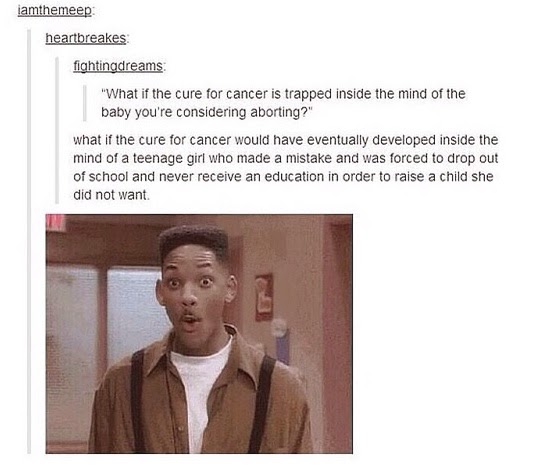
I love this because it illustrates some really bizarre assumptions and why they’re bizarre.

Like the all-too-common-among-pro-lifers assumption that an unborn fetus represents absolutely limitless possibility. Unborn fetuses are positively magical that way– they could cure cancer, end world hunger, invent a perpetual motion machine, anything! They could save the world in a thousand different ways! Instead of, you know, fates that could be considered more likely for unwanted children, which aren’t nearly so sparkling and brimming with promise.

Whereas the actual already-existing person in this equation, the woman, is granted no potential at all. Presumably because of the fact that she’s pregnant, which means that she’s a woman (yes, obviously) but also the assumption is that she screwed up somehow (this is even granted in the quote, but it ain’t necessarily so– most abortions aren’t given to teenagers who screwed up) and must therefore be a loser, slut, etc. who would amount to nothing whether she got pregnant or not.

Women? They don’t cure cancer. Especially not the ones dumb enough to have unplanned pregnancies, amiright? Ha ha…ha…..ha…..urgh.

#Inktober 2014

#Inktober 2014 published on No Comments on #Inktober 2014

I got a late start– not for any good reason, but because it just completely slipped my mind until October 3rd that it was Inktober– but I’m participating. I’m posting drawings here, as well as on Twitter and Facebook.

As with last year, the quality varies. I’m trying to do something unfamiliar each time, and sometimes it just doesn’t turn out well. But hey, that’s the point, right? To practice. And to show the world what your practicing looks like, failures and successes alike.

Categories

Totally not sexist

Totally not sexist published on No Comments on Totally not sexist

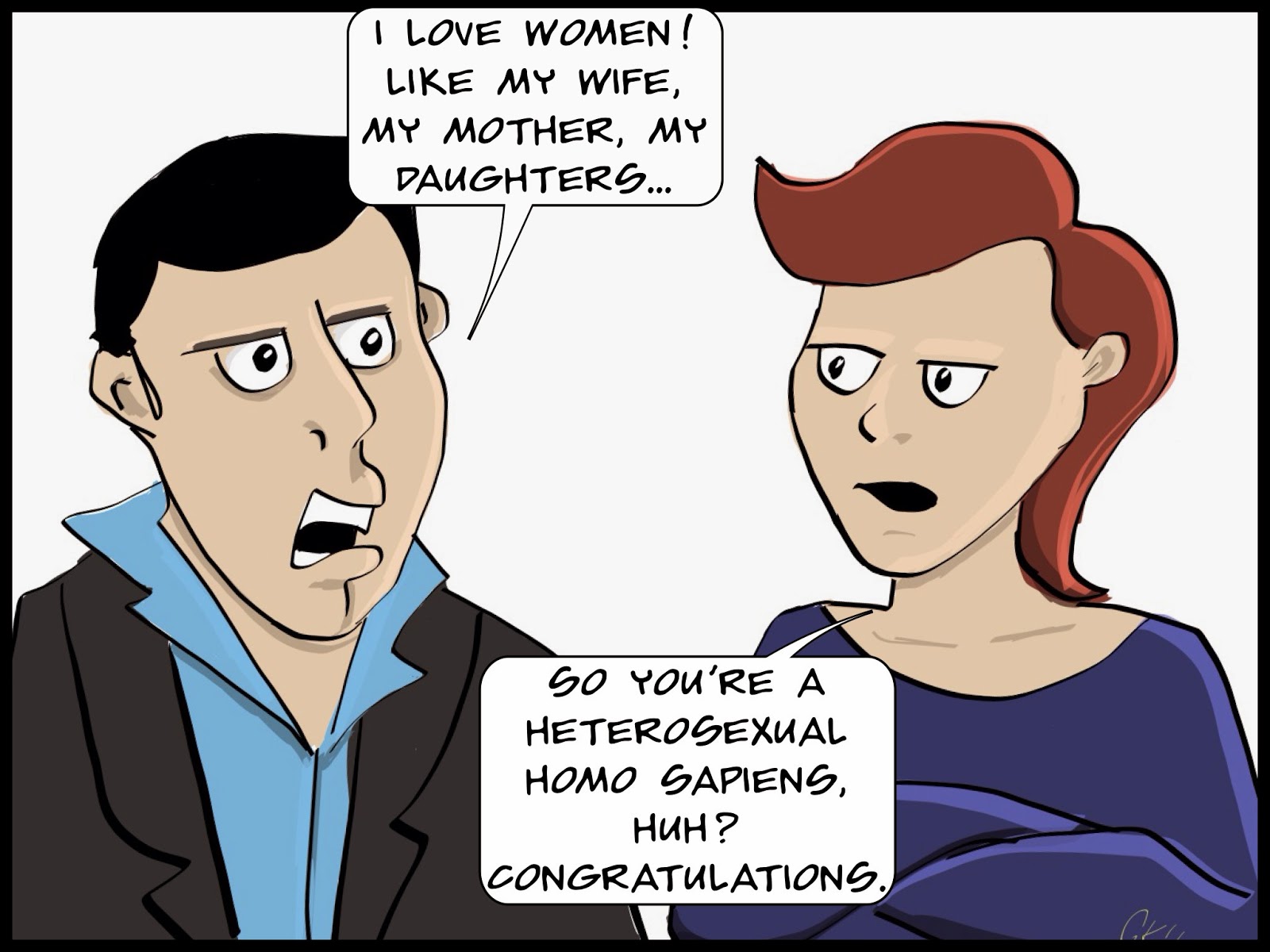
Some of my best friends are women!

Inspirations:

http://the-toast.net/2014/09/11/father-daughters-think-treat-women-like-daughters/

http://freethoughtblogs.com/butterfliesandwheels/2014/09/im-right-youre-wrong-and-shes-a-feminist-detractor/

Rat Queen Dee

Rat Queen Dee published on No Comments on Rat Queen Dee
Dee in conversation with her mother

I’m in the market for new comics– but let’s note that to me, all comics are basically new. I have read and loved Maus 1 and 2 by Art Spiegelman and Alan Moore’s Top 10 series, but that’s pretty much it. In thinking about what to start reading I came across some review or another for Rat Queens, maybe this one on The Mary Sue. It sounded like what I was looking for– a good story, amazing art, plenty of humor, and female main characters.

Then I read that one of the characters is an atheist cleric, and I was sold.

An atheist cleric? Yep. Dee is the daughter of two adherents of the blood-drinking squid god N’rygoth. She rejected the faith of her parents and set out on her own to join an all-female band of adventurers called the Rat Queens (all of whom seem to be rejects of some form or another), in which she functions as a magic-user, primarily a healer, apparently drawing on divine magic even though she doesn’t believe in any gods. When Betty, the smidgen (think halfling) thief asks how this is possible, Dee explains “I’m goddess enough.” No, I don’t know exactly what that means either.

That’s in the first volume of Rat Queens, which is the only one currently– the next one should be out in December. And let me stress that the entire thing so far is awesome. Everybody has a backstory, and of course the first volume contains a lot of exposition about those stories. Dee is but one member of a group of talented, badass, sarcastic women of various races who exist in a D&D style fantasy world and spend a good amount of their time making fun of it. But there are some very serious moments too, and they are sharpened by the levity with which they’re contrasted.

The story is by Kurtis J. Wiebe and art by Roc Upchurch. They’ve done an amazing job, and I want everyone to see it. Definitely recommended.

Good Arguing: the low-hanging fruit

Good Arguing: the low-hanging fruit published on 4 Comments on Good Arguing: the low-hanging fruit

So I’ve talked in the last few posts about making good arguments by addressing the substance of your
opponent’s position rather than attacking irrelevancies. I described the practice of strawmanning, which is constructing an inferior version of the argument you’re trying to demolish because it’s easier, and how that shouldn’t be mistaken for actually defeating the position you oppose.

But what about when you’re addressing a whole group of people who share a belief, and you deliberately choose to address only those who are saying the worst things, making the worst arguments, if they’re bothering to make arguments at all? That is, what if you only pay attention to the low-hanging fruit? Is that also a kind of strawmanning?

Well, yes and no. It could be, but not necessarily.

Because here’s the thing– life is not philosophy. Philosophy is what humans do when they get time to stop and think without anyone trying to kill them or ruin their reputation, when there’s food on the table and a bed to sleep in and there are no pressing issues at hand like legislators trying to pass laws that make it illegal to do things like philosophy. Steelmanning, for that matter, is something philosophers do when those philosophers are feeling particularly chill. An angry philosopher cannot be counted upon to steelman. Even though they should.

In real life, people are constantly making terrible arguments for terrible things, and horrifyingly, many of those people are influential (I would say “They’re called ‘politicians,’ but politicians are merely the most visible of this sort). When that happens, it’s important to point out those terrible arguments and say “Look at this stupid, hateful thing this person is saying,” to minimize the potential ideological damage they can cause.

That’s what a lot of bloggers do, and I respect them like crazy for doing it, because it’s a tiring, endless, and often thankless task. My friend Ed Brayton has been pillorying terrible arguments on religion, science, and politics on his blog since 2003, or maybe longer. And he’s never going to run out of material, because there will never not be people making these arguments. Often the same ones, for years upon years, sometimes re-skinned in order to continue arguing badly for a slightly different position. That’s fighting the good fight. I don’t believe in a Lord, but if I did, that would be the Lord’s work. You know the quote usually attributed to Mark Twain, “A lie can travel halfway around the world while the truth is still putting on its shoes”? We will always need people who help the truth put on its shoes.

There is something incumbent upon these pickers of low-hanging fruit to do, however. If you’re going to do the– again, very necessary– task of addressing the worst arguments out there for the sake of diminishing their power, you must be careful to not pretend that these are the only sort of arguments that people who hold that position, people in that same ideological group, are capable of making. Unless, of course, they are.

What I’m saying is that you should not effectively straw-man people who hold position X as a group by deliberately choosing to destroy only the arguments of people who agree with position X but are crap at supporting it, and then acting as if you have defeated position X itself by doing so. You have not proven, for example, that man-made climate change is a lie by laughing at people who think that every time you drive somewhere, a polar bear starves to death. These people are wrong, but they do not speak for the truth or falsity of man-made climate change. Proving that there are environmentalists who are idiots does not prove that environmentalism is idiotic. Tugging at the low-hanging fruit doesn’t bring down the tree.

Which is why, if you are asked to evaluate the merits of a position in general rather than to address specific arguments in favor of it, I’d say you are obliged to not restrict yourself to considering only the worst arguments. In fact, you really should ignore those arguments entirely and focus on the best arguments, because it’s only fair to consider a position invalid if no valid arguments can be made in support of it. It’s not the fault of someone who holds a legitimate position if there are people who share that position and are troglodytes, mentally or morally or (as is often the case) both.

Like steelmanning, this is not always easy to do. It’s really, really tempting, especially when considering an issue that is personally relevant, to pick out the loudest and most obnoxious of those who oppose your position and make them the standard-bearers for the other side. But that is the seed of prejudice, isn’t it? That’s how people come to believe that all members of ideological group X are stupid or immoral by virtue of holding X position, on the grounds that some members of that group are stupid/immoral. That requires ignoring the existence of the more intelligent or moral members of that group and their arguments in order to maintain the belief that position X is untenable.

But it goes against our tribalistic impulses to think this way. It feels good to have ideological kindred who are in the right, and those who oppose us who are wrong, placing individuals on one side of that line or the other and leaving them there. Alliances of this sort are shaken up all of the time when it’s discovered that somebody has views in common with people in that group, and that group isn’t this group, but it still matters because people in that group are horrible and this group is good. Oh, you’re a vegetarian atheist feminist…who owns guns? Go to hell! Gun-owners are a bunch of angry psychopaths. None of your other positions matter now.

Some of that tribalism and low-hanging fruit picking was, disappointingly, on display by Daniel Dennett in this article on Richard Dawkins’s pattern of stirring up enmity on social media:

I thought Richard’s responses were right on target. If some radical feminists (and others) think that all rape is equally bad, do they think it is not quite as bad as murder? If so, are THEY condoning rape? And if they think rape and murder are always equally bad, they really have lost their bearings and do not deserve our attention. Richard has been immensely important.

The problem is, most of the people I saw reacting with hostility to Dawkins’s tweet that ““Date rape is bad. Stranger rape at knifepoint is worse. If you think that’s an endorsement of date rape, go away and learn how to think,” didn’t think that at all. For that matter, I didn’t actually see a single person claim that all rape is equally bad, “radical feminist” or no.

What I  saw was a lot of people saying things more along the lines of Ashley Miller’s position, which was basically to point out that making blanket declarations about the relative significance of other people’s suffering (out of nowhere, as in a tweet) as a supposed attempt to deliver a lesson on logic is a really callous and bizarre thing to do. Especially when those declarations might arguably be factually incorrect (i.e., that some victims of aquaintance rape, which is the majority of rape, actually suffer more than they might’ve if raped by a stranger, because of perception and treatment by others after the fact, and having to live with the violation of trust that acquaintance rape represents). And of course, that has precisely nothing to do with whether Dawkins has been “immensely important” or not. It seems clear that Dennett’s only intention was to support his friend, and the most expedient way to do that was by picking some seriously low-hanging fruit.

Which is, I hasten to point out, a more reasonable assumption than to say he was simply strawmanning. You could say that literally nobody, anywhere, was claiming that all rape is equally bad. That Dawkins was strawmanning in constructing this person who allegedly holds this position, and then Dennett joined him in beating that strawman to death. But when you’re talking about a position rather than a specific argument or person, you can pretty much count on there being somebody out there who does authentically hold it. I’m sure there are people out there who think all rape is equally bad. I’m equally sure that they’re the least important people to consider when answering the question “What do you think of the criticism of Richard Dawkins’s tweet?”

Again– nobody is immune to doing this.

But it’s still unfair and logically sloppy to do, and that’s what I’m driving at. By all means, tear apart bad arguments when you see them. Practicing critical thinking is doing yourself and the world a service, and I’m sure you know that we could all, always, use more of it. But be careful, and be precise in doing so. Don’t act as though you’ve taken down the queen when you’ve merely eliminated a pawn, even if the pawns in this game seem endless. Taking care to remember that there are good, intelligent people who hold positions you oppose, and their arguments are very likely to be better than others, is a good way to avoid ideological prejudice. When you are arguing against a position in general rather than a specific argument or person, steelman the hell out of that position.

And then when you’ve done so, keep that thought in the back of your mind whenever talking to people who hold that position, because hey– most arguments people make in favor of anything, even the beliefs they hold most dear, happen in real life. Most people argue on their feet, with the weapons they’ve got at hand. As a consequence, they probably won’t offer the best defense of that position possible, and they certainly won’t do so all the time. And yeah, that includes you too.

Good Arguing: How to steelman (and why it’s hard)

Good Arguing: How to steelman (and why it’s hard) published on 2 Comments on Good Arguing: How to steelman (and why it’s hard)

In the last couple of posts I’ve been exploring different ways in which it’s possible to make bad arguments against someone’s position by ignoring the substance of their argument in favor of some distraction from it or distortion of it, even a completely fictional version of it. The tactic of constructing an inaccurate version of an argument in order to demolish it is called strawmanning.

Strawmanning is easy to do, and advantageous when the only people you care about impressing are people who already agree with you, and who also aren’t particularly concerned about you representing your opponent fairly– they just want to see you rip him/her apart, or at least a sufficiently convincing facsimile thereof. And since it’s very likely that the image of your opponent is already more of a caricature in the eyes of those who agree with you (that’s tribalism, in a nutshell), the chances are relatively low that someone on your side is going to pull back from basking in the warmth and comforting glow of the effigy which you’ve just set ablaze to tug at your sleeve and point out– hey man, that’s an effigy.

A strawman version of your opponent’s argument is easier to demolish for precisely the same reasons that the first little pig’s straw house was easy for the big bad wolf to demolish– it’s flimsy. It was constructed in haste with little thought put into it (who lives in a house made of straw, anyway?), and takes but a few forceful huffs and puffs and logic to blow it to smithereens. So if you, rhetorical big bad wolf that you are, could actually choose to have the person you’re arguing against live in a straw house rather than something sturdier, you would, wouldn’t you? It makes everything so. Much. Easier. And you’re angry, because damn that pig for having the gall to say…whatever horrible thing pigs say. Why should he get the benefit of a charitable, sturdy interpretation of his house I mean, argument?

Well, because that’s what logic– and fairness– demand. You want your opponent to engage the argument you’re actually making, rather than some shoddy imitation that’s easier to dismantle, so shouldn’t you extend the same consideration? And if his/her argument is really so pernicious and threatening, doesn’t that make it especially important to make sure that you’re addressing it accurately, in order to publically demonstrate its problems to every witness, so that they can avoid being taken in by it?  Does the group of people you care about convincing of the problems with your opponent’s argument include the opponent him/herself? And if not, shouldn’t it?

This is why steelmanning is so important. And so difficult. And so important.

Steelmanning is exactly what it sounds like– you turn the analogy of the strawman on its head, and imagine constructing a stronger, better version of your opponent’s argument. Perhaps even better than the one he/she initially constructed. You take the time to contemplate your opponent’s concerns, including the unspoken ones, and address them. You create the most convincing, best possible version of your opponent’s argument, and you lay it out for everyone to see. And then– only then– do you you show why it’s wrong.

To the best of my knowledge, use of the term “steelmanning” to refer to this practice originated with Chana Messinger. To quote her on the subject:

But Chana, you might say, I’m actually trying to get something done around here, not just cultivate my rationalist virtue or whatever nonsense you’re peddling. I want to convince people they’re wrong and get them to change their minds. Well, you, too, have something to gain from steelmanning. First, people like having their arguments approached with care and serious consideration. Steelmanning requires that we think deeply about what’s being presented to us and find ways to improve it. By addressing the improved version, we show respect and honest engagement to our interlocutor. People who like the way you approach their arguments are much more likely to care about what you have to say about those arguments. This, by the way, also makes arguments way more productive, since no one’s looking for easy rebuttals or cheap outs. Second, people are more convinced by arguments which address the real reason they reject your ideas rather than those which address those aspects less important to their beliefs. If nothing else, steelmanning is a fence around accidental strawmanning, which may happen when you misunderstand their argument, or they don’t express it as well as they could have. Remember that you are arguing against someone’s ideas and beliefs, and the arguments they present are merely imperfect expressions of those ideas and beliefs and why they hold them. To attack the inner workings rather than only the outward manifestation, you must understand them, and address them properly.

Now, of course, the concept of taking on the most robust version of your opponent’s argument, even if you have to construct it yourself, has been around a lot longer than the term “steelmanning” itself. You could simply call it arguing charitably. You could, as philosopher Daniel Dennett has been known to do, actually insert a stand-in for your opponent in the text of your own elucidation of your position, to fire objections and criticisms of that position in “real time,” giving you the opportunity to answer those criticisms. Of course, when you have multiple opponents, this means you probably won’t have the time and space to answer all of their potential criticisms. But again, you can choose the best of these and answer them– or at least, the best of them so far as you can honestly assess.

Dennett outlines the practice of charitable criticism in his recent book Intuition Pumps and Other Rules for Thinking, attributing it to Russian-American psychologist Anatol Rapoport:

Anatol Rapoport… once promulgated a list of rules for how to write a successful critical commentary on an opponent’s work. First, he said, you must attempt to re-express your opponent’s position so clearly, vividly and fairly that your opponent says “Thanks, I wish I’d thought of putting it that way.” Then, you should list any points of agreement (especially if they are not matters of general or widespread agreement), and third, you should mention anything you have learned from your opponent. Only then are you permitted to say so much as a word of rebuttal or criticism. I have found this a salutary discipline to follow– or, since it is challenging, to attempt to follow. When it succeeds, the results are gratifying: your opponent is in a mood to be enlightened and eagerly attentive.

Sounds good, right? Sounds like a total “best practice” for argumentation. This is something everybody should be doing right? So….why is, when we look around, we see so few people actually doing it? So few people, when deciding how to depict a position they oppose, selecting materials by reaching immediately for the straw rather than the steel?

Well, I know one thing with certainty– it’s not because they’re incapable.

There is no level of intelligence or education at which a person moves beyond having the incentive to strawman. The incentives, as I’ve described, include that that it’s easier and faster, but also there is the fact that it’s simply more satisfying to pin down and torture a good straw man when you’re angry, and when you’re speaking to people who are already angry for the same reason that you are, or whom you would like to make angry for the same reason.

A rhetorical crime has been committed, and by golly we want someone to answer for it. We want to haul in some guilty party and hold them to account, and when the guilty party is an argument, the penalties for getting the wrong man tend to be few. Violation of due process of the laws of logic for suspect arguments is not an offense for which most really suffer. We’re biased in a multitude of ways, perhaps most predominantly in favor of our own sense of being right. Being right feels good. Righteous indignation feels good. Watching people whose righteous indignation you share royally trouncing an argument that you find offensively wrong?  Gosh, that’s nice. That’s why we value an intelligent, caustic, sardonic ranter on our side so highly. Perhaps more than is really healthy on a sociological level, we value these people. There’s a reason for that.

But there ways to make steelmanning a great deal easier and more likely. Here are some I can identify:

  1. A polite disagreement, where passions are low. 
  2. Time is not a highly significant factor. This suggests that strawmanning is much more likely in verbal debates than in print.
  3. Opponents know each other. It’s much easier to represent your opponent’s position charitably when you’re familiar with his/her views on other things which aren’t directly related to the topic of contention. 
  4. Space, or rather the lack thereof, is not a significant factor. If you take the time to recreate a better version of your opponent’s argument before answering it with your own, there had better be some room to do it. Which means that you’re more likely to find steelmanning in a book than an essay or blog post. A blog post or essay than a verbal argument. A verbal argument than a sound bite. 
  5. A reasonable expectation of continued interaction, on some level. 

Steelmanning is possible for all of us, though. It’s a best practice for all of us. We’re not terrible people if we fail to do it, but it’s something to aim for. It’s good arguing.