Skip to content

Looking back

Looking back published on No Comments on Looking back

I maintained a Livejournal account from March 2002 through November 2009 and am now trying to decide what to do with it. Looking back through, I really wish I’d kept an actual blog instead, or at least in addition– it’s a mix of personal things that wouldn’t be blog-appropriate and comments on current events and my studies that absolutely would, and it definitely would have been a good idea to separate those out and put the latter group somewhere else. Somewhere like…well, here. I guess I thought that if I didn’t put everything I had to say into entries that would pop up in people’s LJ friends feeds, they wouldn’t read it. But now I’ve either realized that that’s not true, or don’t care if it is. Briefly in 2005 I had a separate account called Gretchen_study which was specifically about religion and evolution, but I didn’t maintain it.

Oh, and all of the photos are gone because I hosted them at Photoisland.com which then shut down. Yes, I had copies, but those were kept on a laptop which was later stolen. Let that be a lesson– back up your stuff, in several places.

If you have an interest in hearing what it was generally like to move in England and do an MA on religion and culture in 2003, here’s where that starts. If you want to read what it was like to move to Denmark in 2005 and do a PhD on religion and cognition, that begins here. If you don’t want to do either one, I don’t blame you in the slightest.

Reading through old entries, I see that I was a vastly more upbeat, optimistic person then. I expected things to turn out well, and was disappointed when they didn’t. That is a tendency which has, shall we say, diminished a bit.

What’s a “bad atheist”?

What’s a “bad atheist”? published on No Comments on What’s a “bad atheist”?

Ian Murphy has a piece on AlterNet called The 5 Most Awful Atheists, the title of which can be read a few different ways. He could be talking about people who happen to be atheists, who are awful. Or, he could be talking about people who are awful at being atheists. His subheading– Many notable atheists believe in some powerfully stupid stuff, thereby eroding the credibility of all atheists— suggests that he might believe that you can be awful at being an atheist by being an awful person, or at least being a person who believes awful things, or who believes things for awful reasons. Murphy’s article actually conflates all of these things, which is precisely the problem with it. It does, however, work admirably as an illustration of why they shouldn’t be conflated.

In short, Murphy contends that Sam Harris, Bill Maher, Penn Jillette, and Ayaan Hirsi Ali are “awful atheists” because they are awful people– in his opinion. Specifically, they hold personal and political stances that he finds repulsive, which means (to him) that they aren’t rational. And as we all know, “rationalist” and “atheist” are the same thing.

Wait, they aren’t? Could’ve fooled Murphy:

The thing about the so-called “rationalist” movement in America is that disbelief in gods seems to be the only qualification to join the club. Disbelief in a supernatural creator, especially as the movement becomes more popular or “hep,” as I’m pretending the kids say, in no way guarantees rationality in matters of foreign policy or economics, for example. Many notable atheists believe in some powerfully stupid stuff—likely owing their prominence to these same benighted beliefs, lending an air of scientific credibility to the myths corporate media seeks to highlight, and thereby eroding the credibility of all atheists in the long-term. In other words: The crap always rises to the top.

Here’s a thought: From here on out, criticize self-proclaimed rationalists for dropping the ball when it comes to being rational. Say that people who declare themselves to be skeptics are “awful skeptics” when they fail abysmally at applying skepticism in their outlook. Disbelief in a supernatural creator– or more accurately, a deity generally– is all it takes to be an atheist. So saying that Harris, Maher, Jillette, and Hirsi Ali are “awful atheists” because of something you dislike about their thinking which is not a lack of belief in a god or gods is incoherent. They have not failed at being atheists. They may have failed at being rationalists, skeptics, humanists, non-bigots, or just decent people generally, but not at atheism.

Why have I excluded S.E. Cupp from this consideration? Well, because I think she might actually have failed at atheism. I really don’t know much about her– less by far than any of the other people Murphy criticizes– but he describes her as being “self-loathing” as an atheist: “She recently said, ‘I would never vote for an atheist president. Ever,’ because she thinks religion serves as a ‘check’ on presidential power.” The only time I am likely to think of someone as a “bad atheist” is when they don’t appear to actually be an atheist, and/or can’t seem to get his or her mind around the concept. The most recent time that happened was Christopher Beha’s review of recent books by atheists in which he counts himself amongst the “disappointed disbelievers” whose only recourse is to seek simple pleasure in recreational drugs (!) or other transient entertainment in order to avoid or ignore the nihilism to which non-belief logically, inevitably leads. Atheism: you’re doing it wrong.

Hemant Mehta wrote of Murphy’s piece:

Here’s a summary of his list:

  • Sam Harris: He thinks religious profiling might have merit and defends torture in some instances.
  • Bill Maher: He’s misogynistic, condescending, and anti-flu-shots.
  • Penn Jillette: He’s a libertarian.
  • Ayaan Hirsi Ali: She’s practices “neoconservative lunacy” and is excessively anti-Islam.
  • S.E. Cupp: She’s a self-loathing atheist

I’ll give him S.E. Cupp. When it comes to atheism, she’s pretty embarrassing, talking about how she openly wishes she were religious and how she refuses to vote for an atheist. It’s arguable that her atheism, true or not, is more of a schtick she uses to get attention. But the rest of them? Please.

Mehta goes on to discuss the validity of Murphy’s individual objections, and evaluates whether these five people in terms of how much they have done to convince other people to become atheists, which I’d say is more a measure of their individual respective knacks for evangelism. It doesn’t specifically address how good they are at being atheists, because that’s fundamentally silly– you can’t be “good” at not believing in something. Lack of belief has no merit badges, no ranks, no authorities, no governing organizations. There are certainly organizations of atheists, but rising in power and influence within those organizations is not about how strongly you disbelieve (what a bizarre thought), but how good you are at….well, making it more comfortable to disbelieve. Easier. More acceptable. Less like something you’d feel the need to snort a line of cocaine to escape from, or openly disdain in order to curry favor with believers who require the myth of the self-destructive and nihilistic non-believer to be maintained.

It is, by the way, to the benefit of atheists to clarify these distinctions rather than blur them, intentionally or otherwise.  If we don’t pretend that rationalism, skepticism, secularism, humanism, and atheism are all the same thing, then people won’t mistakenly think that pointing out downfalls in one is the same as refuting them all, especially when the downfalls they’re pointing out are restricted to an individual person– intended for some reason to not only represent the entirety of one (non)ideology, but of all of them. That’s an absurd move, one that shouldn’t receive any help from the people it seeks to vilify. So don’t give that help. Pay attention to the distinctions. Recognize that people aren’t packages– they can be exemplary at one thing you admire while failing abysmally at another– and adjust your need for spokespeople accordingly.

Reject them when they don’t speak for you. Don’t let other people assume they do, and then hold you accountable for their failings. And for god’s sake, don’t assume that a person failing in any way somehow reflects on an entire body of people whose connection to that person really has nothing to do with whatever flaw you found. That’s called prejudice, and the people unfairly slandered by it are not the ones at fault.

But what was it actually like?

But what was it actually like? published on 1 Comment on But what was it actually like?
Now that I’ve made my strident post for the day, here’s one that will be much less so. I personally didn’t see any, but apparently there was some real misbehavior going on yesterday at Chick-fil-A restaurants, by both supporters and opponents, in various places on Mike Huckabee’s Chick-fil-A Appreciation Day.

A CFO/Treasurer at Vante called Adam Smith no longer holds that role, having been being fired from the company after filming himself berating a Chick-fil-A drive-through employee.

Gay and lesbian employees at Chick-fil-A have had a rough time of it from all directions– they were hit with a barrage of homophobic speech from supporters of Dan Cathy, as well as accusations of supporting it themselves from customers/protesters/protesting customers who assume that working for the company means accepting the beliefs of its owners wholesale. Cathy himself has expressed how very much he would like for this to be the case, but it isn’t. And it isn’t fair to punish workers, especially low-level workers, for what Cathy’s family has said and done:

One gay employee who works at Chick-fil-A headquarters in Atlanta, Ga., and asked to remain anonymous for fear of losing his job, says he is getting it from both sides. On the one hand, there is the customer who came in and said he supported Dan Cathy and then “continues to say something truly homophobic, e.g. ‘I’m so glad you don’t support the queers, I can eat in peace,'” the employee, who is 23 and has worked for Chick-fil-A since he was 16, wrote in an email. On the other hand, he continued, “I was yelled at for being a god-loving, conservative, homophobic Christian while walking some food out to a guest in a mall dining room.” He disagrees with Cathy’s views, but the reaction from the public has been just as hard to swallow. “It seems like very few people have stopped to think about who actually works for Chick-fil-A and what those people’s opinions are,” he wrote. “They are putting us in a pot and coming to support us or hate us based on something they heard and assume we agree with.” Gabriel Aguiniga, a gay employee at a Chick-fil-A in Colorado, also said the hardest part hasn’t been hearing Cathy’s comments. Instead, “[it’s] constantly having people come up to you and say, ‘I support your company, because your company hates the gays,'” Aguiniga, 18, wrote in an email. “It really takes a toll on me.” . . .”Now, anyone that works there is stuck with a stigma of being homophobic, even when many of us are far from it,” K said. One of her coworkers, who supports same-sex marriage, has had people say things like, “Don’t give me that hate sh*t,” and “I hope you choke on that chicken,” while she was handing out samples. But for K, the hardest part hasn’t been the actions of customers and protesters, it’s the money the company gives to anti-gay groups. “At the end of the day part of our profits still go towards Dan Cathy, and subsequently, all the organizations he supports,” she said. K is now actively searching for work elsewhere. Many of her coworkers, she said, are looking for new jobs, too.

And then….we have this:

I always say I admire Ed Brayton for his ability to document so much political lunacy that requires actually hearing and seeing the words come from the horse’s mouth, because I can’t do it. It’s some combination of horror at the words themselves and a general sympathy for people who embarrass themselves publicly, perhaps, but it makes videos like this one extremely hard to watch. But at least I got to laugh at 5:22-5:30.

ETA: At the Daily Beast, A Gay Chick-fil-A Employee Speaks Out. Excerpt:

We were so busy we nearly ran out of food. We did run out of some things, like nuggets, strips, lemonade, and waffle fries. Though we didn’t have to close early like we feared, by 10 p.m., we barely had anything left. Never before have I been so grateful that I have tomorrow off. Customers sang “God Bless America” in the dining room. They vocalized their support for “family values” in a way that made me want to vomit. We had two protestors outside, and I took five minutes to run out, hug them, and tell them: if I weren’t working here now, I’d be out here with you. They said, “It’s okay, we know what it’s like to have to work for a paycheck.” Hearing that was ten times better than hearing from my acquaintances on the other side of the coin: “How do you work there and still sleep at night, knowing their stance against equal rights?”  I sleep with a roof over my head, which is about all I can ask. I can’t tell you much more about the customers today, because of my limited contact with them. I work in the kitchen, so I don’t see much of the clientele.  What made today so difficult—more difficult than always being behind on food, running out of one thing or another, needing to be in two places at once, etc—was the attitudes of the other employees. No one really stopped talking about the reasons why today was as busy as it was. The people I work alongside kept going on and on about how powerful it was to be part of such a righteous movement, and how encouraged they were to know that there were so many people who agree with Dan Cathy. They went on at great length about how it was wrong not just for gays to marry, but to exist. One kid, age 19, said “I hope the gays go hungry.” I nearly walked out then and there. That epitomizes the characteristics of these evangelical “Christians” who are so vocally opposed to equal rights. Attitudes like that are the opposite of Christ-like.

ETA 2:  I have no comment on this, because nothing needs to be added. But do give it a read.

Bigotry Appreciation Day

Bigotry Appreciation Day published on No Comments on Bigotry Appreciation Day

Some photos from the event near me yesterday:

Some 200 people were standing outside in line, and I have no idea how many cars…they were winding around the block. Police officers were directing traffic. I parked across the street and walked over to have a look around, and noticed several people with the same idea– not just walking away with bags of Chick-fil-A food, but multiple bags. Each one looked like he or she was getting food for an entire family. My own appetite was gone– the sight of so many people happily, gleefully showing up to support the donation of over $5 million to groups that not only want to prevent gay marriage but make homosexuality illegal again turned my stomach. I’d thought I might go somewhere else and have a chicken sandwich, but even that didn’t sound like a good idea anymore. 
Every last person I saw was white and rather affluently dressed, and arrived in a nice car. Nobody looked as though a lightness of their pocketbook was forcing them to come here– quite the opposite, in fact. Poor Chick-fil-A has been “attacked” by people who believe in marriage equality choosing not to eat there anymore, so by golly it’s time to eat some chicken and show those non-homophobes what’s what! 
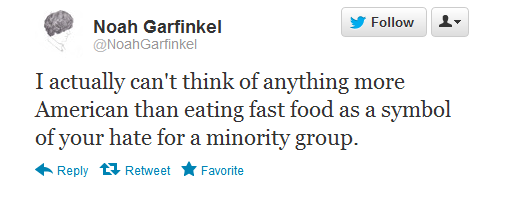
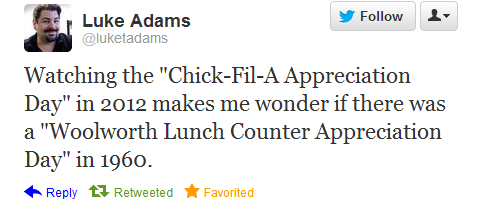
Two of my favorite tweets from yesterday:
But my favorite explanation of why the word “bigot” is appropriate for the people in those pictures above comes from Jen McCreight:

So you were just called a bigot I know your feelings are hurt. No one wants to be called a bigot, right? But before you do something silly like scream “FREE SPEECH” or say I’m the bigot, let’s rewind a bit. Chick-Fil-A has funneled millions of dollars toward certified hate groups in order to fund campaigns that depict gay people as pedophiles, fight against “gay behavior” and the legalization of same-sex marriage, and support dangerous “pray away the gay” programs. They also used their profits to support Uganda’s “Kill the Gays” bill. When I first found out about these atrocious things a couple of years ago, I stopped eating at Chick-Fil-A (despite how much I love their delicious chicken sandwiches). I did not feel right knowing my money could ultimately be used to hurt GLBT people. I could originally understand why someone wouldn’t boycott an organization that they disagree with politically. I bet there are things I buy that support things I hate, mostly because I don’t know any better, partially because I can’t financially afford to boycott everything. But now that Chick-Fil-A has been in the public eye, you know better. And if you drove to a Chick-Fil-A today to show your solidarity with the organization, you’re not just some random apathetic person who likes a chicken sandwich and doesn’t care about where their $5 goes. You are a bigot. You are saying “I agree with Chick-Fil-A’s anti-gay stance!” And your irrational hatred of gay people is bigotry at its finest.

No, it stemming from religion matters not at all. Religion-based bigotry is still bigotry.

No, Dan Cathy didn’t simply express support for marriage between members of the opposite sex (as if it needs supporting– who is trying to get rid of that, now?). His company has condemned gay marriage and actively fought against gay rights in general.

No, nobody said he doesn’t have the right to believe and say that. If you ate at Chick-fil-A out of some misguided belief that they did, and his right to free speech needs to be supported, your money would have been more appropriately donated to the ACLU.

No, you aren’t standing up for freedom, justice, and equality. You’re buying fast food to support a multi-million dollar corporation which opposes those things. Congratulations.

Priorities

Priorities published on No Comments on Priorities

A couple of months ago I wrote about different categories I fit in, ideologically and politically. I was tempted to expand on it earlier this month when PZ Myers wrote a post asking people what kind of atheist they are– scientific, philosophical, political, or humanist. I understood what he was getting at, but my first impulse was to ask “Why is the ‘atheism’ part the constant? The most important thing?” Because when it comes to politics and ideology I am, first and foremost, a free-speechist.

If you’re not a free-speechist, whatever else you believe and whatever priorities you give those beliefs, you’re not on my side. That seems harsh, maybe, but I’ll explain why that is, and what a free-speechist is.

A free-speechist is a person who believes that a free market of ideas is absolutely critical to the maintenance of an educated and moral society, and as such the only real justifications for government censorship of speech are those related to safety and property rights– e.g. you can’t shout ‘fire’ falsely in a crowded theater, and you can’t make money off of someone else’s creative work by representing it as your own. I value private forums which cherish a relative freedom of expression also, but a) as private forums they don’t have an obligation to allow anyone at all to speak, let alone everyone, and b) an “anything goes” atmosphere is not conducive to ideas being exchanged freely and productively, so some amount of moderation in order to eliminate abusive content and commenters is arguably not just permissible but necessary. So if you’re one of those people who whines that any sort of moderation whatsoever on an internet chat site, blog, or forum is wrong because it violates commenters’ freedom of speech, you’re not only wrong (since the First Amendment does not apply to private fora, and couldn’t since that would violate the owner’s right to freedom of association) but probably a troll.

Briefly put, trying to defeat an idea by either silencing the person voicing it or causing damage to their person or property is the coward’s way out. It’s an act of aggression against a person because you dislike the content of their ideas; it does not refute the ideas.

And no, a boycott isn’t a form of that. A boycott is an individual refusal to contribute to someone’s livelihood because doing so amounts to contributing indirectly to something you wouldn’t support directly. Similarly to a private forum, not being allowed to boycott would mean abdicating your own freedom of speech by being made to support ideas you don’t agree with whether you like it or not.

This might seem like a rather long-winded way to get to the point that I’m livid about hearing that yet another government official has seen fit to wield unique power to prevent someone from doing business because he objects to the content of that person’s ideas:

District of Columbia Mayor Vincent Gray says he won’t support an expanded presence for Chick-fil-A in the district because the president of the fast-food chain is opposed to gay marriage. Gray, a Democrat, referred to the company’s product as “hate chicken” in a tweet on Friday. His statement referenced his “long-standing strong support for LGBT rights and marriage equality” and followed similar statements by mayors in Boston, Chicago and San Francisco that the company was not welcome.

You know what’s depressing? It’s depressing that Mike Huckabee and Rick Santorum, of all people, are pursuing the correct course of action with regard to freedom of expression by encouraging people who agree with their opposition to gay marriage to vote with their wallets and support Chick-fil-A. Of course, neither of them is actually in office and therefore in a position to use legal power to promote or inhibit a view by damaging the business of the person espousing it, so let’s not give them too much credit. Let’s not give them any credit, for that matter, except to note that what they’re doing does not violate anyone’s freedom of speech whereas blocking someone’s business simply because you don’t like the views they support absolutely does.

And I say this as a passionate advocate of LGBT equality since 1993. There is a right way and a wrong way to fight for these things. Silencing and intimidation are the wrong way.

That’s why I’m a free-speechist.

Reddit’s rape thread

Reddit’s rape thread published on No Comments on Reddit’s rape thread

I had a whole blog post written about the Reddit thread discussing what it’s like to be a rapist, and now I don’t like it. It was supposed to be about the psychology of assigning moral responsibility to rapists and rape victims, but ended up being preachy and not scientifically supported to my satisfaction. So, in the trash can it goes. As I usually do when something like this happens, I’m going to try and walk it back and distill it into a simple list of observations. If I do this and still end up sounding preachy, well…I apologize.

1. That thread is very likely filled with a lot of deception. The very thing which encourages people to come out and actually admit to doing something horrendous like rape– anonymity– also allows them to tell a story with no truth in it whatsoever if they want to. So there are doubtless at least a few people in there getting their chuckles by telling a lurid and shocking tale that is also 100% fabricated.

2. Nevertheless, I don’t think reading it is a complete waste of time because even a person’s totally made-up characterization of a rapist is interesting. It’s interesting to see if they agree with the characterizations given by those who claim to be victims (who are also posting in that thread), and because a person who fabricates a story of what it’s like to be a rapist is likely telling you what he would in fact do and think if he decided to ever become a rapist.

3. The mentality of a perpetrator of rape, like the mentality of any perpetrator, is worth knowing about. It’s disturbing to learn, but necessary to understand. We must always listen to the explanations of victims, but when the victims are the only ones allowed to explain then we end up verging into the myth of pure evil— the perpetrator’s motivations are simplified (must be hate/desire for power) and isolated (must be deliberate and malicious) in order to maximize his responsibility. That isolation is a problem if it turns out to be mistaken, because as I wrote last month, you can’t really discourage people from doing something that they don’t view themselves as doing to begin with.

4. The self-proclaimed rapists and attempted rapists in the Reddit thread generally (with some major exceptions like this) describe themselves as realizing what they were doing and how wrong it was after the fact, unless they realized actually during, and had to stop themselves when they finally grasped that their female partner wasn’t willing. The closest they come to admitting malice is stating bluntly that the comfort and wishes of their partners weren’t any sort of priority for them– they simply disregarded them in favor of getting what they wanted.

5. That disregard is where the term “rape culture” begins to make sense for me. A rape culture is a culture in which women’s desires generally, but especially their desires regarding sex, are not regarded. Unfortunately most of the things I could say about this are prone to misinterpretation, by both people who agree and those who disagree, in the same way that statements I make about what it means to be a feminist can be misinterpreted. For that reason I don’t place a lot of stock in whether someone brands him or herself a feminist or not, or thinks “rape culture” is a fitting description for a phenomenon existing in the United States or not. What matters is whether we’re talking about the same thing. Do we have a culture in which women’s desires are commonly dismissed or viewed as subordinate to men’s desires? Yes. Does that mentality enable rapists to rape? Most likely, if their own descriptions of their motivations matter and are accurate. That’s minefield #1.

6. Minefield #2 is the characterization of rape victims, which goes right to the heart of why rape is wrong. Even the word “victim” is repudiated by some people, at least as a permanent status, because they reject the idea that the rapist continues to have power over them. A commenter on Salon’s article discussing the Reddit thread remarks:

As a social worker, I don’t find this comment/pronouncement [a description of a rapist being a cheerful, happy person who has traumatized a woman for life] particularly useful. These women are survivors, not victims. Some have moved on from the trauma by not making it the main narrative in their life story. This working through does not diminish the culpability of the perpetrator, and more importantly, it does not trivialise the gravity of the crime. What it does suggest is that women don’t have to make trauma central to their identity. Yes, it will inform who they are and affect them, but laymen and observers must refrain from condemning women to a life of suffering by not making ‘damaged forever’ forecasts. These include such misguided statements as, “She will never recover”, “It’s going to ruin her life” or “People never get over that kind of thing”. At the risk of sounding glib and simplistic, I am reminded of the quote “Life is ten percent what happens to you and ninety percent how you respond to it.”

To which another commenter responds:

Let me guess – you blame the ones who haven’t “moved on” for their suffering, because they are obviously simply choosing to “make [the trauma] the main narrative in their lives.” As both a child abuse and sexual assault survivor, and as someone who suffers from chronic complex PTSD as a result: SCREW YOU. Yes, it is great when a survivor can heal adequately enough to “move on,” but the timeline for that is different for every individual, and your severe lack of empathy on that point makes me think that either, a) you are lying about being a social worker, or b) you are one of the terrible social workers of the world. 

I can’t help but sympathize with that. Whether the (supposed) social worker does in fact blame women for not recovering from their rapes or not, the perverse attempt at self-empowerment that allows a person to describe those women who have recovered from a rape as having done so “by not making it the main narrative in their life story” certainly doesn’t make a clear distinction there. I think it’s possible to both congratulate and respect the work a person who was raped has done in order to improve her perspective on life and possibly grow as a person without suggesting that such an effort is both a) universally possible and b) merit-based, but the second commenter clearly doesn’t view the first as having done that. A rape victim is responsible for how she deals with the attack to the extent that she continues to have an obligation to be a moral person, but expecting her to be her own therapist and “fix” herself does, in fact, both “diminish the culpability of the perpetrator” and “trivialize the gravity of the crime.”

There’s a simple alternative to this, of course, and that is to not pretend that the damage of being raped is exactly the same for everyone. We don’t need to do that in order to avoid adjusting our view of the severity of the crime, any more than it’s necessary to say that child molestation isn’t such a bad thing because some children who have experienced it grow up to be well-adjusted adults. If you follow “how you respond to it” far enough around the circle of responsibility, you find yourself right back at “what happens,” since there is a point at which your response is simply a thing that happens. In failing to acknowledge this, doctrines of self-empowerment play a cruel joke– while trying to emphasize the ability to be happier by asserting “This is within your power,” they implicitly endorse the corollary, which is of course that if you fail to become happier that is also your fault. And that, as you might expect (and see in the second comment), tends to provoke some bitterness from people who are not happier.

7. Because of this thread on Reddit, fantasy author Jim C. Hines (whom you may remember from his awesome blog post in which he tried to pose like the women featured on the covers of books like his) decided to cancel an author Q&A session he was going to do for Reddit readers. I don’t blame him, though I wish he hadn’t. As many Redditors have pointed out, even if the “how rapists think” thread has no merit whatsoever and all who are involved in it should be ashamed (which I don’t believe), it hardly represents the community as a whole, much less the portion who were looking forward to his answering questions about how books. Hines is fully aware of this, but says that in canceling he wants to attract the attention of people who can “make a change” at Reddit. Unfortunately, I think he has simply made the change of providing Redditors with one less non-rape-related topic to discuss than they had before.


Chick-fil-A stuff that happened today, in increasing order of difficulty of predictability:

Chick-fil-A stuff that happened today, in increasing order of difficulty of predictability: published on 3 Comments on Chick-fil-A stuff that happened today, in increasing order of difficulty of predictability:
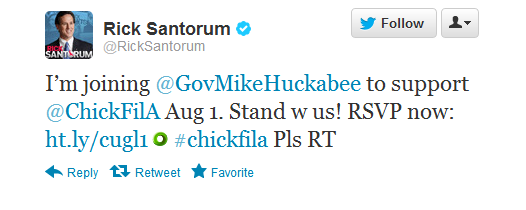
1. Rick Santorum jumps on Mike Huckabee’s bandwagon (if that sounds dirty to you, it’s not my fault) and declares that he too is going to eat at Chick-fil-A on August 1st– as well as today with his entire family, which took three tweets to explain– in support of that beleaguered Christian business which is just standing up for what’s right by doing their level best to prevent marriage equality. 
Predictability difficulty level: 0. Santorum never met an anti-gay cause he didn’t like.
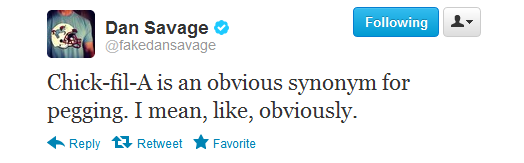
2. Dan Savage decides that Chick-fil-A totally sounds like a euphemism for the act of a woman rectally penetrating a man with a strap-on. 
Predictability difficulty level: 1. You know that Savage was the force behind the re-definition of “Santorum,” right? 


3. Eugene Volokh patiently and calmly explains why banning Chick-fil-A from establishing a business in a city because you disapprove of their support for a political cause is not only an unconscionable abuse of power but also un-freaking-constitutional:

But denying a private business permits because of such speech by its owner is a blatant First Amendment violation. Even when it comes to government contracting — where the government is choosing how to spend government money — the government generally may not discriminate based on the contractor’s speech, see Board of County Commissioners v. Umbehr (1996). It is even clearer that the government may not make decisions about how people will be allowed to use their own property based on the speaker’s past speech. And this is so even if there is no statutory right to a particular kind of building permit (and I don’t know what the rule is under Illinois law). Even if the government may deny permits to people based on various reasons, it may not deny permits to people based on their exercise of his First Amendment rights. It doesn’t matter if the applicant expresses speech that doesn’t share the government officials’ values, or even the values of the majority of local citizens. It doesn’t matter if the applicant’s speech is seen as “disrespect[ful]” of certain groups. The First Amendment generally protects people’s rights to express such views without worrying that the government will deny them business permits as a result. That’s basic First Amendment law — but Alderman Moreno, Mayor Menino, and, apparently, Mayor Emanuel (if his statement is quoted in context), seem to either not know or not care about the law.

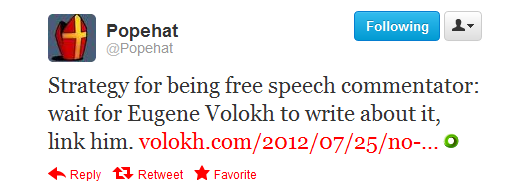
Predictability difficulty level: 2. As Popehat remarked,

4. The Jim Henson Company severs their relationship with Chick-fil-A as a consequence of the latter company’s support for anti-gay causes. Chief Executive Lisa Henson opts to affirm the company’s standpoint on this issue by donating their payment to GLAAD (The Gay and Lesbian Alliance Against Defamation).  Jim Henson toys are pulled from Chick-fil-A kids’ meals. George Takei posts the following on his Facebook wall:

Predictability difficulty level: 5. That’s a pretty decisive move for the muppet makers, and cements the understanding that Chick-fil-A’s actions are anything but personal and simply supportive of “traditional biblical marriage.”

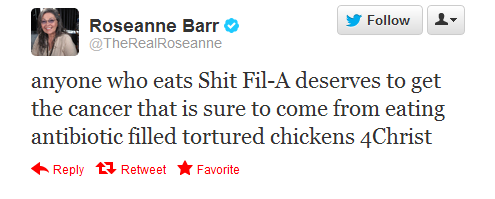
5. Roseanne Barr tweets that Chick-fil-A customers deserve to get cancer.

Predictability difficulty level: 7. Of course, I don’t know if Barr has a habit of wishing mortal illness on people who decide not to protest businesses which oppose civil rights, or if she simply has a bet with Thomas Menino on who can make those businesses seem most sympathetic. Note: there certainly are ethical and health concerns to be had in eating meat from animals who were fed antibiotics, but a) that kind of meat sure as hell isn’t exclusive to Chick-fil-A, and b) it isn’t likely to give you cancer. 
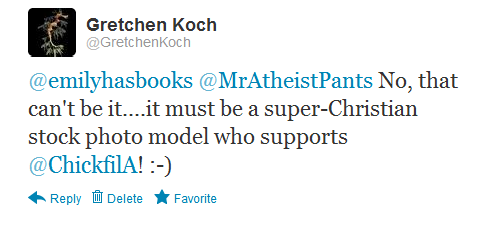
6. Chick-fil-A claims that the Jim Henson toys were pulled from kids’ meals for safety reasons. But apparently they’re concerned about being believed in this claim, because it sure looks like they created a profile on Facebook for a non-existent teenage girl to defend their honor. “Abby Farle” turns up on a post made on Chick-fil-A’s wall doubting the reasons given for pulling the Jim Henson toys, quoting bible verses and claiming that the toys were pulled long before the company divorced itself from the pushers of biblical-marriage-only. Only thing is…it turns out “Abby Farle’s” pictures are actually of a redheaded teenager in Shutterstock stock photos
I dunno. It could, of course, still be legit….
Predictability difficulty level: 9. This seems like a desperate move, or a move made by someone particularly unfamiliar with the Streisand Effect. 
It’s hard to say what wackiness remains yet to come. 

Persecution complex tastes like chicken

Persecution complex tastes like chicken published on 5 Comments on Persecution complex tastes like chicken

Wishing I’d stop blogging about Chick-fil-A? Yeah, so am I. But you see, the ridiculousness just keeps on coming, and I can’t help but remark on it. Two items today, neither of which is remotely surprising, but each is actually rather fascinating in its predictability. Let me show you what I mean:

Item #1: Conservative Christian politician labels criticism of contributions to a bigoted cause “attacks,” asks people to stand up for God by helping the bigots out. 

A new Chick-fil-A franchise opened up recently near me. They built a two-lane drive-through with ample room for long lines of cars, but additional security was still necessary in the first week or so they were open, and every day (except Sunday, of course) those long lines continue to form for lunch, dinner, and yes, breakfast too. They don’t seem to be hurting for business at all, but former Arkansas governor Mike Huckabee is nevertheless concerned that Chick-fil-A might be hurting financially from the relentless horrible bullying of people expressing their displeasure about Chick-fil-A’s ownership donating millions of dollars to anti-gay-rights causes. So by golly Mike Huckabee is doing something about it, and that “something” is declaring that Wednesday August 1st should be a day of appreciation for Chick-fil-A, when everyone who wants to “affirm a business that operates on Christian principles” will get themselves a chicken sandwich and waffle fries for Jesus. Thus far, Huckabee’s Facebook campaign for this purpose has attracted more than 38,000 people who forgot that their savior condemned divorce but said nothing about homosexuality followers.

Item #2: Self-proclaimed “irreverent raconteur,” forgetting that he has roughly half the intellect and none of the wit of H.L. Mencken, non-ironically condemns those who have “attacked” Chick-fil-A (by refusing to dine there for ethical reasons) while at the same time maintaining that his own reasons for choosing to eat there are beyond reproach. 

Requisite caveat: It is entirely possible that this guy is a Poe. I am forced to conclude that the column is legitimate since it didn’t appear in The Onion or Landover Baptist but an actual community blog section for The Washington Times, but it’s…well, honestly hard to believe. Let me give you some examples:

When I decide to buy something I have only one criterion: Is it the best quality at the best price to satisfy my needs or desires?  I do not believe in social compacts, social responsibility, or any other idiotic political mumbo jumbo. I only believe in getting the best product or service at the lowest price. . . I only care about getting a tasty meal fast. That is all that counts. My wants and needs trump social-moral-economic-political-justice equine excrement every single time. . . He just believes that marriage is defined as a partnership between a man and a woman. For that he must be tarred, feathered, and lynched.    To the lynch mobs and exploding heads, his belief about marriage is an egregious, heinous crime. Expression of beliefs that run counter to the lynch mob is not to be allowed.  The spiteful screechers and scribblers came out with the usual false accusations of hatred and homophobia – whatever that is.

And it goes on, and on, and on like that.

I don’t know if I’ve ever seen such a spectacular display of someone declaring that he doesn’t give the tiniest shit about anyone else while simultaneously claiming that their slightest objection to anything he considers important amounts to…well, you saw it. A lynch mob. People who boycott an eatery because they dislike the political contributions of its owners are just like a group of rabid racists who torture and kill people for being the “wrong” color. In other words, people who object to bigotry are just like bigots themselves.

What?

Leaving aside the immediate concern of why a person who professes to not even know what homophobia is should be heeded when making proclamations about when boycotts in response to it are or aren’t legitimate…you can understand my confusion and refusal to take this seriously. Social responsibility is “idiotic political mumbo jumbo.” Social justice is “equine excrement.” Bigotry against homosexuals is apparently not even comprehensible as a concept. Poe, American from 1954 or modern day Saudi Arabian? Your guess is as good as mine, but suffice to say…do not want.

Stage fright = selfishness?

Stage fright = selfishness? published on 3 Comments on Stage fright = selfishness?

Via Big Think, actor Jonathan Pryce characterizes stage fright as selfishness:

It’s an interesting thought, and I’m not going to say he’s wrong, but will point out a few things:

1. Self-consciousness and selfishness are not the same thing. Portraying it as selfishness isn’t just “cruel” because it’s hard to hear someone telling you that you’re selfish (though it is), but because it suggests that the anxiety they feel while speaking publicly is because they are somehow trying to monopolize everyone’s attention and make the audience think they’re better than they are. I’ve seen speakers who give off this impression, and they don’t appear to be frightened in the slightest. When a person obviously has stage fright, it’s perhaps as painful to watch and listen to them speak as it is for them to do it. Their voice quavers and they speak too quickly, and you want to whisk them away to a safer location where they may relax, have a beer (or two or three), and record their talk so that you can listen to it later. It would be a better time for all parties involved.

2. After describing stage fright as selfish, Pryce goes on to contrast it with something that sounds, to me, more like selfishness: focusing on what you have to give the audience. It assumes that you have something to give the audience, something important, something they perhaps can only get from you. I’ve never been quite able to make this assumption, though I don’t know whether that’s ultimately at the root of my own stage fright. I do know that mine is very real, and it has a very physical manifestation: I go faint. It feels exactly like I feel when I try to give blood, which is a light-headedness combined with nausea, and I start to see red and blue spots. I want to throw up or flee the room, or both. I actually did faint once while performing in a competition in high school– dropped straight to the ground. It was an unpleasant and embarrassing experience, to say the least. Since then I’ve found that I can speak before an audience only if I have a prepared paper in front of me from which to read, and the prescribed assistance of Propranolol to stop my heart from beating out of my chest as I do so. As you can imagine, I try to avoid the necessity of doing this very often. Some of us just aren’t performers.

3. This is, notably, an instance of a person who has succeeded at solving a problem deciding to diagnose the reason why people who have failed, have failed. It seems as though there are degrees of stage fright, and people who get a small amount of it tend to assume that their experience is universal– that nobody else experiences something worse. People who have a “trick” that makes their stage fright manageable are rather like people who have a “trick” that makes it easier to avoid eating too many sweets. It might work for them, but there’s no particular reason it should work for anyone else. And yet because of the popular doctrine of self-empowerment, it seems as if a trick that works for someone else should work for you, and if it doesn’t then it’s your own fault. I wonder if that creates a similar effect to that of failing at dieting– the failure brings with it a sense of personal futility that compounds the original concern and discourages future attempts to improve. This seems like something that a person trained in clinical psychology should address, and…that person would not be me.

A rampage killer and the problem of “evil”

A rampage killer and the problem of “evil” published on 4 Comments on A rampage killer and the problem of “evil”

“The problem of evil” is the common term for a certain argument against the existence of God. Or at least, the existence of the so-called “omni god”: one who is omniscient (all-knowing), omnibenevolent (all-loving) and omnipotent (all-powerful). The argument goes, basically, that evil would not exist in a universe created by such a deity, because he would know about it, care about it, and be able to prevent it if he had these three qualities. For the purposes of this argument, “evil” is generally defined as suffering– pain and anguish, usually on the part of humans but sometimes in general. Responses to this argument, defenses of the belief that evil could exist in a universe created by such a god, are called theodicy. Generally an argument of theodicy will appeal to free will and assert that humans wouldn’t have it if we weren’t able to commit evil acts, and further that pain and suffering are certainly bad but they’re also the origin of virtues like compassion and altruism. Of course, not all pain and suffering is caused by human behavior– natural disasters are an enormous source for these, but they generally aren’t called “evil” because evil requires an agent. A person is needed to be evil and commit evil acts.

Arguments from either direction on this topic are not terribly convincing to me, in large part because I not only disbelieve in God but also in evil.

I believe in pain and suffering, certainly, but I believe that attributing them to evil explains precisely nothing. And that’s a problem, since it is frequently used to explain things, generally when the pain and suffering is particularly heinous, the speaker has no real idea why they have occurred, and the speaker is either the victim of this pain and suffering and/or sympathizes with the victims. It’s like a place-holder for the actual cause, but more importantly (and more significantly) it tends to stand in the way of identifying and articulating the actual cause. It essentializes the perpetrator of the heinous act, who is labeled the evil one, and therefore the explanatory buck stops with him/her. In order to portray this person as absolutely responsible for his or her act, the label of evil forestalls any explanatory circumstances in the mistaken belief that they would constitute exculpatory circumstances. This is why I call evil supernatural– it’s an idea that there’s some aspect of a person which is distinct and elevated from all causal factors which contributed to his or her behavior. I’m quite willing to say that people can be bad, be immoral, deliberately or mistakenly do things with disastrous consequences for others as well as themselves. But I won’t call them evil, because badness and mistakes can be explained while evil cannot.

Psychologist Roy Baumeister wrote a very important book called Evil: Inside Human Violence and Cruelty, in which he articulates what he calls the “myth of pure evil.” The myth entails the following:

  • Evil is the intentional infliction of harm on people.
  • Evil is driven primarily by the wish to inflict harm merely for the pleasure of doing so (or for no reason at all). Harm inflicted by evil forces is gratuitous and therefore unjustified.
  • The victim is innocent and good.
  • Evil is the other, the enemy, the outsider, the out-group.
  • Evil has been that way since time immemorial.
  • Evil represents the antithesis of order, peace, and stability
These are the characterizations we give the things and the people we want to call evil, because we want to distance ourselves from them and signify at once that we a) are not capable of committing such acts ourselves, and b) certainly didn’t commit any such act in this instance. The worse the act in question becomes, the stronger this impulse is. Suddenly it’s not only permissible but obligatory to use any words of condemnation possible to describe the act and its perpetrator, even if they are not accurate. Recall when Bill Maher lost his job as host of Politically Incorrect because he refused to call the 9/11 terrorists “cowards”? He wasn’t by any means refusing to say that what they did was wrong, and that they are bad people, but he would not describe their actions as cowardly given that they knowingly and willingly were doing something that would necessarily lead to their deaths. But because Maher refused to feed the myth of pure evil, he was viewed as excusing it and therefore at least a little bit evil himself. Describing someone as evil as an explanation for their behavior is a kind of fundamental attribution error— it attributes all responsibility for the act to the nature of the person rather than his or her situation– and people who openly refuse to commit this error risk being viewed as sympathetic to the perpetrator and even to the act itself.
In this context, I want to consider the words of Colorado governor John Hickenlooper about James Holmes, the 24-year-old suspect of Friday’s mass shooting in Aurora:

Colorado Gov. John Hickenlooper says the mass killing of a dozen people and wounding of another 58 at a movie theater may not have been political terrorism, but it was the act of a deranged, demonic person who wanted to create intense fear. The Democratic governor appeared on CNN’s “State of the Union” Sunday and says officers are getting a lot more evidence from suspect James Holmes’ apartment and are learning more about him moment by moment. Hickenlooper told ABC’s George Stephanopoulos on “This Week” that Holmes was diabolical and he would have found a way to create this horror even if he did not have access to guns. Hickenlooper says Holmes would have used explosives, poisonous gas or some other method to create the terror.

“Demonic?” Does Hickenlooper actually believe in demons, and that they caused Holmes to murder? I seriously doubt it, although if he does believe that he should be evicted from office as soon as possible. It certainly sounds as though he’s using the word to express the extent of his horror at the act, and it accomplishes that. But unfortunately it also accomplishes something else, an incorrect or at least far too hasty explanation for the killer’s actions. There is no way for Hickenlooper– for any of us– to know at this point whether Holmes is “deranged,” much less “diabolical.” Those two words create an interesting paradox, actually– if by “deranged” Hickenlooper means that Holmes is mentally ill, then that would effectively prevent him from being “diabolical,” since the myth of pure evil entails that the perpetrator commits his or her heinous acts with full knowledge and deliberateness, with a sound mind. That’s how we hold the person fully responsible, morally and legally. People with mental illnesses can certainly be responsible, but if mental illness drives a person to do something like go to a movie theater and open fire on its occupants then I think it’s safe to say that the person was not in full control of his or her faculties, however much thought he put into it beforehand. It is entirely possible to be both disturbed and calculating.

The last similarly horrible event that occurred in Colorado was the shootings at Columbine High School in 1999. Dave Cullen, the journalist who authored the book Columbine, has an editorial in the New York Times today advising extreme caution in interpreting the causes behind this one:

You’ve had 48 hours to reflect on the ghastly shooting in Colorado at a movie theater. You’ve been bombarded with “facts” and opinions about James Holmes’s motives. You have probably expressed your opinion on why he did it. You are probably wrong. I learned that the hard way. In 1999 I lived in Denver and was part of the first wave of reporters to descend on Columbine High School the afternoon it was attacked. I ran with the journalistic pack that created the myths we are still living with. We created those myths for one reason: we were trying to answer the burning question of why, and we were trying to answer it way too soon. I spent 10 years studying Columbine, and we all know what happened there, right? Two outcast loners exacted revenge against the jocks for relentlessly bullying them. Not one bit of that turned out to be true. But the news media jumped to all those conclusions in the first 24 hours, so they are accepted by many people today as fact. The real story is a lot more disturbing. And instructive. At every high school, college and school-safety conference I speak at, I hold up the journals left behind by the killers, Eric Harris and Dylan Klebold. The audience is shocked at what they learn. Perpetrators of mass murder are usually nothing like our conceptions of them. They are nothing like a vision of pure evil. They are complicated.

Complicated.

Evil is simple. Easy. Practically a write-off. And therein lies both its appeal, and its fundamental mistake.