Skip to content

Should we be surprised?

Should we be surprised? published on No Comments on Should we be surprised?

So Rock Beyond Belief has apparently been canceled.  All of that time and effort put into creating a secular concert and expecting the military to honor its agreement to support the show to the same extent that it supported a Billy Graham evangelical event before, and it’s not going to happen.

“It’s heartbreaking,” said Sgt. Justin Griffith, who announced the cancellation in a Thursday letter to Col. Stephen Sicinski, the garrison commander at Bragg. “I’m personally invested in this, both in money and time. And now I feel like I’ve strung people along.” 

As Ed Brayton (scheduled to emcee the concert) says, Griffith didn’t string anyone along– Fort Bragg leadership did.

Plans for the Rock Beyond Belief concert, which was planned to include famed British atheist Richard Dawkins as its keynote speaker, began last fall, after an event on the post called Rock the Fort. That event, sponsored in part by the Billy Graham Evangelistic Association, was criticized by groups like Americans United for the Separation of Church and State as an attempt to evangelize not just soldiers, but civilians, who could also attend the show. Military leaders said at the time they would support similar events by non-Christian groups, a promise reiterated in a letter last month from the Office of the Staff Judge Advocate at Bragg to the Freedom From Religion Foundation. “Fort Bragg continues to be willing to provide the same level of support to comparable events proposed by non-federal entities,” wrote Lt. Col. Nelson Van Eck Jr. Griffith and other organizers say that changed abruptly this week, when they were told that they couldn’t have the large outdoor gathering with games and activities they had planned. Instead, they were told the event could take place at one of two indoor theaters, with the larger one accommodating about 700 people. In his letter to Sicinski, Griffith also says the base declined to cover any of the costs for Rock Beyond Belief, while it paid $54,500 toward the Christian event. Griffith also says he was told that any advertisements for the secular event would have to carry disclaimers that the concert wasn’t endorsed by Bragg, while the Christian event was explicitly endorsed by the post. A military chaplain, for example, had sent out letters on Army stationary to area Christian pastors asking for their assistance in running the Christian concert. Because of the disclaimer, the financial support and the venue change, Griffith said, the concert he planned wasn’t able to go forward, which has left him disappointed and frustrated. “This happened at the last minute,” he said. “I just don’t know how to pursue this further without litigation.”

Ed comments:

And litigation is being prepared by the Military Religious Freedom Foundation. The fact is that this was a test from the start, a test of the military’s promise that they would treat a non-Christian event the same as they treated the previous Christian one. And the military failed that test. We know from FOIA requests that the base paid tens of thousands of dollars in support for the Billy Graham event and they are now refusing to do the same for our event. I’m disappointed, of course, because I was really looking forward to hosting the show. But perhaps a lawsuit is what it will take to put a stop to the military’s constant promotion of religion.

SCOTUS rules in favor of Westboro on funeral protests

SCOTUS rules in favor of Westboro on funeral protests published on No Comments on SCOTUS rules in favor of Westboro on funeral protests

Cross-posted from State of Formation.

The Supreme Court ruling on Snyder v. Phelps was issued this morning– 8-1 in favor of Phelps, saying that the First Amendment protected the WBC’s right to protest the military funeral.  I couldn’t have imagined it going any other way, but there was still a niggling worry that it might.  The opinion, authored by Roberts with Breyer concurring, notes that the protest was taking place on public land, roughly a thousand feet from the church (as instructed by police), and none of the protesters entered the cemetery.  None of them interfered in the funeral in any way, and the plaintiff was not even able to read what their signs read until that evening when he saw them on a news broadcast.  The lone dissenter to the opinion, Justice Alito, disagreed mainly on the grounds that the protest took place at a time and location geared to garner maximal attention.  Which…isn’t that what protesters always do?

I’m very glad that this case went to the Supreme Court, and that this was the decision they delivered.  That doesn’t mean I have a shred of sympathy for Westboro or their supposed cause, but I do think that delivering a $5 million dollar judgment against a group protesting on public grounds without any violence or even cursing would set a very, very bad precedent in terms of freedom of speech.  From the opinion:

Westboro believes that America is morally flawed; many Americans might feel the same about Westboro. Westboro’s funeral picketing is certainly hurtful and its contribution to public discourse may be negligible. But Westboro addressed matters of public import on public property, in a peaceful manner, in full compliance with the guidance of local officials. The speech was indeed planned to coincide with Matthew Snyder’s funeral, but did not itself disrupt that funeral, and Westboro’s choice to conduct its picketing at that time and place did not alter the nature of its speech.

Speech is powerful. It can stir people to action, move them to tears of both joy and sorrow, and—as it did here—inflict great pain. On the facts before us, we cannot react to that pain by punishing the speaker. As a Nation we have chosen a different course—to protect even hurtful speech on public issues to ensure that we do not stifle public debate. That choice requires that we shield Westboro from tort liability for its picketing in this case.

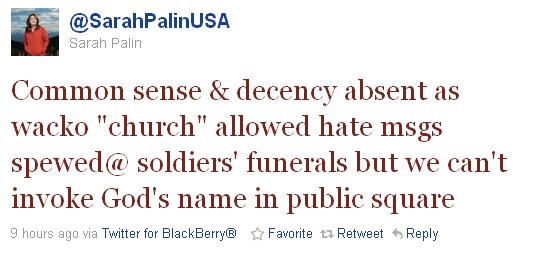
Memo to Sarah Palin…

Memo to Sarah Palin… published on No Comments on Memo to Sarah Palin…

Umm, both your and Westboro’s wacko pronouncements in the public square (such as, for example, this very tweet) invoke God’s name on a regular basis.  They got sued for it; you didn’t.  It appears their liberty to be religious in public is more in danger than yours is.

First Amendment and irony comprehension fail.  But you have to love someone who complains that they’re not allowed to do something as they’re doing it.

The fallacy being applied by this particular politician is….. *drumroll*….. equivocation, combined with a bit of false analogy.  First of all, simply invoking God’s name in the public square hasn’t gotten either the WBC or Sarah Palin in any kind of trouble.   In fact, doing so is pretty much a requirement for both churches and conservative politicians alike, hmm?  Oh, I’m sorry– “church,” in scare quotes, says the woman whose own church invited a witch hunter to come and bless her.  Second, for Sarah Palin the word “can’t” means that somebody, somewhere, will have a negative opinion of her for doing something.  For Westboro, regardless of how you might view their beliefs and practices, it means they might be out $5 million.   A tiny bit of a difference, there?  Perhaps.

Gratuitous bird shot

Gratuitous bird shot published on No Comments on Gratuitous bird shot

My daytime companions, budgies Freddie (left) and Charlie (right).  Freddie is about a year and a half old, and Charlie is a little over three months.  Freddie is talkative, afraid of change, and rather manic. Charlie is brave to the point of foolhardiness, pushy, and fastidious.

SCOTUS rules in favor of Westboro on funeral protests

SCOTUS rules in favor of Westboro on funeral protests published on No Comments on SCOTUS rules in favor of Westboro on funeral protests

The Supreme Court ruling on Snyder v. Phelps was issued this morning– 8-1 in favor of Phelps, saying that the First Amendment protected the WBC’s right to protest the military funeral.  I couldn’t have imagined it going any other way, but there was still a niggling worry that it might.  The opinion, authored by Roberts with Breyer concurring, notes that the protest was taking place on public land, roughly a thousand feet from the church (as instructed by police), and none of the protesters entered the cemetery.  None of them interfered in the funeral in any way, and the plaintiff was not even able to read what their signs read until that evening when he saw them on a news broadcast.  The lone dissenter to the opinion, Justice Alito, disagreed mainly on the grounds that the protest took place at a time and location geared to garner maximal attention.  Which…isn’t that what protesters always do?

I’m very glad that this case went to the Supreme Court, and that this was the decision they delivered.  That doesn’t mean I have a shred of sympathy for Westboro or their supposed cause, but I do think that delivering a $5 million dollar judgment against a group protesting on public grounds without any violence or even cursing would set a very, very bad precedent in terms of freedom of speech.  From the opinion:

Given that Westboro’s speech was at a public place on a matter of public concern, that speech is entitled to “special protection” under the First Amendment.  Such speech cannot be restricted simply because it is upsetting or arouses contempt.  “If there is a bedrock principle underlying the First Amendment, it is that the government may not prohibit the expression of an idea simply because society finds the idea itself offensive or disagreeable.” Texas v. Johnson, 491 U. S. 397, 414 (1989).  Indeed, “the point of all speech protection . . .is to shield just those choices of content that in someone’s eyes are misguided, or even hurtful.”  Hurley v. Irish-American Gay, Lesbian and Bisexual Group of Boston, Inc., 515 U. S. 557, 574 (1995).   The jury here was instructed that it could hold Westboro liable for intentional infliction of emotional distress based on a finding that Westboro’s picketing was “outrageous.” “Outrageousness,” however, is a highly malleable standard with “an inherent subjectiveness about it  which  would allow a jury to impose liability on the basis of the jurors’ tastes or views, or perhaps on the basis of their dislike of a particular expression.” Hustler, 485 U. S., at 55 (internal quotation marks omitted).  In a case such as this, a jury is “unlikely to be neutral with respect to the content of [the] speech,” posing “a real danger of becoming an instrument for the suppression of . . . ‘vehement, caustic, and sometimes unpleasan[t]’ ” expression.  Bose Corp., 466 U. S., at 510 (quoting New York Times, 376 U. S., at 270).  Such a risk is unacceptable; “in public debate [we] must tolerate insulting, and even outrageous, speech in order to provide adequate ‘breathing space’ to the freedoms protected by the First Amendment.” Boos v. Barry, 485 U. S. 312, 322 (1988) (some internal quotation marks omitted).   What Westboro said, in the whole context of how and where it chose to say it, is entitled to “special protection” under the First Amendment, and that protection cannot be overcome by a jury finding that the picketing was outrageous. 

Their conclusion:

Westboro believes that America is morally flawed; many Americans might feel the same about Westboro. Westboro’s funeral picketing is certainly hurtful and its contribution to public discourse may be negligible. But Westboro addressed matters of public import on public property, in a peaceful manner, in full compliance with the guidance of local officials. The speech was indeed planned to coincide with Matthew Snyder’s funeral, but did not itself disrupt that funeral, and Westboro’s choice to conduct its picketing at that time and place did not alter the nature of its speech. Speech is powerful. It can stir people to action, move them to tears of both joy and sorrow, and—as it did here—inflict great pain. On the facts before us, we cannot react to that pain by punishing the speaker. As a Nation we have chosen a different course—to protect even hurtful speech on public issues to ensure that we do not stifle public debate. That choice requires that we shield Westboro from tort liability for its picketing in this case.

ETA: Fred Phelps’ estranged son Nate, an LGBT activist who lives in Canada, does not support the decision.  I find that disappointing but not surprising.  

Interesting links of the day

Interesting links of the day published on No Comments on Interesting links of the day

Tuesday health trilogy

Tuesday health trilogy published on No Comments on Tuesday health trilogy
  • On Boing Boing, travel writer Bob Harris talks about his feet being given a “pedicure” by doctor fish during a visit to Singapore.  The tiny fish eat dead skin (and only dead skin, thankfully) off the feet, making them a useful treatment for people with psoriasis or eczema.  When salons in a few different places in the states have tried to offer this service, they have been swiftly prohibited by health departments concerned about the potential for infection– though there don’t appear to have actually been any cases of people getting infected.  It’s currently legal in the UK, but might not be for much longer considering that the same fear has taken hold there, again without any actual instances of infection.  I’d be curious to try it, but it might not be the best idea for a ticklish person.  And anyway, Wikipedia says that it won’t work for doctor fish which are kept in an aquarium as pets.  Bummer. 

  • At The Fat Nutritionist, Michelle explains why poor people tend to eat…well, poorly.  It’s not because they don’t know about nutrition, she says, but because they’re obeying the hierarchy of food needs (based on Maslow’s hierarchy of needs in general) and prioritizing quantity of calories first.  Being able to eat healthily and thoughtfully really is something you can only do once you have enough money to eat, period, so we should focus on making sure that everyone fits that description first rather than lecturing them out of a Michael Pollan book.  There’s also some really interesting discussion in the comments about the extent to which class affects diet.  
  • And in the UK, breast milk ice cream first goes on sale for a very steep £14 per scoop, then is seized and removed from the counters due to complaints from the public and concerns of the Health Protection Agency and the Food Standards Agency.  It is possible to transmit viruses such as hepatitis through breast milk, but I’m guessing the “ew” factor was the primary motivator there, considering that it’s also possible to transmit viruses through cow’s milk and the solution to preventing transmission of such in both cases is pasteurization.  You wouldn’t catch me eating it should it become legal in the states, however, mainly because of that $20 price tag.

No children were harmed in the writing of this post

No children were harmed in the writing of this post published on No Comments on No children were harmed in the writing of this post

I have a special place in my heart for a lot of people accused of making or possessing kiddie porn.

What? Did she really say that?
  

A photo of actual children here
might bias you against me.

Yep, I did.  But hear me out.  I say this because child molestation is one of the worst crimes possible in the minds of probably most Americans, and because of this a lot of people who weren’t actually molesting children– for the sake of making and distributing pornography or otherwise– tend to get caught up in the legal crossfire and punished in ways that are far out of proportion to their deeds. Call me a bleeding heart, but I don’t think it takes away in the slightest from the severity of real child victimization to feel for those who didn’t actually victimize any children, but are treated as if they did.

For instance, teenagers who are guilty of “sexting”– sending racy photos of themselves to each other.  No child molestation there, and yet in some parts of the country these kids are receiving felony charges and convictions for it.  In my own state of Texas they’re considering downgrading this “crime” from a felony to a misdemeanor.  That’s an improvement, but it would still mean using laws that were originally intended to prevent adults from preying on children to also punish teenagers for ill-advised behavior that damages little but their own reputations.  I understand the impulse to protect them from this considering that once photos get onto the internet they effectively become immortal, but surely arresting, convicting, and putting teenagers on a sex offender registry alongside rapists and actual pedophiles is precisely the opposite of “protecting” them.

In a case I read about today, the culprit is a little less innocent than a sexting teen– okay, he seems downright creepy– but what happened to him is nonetheless a travesty of justice.  A 34-year-old Indiana man named Eric Rinehart had sexual relationships with two young women, aged 16 and 17 respectively.  Yes, I know– ew.  But it was entirely legal for him to do so, as the age of consent in Indiana is 16, as it is in roughly half the country.  One of the girls offered to take naked photos of herself for him, and he agreed and then later took more photos of her as well as the other girl.  He didn’t distribute them at all, just kept them on his computer.  Here’s what happened next:

In 2007 Rinehart was convicted on two federal charges of producing child pornography. U.S. District Court Judge David Hamilton, who now serves on the U.S. Court of Appeals for the 7th Circuit, reluctantly sentenced Rinehart to 15 years in prison. Thanks to mandatory minimum sentences, Hamilton wrote, his hands were tied. There is no parole in the federal prison system. So barring an unlikely grant of clemency from the president, Rinehart, who is serving his time at a medium-security prison in Pennsylvania, will have to complete at least 85 percent of his term (assuming time off for good behavior), or nearly 13 years. Hamilton was not permitted to consider any mitigating factors in sentencing Rinehart. It did not matter that Rinehart’s sexual relationships with the two girls were legal. Nor did it matter that the photos for which he was convicted never went beyond his computer. Rinehart had no prior criminal history, and there was no evidence he had ever possessed or searched for child pornography on his computer. There was also no evidence that he abused his position as a police officer to lure the two women into sex. His crime was producing for his own use explicit images of two physically mature women with whom he was legally having sex. (Both women also could have legally married Rinehart without their parents’ consent, although it’s unclear whether federal law would have permitted a prosecution of Rinehart for photographing his own wife.) “You can certainly conceive of acts of producing actual child pornography, the kind that does real harm to children, for which a 15-year sentence would be appropriate,” says Mary Price, general counsel for the criminal justice reform group Families Against Mandatory Minimums. “But this is a single-factor trigger, so it gets applied in cases like this one, where the sentence really doesn’t fit the culpability.”

Families Against Mandatory Minimums, or FAMM, is a non-profit organization dedicated to changing legislation to prevent grossly out-of-proportion sentencing.  They deserve all of the support we can give them, but making changes in this area is decidedly an uphill battle.  

In his sentencing statement, Hamilton urges executive clemency for Rinehart. He points out that under federal law Rinehart received the same sentence someone convicted of hijacking an airplane or second-degree murder would receive. For a bank robber to get Rinehart’s sentence, Hamilton writes, “he would need to fire a gun, inflict serious bodily injury on a victim, physically restrain another victim, and get away with the stunning total of $2.5 million.” . . .Hamilton is not the first federal judge to express frustration over federal child porn sentencing laws. In May 2010, The New York Times profiled U.S. District Court Judge Jack Weinstein, who after 43 years on the bench has essentially gone rogue, twice throwing out convictions of a man convicted of receiving child pornography because of the five-year mandatory minimum sentence attached to the offense. Weinstein has also indicated that in future child porn cases he will disregard the federal rules of criminal procedure and inform his juries of the sentences defendants will get if convicted. 

I would imagine that opponents of draconian laws against drunk driving have an easier time of it than people who take aim at those having to do with child porn.  Nobody wants appear as though they are coddling sexual predators, and so they are reluctant to speak out against the worst travesties of justice that come from laws intended to protect kids.  The road to hell is paved with such intentions, as a Florida lobbyist named Ron Book can attest.  Fear plus grief plus a desire for revenge can be the equation for some horrific legislation.  In order to prevent the victimization of people as an unintended consequence of this kind of legislation, we need to be able to speak up about it.  And in order to do that, we need to realize that there is a clear distinction between disapproving of a behavior (actual child molestation) and approving of measures purporting to stop it which actually don’t– just as with any other crime.

In the meantime, things do not look good for this case:

It could actually have been worse for Rinehart. Under federal law, he could have faced up to 25 years in prison. In exchange for a guilty plea, prosecutors agreed to seek only the minimum sentence. Unfortunately for Rinehart, that plea agreement also prevents him from challenging his conviction or sentence. His only hope for early release is executive clemency. Given the clemency records of the last two administrations, that does not seem likely.

Sue Blackmore decides that religions are not, in fact, viruses of the mind

Sue Blackmore decides that religions are not, in fact, viruses of the mind published on 3 Comments on Sue Blackmore decides that religions are not, in fact, viruses of the mind

Sue Blackmore is one of the go-to voices in the UK on matters of religious thinking and consciousness. She is, believe it or not, an atheist with a PhD in parapsychology.  Originally a firm believer in the paranormal, she reached the conclusion in the course of her study that it doesn’t in fact have any scientific basis.  At that point she decided to find out what the mind really is capable of doing, which resulted in a number of books including the excellent (though steeply priced) Consciousness: An Introduction.

She is probably most famous for The Meme Machine, however, a book in which she takes the idea of the meme which Richard Dawkins proposed in his 1976 book The Selfish Gene (yes, it really was that long ago) and ran with it.  I don’t think most people who use the word “meme” these days really have any idea where the term originally came from and how it was formulated.  Some people don’t even know how to pronounce it, because they don’t realize it was intended to sound similar to “gene” in order to convey a similar means of propagation.  Genes, Dawkins wrote, have their own metaphorical interests which can be viewed as independent from ours in that they “desire” to be perpetuated  into the next generation.  In the same way, memes are ideas which “desire” to be spread as far and widely as possible.  Blackmore expressed this epidemiologically, comparing memes to viruses which need hosts that are most conducive to spreading them.  A memeplex is a conglomerate of ideas which are transmitted together because they are mutually supporting, such as a philosophical outlook or a religion.

As you can imagine, an idea’s interests that are independent from ours might well be also contrary to ours, which is what the word “virus” is intended to convey.  Viruses are not symbiotic with us– they manage to propagate at the expense of our health by making us sick.  In his 2006 book Breaking the Spell, Daniel Dennett compared religion to a lancet fluke which invades the mind of an ant, driving it to climb to the top of a blade of grass to be eaten by grazing animals, and didn’t seem to fully acknowledge how that analogy could be perceived as insulting to believers.  It smudged the line between being willing to die for worthy causes, of which martyrdom is perceived to be one, and being made to die pointlessly for someone/something else’s desires.  You might say “Well, that’s the entire point– the memes just make you think you’re doing something meaningful!”  Maybe so, but that’s assuming one’s conclusion.  Most of us would grant that some forms of self-sacrifices are in fact noble and not at all pointless, but both Blackmore and Dennett would say that those are caused by memes as well.  How do we determine which ones are virus- or fluke-like and which are not?

After attending an Explaining Religion conference at the University of Bristol, Blackmore says that she no longer views religions as viruses of the mind in the sense of being detrimental to their hosts. Why? Two main reasons:

1.  Michael Blume was able to show that religious people have far more children than non-religious people.
2.  Ryan McKay was able to show using experimental data that “religious people can be more generous, cheat less and co-operate more in games such as the prisoner’s dilemma, and that priming with religious concepts and belief in a ‘supernatural watcher’ increase the effects.”

To the first point a person could note that there are more important things in life than the number of one’s children.  True in a proximate sense, but not in an ultimate one.  If we’re evaluating the benevolence of a meme on an evolutionary scale, increasing reproduction is a clear advantage even if it’s not in the best interest of individuals or, indeed, the world itself.  To the second point, which is well-supported by a number of studies that have been performed over recent years, a person could dither about the degree to which being cooperative and honest should be counted as more a benefit to the individual or to the group, and then talk about whether it promotes in-group cooperation at the expense of creating inter-group hostility.

However, I’m not sure we really need to conduct either discussion.  Memetics is not the only way to examine religious ideas epidemiologically.  The advantage in looking at religion as a memeplex is that it emphasizes that religious ideas are transmitted between human minds just like any other ideas, but I think that Pascal Boyer manages to do that more effectively using his epidemiological approach because he doesn’t feel compelled to treat ideas as strict analogs to genes.  He tries to figure out first what should count as a religious idea, and then discusses which religious ideas are more likely to “stick” and which others are not, but not by attributing metaphorical interests to them.  That isn’t to say that Boyer doesn’t have his own ideas about whether religious ideas are on the whole more beneficial to us or more detrimental, but that question is not essential to his theorizing about what fundamentally makes an idea religious and likely to spread.  In fact, it’s quite irrelevant to that theorization.

I don’t think the matter of whether and when religion benefits humanity and when it harms us should be off-limits to scientific inquiry.  And even if I did, scientists are going to research those topics anyhow.  But it doesn’t seem appropriate to make a decision about the value of religion as a whole as part of your theorizing about how it works.  These studies which point out various ways in which being prompted to think religiously causes people to be better to each other are tightly circumscribed and specific.  I don’t think showing that people tend to behave better when they think they are being watched, for example, really says anything about the value of religious beliefs in general even if one function of religion is to perpetuate the idea that there is always someone watching.   This experimental data is important, but it’s also important to hold off on forming grand conclusions on the basis of a few studies.  It’s good that Blackmore has decided religion isn’t a mental virus, but that doesn’t mean it’s a mental panacea either.

Musical interlude: Katie Melua

Musical interlude: Katie Melua published on No Comments on Musical interlude: Katie Melua

Ketevan “Katie” Melua (born 16 September 1984) is a Georgian-British singer, songwriter and musician. She moved to Northern Ireland at the age of eight and then to England at fourteen. Melua is signed to the small Dramatico record label, under the management of composer Mike Batt, and made her musical debut in 2003. In 2006, she was the United Kingdom’s bestselling female artist and Europe’s highest selling European female artist.