Skip to content

Glenn Beck vs. lady parts

Glenn Beck vs. lady parts published on 1 Comment on Glenn Beck vs. lady parts
When a man and a woman love each other very
much, her happy pink ghost has grapes. Pretty sure
this is how many right-wingers understand reproduction

By the way…I’m a hooker who is planning on having 400 abortions. There, I’ve outed myself. Whew! It feels good to get that off my chest. Or out of my womb. Or something.

Because you see, I rely on Planned Parenthood currently for reproductive services and have done so, off and on, for the past few years. And that’s the only kind of woman who would do such a thing.

There is no other reason that a normal, healthy person would need Planned Parenthood on a regular basis for something other than abortion, which can be seen in the other 97% of the pie chart on the left below. No sirree bob. None at all.

You can listen to the recording of Glenn Beck at the above link, but I wouldn’t recommend it as it might inspire spewing of your last meal. I don’t watch or listen to Beck normally and my opportunity to do so has decreased significantly now that his show on Fox has been canceled, but he does still have a nationally syndicated radio show that runs for three hours daily, which is what that clip is from. Three hours a day is a lot of time to dispense complete bullshit, so it’s really not surprising that gems like this should come out of his mouth on a regular basis..accompanied, of course, by mockery of people like Lawrence O’Donnell for thinking about the effect that budget cuts for Planned Parenthood would have for women he knows who depend on it.

I can’t be one of those people who regularly dissect the nonsense of Beck, Rush Limbaugh, and Bill O’Reilly, because it almost literally pains me to listen to it. There’s something inside me that shrivels up and dies when I hear them, and it seems to be directly tied to the sensation I get when witnessing someone embarrassing or hurting himself. It’s really not pleasant. So if it’s ever important to know what they have to say (which is itself in doubt), I generally rely on transcripts. It’s just that with the quote above, I genuinely could not believe that Glenn Beck said those words without hearing them for myself. Beck is the guy who rambles on about conspiracies and imminent Armageddon. Limbaugh is the guy who says nasty things about women. That’s what I thought, anyway, but apparently I was wrong– that, or Beck’s branching out. Lucky us!

Between Beck and that guy on Fox and Friends who thinks you can get a pap smear at Walgreens, I sometimes wonder if the loudest conservative men have ever even met a woman.  Because honestly, they have this disturbing tendency of speaking about us as if we’re something they have only read of a children’s book.

On being “gender atypical”

On being “gender atypical” published on No Comments on On being “gender atypical”

I’ve written before about how LGBT issues are ultimately about gender role conformity in general, and Dan Savage posted on that topic today in relation to the It Gets Better Project:

Got this question last night at Cornell University… 

Cornell professor Ritch Savin-Williams said in the New York Times that he’s concerned that it’s not about gay youth, but about gender-atypical kids. Is the “It Gets Better” campaign too narrowly focused?

The kids who suffer the most from anti-gay bullying—the prime targets—are the gender-nonconforming kids, i.e. the sissies and the tomboys, the kids who can’t pass for straight. And some of the kids who can’t pass for straight are straight. Most kids who are gender nonconforming, or gender atypical, are lesbian, gay, bi, or trans, and the IGBP was created to reach out to these queer kids. But the messages at the IGBP are relevant to straight gender-atypical kids, and we know that straight-but-gender-nonconforming kids are watching the videos, commenting on them, taking hope from them, and contributing their own videos. But, yes, we have to address issues around gender—gender expectations and stereotypes—to truly address anti-gay bullying. We can learn to recognize rough gender norms without stigmatizing or punishing kids who depart from those norms. 

Homophobia doesn’t just punish people who are actually gay, bi, or trans. It punishes everyone who doesn’t match a traditional idea of what maleness and femaleness are.  I was a tree-climbing short-haired tomboy through most of elementary and middle school, and was called a dyke more times than I’d care to remember by the same straight guys who punished each other regularly for deviating from a rigid standard of machismo in the slightest. I feel sorry for them in retrospect, because they were victims of the same rigid, idiotic standards of gender that they inflicted on me.

Jen McCreight channels her 13-year-old self to reply to Savage:

I like boys, and I have a huuuuge crush on one who I think likes me back. But I’m a tomboy and I always have been. . .  And that’s why everyone thinks I’m a lesbian. I don’t care if people are gay, but the way they say the word hurts so much. They whisper it like I’m dirty or broken. Girls don’t like changing by me in gym class, even though I’m more concerned that my underwear is dorky than what they look like in their underwear. I know it’ll probably stop when I get a boyfriend (if that ever happens, sigh) but that just makes me feel worse, knowing that the kids who really are gay can’t hide like that and have to put up with this forever. But when I’m feeling down, I can watch the It Gets Better Project videos and know I’m not alone. So this big letter was to say “thank you.”

Suppositions

Suppositions published on No Comments on Suppositions
Human nature, by Junior Lopes

Here are a few…let’s call them suppositions I’ve reached in the process of doing a very cultural degree program followed by a very cognitive one:

1. Perspective always matters. None of us are truly objective, because we speak from a perspective by necessity. But by seeking out and being informed by the perspectives of others, we can come closer to objectivity. The truly objective is that which is true or existent independent of our perspectives, however, and cannot be determined by simply adding up subjective views. If nine out of ten people think Beck is the best musical artist ever, that’s useful information. It does not mean that Beck is objectively the best musical artist ever. You can’t vote on the sex of a rabbit, etc.

2. Perspectives often differ as a result of distributions of power. The more powerful often speak more loudly and are easier to hear. Power may come from many sources–sheer numbers, monetary wealth, physical strength, influence, and so on. While the perspectives of the less powerful are important because they can include insights that are simply overlooked by the powerful, they are not right simply by virtue of being relatively powerless. If you added up all of the kinds of non-privilege in the world and found them all existing in one person, that person would not be the wisest human being ever. But he/she would probably have a hell of a story to tell, and it’s one we should hear.

3. There is such a thing as human nature, but we are not biological robots. We are both natured and nurtured. Biological determinism and strict social constructivism are both telling partial stories which are thereby incorrect stories. A person who thinks a trait of the human mind is more biologically determined than you do is not necessarily a biological determinist, and a person who thinks the trait is more shaped by society is not necessarily a strict social constructivist. People who focus on culture tend to fixate on difference while people who focus on cognition tend to focus on commonalities. This does not make them enemies, but collaborators (that is, if they’re willing to be). “Biological” and “neurological” do not mean “permanent,” and “cultural” does not mean “easily/quickly mutable.”

4. Nor do those classifications mean the abdication of responsibility or legitimization of normativity.  Our minds are built by both biological evolution and the culture around us, and saying that a certain trait is adaptive no more confirms that it is good than does saying something is a message sent by society.  Neither evolution nor society have “wants.” They are both complex forces that shape people without purpose. We as individuals take what we’re given and decide what to do with it. We don’t hand responsibility over to either force, but share it with them. Free will– the kind of free will worth wanting– is created in the exchange.

These are all very general “planks” of my thinking about how minds work, but I thought it important to jot them down because holding these suppositions says a lot about what I do or don’t find surprising, likely, or moral. For example, you’re not likely to arouse outrage in me at the idea that rape is an evolutionarily adaptive trait. It might be completely untrue, but the very idea won’t offend me because I know that doesn’t remotely mean that rape is good, prudent, or hard to avoid committing. I’m already very familiar with the idea that war, sexual deception and jealousy, religion, and more biases than could possibly be conceived may well be adaptive, and those possibilities are interesting in terms of their explanatory value but hardly threatening. And to return to Stephen Pinker-think, nothing we discover about the human mind is going to legitimize rape.  If someone claims otherwise, they’re doing science wrong. Or not doing it at all.

Standing with the sluts

Standing with the sluts published on 2 Comments on Standing with the sluts

No, that’s not a character’s name from a take-off of Dances With Wolves. It’s a post from the blog of a Californian history and gender studies professor called Hugo Schwyzer, who writes about a great event with an unfortunate catalyst:

This past Sunday, the world’s first “Slut Walk” took place on the chilly streets of Toronto, Canada. The official site is here. The march was organized in response to the infuriating remarks of a police constable, who told a safety workshop at a Canadian university that “women should avoid dressing like sluts in order not to be victimized.” (The officer has apologized, but it’s evident that his trogolodytic view of sex and responsibility remains widely held.)  I’ve written many times in support of women’s right to wear what they want in public without fear of harassment or harm. This includes both revealing and concealing clothing; I’ve written in favor of the right to go topless in public and in opposition to bans on headscarves and burqas.  There are so many things that trouble me about the obsession with regulating women’s bodies. But as a man, I am particularly exasperated at the assumption that lies beneath the insistence on modesty: the myth that men cannot control themselves. As feminists often point out, the real “man-haters” are those who promote modest dress for women out of the belief that men lack self-control. There is nothing more contemptuous than the suggestion that those of us with penises and Y chromosomes are prisoners of our biology, liable to rape or commit infidelity at the first sign of cleavage. The myth of male weakness sells us woefully, heartbreakingly short. 

Emphasis in the original. Read the whole thing; it’s worth it.

I really like what Schwyzer does here. He flatly rejects the proposition that it’s the responsibility of women to dress in ways that will not encourage men to harass or attack them, rather than the responsibility of men to control their own behavior. He supports the general right of women to wear whatever they want, for whatever reason they want, which I would call individualist feminism though I know that’s not the only term for it. In this formulation, the particular reasons for why women would want to do something are always secondary or even irrelevant to the importance of their ability to decide for themselves. If they want to go naked, fine. If they want to cover themselves from head to toe, fine. It’s up to them. And thirdly, he points out that this form of misogyny amounts to misandry as well, which is often the case. Men and women have different hormonal balances and to some extent we are at their mercy, but that doesn’t mean that men are physically incapable of restraining themselves in the presence of an attractive woman, and it does the male sex no favors to suggest otherwise. Men like Schwyzer are right to object to that insulting characterization when it is used by others who are trying to dodge culpability by claiming weakness. If that were really the case, the fairest thing to do would be to not allow men out in public because they’re incapable of behaving– not blame women for making themselves the occasion of sin.

Please don’t molest the feminist bloggers

Please don’t molest the feminist bloggers published on 2 Comments on Please don’t molest the feminist bloggers
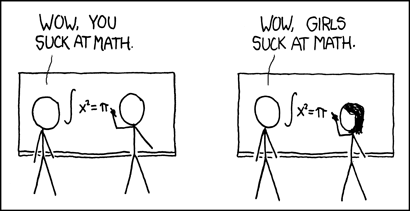
From the wonderful xkcd.com

Poor Jen McCreight. Seriously. If all she did was post about things that offend her, I could understand people thinking that she’s too sensitive and probably a miserable person generally– even though, of course, there are more than enough offensive things happening every second of every day that documenting them could be a full-time job for many people. But she seems to be a pretty upbeat, curious, enthusiastic person who blogs on a variety of topics, and when she does post about something that bothers her, people pop in and pronounce such comments a sign of everything that’s wrong with feminism. Or, if they’re even less charitable, women. On what planet does that make sense?

To return to a comparison I made before, nobody would disavow the cause of racial equality if someone involved in that effort accused someone unfairly of racism. They wouldn’t throw up their hands and say “Can’t anyone make a joke anymore? I just don’t understand these anti-racists!” Yet for some reason it’s perfectly okay to say such things if the topic at hand is sexism instead. That’s not to say that Jen’s complaint is justified or unjustified (though my opinion on that will be clear if you read the comments on that post), but that its legitimacy is entirely beside the point. Even if she made the stupidest accusation ever (and I’m willing to grant that accusations of bias can be terribly stupid), that wouldn’t come close to legitimizing bashing the entire enterprise of feminism.

Being specific about why you disagree with the offense someone has taken says “I share your concerns. I just don’t think that this is a case in which something harmful has been said or done for a reason that I can articulate.” Taking the opportunity to say “I don’t understand you ______ people,” on the other hand, says “I don’t give a damn about your concerns, and I’m using this particular event of your offense as an excuse to dismiss them.” Big difference. If you honestly don’t care, what are you doing on the blog of a person who does care, aside from trolling? What actual contribution are you making?

Yes, yes, it’s important to have a thick skin. Everybody with a blog knows that, especially the ones which allow comments. But honestly, intellectual laziness can be exhausting. And it’s the height of intellectual laziness to seize on a single comment, let alone a single blog, single person, or single group, and use that as basis for dismissing an entire movement.

I’m tempted to get into a discussion about whether sex-based forms of bigotry are the most permissible these days, but a) that’s a huge topic and b) it’s really hard to approach objectivity on that sort of thing.  Regardless, it isn’t necessary to make the basic point that replying to complaints of prejudice, justified or otherwise, with prejudice makes a person a jerk.

We’ve all got our own stuff

We’ve all got our own stuff published on No Comments on We’ve all got our own stuff

Again on Colorlines (I’m really happy to have discovered that site), Thoi Lu discusses black male feminism:

In light of the recent 11-year-old Latina who was reportedly gang raped by 18 black men in Cleveland and news of Chris Brown’s continuing meltdowns, Texas, a few black male writers have stepped up to the plate to explicitly discuss their journey toward becoming feminists. Byron Hurt of The Root wrote last last week on “Why I am a Male Feminist,” which prompted G.D. of PostBourgie to also write candidly about the topic two days later. Hurt admitted that observing the way his father would invoke fear in his mother during arguments by virtue of his greater size influenced his own relationships with women. He fell into feminism accidentally; Hurt interviewed for a position with the Mentors in Violence Prevention Project, not knowing that it was designed to use the status of athletes to make gender violence socially unacceptable. After hearing how women protected themselves from sexual assault and rape, his conception of feminism radically changed:

Like most guys, I had bought into the stereotype that all feminists were white, lesbian, unattractive male bashers who hated all men… Not only does feminism give woman a voice, but it also clears the way for men to free themselves from the stranglehold of traditional masculinity. When we hurt the women in our lives, we hurt ourselves, and we hurt our community, too.

While Hurt’s father’s presence was inescapable, G.D. wrote, “mine was imperceptible.” He had an absent father figure and was raised by “black women who were fantastically smarter and more competent than I was.”  G.D. internalized how his mother always cautioned his twin sister to be responsible while in public, in a way he didn’t have to. Also, during a college summer, one of his female friends woke up in an empty dorm room in a bare bed and had to file a police report and get a rape kit, which was another situation he couldn’t fathom living through. At the least, however, he admits to his own ignorance:

I am routinely very, very dumb about this shit as a heterosexual dude — with all the tunnel vision and privilege that attends that location. The relationship those realities have to my blackness is a muddled one; sometimes they’re independent, sometimes they act in concert. But if growing up black and poor and male provided an unlikely bridge to anti-sexist thinking, so has feminism complicated the way I think about blackness and class.

Feminism as an ideology has a reputation for being a privilege of white women. They have been the ones who have generally been wealthier and more educated, the ones with the time and money to go off to university and take Women’s Studies courses and sit around discussing the patriarchy and learning to appreciate the value of a vagina. Black women were too busy working. They didn’t have time to do the kind of navel-gazing white women did in the 60’s (and still today) about the feminine mystique and the legitimacy of working outside the home, because they were already doing it. The issues they faced weren’t quite the same. So black women felt that their struggles were not being properly represented by a movement that purported to speak on behalf of Womankind. If in actuality it’s all about the interests of upper class white women, then we might as well just say so, but hopefully none of us actually want that to be the case. If we mean that, then being a feminist should be about representing the concerns of all women. If there is a single woman of any sort anywhere in the world who is being mistreated and her choices in life denied, we should all be feminists for her…shouldn’t we?

There are multiple dimensions to distribution of power in life, and it’s not surprising that one minority group should view one or more other minorities groups with oppressive eyes very similar to the ones with which they themselves are viewed. Hence, you get rich minorities looking down on the poor, white minorities looking down on minorities of different races, male minorities looking down on females, straight minorities looking down on non-straights, cisgender minorities looking down on transgenders, and various religious minorities looking down on each other and on non-believers. I’m sure there are more examples, but that’s a good representative sampling. I can see how if you’re anything but a white straight rich cisgender male, it would be easy to pick one or more minority groups to look down on order to get some sense of superiority. It’s not shocking at all that there are white feminist racists and homophobes, and blacks who are passionately concerned with racial equality but are themselves homophobic and/or misogynistic. Having your own struggle doesn’t automatically flip on some kind of empathy switch for other people’s struggles, as nice as that would be.

I don’t think I need to imply that men should speak for women in order to say that it’s an absolute pleasure to see/hear of them speaking up on our behalf. Often we’re not there to speak up for ourselves, and it has never made sense to me to think that it’s okay to make sexist/racist/homophobic/etc. comments just because someone who represents the group you’re talking about isn’t present. This post from from A Division By Zer0 makes the point that there are some men out there who think that rape is okay, provided you don’t call it “rape.” It’s sort of like murder, in that “murder” is the name for killing that is definitely wrong, and “rape” is the a name for a kind of sexual contact that is definitely wrong. But just as there are people who murder while considering it acceptable killing (for whatever reason), there are people who rape or would be willing to rape while considering it plain ol’ sex. The argument goes that by trivializing rape around such people, you are confirming in their minds that it is in fact trivial–giving them the impression that it’s normal to think the way they do, that there’s nothing wrong with it. The same is true of casual sexism, racism, classism, and homophobia. If the victims of these prejudices are the only ones to ever speak up in reaction to them, they will never be eliminated. That’s why we need feminist men, along with straight LGBT rights advocates, white racial equality advocates, and wealthy people who not only give to charity but don’t think of the poor as stupid, helpless, or otherwise inherently lesser.  

I realize how very kumbaya this sounds, but we all have to stand up for all of us. There’s just no other way.

More follow-up: the difference between neutrality and objectivity

More follow-up: the difference between neutrality and objectivity published on No Comments on More follow-up: the difference between neutrality and objectivity

Journalist Lauri Lebo wrote a book about Kitzmiller v. Dover Area School District, the 2005 creationism case which occurred in her home state of Pennsylvania.  Prior to the actual court battle she had been covering the situation locally in newspapers, reporting on what transpired at school board meetings and such.  During and after the trial, however, she was accused by her newspaper editor of failing to be properly objective because she noted when creationist members of the school board perjured themselves on the stand and when their arguments were blasted out of the water by legal and scientific authorities.  Her editor, you see, actually wanted her to be neutral— to present both sides as if they were equally legitimate.  But they weren’t, and writing as if they were would constitute a failure to present the story factually.  Journalists are supposed to gather different perspectives on the stories they tell, but they should not be expected to be neutral.  Lebo expresses this concept beautifully in The Devil in Dover: objective reporting is not treating both sources as legitimate if one source has the truth on its side and the other is full of crap.  Objectivity is not making sure you include some nonsense to balance out your sense, or vice versa.  It’s being as truthful as possible, no matter who that bothers.

That’s the problem I have with this response from the New York Times to the “outrage” about the original McKinley story on the gang rape in Cleveland, Texas– it acknowledges simply that the story “lacked a critical balancing element.”  That it contained no quotes of someone sympathizing with the victim rather than the perpetrators.  That it wasn’t neutral.  And yes, the story would have been better if it had included some of those quotes, rather than giving the impression that nobody in Cleveland cares about the girl who was raped, as I surely hope is not the case.  It would have come closer to representing the truth.  But the truth itself isn’t neutral.  The truth is that it’s called rape for a reason, and that is that the victim is never to blame, even slightly.  It seems extra abhorrent because the girl was only eleven years old, but this would be just as true if they had gang-raped a twenty-eight year old woman.  That’s a fact that might have escaped a number of people in the Cleveland area, but it ought to be expressed overtly by someone reporting on the situation objectively: “Somebody in this story suggested something that isn’t true.  Here are the actual facts.”  And don’t tell me that reporters have an obligation to keep their opinions out of their stories– that might be true, but the law is not a matter of opinion, and the law says that it doesn’t matter what the girl was wearing or how much makeup she had on, why she was in a dangerous part of town, or where her parents were.  If she was raped, she was raped, and that is entirely the fault of the men and boys who perpetrated it.  Period.

Should we, as a readership, have known this full well and not have needed to have it pointed out to us?  Yes, absolutely.  But clearly that’s not the case– not if anyone from Cleveland (for example) reads the New York Times.  I would say that they should, except that apparently they won’t find any corrections on their misconceptions there.  At least, not today.

How not to represent rape: a report on a Texas travesty

How not to represent rape: a report on a Texas travesty published on 1 Comment on How not to represent rape: a report on a Texas travesty

A horrible crime happened in Cleveland, Texas.  A small town just northeast of Houston, it has a population of only 9,000 people, but that apparently includes up to 18 boys and men who were willing to take part in the gang rape of an eleven year old girl.  I imagine that the fallout from this event will be extensive and the investigation will take quite some time (it began just after Thanksgiving of last year), but the coverage in the New York Times has already come under fire because of how it chose to portray the story.  The offending passages:

The case has rocked this East Texas community to its core and left many residents in the working-class neighborhood where the attack took place with unanswered questions. Among them is, if the allegations are proved, how could their young men have been drawn into such an act?“It’s just destroyed our community,” said Sheila Harrison, 48, a hospital worker who says she knows several of the defendants. “These boys have to live with this the rest of their lives.” . . .Residents in the neighborhood where the abandoned trailer stands — known as the Quarters — said the victim had been visiting various friends there for months. They said she dressed older than her age, wearing makeup and fashions more appropriate to a woman in her 20s. She would hang out with teenage boys at a playground, some said. “Where was her mother? What was her mother thinking?” said Ms. Harrison, one of a handful of neighbors who would speak on the record. “How can you have an 11-year-old child missing down in the Quarters?”

After reading the article my first reaction was “Wow, blame the victim much?”  And I apparently wasn’t alone–  Jezebel, Feministing, and Slate all have commentaries about how the article appears to focus on how the men and boys in this community are going to suffer from this incident and what could have prompted them to behave in this way, up to and including the suggestion that the victim is actually to blame for what happened to her. It is of course worth being concerned about whether people who actually weren’t involved in the crime might have been accused unjustly, but that specific worry isn’t actually mentioned in the body of the article.  Nor are the obvious attempts by members of the community to find some way to pin responsibility for the rape on this young girl labeled for what they are– victim-blaming.  Libby Copeland wonders

How can the New York Times fail to frame these quotes properly, to point out the stunning cultural misogyny that allows a brutal gang rape to be reinterpreted as vigilante moral policing? To report these details bare, without context, puts the misogyny squarely in the voice of the Times.  The kindest reading of what makes people blame the victims of rape is fear. We don’t want to imagine that what happened to this 11-year-old could happen to us or to our daughters, so we rationalize that it couldn’t, that we are not like her. But there’s much more going on. There’s deep-seated fear of and disgust for women and female sexuality. We don’t have the same reaction to a boy getting beat up as we do to a girl getting raped; we don’t tend to wonder what the boy did to provoke the bully.Here’s the thing: Any attempt to gain emotional distance on rape by transferring just a tiny portion, just one percent, of the blame onto the victim is an absolute moral wrong. It subtracts from the agency of the individual doing the raping. He is completely culpable. It is his crime — or, in the case of 18 young men and boys, it is theirs.

Amanda Marcotte blames this strange story-telling on journalistic objectivity gone too far:

I was under the impression that gang raping children is generally assumed to be such a horrific crime that reporters don’t have to strike a studied neutral pose, as you would with more overtly controversial issues, but apparently not. I feel strongly there’s a missed opportunity here.  I grew up in a rural Texas town on the other end of the state, and have more than a passing familiarity with how common it is for these kinds of communities to be shockingly tolerant of gang rape.  I don’t think it’s radical to point out that victim-blaming and assailant-sympathizing in a community sends permission signals to would-be rapists and makes crimes like this likelier to occur.  This could have been an opportunity to write a story examining the relationship between victim-blaming attitudes and the rapes themselves, much in the way that the murder of James Byrd in nearby Jasper in 1998 became an occasion to look at how racism still thrives in the South and created the context for hate crimes.

I agree, but such a story wouldn’t have been less objective– it would have been more objective, because objectivity isn’t simply dutifully recording people’s opinions and representing them in print.  It requires actually telling the facts of the story, including the fact that blaming the victim is what your sources are doing.  The story pays almost no attention at all to what the girl who was attacked in this way might have experienced or how difficult it must be to survive it physically and emotionally, but instead discusses how men might have been “drawn into” attacking her and how this ordeal must be affecting them.  I’m not sure it’s possible to be excessively neutral or objective, but it’s certainly possible to write an article that gives a definite impression of sympathy for the perpetrators, and that’s what happened here.  Marcotte is willing to give the article’s author, James McKinley, the benefit of the doubt and assume that he had no intention of lending credence to Cleveland residents who saw fit to speculate on how the girl provoked her own victimization.  I would like to do so as well, but if that’s the case I’m still mystified as to why the piece was written in this way and these specific quotes used without comment.  That isn’t a “studied neutral pose;” it’s just bad and biased reporting.

ETA: I missed this sardonic comment by Mac Mclelland at Mother Jones.  Money quote:

This is the point at which, as the writer’s editor, I would send him an email. “Dear James,” it would say. “Thanks for getting this in! I have some concerns that we’ve only got quotes from people who are worried about the suspects (‘The arrests have left many wondering who will be taken into custody next’) and think the girl was asking for it, especially since, even if she actually begged for it, the fact that she is 11 makes the incident stupendously reprehensible (not to mention still illegal). We don’t want anyone wrongly thinking you are being lazy or thoughtless or misogynist! Please advise if literally no other kinds of quotes are available because every single person who lives in Cleveland, Texas, is a monster.” 

Dan Savage as sexual ethicist

Dan Savage as sexual ethicist published on 2 Comments on Dan Savage as sexual ethicist
As president?  Well, maybe not…but we could do
and have done a lot worse for that, too.

Lutheran pastor Benjamin Dueholm wrote an interesting and thorough article on this subject for Washington Monthly.  It’s definitely worth a read, though I disagree with some of his analysis.  So does Amanda Marcotte, who ripped into the article to some extent for sexist/heteoronormative bias, and Lindsay Beyerstein, who points out that Savage isn’t nearly as opposed to monogamy as he is generally portrayed.  It’s true; he isn’t– though he also doesn’t believe that everybody should be monogamous, or that people who cheat in a monogamous  relationship are necessarily the scum of the earth and should never be forgiven.

Dueholm’s careful description of Savage’s ethos points out that in relationships he emphasizes honesty, autonomy, reciprocity, and willingness to give, which I would characterize as a mature respect for one’s partner. Just as different things make different people happy, different relationships can flourish under varied conditions and one size definitely doesn’t fit all.  Savage’s willingness to acknowledge that and address individual relationships on their own terms is, I think, what has made and kept his column (and now podcast) so popular for so long.  If we as a country were going to appoint a sexual ethics czar, we could do a lot worse.

Speaking of what makes people laugh becoming a moral issue…

Speaking of what makes people laugh becoming a moral issue… published on No Comments on Speaking of what makes people laugh becoming a moral issue…

this is pretty much the definition of it.

I’m not sure if I want to write a full-fledged post on this topic or not.  As you can see from that timeline it’s a controversy that has been going on since August of last year with frequent twists and turns, and no shortage of different perspectives– but then that’s always the case, isn’t it? There are almost never just two sides. I think some timeless truths about online disputes can be drawn from it, though.  Such as:

  • It’s hard to overestimate the ability of gamers to be arses, particularly of the misogynistic variety.  And I say this as a person who loves to play the video games herself, but the community does have its share of misogynerds.  (I just learned that term today, and this will probably be the only time I use it.  But it’s fitting now, if ever)
  • Reasonable people may disagree, but they don’t threaten violence.  That’s an automatic and permanent revocation of one’s credibility card.  
  • As a debate about the value of something said on the internet continues, the probability that someone will interpret objections as threats to freedom of speech approaches 100%.  
  • Real or effective online anonymity plus an audience doesn’t turn everyone into total fuckwads, but it inevitably works like a charm for some.