Skip to content

Three Hindus in Switzerland acquitted of destroying holy texts

Three Hindus in Switzerland acquitted of destroying holy texts published on No Comments on Three Hindus in Switzerland acquitted of destroying holy texts

…but only because they didn’t actually go through with it:

Three men who announced their intention to burn copies of the Koran and the Bible on Bern’s Parliament Square last November have been acquitted by a Swiss court. The book burnings never took place but the three, two Indians and a Swiss, were charged with violating laws on freedom of faith and religious practice. The judge ruled that the men could not be prosecuted for simply announcing their intention to burn the religious texts. However the three were asked to pay half of the costs on the grounds that they had overstepped the boundaries of personal freedom and injured the religious feelings of others.

You could, I assume, feel free to burn a Spiderman comic if you wanted to. Even in the presence of someone who had read every one, collects them all, and has seen every movie and cartoon ever made. In order to get that changed, Spiderman aficionados would presumably have to declare their allegiance a faith, accumulate sufficient numbers, and get their religion recognized as such by the government. Then it would be against the law to hurt the feelings of someone who worships yet another supernatural figure. Because feelings about supernatural entities are special and deserve punishment if they are denigrated in any way.

As is often the case, the men in question were not themselves big proponents of freedom of speech either:

The trio first publicly called for a ban on young people reading the Koran and the Bible.

I’m so glad for the First Amendment. A government which punishes people for speech which hurts religious feelings out of concern that a rabid mob will rise up in violence against it otherwise has not actually prevented violence– it has simply taken the mob’s job.

Will you quit making it about freedom of speech?

Will you quit making it about freedom of speech? published on 4 Comments on Will you quit making it about freedom of speech?

No, I won’t. Not when people in positions of power to do so, such as Senators Harry Reid and Lindsey Graham, suggest that perhaps they ought to take some sort of action against people like Terry Jones and his congregation for their blasphemy:

Senate Majority Leader Harry Reid says congressional lawmakers are discussing taking some action in response to the Koran burnings of a Tennessee pastor that led to killings at the U.N. facility in Afghanistan and sparked protests across the Middle East, Politico reports.  “Ten to 20 people have been killed,” Reid said Sunday on CBS’ “Face the Nation.” “We’ll take a look at this of course. As to whether we need hearings or not, I don’t know.”  Sen. Lindsey Graham said Congress might need to explore the need to limit some forms of freedom of speech, in light of Tennessee pastor Terry Jones’ Quran burning, and how such actions result in enabling U.S. enemies.  “I wish we could find a way to hold people accountable. Free speech is a great idea, but we’re in a war,” Graham told CBS’ Bob Schieffer on “Face the Nation” Sunday.

Andrew Sullivan notes:

And there you have a classic example of how warfare abroad can curtail liberties at home. Koran burning is obviously a disgusting act of disrespect and incivility. But that very kind of act is what the First Amendment is designed to protect. And we should also remember that this war has no end, and that therefore the liberties taken away by wartime are permanently taken away.

Afghans attack U.N. building, murder workers and each other after Qur’an burning

Afghans attack U.N. building, murder workers and each other after Qur’an burning published on 6 Comments on Afghans attack U.N. building, murder workers and each other after Qur’an burning
Rioters condemning America in Mazar-i-Sharif, Afghanistan

Remember Terry Jones? Not the guy from Monty Python, but the Florida pastor who threatened to burn copies of the Qur’an last August in response to the building of the Cordoba House Islamic cultural center a few blocks away from where the World Trade Center used to stand? And the president actually got on television to ask him not to do it? And Jones responded that he wouldn’t, not ever?

He finally got around to burning a Qur’an about a week ago. Well, another pastor actually did it but Jones “supervised,” during a mock trial of the text in which it was apparently found guilty. And nobody much cared…until some angry mullahs in Afghanistan encouraged a crowd of 20,000 Muslims to “avenge” the burning. Which they did yesterday, by attacking a United Nations compound in the northern city of Mazar-i-Sharif, killing at least twelve people, none of whom were American. Seven of them were United Nations workers from European countries, and five were Afghani. The crowd had attacked the United Nations building because they had been unable to find any Americans on which to vent their anger.

Mr. Jones, the Florida pastor, caused an international uproar by threatening to burn the Koran last year on the anniversary of the Sept. 11 attacks. Among others, the overall commander of forces in Afghanistan, Gen. David H. Petraeus, had warned at that time that such an action could provoke violence in Afghanistan and could endanger American troops. Mr. Jones subsequently promised not to burn a Koran, but he nonetheless presided over a mock trial and then the burning of the Koran at his small church in Gainesville, Fla., on March 20, with only 30 worshipers attending.The act drew little response worldwide, but provoked angry condemnation in this region, where it was reported in the local media and where anti-American sentiment already runs high. Last week, President Asif Ali Zardari of Pakistan condemned the burning in an address before Parliament, and President Hamid Karzai of Afghanistan on Thursday called on the United States to bring those responsible for the Koran burning to justice. A prominent Afghan cleric, Mullah Qyamudin Kashaf, the acting head of the influential Ulema Council of Afghanistan and a Karzai appointee, also called for American authorities to arrest and try Mr. Jones in the Koran burning. The Ulema Council recently met to discuss the Koran burning, Mullah Kashaf said in a telephone interview. “We expressed our deep concerns about this act, and we were expecting the violence that we are witnessing now,” he said. “Unless they try him and give him the highest possible punishment, we will witness violence and protests not only in Afghanistan but in the entire world.”Mr. Jones was unrepentant. “We must hold these countries and people accountable for what they have done as well as for any excuses they may use to promote their terrorist activities,” he said in a statement. “Islam is not a religion of peace. It is time that we call these people to accountability.”

Do I need to list off all of the absurd elements in this situation? Maybe I do:

  1. Both sides were blaming enormous groups for the actions of individuals. In Jones’ case it was the entirety of Islam for the acts of some terrorists; in the mob’s case it was the entirety of America for the acts of a small congregation of loony Americans. And in the mob’s case they not only decided to punish the group as a whole, but couldn’t even be bothered to make sure that the people they attacked were even members of it or that the property they destroyed was owned by members of it.
  2. Had the three mullahs in Mazari-i-Sharif not encouraged people to take to the streets and commit murder, they almost certainly would not have done so. Just as with the Danish cartoons depicting Muhammad, none of this destruction would have happened had it not been for mullahs stirring up the anger of Muslims.
  3. And yet, Mullah Kashaf holds Jones responsible. He, along with President Karzai, want the United States to bring Jones to justice for doing something that is perfectly legal here. Jones burnt a book in another country; the mullahs actively incited violence in the angry mob standing before them. Obviously, Jones is the guilty party.
Let’s be clear on one thing– in no sense do I have to condone Jones’ ideology, his hatred of Muslims, or his decision to burn a copy of their sacred text in order to hold the Afghani mullahs and rioters 100% responsible for what they did. They reacted violently in response to desecration of a symbol, a reaction to which Americans are not immune (as can be seen in the effort every couple of years to ban burning of the flag) but which for the most part we have rightly condemned as a fundamentally unacceptable response. Burning a sacred text is not shouting “Fire” falsely in a crowded theater; it is not incitement to violence; it is not a violation of anyone’s property rights provided the copy you burn is your own. It is Constitutionally protected free speech in America, something that Afghanistan might want to try. There just might be fewer violent outbursts if their own government decided that the destruction of sacred symbols is not desirable but also doesn’t justify attacking anyone or anything.
Afghanistan, I’m sorry you are a country in which is considered okay to react to blasphemy in this way.  But that’s not Jones’s fault– it is, ironically, part of what he was complaining about. He went wrong by blaming Islam as a whole, but it is the fault of specific Muslims that this happened. Just as with the Danish cartoons, reacting by wishing death on an entire country and taking to the streets to kill people and burn down buildings kind of puts the lie to that “religion of peace” thing.
I’ve written before about the heckler’s veto— the attempt to convince someone not to do something by threatening that you will throw a fit about it. In the interests of preventing violence, otherwise decent people react to these threats by encouraging the speaker to not say whatever he or she was going to say. It’s a means of transferring blame for violent behavior away from the actual violent person, and nobody should condone it. I was happy to see that Obama’s comment on the U.N. attacks did not mention Terry Jones or his church at all:

In Washington, President Obama issued a statement strongly condemning the violence against United Nations workers. “Their work is essential to building a stronger Afghanistan for the benefit of all its citizens,” he said. “We stress the importance of calm and urge all parties to reject violence.” The statement made no reference to the Florida church or the Koran burning.

It would have been better, of course, for the president to flatly reject any and all suggestions that Jones should be punished by his government for anything, and to affirm that desecration of religious symbols should be legal everywhere and reacted to with displeased words at most. But I probably would’ve fainted dead away if he’d said that.

“Freedom for me, but not for thee” of the day

“Freedom for me, but not for thee” of the day published on No Comments on “Freedom for me, but not for thee” of the day

From the American Family Association’s spokesman, Bryan Fischer:

Islam has no fundamental First Amendment claims, for the simple reason that it was not written to protect the religion of Islam. Islam is entitled only to the religious liberty we extend to it out of courtesy. While there certainly ought to be a presumption of religious liberty for non-Christian religious traditions in America, the Founders were not writing a suicide pact when they wrote the First Amendment.

Isn’t it interesting how people claim that the Constitution is not a “suicide pact” when they want to refuse to acknowledge something clearly guaranteed in it, but dollars to donuts are the same ones who will be thrusting said document into the air and yelling at the top of their lungs should someone come along who says the same thing about something they actually value?  

The First Amendment, last I checked, singles out no particular religion when it acknowledges both our freedom to religious expression and restrains the government from foisting its own expressions upon us.  Nor is it accurate to say that the founders had no intention of protecting freedom of religious expression for Muslims:

In his seminal Letter on Toleration (1689), John Locke insisted that Muslims and all others who believed in God be tolerated in England. Campaigning for religious freedom in Virginia, Jefferson followed Locke, his idol, in demanding recognition of the religious rights of the “Mahamdan,” the Jew and the “pagan.” Supporting Jefferson was his old ally, Richard Henry Lee, who had made a motion in Congress on June 7, 1776, that the American colonies declare independence. “True freedom,” Lee asserted, “embraces the Mahomitan and the Gentoo (Hindu) as well as the Christian religion.” In his autobiography, Jefferson recounted with satisfaction that in the struggle to pass his landmark Bill for Establishing Religious Freedom (1786), the Virginia legislature “rejected by a great majority” an effort to limit the bill’s scope “in proof that they meant to comprehend, within the mantle of its protection, the Jew and the Gentile, the Christian and Mahometan.”

And the atheist? Well, that’s another story. But it’s absurd on its face to claim that the right to religious expression exists for Christians alone. If it did, then the word “freedom” would hardly describe it.

Again…tragedy + internet = outrage and nastiness.

Again…tragedy + internet = outrage and nastiness. published on 1 Comment on Again…tragedy + internet = outrage and nastiness.

A few days ago a UCLA student named Alexandra Wallace posted this charming racist rant about Asians in her university library:

If you’re one of the few people in the country who hadn’t seen that video previously, I’m sure you’re edified to have had the privilege now.  And can probably guess the response, if I haven’t given it away already– yes, outrage and nastiness.  The “outrage” part is good– it’s certainly better than apathy or agreement.  But the nastiness is a different story.  Jorge Rivas at Colorlines reports:

Alexandra Wallace’s now famous rant against Asian students at UCLA has been seen more than five million times.* Countless more people have seen or read about the video in the New York Times, Gawker, the UK’s Daily Mail and elsewhere. And in all these places, the video prompted outraged commentary from readers and viewers who told Wallace about her racism—and, in the process, slung mounds of misogyny her way, too. (Not to mention posting her address and, reportedly, sending her death threats.) Even on Colorlines.com and Jezebel.com, which targets a largely progressive female readership, many of the comments posted in response to Wallace were loaded with sexist name-calling. “I’m sure her mom also taught her to make sure you wear a tight tank top that exposes your boobs when ranting about Asian students on video,” a commenter wrote on Jezebel. On our site, the word “bimbo” thrived. Caroline Heldman at Ms. Magazine’s blog reminded readers that oppression comes in many different forms. She offers a hypothetical for comparison: “Imagine if an African American man posted a sexist video and commenters responded with a steady stream of racial slurs.” The point isn’t to equate race and gender. Rather, Heldman’s question offers a good place to start a discussion. What if Alexandra Wallace was black or Latina and people called her racial epithets? Would people be OK with that? Probably not. But some of the most popular comedic web videos of people of color sounding off against Wallace include starkly misogynistic language and ideas. . .  The Daily Bruin reports that Wallace, who issued an apology for the video, contacted university police on Sunday evening after receiving hundreds of threats via e-mail and phone. She’s been advised to reschedule her finals because her address and school schedule have been posted online.

*facepalm*

Channing Kennedy, also at Colorlines, summed it up well: “the Internet’s rebuttal to Wallace fought unexamined bigotry and hateful language with unexamined bigotry and hateful language.”  And death threats, because you can’t have footage of yourself doing or saying anything offensive on the internet anymore without death threats.  I’m sure that’s partially due to the tragedy factor, but other recent examples that have nothing to do with the tragedy include the Australian bully in a recent video who got smacked down by his victim and a British woman who put a cat in a trash bin.  The internet is full of hateful, hypocritical people who apparently see themselves as the agents of karma.  I know this has been the case for a long time, but the fact is making itself especially salient to me now.  

On the brighter side, Kennedy writes

a must-read thread on Facebook digs deep into the intersectionality of race and gender in Wallace’s video and in the responses. You should read the whole thing, but by way of an excerpt, here’s Sulekha Gangopadhyay: 

I didn’t find the misogynistic responses calling her a “slut”, “bimbo” or “whore” particularly empowering for me as a woman of color; men of color who rely on compensatory sexism have generally not been my allies.

Two different readers, Helen Lopez and Phoenix Activists, pointed us toward this response video by spoken-word artist Beau Sia, written from Wallace’s perspective. Phoenix says “Here’s the only non-sexist and most thought-provoking video response I’ve seen; it really makes us think how people like Wallace have the sentiments they have to begin with.”

They’re right. It really is an excellent video, and should be seen by everyone who has watched Ms. Wallace’s:

ETA:  There is some talk about what action UCLA could take against Wallace, whether she should be punished for violating their speech code.  I don’t know whether there are grounds or not, but also don’t care– I don’t think universities should have speech codes to begin with.  The chancellor has already made a public comment condemning what she said, which is rather silly considering that no rational person would assume that the racist beliefs of a college student somehow reflect the views of the university he/she attends. But to the point, universities should absolutely not punish students for bigoted speech on Youtube– and if they do, then they had better figure out whether all of those people who have made hateful videos about Wallace are bigots as well, and whether they’re also UCLA students so as to determine whether a mass expulsion is in order.  

Palin clarifies– that she still doesn’t understand freedom of speech

Palin clarifies– that she still doesn’t understand freedom of speech published on No Comments on Palin clarifies– that she still doesn’t understand freedom of speech

From The Daily Caller:

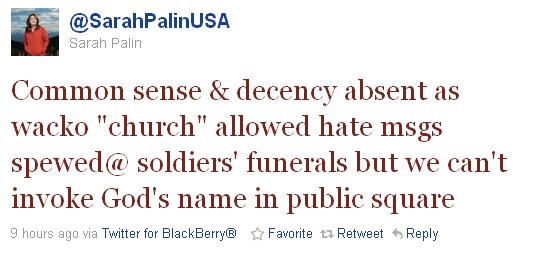
Former Alaska Gov. Sarah Palin clarified remarks posted on Twitter this week in response to a Supreme Court ruling in favor of a church that demonstrates at military funerals, saying she was making a point about a double standard on free speech, not that the group shouldn’t have the right to protest.Her quote was interpreted by many news outlets, including The Daily Caller, to mean that she disagreed with the Supreme Court’s ruling, although in a new statement exclusive to TheDC, Palin said she agreed with the ruling in favor of the church.

“Obviously my comment meant that when we’re told we can’t say ‘God bless you’ in graduation speeches or pray before a local football game but these wackos can invoke God’s name in their hate speech while picketing our military funerals, it shows ridiculous inconsistency,” Palin told TheDC. “I wasn’t calling for any limit on free speech, and it’s a shame some folks tried to twist my comment in that way. I was simply pointing out the irony of an often selective interpretation of free speech rights.”

Oh, of course. Obviously when she said that “common sense and decency” were absent on the occasion of the SCOTUS ruling, that didn’t mean she disagreed with the ruling.  How silly of us to think that.  No, Sarah Palin doesn’t want to limit free speech– she wants more of it!  You know, the kind of free speech that allows public school officials to speak on behalf of students to express their religious convictions, whether the students actually hold those convictions or not.  But only Christian convictions, I assume– not to put words in Palin’s mouth, but I would tentatively guess that she wouldn’t be so enthusiastic about school officials offering Muslim prayers at graduation or before a football game.

The students, of course, retain their freedom to pray to whomever and invoke whichever god’s name they want on these occasions.  So yes, I suppose you could call that a “selective interpretation”– it selects in favor of the freedom of students rather than the “freedom” of government representatives (which is what public school officials are) to speak on their behalf.  It’s a pretty clear distinction, one would think.  But I guess we shouldn’t be surprised that Palin doesn’t quite get it, considering that she said Dr. Laura Schlessinger’s cancellation of her own radio show meant that Schlessinger’s First Amendment rights had “ceased to exist.”

So, for those keeping score– criticizing someone’s speech means that their right to free speech has ceased to exist.  Unless you’re Sarah Palin criticizing someone, in which case you are exercising your freedom of speech to question why there isn’t more freedom, including the freedom of governmental officials to make religious pronouncements on behalf of children, which for some reason is the same as “invoking God’s name in the public square.” Got it?

Speaking of what makes people laugh becoming a moral issue…

Speaking of what makes people laugh becoming a moral issue… published on No Comments on Speaking of what makes people laugh becoming a moral issue…

this is pretty much the definition of it.

I’m not sure if I want to write a full-fledged post on this topic or not.  As you can see from that timeline it’s a controversy that has been going on since August of last year with frequent twists and turns, and no shortage of different perspectives– but then that’s always the case, isn’t it? There are almost never just two sides. I think some timeless truths about online disputes can be drawn from it, though.  Such as:

  • It’s hard to overestimate the ability of gamers to be arses, particularly of the misogynistic variety.  And I say this as a person who loves to play the video games herself, but the community does have its share of misogynerds.  (I just learned that term today, and this will probably be the only time I use it.  But it’s fitting now, if ever)
  • Reasonable people may disagree, but they don’t threaten violence.  That’s an automatic and permanent revocation of one’s credibility card.  
  • As a debate about the value of something said on the internet continues, the probability that someone will interpret objections as threats to freedom of speech approaches 100%.  
  • Real or effective online anonymity plus an audience doesn’t turn everyone into total fuckwads, but it inevitably works like a charm for some.  

Should we be surprised?

Should we be surprised? published on No Comments on Should we be surprised?

So Rock Beyond Belief has apparently been canceled.  All of that time and effort put into creating a secular concert and expecting the military to honor its agreement to support the show to the same extent that it supported a Billy Graham evangelical event before, and it’s not going to happen.

“It’s heartbreaking,” said Sgt. Justin Griffith, who announced the cancellation in a Thursday letter to Col. Stephen Sicinski, the garrison commander at Bragg. “I’m personally invested in this, both in money and time. And now I feel like I’ve strung people along.” 

As Ed Brayton (scheduled to emcee the concert) says, Griffith didn’t string anyone along– Fort Bragg leadership did.

Plans for the Rock Beyond Belief concert, which was planned to include famed British atheist Richard Dawkins as its keynote speaker, began last fall, after an event on the post called Rock the Fort. That event, sponsored in part by the Billy Graham Evangelistic Association, was criticized by groups like Americans United for the Separation of Church and State as an attempt to evangelize not just soldiers, but civilians, who could also attend the show. Military leaders said at the time they would support similar events by non-Christian groups, a promise reiterated in a letter last month from the Office of the Staff Judge Advocate at Bragg to the Freedom From Religion Foundation. “Fort Bragg continues to be willing to provide the same level of support to comparable events proposed by non-federal entities,” wrote Lt. Col. Nelson Van Eck Jr. Griffith and other organizers say that changed abruptly this week, when they were told that they couldn’t have the large outdoor gathering with games and activities they had planned. Instead, they were told the event could take place at one of two indoor theaters, with the larger one accommodating about 700 people. In his letter to Sicinski, Griffith also says the base declined to cover any of the costs for Rock Beyond Belief, while it paid $54,500 toward the Christian event. Griffith also says he was told that any advertisements for the secular event would have to carry disclaimers that the concert wasn’t endorsed by Bragg, while the Christian event was explicitly endorsed by the post. A military chaplain, for example, had sent out letters on Army stationary to area Christian pastors asking for their assistance in running the Christian concert. Because of the disclaimer, the financial support and the venue change, Griffith said, the concert he planned wasn’t able to go forward, which has left him disappointed and frustrated. “This happened at the last minute,” he said. “I just don’t know how to pursue this further without litigation.”

Ed comments:

And litigation is being prepared by the Military Religious Freedom Foundation. The fact is that this was a test from the start, a test of the military’s promise that they would treat a non-Christian event the same as they treated the previous Christian one. And the military failed that test. We know from FOIA requests that the base paid tens of thousands of dollars in support for the Billy Graham event and they are now refusing to do the same for our event. I’m disappointed, of course, because I was really looking forward to hosting the show. But perhaps a lawsuit is what it will take to put a stop to the military’s constant promotion of religion.

Memo to Sarah Palin…

Memo to Sarah Palin… published on No Comments on Memo to Sarah Palin…

Umm, both your and Westboro’s wacko pronouncements in the public square (such as, for example, this very tweet) invoke God’s name on a regular basis.  They got sued for it; you didn’t.  It appears their liberty to be religious in public is more in danger than yours is.

First Amendment and irony comprehension fail.  But you have to love someone who complains that they’re not allowed to do something as they’re doing it.

The fallacy being applied by this particular politician is….. *drumroll*….. equivocation, combined with a bit of false analogy.  First of all, simply invoking God’s name in the public square hasn’t gotten either the WBC or Sarah Palin in any kind of trouble.   In fact, doing so is pretty much a requirement for both churches and conservative politicians alike, hmm?  Oh, I’m sorry– “church,” in scare quotes, says the woman whose own church invited a witch hunter to come and bless her.  Second, for Sarah Palin the word “can’t” means that somebody, somewhere, will have a negative opinion of her for doing something.  For Westboro, regardless of how you might view their beliefs and practices, it means they might be out $5 million.   A tiny bit of a difference, there?  Perhaps.

SCOTUS rules in favor of Westboro on funeral protests

SCOTUS rules in favor of Westboro on funeral protests published on No Comments on SCOTUS rules in favor of Westboro on funeral protests

The Supreme Court ruling on Snyder v. Phelps was issued this morning– 8-1 in favor of Phelps, saying that the First Amendment protected the WBC’s right to protest the military funeral.  I couldn’t have imagined it going any other way, but there was still a niggling worry that it might.  The opinion, authored by Roberts with Breyer concurring, notes that the protest was taking place on public land, roughly a thousand feet from the church (as instructed by police), and none of the protesters entered the cemetery.  None of them interfered in the funeral in any way, and the plaintiff was not even able to read what their signs read until that evening when he saw them on a news broadcast.  The lone dissenter to the opinion, Justice Alito, disagreed mainly on the grounds that the protest took place at a time and location geared to garner maximal attention.  Which…isn’t that what protesters always do?

I’m very glad that this case went to the Supreme Court, and that this was the decision they delivered.  That doesn’t mean I have a shred of sympathy for Westboro or their supposed cause, but I do think that delivering a $5 million dollar judgment against a group protesting on public grounds without any violence or even cursing would set a very, very bad precedent in terms of freedom of speech.  From the opinion:

Given that Westboro’s speech was at a public place on a matter of public concern, that speech is entitled to “special protection” under the First Amendment.  Such speech cannot be restricted simply because it is upsetting or arouses contempt.  “If there is a bedrock principle underlying the First Amendment, it is that the government may not prohibit the expression of an idea simply because society finds the idea itself offensive or disagreeable.” Texas v. Johnson, 491 U. S. 397, 414 (1989).  Indeed, “the point of all speech protection . . .is to shield just those choices of content that in someone’s eyes are misguided, or even hurtful.”  Hurley v. Irish-American Gay, Lesbian and Bisexual Group of Boston, Inc., 515 U. S. 557, 574 (1995).   The jury here was instructed that it could hold Westboro liable for intentional infliction of emotional distress based on a finding that Westboro’s picketing was “outrageous.” “Outrageousness,” however, is a highly malleable standard with “an inherent subjectiveness about it  which  would allow a jury to impose liability on the basis of the jurors’ tastes or views, or perhaps on the basis of their dislike of a particular expression.” Hustler, 485 U. S., at 55 (internal quotation marks omitted).  In a case such as this, a jury is “unlikely to be neutral with respect to the content of [the] speech,” posing “a real danger of becoming an instrument for the suppression of . . . ‘vehement, caustic, and sometimes unpleasan[t]’ ” expression.  Bose Corp., 466 U. S., at 510 (quoting New York Times, 376 U. S., at 270).  Such a risk is unacceptable; “in public debate [we] must tolerate insulting, and even outrageous, speech in order to provide adequate ‘breathing space’ to the freedoms protected by the First Amendment.” Boos v. Barry, 485 U. S. 312, 322 (1988) (some internal quotation marks omitted).   What Westboro said, in the whole context of how and where it chose to say it, is entitled to “special protection” under the First Amendment, and that protection cannot be overcome by a jury finding that the picketing was outrageous. 

Their conclusion:

Westboro believes that America is morally flawed; many Americans might feel the same about Westboro. Westboro’s funeral picketing is certainly hurtful and its contribution to public discourse may be negligible. But Westboro addressed matters of public import on public property, in a peaceful manner, in full compliance with the guidance of local officials. The speech was indeed planned to coincide with Matthew Snyder’s funeral, but did not itself disrupt that funeral, and Westboro’s choice to conduct its picketing at that time and place did not alter the nature of its speech. Speech is powerful. It can stir people to action, move them to tears of both joy and sorrow, and—as it did here—inflict great pain. On the facts before us, we cannot react to that pain by punishing the speaker. As a Nation we have chosen a different course—to protect even hurtful speech on public issues to ensure that we do not stifle public debate. That choice requires that we shield Westboro from tort liability for its picketing in this case.

ETA: Fred Phelps’ estranged son Nate, an LGBT activist who lives in Canada, does not support the decision.  I find that disappointing but not surprising.