Skip to content

Booth babes

Booth babes published on 2 Comments on Booth babes

Gizmodo takes ’em on:

At CES last week, in addition to all the gear and gadgets, there was something else on display: women. As with many trade shows—especially ones aimed at a male audience—CES was rife with booth babes. Yet when the BBC ran a story on the practice of hiring scantily-clad models to stand around booths and draw stares from wandering men, it found an interesting defender: Consumer Electronics Association president and CEO Gary Shapiro, the guy who puts on the biggest electronics trade show in the USA. “Well, sometimes it is a little old school, but it does work,” Shapiro tells the BBC. “People naturally want to go towards what they consider pretty. So your effort to try to get a story based on booth babes, which is decreasing rather rapidly in the industry, and say that it’s somehow sexism imbalancing, it’s cute but it’s frankly irrelevant in my view.” Cute? Irrelevant? “Imbalancing?” (Is that even a word?) I’m sorry. Would you care to try again, Gary? The reason his answer is so bothersome is because as the head of the CEA he is, in a very real sense, speaking for all of us in the technology industry. And that Mad Men bullshit doesn’t represent who we are as an industry anymore, and it certainly doesn’t represent what we should aspire to. Technology is about the future, and this attitude is from the past. Shapiro needs to retract those dismissive remarks. And if he’s smart, he’ll do more than simply that. He’ll get ahead of it. He’ll become the example of what to do, rather than what not. There are two issus at play here. First, there’s the gender issue. Women are under-represented in the tech sector. And while there are a thousand theories why that is, the one thing that is clear is that they aren’t underrepresented in society, and by extension, the marketplace. The argument that says CES should be geared towards men because men buy the most electronics ignores that women like gadgets too. If the industry keeps ignoring women in order to market towards men, it’s going to lose sales. If you can create a gadget that women like just as much as men (hello, iPhone) you have a hit on your hands. So why would you want to do anything that might discourage women from showing up? (And it’s abundantly clear that some women certainly are off-put by booth babes.) Why wouldn’t you want to know what a key demographic thinks of your product before it goes on sale? But the second issue is arguably more important. It’s the cluelessness. To demean the concerns about booth babes as “cute” and “irrelevant” shows a huge disconnect with, I dunno… this century. The drumbeat against booth babes grows louder every year. It isn’t going away, and will only get bigger. Other trade shows are at least addressing it, and the CEA should do the same before it finds 60 Minutes shoving a camera in Shapiro’s mug.

And this is right on the heels of a stereotype-debunking study that suggests women are more avid consumers of technology than men:

Women are more likely than men to purchase tabletslaptops and smartphones – three out of the four top consumer electronics categories, according to a new study.Parks Associates asked 2,000 consumers, ages 18 and older about their buying habits in the consumer tech space. The study, which was conducted in late 2011, asked men and women which products they intend to buy before January 1, 2012. Retailer HSN announced the findings on Monday at the 2012 Consumer Electronics Show. Women expressed more interest in tablets (18%), laptops (20%) and smartphones (20%). Only 15% of men planned to buy a tablet, while 14% sought a laptop and 17% intended to buy a smartphone. The only category in which men surpassed female interest was flat screen LCD TVs, with men (19%) favoring the sets over women (17%). “The tech industry has long been dominated by men — even at CES — but women are really the powerhouse in the household driving purchase decisions,” Jill Braff, executive VP of digital commerce for HSN, told Mashable. “Women are highly engaged with the latest and greatest gadgets and technology.”

PAX, the convention organized by Penny Arcade….founders? Authors? Guys? Jerry Holkins and Mike Krahulik, banned booth babes in 2010, while E3 (Electronics Entertainment Expo) appears to celebrate them.

Just speaking for myself…there might be more efficient ways to drive me away from wanting to learn more about and possibly buy a product than to have a “spokesmodel” promoting it, but that’s surely near the top.

Structurally unsound: video game women

Structurally unsound: video game women published on 2 Comments on Structurally unsound: video game women

I had a post started about a month ago about women in video games, but never finished so I’m going to revamp it now. I’ve been a gamer practically since birth, starting with a family-owned Atari 2600 (favorite game: Adventure) and continuing to present day (PC and Xbox). As with comic books, table-top games, and science fiction and fantasy in general (AKA geek culture), the video game genre has been largely produced by and for heterosexual men since…well, forever. There have always been some women involved on both ends and that number is ever-increasing, however. This means that the questions of how women should create games, how they should be presented in them, and how female gamers should be perceived and treated is being debated more and more. As are, in turn, the same questions about queer players of all kinds.

Straight male privilege in video games takes many forms. If you play a specific humanoid character, it will usually be a male and rippling with muscles. If you play a female, she will usually be curvaceous (sometimes impossibly so– we’ll get to that in a minute) and wearing revealing, impractical clothes. Any females depicted, for that matter, will most likely fit that standard. If the game offers opportunities to form relationships with NPCs (non-player characters), they will generally be heterosexual. If the game is online and offers the opportunity for players to chat, the chat will contain sexist innuendo, people calling each other “fag,” describing beating an opponent particularly badly as “raping” them, and either fawning over or harassing players discovered to be female. I am not saying these things are ubiquitous– I’m saying they are general trends that female players must tolerate if they want to play. They can complain, but they will meet resistance from the majority every time. That doesn’t mean complaining is futile, just that effecting any change means having to wade through a lot of bullshit along the way. Privilege is, after all, unacknowledged by its nature. The advice blog Dr. Nerdlove observes

Y’see, one of the issues of male privilege as it applies to fandom is the instinctive defensive reaction to any criticism that maybe, just maybe, shit’s a little fucked up, yo.  Nobody wants to acknowledge that a one-sided (and one-dimensional) portrayal of women is the dominant paradigm in gaming; the vast majority of female characters are sexual objects. If a girl wants to see herself represented in video games, she better get used to the idea of being the prize at the bottom of the cereal box. If she wants to see herself as a main character, then it’s time to get ready for a parade of candyfloss costumes where nipple slips are only prevented by violating the laws of physics. The number of games with competent female protagonists who wear more than the Victoria’s Secret Angels are few and far between. The idea that perhaps the way women are portrayed in fandom is a leetle sexist is regularly met with denials, justifications and outright dismissal of the issue. So regularly, in fact, that there’s a Bingo card covering the most common responses. Part of the notion of male privilege in fandom is that nothing is wrong with fandom and that suggestions that it might benefit from some diversity  is treated as a threat.

In that post, Dr. Nerdlove goes on to analyze some of the characters in Batman: Arkham City. Here are some other places to see analysis of female characters in video games and video game art:

Escher Girls — Addresses physically impossible body types and poses depicted
Boobs Don’t Work That Way — Self-explanatory
Women Fighters in Reasonable Armor — Show examples of female characters in attire that makes sense

Ryan at Mad Art Lab was inspired by the latter blog to make his own post with suggestions about how to dress female fighter characters called Fantasy Armor and Lady Bits, and then another post which was what actually stimulated me to revive and continue this one: Rubber Spines and Bent Space. In it he delves into a possible biological reason why people find images of humans with impossible proportions and posed in impossible (or very unlikely) positions not only comprehensible but attractive. The most important part of the explanation to me is this, which I’ll quote at length because frankly he nails it:

2: Supernormal Stimulus
Why is it that artists are consistently and purposefully going to extra effort to put biologically unlikely characters in physically improbable positions? Well, because it’s effective.
I have heard rather a lot of women and a few men say with conviction that these images are not attractive. I will hereby declare that they are incorrect, at least partly. They are wrong, because they are attractive to me. They are attractive to all of the young men that I know who have purchased / sought out these images simply for their titillating qualities. I will concede, though, that them being attractive doesn’t make good rational sense. That is because they’re not appealing to a rational sense.
The poses and figures of women in things like this: 

Soulfire, Volume 2, Aspen MLT Inc.

are deliberately attempting to exaggerate the sexual characteristics of the character to elicit a reaction beyond what should be possible with a real human. This effect is called supornormal stimulus. In short, it plays on what we find attractive and then extrapolates beyond what is physically possible. Apparently, you can get geese really excited about volleyballs painted like their eggs because that must be the biggest, healthiest egg that was ever laid. The same thing works for sexual characteristics. We like large perky breasts, so make them defy gravity. We like large eyes, make them too big to fit inside a skull. A narrow waist and round hips are appealing, so remove some of that lower intestine and kidneys and shave off some of that pelvic bone. An arched back is a signal of sexual readiness, so a very arched back must indicate an unprecedented level of randiness. Moreover, given the fact that we will fixate on certain details and happily ignore gaps, they can show all of these features at the same time. If you twist a body in such a way as to show off the eyes, legs, waist, hips, breasts, shoulders and butt, you can get hit all of the arousal points simultaneously. A human being can’t accomplish these things, of course. Physics and biology put some limits on these attributes so that they never get beyond a certain point. Partly because of that, we’re not trained to easily recognize when they’ve gone beyond the “healthy, youthful” look into the “structurally unsound” area. However, artists are not bound by the constraints of reality and can therefore abuse them for market appeal. 

He goes on to describe what he sees as the ramifications:

3: Unforeseen Consequences What’s the harm in producing these images? The artists are producing something that people are buying. It excites the audience and everyone knows that it’s not real. So is there a problem? I argue that there are a couple of problems. 3.1 Desensitization
As with any stimulus, too much of it and you will numb to the effect somewhat. It’s like walking by a Cinnabon: If you only do it on occasion, the smell is intoxicating. If you do it regularly, you find it satisfying. If you work there, you barely notice it. So too with imagery. The first time you see something erotic, it makes your brain leak out your ears. In order to keep that level of arousal up, the stimulus needs to vary or increase. Anything less will seem bland in comparisson.
So an occasional glimpse at this sort of thing wouldn’t be bad. It would be like an occasional guilty pleasure, like a fine wine or chocolate. But if you’re surrounded by it, then it becomes routine. The supernormal stimulus can become the baseline. 3.2 Personal Image
Humans can’t be comic book characters. However, those characters are presented as an ideal. They’re more human than human, better in every way. However, unlike a well-toned athlete or the hottest kid in school, they’re an impossible goal. Some people will strive to look like those cartoons and that isn’t healthy. 3.3 The Feedback Loop
We are attracted to what we’re used to seeing. We generally like partners who are similar to what we were raised with. Media reacts to that demand and provides it in an exaggerated state to get us interested. When we begin to expect the exaggeration, they have to push beyond that to keep our attention.  This push-pull effect can drag the expected, default image of women in impossible directions over time. Troublesome, no?

Video games which allow you to customize your character, usually RPGs (role-playing games) often don’t even make it possible to play a female character with a realistic body. And if they do, they also provide options which are so off the charts in terms of supernormal stimulus that they make the more realistic options appear chunky and ugly by comparison. It has been my experience that female gamers typically want to play a character which is attractive. But what happens when they are presented with options including character that are impossibly attractive? They want to play those as well, both because we are of course also susceptible to supernormal stimulus, and because choosing a more realistic option can actually earn negative attention.

Character options for RPGs typically include the chance to choose your class (the kind of powers your character will have) and your race. The former will most likely determine how you dress (melee fighters need armor, of course, whereas magic-wielders can get away with wearing fabrics only and will likely be restricted to such) but the latter will determine your appearance, including body type. In some cases it is literally impossible to make your female character fat and/or small-breasted, not that most people would choose to play such an option. What’s interesting though is if you get as close enough to that as possible, achieving a body that would be at least average in real life, females of the race you’re playing will be called ugly. If the body of the race you’ve chosen is muscular rather than slight, females of the race you’re playing will be called ugly. Never mind how bizarre would be for someone with a body like Gisele Bundchen (5’11”, 125 lbs) to swing an axe with enough force to decapitate a minotaur.

Gamer evaluation: “Nice for a barbarian, I suppose,
but can you make her breasts bigger?”

This creates an interesting quandary for game designers. Male gamers want to be able to play characters who are big and strong. A slight build is acceptable for a mage, but if you’re going to play a fighter than piling on the muscles to the point of absurdity is just fine. But for every race, there have to be both male and female counterparts, so there has to be a female option for every barbarian/orc/troll/demon/brute-type creature. Even if no one’s going to play her, because nobody wants play a woman who looks large, lumbering and muscle-bound compared to the more dainty-but-physically-impossible options. “Nobody” is of course an exaggeration– there are some people who are quite happy to do so. They’re a distinct minority, and require a thick skin to deal with the ribbing they’ll get from other players both in-game and in conversation about the game elsewhere.

My suggestion would be, then, to avoid the supernormal stimulus. Of course if you’re going to have distinct races in a game they should differ physically, but please don’t give us an option to play Barbie-like characters who literally could not function if they manifested in real life, because that means we’re less likely to be penalized for not choosing to play them.  That doesn’t mean characters can’t be sexy– the real world, after all, is full of people with real-life sexy bodies. Maybe Gisele couldn’t battle a yeti, but I bet Gabrielle Reece or Venus Williams could do some damage. Beautiful women who are not, to use Ryan’s awesome term, structurally unsound. 
Another issue is attire– please don’t dress my badass hunter who needs to scramble through dungeon tunnels, leap over barricades, engage in melee combat, and sneak down hallways in a bustier, thigh-highs, and five inch heels. She doesn’t need these things in order to be attractive, and putting them on her anyway makes her ridiculous. Plenty of games either force your character to start out in his/her underwear before acquiring armor or at least make it possible to strip down to that state, but the underwear doesn’t need to be Victoria’s Secret. It doesn’t need to take the form of garments that have the primary purpose of being impractical. Yes, a video game is a fictional world, and a fictional world of supermodels fighting evil would be pretty amusing. Just, you know, call it that. Let us acknowledge that that’s what it is, and laugh, and not pretend it’s anything else. 
I referred to actual behavior between players in-game toward the beginning, but discussion of that will have to wait for other posts. Women in video games is an enormous topic, so this one will have To Be Continued.

RPGs and skepticism (Sunday fun post)

RPGs and skepticism (Sunday fun post) published on 2 Comments on RPGs and skepticism (Sunday fun post)

If you really aren’t interested in video games at all, you….probably won’t bother reading this post. But if you’re somewhat interested in them but don’t know much about them, you might not know that this weekend has been BlizzCon, the annual convention held in Anaheim, California by Blizzard Entertainment. Blizzard’s most famous and far-reaching games are Diablo, Starcraft, and most importantly for this topic, World of Warcraft.

A role-playing game, or RPG, is any game in which you’re expected to adopt the role of a specific character and control him or her throughout, advancing him or her in ability by leveling– accumulating experience points which make that character stronger, smarter, faster, wiser, etc. and therefore able to accomplish more difficult tasks and battle stronger adversaries. Dungeons and Dragons is the most famous table-top RPG, and World of Warcraft, I think it’s safe to say, is the most famous video game RPG.World of Warcraft is also an MMO (massive multiplayer online game), which means that your character is always interacting with those of other people in real time. In that sense the character represents you– the faction, race, gender, class, and appearance you choose are all used as information about you. Having made all of those choices, you can decide whether to role-play (always speak and act in game as if you are actually your character) or whether to talk about your character with some degree of remove.  Most people opt for this, whether by speaking explicitly in third person (“He/she,” “my character/toon,” or “(character’s name)”) or by speaking in first person but using game terms and clearly speaking as a player rather than a character. It’s common to see the two combined, as with a person saying something like “Is it more important for my rogue to have attack power or a better critical hit chance? I’m trying to decide which pair of boots will get me a better bonus.”

So obviously the degree of immersion varies a great deal. And it’s not a new topic for RPG gamers at all– it has been discussed to death, including for the purposes of armchair psychoanalysis: do people who play a character of a different gender secretly want to be that gender? Do they play a race that is more attractive (by human standards) because they want to be accepted, or an uglier one because they like being non-conformists? If they pick a plain ol’ human to play rather than something like an orc, does it mean they lack imagination, or are people who play orcs afraid to be themselves? And of course– are people who play races like human, elf, dwarf, or gnome (the Alliance faction in WoW) good, and people who play orcs, trolls, undead, and goblins (the Horde faction in WoW) bad?

“Class” is the term for the means by which your character defends him/herself and others against the world. Do your powers come mainly from armor and big scary weapons? From your ability to melt into the darkness and evade attacks against you?  Or perhaps from your ability to manipulate magic? Magic generally comes from two distinct sources– arcane (from energy existing in the universe which can be focused and manipulated) or divine (from, quite simply, the gods). Again, people like to psychoanalyze this choice– are you a rogue because you enjoy stabbing people in the back? A warrior because you’re a control freak? A mage because you’re physically weak and like the thought of summoning power from something else?

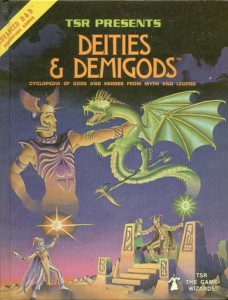
The magic aspect is what makes the Twitter exchange at the beginning of this post interesting. As you may be aware, PZ Myers and JT Eberhard are both atheists activists– very outspoken ones. Given that atheists joke all of the time about being evil to mock the public perception they are, it could be expected that they would be drawn to play the underdogs, the misunderstood, the commonly perceived as evil Horde. And given the rejection of supernatural powers of any kind, they could be expected to have no attraction at all to a class like Priest, who uses divine energy to heal other players but also to attack enemies. In Dungeons and Dragons when you play a priest– a cleric, as they are called there– you choose a god or goddess to serve, and those of us who have played remember fondly the book of Deities and Demigods which not only described and visualized countless gods both from existing mythologies and created especially for the game, but gave them in-game attributes and abilities. So, for example, you could decide to serve the Egyptian god Ptah, creator of the universe (alignment: lawful neutral), or perhaps the Norse goddess Freya, representing love and fertility (alignment: neutral good). I’m sure I’m not the only one whose interest in mythology as a kid was encouraged by this book.

In WoW, by contrast, the powers of a priest fall under the general category of Holy, and their description is as follows:

Priests are devoted to the spiritual, and express their unwavering faith by serving the people. For millennia they have left behind the confines of their temples and the comfort of their shrines so they can support their allies in war-torn lands. In the midst of terrible conflict, no hero questions the value of the priestly orders.

So in one RPG we have the existence of gods asserted, and their attributes described quite explicitly, whereas in the other it’s…well, a little more esoteric. WoW does have its own very complex assortment of demigods as well as some authentic deities, including Elune, goddess of the night elves. The races in WoW have their own cultural mythologies, but becoming a human priest (for example) does not require you to sign up for allegiance to anyone in particular. Nor does becoming a paladin (holy warrior), druid, shaman, or– in the next expansion– a monk. Mages and warlocks are also magic users, of course, but their powers come from either their own abilities specifically or harnessing the (often unwilling) assistance of demons. In this world, it’s more like a messy confluence of hierarchies of non-physical power….for basically everybody except warriors and rogues, and hunters for the most part, who rely either on either their own brute strength and agility or that of their pets.

So strictly speaking, ought not a skeptic who is determined to remain a skeptic in-game be suspicious of most of these classes?  Priests and paladins are the ones who connect their abilities most directly to divine power (because in the WoW universe, “healing” = “holy”), but almost everybody’s drawing on the supernatural in some way or another. The skeptic would, and should, ask: how do they know?

Well, it’s a game. A fictional universe– its terms are its own, and this game has gods, god dammit.

That’s one answer. Another answer is that in this universe, the power of spells has been repeatedly tested and applied, and found to exist, in one form or another. A skeptic, upon observing this happen or (ideally) performing the rituals and observing the results for him/herself, would be compelled to believe in the existence of….something. And of course, that “something” is the tricky part. How much would a scientifically-minded denizen of Azeroth be able to confirm, assuming he/she had the luxury to think on the matter intently in between fighting off incursions from the Horde or the Alliance (depending), as well as the multiple itinerant tribes, beasts, demons, elementals, and constructs roaming the land? His/her main concern, of course, is going to be for what works– what produces results. Most spells are performed to either damage an enemy or provide a buff (protection, fortification) to oneself or others. If the only way to achieve that effect is by using reagents and/or incantations in specific way, that can be tested and confirmed. Right?

But it can’t be confirmed as the result of divine power, and that’s the rub. Even in a world where mysteriously powerful beings exist, the infiniteness of their abilities still can’t be confirmed by finite beings. Which might be why, one could surmise, RPG designers (regardless of platform) don’t spend a lot of time or space proclaiming the “omni-ness” of the gods involved in them.

How not to deal with misogyny, gaming edition

How not to deal with misogyny, gaming edition published on 6 Comments on How not to deal with misogyny, gaming edition
Girls, keep out!

Let’s say you’re planning a big party. Unfortunately, when parties like the one you have in mind have been thrown in the past, they have tended to attract…well, some assholes. These assholes direct their ire to and about a certain specific group of people, and it can be really obnoxious, making others feel uncomfortable or even unsafe. You want to make sure that kind of thing isn’t going to happen at your party. So what do you do?

A) Announce in advance that assholery of any kind will not be tolerated, and enforce it by kicking out anyone at the party who insists on behaving that way.
B) Take note of assholes who have attended such parties in the past, and make an effort not to invite them.
C) Incentivise people of the group targeted by the assholes to attend, so as to create a disparity in numbers which encourages the assholes to keep their traps shut.
D) Some combination of the above.

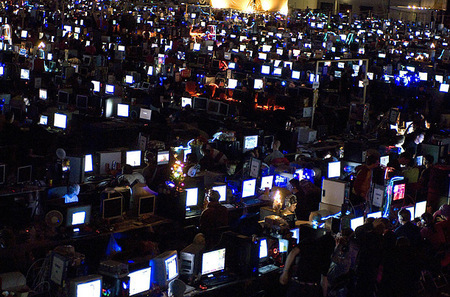
If you’re one of the organizers of an upcoming LAN party in Austin, Texas for Battlefield 3, your answer was…. E) None of the above! Announce that members of the group targeted by assholes are not invited to attend, for the sake of their own protection.

Yes, really. And as you can guess from this post’s title, the targeted group is women. From Owen Good at Kotaku:

Enthusiasts of military-style first-person shooters are not well known for their progressive thoughts on the matter of gender. The organizers of a large LAN party in Texas, scheduled to celebrate the launch of Battlefield 3, have decided the best way to deal with any slurs hurled at female gamers is to simply forbid them from attending. “Nothing ruins a good LAN party like uncomfortable guests or lots of tension, both of which can result from mixing immature, misogynistic male-gamers with female counterparts,” the organizers originally wrote in an event FAQ. “Though we’ve done our best to avoid these situations in years past, we’ve certainly had our share of problems. As a result, we no longer allow women to attend this event. This paragraph has since been removed, as the stink over the exclusion went viral, and replaced with: “This event is a ‘gentlemen’s retreat’; as such we do not allow women to attend.” Later, they clarified that with: “We actively discourage gamers from being the kind of mysogynistic jackwagons seen in the Reddit post, and such behavior should not be tolerated. Frankly, we don’t like that kind of player either. So far as this event goes, it is an special event designed specifically for male gamers. Further, it is meant as a getaway designed to help said male contingent become better men both for themselves and for those who love us.” This is a large, private event and its organizers certainly have the right to associate with whomever they please. But given what I usually hear over my headset in military shooters like Battlefield, I wonder if this party would so outwardly ban any black gamers from registering. Because it would be so, you know, uncomfortable to hear them being insulted. Or maybe the answer here is to forbid that kind of obnoxious behavior, and kick out anyone who breaks the rule, $49 registration be damned. Or maybe this event is more about the comfort of the organizers than the participants.

This is not the sort of event I would want to attend anyway, not being big on first person shooter (FPS) style games, let alone playing them with strangers who are known for their propensity to engage in aggressive smack talk throughout the game. That this is the general pattern of conversation for multiplayer FPS games is so well-known it is practically a truism. But as Good suggests above, insults to and about women are not the only kind of prejudice displayed in gamer put-downs. It’s not at all uncommon to hear racism and especially homophobia as well– would the LAN party organizers ban non-whites and/or gays as well, in the name of making those gamers who are allowed to attend “better”?  Doesn’t it seem a little odd on its face to keep the assholes and exclude the victims, for the sake of decreasing the levels of general assholery?

The Battlefield 3 party is being organized by Powers Gaming, which is a private organization so of course they get to make their own rules. And I have no doubt that they are genuinely interested in keeping the level of aggressiveness during gameplay itself to a minimum. But their chosen means of doing so amounts to creating a heckler’s veto— an institutionalized means for those who are willing to be obnoxious to penalize those who are not, while escaping any penalty for themselves.

Lesley at Two Whole Cakes sums up what is going on:

Since it’s been picked up by some blogs, the text has been changed to describe the event simply as a “gentleman’s retreat”, with a link to this site, in an effort to either elicit hilarity (that said men are trying to be better people by playing Battlefield 3 together) or to earnestly reframe the male-exclusive space as a positive thing. There is also some weird drama in which possibly-imaginary female attendees describe harassment at prior LAN parties put on by this group that may have never happened. Ultimately, the question of whether women have been egregiously harassed at past events — although it would seem to be implied by the original wording — is irrelevant to this post. All I want to unpack here is the original language in the original pre-drama announcement quoted above, because I think it demonstrates a lot of what is wrong with games culture in an especially clear way. The encoded, indirect message behind that text is this: We don’t want this to be difficult. We just want to play our games and not have to worry about forcing people to behave. We don’t want to think critically about what kind of ground rules would need to be laid down, how we would make them clear, and how we would enforce them, because that seems like a lot of work without any worthwhile payoff. We don’t want to be distracted by having to police our participants. We just want to play some motherfucking Battlefield 3, and have fun doing it. Because dealing with misogyny, racism, homophobia, or any kind of hate speech? It’s just not fun. So in the interest of making this event fun for the men and safe for the women, we’re just going to require that the women stay home. The idea that it is somehow “safer” to make the event male-only is problematic in that it reinforces the assumption that men are feral fucking animals who are incapable of controlling their allegedly natural chromosomal need to be assholes. It presupposes that getting dudes to treat women and other non-dudebro people like human beings is, at best, a huge imposition, or at worst, an impossibility.

Exactly. Yet again, such a characterization is not doing men or women any favors.

I do very much believe that, in addition to simply being regularly exposed to friendly interaction with members of a targeted group, the next best way to eliminate prejudice against that group is peer pressure. As in, having friends who are not members of that group say to you “Hey, that’s not cool. Saying things like that makes you sound like a douche, actually. And I know you’re not one, so cut it out.” But I’m under no illusions that that is at all what this Battlefield 3 “gentleman’s retreat” will be about.  It will be, quite naturally, about playing Battlefield 3. And that’s perfectly fine– that’s the reason the event is being held.  But it could still be about Battlefield 3 without preemptively excluding the people who are likely to get picked on while the bullies walk right in the door…presumably to conduct all of the bullying they care to do, since the parties most likely to be offended have been eliminated.

Or have they? How cool would it be if a certain number of guy gamers went to the event to stand in for the excluded girl gamers?  To apply a little peer pressure, while simultaneously not approving of the chosen format which makes it so much more important for them to fulfill that role?

Maybe I’m dreaming, in that regard. But it would be nice.

Tuesday links

Tuesday links published on No Comments on Tuesday links

Video game death

Video game death published on 3 Comments on Video game death

Boingboing produced this video montage of deaths in the old school age of video games (Atari and NES/Sega mostly, for you young’uns). Along with the memories, the music is actually what makes it– it has a serene yet wistful feeling, bringing to mind the monologue at the end of American Beauty as though it had been spoken by a video game character:

Sometimes I feel like I’m seeing it all at once, and it’s too much, my heart fills up like a balloon that’s about to burst… And then I remember to relax, and stop trying to hold on to it, and then it flows through me like rain and I can’t feel anything but gratitude for every single moment of my stupid little life… plus the three additional ones I earned in those dungeons on levels 5 and 7.

Speaking of what makes people laugh becoming a moral issue…

Speaking of what makes people laugh becoming a moral issue… published on No Comments on Speaking of what makes people laugh becoming a moral issue…

this is pretty much the definition of it.

I’m not sure if I want to write a full-fledged post on this topic or not.  As you can see from that timeline it’s a controversy that has been going on since August of last year with frequent twists and turns, and no shortage of different perspectives– but then that’s always the case, isn’t it? There are almost never just two sides. I think some timeless truths about online disputes can be drawn from it, though.  Such as:

  • It’s hard to overestimate the ability of gamers to be arses, particularly of the misogynistic variety.  And I say this as a person who loves to play the video games herself, but the community does have its share of misogynerds.  (I just learned that term today, and this will probably be the only time I use it.  But it’s fitting now, if ever)
  • Reasonable people may disagree, but they don’t threaten violence.  That’s an automatic and permanent revocation of one’s credibility card.  
  • As a debate about the value of something said on the internet continues, the probability that someone will interpret objections as threats to freedom of speech approaches 100%.  
  • Real or effective online anonymity plus an audience doesn’t turn everyone into total fuckwads, but it inevitably works like a charm for some.