|
| How would you feel if this man called you “babe”? |
Here’s a sticky one…or maybe not so sticky. Jo Walters writes in the Guardian about her experience of being called “babe” by a bus driver, and then her experience of how she has been viewed and treated following making a complaint about that:
In the past week I’ve been to the cinema twice (The Artist, and The Descendants – both fairly good), stocked up my fridge (meatballs and pizza on the menu this week) and arranged to catch up with friends. Oh and I’ve been called “an irate woman”, “a daft woman”, a “silly, silly woman” told I “must look like the old back of a bus”, to “Get a life!” and that “I need an operation, to remove the chip from [my] shoulder” – all by people I don’t know and have never met. What is my crime? Just politely contacting my local bus company to let them know that I don’t like it when their bus drivers use terms such as “love”, “darling” and “babe”. I pointed out that I generally find their drivers friendly and courteous but that when some of them use that language I find it demeaning. I wasn’t angry, I didn’t ask to make a formal complaint, I wasn’t trying to get anyone into trouble, I’m not trying to get anyone fired, I didn’t threaten legal action – I just thought they might like to know how the actions of some of their staff made me feel. I received a prompt and friendly response agreeing that it wasn’t really appropriate language and not something the company would condone. They promised to let drivers know that this sort of language isn’t appreciated and I didn’t really think much more of it until my local radio station, Brighton’s Juice 107.2 mentioned on Facebook that drivers had been asked not to call people babe. From there I spotted it in our local newspaper, the Metro, the Mail Online, found it was discussed on Loose Women and various local radio stations. The thing I find weird is that I don’t really think this is news; I just sent some feedback to a company. It seems that people find the idea that language can affect others a bizarre concept and that it is “just political correctness gone mad” (that gem came up a few times). Much of the coverage and comments paints me as some angry woman who should be grateful for the apparent compliment. I didn’t make it a gender issue; the coverage and comments did.
The thing is though, I personally find terms like “babe” coming from men to be overfamiliar, sexist and patronising. I’m allowed to interpret their words in that way, it doesn’t make me irrational or oversensitive. It doesn’t mean I don’t have a sense of humour or that I should be grateful for the attention. It is interesting to note that lots of the critical comments are from men.
I don’t think it’s that people find the idea that language affects others bizarre– it’s more likely that they either fail to understand the concept of benevolent sexism, fail to recognize benevolent sexism when they see it, or simply don’t agree that this counts. Why would anyone but a cold, angry, PC-obsessed woman fail to see being called ________ (“babe,” in this case) as flattering, or at least benign? What kind of person is offended by a compliment or a nicety?
Context matters, naturally. In this case the entire discussion is about context, but it’s important to point out a cultural difference specifically. I think most Americans would see it as a no-brainer that public servants– or indeed, anyone who works in customer service– should not call patrons/customers “babe,” but in the UK it’s not just kind old ladies in department stores who will refer to you in diminutives; it’s everybody. I didn’t mind hearing “Ta, love” from a ticket-taker on the train, and in fact found it nice, because I knew it’s something practically every ticket-taker says to practically everyone. It would make me sad if “Ta, love” went away, even though I no longer ride trains in the UK. So in that regard I can understand people being miffed about a crackdown on the kind of language bus drivers are allowed to use, except that “babe” seems to me to be fundamentally different (in England) from “love.” Here in the states, hearing either one from a male bus driver would probably seem equally inappropriate.
A male bus driver? Yes, because of course it’s a gender issue. Being called “honey” or “dear” by the old lady at the department store is a different beast from being called the exact same by a man in the same place, much less for example the DMV (the former being far more elective than the latter). The division between between a nicety and an inappropriate remark depends on who it’s coming from as well as where you are. And everyone seems to treat the matter of where that division lies the way Oliver Wendell Holmes famously described identifying pornography: “I know it when I see it.” Or in this case, hear it. One commenter on the Guardian article wrote:
I like it when I get called ‘bach’ which means little but is used like ‘pet’, by Welsh speakers in my local shops.
Feels like an endearment.
The writer should keep her outrage for the important issues.
If a bus driver calls you a ‘ho’ then complain by all means, but babe is used in a positive way by many people, girls call other girls babe all the time.
Using words like love, bach, pet, dear all help oil the wheels of social intercourse.
Rebuffing something said with good heart is just downright rude.
I didn’t see anything in Walters’ piece that sounded like “outrage,” but it’s not surprising to see her comments portrayed as such. Along with the sexism-specific trope of “You should find it flattering,” I wouldn’t be surprised if the term “outrage” was used more often to portray complaints of offense as irrational and hysterical (yes, that word used intentionally) than to describe actual reactions to wanton cruelty or gross violations of decency. When reacting to a complaint by someone that something is offensive which you find innocuous, it seems that the immediate response is to magnify the offense far beyond what was originally stated. I’m guilty of doing this myself all of the time, and it’s a hard urge to control. Why am I not doing it now? Because I don’t see a complaint about being called “babe” as a threat. I see the complaint as legitimate, but even if I didn’t it wouldn’t threaten my self-image to learn that in this case, someone finds something unacceptable that I don’t. Re-examining my assumptions, or examining them for the first time, wouldn’t be painful. Being intellectually humble is comparatively easy. It’s harder to be humble that way when you, or people you agree with and/or care about, are the source of the offense.
Notice I haven’t said that offense can’t simply be illegitimate. I certainly think it can, but would point out that our conclusions about such tend to be shaped by the effect the conclusion holds for our self-images. Ethical dissenters— and by that I mean, people who disagree with the majority for ethical reasons– are a living, breathing, practicing condemnation of what most people regard as normal or at least uncontroversial, and many find that disturbing. Understandably so, but the problem comes when the next step is to misrepresent the dissenters in order to deflect their grievance. This can be counted on to happen regardless of whether said grievance is legitimate or not. Simply speaking up about it is enough to set the wheels in motion.
A few other tropes from the comments:
Let me give you a tip. You always have a choice to take offence or not to take offence.
I strive never to take offence unless I’m absolutely certain that offence is intended.
AKA “Your offense is your own fault” coupled with “Your offense isn’t legitimate unless I’m offended too.” The feeling of offense absolutely is not a choice, but the expression of offense is, which the commenter conflates here. He/she has it precisely backwards in suggesting that one shouldn’t express offense if none is intended, because people who have been offensive inadvertently are the only ones who would care and want to change their behavior. People who have offended on purpose will be at best unaffected, and at worst gratified by the news that their arrows have hit their mark.
Spot on!
I can see that despite the friendly intentions behind it, the language is totally and utterly degrading.
Oh hang on a second… I can’t
You must be so much fun to be around!
AKA “Can’t you take a joke?” coupled with another “Intent is all that matters.” Certainly intention matters, but again– that’s why we kindly explain to Grandma that it’s not the best idea to use the word “negro” anymore, and to Junior that calling his gaming pals “fags” when he bests them in a game isn’t cool.
are you seriously expecting generations of people to re think how they speak?
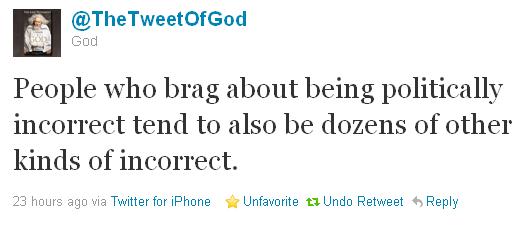
Yes, she is. This is the essence of political correctness; any word that someone, somewhere might find offensive must be eliminated, however harmlessly it was meant.
It’s all covered by that maddening word “inappropriate”. Inappropriate to whom? Also “unacceptable”. Unacceptable to whom?
Some self-righteous prude, that’s who.
Merriam-Webster defines a slur as “a: an insulting or disparaging remark or innuendo, b: a shaming or degrading effect.” I like that this definition includes both intent and effect, and doesn’t require that they be coupled. And yes, the process of discovering that certain language has the effect of degrading, dismissing, shaming, or trivializing people– that is, it amounts to a slur– and asking that it not be used on that basis is expecting generations of people to rethink how they speak. That’s sort of the point. Congratulations first commenter, you have grasped it!
I’m going to make some assumptions about the second commenter, but would bet money that they’re true: 1) he’s male (okay, his name is “Howard,” but I promise I didn’t look at that first), 2) white, and 3) straight. The grand trifecta of potential for dedicated ignorance of privilege and griping about political correctness. Which, if I were less of a person, would make me wish that he will be referred to as “babe” by every hulking male bus driver to enter his life forevermore.
But I’m nicer than that.
ETA: Okay, stop dancing for a minute while I clarify: No, I was not saying that white, straight, men are the only people with unexamined privilege, the only people who complain about political correctness, and certainly not the only people who can be prejudiced. Prejudice is, ironically, an equal-opportunity pursuit. I’m saying that the people most ignorant about privilege tend to be the ones who have the most privilege, which means you guys sitting at the top of the privilege pyramid: straight, while, males. I’m actually least certain about race amongst those three traits, since we’ve seen ample evidence recently of sneering at political correctness by a certain straight black male.
By all means, please resume dancing now.