Skip to content

Religion is and isn’t special

Religion is and isn’t special published on 1 Comment on Religion is and isn’t special
Passerotti, God the Father

The primary reason, it seems, that people are now telling Dan Savage that he shouldn’t have apologized– even in as qualified and precise terms as he did– is because it gives the impression that one should not criticize religious beliefs. And if one does so, and it offends, the appropriate thing to do is to relent and express sincere regret. The basic impression of someone who hasn’t dug into the details and/or prefers not to consider them is that Dan Savage insulted Christianity, Christian students were offended, and so Savage apologized to them. Examining the situation beyond that very superficial level reveals all three of these statements to be inaccurate, but people who are just fine with the idea of insulting religious beliefs are concerned to see Savage, ordinarily very much just fine with doing such himself, suddenly appear to acquiesce to those he disturbed. It looks like appeasement, like giving up legitimacy and rhetorical ground.

The “spell” referenced in the title of philosopher Dan Dennett’s book Breaking the Spell is not religion itself, but the protective aura of deference surrounding discussion of it. Dennett argues that if we aim to properly discuss the origins and effects of religion, we can’t be held back by barricades of etiquette which allow the description of religious beliefs and practices as true and/or moral, but not false and/or immoral. Further, we must reject the proposition that religion is a sui generis pursuit, noncontinuous with other kinds of human thought and behavior or even with other kinds of non-human animal thought and behavior. Does this mean saying religion is just like all other kinds of basic things humans– and even other animals– do? No, of course not. The fact that it has a name, constitutes a category, suggests that there are reasons for saying that some things people do, say, and believe are religious whereas others aren’t. However it’s also true that religious speech is a kind of human speech, religious behavior is a kind of human behavior, and religious beliefs are kinds of human beliefs. These are all things that humans conceive, live, and do with their human brains and their human bodies in their human societies and cultures. Studying the cognition of religion– the production and perpetuation of it in terms of how minds produce and perpetuate all other kinds of human activity– means starting with this recognition.

It sounds pretty basic and non-controversial, except when you consider that there are believers who are so certain of the one-of-a-kind, completely separate and special nature of their beliefs that they won’t even call them religion. Instead you get “I’m spiritual; not religious” or “Other people have religion; I have a personal relationship with Jesus.” To them, “religion” is the category of all of the failed, false, misguided attempts of humanity to reach the divine, whereas they have the real thing. To say otherwise is not only mistaken but offensive, precisely because this body of beliefs has been declared so very personal. You wouldn’t question out loud whether someone loves his mother, and for that same reason you shouldn’t question whether he loves his Lord– or how he knows he has a Lord in the first place. The problem is, of course, that loving someone is a highly subjective and emotional matter, whereas gods, spirits, ghosts, demons, souls, and any other entities which are supernatural but asserted to exist objectively are not. Whether God exists as creator of the universe and answerer of prayers, performer of miracles, and possible hater of gays is an objective proposition whose truth or falsity matters. The truth or falsity of the objective existence of all things matter, of course, but you’d think especially that of the supposed origin of life, the universe, and everything.

So claims of empirical truth that come from religion are just like all other empirical truth claims in terms of being subject to the same demands for evidence and justification. Atheists by definition are just people who don’t believe in any gods, but atheists who are also skeptics will point out that they disbelieve because they have searched for such evidence and justification and found them to be lacking. The case for God did not convince them. This is obviously not the entire story, however…atheists are not rational androids who simply  applied logic to the proposition that gods or the entirety of supernatural agents existing and then concluded that they don’t. Being human, atheists are subject to the same intuitions and biases that affect everyone else– and that’s where things get interesting.

See, there’s reason to believe that religion is intuitive….that we suspect and come to believe in the existence of “spiritual beings” because of ordinary features that come with being human. We are social animals, particularly keen to detect and discern the motivations of other creatures with agency. We anthropomorphize at the drop of a hat. We have an existential sense that makes questions like “What’s it all about, anyway? Why are we here?” seem not only sensical but important– especially in the face of crisis. We are incapable of knowing what it’s like to be dead, because there is no way to be conscious of complete non-consciousness (no, sleeping does not count), so accounts of life after death seem compelling and we speculate about what Grandma must be thinking and feeling or even doing right now, even though she passed on years ago. Participating in religious rituals makes other participants feel like family, even if they aren’t actually kin, and being willing to expend resources to do so presents a powerful signal to others of our commitment to the group. We tend to believe in a just universe— the idea that immoral acts must be punished and good ones rewarded, somehow in the fabric of existence if not through the justice systems humans have created. There is just all of this stuff that human brains are prone to do that makes belief in supernatural entities and moral codes likely, if by no means determined. And of course there’s the fact that each individual human born into the world doesn’t have to take on the responsibility of creating a religion from scratch– there is almost certainly one available for him or her, handed down from his or her parents virtually from birth.

Some recent research has indicated that more intuitive thinkers tend to be more likely to also believe in a personal god. An intuitive thinker is a person who tends to think with his or her “gut,” allowing feelings to guide conclusions about the rightness or wrongness or even truth or falsity of different propositions. Intuitive thinking is reflexive and quick, and– let’s be honest– how most of us think, most of the time. It’s not a bad thing; in fact without intuitions we would be utterly lost. We just don’t have the time to make all of the thousands of decisions we make in a day by taking a time out, sitting down, and pondering what to do while taking every possible factor into consideration, weighing the pros and cons, and making an inductively or deductively reasonable conclusion…which charitably but falsely assumes that that’s what we are inclined to do in the first place.

The human mind is designed to reason adaptively, not truthfully or even necessarily rationally.

It would be far too cut and dry to say that intuitive thinking is affective, feeling-based, whereas counter-intuitive thinking is…well, thinking-based, but let’s say that counter-intuitive thinking is more reflective. It’s slower and requires a little more effort. Well, a little effort, period, as opposed to simply allowing your first emotionally-laden conclusion to rule the day. It’s intuitive for a religious person to think about God as behaving more or less like a super-human— having amazing powers and knowledge, but still doing things like focusing on one thing at a time and using the most direct physical means to cause events. Having a gender, opinions, and emotions. That’s the “personal god” the most intuitive person is most likely to believe in. I like to say that religion is intuitive but theology is counter-intuitive– theology is where you will find descriptions of God as a genderless amorphous “ground of being” whose behavior (if you can call it that) is complex and ubiquitous. This god is ultimate, and by that I don’t mean “super awesome” but rather “distant and removed.” This is not a god who intervenes directly in human endeavors by means of causing either catastrophes or miracles in order to influence our behavior. That is a proximate, personal god, the kind of being Pat Robertson and the late Jerry Falwell would describe as punishing liberals every time a natural disaster or terrorist attack occurs. This is the god Rick Perry ordered Texans to pray to for relief from drought and threats to property rights, and who he, Michele Bachmann, Rick Santorum, and Herman Cain all believe told them to run for president. The god George W. Bush says told him to go to war.

You can probably guess the dangers I see in making God that personal, that proximate. But thoughtful theists generally recoil from it. They recognize the problems in claiming that God subverts human choices (“free will”) to specially punish or reward politicians, the enemies of fundamentalists, or football teams, not to mention directly cause or inhibit natural events such as tornadoes, tsunamis, or the processes of natural selection. Evolution is not a threat to a person who doesn’t demand that God be proximate. The plaintiffs in Kitzmiller v. Dover were mostly Christian, a couple of them even Sunday school teachers, but nevertheless they were branded atheists for supporting the teaching of evolutionary theory in public schools unqualified by disclaimers questioning its validity. From the perspective of someone who believes in proximate, personal, In-Your-Face God, everyone who isn’t might as well be a nonbeliever. And nonbelievers are the enemy.

This is the type of person who views critique of his or her religion as bullying or blasphemy, who places matters of faith off limits to critical discussion while simultaneously holding that God intercedes directly in world events in a perceptible ways on a regular basis– that is, that God’s existence, nature, and behavior are easily empirical matters. This is the type of person who, while virtually ubiquitous, must not be allowed to dictate the rules of the conversation. If they are, the definition of “respect” becomes “behave as though my beliefs are true,” when in actual fact a) it is possible to maintain that a belief– any belief– is false respectfully, and b) respect can and often should be abandoned when considering beliefs that are ridiculous and/or obviously harmful. It’s not a choice between understanding these beliefs and openly forming opinions about their truth or falsity, how morally acceptable or objectionable they are– we can and should strive to do all of the above. With these as a simultaneous goal, it becomes easier to identify when being critical crosses over into being an asshole and when being empathetic and understanding crosses over into being a doormat.

Religion is special.
And it isn’t.
Bullshit

Bullshit published on 2 Comments on Bullshit

In today’s news, a group of high school students were offended and walked out of a talk because they were told that they are too moral to do things like stoning women for being non-virgins on their wedding night or owning slaves. The person giving this talk called them cowards for doing so. When word of this event reached certain sources afterward, they loudly condemned the speaker for being a bully. The speaker then apologized.

Yes, I’m serious.

What, you want more details? Fine…

The speaker was sex advice columnist and gay rights advocate Dan Savage. The talk he was giving was about bullying of LGBT students and causes of such. And what happened was….well, just watch the video:

It’s important to actually hear what was said and done, yes, but mostly so that you can recognize the correct interpretation of what happened rather than what is being reported, which is that Savage went on an “anti-Christian tirade.” No, he did not. Nor did he go on an anti-Christianity tirade, or even really an anti-bible tirade. He did not bully Christian students, he didn’t abuse anyone, and– let’s note– he didn’t offend most of the Christian students in the room, at least not enough to make them walk out. I don’t find it likely that the loud cheers and applause when Savage dryly remarked “It’s funny, as someone who’s on the receiving end of beatings that are justified by the bible, how pansy-assed some people react when you push back” came from a group made up of all atheists, Muslims, and Jews. I think it included at least a few Christians who recognized how absurd it is to be offended at the suggestion that the Bible includes descriptions of and outright commands to do some silly or even horrible things, and modern Christians are content to leave such things to history rather than interpret them as rules for living today. And that if Christians can do that with stoning and slavery, they can do it with attacking homosexuals.

Because that’s what Savage said. Only he chose to describe those silly and/or horrible things as “bullshit,” which apparently was a bridge too far. Or at least I hope that’s what got so many outraged posteriors out of uncomfortable-looking conference hall seating. I hope it wasn’t a belief that it’s actually really unfortunate that we can’t stone fornicating women to death anymore, because such is God’s true and enduring will.

I realize that language was the primary concern that caused the movie Bully to ironically be rated as appropriate only for ears older than those of the victims depicted in the documentary. But really, no high school student hasn’t heard the word “bullshit” countless times. As the title of a popular long-running show on Showtime, it barely rates as profanity. But was it an inaccurate word for what Savage was describing? In his apology, he says

On other occasions I’ve made the same point without using the word bullshit…

We can learn to ignore what the bible says about gay people the same way we have learned to ignore what the Bible says about clams and figs and farming and personal grooming and menstruation and masturbation and divorce and virginity and adultery and slavery. Let’s take slavery. We ignore what the Bible says about slavery in both the Old and New Testaments. And the authors of the Bible didn’t just fail to condemn slavery. They endorsed slavery: “Slaves obey your masters.” In his book Letter to a Christian Nation, Sam Harris writes that the Bible got the easiest moral question humanity has ever faced wrong. The Bible got slavery wrong. What are the odds that the Bible got something as complicated as human sexuality wrong? I’d put those odds at about 100%. 

It shouldn’t be hard for modern Christians to ignore what the bible says about gay people because modern Christians—be they conservative fundamentalists or liberal progressives—already ignore most of what the Bible says about sex and relationships. Divorce is condemned in the Old and New Testaments. Jesus Christ condemned divorce. Yet divorce is legal and there is no movement to amend state constitutions to ban divorce. Deuteronomy says that if a woman is not a virgin on her wedding night she shall be dragged to her father’s doorstep and stoned to death. Callista Gingrich lives. And there is no effort to amend state constitutions to make it legal to stone the third Mrs. Gingrich to death.

…and maybe I shouldn’t have used the word bullshit in this instance. But while it may have been a regrettable word choice, my larger point stands: If believers can ignore what the Bible says about slavery, they can ignore what the Bible says about homosexuality. (The Bible also says some beautiful things that are widely ignored: “Sell what you possess and give to the poor… and come, follow me.” You better get right on that, Joel.) Finally, here’s Mark Twain on the Bible:

It is full of interest. It has noble poetry in it; and some clever fables; and some blood-drenched history; and some good morals; and a wealth of obscenity; and upwards of a thousand lies. 

 I’m not guilty of saying anything that hasn’t been said before and—yes—said much better. What is “bullshit” in this context but “upwards of a thousand lies” in modern American English? 

That part, at least, doesn’t sound very apologetic. What Savage was actually apologizing for is calling the students who walked out “pansy-assed,” which sounds like a pretty good description to me for rising up from one’s chair and walking out almost the moment a speaker even mentions your holy text in a discussion on atrocities that once were seen as acceptable but are now easily recognizable as abhorrent. That is what happened, and I’ve seen claims in a few places that the walkout was planned in advance, before Savage even hit the stage.

Hemant Meta’s discussion of this says that Savage should not have used the words “bullshit” and “pansy-assed” because they are alienating. Perhaps they are, but that isn’t necessarily an argument against using them. For one thing, the students Savage called “pansy-assed” were already feeling good and alienated. And I thought it pretty clever to use one of the predominate epithets hurled against gay men for the past few decades to describe a walkout in response to the suggestion that the bible is a source of bigotry and bullying. It’s not the source, however, as Meta surprisingly claims:

So did he go too far in talking about the Bible? Nope. If you’re a journalist covering this subject, you should know about the root cause of anti-gay bigotry: The Bible. I don’t know how anyone could give a speech like this without talking about religion.

“The Bible” ! = “religion.” It wouldn’t even be accurate to say that religion is the root cause of anti-gay bigotry, but it would be a lot closer. Many religions contain moral codes in which some notion of sexual purity and prescribed gender roles are important and therefore men who “act like women” and women who “act like men” by sleeping with members of the same sex are regarded as unnatural and profane. Ultimately, however, mistrust of any and all people who step outside of rigid gender roles is so widespread that I believe it precedes and is imported into religion by people who want to believe God not only shares but is the source of their bigotry. Indeed, you can’t– or at least, shouldn’t– give a talk addressing bullying and general mistreatment of gays without addressing how religion contributes to it. But that doesn’t mean holding all religious people solely accountable for homophobia, which Savage took great pains not to do. That was the point of noting that there are all sorts of things good religious people no longer believe or practice even if old doctrines say they should, because they (the people) are good. People who have been taught that God considers homosexuality sinful change their position on this all of the time, usually because they are actually exposed to the existence of homosexuals who are decent, kind, normal people who aren’t harming anyone.  “Therefore,” the non-homophobic religious person concludes, “I must have been given bad information about what God thinks is sinful in this regard. Surely in order to be considered sinful something must be harmful to someone, and homosexuality isn’t.”

The existence of this sort of person must be acknowledged and respected, and my hunch is that Dan Savage’s audience was largely composed of them. Those are the people who laughed when he said “The bible guys in the hall can come back now because I’m done beating up the bible,” because they knew he wasn’t really beating up the bible. And he sure as hell wasn’t beating up Christianity or Christians. He was beating up the notion that it’s acceptable to hypocritically discard other relics of religious hatred from 2,000 years ago because they don’t apply to how we should live today, but not when it comes to beating on the gays. And that’s a message for which nobody should apologize.

Weekend web readin’, special edition: religion in video games

Weekend web readin’, special edition: religion in video games published on No Comments on Weekend web readin’, special edition: religion in video games

From Game Front, Questionable Religious Content

Money quote:

The game industry as a whole sends a really ridiculous message when it backs away from religious commentary. It’s an industry where beheadings, total body disruption, overt sexuality and jokes about poo run rampant, but where everybody gets suddenly very timid and serious whenever religion is brought up. I hate this idea that you can cut off heads, you can shoot old people in the face, but you can’t ever mention a real world religion. That is an absolutely bloody ludicrous position for an industry to be in. If I had to choose between murdering a person or criticizing a Biblical story, I know which one I’d pick as the lesser of two evils. Yet the videogame industry has it the other way around — depictions of extreme violence are acceptable, depictions of religion being imperfect are not.

From Gamespot, Escape from Mount Stupid: Religion 

Money quote video:

From Lousy Canuck, Religion in video games: more problematic than reality?

Money quote:

There are most certainly video games that laud faith, that reward peaceful resolution to conflicts, that equate being good with being angelic and being evil with being demonic, that operate morality as a binary sliding scale where your choices are between saving the box of kittens, or exploding them with a fireball spell. These games reify the morality as set forth by the Abrahamic religions, as with the BioWare offerings, or they ignore it altogether to present a wholly secular system for punishment as with the Elder Scrolls games. And yet, in many or all of these fantasy offerings, these deities actually exist within the context of the game world. They have tangible effects on the plot and characters and leave evidence for the players to collect and use as they see fit. It is only in this way that video games’ depictions of religion are generally problematized. No religion here in the real world can make any such claim to evidence. Otherwise, religion’s influence on humanity (or whatever race exists in the particular game world) is pretty much described to a tee in every one of the games Perreault examined.

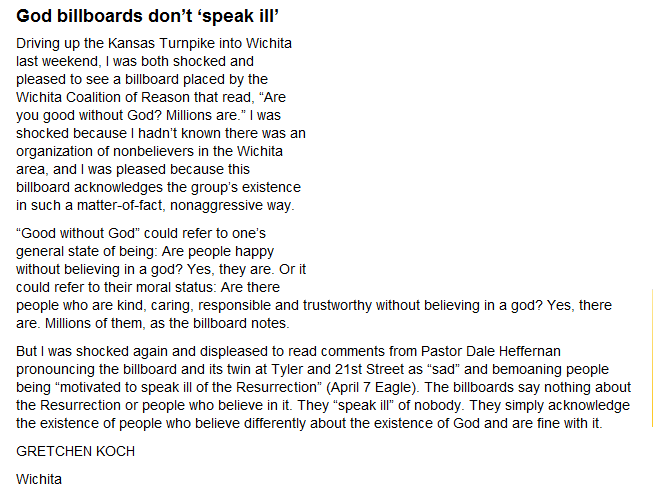
If I’m going to be in Wichita….

If I’m going to be in Wichita…. published on No Comments on If I’m going to be in Wichita….

…you can bet I will be writing letters to the editor:

If it’s not a battle, why make it one?

If it’s not a battle, why make it one? published on No Comments on If it’s not a battle, why make it one?

The ever-controversial American Atheists have erected billboards in Paterson, New Jersey (large Muslim population) and Brooklyn, New York (large Jewish population), respectively, with the following two messages:

Even though the CNN Belief Blog notes that AA president Dave Silverman says that the billboards are intended to reach atheists in these communities who feel pressured by those around them to conform to religious beliefs and customs, their title for the piece still claims that “Atheist group targets Muslims, Jews with ‘myth’ billboards in Arabic and Hebrew” and portrays the billboards as taking a step further in the “battle between atheists and believers.” Because that’s more exciting, I guess. Quote from Silverman:

“Those communities are designed to keep atheists in the ranks,” he says. “If there are atheists in those communities, we are reaching out to them. We are letting them know that we see them, we acknowledge them and they don’t have to live that way if they don’t want to.”

Hence writing the text both in English and in these languages. Reactions from Muslim and Jewish figures in these communities hover around irritation, amusement, and disdain, as you might expect:

Mohamed Elfilali, executive director of the Islamic Center of Passaic County, laughed when he learned the Arabic billboard would go up in the same town as his office. He says he’s surprised that someone is spending money on such a sign. “It is not the first and won’t be the last time people have said things about God or religion,” Elfilali says. “I respect people’s opinion about God; obviously they are entitled to it. I don’t think God is a myth, but that doesn’t exclude people to have a different opinion.” But Elfilali bemoaned the billboards as another example of a hyper-polarized world. “Sadly, there is a need to polarize society as opposed to build bridges,” he says. “That is the century that we live in. It is very polarized, very politicized.” The Brooklyn billboard is likely to raise eyebrows among Jews, in part because Orthodox Jews don’t write out the name of God, as the billboard does. “It is an emotional word, there will be an emotional response,” said Rabbi Kenneth Brander, dean of Yeshiva University’s Center for the Jewish Future. “People will look at it in a bizarre way. People won’t understand why someone needed to write that out.”

Except that the billboards aren’t intended for observant Jews and Muslims (ostensibly). They’re intended for atheists living in neighborhoods dominated by such people who are probably visibly indistinguishable from those who are observant, because they are afraid of backlash. I get it. In theory, at least, these are intended to be advertisements to give such people the message that they are not alone; that there are others out there who have seen fit to question and even abandon their religious faith. One major thing a lot of people wrestle with in this process is the feeling of having to give up the support structure that a religious community provides, and this is probably doubly, triply, a concern when your religion is a minority one. And, you know, when you live smack dab inside one of its enclaves. This is something that appears to have flown right by Elfilali and Brander, who can only interpret the billboards as directed toward the entire body of Muslims/Jews.

…Not that I can blame them, exactly, when the billboards say “You know it’s a myth.” I think that if the intent of the billboards is, as Silverman says, to reach out to specific people who have abandoned or are abandoning their faiths, the message would be made drastically more clear– and drastically less obnoxious– if it read “If you believe it’s a myth.” Here’s why:

1. It’s presumptuous, but more importantly often dishonest, to tell other people what they know. If you haven’t heard a prior statement from them claiming such, or witnessed them facing evidence that directly contradicts their belief, then you have no idea what they know regarding it. And even if you have been exposed to such things, you can’t quite be sure. Knowledge is justified, true belief. If people do not believe a thing, they cannot know it. If there is a possibility that a person is ignorant or mistaken, it is erroneous to claim that they know. People sometimes claim to believe what they know to be false, but to suggest that to an entire community simply because you believe (or even know) what they believe is false is an error. And an offensive one, because it accuses them of dishonesty in addition to ignorance/mistakenness.

2. “If you believe it’s a myth” sacrifices nothing in terms of epistemological grounding, and gains everything in terms of clarity and consideration. It doesn’t entail that the speaker loses any knowledge of whether the religion in question is a myth, but acknowledges that the listener (reader, in this case) may or may not believe it to be a myth. Indeed, that’s what determines whether the billboard is speaking to that particular individual or not. A person who does not believe that his/her religion is a myth might have use for an atheist organization according to the atheist organization, but probably not according to him/herself, so can safely ignore the message and– more importantly– need not be offended by it. After all, for every religious doctrine out there, there is someone who considers it mythological in the sense of not being true. A person who is offended by this fact would be just as offended by the existence of a billboard advertising for any other religion besides his/her own.

“If you believe it’s a myth” does not entail that a person can’t also know it’s a myth. After all, all of those who know also believe. But the use of the words “if” and “believe” would enable the billboard to more effectively pick out the members of these communities to whom it is ostensibly directed, and do so far less offensively without sacrificing its own viewpoint. Win-win, I’d say. And they should keep “And you have a choice,” because presumably that choice is about what to do regarding this view that the religion which predominates in one’s community is a myth. You believe it’s a myth; now what? Well, I guess you go to www.atheists.org and proceed from there, on your way to becoming a well-adjusted atheist.

JT Eberhard has a post up today saying that the billboards are an answer to “fatwa envy.” “Fatwa envy” is a term for the resentment some Christians voice when atheists are insufficiently (in the Christian’s view) critical of Islam, suggesting that the reason is that atheists refrain from such because they fear Muslims but not Christians. It’s masked as a complaint about inconsistency, but in this particular form is really a case of the Christian making the complaint ruing the fact that they aren’t as scary– that they can’t say “I’ll make you shut up” and have anything with which to back up that threat (whether that means Christian terrorists or laws against blasphemy, or both).

Sure, the billboards count as equal opportunity pissing off of religious people. I just don’t see any particular reason to piss them off in this case, view it to be a matter of incoherence of message and failure in logic, as well as counter-productive. Four counts against it, and none for it (at least, if you count this as an argument for altering the message rather than silencing it, which is the intent).

Eberhard then posts a couple of pro-religion billboards, one which depicts a boy with a gun aimed at you (the viewer) which reads “If God doesn’t matter to him, do you?”; the other simply asks “Where are you going? Heaven or Hell” with an enormous phone number underneath: 855-FIND-TRUTH (you can dial that; I sure am not going to). Yes, those are offensive– strangely enough, for much the same reason that the American Atheist billboards are. They all make unfounded, presumptuous assumptions about both the person reading the billboards and the beliefs (or lack of beliefs) they attempt to depict. There is no evidence whatsoever that if God doesn’t matter to a person, people don’t. None. Fail on that one, for a crap argument which offensively suggests that a person’s lack of belief makes them violent. The second billboard compounds the error of assuming what the reader knows with an outright (and ironically vague) threat: heaven or hell?  You’re going to one of them, for some reason, and we’re not saying why but we’re sure you know it! Or maybe I’m reading it wrong, and it’s a one-question quiz: Where are you going? A) Heaven, or B) Hell? That, I suppose, would make the acronym in the phone number at bottom make a lot more sense. However, in that case it assumes that you don’t know your eternal destination whereas whoever/whatever answers the phone can tell you.

So ultimately, bringing up those billboards amounts to a tu quoque: they’re doing it, so why shouldn’t we? The answer can be expected: Because two wrongs don’t make a right. Because not all offense is created equal. Some people are offended simply by being told that their beliefs are false, sure– the more important the beliefs are to them, the more offense is likely. But the A/A billboard claims that not only are religions myths, but that the person reading those words– who is more likely to be an actual observant Jew/Muslim than anything else– knows it. That’s justifiably offensive for reasons that I have already explained, and what’s more completely unnecessary. No better than telling someone they know that they are going to Hell, another version of asserting someone’s beliefs for them. Not nearly as bad as telling someone they’re likely to be a murderer because they don’t share your beliefs, or telling other people falsely that they are, I’ll grant. But still offensive, and pointlessly, counter-productively so. What’s to be gained from that, I really don’t know.

Marks of the cross that don’t rub off

Marks of the cross that don’t rub off published on No Comments on Marks of the cross that don’t rub off
Tattoo representing the Fourth Station: Jesus
meeting his mother

As mentioned previously, I’m a tattooed person. Not heavily so, but I’ve got ’em. I also have, after quite a lot of observation of other people’s tattoos and their explanations of why they got them, developed a schema regarding the central elements of getting a tattoo:

1) Placement: where does it go on your body, and how is it aligned?
2) Significance: what is its meaning, and how well is that conveyed?
3) Aesthetics: how good does it look, in the end?

These are weighted differently for different people, but they’re all important. Discount any one of those three, and you’re on your way to a bad tattoo. A highly meaningful, beautiful tattoo will very likely still be regretted if you get it in a place where you might later want to hide it but can’t, or it doesn’t work with your body. A beautiful tattoo in a good place that means nothing to you might be just fine if you’re already covered with other tattoos, but if it’s your only one or one of just a few, you might later wonder why you bothered getting it. A tattoo which is very important to you and in a good place but looks bad will leave you regretting that you didn’t choose to represent such a significant thought better.

With regard to meaning, it’s cliche that you shouldn’t get the name of a significant other tattooed on you. It’s tempting fate, practically foretelling the end of what was previously considered a rock solid, everlasting case of true love. I would even say that in most cases it’s probably not a good idea to get text tattooed on yourself, though there are exceptions. The name of a deceased relative or your child is probably pretty safe– the deceased relative is gone and cannot change (though I suppose you could discover something horrible about them posthumously, the likelihood of that seems small) and whatever happens with your child, he/she is still your child.

What about….your religion?

 In a hip, artsy, area of Houston, a hip, artsy pastor is taking an unorthodox approach to Lent.
Standing in front of his congregation at Ecclesia Church, a congregation he admits is different – more diverse, more urban – than many evangelical churches – Chris Seay encouraged them to do so something he said combines the ideas of sacrifice and devotion that mark the Lenten season, the 40-day lead up to Easter. He asked them to get tattoos. Specifically, he asked congregants to get a tattoo corresponding with one of the Stations of the Cross, the collection of images that depict scenes in Jesus’ journey to his crucifixion. “The tendency we have as Christians is to skip past Jesus’ suffering,” Seay said in an interview. “Not only do tattoos come with a bit of suffering, they are also an art form that has not fully been embraced.” To help with the project, Seay enlisted Scott Erickson, artist-in-residence at his church. Erickson designed 10 distinct Stations of the Cross tattoos, leaving out four stations that Seay said changed in context when you are asking someone to get something permanently drawn on their body.

So, not just religious tattoos (though those are numerous, in most religions you can think of as well as plenty more). Tattoos encouraged by your pastor, within specific parameters, applied by your church’s artist-in-residence. The article doesn’t say which four stations of the original 12 Stations of the Cross were left out because they change in context as tattoos, but I’m guessing “Jesus is stripped of his garments” is one of them.

It’s up to them, of course, but it doesn’t sound like the best idea to me. First, because people have been known to change religions, or deconvert entirely. Second, because even if they don’t change religion, they might leave this church. And if they do, they would leave it bearing a very specific mark that ties them to every other member of the congregation who likewise decided to participate in this. Third, because that’s a whole lot of constraint on the design and aesthetic quality of the tattoo that they might not have chosen for themselves otherwise. Individuals opt to get tattooed ritually– that is, to make a religious ritual out of the experience of getting tattooed itself– all of the time. But to make a proposition of such to a congregation on the occasion of Lent seems…well, pushy. Like some people might feel encouraged to get a permanent mark etched on their skin as a signal to pastor and/or congregation of their commitment, rather than as a signifier to themselves as individuals of the meaning of Jesus’ sentencing, suffering, death, and resurrection.

Other people can argue about whether getting a tattoo in the first place is fundamentally irreligious. I don’t believe it is. It seems to me that if people do something for the sake of religion, it can’t be irreligious by definition. I also don’t care to play No True Christian and take a side on whether it’s doctrinally appropriate for believers of the Bible to get tattoos (though there are comments on that in the article itself if you wish to play). The pastor (Seay) says he has dissuaded some congregants from getting tattoos after announcing the idea, though the article doesn’t discuss why.

The standard objection to tattoos is “How is that going to look when you’re old?” I’d say a much more important concern is “How are you going to think about that if/when you become a different person, or when others do?”

Jay Leno vs. some angry Sikhs

Jay Leno vs. some angry Sikhs published on No Comments on Jay Leno vs. some angry Sikhs

From BBC News:

A Leno skit showed the temple as the summer home of Republican presidential candidate Mitt Romney. Mr Romney has faced taxation questions over his huge wealth and many Sikhs are angry the temple has been depicted as a place for the rich. The Sikh community has launched an online petition and an Indian minister called the comments “objectionable”. Overseas Indian Affairs Minister Vayalar Ravi told reporters: “It is quite unfortunate and quite objectionable that such a comment has been made after showing the Golden Temple.” Mr Ravi said the Indian embassy would take up the matter with the US state department, the Press Trust of India reported. He said: “The Golden Temple is the Sikh community’s most sacred place… The American government should also look at this kind of thing. “Freedom does not mean hurting the sentiments of others… This is not acceptable to us and we take a very strong objection for such a display.”

The Golden Temple is….well, it is what you might expect: an enormous building, literally covered in gold. Harmandir Sahib in Amritsar, Punjab, India looks like a monument to ostentatiousness. Leno’s writers could have done a GIS for “fancy building” and picked the most impressive one that showed up, but part of the joke  I’m guessing in choosing to use the Golden Temple as Romney’s summer home is to suggest that he is obscenely wealthy. Not just well off, not just private jet rich, but affluent to the extent that it seems offensive. Profane. You know, like the kind of guy who would live in a monument to someone else’s religion if he found it sumptuous enough. Here’s the bit:

You have to admit, in comparison with the preceding photos of quite nice but not crazily impressive homes belonging to Gingrich and Paul, respectively (which I assume are their actual residences), following it up with what appears to be the fanciest building ever to exist and calling it Romney’s “summer” home is pretty funny. It’s funny in part because it doesn’t remotely even look like a home. Victoria Nuland, spokeswoman for the U.S. State Department, pointed out in a statement that Leno’s use of the photo is both a) Constitutionally-protected and b) obviously satire. And it was satire of Romney, not of Sikhs. But even if it was making fun of Sikhs, it’s still protected. That is because freedom of speech does, in fact, include “hurting the sentiments of others.” If it doesn’t, well…that hurts my sentiments. Further appreciation to Nuland for saying that the United States government respects India and its citizenry without saying that the it respects Sikhism.

The online petition organised by members of the US Sikh community says Leno has been guilty of derogatory comments on Sikhs before. It adds that “Jay Leno’s racist comments need to be stopped right here”. Petition signatory Simran Kaur says: “Jay Leno must apologise and promise not to make any direct or oblique references to Sikhs or their places of worship.” Leno has not yet commented on the matter.

Not being familiar with Leno’s show, I have no idea what “derogatory comments” this refers to. But if it’s simply making references to Sikhs or their places of worship, acknowledging that they exist, my question would be…why? Surely it would be worse to have your existence ignored?

I also don’t know what “objectionable comment has been made after showing the Golden Temple,” because so far as I can tell there was no comment after showing it– simply depicting it was the gag. I can’t help but wonder if Ravi and the community who organized this petition actually saw the bit in question and understand it.

ETA: From Ken at Popehat:

First up, we have Dr. Randeep Dhillon! Dr. Dhillon is suing Jay Leno. Is he suing Jay Leno for being a trite, phone-it-in placeholder? NO! There’s no California cause of action for that! SAG would never allow it! No, Randeep Dhillon is suing Jay Leno for a lame joke about Mitt Romney suggesting that his vacation home was the Golden Temple of Amritsar, a holy site for Sikhs! Dr. Dhillon says that by making this joke, Leno “exposes plaintiff, other sikhs and their religion to hatred, contempt, ridicule and obloquy because it falsely portrays the holiest place in the Sikh religion as a vacation resort owned by a non-Sikh.” He’s backed up by an Indian foreign affairs minister who says “freedom does not mean hurting the sentiments of others.” Congrats, Dr. Dhillon! You win a date with California’s robust anti-SLAPP statute! You’re going to pay Jay Leno’s attorney fees in this case, which I will estimate to be $50,000! And because some people will generalize about Sikhs based on the act of one asshole — you — you’ve just done more to expose Sikhs to hatred, contempt, ridicule, and obloquy than that threadbare hack Leno ever could! Way to go!

Pareidolia of the– hey, wait a minute….

Pareidolia of the– hey, wait a minute…. published on No Comments on Pareidolia of the– hey, wait a minute….

If you’re just too impatient to see Jesus or the Virgin Mary’s face appearing in bird poo, a cliff face, or a testicular tumor, for just $32 you can see one of them appearing reliably in an easily accessible location– your toast. Jesus and Virgin Mary toasters are apparently a hot commodity this holiday season, with 50 to 100 of the Jesus variety reportedly being sold daily by Vermont entrepreneur Galen Dively.

Fairly straightforward, huh? I thought the aura around Jesus’ head was a nice touch. Turns out the image is formed by an insert that slides into the toaster and can adjust the heat applied to imprint virtually any image on the surface of bread, from happy faces to peace signs (apparently the second most popular design after Jesus) to other religious symbols including the Star of David and the Hindu god Ganesh. I can’t help but think that in addition to most Americans not being Hindu, Ganesh doesn’t show up more often because it’s harder to detect an elephant face in a door or block of concrete than a human one. Hmmm…
Anyway, in CNN’s video interviewing people about the Jesus toaster, nobody appears offended by the product. Is that because they don’t view the deliberate placing of the face of the holy figure on a slice of toast as a mockery of the “real” incidences of it appearing in such places? Or because they do view it as such, but don’t care? I think it’s fair to call the toaster irreverent in that regard, but perhaps even more so in that as Ed Brayton points out, “nothing says religious piety like spreading peanut butter over your savior’s face.”
Don’t get me wrong; I love toast. But I think I’ll stick with plain ol’ boring evenly toasted bread, thanks.

Why Rick Santorum is wrong

Why Rick Santorum is wrong published on 2 Comments on Why Rick Santorum is wrong

The title of this post might sound a little obvious to most who might read it– Rick Santorum, wrong? Perish the thought! But I think it’s important to take a look at why he was wrong, specifically, when he said this in an interview with Piers Morgan:

I think just because we disagree on public policy, which is what the debate has been about — which is marriage — doesn’t mean that it’s bigotry. Just because you follow a moral code that teaches that something’s wrong doesn’t mean that — are you suggesting that the Bible and that the Catholic Church is bigoted? If that’s what you believe, fine. […] Well, I shouldn’t say — not fine. I don’t think it’s fine at all. I think that is contrary to both what we’ve seen in 2,000 years of human history and Western civilization, and trying to redefine something that has been — that is — seen as wrong…I think is in itself an act of bigotry.

Okay, let’s unpack. Santorum is saying that the Bible and Catholic Church cannot be bigoted because of “2,000 years of human history and Western civilization,” which could mean one of two things:

  1. Over the past 2,000 years, homosexuals have justified the belief that homosexuality is immoral, and therefore that belief is not based in bigotry.
  2. The Bible and the Catholic Church have maintained that homosexuality is immoral for 2,000 years, and therefore can’t be wrong. 
What is bigotry? A good definition would be: a determination to ascribe to a group of individuals a characteristic(s) which is/are not logically required by the characteristic(s) which they do actually have in common. This would include the belief that black people are untrustworthy, which is particularly noxious considering that skin color is a circumstance of birth, and we tend to be most offended by the insistence that a people must share some undesirable trait based on something they were born with and can do nothing (or almost nothing) about. But a trait doesn’t have to be a circumstance of birth in order for someone to form bigoted beliefs about it. If I said that people who like to play Dungeons and Dragons are idiots, that would be a bigoted claim on my part because there is no evidence at all to show that there’s a particular attraction between that game and people of low intellectual caliber, let alone a necessary connection. If there was a connection but it wasn’t absolute, then I would still be guilty of making a false generalization. But the more I insist that individuals in a group must share a negative quality because of something else that they have in common, the more offensive I become because of how much more unfounded my insulting statements clearly are.  
If the first statement– that time has justified the belief that homosexuality is immoral– was Santorum’s intended meaning, would it be a good defense? Maybe…if it were true. If, over a period of 2,000 years, we could observe that sexual intercourse between people of the same gender resulted in something catastrophic every time, it might be fair to say that it’s immoral. Say, if sex between two women caused nearby buildings to explode. That would be pretty bad. We would have good reason to tell those lesbians to cut that out, and think poorly of them if they refused to.* But of course, there is no foundation for such a belief. Sexual intercourse between two people of the same gender does not inevitably result in anything unfortunate happening. And what’s more, the Bible and the Catholic Church (I’m going to continue grouping them that way in spite of the distinctions a person might want to point out, because it’s part of Santorum’s claim) do not claim that homosexuality is immoral based on any such observation, over 2,000 years or two months. Rather they claim it by fiat on God’s part, which strongly suggests that this is not what Santorum meant.
So let’s assume that Santorum is in fact saying that the sheer length of time that the Bible and the Catholic Church have been claiming that homosexuality is immoral demonstrate that it is.  That the Bible has been claiming it for that duration isn’t exactly impressive– it’s a book, albeit one with a large number of translations and interpretations which nonetheless haven’t much altered the statements regarding the morality of sex between two men or two women. That the Church has maintained that homosexuality is immoral for that period of time, on the other hand, demonstrates….what, exactly? That the Church is tenacious in this belief. Does its tenacity demonstrate the truth of the belief? Not remotely. The claim that the sheer amount of time that you’ve held onto something demonstrates its worth or validity is an appeal to tradition, and it’s a fallacy.

So we see that the allegation that the Bible and the Catholic Church are bigoted for calling gays immoral is not rendered unfounded by the reality of homosexual intercourse being immoral or the fact that they’ve been making this claim for a very long time. Santorum’s last objection is to “trying to redefine something that has been seen as wrong.” In other words, he objects to people saying that a previously held claim of something being immoral is mistaken. Really? So is there no such thing as moral progress– society did not advance in any way by the willingness of people being willing to say loudly and clearly that slavery, for example, was wrong? After all, there was (and still is, in some parts of the world) a long-standing belief to the contrary. When miscegenation was legalized in the United States, there was definitely still a widespread and firmly held belief that that was wrong. Would Santorum argue that this “redefinition of something that has been seen as wrong” was therefore a bad thing?  I doubt it.

Finally, there is Santorum’s allegation that believing that the Bible and Catholic Church’s insistence that homosexuality is immoral constitutes bigotry is itself a form of bigotry. Well, Rick, show us your work please…because that doesn’t hold by the definition of bigotry I’m using, or indeed any definition I know. For a start, neither the Bible nor the Catholic Church are a group of people. The Bible certainly isn’t, and the Church is an institution with identifiable agreed-upon doctrines. It might be mistaken to say that the Church is bigoted, but that could not be a bigoted statement in itself simply by definition. And there is no association being made which could constitute correlating an unfounded trait with a unifying trait– nobody is saying that the Bible and the Catholic Church say _______, therefore they must consider homosexuality immoral and are therefore bigoted. They say openly that homosexuality is immoral, and that is being evaluated as bigotry.  Rightly so, I have argued, whether homosexuality is considered a circumstance of birth or not.

* If they agreed, however, and became sexually inactive or were willing to have sex with men instead, they would not cease to be lesbians. I know this. I am not at all combating the notion that sexual orientation is a matter of identity, not behavior. I am simply for the purposes of this post treating it as a behavior in order to point out that negative associations on that basis still qualify as bigotry.  

When is a pasta strainer not a pasta strainer?

When is a pasta strainer not a pasta strainer? published on 2 Comments on When is a pasta strainer not a pasta strainer?

An Austrian man, Niko Alm, was acknowledged the right of wearing a pasta strainer on his head for his driver’s license photo:

Pasta strainers are now considered suitable religious headgear in Austria … at least as far as the transport authorities are concerned. Three years after applying for a new driver’s licence, an Austrian man has finally received the laminated card. And the picture shows him sporting an upturned pasta strainer on his head.
Nothing to worry about: the authorities ruled the kitchen utensil was a suitable religious accessory for a Pastafarian. Niko Alm, an entrepreneur, told the Austria Press Agency he had the idea when he read that headgear was allowed in official pictures only for “confessional” reasons. The atheist says he belongs to the Church of the Flying Spaghetti Monster, a light-hearted “faith” whose members call themselves Pastafarians and whose “only dogma … is the rejection of dogma,” according to its website. Accordingly, Alm sent his application for a new driver’s license in 2008 along with a picture of himself with a colander on his head. The stunt got him an invitation to the doctor’s to check he was mentally fit to drive, but after three years, Alm’s efforts have paid off. He now wants to apply for Pastafarianism to become an officially recognised faith in Austria.

As you may recall, the Church of the Flying Spaghetti Monster began in the first place in relation to the controversy about teaching evolution in Kansas public schools. The idea was that if the schools are going to teach a particular religion’s origin story, they should have to teach everyone’s. The degree to which the story is ridiculous doesn’t matter, because in the eyes of the law religion is religion.

Since that time Pastafarianism has taken off as a pseudo-religion, to the point that there was actually a panel at the American Academy of Religion conference dedicated to it in 2007. They discussed it as a “new religious movement,” with little to no discussion about evolution or the law from what I recall, and very little about whether its adherents were/are actually serious.

I don’t know what Niko Alm thinks or knows about that, but since the article says that he’s an atheist I assume he intends to make another point about how religions are viewed by the state. Presumably in Austria religious headgear is the only kind of headgear you are allowed to wear in photos on official identifying documents. So the particular item’s form is not what matters– what matters is whether it is associated with a belief system revolving around supernatural entities, regardless of whether the person in the photo actually holds that belief system or not. Religion is an object of special treatment in the eyes of the law.

This, I assume, is why Alm is continuing in a crusade to have Pastafarianism to become an officially recognized faith in Austria– to make it explicit that literally anything could qualify for special treatment. And when anything qualifies, what does “special” mean anymore?