Skip to content

Religion going extinct? I doubt it.

Religion going extinct? I doubt it. published on No Comments on Religion going extinct? I doubt it.

The BBC reports on a paper recently presented at the American Physical Society meeting here in Dallas which makes claims about a decreasing level of religiosity in some parts of the world.  The paper, entitled “A mathematical model of social group competition with application to the growth of religious non-affiliation,” suggests that religion will effectively be extinguished in certain parts of the world just as certain languages die out due to lack of usage.  One of the paper’s authors elaborates:

“The idea is pretty simple,” said Richard Wiener of the Research Corporation for Science Advancement, and the University of Arizona. “It posits that social groups that have more members are going to be more attractive to join, and it posits that social groups have a social status or utility. “For example in languages, there can be greater utility or status in speaking Spanish instead of [the dying language] Quechuan in Peru, and similarly there’s some kind of status or utility in being a member of a religion or not.” Dr Wiener continued: “In a large number of modern secular democracies, there’s been a trend that folk are identifying themselves as non-affiliated with religion; in the Netherlands the number was 40%, and the highest we saw was in the Czech Republic, where the number was 60%.” The team then applied their nonlinear dynamics model, adjusting parameters for the relative social and utilitarian merits of membership of the “non-religious” category.

I’m skeptical.  The most obvious distinction that jumps out when comparing languages to religion is, at least to my knowledge, that at no point in history have people stopped using language.  They have stopped using specific languages in favor of other ones, just as they have stopped adhering to certain religions and converted to others.  But they haven’t cast religion aside. The study discusses how many people would answer that they are non-religious or have no religious affiliation, but that does not answer, as psychologist Bruce Hood points out, whether they have abandoned supernatural beliefs.  As I’ve mentioned before, there is a difference between being “non-religious,” being an atheist, and being a naturalist/materialist, and I don’t consider it accurate to say that religion has become “extinct” in a population unless its members fit the latter description.  Which, quite honestly, I don’t see ever happening.

Why be such a stickler about this?  Well, because when you talk to a person who says that she doesn’t consider herself to be religious (or worse, “non-affiliated”), digging a little deeper may reveal that she actually believes that the universe is God, that prayer and willpower cause wishes to come true, that everything happens for a cosmic reason, that casting spells works, and/or that everyone will be reincarnated after they die.  Her pantheism may disqualify her from being properly labeled an atheist, but the rest of it wouldn’t.  And even if she believes in none of those things she may well believe in ghosts, alien abduction, extra-sensory perception, Tarot-reading, and/or Reiki, which you might call secular supernatural ideas.  And to me, a god has more in common with a ghost than a cross has with a Tibetan prayer flag.  The latter two may both signify religious beliefs, but the former are both supernatural agents about which humans have a stunning number of intuitive beliefs in common.  That is, we use the same mental tools to conceive of and believe in them.

And if I’m right about that, then we will probably will carry on in these beliefs for as long as we have the kinds of minds that find them appealing.  I’m also not convinced that religious violence is fundamentally different in kind from any other violence which is rooted in a notion of a transcendent force which unifies one’s own group against whatever group(s) it views as threatening.  I don’t believe that it takes religion to make good men do bad things– or, for that matter, for bad men to do good.  I don’t see the extinction of religion specifically, even on a completely voluntary basis, as some kind of goal toward which we should all be striving.  Which is a good thing, considering that it probably won’t come to pass.

Unlike Hood, however, I do think we should strive toward rationality always, identify and eliminate bias wherever it can be found, and in general try to always have our skeptic’s hats on.  I consider supernatural thinking a mistake even if it’s an adaptive one. That doesn’t mean I have to single out people who think supernaturally as sui generis irrational, because we all do it occasionally.  And it certainly doesn’t mean I have to single out people who consider themselves religious as essentially thinking differently from, and/or worse or better than, everyone else.  
Helping vs. blaming in Japan

Helping vs. blaming in Japan published on No Comments on Helping vs. blaming in Japan

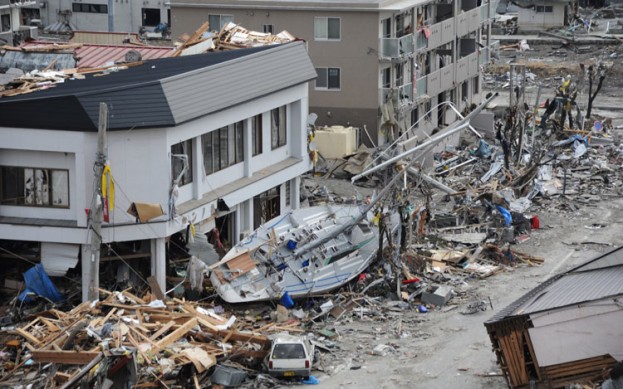
Over at Religion Dispatches Levi McLaughlin, a professor of religion who specializes in East Asian traditions, writes about Tokyo’s governor Shintaro Ishihara describing the tsunami that struck Japan as “divine punishment.”

Ishihara, a prize-winning novelist, stage and screen actor, and a populist hero of the Japanese right, has gained notoriety for his willingness to court controversy, but his take on the tragedy in northeastern Japan offended even his staunchest supporters. On March 14, just three days into the crisis, Ishihara told reporters that he saw the tsunami as “divine punishment,” or tenbatsu, a term usually employed in Japanese to describe a righteous and inevitable punishment of the wicked. For Ishihara, the tsunami produced by Japan’s largest-ever recorded earthquake was a means of washing away the “egoism” (gayoku in Japanese) afflicting the Japanese people.  While the Tokyo Governor said that he felt sorry for the victims, he concluded that “We need a tsunami to wipe out egoism, which has rusted onto the mentality of Japanese over a long period of time.”  Ishihara, who will seek a fourth term as Tokyo Governor in a 2013 election, apologized publicly the next day, following comments by Miyagi Prefecture Governor Yoshihiro Murai, leader of the prefecture closest to the quake epicenter. Murai condemned Ishihara and urged sympathy for the hundreds of thousands of victims suffering in northern Japan. Despite Ishihara’s expression of regret, his “divine punishment” comment lingers as the most widely known religious sentiment yet expressed by a high-profile Japanese public figure in reaction to the current crisis. It resonates with similar remarks made in the United States following disasters, such as those by Pat Robertson in 2005, who described Hurricane Katrina as divine retribution for Supreme Court Chief Justice John Roberts upholding Roe vs. Wade, or the televised conversation between Robertson and Jerry Falwell on September 13, 2001 in which they characterized the attack on the Twin Towers as God’s punishment for American tolerance of “abortionists,” gays, feminists and the ACLU. 

In his willingness to attribute this current natural disaster to divine influence, Ishihara joins the esteemed ranks of Glenn Beck, who was equally sure that a message was being sent but a bit less specific about what it was:

What God does is God’s business, I have no idea. But I’ll tell you this — whether you call it Gaia or whether you call it Jesus, there’s a message being sent. And that is, “Hey you know that stuff we’re doing? Not really working out real well. Maybe we should stop doing some of it.”

The need to believe that everything happens for a reason and that good will be rewarded with good while bad is punished by bad is called just-world bias, and it’s on full display here.  You could point out to Ishihara or Beck that the cause of earthquakes is actually plate tectonics which were set in place long before Japan was Japan, but the answer would almost certainly be “I know– and why do you think that was?  Why did it happen now?”  


Well, for reasons someone with more geological knowledge than I could doubtless explain, but that simply pushes the question back another notch.  There has to be an ultimate explanation in this thinking, and “That’s the way the world is” isn’t good enough.  It’s not hard to sympathize with this desire to find reasons behind it all, because having reasons makes it easier for us to cope– or at least, it seems like it does.  But when people try to draw a direct connection between a disaster and a punishment from some divine power it sounds an awful lot like blaming the victim, doesn’t it?  Strange how it’s so rare that you hear someone who has suffered due to a disaster saying “Yes, that was obviously God’s cosmic punishment for my behavior.”  No, it’s almost always somebody else’s suffering that was earned.  I wonder if Governor Ishihara counts himself amongst the “egotistical” people who needed to be taught this terrible lesson.  

On a brighter note, McLaughlin notes that the religious populations of Japan do not appear to be paying Ishihara much credence– they continue to help in relief efforts as they’re able:

Temples, shrines, and other religious facilities across the Tohoku region, and elsewhere, have been transformed into refugee centers. An article from March 16 on Asahi.com reports that the priest at the Rinzai Zen temple Jionji in Rikuzentakata village is housing 69 refugees who were treated by doctors and nurses from the Japan Red Cross. Seventy to eighty percent of the town’s 8000 households were wiped out by the tsunami. Jodo Shinshu, Japan’s largest traditional Buddhist sect, has cancelled plans for the 750th memorial of sect founder Shinran. Instead, the Shinshu priesthood has transformed head temple Higashi Honganji in Kyoto into a dispatch center for relief supplies. Temple staff members are loading water, food, and portable stoves into trucks to be sent to the afflicted Tohoku region, and they’ve turned their famous garden Shoseien into a center for fundraising; and this at a time when the 115 Higashi Honganji Jodo Shinshu temples in Iwate, Miyagi, and Fukushima Prefectures have been damaged, clergy in Sendai have been killed, and the sect is unable to make contact with seven temples. Meanwhile, leaders of the Pure Land Buddhist sect Jodoshu report that they’re unable to contact approximately twenty of the 300 sect temples in these prefectures; they’ve also assigned their headquarter staff to gather funds and supplies. Rinzai Zen headquarters in Kyoto have dedicated their staff to raising funds for emergency relief. The Soto Zen headquarters at Eiheiji reports that it has mobilized clergy to accompany members of its volunteer organization Shanti International Association who will travel to northeastern Japan to aid in relief efforts. Staff at the head temple of Nichirenshu, the largest sect of Nichiren Buddhism, is still contacting its temples in northeastern Japan, and it has cancelled all other activities in favor of fundraising. It’s likely that the leaders of every other traditional Buddhist denomination have dedicated their staff to raising money and gathering materials for earthquake relief. Shinto organizations have also pitched in. Shinseikyo, or the National Association of Shinto Youth, immediately established a “Disaster Policy Committee” responsible for fundraising and contacting Shinto priests in the disaster area. The Shinseiky message board is now filled with inquiries seeking contact with Shinto clergy in shrines that cannot be contacted and are most likely destroyed. Christians in Japan, who make up less than one percent of the country’s population, consistently initiate successful and high-profile social welfare activities, and they have leapt into action to provide relief. On March 12, mere hours after the quake and tsunami hit the Tohoku region, the YMCA in Kobe began soliciting relief funds; as an organization that survived the January 17, 1995 earthquake in western Japan and provided relief to residents in Kobe, they are eager to help victims of this latest natural disaster.

An observation

An observation published on No Comments on An observation

The video of TamTamPamela thanking God for the Japanese earthquake was all over the web yesterday.  I’m kind of disappointed in how willing people were to buy it without question.  Not because it’s a skepticism fail per se (I fall for Poes often– that’s the point of a Poe), but because they were so ready to believe that someone would be that hateful and already had their outrage pants on, good to go.

Guess I shouldn’t be surprised, as tragedy tends to magnify everything.  It’s probably unfair to think that there really are so many people out there who have no problem at all believing such a thing because their expectations of religious people are already that low, and it’s actually just that everyone’s nerves are on the surface.  I hope.

But we could do with a few less people pointing and saying “This is what religion does to you.”

TAM 9 speakers

TAM 9 speakers published on 3 Comments on TAM 9 speakers

The Amazing Meeting has announced its list of speakers for this year, its ninth meeting.  There are a lot of them, and quite a few– at least ten, from what I can tell– are people who can speak to the topic of how and why people believe weird things.  Or rather, why everyone isn’t skeptical all of the time.  That’s really encouraging.  If I were able to go, I’d make sure to attend those talks.  However accomplished a scientist or entertainer you are, I’m just not as interested in hearing how sure you are that ghosts and gods don’t exist and/or making fun of people who think they do.  That’s not to say that those topics don’t have their place, but they just don’t really grab me anymore.  Well, not unless the non-skeptical are trying to implement their non-skeptical beliefs via legislation or terrorism, in which case I’m definitely interested but it’s less about the lack of skepticism than about the use of force to push it.

But hey– it’s their meeting and I’m not going (can’t afford it), so who cares what I think?  It’s just nice to see skeptics being interested in the hows and whys regarding “woo” and not just the whats.

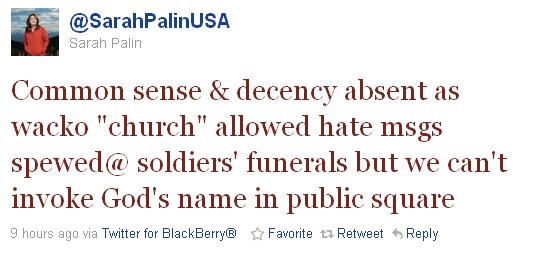
Palin clarifies– that she still doesn’t understand freedom of speech

Palin clarifies– that she still doesn’t understand freedom of speech published on No Comments on Palin clarifies– that she still doesn’t understand freedom of speech

From The Daily Caller:

Former Alaska Gov. Sarah Palin clarified remarks posted on Twitter this week in response to a Supreme Court ruling in favor of a church that demonstrates at military funerals, saying she was making a point about a double standard on free speech, not that the group shouldn’t have the right to protest.Her quote was interpreted by many news outlets, including The Daily Caller, to mean that she disagreed with the Supreme Court’s ruling, although in a new statement exclusive to TheDC, Palin said she agreed with the ruling in favor of the church.

“Obviously my comment meant that when we’re told we can’t say ‘God bless you’ in graduation speeches or pray before a local football game but these wackos can invoke God’s name in their hate speech while picketing our military funerals, it shows ridiculous inconsistency,” Palin told TheDC. “I wasn’t calling for any limit on free speech, and it’s a shame some folks tried to twist my comment in that way. I was simply pointing out the irony of an often selective interpretation of free speech rights.”

Oh, of course. Obviously when she said that “common sense and decency” were absent on the occasion of the SCOTUS ruling, that didn’t mean she disagreed with the ruling.  How silly of us to think that.  No, Sarah Palin doesn’t want to limit free speech– she wants more of it!  You know, the kind of free speech that allows public school officials to speak on behalf of students to express their religious convictions, whether the students actually hold those convictions or not.  But only Christian convictions, I assume– not to put words in Palin’s mouth, but I would tentatively guess that she wouldn’t be so enthusiastic about school officials offering Muslim prayers at graduation or before a football game.

The students, of course, retain their freedom to pray to whomever and invoke whichever god’s name they want on these occasions.  So yes, I suppose you could call that a “selective interpretation”– it selects in favor of the freedom of students rather than the “freedom” of government representatives (which is what public school officials are) to speak on their behalf.  It’s a pretty clear distinction, one would think.  But I guess we shouldn’t be surprised that Palin doesn’t quite get it, considering that she said Dr. Laura Schlessinger’s cancellation of her own radio show meant that Schlessinger’s First Amendment rights had “ceased to exist.”

So, for those keeping score– criticizing someone’s speech means that their right to free speech has ceased to exist.  Unless you’re Sarah Palin criticizing someone, in which case you are exercising your freedom of speech to question why there isn’t more freedom, including the freedom of governmental officials to make religious pronouncements on behalf of children, which for some reason is the same as “invoking God’s name in the public square.” Got it?

Should we be surprised?

Should we be surprised? published on No Comments on Should we be surprised?

So Rock Beyond Belief has apparently been canceled.  All of that time and effort put into creating a secular concert and expecting the military to honor its agreement to support the show to the same extent that it supported a Billy Graham evangelical event before, and it’s not going to happen.

“It’s heartbreaking,” said Sgt. Justin Griffith, who announced the cancellation in a Thursday letter to Col. Stephen Sicinski, the garrison commander at Bragg. “I’m personally invested in this, both in money and time. And now I feel like I’ve strung people along.” 

As Ed Brayton (scheduled to emcee the concert) says, Griffith didn’t string anyone along– Fort Bragg leadership did.

Plans for the Rock Beyond Belief concert, which was planned to include famed British atheist Richard Dawkins as its keynote speaker, began last fall, after an event on the post called Rock the Fort. That event, sponsored in part by the Billy Graham Evangelistic Association, was criticized by groups like Americans United for the Separation of Church and State as an attempt to evangelize not just soldiers, but civilians, who could also attend the show. Military leaders said at the time they would support similar events by non-Christian groups, a promise reiterated in a letter last month from the Office of the Staff Judge Advocate at Bragg to the Freedom From Religion Foundation. “Fort Bragg continues to be willing to provide the same level of support to comparable events proposed by non-federal entities,” wrote Lt. Col. Nelson Van Eck Jr. Griffith and other organizers say that changed abruptly this week, when they were told that they couldn’t have the large outdoor gathering with games and activities they had planned. Instead, they were told the event could take place at one of two indoor theaters, with the larger one accommodating about 700 people. In his letter to Sicinski, Griffith also says the base declined to cover any of the costs for Rock Beyond Belief, while it paid $54,500 toward the Christian event. Griffith also says he was told that any advertisements for the secular event would have to carry disclaimers that the concert wasn’t endorsed by Bragg, while the Christian event was explicitly endorsed by the post. A military chaplain, for example, had sent out letters on Army stationary to area Christian pastors asking for their assistance in running the Christian concert. Because of the disclaimer, the financial support and the venue change, Griffith said, the concert he planned wasn’t able to go forward, which has left him disappointed and frustrated. “This happened at the last minute,” he said. “I just don’t know how to pursue this further without litigation.”

Ed comments:

And litigation is being prepared by the Military Religious Freedom Foundation. The fact is that this was a test from the start, a test of the military’s promise that they would treat a non-Christian event the same as they treated the previous Christian one. And the military failed that test. We know from FOIA requests that the base paid tens of thousands of dollars in support for the Billy Graham event and they are now refusing to do the same for our event. I’m disappointed, of course, because I was really looking forward to hosting the show. But perhaps a lawsuit is what it will take to put a stop to the military’s constant promotion of religion.

Memo to Sarah Palin…

Memo to Sarah Palin… published on No Comments on Memo to Sarah Palin…

Umm, both your and Westboro’s wacko pronouncements in the public square (such as, for example, this very tweet) invoke God’s name on a regular basis.  They got sued for it; you didn’t.  It appears their liberty to be religious in public is more in danger than yours is.

First Amendment and irony comprehension fail.  But you have to love someone who complains that they’re not allowed to do something as they’re doing it.

The fallacy being applied by this particular politician is….. *drumroll*….. equivocation, combined with a bit of false analogy.  First of all, simply invoking God’s name in the public square hasn’t gotten either the WBC or Sarah Palin in any kind of trouble.   In fact, doing so is pretty much a requirement for both churches and conservative politicians alike, hmm?  Oh, I’m sorry– “church,” in scare quotes, says the woman whose own church invited a witch hunter to come and bless her.  Second, for Sarah Palin the word “can’t” means that somebody, somewhere, will have a negative opinion of her for doing something.  For Westboro, regardless of how you might view their beliefs and practices, it means they might be out $5 million.   A tiny bit of a difference, there?  Perhaps.

SCOTUS rules in favor of Westboro on funeral protests

SCOTUS rules in favor of Westboro on funeral protests published on No Comments on SCOTUS rules in favor of Westboro on funeral protests

The Supreme Court ruling on Snyder v. Phelps was issued this morning– 8-1 in favor of Phelps, saying that the First Amendment protected the WBC’s right to protest the military funeral.  I couldn’t have imagined it going any other way, but there was still a niggling worry that it might.  The opinion, authored by Roberts with Breyer concurring, notes that the protest was taking place on public land, roughly a thousand feet from the church (as instructed by police), and none of the protesters entered the cemetery.  None of them interfered in the funeral in any way, and the plaintiff was not even able to read what their signs read until that evening when he saw them on a news broadcast.  The lone dissenter to the opinion, Justice Alito, disagreed mainly on the grounds that the protest took place at a time and location geared to garner maximal attention.  Which…isn’t that what protesters always do?

I’m very glad that this case went to the Supreme Court, and that this was the decision they delivered.  That doesn’t mean I have a shred of sympathy for Westboro or their supposed cause, but I do think that delivering a $5 million dollar judgment against a group protesting on public grounds without any violence or even cursing would set a very, very bad precedent in terms of freedom of speech.  From the opinion:

Given that Westboro’s speech was at a public place on a matter of public concern, that speech is entitled to “special protection” under the First Amendment.  Such speech cannot be restricted simply because it is upsetting or arouses contempt.  “If there is a bedrock principle underlying the First Amendment, it is that the government may not prohibit the expression of an idea simply because society finds the idea itself offensive or disagreeable.” Texas v. Johnson, 491 U. S. 397, 414 (1989).  Indeed, “the point of all speech protection . . .is to shield just those choices of content that in someone’s eyes are misguided, or even hurtful.”  Hurley v. Irish-American Gay, Lesbian and Bisexual Group of Boston, Inc., 515 U. S. 557, 574 (1995).   The jury here was instructed that it could hold Westboro liable for intentional infliction of emotional distress based on a finding that Westboro’s picketing was “outrageous.” “Outrageousness,” however, is a highly malleable standard with “an inherent subjectiveness about it  which  would allow a jury to impose liability on the basis of the jurors’ tastes or views, or perhaps on the basis of their dislike of a particular expression.” Hustler, 485 U. S., at 55 (internal quotation marks omitted).  In a case such as this, a jury is “unlikely to be neutral with respect to the content of [the] speech,” posing “a real danger of becoming an instrument for the suppression of . . . ‘vehement, caustic, and sometimes unpleasan[t]’ ” expression.  Bose Corp., 466 U. S., at 510 (quoting New York Times, 376 U. S., at 270).  Such a risk is unacceptable; “in public debate [we] must tolerate insulting, and even outrageous, speech in order to provide adequate ‘breathing space’ to the freedoms protected by the First Amendment.” Boos v. Barry, 485 U. S. 312, 322 (1988) (some internal quotation marks omitted).   What Westboro said, in the whole context of how and where it chose to say it, is entitled to “special protection” under the First Amendment, and that protection cannot be overcome by a jury finding that the picketing was outrageous. 

Their conclusion:

Westboro believes that America is morally flawed; many Americans might feel the same about Westboro. Westboro’s funeral picketing is certainly hurtful and its contribution to public discourse may be negligible. But Westboro addressed matters of public import on public property, in a peaceful manner, in full compliance with the guidance of local officials. The speech was indeed planned to coincide with Matthew Snyder’s funeral, but did not itself disrupt that funeral, and Westboro’s choice to conduct its picketing at that time and place did not alter the nature of its speech. Speech is powerful. It can stir people to action, move them to tears of both joy and sorrow, and—as it did here—inflict great pain. On the facts before us, we cannot react to that pain by punishing the speaker. As a Nation we have chosen a different course—to protect even hurtful speech on public issues to ensure that we do not stifle public debate. That choice requires that we shield Westboro from tort liability for its picketing in this case.

ETA: Fred Phelps’ estranged son Nate, an LGBT activist who lives in Canada, does not support the decision.  I find that disappointing but not surprising.  

Sue Blackmore decides that religions are not, in fact, viruses of the mind

Sue Blackmore decides that religions are not, in fact, viruses of the mind published on 3 Comments on Sue Blackmore decides that religions are not, in fact, viruses of the mind

Sue Blackmore is one of the go-to voices in the UK on matters of religious thinking and consciousness. She is, believe it or not, an atheist with a PhD in parapsychology.  Originally a firm believer in the paranormal, she reached the conclusion in the course of her study that it doesn’t in fact have any scientific basis.  At that point she decided to find out what the mind really is capable of doing, which resulted in a number of books including the excellent (though steeply priced) Consciousness: An Introduction.

She is probably most famous for The Meme Machine, however, a book in which she takes the idea of the meme which Richard Dawkins proposed in his 1976 book The Selfish Gene (yes, it really was that long ago) and ran with it.  I don’t think most people who use the word “meme” these days really have any idea where the term originally came from and how it was formulated.  Some people don’t even know how to pronounce it, because they don’t realize it was intended to sound similar to “gene” in order to convey a similar means of propagation.  Genes, Dawkins wrote, have their own metaphorical interests which can be viewed as independent from ours in that they “desire” to be perpetuated  into the next generation.  In the same way, memes are ideas which “desire” to be spread as far and widely as possible.  Blackmore expressed this epidemiologically, comparing memes to viruses which need hosts that are most conducive to spreading them.  A memeplex is a conglomerate of ideas which are transmitted together because they are mutually supporting, such as a philosophical outlook or a religion.

As you can imagine, an idea’s interests that are independent from ours might well be also contrary to ours, which is what the word “virus” is intended to convey.  Viruses are not symbiotic with us– they manage to propagate at the expense of our health by making us sick.  In his 2006 book Breaking the Spell, Daniel Dennett compared religion to a lancet fluke which invades the mind of an ant, driving it to climb to the top of a blade of grass to be eaten by grazing animals, and didn’t seem to fully acknowledge how that analogy could be perceived as insulting to believers.  It smudged the line between being willing to die for worthy causes, of which martyrdom is perceived to be one, and being made to die pointlessly for someone/something else’s desires.  You might say “Well, that’s the entire point– the memes just make you think you’re doing something meaningful!”  Maybe so, but that’s assuming one’s conclusion.  Most of us would grant that some forms of self-sacrifices are in fact noble and not at all pointless, but both Blackmore and Dennett would say that those are caused by memes as well.  How do we determine which ones are virus- or fluke-like and which are not?

After attending an Explaining Religion conference at the University of Bristol, Blackmore says that she no longer views religions as viruses of the mind in the sense of being detrimental to their hosts. Why? Two main reasons:

1.  Michael Blume was able to show that religious people have far more children than non-religious people.
2.  Ryan McKay was able to show using experimental data that “religious people can be more generous, cheat less and co-operate more in games such as the prisoner’s dilemma, and that priming with religious concepts and belief in a ‘supernatural watcher’ increase the effects.”

To the first point a person could note that there are more important things in life than the number of one’s children.  True in a proximate sense, but not in an ultimate one.  If we’re evaluating the benevolence of a meme on an evolutionary scale, increasing reproduction is a clear advantage even if it’s not in the best interest of individuals or, indeed, the world itself.  To the second point, which is well-supported by a number of studies that have been performed over recent years, a person could dither about the degree to which being cooperative and honest should be counted as more a benefit to the individual or to the group, and then talk about whether it promotes in-group cooperation at the expense of creating inter-group hostility.

However, I’m not sure we really need to conduct either discussion.  Memetics is not the only way to examine religious ideas epidemiologically.  The advantage in looking at religion as a memeplex is that it emphasizes that religious ideas are transmitted between human minds just like any other ideas, but I think that Pascal Boyer manages to do that more effectively using his epidemiological approach because he doesn’t feel compelled to treat ideas as strict analogs to genes.  He tries to figure out first what should count as a religious idea, and then discusses which religious ideas are more likely to “stick” and which others are not, but not by attributing metaphorical interests to them.  That isn’t to say that Boyer doesn’t have his own ideas about whether religious ideas are on the whole more beneficial to us or more detrimental, but that question is not essential to his theorizing about what fundamentally makes an idea religious and likely to spread.  In fact, it’s quite irrelevant to that theorization.

I don’t think the matter of whether and when religion benefits humanity and when it harms us should be off-limits to scientific inquiry.  And even if I did, scientists are going to research those topics anyhow.  But it doesn’t seem appropriate to make a decision about the value of religion as a whole as part of your theorizing about how it works.  These studies which point out various ways in which being prompted to think religiously causes people to be better to each other are tightly circumscribed and specific.  I don’t think showing that people tend to behave better when they think they are being watched, for example, really says anything about the value of religious beliefs in general even if one function of religion is to perpetuate the idea that there is always someone watching.   This experimental data is important, but it’s also important to hold off on forming grand conclusions on the basis of a few studies.  It’s good that Blackmore has decided religion isn’t a mental virus, but that doesn’t mean it’s a mental panacea either.

Rock Beyond Belief

Rock Beyond Belief published on No Comments on Rock Beyond Belief

A secular-type person?  Going to be anywhere near North Carolina on April 2nd?  Then consider attending:

From a statement by the Military Associations of Atheists and Freethinkers (MAAF) on how the event originated:

On Sep 25th, 2010, Billy Graham Evangelistic Association held a concert on the Fort Bragg Main Parade Field. Attendance was projected by BGEA to be 10,000, but photos indicate closer to hundreds than thousands. Whatever the size, this event was specifically “evangelical in nature” according to the event site and letters sent to the community by the senior Ft Bragg chaplain. The photos also show that the Golden Knights parachute team performed at the event, which requires special military authorization. An included “Family Fun Event” has balloons and face painting targeted at children and the “God Rocks” children ministry. The prayer call associated with the event calls for soldiers to bring their “battle buddies”. The chaplain enthusiastically encouraged members of the local community to attend. New reports by the Freedom From Religion Foundation show the Army spent at least $50,000 of taxpayer funds on this event. . .On a positive note, the Ft Bragg commander’s letter offered “similar support to comparable events.” The fact is that only evangelical Christians would request an evangelical event, so there will be no request for a ‘comparable event’. MAAF would oppose an military promotion of religion or nontheist beliefs like atheism or Secular Humanism just as it does Christianity. That having been said, nontheists at Ft Bragg may request the opportunity to hold an event for themselves with no atheist “evangelical” purpose. The new Ft Bragg military group Military Atheists & Secular Humanists is planning an event titled Rock Beyond Belief. While any event held should not be a “me too” copy of this evangelical concert, nontheists do come together and local nontheists may accept the commanding general’s offer to host a nontheistic, non-evangelical event that has none of the Constitutional complications of Rock the Fort.

As noted on the poster, the event will be free for both military members and civilians.