Skip to content

RPGs and skepticism (Sunday fun post)

RPGs and skepticism (Sunday fun post) published on 2 Comments on RPGs and skepticism (Sunday fun post)

If you really aren’t interested in video games at all, you….probably won’t bother reading this post. But if you’re somewhat interested in them but don’t know much about them, you might not know that this weekend has been BlizzCon, the annual convention held in Anaheim, California by Blizzard Entertainment. Blizzard’s most famous and far-reaching games are Diablo, Starcraft, and most importantly for this topic, World of Warcraft.

A role-playing game, or RPG, is any game in which you’re expected to adopt the role of a specific character and control him or her throughout, advancing him or her in ability by leveling– accumulating experience points which make that character stronger, smarter, faster, wiser, etc. and therefore able to accomplish more difficult tasks and battle stronger adversaries. Dungeons and Dragons is the most famous table-top RPG, and World of Warcraft, I think it’s safe to say, is the most famous video game RPG.World of Warcraft is also an MMO (massive multiplayer online game), which means that your character is always interacting with those of other people in real time. In that sense the character represents you– the faction, race, gender, class, and appearance you choose are all used as information about you. Having made all of those choices, you can decide whether to role-play (always speak and act in game as if you are actually your character) or whether to talk about your character with some degree of remove.  Most people opt for this, whether by speaking explicitly in third person (“He/she,” “my character/toon,” or “(character’s name)”) or by speaking in first person but using game terms and clearly speaking as a player rather than a character. It’s common to see the two combined, as with a person saying something like “Is it more important for my rogue to have attack power or a better critical hit chance? I’m trying to decide which pair of boots will get me a better bonus.”

So obviously the degree of immersion varies a great deal. And it’s not a new topic for RPG gamers at all– it has been discussed to death, including for the purposes of armchair psychoanalysis: do people who play a character of a different gender secretly want to be that gender? Do they play a race that is more attractive (by human standards) because they want to be accepted, or an uglier one because they like being non-conformists? If they pick a plain ol’ human to play rather than something like an orc, does it mean they lack imagination, or are people who play orcs afraid to be themselves? And of course– are people who play races like human, elf, dwarf, or gnome (the Alliance faction in WoW) good, and people who play orcs, trolls, undead, and goblins (the Horde faction in WoW) bad?

“Class” is the term for the means by which your character defends him/herself and others against the world. Do your powers come mainly from armor and big scary weapons? From your ability to melt into the darkness and evade attacks against you?  Or perhaps from your ability to manipulate magic? Magic generally comes from two distinct sources– arcane (from energy existing in the universe which can be focused and manipulated) or divine (from, quite simply, the gods). Again, people like to psychoanalyze this choice– are you a rogue because you enjoy stabbing people in the back? A warrior because you’re a control freak? A mage because you’re physically weak and like the thought of summoning power from something else?
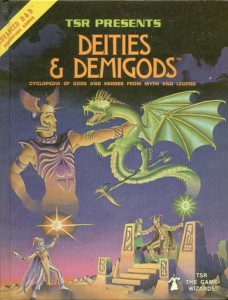
The magic aspect is what makes the Twitter exchange at the beginning of this post interesting. As you may be aware, PZ Myers and JT Eberhard are both atheists activists– very outspoken ones. Given that atheists joke all of the time about being evil to mock the public perception they are, it could be expected that they would be drawn to play the underdogs, the misunderstood, the commonly perceived as evil Horde. And given the rejection of supernatural powers of any kind, they could be expected to have no attraction at all to a class like Priest, who uses divine energy to heal other players but also to attack enemies. In Dungeons and Dragons when you play a priest– a cleric, as they are called there– you choose a god or goddess to serve, and those of us who have played remember fondly the book of Deities and Demigods which not only described and visualized countless gods both from existing mythologies and created especially for the game, but gave them in-game attributes and abilities. So, for example, you could decide to serve the Egyptian god Ptah, creator of the universe (alignment: lawful neutral), or perhaps the Norse goddess Freya, representing love and fertility (alignment: neutral good). I’m sure I’m not the only one whose interest in mythology as a kid was encouraged by this book.

In WoW, by contrast, the powers of a priest fall under the general category of Holy, and their description is as follows:

Priests are devoted to the spiritual, and express their unwavering faith by serving the people. For millennia they have left behind the confines of their temples and the comfort of their shrines so they can support their allies in war-torn lands. In the midst of terrible conflict, no hero questions the value of the priestly orders.

So in one RPG we have the existence of gods asserted, and their attributes described quite explicitly, whereas in the other it’s…well, a little more esoteric. WoW does have its own very complex assortment of demigods as well as some authentic deities, including Elune, goddess of the night elves. The races in WoW have their own cultural mythologies, but becoming a human priest (for example) does not require you to sign up for allegiance to anyone in particular. Nor does becoming a paladin (holy warrior), druid, shaman, or– in the next expansion– a monk. Mages and warlocks are also magic users, of course, but their powers come from either their own abilities specifically or harnessing the (often unwilling) assistance of demons. In this world, it’s more like a messy confluence of hierarchies of non-physical power….for basically everybody except warriors and rogues, and hunters for the most part, who rely either on either their own brute strength and agility or that of their pets.

So strictly speaking, ought not a skeptic who is determined to remain a skeptic in-game be suspicious of most of these classes?  Priests and paladins are the ones who connect their abilities most directly to divine power (because in the WoW universe, “healing” = “holy”), but almost everybody’s drawing on the supernatural in some way or another. The skeptic would, and should, ask: how do they know?

Well, it’s a game. A fictional universe– its terms are its own, and this game has gods, god dammit.

That’s one answer. Another answer is that in this universe, the power of spells has been repeatedly tested and applied, and found to exist, in one form or another. A skeptic, upon observing this happen or (ideally) performing the rituals and observing the results for him/herself, would be compelled to believe in the existence of….something. And of course, that “something” is the tricky part. How much would a scientifically-minded denizen of Azeroth be able to confirm, assuming he/she had the luxury to think on the matter intently in between fighting off incursions from the Horde or the Alliance (depending), as well as the multiple itinerant tribes, beasts, demons, elementals, and constructs roaming the land? His/her main concern, of course, is going to be for what works– what produces results. Most spells are performed to either damage an enemy or provide a buff (protection, fortification) to oneself or others. If the only way to achieve that effect is by using reagents and/or incantations in specific way, that can be tested and confirmed. Right?

But it can’t be confirmed as the result of divine power, and that’s the rub. Even in a world where mysteriously powerful beings exist, the infiniteness of their abilities still can’t be confirmed by finite beings. Which might be why, one could surmise, RPG designers (regardless of platform) don’t spend a lot of time or space proclaiming the “omni-ness” of the gods involved in them.

New blog network: FreethoughtBlogs

New blog network: FreethoughtBlogs published on No Comments on New blog network: FreethoughtBlogs

My friend Ed Brayton who currently blogs at Dispatches From the Culture Wars on Scienceblogs is launching a new blogging network specifically for skeptical/humanist concerns called FreethoughtBlogs on Monday, August 1st. You can see the event announcement on Facebook here, and here is the description given:

A new blog network is hitting the web on August 1. Led by two of the most prominent and widely read secular-minded blogs in the country – PZ Myers’ Pharyngula and Ed Brayton’s Dispatches from the Culture Wars – Freethoughtblogs.com will be THE central gathering place for atheists, humanists, skeptics and freethinkers in the blogosphere. Freethoughtblogs will be more than just a place for people to read the opinions of their favorite bloggers. It will be a community of like-minded people exchanging ideas and joining forces to advocate for a more secular and rational world.  The network will launch Aug. 1 with a handful of blogs with many more to be added after the first three months of operation. Here are the five blogs that will lead the way: Pharyngula. PZ Myers has built one of the most popular atheist blogs in the world. Never one to shy away from controversy, Myers has built an astonishing following over the last few years and has traveled around the world speaking to skeptical audiences. As a PhD biologist he is the scourge of creationists everywhere but he takes on a wide range of subjects in his blogging, including religious criticism, women’s rights and progressive politics.  Dispatches from the Culture Wars. Ed Brayton was raised by a Pentecostal and an atheist, sealing his fate forever as someone who is endlessly fascinated by how religion intersects with other subject, particularly science, law, history and politics. He is a popular speaker for secular organizations around the country, has appeared on the Rachel Maddow show and is pretty certain he’s the only person who has ever made fun of Chuck Norris on C-SPAN.  The Digital Cuttlefish. Cuttlefish are shy and elusive creatures; when necessary, they hide in their own ink. This particular cuttlefish has chosen as its habitat the comment threads of science, religion, and news sites, where it feeds on the opinions of those who are emboldened by the cloak of internet anonymity. Cuttlefish is an atheist, a skeptic, and is madly, passionately in love with science. The Digital Cuttlefish has, since October of 2007, been a repository of commentary and satire, usually (but not exclusively) in verse and now moves to Freethoughtblogs.  This Week in Christian Nationalism. Chris Rodda is the author of “Liars For Jesus: The Religious Right’s Alternate Version of American History.” Since the release of her book in 2006, Chris has been blogging at Talk2Action.org and Huffington Post about the use of historical revisionism in everything from education to legislation. Chris is now launching her own blog on Freethoughtblogs.com that will accompany her weekly podcast, This Week in Christian Nationalism. Zingularity. Steven “DarkSyde” Andrew is a 40 something former stock and bond trader and one time moderate conservative. He grew up in the Southwest and has long been fascinated by science, particularly evolutionary biology, physics, and astronomy. He is a frequest contributor to the popular progressive website Daily Kos and now blogs at Zingularity, where legit science disappears forever down an event horizon of petty snark and cynicism. If you would be so kind as to help us have a successful launch, please post the above information, or at least a link to the new network, on your Facebook pages, on your own blogs and in forums in which you participate that might be interested in it.  We want this to quickly become the most important gathering place for the skeptical community in the blogosphere.

I’m very interested to see what will come of this project, and wishing it success….not that they’ll need my wishes, as this is a very good crew of bloggers with dedicated audiences who will hopefully form a lasting community.

Pareidolia of the day: Holy sh!t!

Pareidolia of the day: Holy sh!t! published on 2 Comments on Pareidolia of the day: Holy sh!t!

Today’s incidence of pareidolia is a doozy. Or a doo-….no, I’m just not going there. The title for this post was enough. For the record, pareidolia is

a psychological phenomenon involving a vague and random stimulus (often an image or sound) being perceived as significant. Common examples include seeing images of animals or faces in clouds, the man in the moon or the Moon rabbit, and hearing hidden messages on records played in reverse.

Or in this case, bird poo. From Bryan, Texas:

Image Of Virgin Mary Appears In Bird Dropping On Area Family’s Truck The image that came in an unlikely form of a bird dropping appeared on Sunday. That was the first time Salvador Pachuca had been back to the home since having an accident there four months ago. “I told my brothers come over here and see what this is and they say this is the Virgin,” he said.

Family members made their way outside to see the image on the truck’s side mirror. Cristal Pachuca said she took pictures and began making calls to invite others to see, what she describes as, a miracle. “We just all feel protected. It’s a blessing to our family and to everybody that comes to see it,” says Cristal Pachuca. Cristal says the truck doesn’t get much use, but last weekend her husband decided to take it out of their garage and wash it. 

A few moments later the image appeared. Since Sunday, a steady stream of family, friends, neighbors and strangers has stopped by to pray and take pictures of the image. The Pachuca’s say the image is more than a coincidence especially since it happened on the 12th. The family says in Mexico, Dec. 12 is celebrated as the day of The Virgin Guadalupe. 

Onlookers say the image is a miracle because the distinct colors and outline of the image on the truck match the image of Virgin Guadalupe. The Pachuca’s say they will continue to welcome anyone who wants to see the image, because the image isn’t going to go away anytime soon. “I think we’re going to just put it on a shelf outside, probably take off the mirror and keep it there cause its something special to us. I’m not going to wash it off,” says Cristal Pachuca. 

“….Seriously?” Part: the end

“….Seriously?” Part: the end published on No Comments on “….Seriously?” Part: the end

…and cue the inevitable “Can’t we all just get along?” post.

Hemant Mehta does a good job of summarizing the whole very high-school situation, though I’m not sure what the point is with the whole “Female 1” and “Female 2” thing. If you’re interested, read.

Interest in attending any future skeptic/atheist conferences: pretty much nil.

“…Seriously?” part 2

“…Seriously?” part 2 published on 7 Comments on “…Seriously?” part 2

Somebody purporting to be Richard Dawkins apparently made some rather idiotic comments on Pharyngula of the “people have it worse than you, so how dare you complain about your own situation” variety, and Jen McCreight rightly excoriates him (or his impersonator) for it.  For reference on these remarks, see this.

Whether that was actually Dawkins or not, I think there’s a pretty obvious take-home lesson: nobody, however fiercely they might like to proclaim it, is on the side of rationality and immune to bigotry simply because they might be a loud proponent of skepticism on a subject where most people reject it. Their courage and eloquence on such matters does not make them infallible. They’re as susceptible to bias as anyone else, only they come pre-packaged with an iron-clad resistance to any suggestion of non-objectivity and therefore become, ironically, decidedly anti-skeptical about their own skepticism. Humility should be skepticism’s best friend, not its nemesis.

Religion going extinct? I doubt it.

Religion going extinct? I doubt it. published on No Comments on Religion going extinct? I doubt it.

The BBC reports on a paper recently presented at the American Physical Society meeting here in Dallas which makes claims about a decreasing level of religiosity in some parts of the world.  The paper, entitled “A mathematical model of social group competition with application to the growth of religious non-affiliation,” suggests that religion will effectively be extinguished in certain parts of the world just as certain languages die out due to lack of usage.  One of the paper’s authors elaborates:

“The idea is pretty simple,” said Richard Wiener of the Research Corporation for Science Advancement, and the University of Arizona. “It posits that social groups that have more members are going to be more attractive to join, and it posits that social groups have a social status or utility. “For example in languages, there can be greater utility or status in speaking Spanish instead of [the dying language] Quechuan in Peru, and similarly there’s some kind of status or utility in being a member of a religion or not.” Dr Wiener continued: “In a large number of modern secular democracies, there’s been a trend that folk are identifying themselves as non-affiliated with religion; in the Netherlands the number was 40%, and the highest we saw was in the Czech Republic, where the number was 60%.” The team then applied their nonlinear dynamics model, adjusting parameters for the relative social and utilitarian merits of membership of the “non-religious” category.

I’m skeptical.  The most obvious distinction that jumps out when comparing languages to religion is, at least to my knowledge, that at no point in history have people stopped using language.  They have stopped using specific languages in favor of other ones, just as they have stopped adhering to certain religions and converted to others.  But they haven’t cast religion aside. The study discusses how many people would answer that they are non-religious or have no religious affiliation, but that does not answer, as psychologist Bruce Hood points out, whether they have abandoned supernatural beliefs.  As I’ve mentioned before, there is a difference between being “non-religious,” being an atheist, and being a naturalist/materialist, and I don’t consider it accurate to say that religion has become “extinct” in a population unless its members fit the latter description.  Which, quite honestly, I don’t see ever happening.

Why be such a stickler about this?  Well, because when you talk to a person who says that she doesn’t consider herself to be religious (or worse, “non-affiliated”), digging a little deeper may reveal that she actually believes that the universe is God, that prayer and willpower cause wishes to come true, that everything happens for a cosmic reason, that casting spells works, and/or that everyone will be reincarnated after they die.  Her pantheism may disqualify her from being properly labeled an atheist, but the rest of it wouldn’t.  And even if she believes in none of those things she may well believe in ghosts, alien abduction, extra-sensory perception, Tarot-reading, and/or Reiki, which you might call secular supernatural ideas.  And to me, a god has more in common with a ghost than a cross has with a Tibetan prayer flag.  The latter two may both signify religious beliefs, but the former are both supernatural agents about which humans have a stunning number of intuitive beliefs in common.  That is, we use the same mental tools to conceive of and believe in them.

And if I’m right about that, then we will probably will carry on in these beliefs for as long as we have the kinds of minds that find them appealing.  I’m also not convinced that religious violence is fundamentally different in kind from any other violence which is rooted in a notion of a transcendent force which unifies one’s own group against whatever group(s) it views as threatening.  I don’t believe that it takes religion to make good men do bad things– or, for that matter, for bad men to do good.  I don’t see the extinction of religion specifically, even on a completely voluntary basis, as some kind of goal toward which we should all be striving.  Which is a good thing, considering that it probably won’t come to pass.

Unlike Hood, however, I do think we should strive toward rationality always, identify and eliminate bias wherever it can be found, and in general try to always have our skeptic’s hats on.  I consider supernatural thinking a mistake even if it’s an adaptive one. That doesn’t mean I have to single out people who think supernaturally as sui generis irrational, because we all do it occasionally.  And it certainly doesn’t mean I have to single out people who consider themselves religious as essentially thinking differently from, and/or worse or better than, everyone else.  

An observation

An observation published on No Comments on An observation

The video of TamTamPamela thanking God for the Japanese earthquake was all over the web yesterday.  I’m kind of disappointed in how willing people were to buy it without question.  Not because it’s a skepticism fail per se (I fall for Poes often– that’s the point of a Poe), but because they were so ready to believe that someone would be that hateful and already had their outrage pants on, good to go.

Guess I shouldn’t be surprised, as tragedy tends to magnify everything.  It’s probably unfair to think that there really are so many people out there who have no problem at all believing such a thing because their expectations of religious people are already that low, and it’s actually just that everyone’s nerves are on the surface.  I hope.

But we could do with a few less people pointing and saying “This is what religion does to you.”

TAM 9 speakers

TAM 9 speakers published on 3 Comments on TAM 9 speakers

The Amazing Meeting has announced its list of speakers for this year, its ninth meeting.  There are a lot of them, and quite a few– at least ten, from what I can tell– are people who can speak to the topic of how and why people believe weird things.  Or rather, why everyone isn’t skeptical all of the time.  That’s really encouraging.  If I were able to go, I’d make sure to attend those talks.  However accomplished a scientist or entertainer you are, I’m just not as interested in hearing how sure you are that ghosts and gods don’t exist and/or making fun of people who think they do.  That’s not to say that those topics don’t have their place, but they just don’t really grab me anymore.  Well, not unless the non-skeptical are trying to implement their non-skeptical beliefs via legislation or terrorism, in which case I’m definitely interested but it’s less about the lack of skepticism than about the use of force to push it.

But hey– it’s their meeting and I’m not going (can’t afford it), so who cares what I think?  It’s just nice to see skeptics being interested in the hows and whys regarding “woo” and not just the whats.

Interesting links of the day

Interesting links of the day published on No Comments on Interesting links of the day

Top 10 Logical Fallacies in Politics

Top 10 Logical Fallacies in Politics published on No Comments on Top 10 Logical Fallacies in Politics

Wonder how he managed to narrow it down to ten…. 

This is a very good list explanations and examples of fallacies commonly made by politicians.  In the world according to Gretchen, all children would learn about logical fallacies in school at a young age and then go home and apply that knowledge when watching politicians speak on TV.  They and their parents would have animated discussions about which fallacies were made and how they know, and as they approached voting age the kids would have developed a sturdy sense of skepticism about everything coming out of the mouth of anyone who had either received votes or was asking for them.

I’d settle, however, for them learning about fallacies in school.