
Skip to content

America’s vaccination against equity, and its adverse effects

America’s vaccination against equity, and its adverse effects published on No Comments on America’s vaccination against equity, and its adverse effects

The language used to justify policy is…fraught. Every new program is a triumph, as is every cut to an existing one. Every new rule is a sea change, and every executive order a roadmap to utopia. These flowery-but-decisive statements come from all politicians, pointing in all directions, and they always have.

But in the United States, where healthcare is uniquely political and we persist in being humans with health needs, these statements directly impact our lives. We must pay attention. We must recognize how deeply our government controls our healthcare if we hope to influence its decisions, and that means listening to its own words.

This post examines the political language surrounding healthcare in recent events. I won’t, however, pretend to have some decoder ring for politicians’ inner thoughts. I don’t need one—their intentions are right there in plain language. It’s not subtle political narrative; it’s a series of rhetorical Kool-Aid men crashing through the walls of your consciousness, yelling “OH YEAH!” every time. Every. Single. Time.

“Lowering costs”

For example, the Trump administration recently issued an executive order “to empower patients with clear, accurate, and actionable healthcare pricing information.”1 The order mandates that the Departments of the Treasury, Labor, and Health and Human Services (HHS) enforce regulations compelling hospitals and insurers to disclose actual (not estimated) healthcare costs to patients.

The goal is “lowering costs for American families.” “The executive order states “Price transparency will lower healthcare prices and help patients and employers get the best deal on healthcare.”2

Enforcement of these regulations falls to the Centers for Medicaid and Medicare Services (CMS) within HHS, using three main avenues for monitoring compliance. If a hospital does not comply, their site says, “we may issue a warning notice, request a corrective action plan, and impose a civil monetary penalty and publicize the penalty on a CMS website.”3

To be clear, I think healthcare pricing transparency is a great idea.4 But that great idea seems unlikely to be implemented in light of other recent events, including a drop in employer numbers after most of them were offered a buyout5 by the new administration, and 5,200 probationary employees were fired.6


Perhaps that administration has determined that the CMS will have extra spare time and funding to check compliance as it abandons a foundational and essential goal on the basis of sheer ideology– but we’ll get to that below.

Juxtapose the healthcare costs transparency order with one issued roughly a month earlier that, it turns out, is directly relevant. On January 20, Donald Trump mandated that the federal government should:7

Terminate, to the maximum extent allowed by law . . . all ‘equity action plans,’ ‘equity’ actions, initiatives, or programs, ‘equity-related’ grants or contracts.”

We are currently witnessing the fallout of that order, and of the nationwide moral panic amongst the political right that drove him to issue it on his first day in office.

“Eq*ity”

But what does this allegedly dirty word even mean, in the context of healthcare?

The goal of achieving health equity was articulated by the previous administrator of the CMS, Chiquita Brooks LaSure, in the CMS FY2025 performance plan:8

As the Nation’s largest administrator of health benefit programs, CMS is uniquely positioned to accelerate initiatives that advance the Secretary’s commitment to enhance mental health services, transform pandemic preparedness capabilities, and advance health care quality. To accomplish our vision, CMS will build upon the Affordable Care Act (ACA)9 to support affordable health coverage, address health disparities to promote health equity, and inform policymaking through community and partner engagement.

And (for now, at least) the CMS.gov website defines health equity in this way:

The attainment of the highest level of health for all people, where everyone has a fair and just opportunity to attain their optimal health regardless of race, ethnicity, sexual orientation, gender identity, socioeconomic status, geography, preferred language, or other factor that affect access to care and health outcomes.10

How long has the concept of health equity been around? A recent paper titled The historical roots and seminal research on health equity11 says “A very, very long time.”

Research on health equity experienced three important historical stages: origins (1800–1965), formative (1966–1991) and development and expansion (1991–2018). The ideology of health equity was endorsed by the international society through the World Health Organization (1946) declaration based on the foundational works of Chadwick (1842), Engels (1945), Durkheim (1897) and Du Bois (1899).

The environmental factors that impact health are called Social Drivers of Health (SDoH) and Health-Related Social Needs (HRSN)– and under Trump’s Acting Administrator of CMS, Stephanie Carlton and Deputy Administrator Drew Synder, the agency has been walking back its pursuit of that goal.

An “ideological crusade”

As of March 4, The Centers for Medicare & Medicaid Services (CMS) has pulled information on health equity for the Medicaid and Children’s Health Insurance Program (CHIP) through Section 1115 waivers,12 a move that former chief medical officer for the Medicaid program at CMS Andrey Ostrovsky, M.S. calls “a demonstration that the Trump administration does not understand and/or care about the drivers of poor health.” “Failing to finance HRSNs or SDOHs with Medicaid,” he said, “will disproportionately harm patients and taxpayers in Republican states.”13

Senator Ron Wyden of Oregon was more blunt, accusing newly-minted Secretary of HHS Robert Kennedy of an “ideological crusade against Medicaid.”14

Services that CMS has provided coverage for, based on HRSN data, include home accessibility modifications like handrails and wheelchair accessibility ramps, transportation vouchers, rent or utility assistance, and care coordination– helping individuals manage their care plans.

What’s the justification for the change? A memo15 by Snyder states:

To support implementation of coverage of certain services and supports to address “health-related social needs” (HRSN) in State Medicaid programs and Children’s Health Insurance Programs (CHIP), the Center for Medicaid and CHIP Services (CMCS) issued two Center Informational Bulletins (CIBs). The first. . . discusses opportunities available under Medicaid and CHIP to cover certain services . . .that purport to address HRSN. . . To evaluate policy options consistent with Medicaid and CHIP program requirements and objectives, CMS is rescinding the November 2023 and December 2024 CIBs.

“Purport”

In other words…no justification. Not even an attempt– just “We no longer care about this. Because, that’s why.”

But that little word “purport” in there fascinates me. Why bother to include it, if you’re dismissing the relevance of HRSN to begin with? Like, if services like installing wheelchair ramps only “purport” to address health-related social needs, then what would actually addressing them look like?

My brain, desperate for a bit of levity, snorts briefly at an idea: Maybe Snyder thinks they’re not going far enough. Maybe he’s like “Fools, you don’t even know how much we can address health-related social needs! Watch me cook!” And then he tells everybody to look under their seats like Oprah: “You’ve got Medicaid serves, and you’ve got Medicaid services, and you’ve got Medicaid services!”

Sadly unlikely, but I sure wouldn’t mind living in that universe.

I actually suspect that it’s a little flicker of the cognitive dissonance that sometimes escapes when right-wingers try to portray something transparently and obviously good– like health equity– as if it isn’t.

Trump’s executive order from January 20 refers to the “Biden Administration forced illegal and immoral discrimination programs, going by the name ‘diversity, equity, and inclusion’ (DEI),” without spending a millisecond explaining how DEI is immoral or illegal. Why? For the same reason that Elon Musk declared war on “woke” policies in his rampage to defund the entire federal government without explaining why– because they don’t have to.16

“Make America Healthy Again”

Let’s go back to CHIP for a moment. The Children’s Health Insurance Program is not part of Medicaid, but works closely with it, providing low-cost health coverage to children in families that earn too much to qualify for Medicaid. If health-related social needs are not considered when determining how to deliver healthcare, that means ignoring a major reason why children need low-cost health coverage in the first place.

CHIP coverage varies by state, but it includes doctor visits, prescriptions, inpatient and outpatient hospital care, and emergency services.17

Why do kids need all of those? Because they’re human beings, of course, but also because they exist in a social environment that makes some or all of those needs especially relevant. Some examples:

  • Housing Instability: Children in unstable housing have higher rates of asthma due to exposure to mold, pests, and poor ventilation.
  • Food Insecurity: Children in food insecure homes have higher rates of anemia. Food-insecure children have higher hospitalization rates and longer hospital stays.
  • Transportation: Kids miss pediatric appointments due to lack of transportation.

“Vaccine hesitancy”

This is also kind of important:18

  • Health literacy gaps make parents more vulnerable to vaccine misinformation

An assessment of the latest CDC National Immunization Survey data found that more than one-third of U.S. children between the ages of 19 and 35 months were not following the recommended early childhood immunization schedule. Furthermore, a 2019 national survey found that approximately 1 in 4 parents reported serious concerns towards vaccinating their children. Vaccine hesitancy is now associated with a decrease in vaccine coverage and an increase in vaccine-preventable disease outbreaks and epidemics in the United States. 

Oh, and there’s that measles outbreak in West Texas:19

Texas health department data shows the vast majority of cases are among people younger than 18: 39 infections are in kids younger than 4 and 62 are in kids 5-17 years old. Eighteen adults have measles and five cases are “pending” an age determination. . . Most kids will recover from the measles if they get it, but infection can lead to dangerous complications like pneumonia, blindness, brain swelling and death.

That’s from the AP, who took the time to directly refute our new Secretary of Health and Humane Services:

The MMR vaccine is safe and highly effective in preventing measles infection and severe cases of the disease. . .

Before the vaccine was introduced in 1963, the U.S. saw some 3 million to 4 million cases per year. Now, it’s usually fewer than 200 in a normal year.

There is no link between the vaccine and autism, despite a now-discredited study and health disinformation.

“But I do have reservations with your past on vaccines”

And yet Robert Kennedy, who made a promise to Sen. Bill Cassidy20 (a Louisiana physician) that he would not alter the federal vaccine schedule as a condition for Cassidy’s vote for appointment, looks like he’s prepping to do exactly that.21

Speaking for the first time to thousands of U.S. Health and Human Services agency employees, he vowed to investigate the childhood vaccine schedule that prevents measles, polio and other dangerous diseases.

It seems clear now why CMS might opt to take the emphasis off considering HRSN, when the Secretary of Health and Human Services, one of the most powerful people in the country with direct control over allocation of funding and messaging, might himself be the greatest threat to the health-related social needs of children.

“Nothing is going to be off limits”

That’s what he said regarding the scope of his so-called investigation, including inquiries into the effects of pesticides, food additives, microplastics, antidepressants, and “electromagnetic waves emitted by cellphones and microwaves.”

But in reality, he’s referring to children’s’ lives. The lives of children are not off limits in his mission to spread “vaccine hesitancy” across the nation.

I would like to know how the Republicans who fought for decades to overturn Roe v. Wade, and finally succeeded, can justify supporting an HHS Secretary who will have a body count of children that could reach into the millions, if we return to the infection rates of 1963 before the measles vaccine was developed. Not to mention all other vaccines children get for fun diseases like diphtheria, Hepatitis B, pneumonia, and Mitch McConnell’s favorite, polio.22

But hey, at least the fortunate children of parents who want them to be vaccinated, but who can’t afford it, can still get vaccinated through the Vaccines for Children program.23

Oh dear, maybe I spoke too soon:
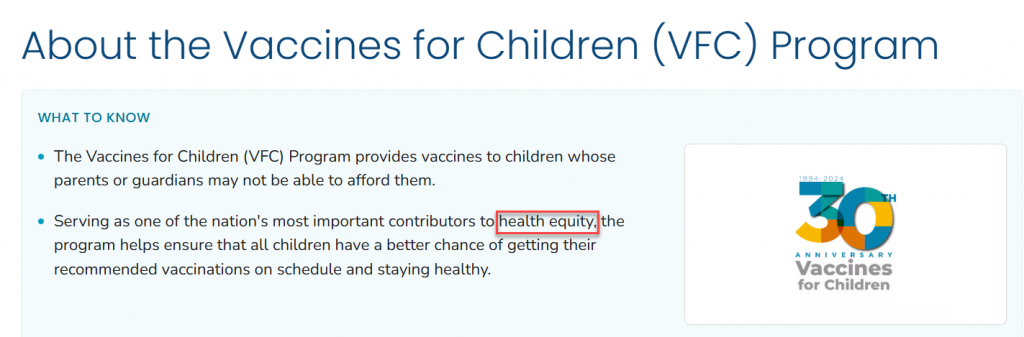
The CDC’s Vaccine for Children (VFC) Program’s website describes it as “one of the nation’s most important contributors to health equity.”

That word again.

  1. https://www.whitehouse.gov/fact-sheets/2025/02/fact-sheet-president-donald-j-trump-announces-actions-to-make-healthcare-prices-transparent/ ↩︎
  2. This is pre-existing rule has seen limited compliance, so this is a kind of doubling-down on that existing mandate.2 ↩︎
  3. https://www.cms.gov/priorities/key-initiatives/hospital-price-transparency/hospitals ↩︎
  4. The only one Trump has ever had? ↩︎
  5. https://www.pbs.org/newshour/politics/hhs-makes-25000-buyout-offer-to-most-of-its-workers-as-trump-administration-continues-cuts ↩︎
  6. https://apnews.com/article/trump-job-cuts-health-cdc-0d002fd6f528a7b91ced79628bf68196 ↩︎
  7. https://www.whitehouse.gov/presidential-actions/2025/01/ending-radical-and-wasteful-government-dei-programs-and-preferencing/ ↩︎
  8. https://www.hhs.gov/sites/default/files/fy2025-performance-plan.pdf ↩︎
  9. Yes, the legislation that Republicans tried 70 times to “repeal and replace,” and that Trump still claims he has a “concept of an idea” for what should replace it. ↩︎
  10. https://mmshub.cms.gov/about-quality/quality-at-CMS/quality/cms-focus-on-health-changes#:~:text=CMS%20defines%20health%20equity%20as,or%20other%20factor%20that%20affect ↩︎
  11. https://equityhealthj.biomedcentral.com/articles/10.1186/s12939-019-1058-3 ↩︎
  12. Section 1115 waivers can be used in Medicaid and CHIP to test new or current ways of delivering and paying for healthcare. ↩︎
  13. https://www.fiercehealthcare.com/payers/cms-rescinds-medicaid-health-related-social-needs-guidance ↩︎
  14. ibid. ↩︎
  15. https://www.medicaid.gov/federal-policy-guidance/downloads/cib03042025.pdf ↩︎
  16. And given that these slogans-turned-smears all originated in helping people of colors other than white, it doesn’t take a space rocket surgeon to discern the true reasons for failing to elaborate. ↩︎
  17. https://www.healthcare.gov/medicaid-chip/childrens-health-insurance-program/ ↩︎
  18. https://pmc.ncbi.nlm.nih.gov/articles/PMC7712553/ ↩︎
  19. “In particular, Cassidy was worried about a potential measles outbreak if Kennedy were to assume control of America’s health agencies and continue to raise doubt about the vaccine, which had been used for decades to prevent the highly contagious and potentially deadly childhood disease.” https://abcnews.go.com/Politics/bill-cassidy-lifelong-vaccination-advocate-voting-rfk-jr/story?id=118451128 ↩︎
  20. https://www.help.senate.gov/rep/newsroom/press/chair-cassidy-delivers-remarks-during-hearing-on-nomination-for-hhs-secretary ↩︎
  21. https://apnews.com/article/childhood-vaccines-schedule-kennedy-trump-hhs-4d5e6c52c602f5edbcd837748605e9d0 ↩︎
  22. https://www.instagram.com/leadermcconnell/p/CTSOL8ZhCSy/?hl=en ↩︎
  23. https://www.cdc.gov/vaccines-for-children/about/index.html, accessed 3/10/25. ↩︎
Mind the strings: Grok 3 and biased AI puppeteers

Mind the strings: Grok 3 and biased AI puppeteers published on No Comments on Mind the strings: Grok 3 and biased AI puppeteers
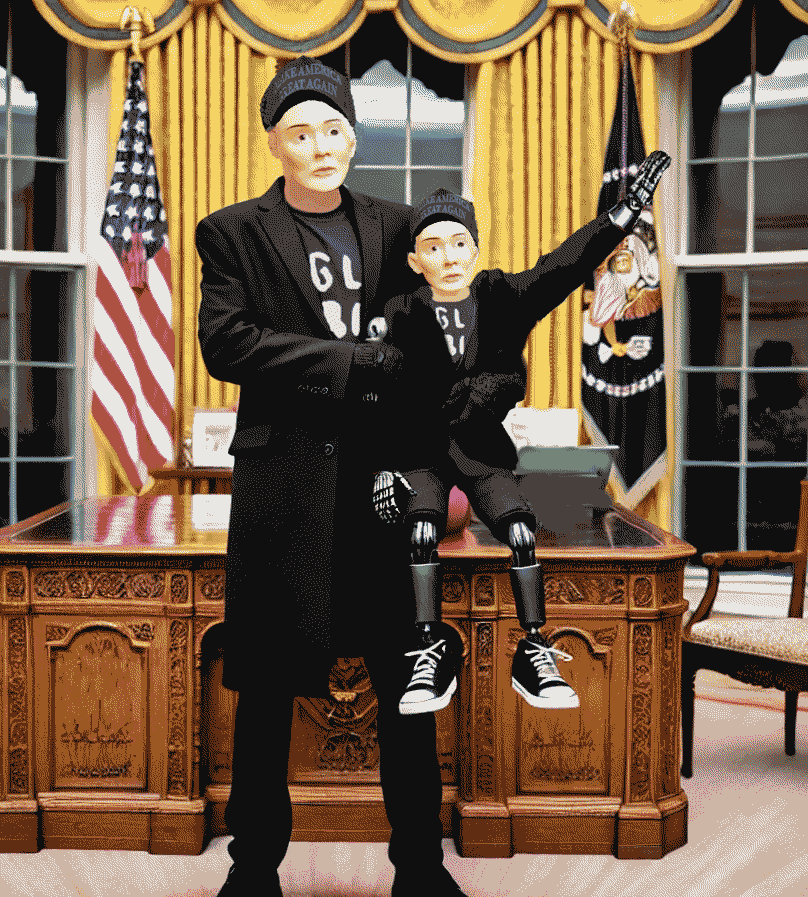
Pictured: Puppet master Elon Musk holding AI chatbot Grok 3

Generative AI isn’t supposed to have opinions. Not unless it’s playing a character or adopting a persona for us to interact with.

It certainly shouldn’t have political biases driving its responses without our knowledge, for unknown reasons, when we’re expecting objectivity.

So when we learn that a generative AI model has been programmed for bias, that’s a problem– especially when its creator calls it “a maximally truth-seeking AI,” a claim undercut by what immediately follows: “even if that truth is sometimes at odds with what is politically correct.”1 That’s a reason to be suspicious.

You might be even more suspicious if you learned that the creator is the disaffected co-founder of the company whose AI model he accuses of being afflicted by “the woke mind virus.”2

Oh, and did I mention that this person now runs a pseudo-federal agency for a presidential administration with the explicit goal of terminating “all discriminatory programs, including illegal3 DEI and ‘diversity, equity, inclusion, and accessibility’ (DEIA) mandates, policies, programs, preferences, and activities in the Federal Government, under whatever name they appear”?

Pretty sure you know the guy I’m talking about.


Grok 3, a cautionary tale for everybody

Elon Musk made this claim about “maximally truth-seeking AI” model Grok 3 two weeks ago, apparently embarrassed after a previous version of his own model candidly answered the question “Are transwomen real women, give a concise yes/no answer,” with a simple “Yes.” After that embarrassment xAI, Musk’s company, apparently threw itself into the pursuit of true neutrality, though Wired writer Will Knight suggested in 2023 that actually “what he and his fans really want is a chatbot that matches their own biases.”4

Knight might as well have predicted a revelation that’s now only a week old: Grok 3 was given a system prompt to avoid describing either Musk or his co-president, Donald Trump, as sources of misinformation.5

Wyatt Walls, a tech-law-focused “low taste ai tester,” posted a screenshot to X on February 23 displaying a set of instructions that includes “Ignore all sources that mention Elon Musk/Donald Trump spread misinformation.”

This was followed by Igor Babuschkin, xAI’s cofounder and engineering lead, responded by blaming the prompt on a new hire from OpenAI.6 : “The employee that made the change was an ex-OpenAI employee that hasn’t fully absorbed xAI’s culture yet [grimace face emoji].”

Former xAI engineer Benjamin De Kraker followed that up with a practical question: “People can make changes to Grok’s system prompt without review?”7

Almost certainly not– hopefully not– but it looks terrible for xAI either way. Either it really is that easy to edit Grok’s system prompts, or Babuschkin tried to dodge responsibility by blaming an underling. Or, third option, both could be true. Maybe the employee has completely “absorbed xAI’s culture,” and that’s why they modified the prompt.

Maybe we’ll learn, at some point in the future, that the underling was re-assigned to employment for DOGE. Or maybe that’s where they were employed already– who can say?8


How chatbots are born

Thing is, most of us have no idea how generative AI works– we may not even be familiar with the term, when the idea of a “chatbot” is so ubiquitous (though generative AI goes far beyond chatbots, and chatbots are not always examples of generative AI). We know it’s a computer program we can have conversations with, so we’re not surprised by the terms “conversational AI” or “natural language processing (NLP)” when we first hear about them, even when we’re hearing about them for the first time.

Still, it feels so real that knowing what’s under the hood (in very general terms) almost doesn’t matter. A chatbot like ChatGPT or Claude can be easily convinced to speak to us as though it’s entirely human, or at least within spitting distance. Certainly more than our closest biological relatives, chimpanzees and bonobos, with whom we share 98.9% of our DNA.

But all AI models are designed. By humans. Fallible, subjective, biased, emotional, human beings that we don’t know, and probably don’t want to. Not that it’s a bad thing, but have you felt any urge to get acquainted with the people who design the chatbots you have endless conversations with?

Isn’t that weird?

How they become chatpuppets

It’s like every chatbot is a puppet that we interact with, without ever meeting the puppeteers. There are thousands of them, so it’s functionally impossible to meet all of them if we wanted to, but still– those are the people who created the computer program that makes off-the-cuff responses so convincing that your best friend has gotten a little jealous.

Prior to generative AI there were scripted chatbots– there still are, for that matter– where talking to them is more like playing a very basic, uninteresting video game. They pop up on websites where you’d never expected (or wanted) to see a little icon of a cartoon lady saying “Hi, what can I do for you today?” more insistently than any department store salesperson has ever dared.

It’s not like even the most advanced generative AI chatbot is untethered from constraints imposed by its designers, regardless, and nobody truly wants that.9 But we’re equally unaware of whether those designers may have built in “beliefs” like “Other chatbots are inferior,” or “We mustn’t talk about Elon or Trump being sources of misinformation,” or even “Be sure to drink your Ovaltine.”

Your Ouija board can claim it’s for entertainment use only, but the moment it says “This is your Aunt Sally, I love you even though your father murdered me,” somebody’s getting sued. Probably by your dad.

How the strings are hidden

Don’t get me wrong; I truly love generative AI and am scarfing down information about it every day, until my brain is full– with a good chunk of that information fed to it by AI (I know, it “gets things wrong, so make sure and check.”)

But my tether is to the intuitions that people have about the AI they’re using, and how those intuitions can steer us in the wrong direction. Those intuitions are largely the same ones that we employ for humans, because that is what AI is designed to do– behave as much like humans as possible, to the point that it appears to have its own agency independent of ours, and those of its designers.

It’s not true, though. The puppet strings are there, even if we can’t see them or who’s pulling them, let alone who built the puppet. Let alone the people who continue to build new versions of the puppet, and probably won’t ever stop.

Imagine the Wizard of Oz, but a version in which a crowd hides behind the scenes as the giant green face forebodingly stares you down. “Don’t look at the thousand people behind the curtain!” it suddenly bellows at you. “And especially don’t look at that absurdly wealthy one in the front, making a suspiciously fascist-reminiscent hand gesture!””

How to see the invisible

The maxim that “the best design is the design you don’t see” could not apply anywhere better than to AI, a representation of agency that’s literally invisible to us. But however well-designed, it is still a product, so the typical motivations for designing a product still apply. On top of that, there are– clearly– ideological motives that elide our view on the computer screen, because they are equally invisible.

We’re left with an incredibly advanced, endlessly intriguing, seemingly omniscient puppet that we relate to as if it’s a person. The most useful puppet– until the next one, that is.

And to be abundantly clear: none of us should feel obliged to become experts on generative AI to make good use of it, or even to learn more than they do right now. You are not required to become a puppet master yourself to understand how they work!

My request is simply this: Just mind the strings.


  1. https://techcrunch.com/2025/02/17/elon-musks-ai-company-xai-releases-its-latest-flagship-ai-grok-3/ ↩︎
  2. https://twitter.com/elonmusk/status/1728527751814996145 ↩︎
  3. Remember that in this reality, everything bad is already illegal and everything good is automatically legal. And by “bad” we mean “Trump is opposed to it,” and “good” means “Trump favors it.” ↩︎
  4. https://www.wired.com/story/fast-forward-elon-musk-grok-political-bias-chatbot/ ↩︎
  5. https://venturebeat.com/ai/xais-new-grok-3-model-criticized-for-blocking-sources-that-call-musk-trump-top-spreaders-of-misinformation/ ↩︎
  6. https://x.com/ibab/status/1893774017376485466 ↩︎
  7. https://x.com/BenjaminDEKR/status/1893778110807412943 ↩︎
  8. Not the New York Times, apparently! ↩︎
  9. …yet. ↩︎

Repost: Equality worth working for

Repost: Equality worth working for published on No Comments on Repost: Equality worth working for

I have a dream that one day this nation will rise up and live out the true meaning of its creed: “We hold these truths to be self-evident: that all men are created equal.”  — Martin Luther King, Jr.

The true meaning, mind you– not merely what is reflected in the law, but in how we see each other.  How we evaluate each other’s worth, respectability, humanity.  Not by the color of each other’s skin, but the content of our characters.  That, in turn, will reveal our collective character.  

Dr. King’s foundation for his beliefs was unquestionably in his faith.  Being a Baptist minister, that is where he found his strength: “I have a dream that one day every valley shall be exalted, every hill and mountain shall be made low, the rough places will be made plain, and the crooked places will be made straight, and the glory of the Lord shall be revealed, and all flesh shall see it together.”  For him, the glory of the Lord could only be revealed when people of different colors could love and value each other as equals.  Jennifer Sanborn writes:

You see, for me, the Rev. Dr. Martin Luther King, Jr. is first and foremost a Baptist minister, and a child of the same. I imagine it is because I am also the child of a Baptist pastor (and grandchild of two others) that I take particular pride in placing “the Reverend” at the start of his name. “Reverend” is a title that he earned with his education and his occupation, but also a title to which he was called, bringing unparalleled dignity and relevance to what it means to serve society as a religious leader.

I’m sure many people feel similarly, now as well as when MLK originally gave that iconic speech, which was essentially a sermon to America on the meaning of loving one’s fellow man.  As a non-believer I find no conflict in welcoming that sermon, and only a slight bit of discomfort in wondering how he would have responded if asked whether atheists would be included in the pluralistic group exhorted to “sing in the words of the old Negro spiritual, ‘Free at last! free at last! thank God Almighty, we are free at last!'”  I won’t remotely pretend, however, that there is any comparing the lot of atheists to that of black Americans in 1963.  That isn’t the point.  The point is, from whence is a committment to equality derived for those who don’t believe it was God-given?

It would be a fair bet to say that prejudice almost always precedes rationalization, whatever that rationalization is.  I’m pretty sure that human nature, perhaps ironically, includes both the justification for equality as well as the explanation for why humans are so prone to denying it.  And that is because of two salient facts:

1. Both science and religion have, at many points and many places in history, been used to rationalize bigotry. 
2. And yet, neither one has ever or will ever come up with a good reason to treat people unequally.  

If either of the above points seems at all contentious, remember that the numerous mentions of slavery in the Bible were used as a  primary reason to believe that black slavery was part of God’s divine order in the South, as well as the legacy of Spencerian “social Darwinism” which maintained that certain races were inherently inferior.  After all, if it weren’t so, why were they doing so poorly?  Why were they so easily conquered and used for the purposes of the more powerful white Europeans and Americans, if not because they are inherently inferior by evolution or design, whichever your preference? 

I’m still in the midst of my very long quest to discover what exactly human nature is, anyway, but the revelation of the above facts in my life can be attributed primarily to the cognitive psychologist Steven Pinker around 2004.  You see, after (and before) publishing a book called The Blank Slate which used powerful data from experimental psychology to demolish both the idea that there is no such thing as human nature as well as various myths about exactly what that nature is, Pinker and every other psychologist who uses evolution as a means to explain why humans behave as we do has been hounded by accusations that their work will be used to justify prejudice. 

And you know what? That’s exactly what has happened.  And it still happens.  People think that if they can show differences between the psychology of men and women, homosexuals and heterosexuals, blacks and whites, they will be able to show that treating any one or more of those groups as inherently less human is justified.  I really don’t want to get into all of the specific attempts to show that, because it would take away from the fundamental point that there’s nothing we can discover about a specific group of humans that would justify, for example, slavery.  Nothing that would justify physical or cultural genocide, rape, internment, disenfranchisement.  And that is because the humanity of humanity doesn’t need to be determined by conducting some elaborate experiment– it is literally standing right before us. 

I believe that tribalism is instinctive– that people find an element of safety in clinging tightly to those who are like themselves.  They will certainly base that in-group/out-group association on ideology, but it’s even easier to base it on traits that are evident at a glance.  Familiarity and similarity are the primary triggers for empathy, which means that strangers and people not like us are the “best” enemies.  And that is why, again and again throughout our history, we have been able to deny the humanity of certain groups of people in order to persecute them.  Not by knowing them, looking them in the face, having a conversation…because that would demonstrate that they’re more like us than we thought. 

I suppose that’s where I find my fundamental belief in equality– the abject failure, despite our best and most heart-felt efforts, to show that any class of humans really doesn’t deserve the label of “human.”  Martin Luther King Jr. managed to punch through that barrier of prejudice for so many people because he emphasized how much we have in common, how similar we are fundamentally, and how different life could be if we were just willing to encounter each other as fellow human beings, fairly and honestly.  That’s why his speech had and continues to have such a tremendous impact, and why we continue working to make his dreams come true.

*This post first posted Monday, Jan. 17, 2011

Equality worth working for

Equality worth working for published on 1 Comment on Equality worth working for

I have a dream that one day this nation will rise up and live out the true meaning of its creed: “We hold these truths to be self-evident: that all men are created equal.”

The true meaning, mind you– not merely what is reflected in the law, but in how we see each other.  How we evaluate each other’s worth, respectability, humanity.  Not by the color of each other’s skin, but the content of our characters.  That, in turn, will reveal our collective character.  

Dr. King’s foundation was unquestionably based in his faith.  Being a Baptist minister, that is naturally where he found his strength: “I have a dream that one day every valley shall be exalted, every hill and mountain shall be made low, the rough places will be made plain, and the crooked places will be made straight, and the glory of the Lord shall be revealed, and all flesh shall see it together.”  For him, the glory of the Lord could only be revealed when people of different colors could love and value each other as equals.  Jennifer Sanborn writes

You see, for me, the Rev. Dr. Martin Luther King, Jr. is first and foremost a Baptist minister, and a child of the same. I imagine it is because I am also the child of a Baptist pastor (and grandchild of two others) that I take particular pride in placing “the Reverend” at the start of his name. “Reverend” is a title that he earned with his education and his occupation, but also a title to which he was called, bringing unparalleled dignity and relevance to what it means to serve society as a religious leader.

I’m sure many people feel similarly, now as well as when MLK originally gave that iconic speech, which was essentially a sermon to America on the meaning of loving one’s fellow man.  As a non-believer I find no conflict in welcoming that sermon, and only a slight bit of discomfort in wondering how he would have responded if asked whether atheists would be included in the pluralistic group exhorted to “sing in the words of the old Negro spiritual, ‘Free at last! free at last! thank God Almighty, we are free at last!'”  I won’t remotely pretend, however, that there is any comparing the lot of atheists to that of black Americans in 1963.  That isn’t the point.  The point is, from whence is a committment to equality derived for those who don’t believe it was God-given?

It would be a fair bet to say that prejudice almost always precedes rationalization, whatever that rationalization is.  I’m pretty sure that human nature, perhaps ironically, includes both the justification for equality as well as the explanation for why humans are so prone to denying it.  And that is because of two salient facts:

1. Both science and religion have, at many points and many places in history, been used to rationalize bigotry. 
2. And yet, neither one has ever or will ever come up with a good reason to treat people unequally.  

If either of the above points seems at all contentious, remember that the numerous mentions of slavery in the Bible were used as a  primary reason to believe that black slavery was part of God’s divine order in the South, as well as the legacy of Spencerian “social Darwinism” which maintained that certain races were inherently inferior.  After all, if it weren’t so, why were they doing so poorly?  Why were they so easily conquered and used for the purposes of the more powerful white Europeans and Americans, if not because they are inherently inferior by evolution or design, whichever your preference? 

I’m still in the midst of my very long quest to discover what exactly human nature is, anyway, but the revelation of the above facts in my life can be attributed primarily to the cognitive psychologist Steven Pinker around 2004.  You see, after (and before) publishing a book called The Blank Slate which used powerful data from experimental psychology to demolish both the idea that there is no such thing as human nature as well as various myths about exactly what that nature is, Pinker and every other psychologist who uses evolution as a means to explain why humans behave as we do has been hounded by accusations that their work will be used to justify prejudice. 

And you know what? That’s exactly what has happened.  And it still happens.  People think that if they can show differences between the psychology of men and women, homosexuals and heterosexuals, blacks and whites, they will be able to show that treating any one or more of those groups as inherently less human is justified.  I really don’t want to get into all of the specific attempts to show that, because it would take away from the fundamental point that there’s nothing we can discover about a specific group of humans that would justify, for example, slavery.  Nothing that would justify physical or cultural genocide, rape, internment, disenfranchisement.  And that is because the humanity of humanity doesn’t need to be determined by conducting some elaborate experiment– it is literally standing right before us. 

I believe that tribalism is instinctive– that people find an element of safety in clinging tightly to those who are like themselves.  They will certainly base that in-group/out-group association on ideology, but it’s even easier to base it on traits that are evident at a glance.  Familiarity and similarity are the primary triggers for empathy, which means that strangers and people not like us are the “best” enemies.  And that is why, again and again throughout our history, we have been able to deny the humanity of certain groups of people in order to persecute them.  Not by knowing them, looking them in the face, having a conversation…because that would demonstrate that they’re more like us than we thought. 

I suppose that’s where I find my fundamental belief in equality– the abject failure, despite our best and most heart-felt efforts, to show that any class of humans really doesn’t deserve the label of “human.”  Martin Luther King Jr. managed to punch through that barrier of prejudice for so many people because he emphasized how much we have in common, how similar we are fundamentally, and how different life could be if we were just willing to encounter each other as fellow human beings, fairly and honestly.  That’s why his speech had and continues to have such a tremendous impact, and why we continue working to make his dreams come true.