Skip to content

No border wands, just brutality: what the death of the CBP One app portends

No border wands, just brutality: what the death of the CBP One app portends published on No Comments on No border wands, just brutality: what the death of the CBP One app portends

It’s infuriating that I have to defend this profoundly unjust yet unfairly maligned, rights-violating, prison gate-keeping, Hollerith-ass, bureaucratic government-enforced insult to human dignity in app form, but here we are.


On Inauguration Day, January 20th, one of the first things Trump did was cancel the CBP One app— an app developed by Customs and Border Protection used by undocumented immigrants to secure an appointment at the southern border of the United States and thereby enter the country legally– most likely after JD Vance told him that it’s an “open border wand” that turns illegal immigrants into legal ones.1

What was that Arthur C. Clarke quote? “Any sufficiently advanced technology is indistinguishable from magic”?

I wouldn’t call CBP One advanced technology per se, but Vance clearly thinks of it as magical– very handy, because then you don’t have to learn how it actually works.


As I have documented in detail, the app works in much the same way that any app used to navigate entry into/exit out of the country works. It’s been a legal mandate for the U.S. to record entry and exit from the country by foreign nationals, since 1996-ish. The CBP One app uses facial recognition technology (FRT), tested initially (for this purpose) on air passengers traveling through checkpoints on their way to a flight.

The way it works is that a traveler gets their photo taken (usually a passport photo), which is then converted to a template used to check their identity against future images taken of them while traveling into/out of the country.

The template can also be used to identify travelers from amongst a group, for example from a flight manifest, to determine whether the person in the photo is in that group– and if so, which one is them. The engine that drives this process is called the Traveler Verification Service, or TVS.

Or this same biometric (identification based on physical distinguishing characteristics) technology could be used to capture images of migrants in Central Mexico and submitted to CBP along with their biographical information.

Then the images and information would be compared to vast databases maintained by the DHS to search all encounters at the border since the beginning of time (effectively) and check whether the migrant in question was involved in any of them. The image is further used for a “liveness check,” aka to verify the migrant’s identity after the appointment has been secured, to ensure that they’re the same person who made the appointment.

Why am I making this comparison?

  • To show how the technology used in the CBP One app mirrors what was already in use for, and was even initially tested on, citizens of other countries visiting the U.S. by air.
  • To show how rigorous the comparison process is– to the point that when it’s used on Americans,2 they become concerned for their own privacy and how that data is gathered and used. As they should be, frankly.
  • To show how, therefore, the claims that CBP One is somehow being used to allow “otherwise impermissible,” “illegal,” or even “criminal” immigrants into the country are unmitigated codswallop.


In fact, this app was, until recently, effectively the only way to enter the country legally.3 Even for asylum seekers, who are not just permitted but required, under U.S.4 and international law, to be physically present within the United States to apply for asylum, and have been since 1967.

That hasn’t been acknowledged in America for an extremely long time, but nevertheless– as rights become further and further violated, it becomes increasingly important to remember what they are.

But let’s snap back to the present, where CBP One,5 or at least its scheduling functionality (has it been used for much else? Hard to say) was shut down as of January 20 at noon.

And now we have a new DHS-developed technology– a registry6 that immigrants staying in the country for 30 days or long will be required to sign up for, providing biometric data in the form of fingerprints, to facilitate their “mass self-deportation.” Because yes, that’s the goal, according to a DHS statement7 issued Tuesday.

Compelling mass self-deportation8 is a safer path for aliens and law enforcement, and saves U.S. taxpayer dollars, in addition to conserving valuable Customs and Border Protection (CBP) and Immigration and Customs Enforcement (ICE) resources needed to keep Americans safe.

Here’s the part that nearly gave me an aneurysm, from newly-installed Secretary of DHS Kristi Noem:9

We’re just going to start enforcing it to make sure [the undocumented immigrants] go back home, And when they want to be an American, then they can come and visit us again.

I have some questions for Ms. Noem.


What does she think migrants are here to do in the first place? Has she tried asking them if they want to be Americans?

Has she offered them a route to citizenship? Did she send the invitation to “come and visit us again” out on pretty stationary, with an enclosed coupon for Cracker Barrel?

How are they supposed to “come visit us again” after they’ve been “mass deported” back to the same countries they tried to escape due to imminent threat to their lives and well-being, and the only way to “come back to visit” legally has just been obliterated before their eyes?

Did she tell them the Cracker Barrel’s door is locked with a deadbolt?


Does she know who said this, in 2018?10

Under this plan, the illegal aliens will no longer get a free pass into our country by lodging meritless claims in seeking asylum. Instead, migrants seeking asylum will have to present themselves lawfully at a port of entry. So they’re going to have to lawfully present themselves at a port of entry. Those who choose to break our laws and enter illegally will no longer be able to use meritless claims to gain automatic admission into our country. We will hold them — for a long time, if necessary.

Did he mean it?

Does he remember saying it?

Does it matter?


The First Lady broke immigration laws,11 as did the Co-President,12 but nobody’s demanding their fingerprints and encouraging them to “self-deport.”

And yet undocumented immigrants are forced to live in a tautology where they will be “illegal” no matter what they do, while the shining promise of existing in America legally isn’t just out of reach, but is dangled teasingly over their heads by the government of the same country with a mandate to welcome them in– the poor, the tired, the huddled masses yearning to breathe free. The people seeking a better life than they could have in the “shithole countries”13 (remember that?) from whence they came.

While I might consider the CBP One app to be a cruel joke, when it was first used to assist migrants, it was as a way for NGOs (non-governmental organizations) to locate those who had been forced into Mexico by the previous Trump administration as part of the so-called Migrant Protection Protocols, and bring them back to the border for a hearing. It was a tool used for collaboration between DHS and NGOs, to make sure that at least some of the migrants who have a right to enter the country were allowed to exercise it

It was a way to be slightly less gratuitously cruel to people, existing in a state of greater desperation than anyone in DHS personally could fathom, who just want to find safety and create a better life.

And now that’s gone, everything’s made up, and the law doesn’t matter.


But maybe I can spend the second half of this post saying something constructive. Some things that might actually help:

  • Stay informed and make good judgments. I know, I know, it’s a horrorshow that can be unbearable to watch/read/listen. But for example, it’s important to know when ICE isn’t going to raid your local church or school because they’re not allowed to raid “sensitive locations,” and you can avoid raising a panic unnecessarily. If you know when to be scared, and how much, that alleviates some of the “scared at 11, 24/7” feeling that will drive you into the ground.
  • Help out the organizations doing the work. I strongly recommend the Immigration Council, who are working their asses off to seek justice for migrants and deserve every dollar you care to donate. Sign up for a newsletter so you don’t have to keep wading through the shouting and rhetoric to learn what’s actually happening with immigration.
  • Show up for “sanctuary policies” at a city council meetings and anywhere in your community having discussions on that topic14 to learn what protections can be provided under those policies for migrants in your area. Remind people, if necessary, that sanctuary jurisdictions are in full compliance with federal law. Don’t let your local government and law enforcement get bullied into doing ICE’s dirty work.
  • Remind people of how immigration is supposed to work. How America is founded on immigration, and how it was once possible to just “show up” at Ellis Island, get checked out by a doctor, and saunter your way in. Show them this video of George H.W. Bush and Ronald Reagan arguing, in a debate at the League of Women Voters in 1980, about who had a more compassionate and reasonable policy for how to make migrants feel welcome in America, and watch their heads explode.
  • Find common ground
    • Find somebody you disagree with about immigration, sit down with them, and do this:
      • Make some choices about how it should work, if it were totally up to you. No basing arguments on facts not in evidence (also known as BSing), and no predictions.
      • Make your rules clear to each other. You don’t have to agree– you just need to fully understand where each other stands. When you reach the point of “I hear you saying this,” followed by “Yes, that’s exactly what I’m saying,” you’ve calibrated correctly.
      • Look up how it actually works. Look at how it’s handled elsewhere in the world, and how it’s been handled before.15
      • Look up what the conditions, the stats, etc., actually are. Learn about the countries and cultures that asylum seekers and refugees are emigrating from.
      • Go back to the rules you created earlier, and re-evaluate. Amend the rules accordingly. Takesies-backsies are not just allowed, but encouraged.
      • This is the hard part: Reconcile how things are with how you want them to be. Explain how doing things your way would make it better– not just better than the status quo, but better than what your partner has in mind.


This is a conversation about how to treat populations of other people who are not necessarily any more similar to each other than you are to that neighbor you hate for letting his dog poop in your yard. Probably a lot less, actually.

So as an added layer of difficulty, stimulate those empathy muscles and walk through all six steps with a hypothetical family in mind, rather than a faceless mass. Give them names, nationalities, motivations. Then imagine how they fare, according to your rules, the current rules, your partner’s rules, etc.


There is no possible way to say “Good luck with that” with the earnest intensity that I mean to put behind it. It’s going to sound dismissive no matter what. But with every fiber of my being, and every ounce of sincerity that is possible to convey, I nevertheless say: Good luck with that.


  1. https://giantif.com/2024/10/04/j-d-vances-weird-dumb-little-racist-jab-at-cbp-one/ ↩︎
  2. Including some of the same Americans who think that the U.S. isn’t scrutinizing migrants enough… ↩︎
  3. https://www.federalregister.gov/documents/2023/05/16/2023-10146/circumvention-of-lawful-pathways ↩︎
  4. The U.S. is is bound by the 1951 Refugee Convention (through its adoption of the 1967 Protocol) and the Immigration and Nationality Act (INA), which explicitly allows anyone physically present in the U.S.—regardless of how they arrived—to apply for asylum. ↩︎
  5. https://www.cbp.gov/newsroom/national-media-release/cbp-removes-scheduling-functionality-cbp-one-app ↩︎
  6. https://www.axios.com/2025/02/26/trump-immigrants-registry-jail-fine-threat ↩︎
  7. https://www.dhs.gov/news/2025/02/25/secretary-noem-announces-agency-will-enforce-laws-penalize-aliens-country-illegally ↩︎
  8. If it’s compelled, how is it self-deportation? See also “compel them to leave the country voluntarily.” ↩︎
  9. https://www.axios.com/2025/02/26/trump-immigrants-registry-jail-fine-threat ↩︎
  10. https://trumpwhitehouse.archives.gov/briefings-statements/remarks-president-trump-illegal-immigration-crisis-border-security/ ↩︎
  11. https://www.vox.com/2016/11/5/13533816/melania-trump-illegal-immigrant ↩︎
  12. https://www.washingtonpost.com/business/2024/10/26/elon-musk-immigration-status/ ↩︎
  13. https://www.nbcnews.com/politics/white-house/trump-referred-haiti-african-countries-shithole-nations-n836946 ↩︎
  14. https://www.americanimmigrationcouncil.org/research/sanctuary-policies-overview ↩︎
  15. https://www.politico.com/news/magazine/2024/12/29/mass-deportation-immigration-history-00195729 ↩︎
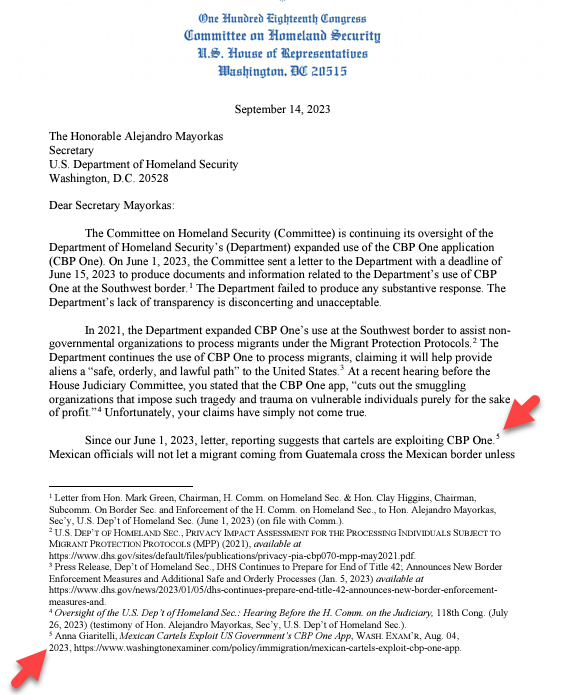

Letter to the U.S. House Homeland Security Committee regarding CBP One

Letter to the U.S. House Homeland Security Committee regarding CBP One published on No Comments on Letter to the U.S. House Homeland Security Committee regarding CBP One

Dear Committee Members, specifically Chairman Green,

I would like to know why, in numerous published statements, Chairman Green has claimed that Anna Giaritelli published a “groundbreaking scoop showing that the criminal cartels had hijacked the CBP One app using virtual private networks (VPNs), and were exploiting the app to make even more money by scheduling appointments for migrants outside the geographical range.”

This is clearly and obviously false to anyone who reads the article. What Giaritelli wrote wasn’t a “groundbreaking scoop,” but rather a baseless claim. At no point in the article does Giaritelli cite a single source confirming that cartels are exploiting CBP One using VPNs.

She refers to “an extensive investigation” of DHS documents, but she doesn’t link to the documents, or quote them, or even say what they specifically address. That’s the closest she comes to providing any evidence whatsoever.

The one quote she provides from an actual DHS official (Erin Waters, Assistant Commissioner for Public Affairs) is refuting Giartitelli’s claim, stating that CBP One has actually been “bad for cartels and other criminal organizations seeking to exploit migrants.” Waters goes on to explain that CBP One rather relies on the location data supplied by devices used to access the app.

I would like to know if the Committee has ever spoken with Erin Waters on this issue– and if not, why not? Why rely on the bald assertions of a right-wing web site over a statement of fact from a DHS official?

At the very least, the obvious contradiction presented here should give the Committee pause, and encourage you to look into the claim further. But apparently the Committee had no time to even take a second look, in your rush to– again, repeatedly– make such a momentous claim, with such an extensive impact. You clearly think this matter is serious, so why are you relying on what amounts to rumors and gossip rather than statements of fact supported by evidence?

Could it possibly be that it’s because the rumors and gossip align with your pre-existing beliefs? That evidence be damned when it contradicts your desire to believe?

If so, that’s grossly irresponsible– not to mention dangerous– behavior on the part of a legislative committee. Misrepresenting the truth gets people killed, and yet you treat this reality with casual disregard.

I dearly hope that I’ve simply missed something here which exculpates Chairman Green’s statements about CBP One– and if I have, then assuredly I’m not the only one. So if you have actual evidence that doesn’t come from a vague and unsupported Washington Examiner article, please post it. I’d still be baffled to why you didn’t just provide that evidence in the first place rather than linking to the Examiner, but perhaps that’s a lesson that can be retained for future statements.

Thanks for your time and consideration on this matter.

For over a year now, the committee has been making hay about this so-called “bombshell report” that doesn’t show what they keep insisting that it shows. This line in particular is revealingly hilarious:

Since the Biden administration debuted the CBP One app in January, immigrants south of Mexico City had no reason to believe they would find a legal way to get into the U.S. if they crossed illegally.

  1. The app debuted in October of 2020 (under Trump, btw), not January of 2023.
  2. Using the app is, by definition, not crossing the border illegally.
  3. CBP One is a legal way– unfortunately for most migrants, the only legal way– to enter the United States.

Republicans are tossing around a lot of terminology to obfuscate 2 and 3. The term “otherwise inadmissible” is a fun one, because it suggests that migrants would fall afoul of other immigration restrictions and be denied entry without using the app.

What’s the basis for this? There is none, and in fact the app’s facial recognition engine is designed to be a screen to prevent such individuals from entering the country before they can even reach the border. It does this by comparing the face captured within the app to templates from DHS’s HART database, which includes records of an individual’s entire history of encounters at the border, as well as any crimes committed.

Once again, as I pointed out in CBP One™: The Border in Your Pocket: the app isn’t designed to let as many people through as possible; it’s designed to make the lives of CBP officials and agents easier. Their lives are easier if they can gather as much information about the migrants as possible, as soon as possible, to minimize the seemingly endless paperwork and stress that comes from trying to process the entirety of someone’s information on the spot, all at once, at the border.

(Yes, I sound very sympathetic to CBP agents here. Am I? No, but I can empathize with their openly acknowledged wish to automate things to the extent that they can be).

Last September, Chairman Green and Subcommittee on Border Security and Enforcement Chairman Clay Higgins “demanded answers” from DHS Secretary Alejandro Mayorkas about cartels “abusing the Biden administration’s expanded use of the CBP One app to enhance their human smuggling operations.”

Yes, relying on this one article from the Washington Examiner. They “demanded” that the DHS Secretary address the baseless claims of a right-wing rag in which a CBP spokesperson was already quoted saying it’s all BS.

It’s staggering, and if I’m not misconstruing any of the details here, it’s staggeringly stupid.

Dignity in light of Obergefell: What Thomas just doesn’t get

Dignity in light of Obergefell: What Thomas just doesn’t get published on No Comments on Dignity in light of Obergefell: What Thomas just doesn’t get
Image: A black person’s hand and a white person’s hand
forming a heart. 

Someday somebody’s gonna ask you 
A question that you should say yes to 
Once in your life 
Maybe tonight I’ve got a question for you 
— “Question,” Old 97’s

Control over your own life. Since we were old enough to recognize the concept, each one of us has wanted this. We wanted it long before our parents, who knew better, were willing to give it to us. And when they started to give us control, it was incremental– you can choose what to wear today. You can choose what electives to take in school. You can choose where to get a job, assuming they’ll hire you. You can choose where, or whether, to go to college, assuming you qualify and can afford it.

And when you’re 18, you can choose everything else (except what to drink in America, for reasons that aren’t exactly clear). It’s a rather arbitrary point at which society decides that an individual is going to have as much control over his or her life as he/she will ever have, but a point had to be chosen. To be an adult is to make your own choices. To be in control of your life, and recognized as such by society.

This control over your life is called autonomy. The mutual recognition of such, between you as an individual and the society in which you live, is called dignity.

There is a competing notion of dignity which is outdated, but persists largely for religious reasons. According to this notion, dignity is an immutable characteristic of humankind by virtue of membership in our species. We all have it, not just from birth, but from conception until…well, forever. It sets humans apart from non-human animals, and is the foundation of free will and moral responsibility. As Kant put it, “Morality, and humanity as capable of it, is that which alone has dignity.”

There’s a recognition in this view that dignity is based in moral autonomy, but that autonomy is believed to be inherent in humanity, which would entail that a) all humans have dignity, and b) cannot ever be deprived of it, c) because they are human.

In reality, of course, we know that this is not true. We have seen the gradual erosion of this concept of dignity, which has correlated with certain realizations that are largely the result of scientific research. We know, for example, that humans are not the only species which makes meaningful choices– even moral choices. We know that mental mechanisms for making such choices exist in our brains, which are themselves far from immutable– the capacity must develop (their ontogeny) according to how they evolved (their phylogeny), it may malfunction, and it will inevitably die, at the same time the organism itself does.

There’s no particular reason to believe that dignity will continue beyond our death, if the machinery which makes meaningful control over our lives possible is disabled at that time….and by all appearances, it does. As anyone with experience around people with degenerative brain diseases knows, it can easily happen prior to death.

For these and other reasons, our understanding of dignity has evolved, along with our understanding of what it means to be human and, by extension, to be a person– a person being a legal entity, with rights and responsibilities that are due to an individual who exists in a society of other people.

A person is someone who should be treated with dignity. They should be treated by their government as if they are autonomous agents, in control of their lives, because to be treated by your government this way enables you to be autonomous and in control of your life. It enables you to take control. To make meaningful choices. To pursue happiness.

This is the sort of dignity described in the decision for Obergefell v. Hodges, authored by Anthony Kennedy.

He describes1 how government came to treat women with dignity with regard to marriage:

Under the centuries-old doctrine of coverture, a married man and woman were treated by the State as a single, male-dominated legal entity. As women gained legal, political, and property rights, and as society began to understand that women have their own equal dignity, the law of coverture was abandoned.

 He continues:

These and other developments in the institution of marriage over the past centuries were not mere superficial changes. Rather, they worked deep transformations in its structure, affecting aspects of marriage long viewed by many as essential. These new insights have strengthened, not weakened, the institution of marriage. Indeed, changed understandings of marriage are characteristic of a Nation where new dimensions of freedom become apparent to new generations, often through perspectives that begin in pleas or protests and then are considered in the political sphere and the judicial process. This dynamic can be seen in the Nation’s experiences with the rights of gays and lesbians. Until the mid-20th century, same-sex intimacy long had been condemned as immoral by the state itself in most Western nations, a belief often embodied in the criminal law. For this reason, among others, many persons did not deem homosexuals to have dignity in their own distinct identity. A truthful declaration by same-sex couples of what was in their hearts had to remain unspoken. Even when a greater awareness of the humanity and integrity of homosexual persons came in the period after World War II, the argument that gays and lesbians had a just claim to dignity was in conflict with both law and widespread social conventions. Same-sex intimacy remained a crime in many States. Gays and lesbians were prohibited from most government employment, barred from military service, excluded under immigration laws, targeted by police, and burdened in their rights to associate.

The decision is an analysis in two parts:

  1. a meditation on the significance of marriage in the context of an individual’s dignity, which is to say his or her control over his/her life and equal ability to pursue happiness in that life (“A first premise of the Court’s relevant precedents is that the right to personal choice regarding marriage is inherent in the concept of individual autonomy”), and
  2. a description of the injustices that gay and lesbian Americans have been dealt in having their dignity denied at every turn by their government, specifically in their equal right as people to be able to make this one specific critical choice in their lives– to be married (“There is dignity in the bond between two men or two women who seek to marry and in their autonomy to make such profound choices. Cf. Loving, supra, at 12 (‘[T]he freedom to marry, or not marry, a person of another race resides with the individual and cannot be infringed by the State’),” “Under the Constitution, same-sex couples seek in marriage the same legal treatment as opposite-sex couples, and it would disparage their choices and diminish their personhood to deny them this right.”)

The conclusion is basically this: To have dignity acknowledged by one’s government is to have the freedom to take part in the institutions considered fundamental to society, to be able to choose for oneself as an equal citizen to commit to marriage. Homosexual Americans have, to date, been denied this dignity at the federal level. That ends now.

In his dissent, Clarence Thomas made what might seem to be the gobsmacking argument that the dignity of homosexuals has been completely unaffected by the denial of their equal right to marry:

Perhaps recognizing that these cases do not actually involve liberty as it has been understood, the majority goes to great lengths to assert that its decision will advance the “dignity” of same-sex couples. Ante, at 3, 13, 26, 28.8 The flaw in that reasoning, of course, is that the Constitution contains no “dignity” Clause, and even if it did, the government would be incapable of bestowing dignity. Human dignity has long been understood in this country to be innate. When the Framers proclaimed in the Declaration of Independence that “all men are created equal” and “endowed by their Creator with certain unalienable Rights,” they referred to a vision of mankind in which all humans are created in the image of God and therefore of inherent worth. That vision is the foundation upon which this Nation was built. The corollary of that principle is that human dignity cannot be taken away by the government. Slaves did not lose their dignity (any more than they lost their humanity) because the government allowed them to be enslaved. Those held in internment camps did not lose their dignity because the government confined them. And those denied governmental benefits certainly do not lose their dignity because the government denies them those benefits. The government cannot bestow dignity, and it cannot take it away. The majority’s musings are thus deeply misguided, but at least those musings can have no effect on the dignity of the persons the majority demeans. Its mischaracterization of the arguments presented by the States and their amici can have no effect on the dignity of those litigants. Its rejection of laws preserving the traditional definition of marriage can have no effect on the dignity of the people who voted for them. Its invalidation of those laws can have no effect on the dignity of the people who continue to adhere to the traditional definition of marriage. And its disdain for the understandings of liberty and dignity upon which this Nation was founded can have no effect on the dignity of Americans who continue to believe in them.

Okay, for just a moment, let’s imagine that the “the majority” did, in fact, reject the notion of innate dignity (even though it did no such thing, at least in the body of the decision). Let’s imagine that dignity is a quality that every human being is born with and dies with, purely because he or she is a human being, and it can neither be bestowed upon us nor deprived from us by any other human being or body of such entities.

In fact, let’s go with an analogy to something that we acknowledge is innate to being a human, at least for the time being: optimal body temperature. The average normal body temperature is 98.6 degrees. This is a fact about human beings which no human can (currently) change.

Now, let’s imagine that the government was in the business of awarding materials for temperature control to its citizenry based on factors like race, gender, and sexual orientation.

  • Winter: Are you white? Here’s some firewood. Are you male? Take this coat. Are you straight? I’ve got kerosene for you!
  • Summer: Hey white, male, straight people, come and get your fans, your sunblock, and some bags of ice! Take the 20 pounder; you’ll need it– it’s supposed to hit 100 tomorrow!

Imagine that the Supreme Court came along and decided that women should get firewood, too. And then it said that interracial couples should also get fans to use when it’s hot. And then, one day, it declared that there is no reason at all why gay and lesbian Americans, possessed of an equal need to maintain their bodies at 98.6 degrees as anyone else of any other race, gender, or sexual orientation, should be likewise afforded a damn coat when it’s snowing outside.

I know, I know, it’s a silly analogy. But it makes my point adequately, which is that even if dignity is something innate to every human being, in order to treat citizens equally under the law as the 14th Amendment requires, the government must, if it is going to afford benefits of temperature control to anyone at all, afford them to minority members of the population whose need for this innate characteristic to be acknowledged by their government does not differ in the slightest from any other member of the citizenry by virtue of their minority status. And such is decidedly, irrefutably, the case if the innate characteristic is dignity instead of optimal body temperature, and the form of acknowledgement is the right to marry rather than to be provided sunblock or kerosene.

For a less silly but very important perspective, see George Takei:

I was only a child when soldiers with bayonetted [sic] rifles marched up our driveway in Los Angeles, banged on our door, and ordered us out. I remember my mothers’ tears as we gathered what little we could carry, and then were sent to live for many weeks in a single cramped horse stall at the Santa Anita racetracks. Our bank accounts were frozen, our businesses shuttered, and our homes with most of our belongings were left behind, all because we happened to look like the people who had bombed Pearl Harbor. Executive Order 9066, signed by President Franklin Delano Roosevelt, was issued on the premise that anyone of Japanese descent could not be trusted and was to be treated as an enemy, even those of us who were American citizens, born in this land. We were viewed not as individual people, but as a yellow menace to be dealt with, and harshly. The guns pointed at us at every point reminded us that if we so much as tried to stand up for our dignity, there would be violent consequences. . . For many, it was indeed a great loss of self-worth and respect, a terrible blow to the pride of the many parents who sought only to protect their children from coming to harm. Justice Thomas need have spent just one day with us in the mosquito-infested swamplands in that Arkansas heat, eating the slop served from the kitchen, to understand that it was the government’s very intent to strip us of our dignity and our humanity. Whether it succeeded with all of us is another question: There was a guiding spirit of what we called “gaman”—to endure with fortitude, head held high— helping us get through those terrible years. At the end of it all, each internee was handed a bus ticket and twenty-five dollars, on which we were expected to rebuild our lives. Many never did.

For these purposes, it doesn’t matter whether you say “The government tried to take our dignity” or “The government denied our dignity.”  Takei says both. Thomas was deliberately side-stepping the point by making it all about whether Whitney Houston was right that no matter what you take from me, you can’t take away my dignity. (Because “dignity” in that sense actually means “pride,” and pride really is a self-assessment)

You can take away someone’s freedoms. You can take away their equality. You can take away official recognition that they are people– adults, citizens, agents– with the right to ask the person they love to marry them, or the right to be asked that question. You can deny their dignity by denying them the right to join in that bond, which is mutually acknowledged, by those who think gays have the right to marry and those who do not, to be foundational in our society.

So of course, in the end, what you’re really arguing about is not whether the government can or should give dignity to gays, but whether it should acknowledge that dignity in the way that gays are asking for. In the way the government is perfectly capable of acknowledging.

And in the end it did, Thomas’s attempt at derailment notwithstanding.

Postscript:

Thomas’s was the most important dissent to me because of the discussion of dignity, about which I have a strong interest. Reading the decision itself was impactful to me as a person who has never been married, but who has, simply by accident of birth, always had the right to marry a partner with the expectation that such marriage would be federally recognized and my standing in it considered equal to that of my partner. I think that anyone who has ever considered marriage should read the ruling, regardless of their current status, for a better understanding of what marriage means and why people would want it so badly, and why they would feel like partial citizens in their own country for being denied it.

I meant to write about this article in the post, but found the current carrying me away from it and didn’t manage to work my way back. I might still have things to say about it, but just in case, definitely give it a read anyway.

1 Some internal references removed for clarity.