It’s infuriating that I have to defend this profoundly unjust yet unfairly maligned, rights-violating, prison gate-keeping, Hollerith-ass, bureaucratic government-enforced insult to human dignity in app form, but here we are.
On Inauguration Day, January 20th, one of the first things Trump did was cancel the CBP One app— an app developed by Customs and Border Protection used by undocumented immigrants to secure an appointment at the southern border of the United States and thereby enter the country legally– most likely after JD Vance told him that it’s an “open border wand” that turns illegal immigrants into legal ones.1
What was that Arthur C. Clarke quote? “Any sufficiently advanced technology is indistinguishable from magic”?
I wouldn’t call CBP One advanced technology per se, but Vance clearly thinks of it as magical– very handy, because then you don’t have to learn how it actually works.
As I have documented in detail, the app works in much the same way that any app used to navigate entry into/exit out of the country works. It’s been a legal mandate for the U.S. to record entry and exit from the country by foreign nationals, since 1996-ish. The CBP One app uses facial recognition technology (FRT), tested initially (for this purpose) on air passengers traveling through checkpoints on their way to a flight.
The way it works is that a traveler gets their photo taken (usually a passport photo), which is then converted to a template used to check their identity against future images taken of them while traveling into/out of the country.
The template can also be used to identify travelers from amongst a group, for example from a flight manifest, to determine whether the person in the photo is in that group– and if so, which one is them. The engine that drives this process is called the Traveler Verification Service, or TVS.
Or this same biometric (identification based on physical distinguishing characteristics) technology could be used to capture images of migrants in Central Mexico and submitted to CBP along with their biographical information.
Then the images and information would be compared to vast databases maintained by the DHS to search all encounters at the border since the beginning of time (effectively) and check whether the migrant in question was involved in any of them. The image is further used for a “liveness check,” aka to verify the migrant’s identity after the appointment has been secured, to ensure that they’re the same person who made the appointment.
Why am I making this comparison?
To show how the technology used in the CBP One app mirrors what was already in use for, and was even initially tested on, citizens of other countries visiting the U.S. by air.
To show how rigorous the comparison process is– to the point that when it’s used on Americans,2 they become concerned for their own privacy and how that data is gathered and used. As they should be, frankly.
To show how, therefore, the claims that CBP One is somehow being used to allow “otherwise impermissible,” “illegal,” or even “criminal” immigrants into the country are unmitigated codswallop.
In fact, this app was, until recently, effectively the only way to enter the country legally.3 Even for asylum seekers, who are not just permitted but required, under U.S.4 and international law, to be physically present within the United States to apply for asylum, and have been since 1967.
That hasn’t been acknowledged in America for an extremely long time, but nevertheless– as rights become further and further violated, it becomes increasingly important to remember what they are.
But let’s snap back to the present, where CBP One,5 or at least its scheduling functionality (has it been used for much else? Hard to say) was shut down as of January 20 at noon.
And now we have a new DHS-developed technology– a registry6 that immigrants staying in the country for 30 days or long will be required to sign up for, providing biometric data in the form of fingerprints, to facilitate their “mass self-deportation.” Because yes, that’s the goal, according to a DHS statement7 issued Tuesday.
Compelling mass self-deportation8 is a safer path for aliens and law enforcement, and saves U.S. taxpayer dollars, in addition to conserving valuable Customs and Border Protection (CBP) and Immigration and Customs Enforcement (ICE) resources needed to keep Americans safe.
Here’s the part that nearly gave me an aneurysm, from newly-installed Secretary of DHS Kristi Noem:9
We’re just going to start enforcing it to make sure [the undocumented immigrants] go back home, And when they want to be an American, then they can come and visit us again.
I have some questions for Ms. Noem.
What does she think migrants are here to do in the first place? Has she tried asking them if they want to be Americans?
Has she offered them a route to citizenship? Did she send the invitation to “come and visit us again” out on pretty stationary, with an enclosed coupon for Cracker Barrel?
How are they supposed to “come visit us again” after they’ve been “mass deported” back to the same countries they tried to escape due to imminent threat to their lives and well-being, and the only way to “come back to visit” legally has just been obliterated before their eyes?
Did she tell them the Cracker Barrel’s door is locked with a deadbolt?
Under this plan, the illegal aliens will no longer get a free pass into our country by lodging meritless claims in seeking asylum. Instead, migrants seeking asylum will have to present themselves lawfully at a port of entry. So they’re going to have to lawfully present themselves at a port of entry. Those who choose to break our laws and enter illegally will no longer be able to use meritless claims to gain automatic admission into our country. We will hold them — for a long time, if necessary.
Did he mean it?
Does he remember saying it?
Does it matter?
The First Lady broke immigration laws,11 as did the Co-President,12 but nobody’s demanding their fingerprints and encouraging them to “self-deport.”
And yet undocumented immigrants are forced to live in a tautology where they will be “illegal” no matter what they do, while the shining promise of existing in America legally isn’t just out of reach, but is dangled teasingly over their heads by the government of the same country with a mandate to welcome them in– the poor, the tired, the huddled masses yearning to breathe free. The people seeking a better life than they could have in the “shithole countries”13 (remember that?) from whence they came.
While I might consider the CBP One app to be a cruel joke, when it was first used to assist migrants, it was as a way for NGOs (non-governmental organizations) to locate those who had been forced into Mexico by the previous Trump administration as part of the so-called Migrant Protection Protocols, and bring them back to the border for a hearing. It was a tool used for collaboration between DHS and NGOs, to make sure that at least some of the migrants who have a right to enter the country were allowed to exercise it
It was a way to be slightly less gratuitously cruel to people, existing in a state of greater desperation than anyone in DHS personally could fathom, who just want to find safety and create a better life.
And now that’s gone, everything’s made up, and the law doesn’t matter.
But maybe I can spend the second half of this post saying something constructive. Some things that might actually help:
Stay informedand make good judgments. I know, I know, it’s a horrorshow that can be unbearable to watch/read/listen. But for example, it’s important to know when ICE isn’t going to raid your local church or school because they’re not allowed to raid “sensitive locations,” and you can avoid raising a panic unnecessarily. If you know when to be scared, and how much, that alleviates some of the “scared at 11, 24/7” feeling that will drive you into the ground.
Help out the organizations doing the work. I strongly recommend the Immigration Council, who are working their asses off to seek justice for migrants and deserve every dollar you care to donate. Sign up for a newsletter so you don’t have to keep wading through the shouting and rhetoric to learn what’s actually happening with immigration.
Show up for “sanctuary policies” at a city council meetings and anywhere in your community having discussions on that topic14 to learn what protections can be provided under those policies for migrants in your area. Remind people, if necessary, that sanctuary jurisdictions are in full compliance with federal law. Don’t let your local government and law enforcement get bullied into doing ICE’s dirty work.
Remind people of how immigration is supposed to work. How America is founded on immigration, and how it was once possible to just “show up” at Ellis Island, get checked out by a doctor, and saunter your way in. Show them this video of George H.W. Bush and Ronald Reagan arguing, in a debate at the League of Women Voters in 1980, about who had a more compassionate and reasonable policy for how to make migrants feel welcome in America, and watch their heads explode.
Find common ground
Find somebody you disagree with about immigration, sit down with them, and do this:
Make some choices about how it should work, if it were totally up to you. No basing arguments on facts not in evidence (also known as BSing), and no predictions.
Make your rules clear to each other. You don’t have to agree– you just need to fully understand where each other stands. When you reach the point of “I hear you saying this,” followed by “Yes, that’s exactly what I’m saying,” you’ve calibrated correctly.
Look up how it actually works. Look at how it’s handled elsewhere in the world, and how it’s been handled before.15
Look up what the conditions, the stats, etc., actually are. Learn about the countries and cultures that asylum seekers and refugees are emigrating from.
Go back to the rules you created earlier, and re-evaluate. Amend the rules accordingly. Takesies-backsies are not just allowed, but encouraged.
This is the hard part: Reconcile how things are with how you want them to be. Explain how doing things your way would make it better– not just better than the status quo, but better than what your partner has in mind.
This is a conversation about how to treat populations of other people who are not necessarily any more similar to each other than you are to that neighbor you hate for letting his dog poop in your yard. Probably a lot less, actually.
So as an added layer of difficulty, stimulate those empathy muscles and walk through all six steps with a hypothetical family in mind, rather than a faceless mass. Give them names, nationalities, motivations. Then imagine how they fare, according to your rules, the current rules, your partner’s rules, etc.
There is no possible way to say “Good luck with that” with the earnest intensity that I mean to put behind it. It’s going to sound dismissive no matter what. But with every fiber of my being, and every ounce of sincerity that is possible to convey, I nevertheless say: Good luck with that.
The U.S. is is bound by the 1951 Refugee Convention (through its adoption of the 1967 Protocol) and the Immigration and Nationality Act (INA), which explicitly allows anyone physically present in the U.S.—regardless of how they arrived—to apply for asylum. ↩︎
One of my first-year classes in college was History of Theater, in which I learned how the Greeks built amphitheaters into hillsides, carving out a semicircle of seating for the audience around the stage to maximize. The scenery for a play completes the circle, just as it does for any show in an amphitheater today. It’s the structure providing the necessary atmosphere for the experience.
Imagine sitting in such a theater, watching Euripides’ Helen, and seeing the demigods Castor and Polydeuces (Helen’s pissed off brothers) descend into the scene by a wooden crane—a mechane — whereupon they put an end to all of this murderous nonsense, and everybody lives happily ever after. It’s a literal top-down solution.
That’s where the expression deus ex machina, or “god from the machine,” comes from. And it became used, and mocked, throughout the world of fiction as a plot device providing a too-convenient, cheap ending to a story.
But my mind just keeps going back to that silly crane. It used to dangle a man dressed as a god before the audience, but these days he’d more likely be a techbro holding a smartphone, probably talking about the wonders of AI.
That’s on my mind today because in this post, I’m about to dangle a hypothetical mobile app in front of my audience– you. I illustrate our country’s mess of a healthcare system, and perhaps even reckon with it. This play isn’t ending any time soon, and we need to find a role in it (else one is chosen for us).
Healthcare data and analytics company Arcadia recently launched its own talk show, Spicy Takes, to discuss “hot perspectives in healthcare” while sampling—you guessed it—spicy food. The first episode placed President and CEO Michael Meucci in conversation with Chief Product and Technology Officer Nick Stepro and Chief Medical Officer Dr. Kate Behan.
I watched it while reading about their SDoH (social determinants of health) package, which promises to justify the time and expense required of providers to consistently record SDoH data by creating registries mapping that data with diagnostic codes, for use in proactively identifying patients at risk and connecting them to resources. While looking over the tear sheet, I heard Meucci say this:
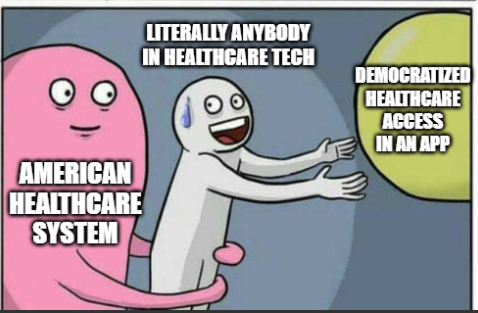
I think that this is such a great platform for digital health as we start to think about how do you democratize access. Because if a patient is concerned that they’re not going to get the right treatment because of the color of their skin or the community they live in, the smartphone is a great equalizer. We talk about what’s changed for the last 10 years—that, to me is the biggest thing, the fact that you can pull out your phone and get connected with a doctor in 15 minutes.
“To your point, Stepro replied, “all of the technology and all of the access to healthcare in the world doesn’t change the fact that the single worst diagnosis you can have as a patient is being poor. You can’t address that with a healthcare institution. We can measure that poor people have lower outcomes but ultimately, we need to find and attack the problem of homelessness and poverty because you can’t just solve that in a clinic or with a smartphone.
I stopped reading and played that section of the show again. Meucci didn’t say that the healthcare industry can solve poverty with smartphones; he said we could democratize healthcare access. If that’s a spicy take then you can call me Spice Girl, because that’s my healthcare platform now. But I suppose coming from someone like him, that’s practically revolutionary.
And he’s right. As a country, America is primed for solutions like that: over 91% of Americans have smartphones. Even households without broadband hang on to their smartphones, because of course they would—it’s a tiny computer that can do more than any of us ever seem to realize, or ever will.
Democracy—another word with ancient Greek origins– literally means “power in the hands of the people.” What would it even look like to do that with a smartphone?
Let’s do a thought experiment to find out.
Time to design a smartphone app.
Imagine that in the beginning of The Legend of Navigating the American Healthcare System, our player character is given their first smartphone.
On that phone there’s an app installed (that I’ve just invented) called HACK: Health Agency, Care, and Knowledge.
Health – A full, patient-owned medical history
Agency – Control over your care, your records, your choices
Care – The power to find, compare, and advocate for treatment
Knowledge – Because to be informed is to be empowered
Does your vision of this app include it conferring access to all of an individual’s health records, stored securely but also accessible in their entirety at any time? If so, you’ve envisioned something better than what existing patient portal apps currently provide.
So yes, let’s absolutely start there, if we’re designing an app that democratizes healthcare in America.
And remember that democracy means that the power is in the hands of the people—not the “patients.”
Problem: we’re not in the driver’s seat.
Social Drivers of Health (SDoH) is the category of data on an EHR encompassing the non-medical factors affecting an individual’s health. In other words, your life, from the hospital where you were born (if you were born in a hospital) to the destination of your organs when you die.
They’ve been called the social determinants of health, but the word “determinant” suggests finality, immutability—that there’s nothing you (or anyone) can do about it. A driver, on the other hand, suggests that while the deck may be stacked against you, things could always change.
How easily could you could do that? *shrug* It depends, but we can safely say that “resident of the United States” is not an easy “driver” to change. We’re driving that road whether we want to or not.
And I hate to break it to you, but we live in a hostile health environment.
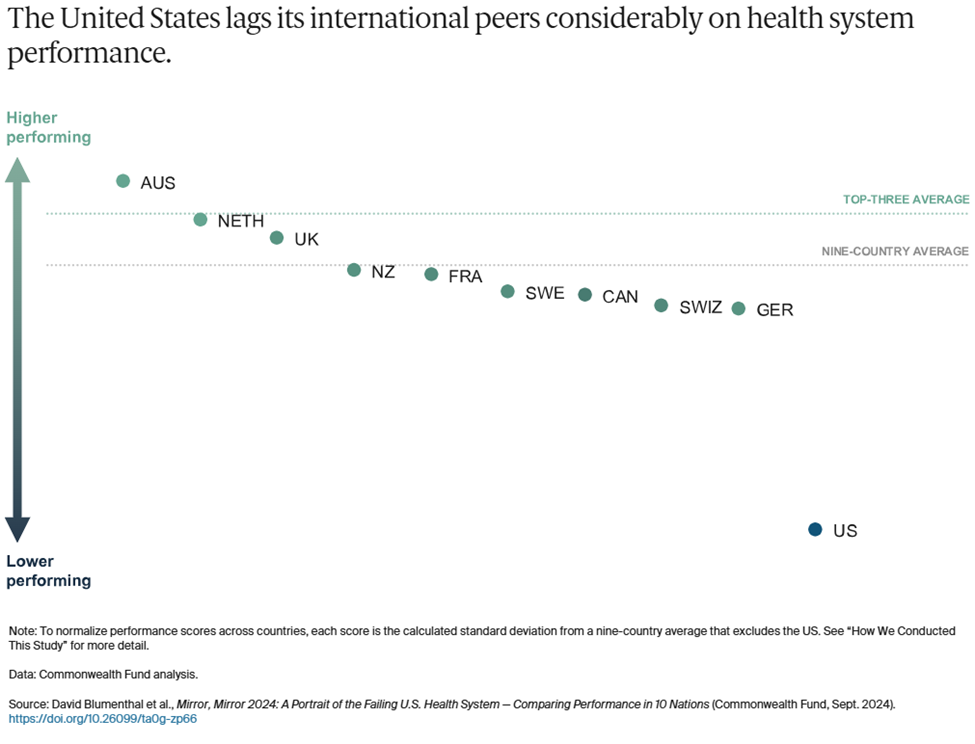
A 2024 study titled Mirror, Mirror 2024: A Portrait of the Failing U.S. Health System was conducted by The Commonwealth Fund to understand why America is doing so poorly by comparison—that is, going beyond the factor that rhymes with “schmooniversal schmealthcare.” The categories they used are:
Access to Care
Administrative Efficiency
Equity
Care Process
Health Outcomes
In all but one of those categories, America comes in dead last or next to last.
To summarize the report, it found that Americans spend more on healthcare as a percentage of GDP to receive lower healthcare system performance than other countries. It faces the most barriers to accessing and affording healthcare. Its physicians and patients are most likely to face hurdles related to insurance rules, billing disputes, and reporting requirements. Equity in healthcare access and experience is low. And we live the shortest lives and have the most avoidable deaths. All by a longshot. USA! USA!
The one exception in these categories is Care Process, where we came in second. Their comments:
Care process looks at whether the care that is delivered includes features and attributes that most experts around the world consider to be essential to high-quality care. The elements of this domain are prevention, safety, coordination, patient engagement, and sensitivity to patient preferences.
I interpret this result as an indication that some version of enabling people to take charge of their own healthcare is key to accessing that care in spite of all other factors. It could even, possibly, raise America in those other categories where we’re currently ranking dead last!
Okay, probably not, but it could definitely help us face the hostile health environment in which we currently exist:
Misinformation is everywhere.
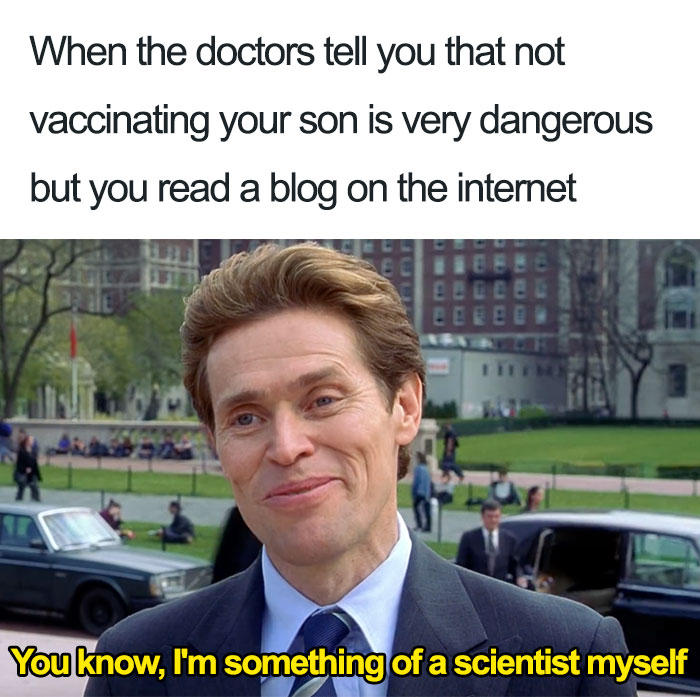
We live in an era where vaccine misinformation spreads faster than the viruses they prevent, leading to the resurgence of eradicated diseases, overwhelmed hospitals, and preventable deaths fueled by fear rather than science.
We live in an era where people google their symptoms and often reach the worst, scariest conclusions that inadvertently contribute to their paranoia, where “doing their research” on healthcare can lead to being convinced of conspiracy theories and pseudoscience.
We live in an era where the president of the United States once advocated for injecting disinfectant as a means of staving off Covid, and in his next term has appointed a raw-milk-drinking anti-vaxxer as Secretary of the Department of Health and Human Services.
We live in an era where social media influencers with no medical expertise gain massive followings by promoting unproven “natural cures,” convincing people to reject evidence-based treatments in favor of detox teas, essential oils, and dangerous fad diets
We can’t afford anything.
We live in an era where Cost-Related Nonadherence (CRN) is the primary reason for medical nonadherence (failure of patients to take their medication as prescribed due to cost) in some cases forced to choose between “treating and eating.”
We live in an era where the term “dual ineligibility” refers to the status of undocumented immigrants in the U.S. who qualify for both Medicaid and Medicare, but are unable to access either one.
We live in an era where medical debt is the leading cause of personal bankruptcy, where a single hospital visit can trap families in a cycle of financial ruin, and where crowdfunding platforms have become a substitute for a functioning healthcare system.
We live in an era where rural hospitals are closing at alarming rates, leaving entire communities without nearby emergency care, prenatal services, or even a local doctor, forcing low-income patients to travel hours for basic medical attention they still might not be able to afford.
Neighbors hate and fear their neighbors.
We live in an era where in transgender healthcare, patients frequently encounter providers who lack adequate knowledge of gender-affirming care or hold prejudiced views that hinder appropriate treatment.
We live in an era where in reproductive healthcare, political and ideological barriers, including misinformation and ignorance, stand in the way of basic, safe medical care.
We live in an area where Black patients are more likely to have their pain underestimated and undertreated, leading to worse health outcomes.
We live in an era where in disability healthcare, patients struggle to have their pain, symptoms, and autonomy taken seriously, with providers sometimes dismissing concerns as psychological or unavoidable aspects of their condition rather than treatable medical issues.
We live in an era where in chronic illness care, patients—especially women—are more likely to be dismissed as exaggerating their symptoms, leading to years-long delays in diagnosis for conditions such as endometriosis, fibromyalgia, and autoimmune diseases.
We live in an era where in elder care, aging patients often have their autonomy disregarded, with medical decisions made on their behalf without full consent, reinforcing the notion that age diminishes a person’s right to control their own body and treatment.
We live in an era where fat patients are often told to lose weight as the solution to every health issue, leading to delayed diagnoses and overlooked conditions that have nothing to do with body size.
We live in an era where for immigrants, language barriers, lack of documentation, and fear of discrimination or legal consequences discourage people from seeking medical care, exacerbating preventable conditions.
But remember: “they” are us, and we all deserve better.
If you’re still thinking about this in terms of how we can help them by this point, stop it. That’s “patient engagement” speak, and our identify is not “patient.”
Our identity is “person,” i.e. member of the human species, class Mammalia, spending every second of life alive, for 100% of the time (until we’re not), thus making our health, and healthcare a relevant part of our lives 100% of the time. Yes, even for doctors.
We all should get a remote control.
A note ondignity: Meucci mentioned not getting the “right” treatment based on the color of your skin or the community you come from, suggesting that a smartphone could be “a great equalizer.”
That’s a powerful thought, given the indignity that confronts many Americans when they try to interface with the healthcare system at any level, including when they see their providers—whether the providers intend that or not. The hypothetical HACK app, simply by virtue of being an app, confers a sense of dignity that we might not get in the doctor’s office, or indeed anywhere else.
As a survey on dignified care put it, “Dignity is at the heart of personalization. Dignity means treating people who need care as individuals and enabling them to maintain the maximum possible level of independence, choice and control over their own lives.”
We live in an era where America’s healthcare system does not prioritize dignity. Is it possible to claw some of that back?
If you’re going to design a healthcare app to democratize healthcare access for people, that includes you.
In another Spicy Takes exchange, Stepro observes, “Isn’t it better when the consumer is educated and activated—after all, it’s our own body on the line? I’m glad folks are turning to Google or GPT for answers, even if they aren’t perfect, because it shows a healthier dynamic.” Behan responds that unvalidated or wrong information is hard to overcome, and Stepro sarcastically asks if misinformation in medicine has been a persistent issue.
Well, yeah, those problems face all of us, don’t they? We all consult with Dr. Google occasionally, because it’s free, and you can consult it at any hour and ask it any stupid question you want. The downside is that the answers aren’t reliable and can’t substitute for what an actual doctor might advise. And Dr. Google has no idea what your full medical history is (not that you want it to).
Some third-party apps like Ada Health improve dramatically on Dr. Google by using symptom checkers based on verified medical information. Chatbots based on large language models can certainly look up your ailments and dispense advice, although you should be wary if they encourage you to eat rocks. If you’re fortunate enough to have access to the Wolters Kluwer’s UptoDate clinical decision support service, you can find loads of evidence-based data refuting social misinformation. You can even get mobile access to it, and at $60 a month that’s not too shabby.
It’s still pretty far from “free,” however, and UptoDate doesn’t know whether you have a medical condition that could make any recommendations it offers highly dangerous. But if that feature is integrated into the HACK app, you lose the danger of uninformed recommendations, and get to keep the endlessly useful medical library.
On that subject, what else can we pack into this thing?
What an app wants, what an app needs
So far, the HACK app has two big features:
A library of trustworthy medical information that you can consult for any reason, at any time, that’s informed by your medical history included in the app.
Your entire medical history, including all lab results, hospital stays, specialist care, etc. regardless of which healthcare provider you saw for any of these treatments.
Let’s continue stealing important features from other smartphone apps to integrate them into the HACK app, bearing in mind that they must be for the individual using the HACK app—not features designed for providers to gather data from, or to influence the behavior of, the patients they treat.
What else?
Let’s say the app has an UptoDate level of education materials in a database that connects to your specific data and diagnosis using MedlinePlus Connect. Give the app a chatbot that can pull from this database to answer all of your questions, regardless of how sensitive or embarrassing, and deliver that information in simplified terms without jargon. Now you’ve got a semi-omniscient doctor in your pocket who can tell your uncle (or RKF Jr.) to stuff it when he goes on about vaccines causing autism.
Let’s say the app prioritizes having control over your own data and lets you update and make corrections to your EHR data using a souped-up version of OpenNotes. It also includes a data permissions management dashboard, with the ability to see an audit trail of who has accessed that information—even if there’s nothing you can do about it.
Let’s say the app can also be a buddy who just happens to have a weird fixation on making sure you follow your treatment plan. It incorporates behavior modeling tools from Health Catalyst’s UpFront app to take over remembering stuff when your brain is full (i.e., cognitive offloading). “Hey, you were supposed to schedule that colonoscopy three weeks ago—want me to go ahead and set up the appointment, ya big baby?” Okay, to be fair, Upfront would be nicer than that.
Let’s say the app can create a localized map of all healthcare providers and resources in your area that you can filter by available services. It builds this using tools like Unite Us’s resource directory or ZocDoc’s appointment booking platform, but no referrals are required—you self-refer. “Hi, I have a weird rash and need to see somebody within a week. What do you have available and how much is it going to cost?”
Let’s say the app also has a filter that flags conditions you have, and procedures you might need in the future that might become, you know, illegal in your area at some point. The app could tell you the next closest location where it’s still legal, and point to ride-sharing and other assistance to help you get there/afford it. It could even alert you to events like Texas Attorney General Ken Paxton suing HHS to slide past HIPAA protects to access data indicating you had an abortion.
For that matter, the app could shield you from (some of) the effects of federal cuts to health services with built-in compliance to existing regulatory measures that protect and preserve your data.
Let’s say the app has access to population health data showing the health risks you face most imminently and what you can do about them, incorporating those insights from Arcadia’s population health platform and Health Catalyst’s Ignite platform. The risks matter whether they’re nature or nurture, and you need to know ASAP what you can do about those affecting you.
Finally, let’s say the app, while placing all of this individualized information and these resources in a little device in your individual hand, also puts you in touch with communities of other human beings affected by the same conditions you are, by offering a feature like HealthUnlocked. You were never alone in this, and here’s the proof.
Nice little fantasy app you’ve got there. Who’s going to make it, though?
Ah, the mask has fallen. The jig is up. The cat’s out of the bag, and the deus is off the machina. What now?
Just kidding. This is a thought experiment for a reason—I don’t expect anyone to make the app. America is ripe for such an app, we need such an app, and we have the tools to create such an app—but that doesn’t mean we’re going to.
But let’s continue to be optimistic– perhaps I’m wrong on that second point. So, okay, what would developing the HACK app require?
A governing body to make sure the app is trustworthy
A sustainable funding model (Stop laughing– we just got started!)
Interoperability across all EHR vendors (I said stop laughing!)
Assume that we have satisfied all three requirements. This is, once again, a thought experiment.
Now, can we seriously address the matter of who makes the HACK app– and why?
What are our options?
The ONC
This one is obvious, because they already oversee FHIR and TEFCA, and interoperability is their dream. They also have regulatory power without a profit motive. But they don’t make software—they just regulate it. Somebody else would have to make it, and put the ONC in charge.
A private tech company (e.g. Microsoft, Google, Apple)
Microsoft attempted something similar with HealthVault, a site where users could store and share their health information, which fizzled and died in 2019.
Google Health was born in 2008, died, and then came back again, finally dying off for good in 2023.
But Apple Health is alive and kicking, using Fast Healthcare Interoperability Resources (FHIR) to let users import and view their health data on their iPhones and iPads after retrieving it. FHIR standards, importantly, were developed and adopted after Microsoft and Google made their respective shots.
When Microsoft and Google started leveraging FHIR, they were no longer in the “patient records for patients” business. Azure Health Data Services and Google Cloud Healthcare API are data platforms used by healthcare systems, payors, research institutions, and so on.
But in none of those cases was the focus on providing services based on patient records—just the records themselves. Apple Health can only function as a sort of meta-patient portal, requiring users to log into their actual patient portals to access their records, and their providers have to agree to letting Apple share the records in the first place.
If a private company like this developed the HACK app, you could argue that it democratizes access far more than the patient-portal-like products these companies previously developed, but, again—it would be their product, for better or worse, and arguably so would we.
A public-private partnership
This means:
Private tech company builds the infrastructure.
Nonprofit coalition manages the project.
ONC (or other federal agency) sets the standards and governs the data.
I guess that’s an option. But if this combination of entities could accomplish something like the HACK app today, why haven’t they done so already?
Who’s going to own it?
Taking on the project of creating the HACK app through that kind of partnership would be a tacit admission that the current system has failed, and that it’s going to take an app to save it—or at least, to survive in the face of that failure.
That’s the paradox of designing a “subversive” app promising to democratize healthcare through the backdoor, while only requiring access to all of the health records that healthcare systems are refusing to share right now, even after the ONC has hounded them to do so for over 20 years.
Each of the app’s features “stolen” from an existing technology really would have to be stolen, and it’s hard to imagine healthcare tech companies welcoming someone pirating their platforms.
On the other hand, it’s also hard to imagine a better example of the healthcare industry doing what it can to make a difference. “I helped someone understand their own medical records and make plans for future treatment today, when otherwise they wouldn’t have” is not nearly as sexy a claim as “I helped someone out of poverty today,” but it’s a lot more realistic– and on a higher scale, both of those claims could easily be true.
But because healthcare tech platforms sell patient engagement tools to providers rather than to people, there’s no motivation to develop a HACK app per se.
And even if the motivation was there, America has a population of—what—over 340 million at this point? How’s the HACK app going to reach all of us, even a large fraction of us?
How do we get this kind of reach?
Let’s assume that the HHS is developing the app—it would have to, to approach anywhere near that reach.
I’ve actually done a lot of research and writing lately about another app, developed by another U.S. federal governmental department, that reached as many as 64 million—while also stringently adhering to high security and data protection standards and relying on nationwide interoperability and data integration. It’s installed on my phone now, actually, though I’ll admit that I haven’t used it recently.
Maybe the HACK app could take some lessons from it?
Federal development and oversight—If HHS takes direct ownership of the app, just as this other agency did, that would mean developing the app in-house rather than outsourcing it to private industry.
Security and data protection—The HACK app would need to encrypt personal data, require strict user authorization as well as access control and permissions management, and comply with federal security standards, just as the other app did.
AI and automation for user navigation—Both apps rely on automated data processing, proactive notifications and engagement, AI-driven risk assessment, and smart eligibility and routing systems that guide users through decision trees based on their data.
Large-scale user support and infrastructure—Both apps must be scalable to handle millions of simultaneous users, both use mobile-first design, and both require redundancy and real-time threat monitoring for resilience against system failures and cyberattacks.
That’s a very general list of requirements, but if another government-developed app can succeed on this level, couldn’t the HACK app do the same? Assuming that the HHS has access to all information and other resources required to do it, that is.
Now, if your answer is “Yes,” how shocked will you be to learn that the other app is CBP One? You know, the app developed by Customs and Border Patrol to scan the faces of migrants and use that as a basis to determine if they can enter the country? The one that Trump shut down on his first day in office, forcing me to defend it after bashing it for months? Yes, that one.
I know, different government agency altogether. Different goals, altogether.
But that’s my point– regardless of how you think about immigration or healthcare, it says a lot that even after such an app was (successfully) developed to regulate immigration, it’s impossible to imagine the government developing a similar app to get healthcare access to Americans.
CBP One has something else in common with regular patient portal apps—it wasn’t developed for its intended end users, but rather the organizations providing the app. And as with patient portal apps, that didn’t stop government officials from boasting about how the app provides migrant empowerment—”There’s a lot of people who would love to migrate to the United States. In essence, they see CBP One as sort of a self-petitioning mechanism that we’ve never had before.”
*cough* So, anyway…
After all of this, have we democratized access to healthcare yet?
No, but we’ve shown that it’s possible to make a tool for getting there.
The U.S. in 2025 is a country:
where the best way to reach the greatest number of the population, regardless of demographics, is via a smartphone
with a disaster of a healthcare system that we have no choice but to navigate
where, within in that system, our healthcare needs are socially driven out of our hands
where huge advancements in healthcare technology have been made, and continue to be made, every day
whose government has already built a large-scale, high-security, interoperable app for mass data processing, supporting daily access by millions of people. Granted, that was for a very different purpose– but still, they did it
All of the problems standing in the way have been solved—just in different directions, for different people, with different purposes.
And now, the goddess Panacea would like a word.
She’s been quietly waiting in the wings, refusing to step anywhere near that cursed crane, even though she’s arguably the most qualified to do so.
She wants us to remember that America is now an older country than it ever has been, and older folks are sicker folks. They’re also notoriously bad with tech—but they’ve come far since the days when everybody was posting screenshots of their parents failing spectacularly at texting. And we’re at the point where the first generation to grow up using computers is eligible for AARP, anyway. So while the HACK app won’t replace their knees later on, it would be the next best thing to having a personal nurse (or tireless family member) with them 24/7.
She also points out that administrative efficiency is one of the categories included in the Commonwealth study where the U.S. tanked, with wasteful administrative spending estimated as high as $570 billion in 2019. And the HACK app could streamline patient access to records, real-time cost transparency, and insurance verification outside of the doctor’s office. Just sayin’.
Lastly, she wants us to know that the deux ex machina isn’t always what we think it is.
If your job is making boots, and you make boots for soldiers to wear to go to war, then boots are not your deus ex machina for winning the war. They’re just the tiny but significant contribution you can make, using the power and skills you have, to make winning the war more possible.
Likewise, if you’re in the business of making healthcare apps, your apps are not your deus ex machina for democratizing access to healthcare—they’re the tiny but significant contribution you can make, using the power and skills you have, to make democratized access to healthcare more possible.
She departs stage left with a warning: Stop hanging gods from cranes, she says. Just build some damn ladders, and let people climb.
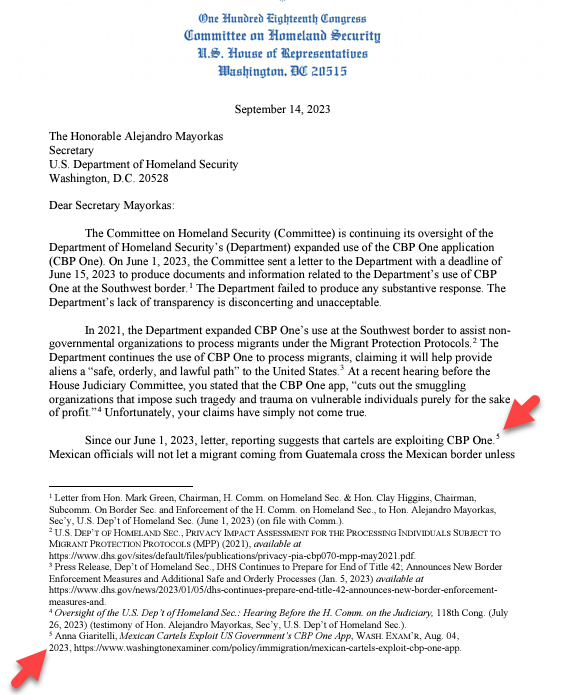
I would like to know why, in numerouspublishedstatements, Chairman Green has claimed that Anna Giaritelli published a “groundbreaking scoop showing that the criminal cartels had hijacked the CBP One app using virtual private networks (VPNs), and were exploiting the app to make even more money by scheduling appointments for migrants outside the geographical range.”
This is clearly and obviously false to anyone who reads the article. What Giaritelli wrote wasn’t a “groundbreaking scoop,” but rather a baseless claim. At no point in the article does Giaritelli cite a single source confirming that cartels are exploiting CBP One using VPNs.
She refers to “an extensive investigation” of DHS documents, but she doesn’t link to the documents, or quote them, or even say what they specifically address. That’s the closest she comes to providing any evidence whatsoever.
The one quote she provides from an actual DHS official (Erin Waters, Assistant Commissioner for Public Affairs) is refuting Giartitelli’s claim, stating that CBP One has actually been “bad for cartels and other criminal organizations seeking to exploit migrants.” Waters goes on to explain that CBP One rather relies on the location data supplied by devices used to access the app.
I would like to know if the Committee has ever spoken with Erin Waters on this issue– and if not, why not? Why rely on the bald assertions of a right-wing web site over a statement of fact from a DHS official?
At the very least, the obvious contradiction presented here should give the Committee pause, and encourage you to look into the claim further. But apparently the Committee had no time to even take a second look, in your rush to– again, repeatedly– make such a momentous claim, with such an extensive impact. You clearly think this matter is serious, so why are you relying on what amounts to rumors and gossip rather than statements of fact supported by evidence?
Could it possibly be that it’s because the rumors and gossip align with your pre-existing beliefs? That evidence be damned when it contradicts your desire to believe?
If so, that’s grossly irresponsible– not to mention dangerous– behavior on the part of a legislative committee. Misrepresenting the truth gets people killed, and yet you treat this reality with casual disregard.
I dearly hope that I’ve simply missed something here which exculpates Chairman Green’s statements about CBP One– and if I have, then assuredly I’m not the only one. So if you have actual evidence that doesn’t come from a vague and unsupported Washington Examiner article, please post it. I’d still be baffled to why you didn’t just provide that evidence in the first place rather than linking to the Examiner, but perhaps that’s a lesson that can be retained for future statements.
Thanks for your time and consideration on this matter.
For over a year now, the committee has been making hay about this so-called “bombshell report” that doesn’t show what they keep insisting that it shows. This line in particular is revealingly hilarious:
Since the Biden administration debuted the CBP One app in January, immigrants south of Mexico City had no reason to believe they would find a legal way to get into the U.S. if they crossed illegally.
The app debuted in October of 2020 (under Trump, btw), not January of 2023.
Using the app is, by definition, not crossing the border illegally.
CBP One is a legal way– unfortunately for most migrants, the only legal way– to enter the United States.
Republicans are tossing around a lot of terminology to obfuscate 2 and 3. The term “otherwise inadmissible” is a fun one, because it suggests that migrants would fall afoul of other immigration restrictions and be denied entry without using the app.
What’s the basis for this? There is none, and in fact the app’s facial recognition engine is designed to be a screen to prevent such individuals from entering the country before they can even reach the border. It does this by comparing the face captured within the app to templates from DHS’s HART database, which includes records of an individual’s entire history of encounters at the border, as well as any crimes committed.
Once again, as I pointed out in CBP One™: The Border in Your Pocket: the app isn’t designed to let as many people through as possible; it’s designed to make the lives of CBP officials and agents easier. Their lives are easier if they can gather as much information about the migrants as possible, as soon as possible, to minimize the seemingly endless paperwork and stress that comes from trying to process the entirety of someone’s information on the spot, all at once, at the border.
(Yes, I sound very sympathetic to CBP agents here. Am I? No, but I can empathize with their openly acknowledged wish to automate things to the extent that they can be).
Last September, Chairman Green and Subcommittee on Border Security and Enforcement Chairman Clay Higgins “demanded answers” from DHS Secretary Alejandro Mayorkas about cartels “abusing the Biden administration’s expanded use of the CBP One app to enhance their human smuggling operations.”
Yes, relying on this one article from the Washington Examiner. They “demanded” that the DHS Secretary address the baseless claims of a right-wing rag in which a CBP spokesperson was already quoted saying it’s all BS.
It’s staggering, and if I’m not misconstruing any of the details here, it’s staggeringly stupid.
That was a quote from a comment about one man’s experience of solitary confinement in prison. I would say it sums it up for me, but it has become all too clear to me that there are many people who are not able to remember it. They never knew it to begin with. The man in question is Thomas Silverstein, who has been in solitary for 28 years so far. He is serving life without parole for having killed two fellow inmates and a guard (he says in self defense) after having originally been imprisoned for armed robbery at 19. Here’s his description of what he has experienced since then:
The cell was so small that I could stand in one place and touch both walls simultaneously. The ceiling was so low that I could reach up and touch the hot light fixture. My bed took up the length of the cell, and there was no other furniture at all…The walls were solid steel and painted all white. I was permitted to wear underwear, but I was given no other clothing. Shortly after I arrived, the prison staff began construction on the side pocket cell, adding more bars and other security measures to the cell while I was within it. In order not to be burned by sparks and embers while they welded more iron bars across the cell, I had to lie on my bed and cover myself with a sheet. It is hard to describe the horror I experienced during this construction process. As they built new walls around me it felt like I was being buried alive. It was terrifying. During my first year in the side pocket cell I was completely isolated from the outside world and had no way to occupy my time. I was not allowed to have any social visits, telephone privileges, or reading materials except a bible. I was not allowed to have a television, radio, or tape player. I could speak to no one and their was virtually nothing on which to focus my attention. I was not only isolated, but also disoriented in the side pocket. This was exacerbated by the fact that I wasn’t allowed to have a wristwatch or clock. In addition, the bright, artificial lights remained on in the cell constantly, increasing my disorientation and making it difficult to sleep. Not only were they constantly illuminated, but those lights buzzed incessantly. The buzzing noise was maddening, as there often were no other sounds at all. This may sound like a small thing, but it was my entire world. Due to the unchanging bright artificial lights and not having a wristwatch or clock, I couldn’t tell if it was day or night. Frequently, I would fall asleep and when I woke up I would not know if I had slept for five minutes or five hours, and would have no idea of what day or time of day it was. I tried to measure the passing of days by counting food trays. Without being able to keep track of time, though, sometimes I thought the officers had left me and were never coming back. I thought they were gone for days, and I was going to starve. It’s likely they were only gone for a few hours, but I had no way to know. I was so disoriented in Atlanta that I felt like I was in an episode of the twilight zone. I now know that I was housed there for about four years, but I would have believed it was a decade if that is what I was told. It seemed eternal and endless and immeasurable… There was no air conditioning or heating in the side pocket cells. During the summer, the heat was unbearable. I would pour water on the ground and lay naked on the floor in an attempt to cool myself… The only time I was let out of my cell was for outdoor recreation. I was allowed one hour a week of outdoor recreation. I could not see any other inmates or any of the surrounding landscape during outdoor recreation. There was no exercise equipment and nothing to do… My vision deteriorated in the side pocket, I think due to the constant bright lights, or possibly also because of other aspects of this harsh environment. Everything began to appear blurry and I became sensitive to light, which burned my eyes and gave me headaches. Nearly all of the time, the officers refused to speak to me. Despite this, I heard people who I believed to be officers whispering into my vents, telling me they hated me and calling me names. To this day, I am not sure if the officers were doing this to me, or if I was starting to lose it and these were hallucinations. In the side pocket cell, I lost some ability to distinguished what was real. I dreamt I was in prison. When I woke up, I was not sure which was reality and which was a dream.
By any sane reckoning, this man has been tortured. For years. There is no reason that solitary confinement has to be like this. And yet, I’ve seen multiple people already both in the comments on the article and on Dispatches saying that there is nothing wrong with this, that he deserves it…to say nothing of the people who are actually responsible for Silverstein’s treatment.
I’ve written before about how I don’t think anyone deserves life in prison, full stop. That means of course I don’t think that anyone deserves to be confined like this. But that’s really beside the point, because it shouldn’t be about what he deserves– it should be about how we as a society are entitled to treat him. We are entitled to imprison violent criminals to keep them from being violent again, to isolate them if necessary for the safety of others. We are not entitled to determine how to make life as much like hell as possible and then inflict that on them for the rest of their lives. We are not entitled to deliberately and methodically drive them insane. If those statements are controversial, if they make me sound like a “bleeding heart,” something is horribly, horribly wrong. Well, obviously something already is horribly wrong, and it’s government-sanctioned.
What this man did to get into prison in the first place, and what he did to stay there, are likewise irrelevant. If it is not acceptable to torture a terrorist for information, it is not acceptable to torture a criminal for satisfaction. What is on the line is not his ability to be civil, to refrain from barbarism, but ours.